


SALTe1 as a regulator of endothelial senescence and cardiac dysfunction during cardiovascular aging
 0
0 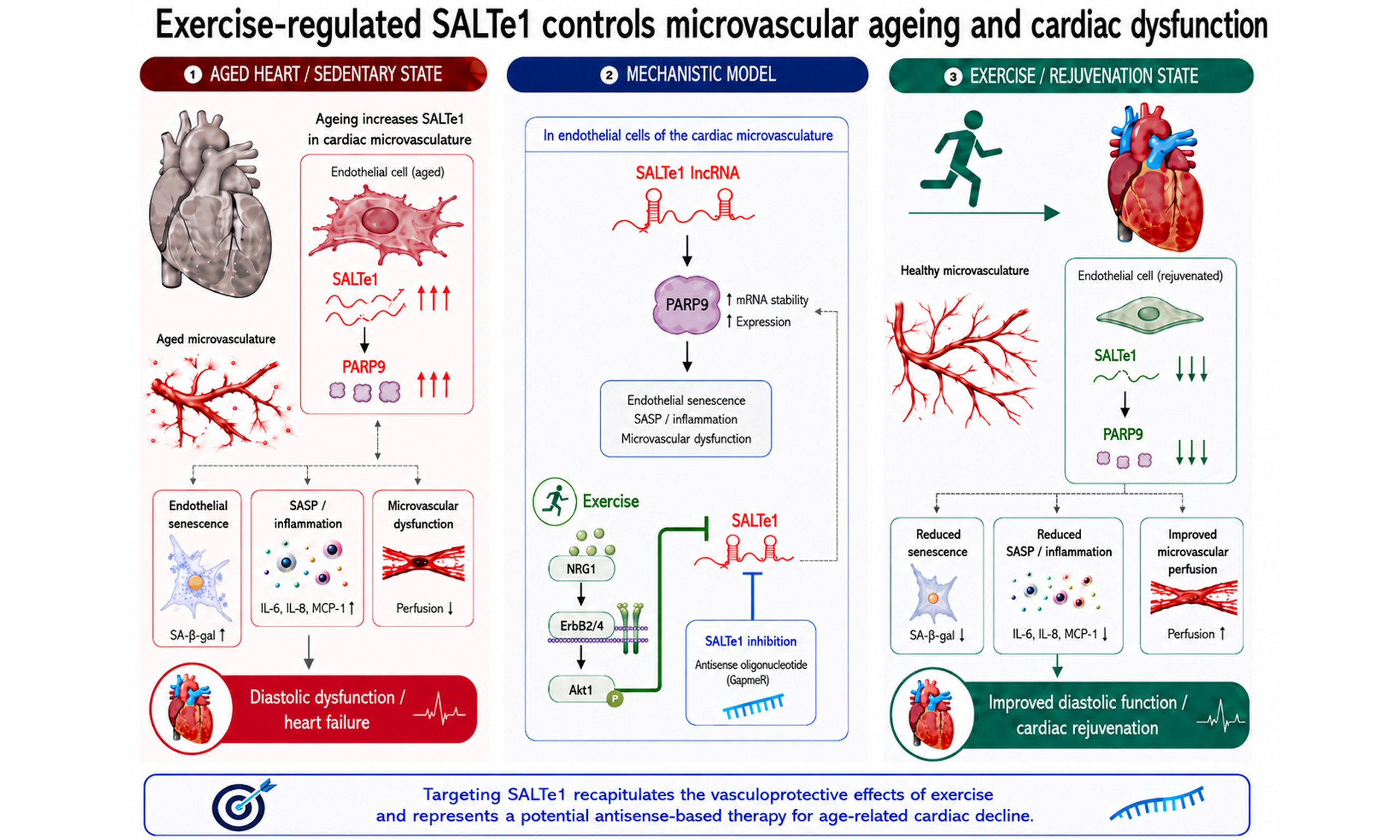
Cardiovascular aging occurs naturally and implies a plethora of progressive declines and vascular dysfunctions that mine the disease-free life expectancy and could anticipate a more systemic age-related health deterioration. These age-related cardiovascular dysfunctions are also associated with the occurrence of heart failure, among which heart failure with preserved ejection fraction (HFpEF) represents one of the most common forms. HFpEF appears to be influenced by several noncoding RNAs, but its direct biological causes remain unclear. As populations age globally, age-associated cardiovascular disorders have become increasingly prevalent, yet disease-modifying therapies remain limited, remaining one of the major unresolved challenges in contemporary medicine[1,2].
Disabled macroautophagy, loss of proteostasis, genomic instability, epigenetic alterations, mitochondrial dysfunction, cellular senescence, dysregulated neurohormonal signaling, and inflammation emerge as common molecular hallmarks of cardiovascular aging[2], and a growing body of evidence reports that experimental interventions designed specifically to delay cardiovascular aging could be sufficient to attenuate aging in model organisms. For instance, targeting vascular endothelial growth factor (VEGF) signaling has been shown to prevent age-related microvascular attrition and delay age-related pathologies, resulting in a prolonged lifespan in mice[3]; at the same time, regular aerobic exercise has been shown to be a major modifier of heart failure and could ameliorate age-related microvascular changes in the heart[4,5].
In a 2026 study in the European Heart Journal, Li et al. used transcriptomic profiling of aged murine hearts subjected to voluntary exercise to identify a novel group of exercise-responsive lncRNAs termed SALTes (Senescence-Associated LncRNA Transcripts in Exercise). Among these, SALTe1 emerged as a particularly intriguing candidate because of its endothelial enrichment, evolutionary conservation, and marked upregulation in aged hearts and in patients with heart failure. Mechanistically, the authors demonstrate that SALTe1 promotes endothelial senescence, at least in part, by stabilizing Poly(ADP-Ribose) Polymerase Family Member 9 (PARP9) mRNA, thereby increasing PARP9 expression and activating downstream senescence-associated pathways. Importantly, endothelial-specific inhibition of SALTe1 in aged mice reduced senescence markers, restored myocardial capillary density and perfusion, and improved diastolic function. Conversely, SALTe1 overexpression in young mice induced features of premature vascular and cardiac aging. Collectively, these findings provide evidence supporting a causal contribution of endothelial senescence to age-related cardiac dysfunction in experimental models and identify the SALTe1/PARP9 axis as a potentially important mechanistic pathway linking exercise biology to vascular rejuvenation[1].
This work is relevant because it advances the idea that endothelial senescence could be a fundamental mechanism underlying cardiovascular decline; as the authors stated, their data support a causal contribution, showing that the selective endothelial targeting of SALTe1 improves cardiac function in naturally aged mice, thereby strengthening the hypothesis that the aging microvasculature could be amenable to therapeutic intervention.
Moreover, noncoding RNAs are involved in key regulatory processes, and a large body of research has identified several pivotal lncRNAs implicated in cardiovascular diseases (CVDs). They can interact with specific proteins and, consequently, regulate gene transcription or signaling pathways, thereby enhancing or inhibiting the onset and progression of CVDs. This work further consolidates the emerging role of lncRNAs as major regulators of cardiovascular aging biology. Over the past decade, lncRNAs have demonstrated important functions in cardiac development, such as FENDRR[6] and BRAVEHEART[7]; in endothelial dysfunction, such as Beta Secretase 1 Antisense (BACE1-AS)[8,9]; and in myocardial aging, as in the case of SARRAH[10] and LOC105378097[11,12]. However, relatively few studies have successfully linked lncRNA signaling to exercise-mediated cardiovascular protection. In this regard, SALTe1 is particularly compelling because it appears to operate at the intersection of endothelial senescence, exercise adaptation, and cardiac dysfunction. The observation that exercise suppresses SALTe1 expression via an NRG1-dependent pathway suggests that this lncRNA may function as a molecular mediator of exercise-induced vascular rejuvenation.
Furthermore, PARP family proteins are widely implicated in DNA damage responses, inflammation, and aging biology; the role of PARP9 in cardiac endothelial dysfunction remained poorly characterized[13]. The authors’ transcriptomic analyses suggest that PARP9 influences pathways associated with senescence, angiogenesis, and metabolic regulation, including Tumor Protein p53 (TP53), Fokhead Box Protein O (FoxO), Phosphoinositide 3-kinase (PI3K), and Hypoxia-inducible factor 1 (HIF-1) signaling. These findings broaden our understanding of how endothelial aging may intersect with metabolic and inflammatory remodeling in the aging heart. Unlike previously described lncRNAs, SALTe1 appears to integrate multiple hallmarks of cardiovascular aging by coupling endothelial senescence with exercise responsiveness through the NRG1/PARP9 axis. Although additional studies will be required to determine whether this represents a unique regulatory mechanism or part of a broader lncRNA network governing vascular aging, these findings provide an intriguing conceptual framework for future investigation.
Despite the great potential, some limitations warrant attention. While antisense oligonucleotide therapies are an exciting therapeutic platform and have shown considerable success in other disease settings, efficient, tissue-specific delivery to the aging cardiovascular system remains challenging. Moreover, most mechanistic data presented by Li et al. derive from murine models of natural aging. Although such models are arguably more clinically relevant than accelerated aging systems, interspecies differences in lncRNA biology remain substantial, particularly given the relatively limited sequence conservation characteristic of many noncoding RNAs[1]. Validation in larger animal models and human vascular tissues, together with a better understanding of long-term safety and delivery efficiency, will be essential before clinical translation can be realistically envisioned. Furthermore, although the authors employed endothelial-enhanced AAV systems and endothelial-specific approaches, complete cell specificity cannot be definitively established. Future studies combining lineage-tracing strategies or single-cell transcriptomic analyses may help further define the cell-type specificity of SALTe1 activity within the aging cardiovascular niche. Given the recognized contributions of macrophages, fibroblasts, and immune signaling to cardiac aging, the possibility that SALTe1 exerts biologically relevant effects in non-endothelial compartments warrants further investigation.
Despite these limitations, the work by Li et al. provides noteworthy evidence that aging may be a modifiable driver of cardiovascular dysfunction[1]. By identifying SALTe1 as a molecular regulator linking endothelial senescence, exercise responsiveness, and cardiac dysfunction, the study expands our understanding of the molecular mechanisms underlying vascular aging. Whether SALTe1 ultimately becomes a clinically actionable target remains to be determined, but these findings clearly support the emerging importance of endothelial senescence as a central mechanistic node in age-related cardiovascular decline and provide a strong rationale for continued investigation and the development of gerotherapeutic strategies.
DECLARATIONS
Authors’ contributions
Writing - original draft, methodology, investigation, conceptualization: Barbi V
Writing - review and editing, funding, supervision: Gaetano C
Availability of data and materials
Not applicable.
AI and AI-assisted tools statement
During the preparation of this manuscript, the AI tool ChatGPT (version 5.5, released 2025-08-07) was used solely for language editing. The tool did not influence the study design, data collection, analysis, interpretation, or the scientific content of the work. All authors take full responsibility for the accuracy, integrity, and final content of the manuscript. The Graphical Abstract is entirely original and does not contain any third-party materials or copyrighted content. During its preparation, the AI tool Claude Opus 5 (version 4.8, released 2026-05-28) was used solely to assist with the development and visual design of the figure. The tool did not influence the scientific content, interpretation, or conclusions presented in the Graphical Abstract. All visual elements were reviewed, edited, and approved by the authors, who take full responsibility for their accuracy, integrity, originality, and final content. No external graphical platforms or third-party materials were used.
Financial support and sponsorship
I-COMET “Infrastruttura tecnologica COndivisa per lo sviluppo di Modelli prEdittivi dell’invecchiamenTo, basati sull’Intelligenza Artificiale” CCR-2020-23670245 to Barbi V; Next Generation UE - PNRR M6C2 - Investimento 2.1 Valorizzazione e potenziamento della ricerca biomedica del SSN (PNRR-POC-2023-12376976) to Gaetano C.
Conflict of interest
All authors declared that there are no conflicts of interest.
Ethical approval and consent to participate
Not applicable.
Consent for publication
Not applicable.
Copyright
© The Author(s) 2026.
REFERENCES
1. Li H, Xiao X, Zhou Y, et al. Long noncoding RNA SALTe1, microvascular ageing, and cardiac dysfunction. Eur Heart J. 2026:ehag356.
2. Abdellatif M, Rainer PP, Sedej S, Kroemer G. Hallmarks of cardiovascular ageing. Nat Rev Cardiol. 2023;20:754-77.
3. Grunewald M, Kumar S, Sharife H, et al. Counteracting age-related VEGF signaling insufficiency promotes healthy aging and extends life span. Science. 2021;373:eabc8479.
4. Ma L, Li K, Wei W, et al. Exercise protects aged mice against coronary endothelial senescence via FUNDC1-dependent mitophagy. Redox Biol. 2023;62:102693.
5. La Gerche A, Howden EJ, Haykowsky MJ, Lewis GD, Levine BD, Kovacic JC. Heart failure with preserved ejection fraction as an exercise deficiency syndrome: JACC focus seminar 2/4. J Am Coll Cardiol. 2022;80:1177-91.
6. Grote P, Wittler L, Hendrix D, et al. The tissue-specific lncRNA Fendrr is an essential regulator of heart and body wall development in the mouse. Dev Cell. 2013;24:206-14.
7. Klattenhoff CA, Scheuermann JC, Surface LE, et al. Braveheart, a long noncoding RNA required for cardiovascular lineage commitment. Cell. 2013;152:570-83.
8. Greco S, Zaccagnini G, Fuschi P, et al. Increased BACE1-AS long noncoding RNA and β-amyloid levels in heart failure. Cardiovasc Res. 2017;113:453-63.
9. Sayad A, Najafi S, Hussen BM, et al. The emerging roles of the β-secretase BACE1 and the long non-coding RNA BACE1-AS in human diseases: a focus on neurodegenerative diseases and cancer. Front Aging Neurosci. 2022;14:853180.
10. Trembinski DJ, Bink DI, Theodorou K, et al. Aging-regulated anti-apoptotic long non-coding RNA Sarrah augments recovery from acute myocardial infarction. Nat Commun. 2020;11:2039.
11. Uchida S, Dimmeler S. Long noncoding RNAs in cardiovascular diseases. Circ Res. 2015;116:737-50.
12. Liu X, Bai X, Liu H, et al. LncRNA LOC105378097 inhibits cardiac mitophagy in natural ageing mice. Clin Transl Med. 2022;12:e908.
Cite This Article
 Open Access
How to Cite
Download Citation
Export Citation File:
Type of Import
Tips on Downloading Citation
Citation Manager File Format
Type of Import
Direct Import: When the Direct Import option is selected (the default state), a dialogue box will give you the option to Save or Open the downloaded citation data. Choosing Open will either launch your citation manager or give you a choice of applications with which to use the metadata. The Save option saves the file locally for later use.
Indirect Import: When the Indirect Import option is selected, the metadata is displayed and may be copied and pasted as needed.
About This Article
Copyright

Data & Comments
Data
0










Comments
Comments must be written in English. Spam, offensive content, impersonation, and private information will not be permitted. If any comment is reported and identified as inappropriate content by OAE staff, the comment will be removed without notice. If you have any queries or need any help, please contact us at [email protected].