

Multimodal artificial intelligence for vascular aging: toward proactive detection and management
 0
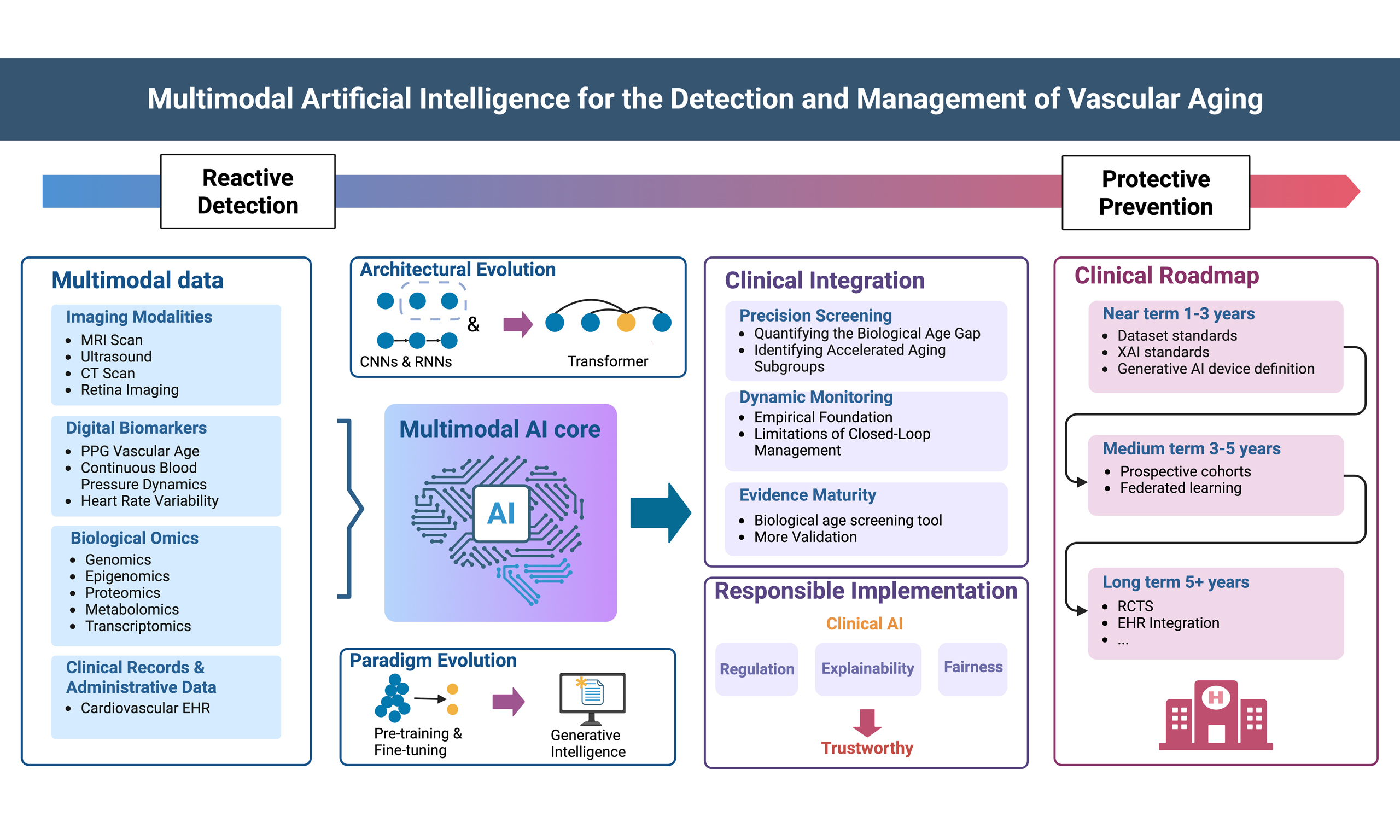
Graphical Abstract
Abstract
Vascular aging is a fundamental driver of cardiovascular diseases (CVD), yet identifying individuals undergoing accelerated vascular aging - and therefore at elevated cardiovascular risk - remains a significant clinical challenge. The traditional “one-size-fits-all” health risk assessments are often insensitive to early, subclinical vascular changes. The recent explosion of medical big data, coupled with the advent of Artificial Intelligence (AI) and Multimodal Foundation Models (MFMs), offer a transformative opportunity to shift vascular aging management from reactive detection toward proactive, predictive protection. This review systematically explores the integration of multimodal artificial intelligence (MMAI) and large-scale foundation models in the identification, stratification, and personalized management of vascular aging. We first delineate the multidimensional data ecosystem of vascular aging, including electronic health records (EHRs), imaging, omics, and continuous physiological signals from wearables, and analyze how deep learning architectures enable the detection of vascular aging by capturing subclinical structural and functional alterations. We then focus on the emerging role of MFMs, which transcend task-specific AI by integrating heterogeneous data types to provide holistic phenomapping. Furthermore, we discuss the utility of Large Language Models (LLMs) in clinical workflows, enhancing patient adherence through natural language interaction, and accelerating research through knowledge synthesis. Despite the potential of foundation models, their clinical translation faces technical and institutional barriers. We analyze four systemic challenges: algorithmic fairness, regulatory uncertainty, explainable AI (XAI) and the lack of real-world validation. We propose a strategic roadmap aligned with international frameworks that progresses from standardized performance reporting for elderly subgroups in the near term to cost-effective, individualized interventions that intercept the health-to-disease transition in the long term. The convergence of big data and foundation models represents a shift from reactive cardiovascular care to proactive, precision-based longevity management, positioning early, AI-enabled identification of high-risk vascular aging phenotypes as a primary target for the next generation of preventive medicine.
Keywords


 Download PDF
REFERENCES
2. Nilsson PM, Boutouyrie P, Laurent S. Vascular aging: a tale of EVA and ADAM in cardiovascular risk assessment and prevention. Hypertension. 2009;54:3-10.
3. Bruno RM, Nilsson PM, Engström G, et al. Early and supernormal vascular aging: clinical characteristics and association with incident cardiovascular events. Hypertension. 2020;76:1616-24.
4. Herzog MJ, Müller P, Lechner K, et al. Arterial stiffness and vascular aging: mechanisms, prevention, and therapy. Signal Transduct Target Ther. 2025;10:282.
5. van der Linden J, Stefens SJM, Heredia-Genestar JM, et al. Ercc1 DNA repair deficiency results in vascular aging characterized by VSMC phenotype switching, ECM remodeling, and an increased stress response. Aging Cell. 2024;23:e14126.
6. Beeche C, Zhao B, Tavolinejad H, et al. Early vascular aging determined by 3-dimensional aortic geometry: genetic determinants and clinical consequences. Circulation. 2025;152:748-61.
7. Lakatta EG. Arterial and cardiac aging: major shareholders in cardiovascular disease enterprises: Part III: cellular and molecular clues to heart and arterial aging. Circulation. 2003;107:490-7.
8. Donato AJ, Machin DR, Lesniewski LA. Mechanisms of dysfunction in the aging vasculature and role in age-related disease. Circ Res. 2018;123:825-48.
9. Fleenor BS, Carlini NA, Ouyang A, Du B, Harber MP. Greater aortic perivascular adipose tissue density is associated with aging, aortic stiffness, and central blood pressure in humans. J Appl Physiol. 2023;134:703-9.
10. Safar ME, Nilsson PM, Blacher J, Mimran A. Pulse pressure, arterial stiffness, and end-organ damage. Curr Hypertens Rep. 2012;14:339-44.
11. Safar ME, London GM, Plante GE. Arterial stiffness and kidney function. Hypertension. 2004;43:163-8.
12. van Sloten TT, Protogerou AD, Henry RM, Schram MT, Launer LJ, Stehouwer CD. Association between arterial stiffness, cerebral small vessel disease and cognitive impairment: a systematic review and meta-analysis. Neurosci Biobehav Rev. 2015;53:121-30.
13. 2023 Causes of Death Collaborators. Global burden of 292 causes of death in 204 countries and territories and 660 subnational locations, 1990-2023: a systematic analysis for the global burden of disease study 2023. Lancet. 2025;406:1811-72.
14. Lakatta EG, Levy D. Arterial and cardiac aging: major shareholders in cardiovascular disease enterprises: part I: aging arteries: a “set up” for vascular disease. Circulation. 2003;107:139-46.
15. Pignoli P, Tremoli E, Poli A, Oreste P, Paoletti R. Intimal plus medial thickness of the arterial wall: a direct measurement with ultrasound imaging. Circulation. 1986;74:1399-406.
16. Celermajer DS, Sorensen KE, Gooch VM, et al. Non-invasive detection of endothelial dysfunction in children and adults at risk of atherosclerosis. Lancet. 1992;340:1111-5.
17. Van Bortel LM, Laurent S, Boutouyrie P, et al. Expert consensus document on the measurement of aortic stiffness in daily practice using carotid-femoral pulse wave velocity. J Hypertens. 2012;30:445-8.
18. Ferrucci L, Fabbri E. Inflammageing: chronic inflammation in ageing, cardiovascular disease, and frailty. Nat Rev Cardiol. 2018;15:505-22.
19. Salvioli S, Basile MS, Bencivenga L, et al. Biomarkers of aging in frailty and age-associated disorders: state of the art and future perspective. Ageing Res Rev. 2023;91:102044.
20. Wang W, Yan Y, Guo Z, et al.; Suboptimal Health Study Consortium and European Association for Predictive. All around suboptimal health - a joint position paper of the Suboptimal Health Study Consortium and European Association for Predictive, Preventive and Personalised Medicine. EPMA J. 2021;12:403-33.
22. Topol EJ. High-performance medicine: the convergence of human and artificial intelligence. Nat Med. 2019;25:44-56.
23. Johnson KW, Torres Soto J, Glicksberg BS, et al. Artificial intelligence in cardiology. J Am Coll Cardiol. 2018;71:2668-79.
24. Yang XY, Li YM, Wang JY, Jia YH, Yi Z, Chen M. Utilizing multimodal artificial intelligence to advance cardiovascular diseases. Precis Clin Med. 2025;8:pbaf016.
25. North BJ, Sinclair DA. The intersection between aging and cardiovascular disease. Circ Res. 2012;110:1097-108.
26. Moor M, Banerjee O, Abad ZSH, et al. Foundation models for generalist medical artificial intelligence. Nature. 2023;616:259-65.
27. Bommasani R, Hudson DA, Adeli E, et al. On the opportunities and risks of foundation models. arXiv. 2022;arXiv:2108.07258.
28. Shao Q, Ndzie Noah ML, Golubnitschaja O, Zhan X. Mitochondrial medicine: “from bench to bedside” 3PM-guided concept. EPMA J. 2025;16:239-64.
29. Greenland P, Blaha MJ, Budoff MJ, Erbel R, Watson KE. Coronary calcium score and cardiovascular risk. J Am Coll Cardiol. 2018;72:434-47.
30. Willemink MJ, Vliegenthart R, Takx RA, et al. Coronary artery calcification scoring with state-of-the-art CT scanners from different vendors has substantial effect on risk classification. Radiology. 2014;273:695-702.
31. Lorenz MW, Markus HS, Bots ML, Rosvall M, Sitzer M. Prediction of clinical cardiovascular events with carotid intima-media thickness: a systematic review and meta-analysis. Circulation. 2007;115:459-67.
32. Lorenz MW, Polak JF, Kavousi M, et al.; PROG-IMT Study Group. Carotid intima-media thickness progression to predict cardiovascular events in the general population (the PROG-IMT collaborative project): a meta-analysis of individual participant data. Lancet. 2012;379:2053-62.
33. Bianchini E, Guala A, Golemati S, et al. The ultrasound window into vascular ageing: a technology review by the VascAgeNet COST action. J Ultrasound Med. 2023;42:2183-213.
34. Spronck B, Terentes-Printzios D, Avolio AP, et al. 2024 recommendations for validation of noninvasive arterial pulse wave velocity measurement devices. Hypertension. 2024;81:183-92.
35. Harloff A, Mirzaee H, Lodemann T, et al. Determination of aortic stiffness using 4D flow cardiovascular magnetic resonance - a population-based study. J Cardiovasc Magn Reson. 2018;20:43.
36. Poplin R, Varadarajan AV, Blumer K, et al. Prediction of cardiovascular risk factors from retinal fundus photographs via deep learning. Nat Biomed Eng. 2018;2:158-64.
37. Nusinovici S, Rim TH, Li H, et al. Application of a deep-learning marker for morbidity and mortality prediction derived from retinal photographs: a cohort development and validation study. Lancet Healthy Longev. 2024;5:100593.
39. Lu AT, Quach A, Wilson JG, et al. DNA methylation GrimAge strongly predicts lifespan and healthspan. Aging. 2019;11:303-27.
40. Levine ME, Lu AT, Quach A, et al. An epigenetic biomarker of aging for lifespan and healthspan. Aging. 2018;10:573-91.
41. Yousefi PD, Suderman M, Langdon R, Whitehurst O, Davey Smith G, Relton CL. DNA methylation-based predictors of health: applications and statistical considerations. Nat Rev Genet. 2022;23:369-83.
42. Liang R, Tang Q, Chen J, Zhu L. Epigenetic clocks: beyond biological age, using the past to predict the present and future. Aging Dis. 2024;16:3520-45.
43. Argentieri MA, Xiao S, Bennett D, et al. Proteomic aging clock predicts mortality and risk of common age-related diseases in diverse populations. Nat Med. 2024;30:2450-60.
44. Ding Y, Zuo Y, Zhang B, et al. Comprehensive human proteome profiles across a 50-year lifespan reveal aging trajectories and signatures. Cell. 2025;188:5763-5784.e26.
45. Raffield LM, Dang H, Pratte KA, et al.; NHLBI Trans-Omics for Precision Medicine (TOPMed) Consortium. Comparison of proteomic assessment methods in multiple cohort studies. Proteomics. 2020;20:e1900278.
46. Jasbi P, Nikolich-Žugich J, Patterson J, et al. Targeted metabolomics reveals plasma biomarkers and metabolic alterations of the aging process in healthy young and older adults. Geroscience. 2023;45:3131-46.
47. Kočar E, Šket R, Vasle AH, et al. Measuring biological age: insights from omics studies. Ageing Res Rev. 2026;114:102988.
48. Emechebe U, Nelson JW, Alkayed NJ, Kaul S, Adey AC, Barnes AP. Age-dependent transcriptional alterations in cardiac endothelial cells. Physiol Genomics. 2021;53:295-308.
49. Golubnitschaja O. How to use an extensive Flammer syndrome phenotyping for a holistic protection against health-to-disease transition - facts and practical recommendations. EPMA J. 2025;16:535-9.
50. Nie G, Zhao Q, Tang G, Li Y, Hong S. Artificial intelligence-derived photoplethysmography age as a digital biomarker for cardiovascular health. Commun Med. 2025;5:481.
51. Zhao Q, Nie G, Nie W, Tang G, Hong S. Artificial intelligence-derived vascular age from photoplethysmography: a novel digital biomarker for cardiovascular health. Eur Heart J. 2025;46:ehaf784.4449.
52. Sheikh AB, Sobotka PA, Garg I, et al. Blood pressure variability in clinical practice: past, present and the future. J Am Heart Assoc. 2023;12:e029297.
53. Kario K. Morning surge in blood pressure and cardiovascular risk: evidence and perspectives. Hypertension. 2010;56:765-73.
54. Drawz PE, Pajewski NM, Bates JT, et al. Effect of intensive versus standard clinic-based hypertension management on ambulatory blood pressure: results from the SPRINT (systolic blood pressure intervention trial) ambulatory blood pressure study. Hypertension. 2017;69:42-50.
55. Guimarães P, Keller A, Böhm M, et al. Artificial intelligence-derived risk prediction: a novel risk calculator using office and ambulatory blood pressure. Hypertension. 2025;82:46-56.
56. Xie H, Yang L, Jiang B, Huang Z, Lin Y. State-of-the-art wearable sensors for cardiovascular health: a review. NPJ Cardiovasc Health. 2025;2:53.
57. Task Force of the European Society of Cardiology the North American Society of Pacing Electrophysiology. Heart rate variability: standards of measurement, physiological interpretation, and clinical use. Circulation. 1996;93:1043-65.
58. Goldstein DS, Bentho O, Park MY, Sharabi Y. Low-frequency power of heart rate variability is not a measure of cardiac sympathetic tone but may be a measure of modulation of cardiac autonomic outflows by baroreflexes. Exp Physiol. 2011;96:1255-61.
59. Hillebrand S, Gast KB, de Mutsert R, et al. Heart rate variability and first cardiovascular event in populations without known cardiovascular disease: meta-analysis and dose-response meta-regression. Europace. 2013;15:742-9.
60. Theurl F, Schreinlechner M, Sappler N, et al. Smartwatch-derived heart rate variability: a head-to-head comparison with the gold standard in cardiovascular disease. Eur Heart J Digit Health. 2023;4:155-64.
61. Vlachopoulos C, Aznaouridis K, Stefanadis C. Prediction of cardiovascular events and all-cause mortality with arterial stiffness: a systematic review and meta-analysis. J Am Coll Cardiol. 2010;55:1318-27.
62. Hong J, Nandi M, Charlton PH, Alastruey J. Noninvasive hemodynamic indices of vascular aging: an in silico assessment. Am J Physiol Heart Circ Physiol. 2023;325:H1290-303.
63. Doherty C, Baldwin M, Keogh A, Caulfield B, Argent R. Keeping pace with wearables: a living umbrella review of systematic reviews evaluating the accuracy of consumer wearable technologies in health measurement. Sports Med. 2024;54:2907-26.
64. Jamieson A, Chico TJA, Jones S, Chaturvedi N, Hughes AD, Orini M. A guide to consumer-grade wearables in cardiovascular clinical care and population health for non-experts. NPJ Cardiovasc Health. 2025;2:44.
65. Boonstra MJ, Weissenbacher D, Moore JH, Gonzalez-Hernandez G, Asselbergs FW. Artificial intelligence: revolutionizing cardiology with large language models. Eur Heart J. 2024;45:332-45.
66. Pons E, Braun LM, Hunink MG, Kors JA. Natural language processing in radiology: a systematic review. Radiology. 2016;279:329-43.
67. Ferreira Santos J, Ladeiras-Lopes R, Leite F, Dores H. Applications of large language models in cardiovascular disease: a systematic review. Eur Heart J Digit Health. 2025;6:540-53.
68. Ferreira Santos J, Dores H. Large language models in cardiovascular prevention: a narrative review and governance framework. Diagnostics. 2026;16:390.
69. Gao Z, Liu X, Kang Y, et al. Improving the prognostic evaluation precision of hospital outcomes for heart failure using admission notes and clinical tabular data: multimodal deep learning model. J Med Internet Res. 2024;26:e54363.
70. Sarmun R, Kabir S, Prithula J, et al. Enhancing intima-media complex segmentation with a multi-stage feature fusion-based novel deep learning framework. Eng Appl Artif Intell. 2024;133:108050.
71. Kim S, Park EA, Ahn C, et al. Performance of fully automated deep-learning-based coronary artery calcium scoring in ECG-gated calcium CT and non-gated low-dose chest CT. Eur Radiol. 2025;35:7084-95.
72. Attia ZI, Friedman PA, Noseworthy PA, et al. Age and sex estimation using artificial intelligence from standard 12-lead ECGs. Circ Arrhythm Electrophysiol. 2019;12:e007284.
73. Rawlani M, Ieki H, Binder C, et al. Artificial intelligence prediction of age from echocardiography as a marker for cardiovascular disease. npj Digit Med. 2025;8:688.
74. Lima EM, Ribeiro AH, Paixão GMM, et al. Deep neural network-estimated electrocardiographic age as a mortality predictor. Nat Commun. 2021;12:5117.
75. Linardos A, Kushibar K, Walsh S, Gkontra P, Lekadir K. Federated learning for multi-center imaging diagnostics: a simulation study in cardiovascular disease. Sci Rep. 2022;12:3551.
77. Avsec Ž, Agarwal V, Visentin D, et al. Effective gene expression prediction from sequence by integrating long-range interactions. Nat Methods. 2021;18:1196-203.
78. Rasmy L, Xiang Y, Xie Z, Tao C, Zhi D. Med-BERT: pretrained contextualized embeddings on large-scale structured electronic health records for disease prediction. npj Digit Med. 2021;4:86.
79. Stahlschmidt SR, Ulfenborg B, Synnergren J. Multimodal deep learning for biomedical data fusion: a review. Brief Bioinform. 2022;23:bbab569.
80. Schouten D, Nicoletti G, Dille B, et al. Navigating the landscape of multimodal AI in medicine: a scoping review on technical challenges and clinical applications. Med Image Anal. 2025;105:103621.
81. Soenksen LR, Ma Y, Zeng C, et al. Integrated multimodal artificial intelligence framework for healthcare applications. npj Digit Med. 2022;5:149.
82. Zhang S, Xu Y, Usuyama N, et al. A multimodal biomedical foundation model trained from fifteen million image-text pairs. NEJM AI. 2025;2:AIoa2400640.
83. Nielsen C, Souza R, Wilms M, Forkert ND. Foundation model-driven distributed learning for enhanced retinal age prediction. J Am Med Inform Assoc. 2024;31:2550-9.
84. Acosta JN, Falcone GJ, Rajpurkar P, Topol EJ. Multimodal biomedical AI. Nat Med. 2022;28:1773-84.
85. Zhang K, Zhou R, Adhikarla E, et al. A generalist vision-language foundation model for diverse biomedical tasks. Nat Med. 2024;30:3129-41.
86. Singhal K, Azizi S, Tu T, et al. Large language models encode clinical knowledge. Nature. 2023;620:172-80.
87. Zakka C, Shad R, Chaurasia A, et al. Almanac - retrieval-augmented language models for clinical medicine. NEJM AI. 2024;1:AIoa2300068.
88. Salih A, Boscolo Galazzo I, Gkontra P, et al. Explainable artificial intelligence and cardiac imaging: toward more interpretable models. Circ Cardiovasc Imaging. 2023;16:e014519.
89. Omar M, Sorin V, Collins JD, et al. Multi-model assurance analysis showing large language models are highly vulnerable to adversarial hallucination attacks during clinical decision support. Commun Med. 2025;5:330.
90. Asgari E, Montaña-Brown N, Dubois M, et al. A framework to assess clinical safety and hallucination rates of LLMs for medical text summarisation. npj Digit Med. 2025;8:274.
91. Hadida Barzilai D, Sudri K, Goshen G, et al. Randomized controlled trials evaluating artificial intelligence in cardiovascular care: a systematic review. JACC Adv. 2025;4:102152.
92. Mossavarali S, Vaezi A, Gholami Z, et al. Determinants of artificial intelligence electrocardiogram-derived age and its association with cardiovascular events and mortality: a systematic review and meta-analysis. npj Digit Med. 2025;8:322.
93. Pedroso AF, Khera R. Leveraging AI-enhanced digital health with consumer devices for scalable cardiovascular screening, prediction, and monitoring. NPJ Cardiovasc Health. 2025;2:34.
94. Cavero-Redondo I, Saz-Lara A, Martínez-García I, Otero-Luis I, Martínez-Rodrigo A. Validation of an early vascular aging construct model for comprehensive cardiovascular risk assessment using external risk indicators for improved clinical utility: data from the EVasCu study. Cardiovasc Diabetol. 2024;23:33.
95. Abedi A, Verma A, Jain D, et al. AI-driven real-time monitoring of cardiovascular conditions with wearable devices: scoping review. JMIR Mhealth Uhealth. 2025;13:e73846.
96. Huang G, Chen X, Liao C. AI-driven wearable bioelectronics in digital healthcare. Biosensors. 2025;15:410.
97. Noci F, Capodici A, Nuti S, Passino C, Emdin M, Giannoni A. Wearable technologies to predict and prevent and heart failure hospitalizations: a systematic review. Eur Heart J Digit Health. 2025;6:868-77.
98. Oikonomou EK, Spatz ES, Suchard MA, Khera R. Individualising intensive systolic blood pressure reduction in hypertension using computational trial phenomaps and machine learning: a post-hoc analysis of randomised clinical trials. Lancet Digit Health. 2022;4:e796-805.
99. Wang TW, Syu JY, Chu HW, et al. Intelligent bio-impedance system for personalized continuous blood pressure measurement. Biosensors. 2022;12:150.
100. Ucdal M, Yurtsever K, Yildiz P, Akalin A, Mert KU, Guven GS. Comparison of artificial intelligence models and human experts in managing dyslipidemia: assessment of adherence to clinical guidelines. Cureus. 2025;17:e91363.
101. Costa F, Gomez Doblas JJ, Díaz Expósito A, et al. Artificial intelligence in cardiovascular pharmacotherapy: applications and perspectives. Eur Heart J. 2025;46:3616-27.
102. Li C, Wong C, Zhang S, et al. LLaVA-Med: training a large language-and-vision assistant for biomedicine in one day. arXiv 2023;arXiv:2306.00890.
103. Hannun AY, Rajpurkar P, Haghpanahi M, et al. Cardiologist-level arrhythmia detection and classification in ambulatory electrocardiograms using a deep neural network. Nat Med. 2019;25:65-9.
104. Liu X, Cruz Rivera S, Moher D, Calvert MJ, Denniston AK; SPIRIT-AI and CONSORT-AI Working Group. Reporting guidelines for clinical trial reports for interventions involving artificial intelligence: the CONSORT-AI extension. Lancet Digit Health. 2020;2:e537-48.
105. Veneziano FA, Cocco N, Veneziano R. Artificial intelligence in interventional cardiology: current applications and future clinical integration. Vessel Plus. 2025;9:3.
106. van Kolfschooten H. The AI cycle of health inequity and digital ageism: mitigating biases through the EU regulatory framework on medical devices. J Law Biosci. 2023;10:lsad031.
107. Chen RJ, Wang JJ, Williamson DFK, et al. Algorithmic fairness in artificial intelligence for medicine and healthcare. Nat Biomed Eng. 2023;7:719-42.
108. Obermeyer Z, Powers B, Vogeli C, Mullainathan S. Dissecting racial bias in an algorithm used to manage the health of populations. Science. 2019;366:447-53.
109. Alderman JE, Palmer J, Laws E, et al. Tackling algorithmic bias and promoting transparency in health datasets: the STANDING Together consensus recommendations. Lancet Digit Health. 2025;7:e64-88.
111. Lashkarinia SS, Lee AWC, Baptiste TMG, et al. Representation of women in cardiovascular disease management: a systematic analysis of ESC guidelines. Open Heart. 2025;12:e003320.
112. St Pierre SR, Kaczmarski B, Peirlinck M, Kuhl E. Sex-specific cardiovascular risk factors in the UK Biobank. Front Physiol. 2024;15:1339866.
113. Mitchell GF, Rong J, Larson MG, et al. Vascular age assessed from an uncalibrated, noninvasive pressure waveform by using a deep learning approach: the AI-vascularage model. Hypertension. 2024;81:193-201.
114. Singh P, Hu T, Hoori A, Al-Kindi S, Wilson DL, Rajagopalan S. Sex-specific cardiovascular risk prediction using AI-derived epicardial adipose tissue measurements on CT calcium scoring exams. Am J Prev Cardiol. 2026;25:101367.
115. De Martin Topranin V, Wiig-Fisketjøn A, Botten E, Dalen H, Langaas M, Bye A. Sex-specific cardiovascular disease risk prediction using statistical learning and explainable artificial intelligence: the HUNT study. Eur J Prev Cardiol. 2026;33:2400-11.
116. Romero LGL. CARAMEL: retrospective study for personalized risk assessment of cardiovascular disease in menopausal and perimenopausal women using real world data (CARAMEL RS). Available from: https://clinicaltrials.gov/study/NCT06999317 [accessed 12 October 2026].
117. Singh R, Bapna M, Diab AR, Ruiz ES, Lotter W. How AI is used in FDA-authorized medical devices: a taxonomy across 1,016 authorizations. npj Digit Med. 2025;8:388.
118. U.S. Food and Drug Administration. List of artificial intelligence-enabled medical devices. Available from: https://www.fda.gov/medical-devices/software-medical-device-samd/artificial-intelligence-enabled-medical-devices [accessed 12 October 2026].
119. Warraich H, Tazbaz T, Califf RM. Regulation of artificial intelligence in health care and biomedicine-reply. JAMA. 2025;333:1003-4.
120. Muehlematter UJ, Daniore P, Vokinger KN. Approval of artificial intelligence and machine learning-based medical devices in the USA and Europe (2015-20): a comparative analysis. Lancet Digit Health. 2021;3:e195-203.
121. Gerke S, Babic B, Evgeniou T, Cohen IG. The need for a system view to regulate artificial intelligence/machine learning-based software as medical device. npj Digit Med. 2020;3:53.
123. Doshi-Velez F, Kim B. Towards a rigorous science of interpretable machine learning. arXiv. 2017;arXiv:1702.08608.
124. Muhammad D, Bendechache M. Unveiling the black box: a systematic review of explainable artificial intelligence in medical image analysis. Comput Struct Biotechnol J. 2024;24:542-60.
125. Loh HW, Ooi CP, Seoni S, Barua PD, Molinari F, Acharya UR. Application of explainable artificial intelligence for healthcare: a systematic review of the last decade (2011-2022). Comput Methods Programs Biomed. 2022;226:107161.
126. Brankovic A, Cook D, Rahman J, et al. Clinician-informed XAI evaluation checklist with metrics (CLIX-M) for AI-powered clinical decision support systems. npj Digit Med. 2025;8:364.
127. López-Otín C, Blasco MA, Partridge L, Serrano M, Kroemer G. Hallmarks of aging: an expanding universe. Cell. 2023;186:243-78.
128. Kalyakulina A, Yusipov I, Moskalev A, Franceschi C, Ivanchenko M. eXplainable artificial intelligence (XAI) in aging clock models. Ageing Res Rev. 2024;93:102144.
129. Strangio A, Leo I, Sabatino J, et al. Is artificial intelligence the new kid on the block? Sustainable applications in cardiology. Vessel Plus. 2024;8:12.
Cite This Article
 Open Access
How to Cite
Wang Z, Dai Y, Li C, Hu Y, Ding Z, Huang Z, Chen T. Multimodal artificial intelligence for vascular aging: toward proactive detection and management. J Cardiovasc Aging. 2026;6:50. https://dx.doi.org/10.20517/jca.2026.35
Download Citation
If you have the appropriate software installed, you can download article citation data to the citation manager of your choice. Simply select your manager software from the list below and click on download.
Export Citation File
Type of Import
Tips on Downloading Citation
Citation Manager File Format
Type of Import
Direct Import: When the Direct Import option is selected (the default state), a dialogue box will give you the option to Save or Open the downloaded citation data. Choosing Open will either launch your citation manager or give you a choice of applications with which to use the metadata. The Save option saves the file locally for later use.
Indirect Import: When the Indirect Import option is selected, the metadata is displayed and may be copied and pasted as needed.
About This Article
Copyright

Data & Comments
Data
0










Comments
Comments must be written in English. Spam, offensive content, impersonation, and private information will not be permitted. If any comment is reported and identified as inappropriate content by OAE staff, the comment will be removed without notice. If you have any queries or need any help, please contact us at [email protected].