

Beyond electronics: classifying functional materials through electron-ion coupling
 0
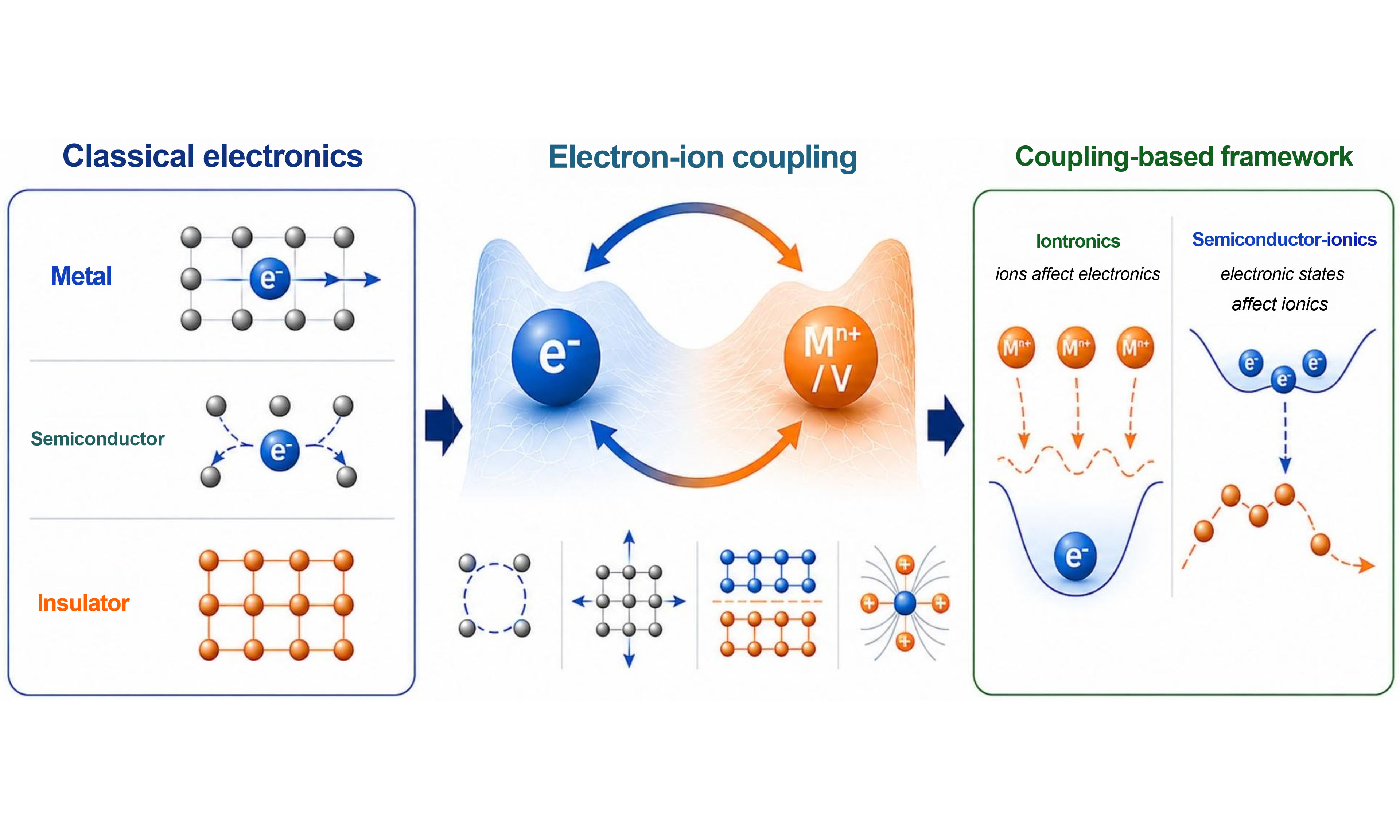


 Download PDF
BEYOND THE ELECTRONIC-MATERIAL PARADIGM
Materials classification grew up with solid-state physics and electronics. Its most familiar categories: metals, semiconductors and insulators, are defined by electronic structure, while dielectrics, ferroelectrics, magnetic materials, piezoelectrics and topological materials are distinguished by the electronic or field responses to their function[1,2]. That language remains indispensable, but in which electrons were usually treated as the principal active carriers and the ions of the lattice as a comparatively fixed background.
This material language system is increasingly difficult to maintain. In many functional materials, ions and ionic defects are mobile on experimental time scales and participate directly in switching, transport, polarization, redox chemistry and interfacial reconstruction. Oxygen vacancies can reshape a conduction path; inserted ions can change carrier density; protonation can alter local bonding; strain can move ionic sublattices and generate polarization fields. The reverse influence is equally important: band alignment, charge redistribution, local electric fields and electronic occupation can change defect charge states, migration energies and ionic populations. In such systems, the electronic and ionic problems are not simply adjacent. They are coupled.
This limitation has become increasingly evident with the emergence of Iontronics and Semiconductor-Ionics, two frontier directions in which ionic and electronic degrees of freedom are functionally coupled rather than merely coexisting. Iontronics exploits ionic motion, redistribution and polarization to regulate electronic states and functions[3], whereas Semiconductor-Ionics uses electronic states, band alignment, polarization and local fields to regulate ionic states and transport[4]. These reciprocal but complementary relationships suggest that electron-ion coupling itself should be treated as a classification variable.
Here we use electron-ion coupling as an additional organizing principle. We first ask where the coupling comes from [Figure 1], then which side of the coupled system exerts the dominant observable effect [Figure 2], and finally how the physics changes as coupling becomes stronger [Figure 3]. The purpose is not to replace established classification system, but to extend them for new functions from advanced materials. Since in extsing classifications electrons, ions, defects, polarization and interfaces cannot always be optimized independently.
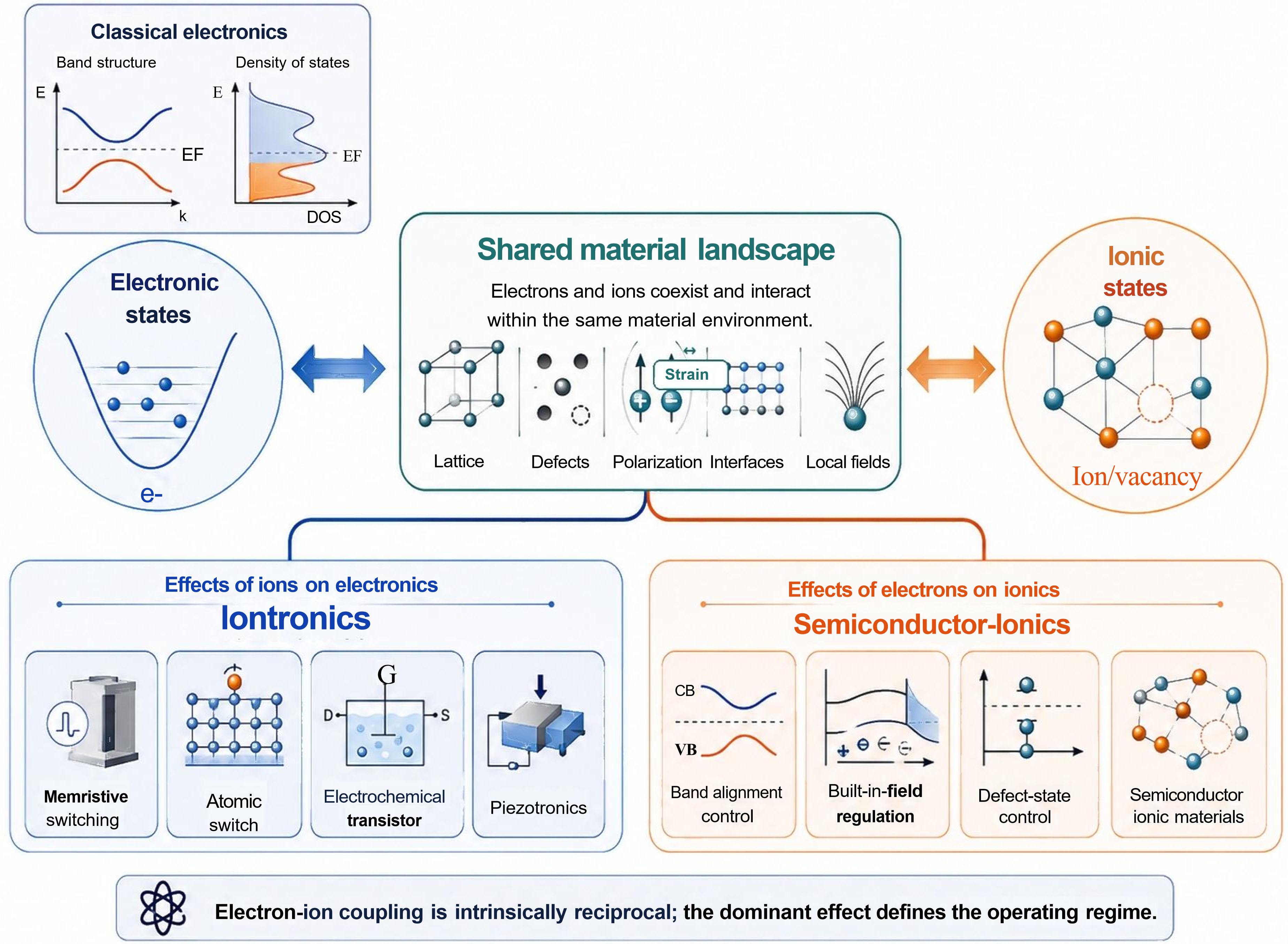
Figure 1. Origin of reciprocal electron-ion interaction in functional materials. Electronic and ionic states coexist within a shared lattice, defect, polarization, strain, interface and local-field landscape. These common variables permit reciprocal cross-effects even when one direction dominates a measured function. MIEC provides a boundary condition: it denotes coexisting ionic and electronic conduction, whereas Iontronics and Semiconductor-Ionics classify functional cross-effects between the two subsystems. EF: Fermi level / Fermi energy; DOS: density of states; CB: conduction band; VB: valence band; MIEC: mixed ion and electron conductor.
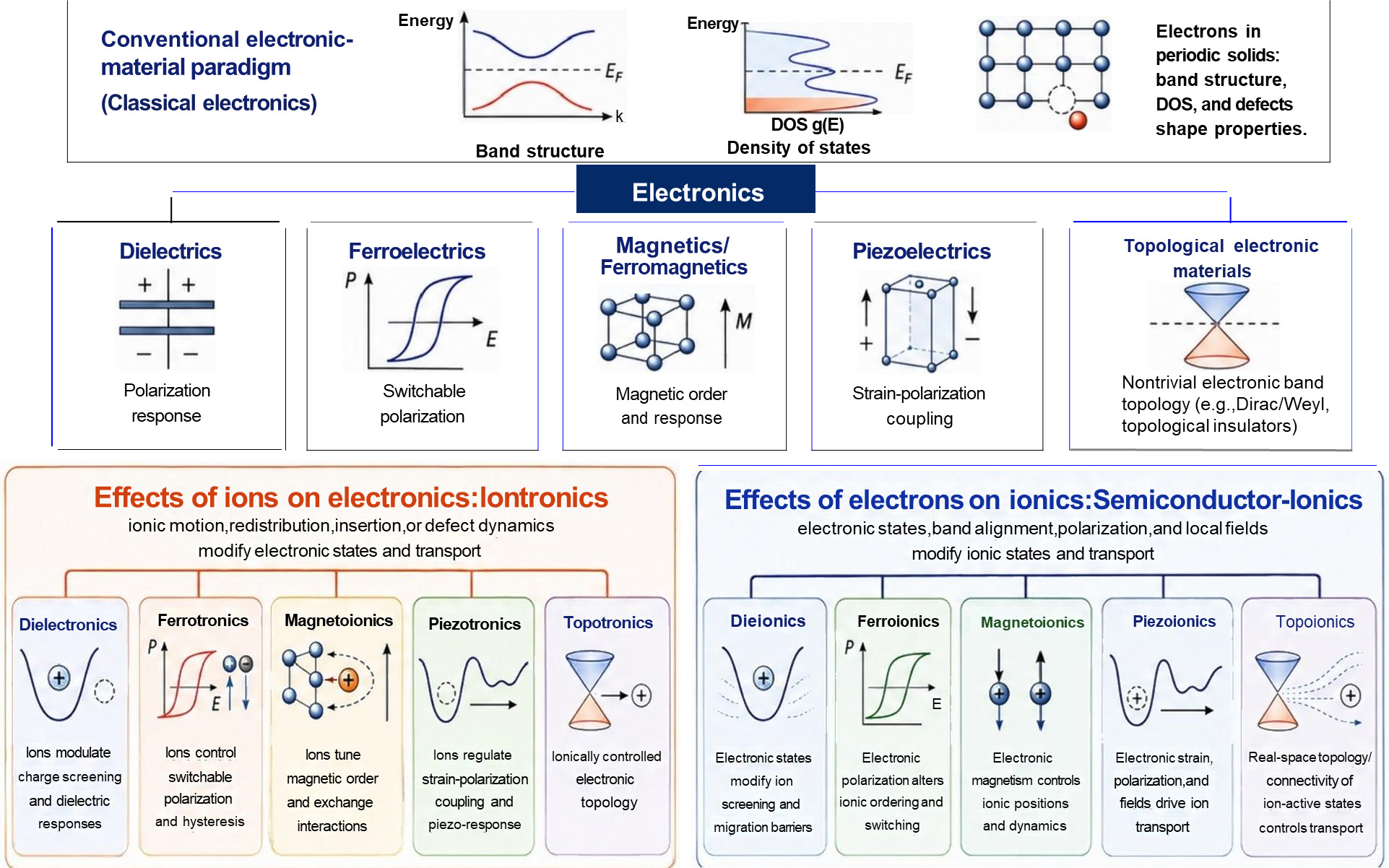
Figure 2. Classification of functional materials by the dominant direction of electron-ion effects. The iontronic branch denotes ion-to-electron cross-effects and the Semiconductor-Ionics branch electron-to-ion cross-effects. Piezotronics is represented by strain-induced ionic/lattice displacement and piezopotential modulation of electronic barriers/current. The topological column distinguishes electronic band topology, ionically controlled electronic topology (Topotronics), and real-space topology/connectivity of ion-active pathways (Topoionics). DOS: Density of states; EF: Fermi level / Fermi energy.
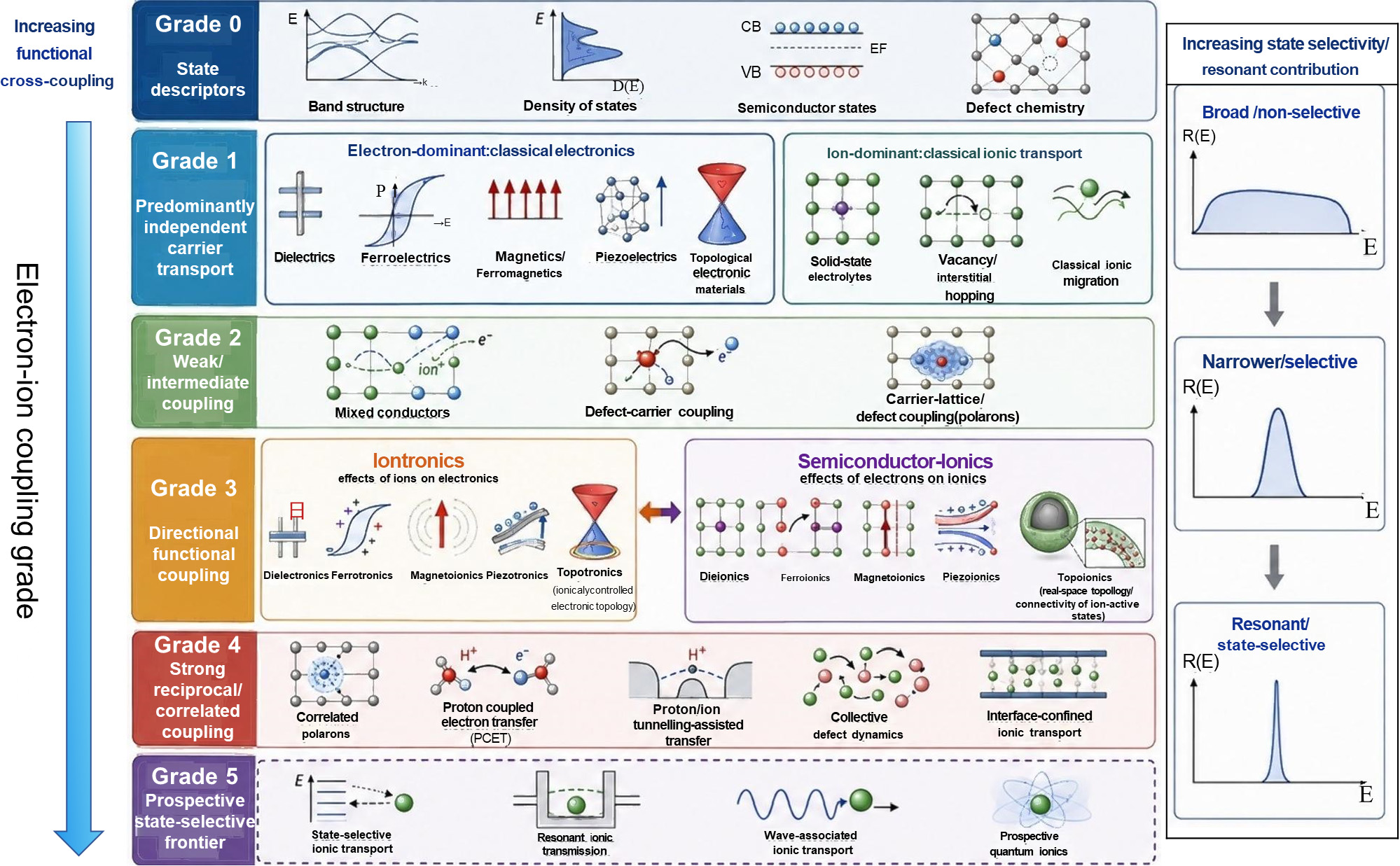
Figure 3. Proposed grades of electron-ion coupling. The framework progresses from approximately separable electronic and ionic behavior to measurable cross-effects, directional functional coupling, strong reciprocal/correlated coupling, and a prospective state-selective frontier. MIEC represents mixed carrier transport, whereas higher grades describe increasing functional interaction between the electronic and ionic subsystems. The right-hand R(E) profiles schematically indicate increasing state selectivity from broad to resonant transport. PCET: Proton-coupled electron transfer; MIEC: mixed ion and electron conductor; CB: conduction band; VB: valence band; EF: Fermi level / Fermi energy.
WHERE ELECTRON-ION COUPLING COMES FROM
The usual separation between electrons and ions has a practical origin. Electrons are light and fast, and their transport is naturally expressed in terms of bands, carrier statistics and electronic states. Ionic motion is slower and is commonly described through defects, migration barriers and activated diffusion. These are different descriptions of different degrees of freedom, but they act within the same solid.
The coupling appears whenever a change in ionic configuration alters the electronic energy landscape, or when a change in electronic state alters the energy landscape seen by an ion. Defect chemistry is one route; polarization and space-charge fields are another. Strain changes orbital overlap and, at the same time, the geometry of an ionic pathway. Interfaces can combine band bending, defect segregation, polarization and chemical reconstruction within the same nanoscale region.
For classification purposes, if an ionic variable Xi, such as concentration, displacement, defect occupation or chemical potential, changes an electronic response Ye, the dominant cross-effect is Xi > Ye. Conversely, if an electronic variable Xe, such as carrier density, Fermi-level position, band alignment, polarization or local electronic field, changes an ionic response Yi, the dominant cross-effect is Xe > Yi.
To make these reciprocal responses experimentally usable, Xi, Ye, Xe and Yi are defined by measurable quantities in Table 1. Each response should be reported over a stated perturbation interval with uncertainty and appropriate controls, so that electrostatic charging, contact changes, Joule heating or photothermal effects are not mistaken for electron-ion coupling.
Experimental meaning of reciprocal-response variables
| Symbol | Meaning | Representative experimental quantities | Ref. |
| Xi | Ionic control variable | ion concentration; vacancy/interstitial occupancy; ionic chemical potential; sublattice displacement | [4-7] |
| Ye | Electronic response | current/conductivity; carrier density; barrier height; magnetization; Hall response | [3,8-12] |
| Xe | Electronic control variable | Fermi level; carrier density; band alignment; polarization/local electronic field | [1,2,4,9] |
| Yi | Ionic response | ionic conductivity/flux; diffusion coefficient; defect population; migration barrier | [4,5,8,9] |
FROM CLASSICAL FUNCTIONALITIES TO COUPLED-MATERIAL CLASSES
Let us consider which side of the coupled system is being modified. Figure 2 classifies coupled functionality by the dominant cross-response. The distinction is not just between ‘electronic’ and ‘ionic’ materials in an absolute sense, but between two dominant directions of response.
Effects of ions on electronics: the iontronic direction
Ion motion, insertion, redistribution or ion-associated polarization can change carrier density, Fermi level, barrier height, polarization, magnetization and electronic conductivity. Oxygen-ion or vacancy motion can reconstruct an electronic conduction path in memristive systems[8], electrolyte-based ionic control can tune functional oxides[9], magnetoionics uses ionic redistribution to tune magnetic states[10,11], and ionic accumulation or insertion changes the electronic carrier population in organic electrochemical transistors[12].
Piezotronics offers a particularly instructive case because its coupling mechanism is direct. In the framework established by Wang and co-workers, applying strain to a non-centrosymmetric piezoelectric semiconductor creates an internal piezopotential through ionic polarization. Because the material is simultaneously piezoelectric and semiconducting, this piezopotential acts as a gate on carrier transport across an interface or junction. Modulation of electronic barriers and current by this strain-induced piezopotential defines the piezotronic effect[13-16].
Effects of electrons on ionics: semiconductor-ionics
The opposite direction is Semiconductor-Ionics: electronic structure and internal fields alter ionic states or ionic transport. Band bending, heterojunction fields, carrier-defect coupling, interfacial polarization and charge-state-dependent defect formation are possible routes[4]. The distinction from a conventional mixed conductor is therefore physical as well as operational: mixed conduction identifies simultaneous electronic and ionic transport, whereas Semiconductor-Ionics requires semiconductor-state physics to become functionally active in regulating ionic behavior.
The proposed Dieionics, Ferroionics, Piezoionics and Topoionics denote mechanism-defined ionic functionalities rather than claims that all are equally deduced as independent disciplines rooted from the electron-ion coupling physics. Their purpose is to create testable questions: for example, a dieionic assignment should require dielectric polarization or an associated local field to change an ionic observable, while a piezoionic assignment should require a strain/polarization perturbation to change ionic accumulation, mobility or flux.
The topological column requires special care. Topological electronic materials refer to topology of electronic states in reciprocal space. Ionically controlled topology describes cases in which ion insertion, migration or redox changes an electronic/topological state. Experiments demonstrate this route: Li intercalation drives topological domain-wall evolution in graphene-based structures[17], ionic gating controls a topological 3Q state in Cox-TaS2[18], and Li intercalation changes Fermi-surface topology in 2H-TaSe2[19]. By contrast, Topoionics refers to real-space ionic transport governed by material architecture, for example a core-shell structure with a highly ion-conducting surface layer and a relatively insulating core. Here, the topology, dimensionality and connectivity of ion-active regions or interfaces determine ionic transport.
One material can move between regimes
The two directions are not mutually exclusive. Ion redistribution may alter an electronic potential, which then redirects subsequent ion motion. Which direction appears dominant can change with bias, temperature, atmosphere, strain, hydration, illumination or defect state. The classification is operational rather than unchangeable: it describes how a material functions under stated conditions.
GRADE OF COUPLING MECHANISMS
Direction alone does not tell us how strongly the two subsystems are tied together. Figure 3 adds this second dimension. The coupling grades should not be read as a rigid ladder of material quality; they are proposed operating regimes.
Grade 0 contains state descriptors from which the coupled problem is built: band structure, density of states, semiconductor states and defect chemistry. Grade 1 is the approximately separable limit. Grade 2 covers weak and intermediate coupling, including mixed ion and electron conductor (MIEC), defect-carrier association and polaronic carrier-lattice coupling. Grade 3 is where a directional cross-response becomes the function. Grade 4 describes strong reciprocal or correlated dynamics, including proton-coupled electron transfer (PCET), correlated polarons, collective defect dynamics and tunneling-assisted transfer. Grade 5 is a prospective state-selective frontier.
The coupling grades are intended as an operational guide not as a universal numerical scale. They are distinguished by whether electron-ion cross-effects are negligible, measurable, functionally dominant or strongly reciprocal under a given operating condition.
Figure 3 proposes the grades of electron-ion coupling. Table 2 further specifies the operational criteria used in Figure 3. The right side of Figure 3 uses R(E), a state-admission function describing the relative contribution of ionic states at energy E to transport, to illustrate how ionic transport may become increasingly state-selective. A broad R(E) represents transport involving many accessible states, whereas a narrower R(E) indicates that fewer states contribute effectively. At the prospective resonant limit, transport is dominated by strongly matched states. Here, R(E) is used schematically rather than as a numerical measure of the electron-ion coupling grade; its relation to the state-resonant energy transmission law (SRETL) framework is discussed further in Section PERSPECTIVE[20].
Operational criteria for the proposed coupling grades
| Grade | Operational criterion | Suggested measurables | Representative interpretation | Ref. |
| Grade 0 | State descriptors only; no coupling assignment | Band structure, DOS, defect chemistry, ionic occupancy | Available electronic and ionic states | [1,2,4] |
| Grade 1 | Electronic and ionic behaviors are approximately independent for the function considered | Electronic or ionic conductivity, activation energy, carrier concentration | Classical electronics / solid electrolytes | [1,2,5] |
| Grade 2 | Electron-ion interaction is measurable but remains secondary to the main function | Changes in conductivity, defect population, carrier density, polarization, mixed-conduction behavior | MIEC defect-carrier or polaronic coupling | [5-7] |
| Grade 3 | One subsystem clearly controls the functional response of the other | Ion-effect on electronic current, barrier, magnetization; or electronic-state/field-effect on ionic conductivity or flux | Iontronics / Semiconductor-Ionics | [3,4,8-16] |
| Grade 4 | Electronic, ionic and lattice responses become strongly interdependent and cannot be treated independently | Reciprocal response, hysteresis, coupled time scales, operando spectroscopy/microscopy | PCET, correlated polarons, collective defect dynamics | [4,7,20] |
| Grade 5 | Transport becomes state-selective or resonant beyond conventional barrier-lowering descriptions | Isotope effects, thermal-to-quantum crossover, frequency-selective resonance, state matching, coherence-sensitive evidence if claimed | State-selective transport / prospective quantum ionics | [21-26] |
FROM CLASSIFICATION TO COUPLING ENGINEERING
A useful classification should suggest what to do next. In this sense, the coupling map is also a design map. Interfaces bring band alignment, space charge and defect segregation into one region. Polarization changes both electronic band bending and ionic chemical potential. Strain alters orbital overlap, lattice vibration and migration geometry. Electronic-state engineering changes defect charge states and formation energies[4,8,9].
Interfaces bring band alignment, space charge and defect segregation into one region. Polarization changes both electronic band bending and ionic chemical potential. Strain alters orbital overlap, lattice vibration and migration geometry. Electronic-state engineering changes defect charge states and formation energies.
These strategies are usually discussed separately. Electron-ion coupling gives them a common design language: structure - coupling- transport mechanism - function. The practical question is no longer only whether a barrier can be lowered or carrier concentration increased, but whether a chosen defect, interface or field creates the cross-response needed for the intended function.
Regime switching, kinetics and service stability
The same material can move between regimes as the operating conditions change. Electric-field-driven proton evolution in SrRuO3 reversibly changes magnetic state[27]; nanoscale hydrogenation/dehydrogenation reversibly switches VO2[28]; and Li intercalation in ferroelectric alpha-In2Se3 produces successive electronic and structural regimes[29]. Regime assignment should therefore specify temperature, bias, ion chemical potential and time rather than composition alone.
More broadly, recent analysis of MnCo2O4-based electrochemical materials illustrates how compositional, structural and device-level engineering can reshape electrochemical behavior and functionality[30]. Table 3 further maps representative literature examples onto the proposed coupling framework.
Representative experiments mapped onto the coupling framework
| System | Perturbation | Measured response | Coupling grade / interpretation | Ref. |
| OMIEC/OECT | Electrochemical doping | Electronic current changes with ionic uptake/redistribution | Grade 2-3: mixed conduction to ion-controlled electronic function | [6,12] |
| ZnO piezotronics | Mechanical strain | Piezopotential changes interface barrier/current | Grade 3: ionic/lattice displacement controls electronic function | [13-16] |
| Magnetoionic interface | Ion migration | Magnetization or magnetic anisotropy changes | Grade 3: ions control magnetic/electronic function | [10,11] |
| SrRuO3 | Electric-field-controlled protonation | Reversible magnetic/electronic-state change | Grade 3-4: reversible ion-controlled state switching | [27] |
| VO2 | Hydrogenation/dehydrogenation | Reversible insulator-metal transition | Grade 3-4: reversible ion-controlled electronic switching | [28] |
| Cu7PS6 | Temperature / phonon activation | Collective Cu-ion hopping | Grade 4: correlated ionic dynamics | [20] |
| Pd-H | Temperature/isotope / H content | Resonant proton tunneling | Grade 5: resonant quantum proton transport | [21] |
| BZY ceramic | Narrow-band MIR excitation | Frequency-selective proton-conductivity enhancement | Grade 5: state-selective proton transport | [22] |
Switching also involves different response times and degrees of reversibility. Electronic changes are usually faster, while ionic redistribution, defect migration and structural relaxation can occur more slowly. Useful observations therefore include response time, hysteresis, retention and cycling stability. A stable coupling state should give a reproducible response during repeated operation, whereas irreversible redox, phase separation or defect accumulation will gradually change the material behavior.
PERSPECTIVE: DIMENSIONALITY AND THE STATE-SELECTIVE FRONTIER
Dimensionality changes the balance of coupling channels. Core-shell or 0D particles emphasize surfaces and interfaces; 1D channels emphasize confinement and anisotropy; 2D materials combine short intercalation distances with reduced screening; and 3D solids emphasize percolating defect networks and bulk chemistry. Recent discussions of 2D nanofluidics and nanoconfined iontronics illustrate how confinement amplifies interfacial control[3,31].
Grade 5 should be read as an evidence ladder rather than a single established class. Resonant proton tunneling in Pd shows isotope dependence, a thermal-to-quantum crossover and state matching[21]. Narrow-band mid-infrared excitation of proton-conducting BaZrO3-based ceramics gives a reversible, frequency-selective conductivity enhancement[22]. Phonon-activated collective Cu hopping in Cu7PS6 has been directly resolved[20], but collective motion alone does not prove coherence. Sezen et al. reported coherent wave-like ionic transport under resonant excitation[23]. These observations motivate, but do not yet establish, a universal quantum-ionics regime.
Accordingly, ‘quantum ionics’ should be used only when evidence goes beyond strong coupling. Relevant criteria include isotope-sensitive tunneling, a thermal-to-quantum crossover, frequency-selective resonance or discrete state matching, and - where coherence is claimed - a phase-sensitive or directly time/space-resolved coherent signal. Joule heating, photothermal effects and conventional electrochemical redistribution must be independently excluded. The SRETL provides one possible state-admission language for organizing such observations[20], but the classification itself does not depend on SRETL.
CONCLUSION AND EXPERIMENTAL VALIDATION
The classical classification of electronic materials remains the foundation of functional materials science, but it is no longer a complete description of materials in which electronic and ionic degrees of freedom regulate one another. The proposed framework adds a measurable question: how strongly and in which direction do the two subsystems interact under operating conditions?
A practical validation workflow is straightforward: identify the relevant ionic and electronic variables, perturb one subsystem while monitoring the response of the other, and repeat the measurements across temperature, bias, frequency, atmosphere and time to establish reproducibility, kinetics and reversibility. Where strong reciprocal coupling or state-selective behaviour is suspected, spectroscopy, microscopy, isotope substitution or other state-sensitive probes can be used to identify the underlying mechanism. Materials screening should therefore focus not only on high ionic or electronic conductivity, but also on the strength, direction and stability of electron-ion coupling.
The framework should be considered predictive only when an assigned coupling regime anticipates a measurable response under a new perturbation or operating condition. Framed this way, Iontronics and Semiconductor-Ionics become reciprocal functional directions, MIECs become one possible intermediate regime rather than the endpoint, and defects, interfaces, polarization, strain, topology and dimensionality become variables for coupling engineering.
DECLARATIONS
Authors’ contributions
The author contributed solely to the article.
Availability of data and materials
Not applicable.
AI and AI-assisted tools statement
During the preparation of this manuscript, OpenAI ChatGPT (GPT-5.6 Sol; version 5.6, released 2026-07-09) was used solely for language editing. OpenAI ChatGPT (GPT-5.6 Luna; version 5.6, released 2026-07-09) was used to help draw Figures 1-3 components in the manuscript. The tool did not influence the study design, data collection, analysis, interpretation, or the scientific content of the work. The author takes full responsibility for the accuracy, integrity, and final content of the manuscript.
Financial support and sponsorship
None.
Conflicts of interest
The author declares no conflicts of interest.
Ethical approval and consent to participate
Not applicable.
Consent for publication
Not applicable.
Copyright
© The Author(s) 2026.
REFERENCES
1. Ashcroft, N. W.; Mermin, N. D. Solid State Physics. New York: Holt, Rinehart and Winston; 1976. https://books.google.com/books?id=o4w6AQAAIAAJ.
2. Sze, S. M.; Li, Y.; Ng, K. K. Physics of Semiconductor Devices. 4th ed. Hoboken: Wiley; 2021. https://www.wiley.com/en-us/Physics+of+Semiconductor+Devices%2C+4th+Edition-p-9781119429111.
3. Liu, Y.; Peng, P.; Qian, H.; Wang, Z. L.; Wei, D. Nanoconfined iontronics and its electronic applications. Nano. Res. Energy. 2025, 4, e9120156.
4. Bibi, B.; Nazar, A.; Zhu, B.; et al. Emerging semiconductor ionic materials tailored by mixed ionic-electronic conductors for advanced fuel cells. Adv. Powder. Mater. 2024, 3, 100231.
5. Riess, I. The possible use of mixed ionic electronic conductors instead of electrolytes in fuel cells. Solid. State. Ion. 1992, 52, 127-34.
6. Paulsen, B. D.; Tybrandt, K.; Stavrinidou, E.; Rivnay, J. Organic mixed ionic-electronic conductors. Nat. Mater. 2020, 19, 13-26.
7. Keene, S. T.; Rao, A.; Malliaras, G. G. The relationship between ionic-electronic coupling and transport in organic mixed conductors. Sci. Adv. 2023, 9, eadi3536.
8. Yang, Y.; Zhang, X.; Qin, L.; Zeng, Q.; Qiu, X.; Huang, R. Probing nanoscale oxygen ion motion in memristive systems. Nat. Commun. 2017, 8, 15173.
10. Bauer, U.; Yao, L.; Tan, A. J.; et al. Magneto-ionic control of interfacial magnetism. Nat. Mater. 2015, 14, 174-81.
11. Nichterwitz, M.; Honnali, S.; Kutuzau, M.; et al. Advances in magneto-ionic materials and perspectives for their application. APL. Mater. 2021, 9, 030903.
12. Rivnay, J.; Inal, S.; Salleo, A.; Owens, R. M.; Berggren, M.; Malliaras, G. G. Organic electrochemical transistors. Nat. Rev. Mater. 2018, 3, BFnatrevmats201786.
13. Wang, X.; Zhou, J.; Song, J.; Liu, J.; Xu, N.; Wang, Z. L. Piezoelectric field effect transistor and nanoforce sensor based on a single ZnO nanowire. Nano. Lett. 2006, 6, 2768-72.
16. Wang, Z. L.; Wu, W.; Falconi, C. Piezotronics and piezo-phototronics with third-generation semiconductors. MRS. Bull. 2018, 43, 922-7.
17. Endo, Y.; Yan, X.; Li, M.; et al. Dynamic topological domain walls driven by lithium intercalation in graphene. Nat. Nanotechnol. 2023, 18, 1154-61.
18. Kim, J.; Zhang, K. X.; Park, P.; et al. Electrical control of topological 3Q state in intercalated van der Waals antiferromagnet Cox-TaS2. Nat. Commun. 2025, 16, 8943.
19. Wu, Y.; Xing, H.; Lian, C.; et al. Ion intercalation engineering of electronic properties of two-dimensional crystals of 2H-TaSe2. Phys. Rev. Mater. 2019, 3, 104003.
20. Lin, H.; Gupta, M. K.; Ouyang, N.; et al. Phonon-activated collective hopping in a superionic phase. Phys. Rev. X. 2026, 16, 031046.
21. Ozawa, T.; Nakanishi, H.; Kato, K.; Shimizu, R.; Hitosugi, T.; Fukutani, K. Observation of resonant tunneling of proton from octahedral to tetrahedral sites in Pd. J. Phys. Chem. Solids. 2024, 185, 111741.
22. Li, H.; Zhu, Y.; Zhao, Z.; et al. Mid-infrared light resonance-enhanced proton conductivity in ceramics. Nat. Commun. 2025, 16, 7707.
23. Sezen, Y.; Çiftçi, N. O.; Sarsıl, M. A.; Czelej, K.; Ergen, O. Quantum coherent Chladni-like resonance: programming ions as matter waves for subpicosecond conduction. Proc. Natl. Acad. Sci. U. S. A. 2026, 123, e2604081123.
24. Zhang, X.; Antonietti, M.; Jiang, L. Bioinformation transformation: from ionics to quantum ionics. Sci. China. Mater. 2020, 63, 167-71.
25. Wang, Y.; Hu, Y.; Guo, J. P.; Gao, J.; Song, B.; Jiang, L. A physical derivation of high-flux ion transport in biological channel via quantum ion coherence. Nat. Commun. 2024, 15, 7189.
26. Zhu, B. A state-resonant energy transmission law for energy materials and beyond. Energy. Z. 2026, 2, 200001.
27. Li, Z.; Shen, S.; Tian, Z.; et al. Reversible manipulation of the magnetic state in SrRuO3 through electric-field controlled proton evolution. Nat. Commun. 2020, 11, 184.
28. Li, L.; Wang, M.; Zhou, Y.; et al. Manipulating the insulator-metal transition through tip-induced hydrogenation. Nat. Mater. 2022, 21, 1246-51.
29. He, X.; Gong, Z.; Wang, T.; et al. Intercalation-induced phase transitions in ferroelectric α-In2Se3. Adv. Sci. (Weinh). 2026, 13, e13712.
30. Zhang, Y.; Fan, Z.; Huo, Q.; Yin, R.; Wei, Y.; Gao, H. MnCo2O4-based materials for supercapacitors: a full-chain analysis from synthesis to device integration. Coord. Chem. Rev. 2026, 566, 218158.
Cite This Article
 Open Access
How to Cite
Zhu, B. Beyond electronics: classifying functional materials through electron-ion coupling. Iontronics 2026, 2, 37. https://dx.doi.org/10.20517/iontronics.2026.34
Download Citation
If you have the appropriate software installed, you can download article citation data to the citation manager of your choice. Simply select your manager software from the list below and click on download.
Export Citation File
Type of Import
Tips on Downloading Citation
Citation Manager File Format
Type of Import
Direct Import: When the Direct Import option is selected (the default state), a dialogue box will give you the option to Save or Open the downloaded citation data. Choosing Open will either launch your citation manager or give you a choice of applications with which to use the metadata. The Save option saves the file locally for later use.
Indirect Import: When the Indirect Import option is selected, the metadata is displayed and may be copied and pasted as needed.
About This Article
Copyright

Data & Comments
Data
0










Comments
Comments must be written in English. Spam, offensive content, impersonation, and private information will not be permitted. If any comment is reported and identified as inappropriate content by OAE staff, the comment will be removed without notice. If you have any queries or need any help, please contact us at [email protected].