

Solid-state ion-storage materials for programmable ion delivery towards precise neuromodulation
 0


 Download PDF
Neuromodulation has attracted extensive attention in materials science, electrical engineering, neuroscience, and clinical medicine[1-3]. External stimulation can regulate abnormal neural activity[4,5]. Among the available approaches, electronic stimulation is widely used because of its adjustable parameters, rapid effects, and compatibility with both invasive and non-invasive devices[6,7]. Advances in electrode materials, flexible electronics and stimulation protocols have further improved spatial resolution and tissue compatibility[8]. Traditional metal electrodes modulate neurons through electric fields generated by Faradaic or capacitive charge-transfer processes[9]. However, electronic stimulation is mainly achieved by altering the membrane potential through electric fields and interfacial charge transfer [Figure 1A]. It provides limited control over the biochemical processes that determine neural activity. Electronic signals often lack chemical specificity and may recruit unintended neural activity. Interfacial electrochemical reactions may alter local pH or generate multiple chemical species without selective control over their identities, limiting precise molecular regulation of neural activity[10].

Figure 1. Basic principles of electronic and iontronic stimulation. (A) Electronic stimulation polarizes neural membranes through an electrode and circuit; (B) Iontronic devices convert an externally supplied electrical command into controlled release of target ions (green), which accumulate and diffuse extracellularly to modulate neural activity through membrane interactions (I) or, where uptake occurs (II), intracellular signaling. Certain graphical elements in (A and B) were created in BioRender. (https://BioRender.com/yz0d795).
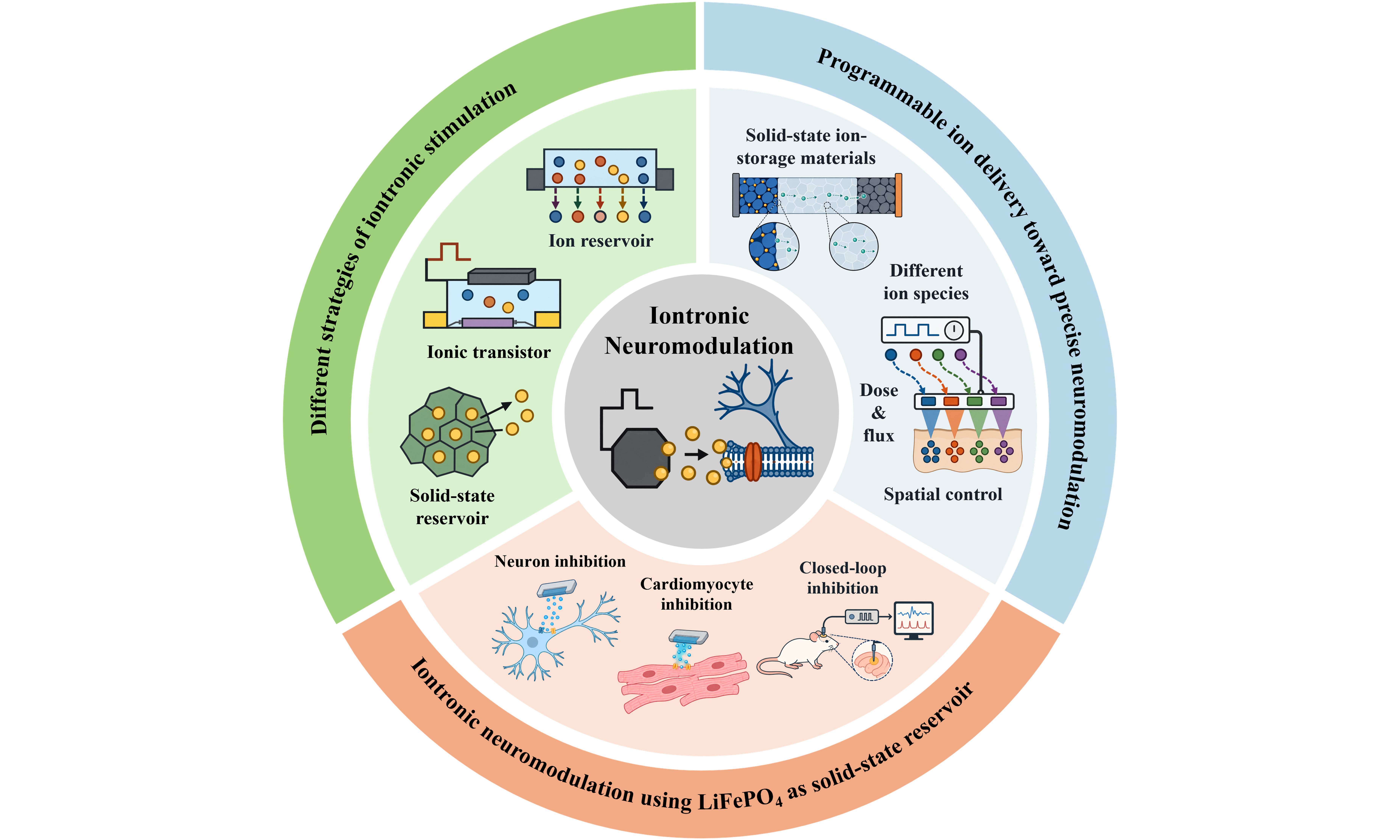
Iontronic stimulation converts electronic signals into controlled ionic signals [Figure 1B]. In these interfaces, ions act as bioactive mediators rather than passive charge carriers[11,12]. Bioactive ions and charged molecules can affect ion channels, membrane pumps, and intracellular pathways[11,12]. Iontronic devices typically employ liquid or hydrogel reservoirs for ion delivery and ionic transistors for signal processing[13,14]. Solid-state ion-storage materials provide a different structure. They can electrochemically release ions stored within their crystal lattices into neural tissue and thereby function as solid-state reservoirs. In this perspective, programmable refers to control over the device output, including ion identity, delivered amount, timing, and spatial profile. Diffusion, cellular uptake, clearance, and ion homeostasis intervene between device output and neural response. Current capabilities therefore support programmable ion delivery toward precise neuromodulation, rather than direct programming of neural activity. However, critical challenges, including chronic safety, tissue-device integration, delivery reversibility, and therapeutic specificity, remain unresolved.
This perspective highlights solid-state ion-storage materials as promising candidates for iontronic neuromodulation. First, we summarize established iontronic stimulation strategies and explain how solid-state ion-storage materials differ from liquid or hydrogel reservoirs. Secondly, we discuss how ion identity, dose, spatial exposure, and biological transport shape neural outcomes. Next, we use LiFePO4 as an example to separate electrochemical release from tissue response. Finally, we summarize the key challenges and future research directions, including device longevity and reversible ion cycling, mechanical compliance and minimally invasive tissue integration, closed-loop dose control, and the diversification of ion-storage materials and therapeutic applications.
MAIN TEXT
Strategies of iontronic stimulation
Iontronic interfaces can introduce chemical specificity into neuromodulation. Iontronic stimulation converts electrical commands into defined ionic species and subsequently into a biological response. Applied voltage pulses establish an electrochemical potential gradient that drives selective ion transport or release. The resulting ionic output is determined by ion identity, concentration, and delivery duration. Current applications mainly involve direct control of excitability and inhibition, modulation of intracellular signaling, and delivery of therapeutic agents.
Liquid and hydrogel reservoirs store ions or charged molecules in a hydrated phase, while membrane-based delivery devices use ion-exchange membranes to selectively transport counterions to the tissue interface[15-17]. Miniaturized iontronic micropipettes use a glass capillary as the reservoir and a polyelectrolyte-filled tip as the selective outlet[13]. Their output is governed by reservoir concentration, membrane selectivity, channel resistance, and applied charge. Ionic transistors, by contrast, operate through ion-controlled electronic conduction[18,19]. In organic electrochemical transistors, a gate voltage drives ions into or out of a mixed ionic-electronic conducting channel, changing its doping state and source-drain conductivity[18]. This mechanism enables ionic sensing, signal amplification, and artificial spiking, but it does not necessarily deliver ions to tissue[19]. Beyond serving as reservoirs, hydrogels and ionogels can also serve as conductors, mechanical interfaces or ion-blocking layers. Supramolecular hydrogel probes combined cortical recording with stimulation and improved pain-related withdrawal responses in rats[2]. A structured piezoionic hydrogel generated pressure-dependent ionic potentials that stimulated sciatic nerves[14]. In a membrane-ionogel assembly, an ion-blocking membrane restricted exchange between synthetic and biological ions while supporting non-Faradaic stimulation[20]. These examples illustrate that capacitive coupling can stimulate tissue without releasing the ionogel electrolyte. When these gel-like materials are implanted, the effects of swelling, dehydration, and leachable components on stability and safety should be assessed. Their structures also impose different limits: reservoir volume and membrane transport constrain delivery, whereas channel stability and ionic relaxation constrain transistor operation.
Solid-state ion-storage materials couple electrochemical reactions directly to ion release by integrating the ion inventory with the electrode. The solid reservoirs reduce the need for a separate liquid reservoir. In solid-state reservoirs, the host composition and state of charge define the available ion species, finite capacity, reaction potential, and, after calibration of Faradaic efficiency, the relation between transferred charge and released dose[10]. This integration may reduce reservoir volume and passive leakage, but it does not by itself guarantee chemical selectivity, spatial precision or biological efficacy. The architectural advantage must therefore be weighed against finite loading, host-phase degradation, competing interfacial reactions and mechanical stiffness. Ion-selective membranes, confined transport paths and device geometry can further shape release rate and spatial exposure, but their performance should be assessed under physiological ionic strength and over repeated cycles[21,22].
Programmable ion delivery towards precise neuromodulation
Programmable ion delivery begins with control over ion identity, concentration, flux, duration, and spatial exposure at the device-output level. Ion identity determines the available biological interactions, while concentration and flux influence response magnitude and duration. From an operational view, precision refers to the validated control of the target ion species, the accuracy and repeatability of the delivered dose, and the confinement of ion exposure to the target area. Na+ and K+ gradients generate and shape membrane potentials[23-25]. Li+ modulates multiple enzymes and intracellular signaling pathways. Mg2+ serves as a cofactor for numerous enzymes and modulates receptor function, and Ca2+ regulates neurotransmitter release and intracellular signals[25,26]. Therefore, device-level control should be evaluated together with the biological pathway engaged by each ion.
Species selectivity begins with reservoir composition and membrane or host chemistry. A cation-exchange membrane rejects co-ions but does not automatically distinguish Li+ from Na+, K+, or H+. Selective channels, separate reservoirs, and independently addressed outlets can reduce cross-delivery; proton-trapping ion pumps provide an example of suppressing H+ transport during drug delivery[15]. For electroactive solid-state ion-storage materials, current density, operation time, and waveform can regulate the amount and rate of ion release. Integrated charge provides a dose estimate only after species-specific Faradaic efficiency has been measured in the relevant biofluid; without that calibration, transferred charge cannot be equated with the amount of target ion delivered.
Table 1 relates representative ion species to reservoirs, control methods and evidence boundaries. Post-lithium storage expands the candidate library: a bioresorbable Na-ion battery used a Na0.44MnO2 electrode, while hydrated manganese birnessite and amorphous manganese oxide have supported Mg2+ and Ca2+ storage, respectively[27-29]. These are energy-storage demonstrations. Translation to neural delivery requires ion-specific release measurements at physiological pH and ionic strength, evaluation of co-released metals, and validation of the proposed biological endpoint. Bioresorbable batteries also illustrate control over device lifetime, but degradation-driven ion release cannot be assumed to provide a programmable therapeutic dose. Implanted organic electronic ion pumps delivered γ-aminobutyric acid (GABA) to spinal targets and reduced mechanical hypersensitivity in awake rats with peripheral nerve injury[30]. Hydrogel probes and membrane-ionogel interfaces also connect ionic materials to pain-related or autonomic outcomes[2,20]. These preclinical studies use different mechanisms and endpoints, without establishing interchangeable dose-response relationships or human efficacy.
Representative ion species
| Ion or molecule | Reservoir and control | Application and main limitation |
| Li+ | Solid-state reservoir; electrochemical delithiation[10] | Cell, nerve and animal inhibition; local dose is not intracellular concentration |
| Na+ | Na0.44MnO2 in a resorbable battery; candidate release through controlled deintercalation[27] | Battery; programmable neural Na+ delivery from this host remains unvalidated. |
| K+ | Aqueous reservoir and polyelectrolyte micropipette; current and outlet geometry[13] | Reversible single-cell modulation in slices; diffusion and ion competition limit specificity |
| Mg2+ | Hydrated manganese birnessite; candidate release through deintercalation[28] | Storage evidence; hydration, competing ions, and host dissolution require biofluid tests |
| Ca2+ | Amorphous manganese oxide; candidate release through deintercalation[29] | Storage evidence; tissue dose and co-released Mn require validation |
| GABA | Aqueous reservoir with an ion-exchange membrane; electrical addressing and proton trapping[15,30] | Animal pain-related effects and selective delivery in separate studies; transport efficiency and pH require calibration |
Therefore, realizing the potential of programmable iontronic neuromodulation requires measured relationships linking device inputs, spatiotemporal ionic profiles, and physiological responses. Important challenges include independently controlling multiple ionic species, achieving rapid and reversible modulation, minimizing unintended electrochemical reactions, and maintaining stable delivery over extended periods. Addressing these challenges will be essential for translating ions into reproducible and biologically meaningful interventions.
Iontronic neuromodulation using LiFePO4 as a solid-state reservoir
The LiFePO4-based device provides an example of a solid-state reservoir. Phase transitions, operating potential, and competing reactions determine whether repeated electronic commands yield reproducible ionic outputs across cycles and biological environments. The device generated a localized Li+ microenvironment at the neural-tissue interface. It can reduce neuronal and cardiomyocyte activity in vitro, suppress compound action potentials in peripheral nerves ex vivo, and inhibit neural activity near the sciatic nerve and spinal cord in vivo[10].
LiFePO4 combines a finite electrochemical lithium inventory with electrically driven Li+ release, allowing electronic inputs to be converted into localized ionic outputs[31]. Anodic polarization drives this reaction:
which converts electronic charge into localized Li+ release[10,32]. LiFePO4 has an olivine structure in which lithium and iron atoms occupy the octahedral centers, while phosphorus atoms occupy the tetrahedral sites[32]. The crystal lattice stores lithium, and the applied charge can regulate the released dose when target-ion Faradaic efficiency is known. In the reported device, simulated extracellular Li+ concentrations ranged from several millimolar to approximately 10 mM near the electrode, compared with the approximately 1 mM systemic concentration used as a reference for conventional lithium therapy. These quantities are not directly equivalent: the device value is a spatially varying extracellular concentration, whereas the treatment reference is systemic, and intracellular exposure depends on transport and uptake. Intracellular Li+ accumulation is time- and current-dependent. At the tissue level, the functional dose dependence is also evident: 6.22 × 10⁻⁴ mmol cm-2 Li+ generated during a 1-min treatment increased the nerve stimulation threshold by approximately 29%, whereas 12.44 × 10⁻⁴ mmol cm-2 generated during 2 min increased it by approximately 83%[10]. These results show dose dependence under the reported conditions but do not define a universal therapeutic range. The reported inhibitory effects developed over minutes to hours, supporting delayed, sustained chemical modulation rather than pulse-by-pulse electrical control. This kinetic profile may be advantageous for sustained local suppression, including prolonged peripheral-nerve inhibition, maintenance-phase modulation of slowly varying pathological activity, or other settings in which chemical specificity and duration are prioritized over millisecond timing. By contrast, rapid and reversible control is more suitable for pulse-locked stimulation, immediate reversal, or high-bandwidth bidirectional control.
Lithium inhibits the nervous system through cAMP-AC pathways[33]. The electrochemical-to-biological cascade contains four experimentally separable stages: LiFePO4 delithiation; Li+ accumulation at the electrode-tissue interface; diffusion through extracellular fluid and uptake across cell membranes; and downstream changes in cellular or neural activity. The first two stages depend mainly on material state of charge, potential and interfacial kinetics, whereas the latter two depend on tissue geometry, clearance, endogenous ion competition and cell-specific transport. Consequently, a reproducible charge-to-release relation does not by itself establish a reproducible release-to-response relation. Although lithium is known to affect multiple intracellular signaling pathways, the cAMP assay supports pathway engagement only in the tested cell model; it does not identify the mechanism that suppresses compound action potentials or establish that the same pathway mediates the in vivo response. Direct measurements of extracellular Li+ profiles, cellular uptake, membrane excitability, pathway-specific perturbations and post-stimulation recovery are required to connect released charge causally to nerve inhibition.
Safety depends on the full electrochemical circuit and tissue interface. Although a low delithiation potential can reduce oxidation risk, overpotential, fouling, local depletion, and counter electrode reactions may promote biomolecule oxidation, pH shifts, or unintended products[10]. Potential windows should therefore be bounded at both electrodes, while pH, target-ion yield, by-products, off-state leakage, and cumulative charge are monitored. Repeated delithiation and lithiation may also alter the LiFePO4/FePO4 phase balance; dissolved oxygen and competing ions can accelerate capacity loss in aqueous electrolytes[34]. Restricting state-of-charge excursions and evaluating ion-permeable protective coatings are testable strategies, but their effects on ion flux and chronic tissue exposure require direct measurement. Mechanical mismatch creates a separate trade-off: higher active-material loading can increase capacity while reducing compliance, whereas compliant binders or hydrogel interlayers may improve contact but slow transport or delaminate. Chronic studies should therefore report device integrity, phase retention, released Fe species, tissue response, and functional recovery across repeated cycles. Physiological ions are not inherently safe at elevated local concentrations, so tissue-specific exposure limits must be established experimentally.
OUTLOOK
In summary, iontronic neuromodulation provides a promising route to localized, chemically specific neural control, but its performance depends on measured links between electrical input, ionic dose, tissue exposure, and biological response. Current approaches include liquid-reservoir delivery, electrochemical generation, and solid-state ion-storage systems. Liquid or hydrogel reservoirs accommodate diverse cargos but face leakage and lifetime constraints; transistor-like devices excel at sensing and signal processing but do not necessarily deliver ions; and solid-state reservoirs integrate ion inventory with the electrode at the cost of finite capacity, stiffness, and cycling-related degradation. Taken together, these comparisons suggest that the field should move from proof-of-release devices toward quantitatively benchmarked ionic therapeutics. A useful development framework is to co-optimize ion identity, dose, spatial spread, and kinetics, with staged validation from charge-to-release calibration, through tissue-exposure mapping, to causal and reversible neural effects. Rather than replacing fast electrical stimulation, solid-state ion reservoirs may be most valuable as complementary sources of sustained, chemically specific modulation. Therefore, interfaces that combine rapid electrical control with slower ionic intervention merit systematic investigation.
Translating iontronic neuromodulation into practical neural interfaces requires integrated advances in materials, devices, and control systems. First, improve device durability by increasing active-material loading, optimizing electrode architecture, and developing rechargeable or recyclable ion-delivery systems. Secondly, implant integration requires soft, flexible, and minimally invasive designs that maintain stable tissue contact during long-term operation. Thirdly, closed-loop control should integrate real-time sensing of neural activity or local ionic conditions with adaptive ion delivery, with explicit limits on cumulative dose and response delay. Finally, therapeutic expansion will require testing in central nervous system applications and exploring other bioactive ions, such as Na+, Zn2+, Mg2+, and Ca2+. Through the combined strategy of materials, devices, closed-loop control, and therapeutic diversification, iontronic neuromodulation is expected to develop into a durable, adaptive, and versatile platform for precise neural intervention.
DECLARATIONS
Authors’ contributions
Conception and writing: Hu, W.
Supervision: Liu, N.
Revision of the manuscript: Huo, K.
All authors participated in substantive discussions regarding the Perspective and approved the final version for publication.
Availability of data and materials
Not applicable.
AI and AI-assisted tools statement
Not applicable.
Financial support and sponsorship
This work was supported by the Natural Science Foundation of Beijing (Z240025 and JQ23002, QY26288), the National Natural Science Foundation of China (22275022), and the National Key R&D Program of China (2024YFF0509300).
Conflicts of interest
Liu, N. is an Editorial Board Member of the journal Iontronics. Liu, N. was not involved in any steps of editorial processing, notably including reviewers' selection, manuscript handling, and decision-making. The other authors declare no conflicts of interest.
Ethical approval and consent to participate
Not applicable.
Consent for publication
Not applicable.
Copyright
© The Author(s) 2026.
REFERENCES
1. Martin, E.; Roberts, M.; Grigoras, I. F.; et al. Ultrasound system for precise neuromodulation of human deep brain circuits. Nat. Commun. 2025, 16, 8024.
2. Qin, Y.; Dang, M.; Yu, D.; et al. Bidirectional brain-machine communication and neuromodulation by supramolecular hydrogel neural probes for chronic pain management. Adv. Mater. 2026, 38, e73367.
3. Yadav, S.; Lee, R. X.; Kajale, S. N.; et al. A nonsurgical brain implant enabled through a cell-electronics hybrid for focal neuromodulation. Nat. Biotechnol. 2026, 44, 1329-39.
4. Wang, W.; Sun, R.; Liu, W.; et al. Neuroimmune-metabolic regulation by a wireless biodegradable neuromodulator for cardiovascular therapy in a mouse model. ACS. Nano. 2026, 20, 12306-20.
5. Sun, X.; Liu, S.; Zhe, Y.; Wang, H.; Zhang, X. Transducer materials for wireless neuromodulation. Adv. Funct. Mater. 2026, 36, e26238.
6. Belkhir, J. R.; Garcea, F. E.; Navarrete, E.; et al. Causal parametric language mapping with electrical stimulation during awake neurosurgery. Sci. Adv. 2026, 12, eadw1599.
7. Moritz, C.; Field-Fote, E. C.; Tefertiller, C.; et al. Non-invasive spinal cord electrical stimulation for arm and hand function in chronic tetraplegia: a safety and efficacy trial. Nat. Med. 2024, 30, 1276-83.
8. Yang, X.; McGlynn, E.; Das, R.; Paşca, S. P.; Cui, B.; Heidari, H. Nanotechnology enables novel modalities for neuromodulation. Adv. Mater. 2021, 33, e2103208.
9. Cogan, S. F. Neural stimulation and recording electrodes. Annu. Rev. Biomed. Eng. 2008, 10, 275-309.
10. Cheng, Z.; Guo, T.; Yan, G.; et al. Mineral-originated bioelectronics for inhibition via lithium electrochemistry. Nat. Mater. 2026, 25, 1873-84.
11. Brock, K. E.; Elliott, E. R.; Taul, A. C.; et al. The effects of lithium on proprioceptive sensory function and nerve conduction. NeuroSci 2023, 4, 280-95.
12. Tyagi, S.; Higerd-Rusli, G. P.; Akin, E. J.; Waxman, S. G.; Dib-Hajj, S. D. Sculpting excitable membranes: voltage-gated ion channel delivery and distribution. Nat. Rev. Neurosci. 2025, 26, 313-32.
13. Arbring Sjöström, T.; Ivanov, A. I.; Kiani, N.; et al. Miniaturized iontronic micropipettes for precise and dynamic ionic modulation of neuronal and astrocytic activity. Small 2025, 21, e2410906.
14. Dai, J.; Xue, Y.; Chen, X.; et al. Artificial nerve for neuromodulation based on structured piezoionic hydrogel. Device 2024, 2, 100436.
15. Strakosas, X.; Seitanidou, M.; Tybrandt, K.; Berggren, M.; Simon, D. T. An electronic proton-trapping ion pump for selective drug delivery. Sci. Adv. 2021, 7, eabd8738.
16. Chen, W.; Zhai, L.; Zhang, S.; et al. Cascade-heterogated biphasic gel iontronics for electronic-to-multi-ionic signal transmission. Science 2023, 382, 559-65.
17. Simon, D. T.; Kurup, S.; Larsson, K. C.; et al. Organic electronics for precise delivery of neurotransmitters to modulate mammalian sensory function. Nat. Mater. 2009, 8, 742-6.
18. Liu, R.; Zhu, X.; Duan, J.; et al. Versatile neuromorphic modulation and biosensing based on n-type small-molecule organic mixed ionic-electronic conductors. Angew. Chem. Int. Ed. Engl. 2024, 63, e202315537.
20. Kim, J. S.; Kim, J.; Lim, J. W.; et al. Implantable multi-cross-linked membrane-ionogel assembly for reversible non-faradaic neurostimulation. ACS. Nano. 2023, 17, 14706-17.
21. Cho, W.; Yoon, S. H.; Chung, T. D. Streamlining the interface between electronics and neural systems for bidirectional electrochemical communication. Chem. Sci. 2023, 14, 4463-79.
22. Jonsson, A.; Inal, S.; Uguz, I.; et al. Bioelectronic neural pixel: chemical stimulation and electrical sensing at the same site. Proc. Natl. Acad. Sci. U. S. A. 2016, 113, 9440-5.
23. Tan, X. F.; Fernández-Mariño, A. I.; Li, Y.; Chang, T. H.; Swartz, K. J. Structural basis of fast N-type inactivation in Kv channels. Nature 2025, 645, 1081-9.
24. Wilbers, R.; Metodieva, V. D.; Duverdin, S.; et al. Human voltage-gated Na+ and K+ channel properties underlie sustained fast AP signaling. Sci. Adv. 2023, 9, eade3300.
25. Bean, B. P. The action potential in mammalian central neurons. Nat. Rev. Neurosci. 2007, 8, 451-65.
26. de Baaij, J. H. F.; Hoenderop, J. G. J.; Bindels, R. J. M.; et al. Magnesium in man: implications for health and disease. Physiol. Rev. 2015, 95, 1-46.
27. Muniraj, V. K. A.; Vijayan, B. L.; Hammoud, H.; et al. Bioresorbable and wireless rechargeable implanted Na-ion battery for temporary medical devices. Adv. Funct. Materials. 2025, 35, 2417353.
28. Nam, K. W.; Kim, S.; Lee, S.; et al. The high performance of crystal water containing manganese birnessite cathodes for magnesium batteries. Nano. Lett. 2015, 15, 4071-9.
29. Wang, D.; Han, X.; Zhang, X. Achieving high-capacity aqueous calcium-ion storage in amorphous manganese oxide nanospheres for calcium-ion asymmetric supercapacitors. J. Power. Sources. 2024, 599, 234215.
30. Jonsson, A.; Song, Z.; Nilsson, D.; et al. Therapy using implanted organic bioelectronics. Sci. Adv. 2015, 1, e1500039.
31. Liu, C.; Li, Y.; Lin, D.; et al. Lithium extraction from seawater through pulsed electrochemical intercalation. Joule 2020, 4, 1459-69.
32. Yan, G.; Kim, G.; Yuan, R.; et al. The role of solid solutions in iron phosphate-based electrodes for selective electrochemical lithium extraction. Nat. Commun. 2022, 13, 4579.
33. Montezinho, L. P.; Duarte, C. B.; Fonseca, C. P.; et al. Intracellular lithium and cyclic AMP levels are mutually regulated in neuronal cells. J. Neurochem. 2004, 90, 920-30.
Cite This Article
 Open Access
How to Cite
Hu, W.; Huo, K.; Liu, N. Solid-state ion-storage materials for programmable ion delivery towards precise neuromodulation. Iontronics 2026, 2, 36. https://dx.doi.org/10.20517/iontronics.2026.33
Download Citation
If you have the appropriate software installed, you can download article citation data to the citation manager of your choice. Simply select your manager software from the list below and click on download.
Export Citation File
Type of Import
Tips on Downloading Citation
Citation Manager File Format
Type of Import
Direct Import: When the Direct Import option is selected (the default state), a dialogue box will give you the option to Save or Open the downloaded citation data. Choosing Open will either launch your citation manager or give you a choice of applications with which to use the metadata. The Save option saves the file locally for later use.
Indirect Import: When the Indirect Import option is selected, the metadata is displayed and may be copied and pasted as needed.
About This Article
Copyright

Data & Comments
Data
0









Comments
Comments must be written in English. Spam, offensive content, impersonation, and private information will not be permitted. If any comment is reported and identified as inappropriate content by OAE staff, the comment will be removed without notice. If you have any queries or need any help, please contact us at [email protected].