

Challenges and opportunities in hydrogel-based iontronics
 0
0 


 Download PDF
UNIQUE PROPERTIES OF HYDROGELS FOR IONTRONICS
Hydrogels are three-dimensional hydrophilic polymer networks that can retain a large amount of water within their structure, enabling ion transport and making them effective ionic conductors[1]. This ion-conducting property is essential for iontronic devices. Iontronics is an emerging technology that utilizes ions as charge carriers, where ionic signals are used for power transmission, signal communication, and interaction with biological systems[2,3]. Owing to their high water content, hydrogels can support ion migration while maintaining soft and tissue-like mechanical properties[4,5]. In addition, hydrogels offer several distinct advantages for iontronic applications, including biocompatibility, stretchability, water retention, and ionic conductivity. Their biocompatibility allows them to form stable interfaces with biological tissues, making them suitable for bioelectronics, medical devices, and skin-mountable sensors[6,7]. Their softness and stretchability enable conformal contact with irregular and dynamic surfaces, such as human skin, reducing mechanical mismatch and improving long-term wearing comfort. Furthermore, their high ionic conductivity supports efficient charge transport and electrostatic induction, which is important for sensors, actuators, bioelectronic interfaces, and energy-harvesting devices such as triboelectric nanogenerators[8-10].
In particular, ion-conducting hydrogels can serve as soft ionic electrodes or conductive layers, replacing conventional rigid metal electrodes in flexible and stretchable systems[11]. Unlike conventional flexible electronics that rely on electrons as charge carriers, hydrogel-based devices utilize hydrogel as a matrix to mediate mobile ions for ion migration and signal transfer. Hydrogel-based iontronic devices incorporate hydrogel electrolytes which serve as ion transport media, enabling a wide range of applications, such as ionic sensors, actuators, computing circuits, energy-storage devices, neuromorphic systems, and interfaces for human-machine communication[12]. In hydrogel iontronics, the key advantage is not simply that hydrogels are soft and conductive, but that they can mediate ionic charge transport while mechanically matching soft biological or deformable interfaces.
CHALLENGES AND FUTURE DIRECTIONS IN HYDROGEL-BASED IONTRONIC DEVICES
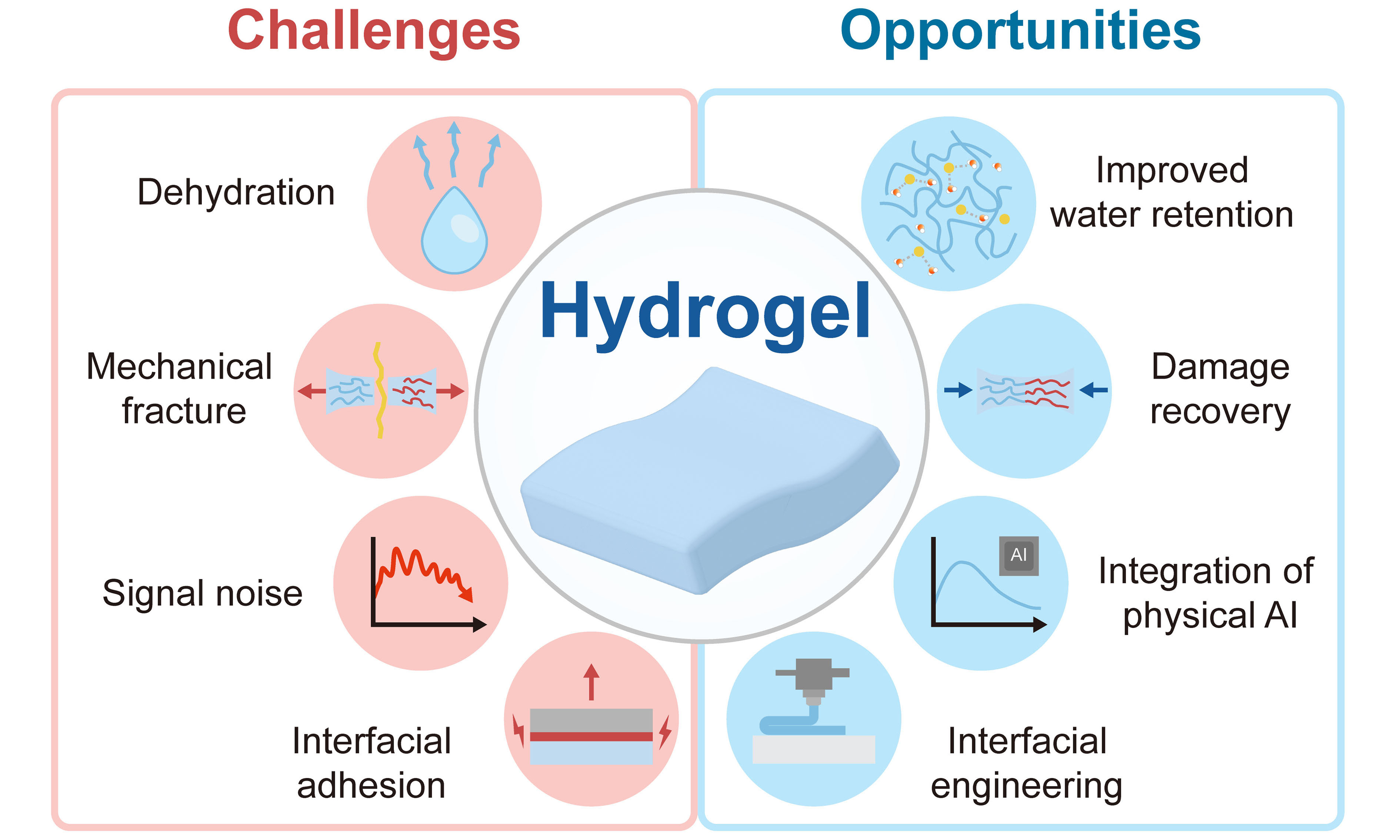
Although hydrogels offer great potential for iontronic applications, several challenges must be addressed to fully realize their practical use. These challenges are closely related to the intrinsic nature of hydrogels, including their high-water content, soft mechanical properties, and ion-dependent conductivity [Figure 1]. At the same time, these limitations provide important opportunities for future research toward more stable, functional, and sustainable hydrogel-based iontronic systems.
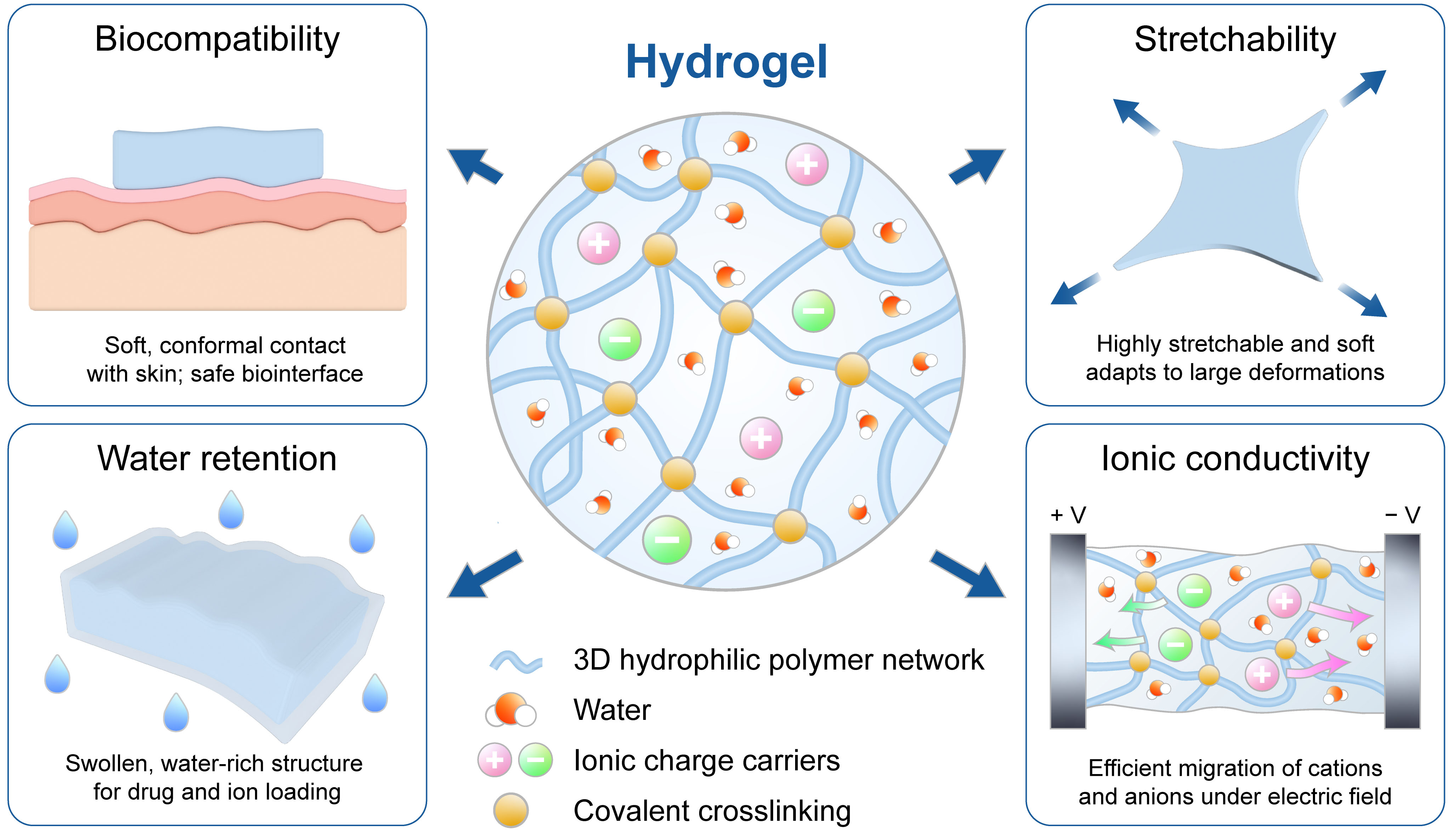
Figure 1. Unique hydrogel properties enabling iontronic applications, including biocompatibility, stretchability, water retention, and ionic conductivity.
DURABILITY, WATER RETENTION, AND LONG-TERM STABILITY
One major challenge of using hydrogels in iontronic devices is their long-term durability and stability. Because hydrogels contain a large amount of water, their mechanical properties and ionic conductivity can be strongly affected by environmental conditions such as temperature, humidity, and pH[13]. In particular, water evaporation can lead to dehydration, resulting in reduced ionic conductivity, mechanical stiffening, and unstable device performance[14]. Such dehydration-induced stiffening renders the hydrogel vulnerable to structural failure upon mechanical deformation. To overcome these issues, future research should focus on developing anti-drying hydrogels with improved water retention by integrating zwitterions enhancing electrostatic hydration with water molecules, self-healing hydrogels that can recover from mechanical damage, and composite hydrogel systems incorporating stable polymers with double-network or highly entangled structures[5,15], inorganic materials, or ionic liquids[15-19]. These strategies will be important for enabling hydrogel-based iontronic devices to operate reliably over long periods.
ELECTROCHEMICAL STABILITY WITH ELECTRICAL DOUBLE LAYER
Ensuring interfacial electrochemical stability of the electrical double layer (EDL) is important for the reliable operation of hydrogel-based iontronic devices. At operating voltages exceeding the electrochemical window of water (~ 1 V)[11], hydrogels suffer from partial electrolysis at the hydrogel-electrode interface. To suppress these unwanted electrochemical reactions, circuit-level approaches can maintain interfacial voltage drops below 1 V. Moreover, mitigating EDL hysteresis requires a deeper understanding of ion relaxation dynamics at the hydrogel-electrode interface. Because EDL hysteresis originates from the slower kinetics of ion redistribution toward an equilibrium state, it introduces distortion in capacitance values, thereby degrading the output performance of ionic devices. To address these limitations, analyzing characteristic charge relaxation times across multi-frequency domains may provide an effective pathway to decouple kinetic delays from capacitance distortions[20]. Future research on systemizing all-ionic components will provide innovative solutions to fundamentally address electrochemical reactions at ionic-electronic interfaces.
IONIC CONDUCTIVITY AND SIGNAL RELIABILITY
Although hydrogels are inherently ionically conductive, their conductivity is often limited by water content, ion concentration, and mobility of charge carriers within the polymer network. Insufficient or unstable ionic conductivity can reduce the sensitivity, response speed, and signal reliability of iontronic devices, potentially inducing signal distortion or signal drift. While conductivity enhancement can be achieved by introducing conductive fillers such as carbon nanotubes, graphene, and metallic nanoparticles[21], these composites primarily contribute to electronic or mixed electronic-ionic conductivity rather than pure ionic conductivity. In terms of ionic conductivity, strategies such as employing ions with smaller hydrated radii to reduce hydrodynamic drag and enhance ionic mobility, as well as increasing ion concentration, may offer effective routes to improved ion transport. In addition, designing polymer networks that support efficient ion transport while maintaining mechanical softness is important, as the network mesh size significantly influences ion-transport kinetics. Such material design is beneficial for enhancing signal selectivity, facilitating the effective separation of target signals from background noise. Future hydrogel-based iontronic systems should not only exhibit high ionic conductivity but also maintain stable electrical performance under repeated deformation and long-term operation.
INTERFACIAL ADHESION AND DEVICE INTEGRATION
Stable integration of hydrogels with other materials, such as metals, polymers, ceramics, and elastomers, remains a critical challenge in hydrogel-based iontronic devices. Poor interfacial adhesion can cause delamination, misalignment, increased contact resistance, and mechanical failure, especially in multilayered or stretchable devices. Although chemical adhesion strategies have been widely explored[22], they can involve complex processing and may become less reliable as the number of device layers increases. Therefore, future research should focus on robust interfacial engineering and advanced fabrication methods, including multi-material 3D printing, microfabrication, patterned adhesion strategies, and interlayer bonding treatments using benzophenone for robust layer-by-layer assembly[23-26]. Achieving stable adhesion not only in the vertical direction but also in the lateral plane will be important for creating complex, self-standing, and highly integrated hydrogel-based iontronic devices.
BIOCOMPATIBILITY AND BIOELECTRONIC INTEGRATION
Hydrogels are generally considered biocompatible, but further improvement is required for long-term use in bioelectronic applications[27]. Devices that directly interface with skin, tissues, or organs must maintain stable performance while minimizing inflammation, irritation, and mechanical mismatch. In terms of bioelectronic integration, achieving reliable implantation of hydrogel-based iontronic devices remains challenging, as ion migration and charge transfer could potentially occur at the attached interface via diffusion or concentration gradients, alongside considerations for device scaling and sterilization[28]. Surface modification, functionalization with bioactive molecules, and the development of bio-responsive hydrogels can improve the interaction between hydrogels and biological systems. In particular, hydrogels that dynamically respond to biological signals, such as pH, temperature, biochemical markers, or mechanical stimuli, may enable more intelligent and adaptive bioelectronic interfaces[29,30]. These materials could play an important role in next-generation wearable sensors, implantable devices, and brain-computer interfaces.
STIMULI-RESPONSIVE AND SUSTAINABLE HYDROGEL SYSTEMS
Future hydrogel-based iontronic devices are expected to move beyond passive ionic conductors toward multifunctional and adaptive systems. Stimuli-responsive hydrogels that selectively respond to external triggers, such as pH, temperature, light, pressure, or chemical signals[13], can provide precise control over ion transport and device behavior. Such materials may enable smart medical devices, adaptive sensors, and self-powered systems that respond to dynamic environments. In addition, as the demand for environmentally friendly materials increases, bio-based and biodegradable hydrogels are becoming increasingly important[31,32]. The development of biodegradable hydrogels that maintain stable performance during use and safely degrade after their lifecycle will be crucial for sustainable wearable electronics, transient bioelectronics, and eco-friendly iontronic devices.
INTEGRATION OF PHYSICAL AI WITH HYDROGEL SYSTEMS
Although hydrogel-based iontronic devices have great potential for attachable and implantable bioelectronics thanks to their low elastic modulus, their integration is challenged by complex and nonlinear signal variations arising from mechanical strain and dynamic movements in daily life. To address these issues, AI can be employed to interpret the coupled ionic and mechanical responses inherent to hydrogel iontronics, where ion migration, water redistribution, viscoelastic deformation, and interfacial polarization can simultaneously affect the electrical output. In particular, variations in ionic conductivity, ion mobility, and hydration state can produce time-dependent drift, hysteresis, and signal distortion under repeated deformation. By learning these coupled relationships from experimental and simulation datasets, AI-assisted hydrogel iontronic systems could distinguish mechanically induced signals from variations originating from ion transport and hydration dynamics. Furthermore, characteristic iontronic features, such as current amplitude, relaxation time, peak area, and transient response, could be correlated with specific deformation or physiological states, enabling adaptive signal calibration and more reliable state prediction[33]. Ultimately, integrating hydrogel iontronics with physical AI could enable soft bioelectronic systems that continuously learn and compensate for dynamic changes in their ionic and mechanical states during real-world operation.
STANDARDIZED TESTING OF HYDROGEL IONTRONIC SYSTEMS
Establishing standardized testing protocols is required to overcome descriptive limitations and enable objective cross-comparison in hydrogel-based iontronic devices. Table 1 provides a comprehensive comparison of representative hydrogel and iontronic systems across ionic conductivity, stretchability, mechanical robustness, interfacial adhesion, and durability metrics, together with the reported testing conditions for each system.
Comparison of representative hydrogel and iontronic systems across electrical, mechanical, interfacial, and durability metrics alongside their corresponding testing conditions
| Gel type | Gel network | Ionic conductivity | Stretchability | Mechanical robustness | Adhesion | Durability metric | Testing condition | |
| Biphasic ionic gel[34] | Polyacrylamide (PAM), Poly(2-acrylamido-2-methylpropanesulfonic acid) (PAMPS) | < 8.55 S m-1 | < 2,900% | Stable impedance (1,000 cycles, 30% strain) | 5 N of peel strength | Weight loss | < 2.5% | After 7 days, in PBS, 37 °C |
| Skin-mimicking biogel[35] | Gelatin | < 0.58 S m-1 | < 80% | High compressive robustness (under 100 N force) | N/A | Weight retention | > 47% | After 60 h |
| Ultra-thin organohydrogel[36] | Poly(vinyl alcohol) (PVA) | N/A | < 580% | Self-healing without obvious cracks (at 80 °C, 1 min) | N/A | Sensing response | 20,000-24,000% | After 120 days, 98% RH |
| Self-healing neuromorphic hydrogel[37] | Poly(acrylic acid) (PAA), Polyethyleneimine (PEI) | N/A | < 1,800% | 0.02 s electrical recovery (after cutting and reattaching) | N/A | N/A | N/A | N/A |
| Recyclable hydrogel[38] | Poly(thioctic acid) (PTA) | < 0.013 S m-1 | < 6,000% | Robust pressure sensing (11,000 cycles, 3 Hz) | N/A | Weight retention | > 97.8% | After 14 days, 30% RH |
| Wet-adhesive gel[39] | PVA, PAA | N/A | < 40% | 493 mmHg burst pressure (200 cycles, 40% strain) | 63.1 kPa shear strength, 303 J m-2 interfacial toughness | Swelling ratio | 0.29 | After 3 days in water |
However, these metrics were often obtained without precise regulation of key testing conditions, such as temperature, relative humidity (RH), and measurement duration, due to the lack of standardized measurement protocols, thereby complicating quantitative comparisons. Achieving reliable comparisons in hydrogel-based iontronic systems requires further advances to resolve key performance trade-offs and environmentally driven variability. At the material level, the trade-offs between ionic conductivity and mechanical strength show that increasing crosslinking density elevates modulus but reduces network mesh size, which hinders ion transport within the ionic materials[40]. In parallel, extrinsic environmental factors could alter iontronic performance. Therefore, standardized testing protocols should be established to ensure the performance of hydrogel-based iontronic devices. Establishing standardized testing conditions, such as 23 °C and 50% relative humidity under the guidance of ISO 291:2008 and ISO 554:1976, could be one possible approach to enabling reliable performance evaluation[41,42]. Ultimately, these standardized evaluation systems will bridge the gap between laboratory prototypes and scalable, commercially viable bioelectronic applications.
CONCLUSION
Hydrogels represent promising materials for advancing iontronic systems, offering unique advantages such as stretchability, biocompatibility, water retention, and ionic conductivity. These properties enable their use in diverse applications, including skin-mountable sensors, energy harvesting systems, bioelectronic interfaces, and self-powered soft devices. However, practical implementation still requires further improvements in long-term durability, stable ionic conductivity, interfacial adhesion, and device integration. Ongoing research on anti-drying hydrogels, self-healing networks, enhanced ion-transport pathways, advanced fabrication techniques, and sustainable bio-based systems is expected to address these challenges. By overcoming these limitations, hydrogel-based iontronics can open new opportunities for next-generation wearable electronics, medical devices, and environmentally sustainable soft technologies.
DECLARATIONS
Authors’ contributions
Wrote the draft: Choi, K.; Cho, H.; Lee, Y.
Visualization: Choi, K.
Supervised: Lee, Y.
Reviewed and edited the manuscript: Choi, K.; Cho, H.; Lee, Y.
Funding acquisition: Lee, Y.
All authors discussed the review and agreed upon the final version of the manuscript.
Availability of data and materials
Not applicable.
AI and AI-assisted tools statement
During the preparation of this manuscript, the AI tool Gemini Flash (version 3.6 Flash, released 2026-07-21) was used solely for language editing. The tool did not influence the study design, data collection, analysis, interpretation, or the scientific content of the work. The author takes full responsibility for the accuracy, integrity, and final content of the manuscript.
Financial support and sponsorship
This work was supported by the National Research Foundation of Korea (NRF) grants funded by the Korean government (MSIT) (RS-2026-25475686). This research was supported by Korea Basic Science Institute (National Research Facilities and Equipment Center) grant funded by the Ministry of Science and ICT (No. RS-2026-25496086).
Conflicts of interest
Lee, Y. is an Editorial Board Member of the journal Iontronics. Lee, Y. was not involved in any steps of editorial processing, notably including reviewers’ selection, manuscript handling, and decision-making. The other authors declare no conflicts of interest.
Ethical approval and consent to participate
Not applicable.
Consent for publication
Not applicable.
Copyright
© The Author(s) 2026.
REFERENCES
1. Kim, C. C.; Lee, H. H.; Oh, K. H.; Sun, J. Y. Highly stretchable, transparent ionic touch panel. Science 2016, 353, 682-7.
2. Han, Y. K.; Kwon, S. J.; Choi, J. R.; Jung, B. M. Fiber supercapacitor using epoxy-based gel polymer electrolyte with high ionic conductivity and mechanical flexibility. Funct. Compos. Struct. 2021, 3, 035005.
4. Park, N.; Kim, J. Hydrogel-based artificial muscles: overview and recent progress. Adv. Intell. Syst. 2020, 2, 1900135.
5. Sun, J. Y.; Zhao, X.; Illeperuma, W. R.; et al. Highly stretchable and tough hydrogels. Nature 2012, 489, 133-6.
6. Zhang, Z.; Yang, J.; Wang, H.; et al. A 10-micrometer-thick nanomesh-reinforced gas-permeable hydrogel skin sensor for long-term electrophysiological monitoring. Sci. Adv. 2024, 10, eadj5389.
7. Wang, Z.; Wei, H.; Huang, Y.; Wei, Y.; Chen, J. Naturally sourced hydrogels: emerging fundamental materials for next-generation healthcare sensing. Chem. Soc. Rev. 2023, 52, 2992-3034.
8. Pu, X.; Liu, M.; Chen, X.; et al. Ultrastretchable, transparent triboelectric nanogenerator as electronic skin for biomechanical energy harvesting and tactile sensing. Sci. Adv. 2017, 3, e1700015.
9. Cho, S.; Jang, S.; Lee, D.; et al. Self-powered hybrid triboelectric–piezoelectric electronic skin based on P (VDF-TrFE) electrospun nanofibers for artificial sensory system. Funct. Compos. Struct. 2022, 4, 045005.
10. Jang, S.; Shah, S. A.; Lee, J.; et al. Beyond metallic electrode: spontaneous formation of fluidic electrodes from operational liquid in highly functional droplet-based electricity generator. Adv. Mater. 2024, 36, e2403090.
11. Keplinger, C.; Sun, J. Y.; Foo, C. C.; Rothemund, P.; Whitesides, G. M.; Suo, Z. Stretchable, transparent, ionic conductors. Science 2013, 341, 984-7.
13. White, E. M.; Yatvin, J.; Grubbs, J. B.; Bilbrey, J. A.; Locklin, J. Advances in smart materials: stimuli‐responsive hydrogel thin films. J. Polym. Sci. B. Polym. Phys. 2013, 51, 1084-99.
14. Lee, G.; Kim, E.; Choi, K.; et al. Droplet Electricity generators with maximized energy collection zone enabled by aloe-inspired midrib and cuticle. Adv. Mater. 2026, 38, e23637.
15. Kim, J.; Zhang, G.; Shi, M.; Suo, Z. Fracture, fatigue, and friction of polymers in which entanglements greatly outnumber cross-links. Science 2021, 374, 212-6.
16. Bae, J.; Chang, S. PVDF-based ferroelectric polymers and dielectric elastomers for sensor and actuator applications: a review. Funct. Compos. Struct. 2019, 1, 012003.
17. Xiang, H.; Li, X.; Wu, B.; Sun, S.; Wu, P. Highly damping and self-healable ionic elastomer from dynamic phase separation of sticky fluorinated polymers. Adv. Mater. 2023, 35, e2209581.
18. Yoo, D.; Jang, S.; Cho, S.; Choi, D.; Kim, D. S. A liquid triboelectric series. Adv. Mater. 2023, 35, e2300699.
19. Li, Z.; Lu, J.; Ji, T.; et al. Self-healing hydrogel bioelectronics. Adv. Mater. 2024, 36, e2306350.
20. You, I.; Mackanic, D. G.; Matsuhisa, N.; et al. Artificial multimodal receptors based on ion relaxation dynamics. Science 2020, 370, 961-5.
21. Zhang, S.; Lee, K. H.; Frisbie, C. D.; Lodge, T. P. Ionic conductivity, capacitance, and viscoelastic properties of block copolymer-based ion gels. Macromolecules 2011, 44, 940-9.
22. Li, J.; Celiz, A. D.; Yang, J.; et al. Tough adhesives for diverse wet surfaces. Science 2017, 357, 378-81.
23. Rafiee, M.; Farahani, R. D.; Therriault, D. Multi-material 3D and 4D printing: a survey. Adv. Sci. (Weinh). 2020, 7, 1902307.
24. Baik, S.; Kim, D. W.; Park, Y.; Lee, T. J.; Ho, Bhang. S.; Pang, C. A wet-tolerant adhesive patch inspired by protuberances in suction cups of octopi. Nature 2017, 546, 396-400.
25. Kim, H.; Lee, Y.; Jung, S.; Lee, H. Micropatterned hydrogel-elastomer hybrids for flexible wet-style superhydrophobic antifogging tapes. Adv. Funct. Mater. 2024, 34, 2401869.
26. Yuk, H.; Zhang, T.; Parada, G. A.; Liu, X.; Zhao, X. Skin-inspired hydrogel-elastomer hybrids with robust interfaces and functional microstructures. Nat. Commun. 2016, 7, 12028.
27. Kim, Y. W.; Kim, J. E.; Jung, Y.; Sun, J. Y. Non-swellable, cytocompatible pHEMA-alginate hydrogels with high stiffness and toughness. Mater. Sci. Eng. C. Mater. Biol. Appl. 2019, 95, 86-94.
28. Choi, K.; Park, J.; Song, W. J.; et al. Soft ionic and electronic triboelectric nanogenerators: toward attachable and implantable biomedical applications. Adv. Mater. 2026, 38, e17321.
29. Wang, G.; Li, Y.; Cai, Z.; Dou, X. A Colorimetric artificial olfactory system for airborne improvised explosive identification. Adv. Mater. 2020, 32, e1907043.
30. Chen, H.; Huang, J.; Liu, J.; et al. High toughness multifunctional organic hydrogels for flexible strain and temperature sensor. J. Mater. Chem. A. 2021, 9, 23243-55.
31. Ji, D.; Park, J. M.; Oh, M. S.; et al. Superstrong, superstiff, and conductive alginate hydrogels. Nat. Commun. 2022, 13, 3019.
32. Park, S.; Lee, H.; Chung, H.; et al. Stretchable and biodegradable hydrogel-nanomembrane electrodes for conformal and transient bioelectronics. Adv. Funct. Mater..
33. Guo, Z.; Ling, Y.; Ouyang, Y.; Hou, Y.; Tong, J.; Hou, X. Artificial intelligence for bioinspired nanofluidic iontronics. Nano. Lett. 2026, 26, 6735-47.
34. Wang, B.; Dong, F.; Sun, X.; et al. Biphase ionic hydrogels with ultrasoftness and high conductivity for bio-ionotronics. ACS. Nano. 2025, 19, 16488-99.
35. Chen, Y.; Wang, S.; Ye, X.; et al. Skin-mimicking biogel-based iontronic sensor with hierarchical bionic coupling for dexterous tactile e-skin. Nat. Commun. 2026, 17, 6856.
36. Ding, Q.; Wang, H.; Zhou, Z.; et al. Stretchable, self‐healable, and breathable biomimetic iontronics with superior humidity‐sensing performance for wireless respiration monitoring. SmartMat 2023, 4, e1147.
37. Pei, M.; Gao, T.; Liu, L.; et al. An iontronic reservoir for highly robust neuromorphic prosthesis. Nat. Mater. 2026, 25, 1199-208.
38. Ye, C.; Li, B.; Sun, Y.; Jiang, B.; Shen, Z.; Zhang, W. An ultra-stretchable, self-healable, and recyclable ionic conductive hydrogel for multi-functional electronics with integrated IoT functionality. Chem. Eng. J. 2026, 537, 176211.
39. Ma, P.; Liang, W.; Huang, R.; et al. Super-structured wet-adhesive hydrogel with ultralow swelling, ultrahigh burst pressure tolerance, and anti-postoperative adhesion properties for tissue adhesion. Adv. Mater. 2024, 36, e2305400.
41. International Organization for Standardization. Plastics - Standard Atmospheres for Conditioning and Testing; ISO 291:2008, 2008.
42. International Organization for Standardization. Standard Atmospheres for Conditioning and/or Testing - Specifications; ISO 554:1976, 1976.
Cite This Article
 Open Access
How to Cite
Choi, K.; Cho, H.; Lee, Y. Challenges and opportunities in hydrogel-based iontronics. Iontronics 2026, 2, 31. https://dx.doi.org/10.20517/iontronics.2026.30
Download Citation
If you have the appropriate software installed, you can download article citation data to the citation manager of your choice. Simply select your manager software from the list below and click on download.
Export Citation File
Type of Import
Tips on Downloading Citation
Citation Manager File Format
Type of Import
Direct Import: When the Direct Import option is selected (the default state), a dialogue box will give you the option to Save or Open the downloaded citation data. Choosing Open will either launch your citation manager or give you a choice of applications with which to use the metadata. The Save option saves the file locally for later use.
Indirect Import: When the Indirect Import option is selected, the metadata is displayed and may be copied and pasted as needed.
About This Article
Copyright

Data & Comments
Data
0







Comments
Comments must be written in English. Spam, offensive content, impersonation, and private information will not be permitted. If any comment is reported and identified as inappropriate content by OAE staff, the comment will be removed without notice. If you have any queries or need any help, please contact us at [email protected].