

From interfacial electric fields to chemistry at interfaces
 0



 Download PDF
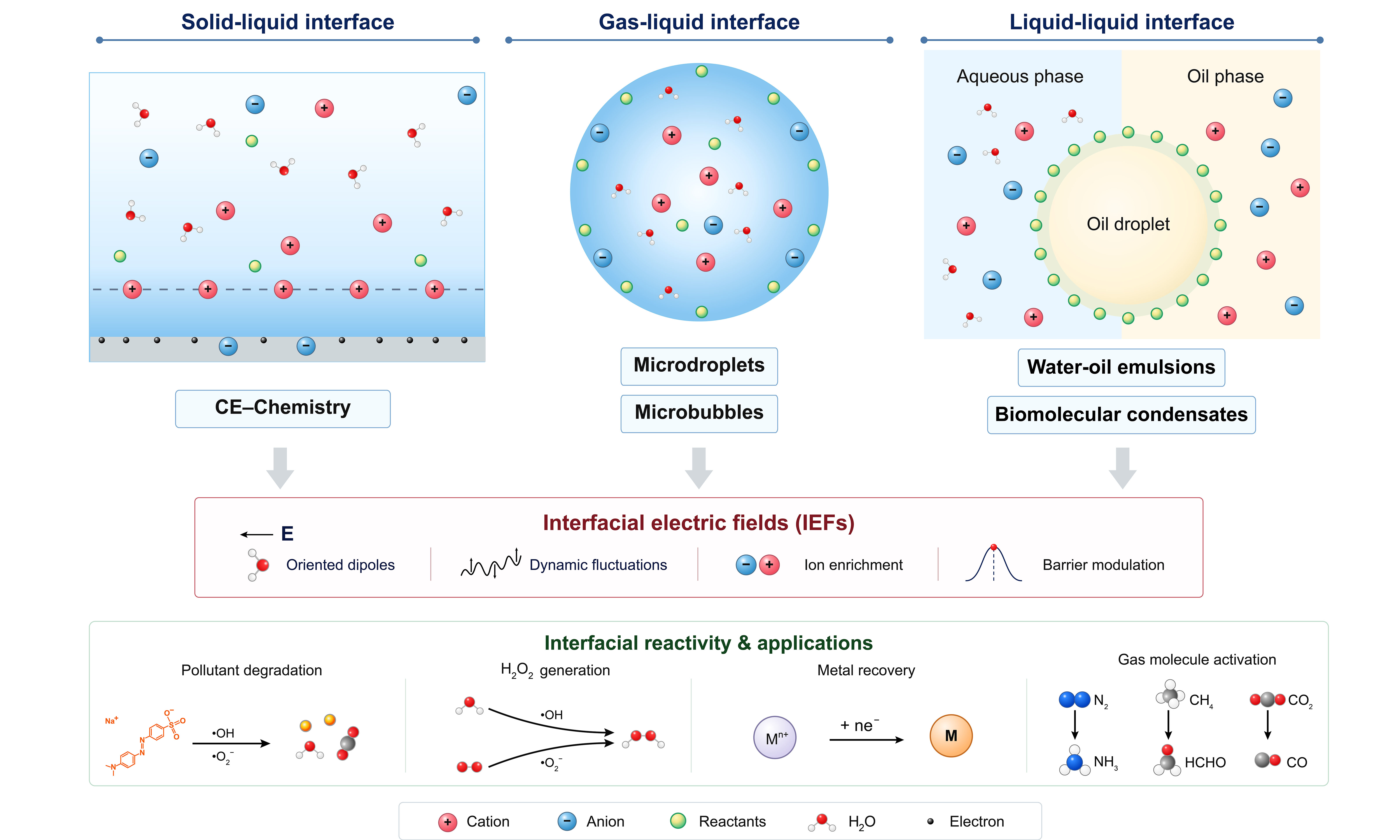
Chemical transformations have been documented across diverse multiphase environments, including solid-liquid, gas-liquid, and liquid-liquid interfaces, without conventional external inputs such as light irradiation, bulk heating, or applied electrical potentials[1]. In these multiphase systems, mechanical processes such as spraying, bubbling, ultrasonication, evaporation, or contact-separation still introduce mechanical energy and concurrently influence interfacial renewal, mass transport, local thermal or cavitation effects, and charge transfer[2-4]. Rather than merely serving as passive boundary conditions, multiphase interfaces can develop localized interfacial electric fields (IEFs), used here as a collective term for fields arising from interfacial charge transfer, electrical double layer (EDL) formation, oriented molecular dipoles, and ion redistribution [Figure 1][1]. Such hidden IEFs are widely regarded as an important factor influencing reaction energetics through reactant polarization, molecular orientation, transition-state stabilization, and modulation of local electrostatic environments. Meanwhile, at multiphase interfaces, these field effects are intrinsically coupled with pH gradients, ion enrichment, solvation restructuring, interfacial curvature, and mass transport. Therefore, enhanced interfacial reactivity should be understood as arising from the interplay between IEFs and these coexisting interfacial phenomena, rather than from IEFs alone[1].

Figure 1. From interfacial electric fields (IEFs) to chemistry at interfaces. CE: Contact electrification; EDL: electrical double layer.
In this perspective, we discuss IEFs across three representative multiphase boundaries: solid-liquid contacts, gas-liquid interfaces, and liquid-liquid boundaries. For dielectric solid-liquid interfaces, contact electrification (CE) between dielectric materials and liquids induces charge transfer, interfacial charge accumulation and EDL formation, giving rise to contact-electro-chemistry (CE-Chemistry)[2,5-7]. At gas-liquid interfaces, such as microdroplets and microbubbles, IEFs are coupled with interfacial water orientation, charge separation, curvature, and dynamic interfacial renewal[8-12]. For liquid-liquid boundaries such as water-oil droplets, emulsions, and biomolecular condensates, ion partitioning, hydrophobicity asymmetry, interfacial water restructuring and possible liquid-liquid CE create adaptive electrostatic microenvironments[4,13-16]. By comparing these systems, we argue that IEFs should be treated as designable reaction parameters for multiphase chemistry at interfaces, whose effects depend not only on field strength but also on spatial localization, temporal fluctuation, solvation dynamics, pH microenvironments, and reactive species chemistry[1].
Multiphase interfaces, such as solid-liquid interfaces, gas-liquid interfaces and liquid-liquid interfaces, can generate localized IEFs through coupled charge transfer, ion redistribution, oriented dipoles and dynamic fluctuations. For solid-liquid interfaces, contact electrification (CE), and electrical double layer (EDL) formation at dielectric material-water boundaries create localized IEFs that mediate CE-Chemistry and reactive species formation. At gas-liquid interfaces, microdroplets and microbubbles provide dynamic electrified boundaries where interfacial renewal, water orientation and field fluctuations cooperate to regulate gas-liquid reactivity. At liquid-liquid interfaces, water-oil emulsions and biomolecular condensates form soft adaptive boundaries, where ion partitioning, hydrophobicity asymmetry and adaptive interfacial structures generate field-active microenvironments. Together, hidden IEFs convert multiphase boundaries from passive boundaries into active, designable reaction microenvironments.
ELECTRIC FIELDS AT SOLID-LIQUID INTERFACES
Solid-liquid interfaces serve as a model system for elucidating how IEFs may contribute to multiphase chemical processes[2]. In CE-Chemistry, these IEFs are not simply generated by static ion adsorption, but emerge from CE-induced charge transfer, charge accumulation and subsequent EDL formation[5,6]. According to Wang’s hybrid EDL model, liquid molecules and ions repeatedly collide with solid surfaces under thermal motion or liquid pressure[6]. At dielectric interfaces such as fluorinated ethylene propylene (FEP)-water, transient overlap of interfacial electron clouds can drive electron transfer from water to electron-accepting surface states on FEP, while ion adsorption and surface ionization may occur concurrently[6,7]. The resulting interfacial charge subsequently drives counter-ion redistribution in the liquid, leading to EDL formation and electrostatic screening. The resulting electron-charged FEP state is accompanied by transient water oxidation processes, rapidly yielding H3O+ and ·OH[7]. These initial charges create a local potential drop, while counter-ion migration in the liquid reconstructs the EDL and screens the charged surface[1]. The chemical function of solid-liquid IEFs arises from the competition between non-equilibrium charge accumulation and EDL screening[1]. During repeated contact-separation, electron transfer, ion redistribution and field formation are coupled within a confined interfacial region. As the EDL develops, ionic screening can suppress further electron transfer, making the field highly dependent on material electronegativity, surface chemistry, wettability, contact dynamics, ionic strength, pH, solvent properties and dissolved gases[1]. Reported IEFs in CE-Chemistry are often estimated to reach ~ 108-1010 V m-1, although many values remain indirect theoretical calculations[1,17]. In this context, FEP and related materials are better viewed as active dielectric interfaces rather than conventional active-site catalysts. They generate and store interfacial charge, establish localized IEFs, regulate water polarization and ion distributions, and mediate reactive species formation[1]. Reactive species such as ·OH and ·O2- can initiate downstream reactions, while localized IEFs can lower the activation barriers of key steps, further promoting interfacial chemical transformations[7,17].
ELECTRIC FIELDS AT GAS-LIQUID INTERFACES
Microdroplets and microbubbles exemplify dynamically renewed gas-liquid boundaries in which IEFs can form and evolve continuously[1,11]. During spraying, evaporation, bubbling, coalescence and breakup, rapid interfacial renewal promotes charge separation, droplet charging and CE-related charge accumulation[1]. Unlike solid-liquid CE-Chemistry, where IEFs are closely associated with CE at dielectric surfaces, the microscopic origins of charging and field formation at gas-liquid boundaries are still unresolved[1,11]. They are generally considered to arise from coupled effects including preferential orientation of interfacial water, surface charge separation, droplet charging, curvature effects and CE-related charge accumulation during dynamic gas-liquid contact and interfacial renewal[1,9]. Experimental probes and simulations have provided complementary evidence for strong gas-liquid IEFs. Vibrational Stark effect-based surface-enhanced Raman scattering (SERS) spectroscopy quantified built-in air-water IEFs approaching ~ 1010 V m-1 during SO2 oxidation in microdroplets, supported by Raman mapping and molecular dynamics (MD) simulations that revealed interfacial ion enrichment[8]. Confocal fluorescence imaging with the voltage-sensitive fluorophore 4-[4-(dimethylamino)styryl]-1-methylpyridinium iodide (4-Di-1-ASP), together with solvatochromic and density functional theory (DFT) analyses, indicated local air-water IEFs of ~ 109 V m-1[12]. However, the interpretation of these observations as evidence for anomalously strong intrinsic fields at the pristine air-water interface remains debated. Recent surface-specific sum-frequency generation (SFG) measurements combined with vibrational frequency-to-field mapping found no spectroscopic signatures of exceptionally strong or long-lived interfacial fields; instead, the bonded-OH field distributions were comparable in average magnitude to those in bulk water, while bulk water exhibited broader distributions and a higher probability of large fields. These results suggest that exceptionally strong, persistent fields should not be regarded as a universal property of the equilibrium air-water interface[18]. At microbubble interfaces, finite-element COMSOL simulations estimated IEFs of ~ 109 V m-1 at pH 13[9]. Reactive force-field simulations of water nanodroplets reported average air-water IEFs on the order of ~ 109 V m-1 and highlighted transient high-field fluctuations[10]. However, gas-liquid reactivity cannot be explained by average field strength alone[10,11]. Dynamic restructuring of interfacial solvation shells can generate electrostatic potential fluctuations and transient high-field events, lowering the activation barrier for ·OH formation[11]. Thus, microdroplets and microbubbles could be viewed as field-active interfacial microreactors and rapid transport carriers, where IEFs may cooperate with solvation structure, curvature, pH microenvironments, mass transfer, ion enrichment and reactive species chemistry. Notably, higher curvature in smaller water microdroplets can amplify local IEFs through interfacial charge accumulation, accelerating interfacial redox chemistry, as evidenced by faster H2O2 formation per interfacial area[3]. Collectively, these effects could promote a series of gas-liquid interfacial reactions, including pollutant degradation, CO2 reduction, nitrogen fixation, and CH4 activation[9,19,20].
ELECTRIC FIELDS AT LIQUID-LIQUID INTERFACES
Soft interfaces formed by immiscible liquids, represented by water-oil microdroplets, emulsions and biomolecular condensate-solution boundaries, provide soft, deformable and compositionally asymmetric platforms for generating and regulating IEFs[4,14,15,21]. Unlike solid surfaces, these boundaries are self-renewing and can support coupled field-generation processes, including preferential ion adsorption or partitioning, spontaneous charge separation, oriented interfacial water dipoles, hydrogen bond disruption, hydrophobicity asymmetry and possible liquid-liquid CE during droplet collision, coalescence or phase separation[1]. Water adjacent to hydrophobic phases adopts a less bulk-like structure, characterized by a weakened hydrogen-bond network, diminished tetrahedral organization, and a larger fraction of free O-H groups[14]. Stimulated Raman-excited fluorescence (SREF) spectroscopy with nitrile-based Stark probes has quantified water-oil microdroplet IEFs on the order of ~ 109 V m-1[13], while interface-selective Raman analysis of oil droplets suggested stronger local fields of ~109 V m-1[14]. In biomolecular condensates, ion partitioning, molecular density gradients and hydrophobicity asymmetry can generate IEFs from ~ 106 to 108 V m-1[15,16]. Taken together, these measurements indicate that liquid-liquid boundaries can sustain adaptive electrostatic environments shaped by charge separation, molecular orientation, and interfacial water organization, rather than behaving as field-free solvent boundaries[1]. Chemically, liquid-liquid IEFs can reorganize solvation, orient reactants, redistribute ions, polarize chemical bonds and lower activation barriers within confined soft interfaces[1]. Liquid-liquid CE further provides a non-equilibrium pathway for charge and field generation, where both electron and ion transfer may occur at immiscible liquid boundaries[4]. For example, ultrasonication-induced perfluorocarbon-water contact can drive transfer of electrons out of water and into the perfluorocarbon phase, producing ·OH and ·O2- radicals[4]. Recent work further demonstrated selective gold recovery from complex aqueous systems using thermally generated water microdroplets at oil-water interfaces, where interfacial redox processes promote Au-ion reduction and subsequent particle growth[22]. Moreover, related oil-water systems have been linked to hydrogen generation, hydrocarbon degradation, and selective C-H oxidation, while biomolecular condensates extend this concept to soft and living systems by modulating redox or hydrolytic chemistry[15,21,23]. Thus, liquid-liquid interfaces should be viewed as adaptive field-active reaction microenvironments, where IEFs cooperate with partial solvation, curvature, ion partitioning, hydrophobic confinement and CE-related charge transfer to reshape multiphase reaction pathways.
Finally, representative IEFs across the three interface classes and their corresponding detection or estimation methods are summarized in Table 1. Notably, because these field strengths are obtained using different experimental and computational approaches, their numerical values should not be directly compared across methods.
Comparison of representative interfacial electric fields across interfaces
| Interface | Origin | Method | Field strength (V m-1) | Reaction | Ref. |
| Solid-liquid | CE | Theoretical calculation | ~ 109-1010 | PFAS activation and defluorination | [17] |
| Solid-liquid | CE | Theoretical calculation | ~ 108 | ORR/WOR | [24] |
| Solid-liquid | CE | Theoretical calculation | ~ 109 | PFAS activation and defluorination | [25] |
| Gas-liquid | Water orientation | Theoretical calculation | ~ 109 | Mechanistic Investigation | [10] |
| Gas-liquid | Ion enrichment | SERS spectroscopy | ~ 1010 | SO2 oxidation | [8] |
| Gas-liquid | Ion enrichment | Theoretical calculation | ~ 109 | N2 oxidation | [9] |
| Liquid-liquid | Charge separation | SREF spectroscopy | ~ 109 | Mechanistic Investigation | [13] |
| Liquid-liquid | Remains unresolved | Raman-MCR | ~ 109 | Mechanistic Investigation | [14] |
| Liquid-liquid | Phase separation | Theoretical calculation | ~ 106 | H2O2 generation | [15] |
CHALLENGES AND OPPORTUNITIES
Despite rapid progress, the central challenge is no longer simply to demonstrate the existence of IEFs, but to identify their fundamental physical origins and establish predictive relationships between interfacial structure, electric-field dynamics and chemical reactivity across solid-liquid interface, gas-liquid interface, and liquid-liquid interface[1]. Although recent spectroscopic and electrokinetic studies suggest that strong IEFs may be a common feature of water in contact with air, oil, and hydrophobic solids, their microscopic origins remain under active debate. Proposed contributions include electron transfer, ion adsorption, hydroxide enrichment, oriented water dipoles, and possible discharge events. These mechanisms are not necessarily mutually exclusive and may contribute to different extents depending on the interface type and local physicochemical environment. At solid-liquid interfaces, Wang’s hybrid EDL model provides one current interpretation of IEFs formation, while other interfacial factors may also contribute. In particular, hydrophobicity-induced water depletion and nanoscale gap formation have been proposed to influence local fields, whereas discharge-like processes during contact-separation remain less established[26]. Resolving this issue is particularly challenging because the most electronegative dielectric materials, especially fluorinated polymers, are also among the most hydrophobic, making electronegativity and hydrophobicity intrinsically correlated in existing material systems. Consequently, independently disentangling the effects of electronegativity, hydrophobicity, surface roughness, nanogap geometry and dielectric breakdown represents a prerequisite for identifying the true origin of solid-liquid IEFs. Fundamental questions likewise remain unresolved at liquid-liquid boundaries and gas-liquid boundaries. Microdroplets and microbubbles are typically generated using solid nozzles, capillaries, cavities or porous substrates, where unavoidable solid-liquid or solid-gas CE may contribute to interfacial charging[27]. Eliminating these CE artifacts is therefore essential before intrinsic gas-liquid IEFs can be unequivocally attributed to water orientation, ion redistribution, interfacial curvature, hydroxide enrichment or dynamic surface renewal[28]. At liquid-liquid interfaces, particularly oil-water systems, directly resolving interfacial electron transfer remains a major challenge because electron transfer, ion partitioning, dipolar polarization, interfacial enrichment and solvation restructuring occur simultaneously and frequently produce similar experimental signatures. More broadly, most current measurements capture only steady-state or ensemble-averaged responses, whereas transient field evolution, spatial heterogeneity, charge-species identity, solvation dynamics and reaction-induced interfacial reconstruction remain insufficiently resolved[28]. Addressing these questions is essential for establishing a quantitative and predictive understanding of how IEFs interact with other physicochemical factors to regulate multiphase interfacial chemistry.
These challenges define major opportunities for understanding and engineering IEFs. For solid-liquid CE-Chemistry, rational material libraries that independently tune electronegativity and hydrophobicity, together with systematically controlled surface roughness, nanogap geometry and dielectric properties, could determine whether strong IEFs originate predominantly from material-dependent electron transfer or from discharge-like events within hydrophilic-hydrophobic interfacial nanogaps. Integrating operando charge mapping, vibrational Stark spectroscopy, electrochromic probes, three-dimensional atomic force microscopy (3D-AFM), Kelvin probe measurements, Raman spectroscopy, SFG spectroscopy and multiscale simulations would enable simultaneous visualization of surface charge evolution, water depletion, EDL dynamics, hydration structures and transient high-field events under identical experimental conditions. For gas-liquid interfaces, contact-free or artifact-minimized platforms, including condensation-generated droplets, acoustically levitated droplets, passivated microfluidic systems and microbubble generators with rigorously controlled wall interactions, could isolate intrinsic air-water IEFs from solid-contact contributions. Coupling these platforms with spatially resolved pH probes, vibrational Stark probes, Raman spectroscopy combined with multivariate curve resolution (Raman-MCR), time-resolved SFG spectroscopy, high-speed imaging, isotope labeling and radical scavenging would enable direct correlation of field generation, ion enrichment and reactive-species chemistry in real time. For liquid-liquid interfaces, interfacial SFG spectroscopy, Raman-MCR analysis, time-resolved optical spectroscopy, electron paramagnetic resonance (EPR) spin trapping and rationally designed oil-water systems with independently tunable electron affinity, ion partitioning and hydrophobicity asymmetry could provide direct evidence for interfacial electron-transfer processes. More broadly, IEFs should not be regarded as isolated electrostatic fields, but as integral components of coupled electrostatic, solvation, transport, and reactive-species microenvironments. Establishing a causal relationship between IEFs and chemical reactivity therefore requires not only identifying correlations between field strength and reaction outcomes, but also distinguishing direct field effects from concurrent changes in pH, ion distribution, solvation structure, interfacial curvature, and mass transport. This will require quantitative field characterization under reaction conditions, controlled perturbation of field strength or direction, and systematic correlations with reaction kinetics, activation barriers, and selectivity. Establishing such predictive relationships between interfacial physicochemical properties, IEFs dynamics, and reaction outcomes will be essential for transforming multiphase interfacial chemistry from phenomenological observation into programmable molecular engineering and for enabling sustainable, low-energy chemical transformations through rational control of interfacial reaction microenvironments.
Beyond developing advanced characterization methods, future studies require standardized and testable design principles for quantitatively linking IEFs with chemical reactivity. At a minimum, interfacial fields should be described by their magnitude, direction, spatial localization, temporal fluctuation, characteristic lifetime, and measurement or modeling uncertainty. Where possible, these field descriptors should be matched to the electrostatic characteristics of specific reaction coordinates, including bond-polarization direction, changes in molecular dipole moment, and the spatial and temporal requirements for stabilizing key intermediates or transition states. Decisive experiments should seek to perturb field strength or polarity independently while minimizing simultaneous changes in pH, ion distribution, solvation structure, curvature, and mass transport, with matched interfaces and field-reversal experiments serving as particularly informative controls. At the reaction level, field descriptors should be quantitatively correlated with rate constants, activation barriers, intermediate populations, product distributions, and selectivity. Combining such measurements with field-dependent molecular simulations or electronic-structure calculations could further test whether experimentally observed changes are consistent with the predicted response of specific reaction coordinates. These criteria would provide a practical framework for moving from qualitative field-reactivity correlations toward predictive control of interfacial reaction microenvironments.
DECLARATIONS
Authors’ contributions
Writing - original draft: Qian, H.; Li, R.
Investigation: Qian, H.; Li, R.
Conceptualization: Qian, H.; Wei, D.
Project administration: Amaratunga, G.
Supervision: Amaratunga, G.
Validation: Amaratunga, G.
Writing - review & editing: Wei, D.
Formal analysis: Wei, D.
Funding acquisition: Wei, D.
Availability of data and materials
Not applicable.
AI and AI-assisted tools statement
Not applicable.
Financial support and sponsorship
This work was supported by the National Natural Science Foundation (grant number 22479016).
Conflicts of interest
Wei, D. is the Editor-in-Chief of Iontronics, and Gehan Amaratunga is an Associate Editor of Iontronics. They were not involved in any steps of editorial processing, notably including reviewers’ selection, manuscript handling, or decision-making. The other authors declared that there are no conflicts of interest.
Ethical approval and consent to participate
Not applicable.
Consent for publication
Not applicable.
Copyright
© The Author(s) 2026.
REFERENCES
1. Li, S.; Wang, Z. L.; Wei, D. Hidden interfacial electric fields in chemistry: contact electrification and beyond. Chem. Soc. Rev. 2026, 55, 4756-82.
2. Wang, Z.; Dong, X.; Tang, W.; Wang, Z. L. Contact-electro-catalysis (CEC). Chem. Soc. Rev. 2024, 53, 4349-73.
3. Lee, K.; Mehrgardi, M. A.; Zare, R. N. Interfacial curvature, not simply size, controls spontaneous hydrogen peroxide formation in water microdroplets. J. Am. Chem. Soc. 2025, 147, 33240-7.
4. Li, H.; Wang, Z.; Chu, X.; et al. Free radicals generated in perfluorocarbon-water (liquid-liquid) interfacial contact electrification and their application in cancer therapy. J. Am. Chem. Soc. 2024, 146, 12087-99.
5. Lin, S.; Chen, X.; Wang, Z. L. Contact electrification at the liquid-solid interface. Chem. Rev. 2022, 122, 5209-32.
6. Lin, S.; Xu, L.; Chi Wang, A.; Wang, Z. L. Quantifying electron-transfer in liquid-solid contact electrification and the formation of electric double-layer. Nat. Commun. 2020, 11, 399.
7. Wang, Z.; Berbille, A.; Feng, Y.; et al. Contact-electro-catalysis for the degradation of organic pollutants using pristine dielectric powders. Nat. Commun. 2022, 13, 130.
8. Liu, Y.; Ge, Q.; Wang, T.; et al. Strong electric field force at the air/water interface drives fast sulfate production in the atmosphere. Chem 2024, 10, 330-51.
9. Yang, S. Y.; Wang, W.; Chen, J. J.; Francisco, J. S.; Liu, X. W. Probing catalyst-free hydroxyl radical generation at microbubble interfaces. Nat. Commun. 2025, 16, 8835.
10. Hao, H.; Leven, I.; Head-Gordon, T. Can electric fields drive chemistry for an aqueous microdroplet? Nat. Commun. 2022, 13, 280.
11. Martins-Costa, M. T. C.; Ruiz-López, M. F. Electrostatics and chemical reactivity at the air-water interface. J. Am. Chem. Soc. 2023, 145, 1400-6.
12. Kol, A.; Herriman, T.; Salmon, W. C.; DiLabio, G. A.; Jackson, M. N. Blue shift in electrochromic dye emission indicates distinct electrostatic environment at air-water interfaces. J. Am. Chem. Soc. 2026, 148, 11359-69.
13. Xiong, H.; Lee, J. K.; Zare, R. N.; Min, W. Strong electric field observed at the interface of aqueous microdroplets. J. Phys. Chem. Lett. 2020, 11, 7423-8.
14. Shi, L.; LaCour, R. A.; Qian, N.; et al. Water structure and electric fields at the interface of oil droplets. Nature 2025, 640, 87-93.
15. Dai, Y.; Chamberlayne, C. F.; Messina, M. S.; et al. Interface of biomolecular condensates modulates redox reactions. Chem 2023, 9, 1594-609.
16. Yang, L.; Yu, W.; Zeng, X.; Dai, Y. Asymmetry in hydrophobicity induces electric potential in non-charged biomolecular condensates. Adv. Sci. (Weinh). 2026, 13, e24324.
17. Wang, Y.; Zhang, J.; Zhang, W.; et al. Electrostatic field in contact-electro-catalysis driven C-F bond cleavage of perfluoroalkyl substances. Angew. Chem. Int. Ed. Engl. 2024, 63, e202402440.
18. Shirley, J. C.; Ng, Z. X.; Chiang, K. Y.; et al. Reevaluating anomalous electric fields at the air-water interface: a surface-specific spectroscopic survey. J. Am. Chem. Soc. 2025, 147, 46163-73.
19. Song, X.; Meng, Y.; Zare, R. N. Spraying water microdroplets containing 1,2,3-triazole converts carbon dioxide into formic acid. J. Am. Chem. Soc. 2022, 144, 16744-8.
20. Zhang, X.; Su, R.; Duan, M.; et al. Ambient catalyst-free conversion of methane to methanol by water radical cations. Sci. Adv. 2025, 11, eadw0584.
21. Chen, X.; Xia, Y.; Wu, Y.; et al. Sprayed oil-water microdroplets as a hydrogen source. J. Am. Chem. Soc. 2024, 146, 10868-74.
22. Li, K.; Yuan, G.; Cao, Y.; et al. Selective gold recovery via thermally generated water microdroplets at oil-water interfaces. J. Am. Chem. Soc. 2026, 148, 29854-63.
23. Chen, X.; Xia, Y.; Zhang, Z.; et al. Hydrocarbon degradation by contact with anoxic water microdroplets. J. Am. Chem. Soc. 2023, 145, 21538-45.
24. Dong, X.; Wang, Z.; Hou, Y.; et al. Regulating contact-electro-catalysis using polymer/metal Janus composite catalysts. J. Am. Chem. Soc. 2024, 146, 28110-8.
25. Wang, R.; Li, W.; Wang, S.; et al. Directional electron transfer in island-sea structured contact-electro-catalysis enables cascade defluorination of PFAS. Angew. Chem. Int. Ed. Engl. 2026, 65, e25861.
27. Zhang, D.; Yuan, X.; Gong, C.; Zhang, X. High electric field on water microdroplets catalyzes spontaneous and ultrafast oxidative C-H/N-H cross-coupling. J. Am. Chem. Soc. 2022, 144, 16184-90.
Cite This Article
 Open Access
How to Cite
Qian, H.; Li, R.; Amaratunga, G.; Wei, D. From interfacial electric fields to chemistry at interfaces. Iontronics 2026, 2, 34. https://dx.doi.org/10.20517/iontronics.2026.29
Download Citation
If you have the appropriate software installed, you can download article citation data to the citation manager of your choice. Simply select your manager software from the list below and click on download.
Export Citation File
Type of Import
Tips on Downloading Citation
Citation Manager File Format
Type of Import
Direct Import: When the Direct Import option is selected (the default state), a dialogue box will give you the option to Save or Open the downloaded citation data. Choosing Open will either launch your citation manager or give you a choice of applications with which to use the metadata. The Save option saves the file locally for later use.
Indirect Import: When the Indirect Import option is selected, the metadata is displayed and may be copied and pasted as needed.
About This Article
Copyright

Data & Comments
Data
0










Comments
Comments must be written in English. Spam, offensive content, impersonation, and private information will not be permitted. If any comment is reported and identified as inappropriate content by OAE staff, the comment will be removed without notice. If you have any queries or need any help, please contact us at [email protected].