
Ion-conductive stretchable light-emitting devices
 0
0 Abstract
Stretchable light-emitting devices have emerged as a key pillar of modern human-machine interaction (HMI) and wearable technologies. Conventional electronic conductors face challenges in balancing mechanical fragility and optical transparency. In contrast, ionic conductors offer high optical transmittance (typically > 90%) and outstanding mechanical compliance. These properties provide a transformative paradigm for the next generation of intrinsically stretchable light-emitting systems. This review systematically summarizes the emission principles, device architectures, and material systems of ionic-conduction-based stretchable light-emitting devices. It is hoped that this review may serve as a useful reference for future studies and contribute to a better understanding of the design considerations and potential applications of high-performance stretchable light-emitting devices in wearable electronics, electronic skins, and intelligent interactive systems.
Keywords
INTRODUCTION
Visual information display and interactive feedback constitute a fundamental pillar of modern human-machine interaction (HMI) and intelligent wearable technologies. As the most intuitive and efficient medium for information transmission, visual feedback not only enables immersive interaction experiences but also serves as a critical carrier for affective and expressive communication[1]. With the evolution of human-machine systems from the traditional “command-execute” paradigm toward continuous sensing, real-time feedback, and bidirectional interaction, visual feedback has become indispensable for enhancing system interpretability, interaction naturalness, and user trust[2].
In early interactive systems, information presentation relied predominantly on external displays or discrete indicator modules, resulting in constrained interaction modalities and limited spatial flexibility - characteristics that are increasingly challenged by emerging applications requiring mobility, personalization, and long-term wearability[3]. With the rapid maturation of smart wearables and soft interfaces, display and feedback functionalities are transitioning from peripheral components to intrinsic system elements, increasingly embedded within textiles or conformally integrated into skin-mounted patches[4]. Nevertheless, current stretchable display technologies face a persistent trade-off between mechanical compliance and optoelectronic stability. Conventional approaches largely rely on the “rigid-island-elastic-interconnect” architecture, utilizing serpentine or buckled electronic conductors such as silver nanowires or carbon nanotubes[5]. While functional, this framework is subject to inherent constraints arising from its underlying physical mechanisms. From a transport-physics perspective, the percolation networks of electronic conductors undergo a progressive reduction in physical contact points under large or cyclic deformation. This increases inter-filler spacing and triggers an exponential rise in quantum tunneling resistance[6,7]. Such highly nonlinear resistance variation is the primary physical origin of severe luminance fluctuations and potential device failure under strain. Furthermore, electronic systems often suffer from limited biocompatibility and an intrinsic antagonism between optical transparency and high stretchability, hindering their seamless integration into high-performance electronic skins (e-skins)[8].
Inspired by the efficient ionic signaling and dynamic camouflage observed in cephalopods, iontronics provides a compelling paradigm for intrinsically stretchable light-emitting systems[9-12]. The fundamental physical distinctions between these ionic systems and traditional electronic counterparts are summarized in Table 1. More than merely an extension of flexible electronics, iontronics shifts the optoelectronic process from “static energy-level matching” to a “dynamically adaptive system”[13]. Unlike electronic counterparts that depend on strain-sensitive charge injection, ionically conductive systems leverage the formation of electric double layers (EDLs) at interfaces[14]. This allows devices to operate via capacitive coupling, ensuring stability under high voltages while mitigating electrochemical degradation[15]. Simultaneously, ionic mobility enables dynamic reconfigurability, facilitating the in situ formation of electrochemical junctions and simplifying device architectures. Crucially, ionic conductors follow a predictable geometric scaling law, expressed as
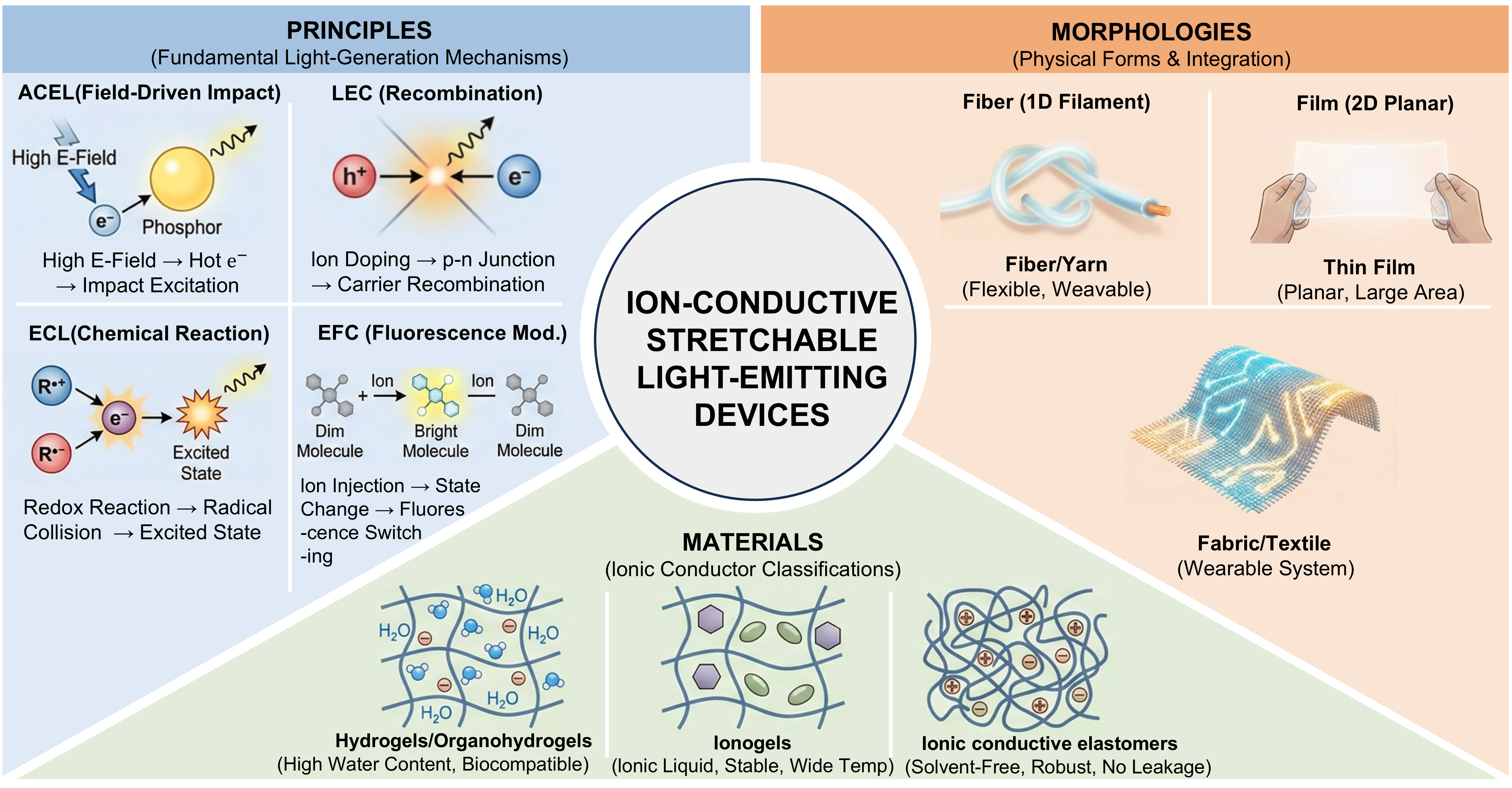
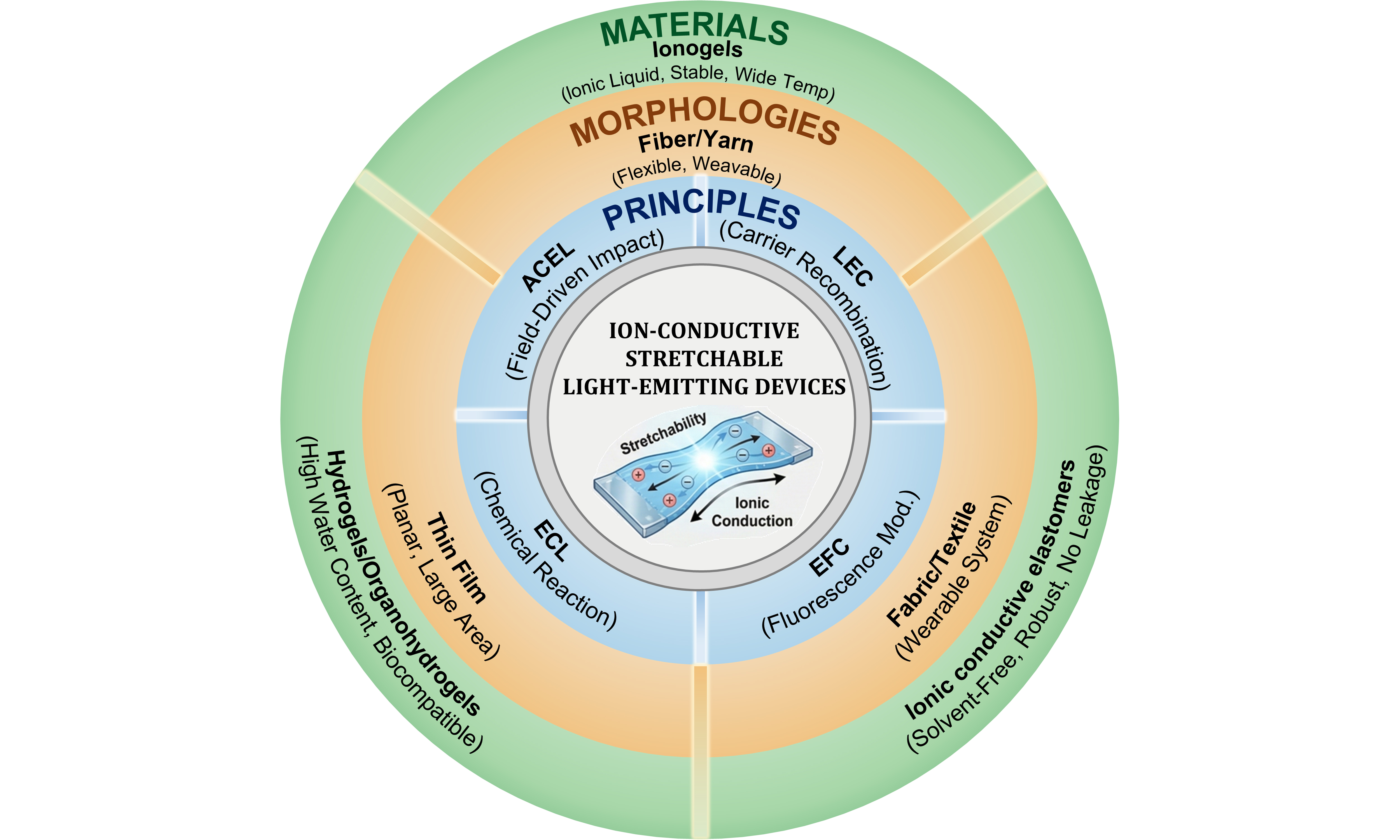
Figure 1. Principles, morphologies and materials of ion-conductive stretchable light-emitting devices. ACEL: Alternating-current electroluminescence; LEC: light-emitting electrochemical cell.
Comparison of physical mechanisms between electronic and iontronic stretchable light-emitting devices
| Physical characteristic | Electronic conductive devices (Stretchable LED/OLED) | Iontronic light-emitting devices (Iontronic ACEL/LEC/ECL/EFC) |
| Dominant carriers | Electrons(e-) and Holes (h+) | Cations (M+) and Anions (M-) |
| Charge transport model | Percolation network, band transport, or hopping transport | Diffusion and drift transport (governed by the Nernst-Planck equation) |
| Interface injection mechanism | Schottky barrier/Thermionic emission; dependent on energy level matching | EDL capacitance-assisted injection or electrochemical doping |
| Response Speed | Ultra-fast (nanoseconds to microseconds); suitable for high-frequency displays | Relatively slow (milliseconds to seconds); limited by ionic mobility |
| Strain stability | Highly sensitive to microstructure (tunneling resistance increases exponentially with deformation) | Strain-insensitive (geometric resistance increases linearly with deformation, following volume conservation) |
| Material compatibility | Strict hydrophobic/oxygen-barrier requirements; sensitive to electrode work function matching | Relatively stable in ambient atmosphere; wide range of electrode choices |
Luminescence principle
By confining the vast majority of the potential drop within a nanometer-scale region, the EDL provides an exceptionally high areal capacitance and an intense interfacial electric field[25,26]. This mechanism not only mitigates the charge-transfer barriers inherent to conventional interfaces but also facilitates robust interfacial contact and stable optoelectronic performance even under substantial mechanical deformation. From a kinetic perspective, owing to the significantly larger effective mass of ions relative to electrons, the formation dynamics of the EDL typically dictate the response rate and impose an upper frequency limit on device operation. This kinetic constraint is particularly salient in the high-frequency operation of ACEL devices and the turn-on dynamics of LECs.
Based on excitation modalities and energy conversion pathways, the devices discussed in this review primarily operate through four distinct mechanisms: ACEL [Figure 2A], LECs [Figure 2B], ECL [Figure 2C], and EFC [Figure 2D]. This section systematically analyzes the intrinsic physical processes underlying these mechanisms, with a particular emphasis on elucidating how the EDL mediates ion-photon and ion-electron coupling. Furthermore, we trace the evolutionary milestones and research progress associated with each mechanism in the context of stretchable iontronics.
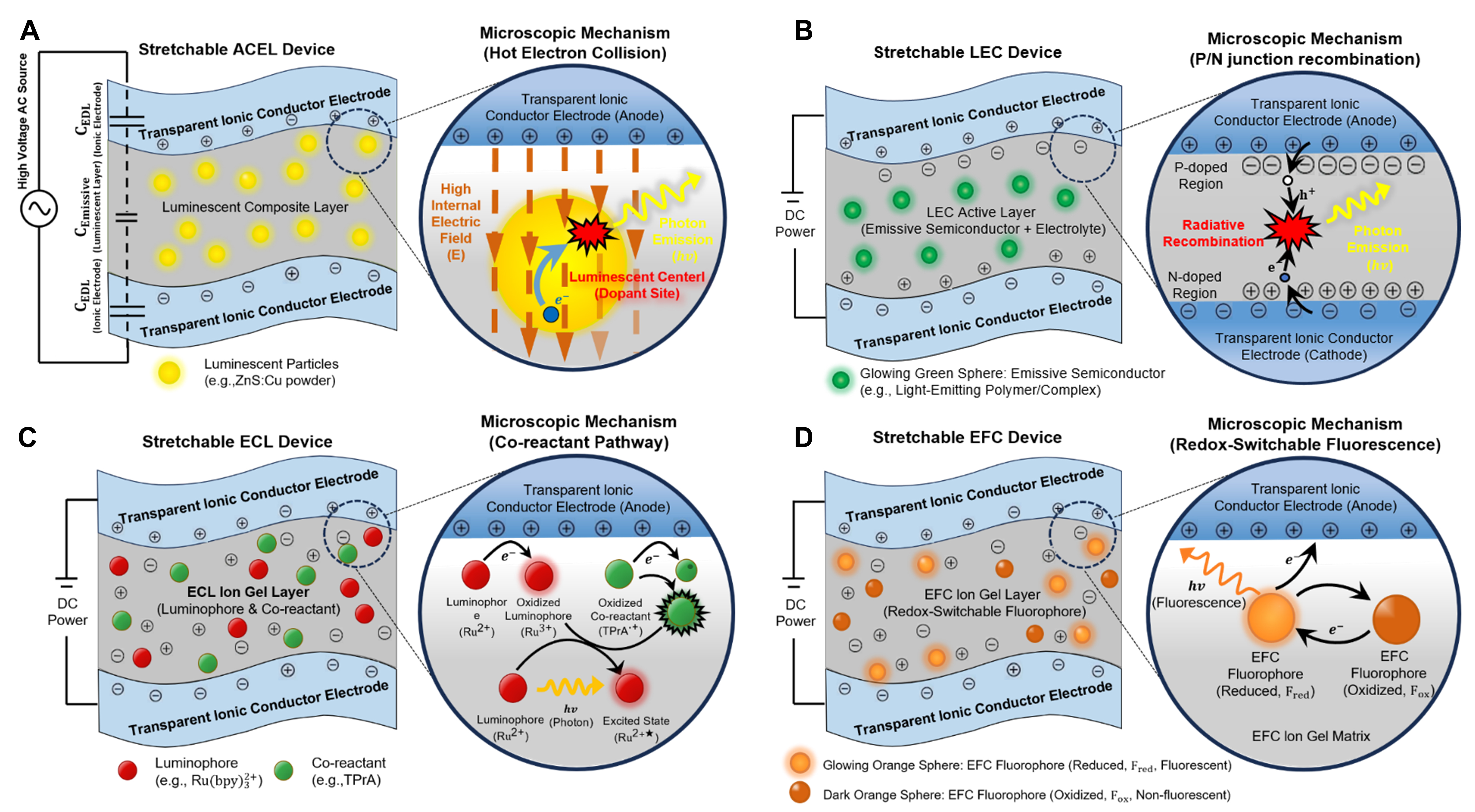
Figure 2. Luminescence principles applied to ion-conductive stretchable light-emitting devices. (A) ACEL Device: hot-electron impact excitation under a high-voltage AC electric field; (B) LEC Device: in situ P/N electrochemical doping and radiative recombination under a DC bias; (C) ECL Device: luminescence via the co-reactant pathway triggered by interfacial charge transfer; (D) EFC Device: fluorescence switching driven by redox-state transitions. ACEL: Alternating-current electroluminescence; LEC: light-emitting electrochemical cell; ECL: electrochemiluminescence; EFC: electrofluorochromism; hv: photon; P/N: p-type/n-type electrochemical doping; Fred: reduced state of the fluorophore; FOX: oxidized state of the fluorophore; AC: alternating current.
Alternating-current electroluminescent devices
ACEL devices operate by exciting ZnS-based phosphors embedded within elastomeric matrices under an alternating electric field. Owing to their carrier-injection-free mechanism, robust architecture, and tolerance to electrode conductivity variations, ACEL devices have emerged as prominent candidates for flexible displays and intelligent skin applications. Ionic conductors, characterized by exceptional optical transparency, intrinsic stretchability, and superior electrical coupling with elastomeric interfaces, have become highly suitable electrode materials[27]. At these ionic-dielectric interfaces, the formation of the EDL plays a pivotal role; the EDL facilitates an exceptionally high areal capacitance that serves not only to minimize interfacial impedance but also to maintain electric field stability even under substantial mechanical deformation[28-30]. Typically, ACEL devices adopt a sandwich-like configuration (ionic electrode-emissive layer-ionic electrode), and research has transitioned from achieving basic mechanical deformability to pursuing lower driving voltages, higher luminance uniformity, environmental stability, and multifunctional integration.
To address the pivotal challenge of high driving voltages, a dominant strategy involves increasing the dielectric constant (high-κ) of the emissive matrix to enhance the local excitation electric field. Liu et al. developed a high-κ dielectric gel matrix that successfully reduced the turn-on voltage to 13 V (0.19 V·μm-1), achieving a luminance of 1,944.7 cd·m-1 at low electric fields while maintaining a stretchability of 600%[31]. Furthermore, multicolor displays were realized through fluorescent dye-based electrodes. Concurrently, Von Szczepanski et al. increased the dielectric constant of polysiloxanes to four times that of conventional polydimethylsiloxane (PDMS) by introducing cyanopropyl side groups[32]. This modification resulted in a 7.5-fold enhancement in luminance and a 50% reduction in the turn-on electric field, offering an efficient material solution for low-power, high-brightness displays. Regarding color control and optical optimization, advanced conversion strategies have been introduced. Zhu et al. reported a high-performance, double-sided white-light-emitting device based on a quantum dot (QD) color conversion layer[33]. By incorporating BaTiO3 nanoparticles into the blue-emitting layer to concentrate the electric field and combining red/green QDs for efficient blue-to-white conversion, the device achieved uniform white emission with a color rendering index (CRI) of 91 and a luminance of 489 cd·m-2. This architecture preserves device transparency and mechanical toughness while ensuring high color purity under complex deformations. Additive manufacturing has opened new avenues for geometric customization. Park et al. demonstrated a three-dimensional (3D)-printed fabrication workflow for multicolor ACEL devices, developing ultraviolet (UV)-curable inks based on thiol-ene click chemistry and thermoresponsive ionic hydrogel electrodes[34]. The resulting 3D structures exhibited 259% stretchability while maintaining a luminance of 267.4 cd·m-2 under 200% strain. In parallel, Yao et al. reported a particulate ionic gel ink where zwitterionic microparticles stabilized ionic liquids, effectively overcoming the leakage and mechanical frailty typical of conventional ionic gels[35]. Benefiting from excellent extrusion continuity, this material provides a robust platform for highly stretchable ion-electronic devices. At the level of system integration, embedding emissive units into textiles is a key milestone in wearable displays. Shi et al. demonstrated large-area display textiles in which miniature ACEL units were integrated at fiber contact points via the interweaving of warp and weft yarns[36]. Display textiles up to six meters in length were fabricated, capable of withstanding over 1,000 mechanical washing cycles. This work demonstrates the unique advantages of ACEL technology in long-range functional integration, marking the transition of luminescent devices from laboratory prototypes toward large-area, system-level intelligent wearable applications. Table 2 highlights the recent progress in ion-conductive stretchable ACEL devices, focusing on their material systems and fundamental performance parameters.
Performance of ion-conductive stretchable ACEL devices
| Ref. | Materials (Ion conductor/emitter) | Max strain | Max luminance (cd·m-2) | Driving conditions | Key highlights |
| [16] | PAAm-NaCl hydrogel | > 2,000% | - | > 10 kV > 10 kHz | Pioneering work defining transparent, ultra-stretchable ionic conductors |
| [31] | ACMO-VEC high-κ gel/ DES gel | 600% | 1,944.7 | 13 V (Turn-on) | Ultra-low field emission enabled by high-κ gel matrix |
| [32] | Cyanopropyl-polysiloxane | 50% | 7.5-fold vs. PDMS | 50% lower field than PDMS | polar-group modification to enhance dielectric permittivity |
| [33] | Ionic hydrogel/QD | 400% | 489 | 2.5 V·μm-1 | Bifacial white-light emission with high color rendering (CRI 91). |
| [34] | Temp-responsive hydrogel (FFP) | 259% | 267.4 | - | Fully 3D-printed multi-color devices via rational ink design. |
| [35] | Granular zwitterionic ionogels | > 600% | ~ 170 | 5.6 V·μm-1 | Granular ink prevents leakage and brittleness for high-precision printing. |
| [36] | Ionic liquid-doped PU fibers | - | 122 | μA-level current | 6-meter long display textiles; breathable and machine-washable. |
| [81] | Fluoropolymer (FS300)/IL | 800% | 1,460 | 23 V (Turn-on) | All-layer self-healing (HELIOS); safe for human-machine interaction |
| [83] | PNN/Chitosan DN ionogel | 1,200% | 647 (@800%) | 300 V, 10 kHz | High-temperature stability; operational at 200 °C |
| [12] | PAM-LiCl hydrogel (HLEC) | 487% | 43.2 mlm·W-1 | 700 Hz | Electroluminescent skin with integrated tactile and proprioceptive sensing |
| [100] | Li-polycarbonate electrolyte (SIG) | 700% | 95 | 1,000 V, 2 kHz | Systematic study of resistance-geometry correlation in ionic conductors |
| [111] | Liquid metal (LM)/Ionic nanocomposite | 400% | 384 | 350 V, 40 kHz | Hybrid electrodes reduce Ohmic loss for large-area uniform display |
| [114] | Dry ion-conducting elastomer (PEO-Li) | 563% | ~ 402 | 6 V·μm-1 | Liquid-free system solving leakage issues; 96% self-healing efficiency |
Light-emitting electrochemical cells
LECs constitute a distinctive class of electrochemically driven devices, in which mobile ions within the active layer enable the in situ formation of a p-i-n junction under an applied bias. Compared with organic light-emitting diodes (OLEDs), which possess complex multilayer architectures and exhibit stringent requirements for electrode work functions, LECs offer notable advantages, including structural simplicity, compatibility with air-stable electrodes, and solution-processed fabrication. In the operation of LECs, the Electric Double Layer (EDL) at the electrode interfaces acts as a “booster” for charge injection; by generating an ultra-high local electric field, the EDL significantly lowers the energy barriers for charge carriers entering from air-stable electrodes into the semiconductor layer, thereby initiating the subsequent electrochemical doping throughout the bulk[37]. These merits have positioned LECs as a pivotal focus for large-area flexible displays and low-cost lighting[38-40]. Accordingly, research has evolved from fundamental electrochemical investigations toward enhancing optoelectronic efficiency via molecular engineering, achieving intrinsic stretchability, and developing fully printed processes for system-level integration.
In terms of improving efficiency and luminance, suppressing exciton quenching and optimizing energy transfer are the core strategies. Tang et al. proposed a universal host-guest design rule, in which tailored trap sites suppress exciton diffusion within the recombination zone, enabling a current efficiency of 99.2 cd·A-1 at 1,910 cd·m-2[41]. Building on this, Lundberg et al. reported thermally activated delayed fluorescence (TADF)-based LECs[42]. By employing polymer blend matrices and maintaining guest concentrations below 1 wt.% to mitigate aggregation-induced quenching, they successfully achieved an external quantum efficiency (EQE) of 7.0%. Additionally, Mindemark et al. introduced star-shaped, branched oligocarbonate ion transporters, which delivered a current efficiency of 13.8 cd·A-1, effectively addressing the efficiency roll-off common in polyether-based electrolytes under high-brightness operation[43]. Endowing devices with intrinsic mechanical deformability is critical for interactive e-skin. Filiatrault et al. developed an elastomeric emissive blend comprising a tris(2,2'-bipyridine)ruthenium(II) hexafluorophosphate [Ru(bpy)3 (PF6)2, where bpy denotes 2,2'-bipyridine] complex, a poly (ethylene oxide) (PEO)- poly(propylene oxide) PPO-PEO triblock copolymer, and an ionic liquid[44]. Thsystem leverages the in situ junction formation of LECs to eliminate the dependence on rigid, low-work-function electrodes. The resulting devices exhibit excellent robustness, withstanding uniaxial strains of up to 27% while maintaining stable luminance and turn-on voltages after multiple 15% strain cycles, underscoring the critical role of matrix elasticity. Regarding color purity, the introduction of narrowband emission has markedly improved display quality. Tang et al. incorporated multi-resonance TADF (MR-TADF) emitters into LECs, achieving a solid-state photoluminescence quantum yield of 91% by tuning host-guest polarity compatibility[45]. This approach suppresses the aggregation of rigid planar molecules, enabling narrowband emission while retaining air-stable electrodes - thus addressing the long-standing issue of spectral broadening in LECs. Concurrently, Xu et al. elucidated the influence of electrode selection on interfacial doping dynamics, providing a theoretical foundation for electrode matching in pixelated arrays[46]. Advanced manufacturing not only ensures scalability but also paves the way for biocompatible applications. Zimmermann et al. reported fully printed LECs based on polycaprolactone electrolytes[47]. Devices fabricated on cellulose substrates via inkjet printing and doctor-blading exhibited luminance exceeding 12,000 cd·m-2, demonstrating potential for disposable medical consumables. Gellner et al. further presented pioneering work on spray-coated, intrinsically stretchable LECs fabricated under ambient conditions[48]. Collectively, these high-efficiency manufacturing strategies, combined with biodegradable materials, highlight the potential of LECs in transient electronics and sustainable display technologies. Table 3 summarizes the representative advancements in ion-conductive stretchable LECs, highlighting their active layer architectures and core optoelectronic characteristics.
Performance of ion-conductive stretchable LEC devices
| Ref. | Active layer/Ion conductor | Max strain | Max luminance (cd·m-2) | Efficiency | Key highlights |
| [41] | PVK: OXD-7 Host/Ir-guest | - | 1,910 | 99.2 cd·A-1 | Efficiency record; trap-assisted suppressing of exciton quenching |
| [42] | PVK: OXD-7/TADF guest | - | 120 | 7.0% (EQE) | First efficient TADF-LEC; 10x performance improvement over state-of-the-art |
| [43] | Star-branched oligocarbonate | - | 1,060 | 13.8 cd·A-1 | Non-polyether ion transporter solving efficiency roll-off at high brightness |
| [44] | Ru-complex/PDMS-matrix | 27% | - | 0.58% (EQE) | Intrinsically stretchable LEC; elastomeric matrix eliminates pinholes |
| [45] | MR-TADF narrowband emitter | - | 500 | 3.8% (EQE) | Narrowband emission (FWHM 31 nm) for high color purity |
| [47] | SY/IL/PU stabilizer | 30% | - | - | Industrial-compatible ambient-air spray coating process |
| [76] | SY/PEO/Li-salt (SWNT) | 45% | ~ 170 | 1.24 cd·A-1 | Metal-free, intrinsically stretchable LEC with shape-memory properties |
| [77] | AMOLEC Array (Vertical OTFT) | 30% | - | - | First fully stretchable active-matrix driven LEC display array |
Electrochemiluminescence devices
ECL devices generate excited luminophores via electrochemical redox reactions and emit photons accordingly. Owing to their low operating voltages (typically < 5 V), elimination of work-function-matched electrodes, and facile all-solid-state integration, ECL devices have demonstrated distinctive advantages in wearable displays and biochemical sensing[49]. Compared with ACEL devices, the defining feature of ECL systems lies in the intimate integration of ionic conductors and emissive species within the active layer[50]. This integrated architecture shifts the focus from bulk field-excitation to interfacial charge-transfer dynamics. Consequently, the formation of the EDL at the electrode/gel interface becomes fundamental to the reaction; by confining the applied potential within a nanoscopic layer, the EDL establishes a steep potential gradient that effectively drives the redox cycles of the active species even at minimal biases. Furthermore, the EDL modulates the local concentration of luminophores and co-reactants through electrostatic screening, ensuring high-intensity emission even at relatively low driving voltages[51,52]. Ion gels, characterized by high ionic conductivity, mechanical robustness, and solution processability, have emerged as highly effective materials for constructing self-supporting, high-performance ECL active layers. Current research has advanced from liquid electrolyte-based systems toward polymer-engineered ion gels with enhanced stability, optimized multicolor emission strategies, highly stretchable transparent electrodes, and multifunctional integration.
From the perspective of materials design and electrochemical performance optimization, the construction of high-strength polymer networks constitutes the physical foundation for stable ECL emission, as their mechanical modulus directly governs luminance uniformity under deformation. Moon et al. first reported solution-processable ion gels based on ABA-type (where A and B represent distinct polymer blocks) triblock copolymers (polystyrene-block-poly(methyl methacrylate)-block-polystyrene, PS-PMMA-PS), producing active layers with a thickness of only 30 μm via simple solution casting. These devices exhibited bright emission exceeding 100 cd·m-2 under merely 4 V at 500 Hz, opening a new pathway toward low-voltage, ultrathin ECL displays[53]. Building upon this concept, Hwang et al. introduced star-shaped six-arm copolymers of star-shaped [poly(methyl methacrylate)-b-polystyrene]6 [(MS)6] as gelators, whose unique physically crosslinked networks increased the storage modulus (G’) of ion gels to approximately 105 Pa - nearly an order of magnitude higher than that of linear polymers at comparable concentrations[54]. This robust network accommodated up to 90 wt.% ionic liquid while maintaining a high ionic conductivity of 5.2 × 10⁻³ S·cm-1, effectively suppressing phase separation at high salt concentrations and significantly improving luminance stability during long-term cyclic operation. To achieve full-color displays while preserving mechanical robustness, Kwon et al. adopted a mixed metal-chelate strategy by tuning the ratio of ruthenium and iridium complexes, thereby optimizing cyan emission[55]. As a result, full-color (RGB: red, green, blue) display matrices were realized, with maximum luminance values of 80, 110, and 35 cd·m-2, respectively. They exhibited negligible luminance degradation after 1,000 bending cycles at a radius of 5 mm. Enhancing mechanical adaptability and interfacial stability is essential for realizing conformable “skin-like” ECL electronics. Chen et al. developed polymer/gold hybrid wrinkled transparent electrodes based on a prestretching stabilization strategy, which combined approximately 60% optical transmittance with an ultralow sheet resistance of 10 Ω·sq-1[56]. ECL devices incorporating these electrodes retained over 90% of their initial luminance at 50% tensile strain and withstood more than ten thousand deformation cycles. Song et al. proposed a surface-embedded nanoparticle electrode fabrication approach, in which metal precursors were directly printed and in situ reduced within the surface layer of elastic substrates, effectively mitigating interfacial delamination between transparent electrodes and ECL active layers under large deformation[57]. In addition, Hong et al. exploited the excellent wettability and cohesion of self-supporting ion gels to develop “sticker-type” ECL devices, which can be transferred and laminated onto diverse irregular substrates to achieve stable emission under 4 V low-voltage operation[58]. Advanced micro- and nanofabrication techniques have further expanded the application modalities and integration levels of ECL devices. Hong et al. combined electrospinning with ion-gel processing to fabricate luminescent ion-gel microfibers, which were subsequently woven into smart textiles capable of light emission, providing a new structural paradigm for wearable displays[59]. For customized manufacturing, Kim et al. reported a complete fabrication route for ECL lighting devices using direct ink writing (DIW) 3D printing[60]. By incorporating silica nanoparticles to tailor ink rheology and employing lateral electrode configurations, complex self-supporting luminescent patterns were realized, circumventing the reliance on transparent top electrodes inherent to conventional sandwich architectures. The real-time conversion of mechanical stimuli into visual feedback represents an advanced application of ECL devices in intelligent skin systems. Lee and Kang proposed a visco-poroelastic ECL skin based on the “piezo-ionic effect”, composed of a thermoplastic polyurethane (TPU) network integrated with ionic complexes[61]. External pressure or tensile deformation induces ionic redistribution, leading to localized modulation of emission intensity. This mechanism enables the device to function not only as a flexible display but also as a highly sensitive tactile sensor without the need for complex signal-processing circuitry, thereby achieving direct transduction from mechanical stimuli to optical signals. Collectively, these studies indicate that ECL devices are rapidly evolving toward low-power, multimodal intelligent skin applications through cross-scale innovations spanning molecular design, materials engineering, and system-level integration. Table 4 summarizes the recent advancements in ion-conductive stretchable ECL devices, presenting their matrix compositions, luminescent species, and essential operational attributes.
Performance of ion-conductive stretchable ECL devices
| Ref. | Ion matrix/host | Luminophore | Max strain | Voltage (AC) | Key highlights |
| [53] | PS-PMMA-PS triblock/[EMI][TFSI] | - | 3 - 4 V | Solution-processable low-voltage emissive displays on plastic | |
| [54] | Star-shaped 6-arm (MS)6 polymer | - | - | High mechanical robustness (G' ≈ 105 Pa); suppressed phase separation | |
| [55] | PMMA/PEG/[EMI][TFSI] | Ru & Ir complexes (RGB) | - | 5.0 V | Full-color display via a mixed-metal chelate system to enhance blue emission |
| [56] | Electrospun fibers/Aqueous sol. | Ru-complex | 50% | < 10 V | Strain-insensitive; 90% luminance retention at 50% strain via wrinkled Au |
| [57] | SBS block copolymer | Ru-complex | 50% | 7.0 V | Surface-embedded electrodes solving delamination at large deformation |
| [58] | P(VDF-HFP)/[EMIM][TFSI] | Ru(bpy)3Cl2 | - | 4.0 V | Sticker-type ECL device; transferable and laminatable on various substrates |
| [59] | Ion gel microfibers (Electrospun) | Ru(bpy)3Cl2 | - | 2.5 V | Light-emitting fabrics woven from dye-doped electrolyte microfibers |
| [60] | PVAc/Silica NPs/[EMIM][TFSI] | Ru(bpy)3Cl2 | - | 7.0 V | All-printed (DIW) via side-by-side electrodes; eliminating top transparent layer |
| [61] | TPU/Ionic composite | 800% | - | Piezo-ionic effect; direct transduction of mechanical stimuli into visual readout |
Electrofluorochromic devices
EFC devices reversibly modulate fluorescence intensity or emission color by inducing redox reactions of active molecules under an applied electric field. Owing to their capability for dynamic optical regulation, EFC systems have attracted considerable attention in high-end anti-counterfeiting, information encryption, and adaptive displays[62,63]. In contrast to conventional electrochromic (EC) devices, EFC devices introduce an additional emissive channel, thereby enabling higher contrast and an expanded optical readout dimension. Central to this modulation is the formation of the EDL at the interface, which functions as a “molecular gate”. By confining the potential drop within a nanoscopic layer, the EDL enables efficient redox switching and charge transfer at sub-volt driving voltages (typically below 1.0 V). Furthermore, the kinetics of ion redistribution within the EDL serves as the critical determinant of the switching speed and cyclic stability of the fluorescence transition[64]. Current research has thus evolved from simple fluorescence on-off switching toward the development of narrowband emission for improved color purity, dynamically crosslinked networks for ultrahigh stretchability, and multifunctional intelligent skin systems.
From the standpoint of molecular design, enhancing fluorescence contrast and response speed constitutes the primary objective. Yang et al. reported a narrowband EFC system based on boron-nitrogen embedded polycyclic aromatic hydrocarbons (B,N-PAHs)[65]. This design achieved a fluorescence quenching efficiency exceeding 90% alongside rapid switching kinetics (coloration within 0.6 s and bleaching within 2.4 s). Notably, the device exhibited negligible performance degradation after 200 cycles, effectively overcoming the poor color purity associated with broadband emission in conventional materials. Adams et al. constructed hydrogel-based EFC devices using water-soluble thiazolo[5,4-d] thiazole (TTz) dyes, realizing quenching ratios above 90% at low operating voltages. Supported by a stable poly (vinyl alcohol) (PVA)/borax physical network, these devices demonstrated stable operation over 250 cycles[66]. Earlier, Kim et al. established a foundation for efficient control by precisely modulating the electrochemical interconversion of tetrazine derivatives between neutral and ionic states[67]. Improving mechanical adaptability and environmental robustness is crucial for translating EFC technology into e-skin. Chen et al. developed a dynamically crosslinked hydrogel electrolyte in which boronate ester bonds and hydrogen bonding synergistically contributed to exceptional mechanical properties, including an elongation at break of 1,155% and a self-healing efficiency of 97%[68]. The fracture toughness reached 136.6 kJ·m-2, enabling devices to recover their fluorochromic functionality even after severe mechanical damage. Zhang et al. reported an ultrastable ion gel based on viologen-type ionic liquids, exhibiting a stretchability of 1,000% and a fracture energy of 3.2 kJ·m-2[69]. By integrating EC and EFC functionalities, the device retained 93% of its initial contrast after 500 cycles (and 88% after two years), while maintaining a quenching efficiency of 99% under 300% tensile strain - achieving deep coupling between visual display and mechanical sensing. Multifunctional integration and intelligent interaction represent the latest frontiers in EFC development. Huang et al. designed a dual-functional electrochromic-electrofluorochromic ionic liquid (EEIL) to construct smart windows capable of dual-mode reflective/emissive display, achieving an energy efficiency of 13.44%[70]. Li et al. exploited multistate molecular switches and dynamic coordination to develop an indirect chromic system, enabling precise switching among colorless, magenta, and cyan states within an ultralow voltage range of 0.9-2.0 V[63]. In the context of interactive displays, Chou et al. vertically integrated pressure sensors with flexible electrochromic units to realize e-skin capable of continuous color modulation under touch pressures of 1-30 kPa[71]. Furthermore, Park et al. reported a transparent stretchable strain sensor with a gauge factor (GF) of up to 10 at large strains[72]. By integrating a polyaniline-based chromic layer, real-time visual feedback of human motion was successfully achieved. Table 5 summarizes the representative progress in ion-conductive stretchable EFC devices, encapsulating their active molecular designs and key modulation properties.
Performance of ion-conductive stretchable EFC devices
| Ref. | Active Molecules/Redox pair | Max Strain | Quenching % | Switching (s) | Key highlights |
| [63] | Cis-ABPX/Metal ions | - | - | 7.8 / 12.3 | Intrinsically multi-color (CMY) via dynamic coordination switching |
| [65] | B,N-PAHs (Narrowband)/p-BQ | - | > 90% | 0.6 / 2.4 | High color purity; FWHM 30 nm solving the broad-spectrum bottleneck |
| [66] | TTz dyes/Ferrocene | - | > 90% | seconds | Triple-mode (EC, EFC, PC) in a low-cost aqueous hydrogel system. |
| [67] | Tetrazine derivatives | - | - | ~ 2.0 s | First demonstration of fluorescence modulation via molecular redox states |
| [68] | Fc-S/PProDOT-Me2 | 1,155% | - | - | Extreme stretchability and 97% self-healing via dynamic boronate bonds |
| [69] | Thienoviologen ionic liquid | 1,000% | 82% | - | Integrated EC/EFC display for visible strain sensing (1,000% stretch) |
| [70] | EEIL (TPA-Carbazole-Imidazole) | - | - | - | Dual-modal (Reflective/Emissive) window with 13.44% energy efficiency |
| [71] | Polymer EC/Pressure sensor | 50% | - | 1.4 / 1.2 | Chameleon skin; interactive color change controlled by tactile sensing |
| [72] | PANI nanofibers V2O5 | 50% | - | - | Skin-integrated strain sensor; real-time visual feedback of body motion |
As summarized in Table 6, distinct light-emission mechanisms exhibit divergent performance characteristics, dictating their suitability for specific application scenarios.
Comparison of ion-conductive light-emitting mechanisms
| Mechanism | Typical operating voltage | Efficiency/Luminance | Mechanical & cyclic stability | Cost & processing |
| ACEL | High (typically > 100 V)[100,111] | Relatively lower compared to LEC; peak luminance ~2,000 cd·m-2[31] | Superior; withstands over 10,000 stretching cycles without significant decay[88] | Low; simple architecture, air-stable, and compatible with large-area fabrication |
| LEC | Low (typically < 10 V)[37] | Very high; efficiencies up to 99.2 cd·A-1[41] or 7.0% EQE[42] | Moderate; constrained by ion migration speeds and interfacial side reactions | Low; compatible with solution processing and air-stable electrodes |
| ECL | Ultra-low (typically < 5 V)[53,59] | Moderate; determined by the concentration of redox-active species | Relatively Low; luminophores are prone to structural degradation during cycling | Moderate; requires specific ion-gel systems but facilitates all-solid-state integration |
| EFC | Ultra-low (0.9-2 V)[63] | High contrast; quenching efficiency > 90%[65,66] | Moderate; depends on the electrochemical reversibility of molecular switches | Moderate; relies on specialized redox-active fluorescent molecules |
In the realm of large-area wearable displays, ACEL currently holds the most promise for near-term commercialization. This potential stems primarily from the exceptional tolerance of ACEL architectures to fluctuations in electrode conductivity, which ensures superior luminance uniformity even under extreme stretching or complex mechanical deformations. Notable benchmarks include light-emitting textile displays spanning up to six-meter-long that withstand industrial laundering[36], as well as ultrasoft luminescent skins capable of enduring areal strains of up to 1,500%[73].
For biomedical integration and implantable electronics, LECs and ECL are more advantageous. Their superiority is largely attributed to ultralow operating voltages (typically < 5 V), which significantly mitigate electrical hazards in biological environments and minimize the risk of tissue damage. For instance, fully printed LECs fabricated on biodegradable poly(ε-caprolactone) (PCL) substrates have demonstrated substantial potential for transient or short-term medical applications[47].
In intelligent interaction and sensory feedback systems, EFC and ECL devices offer unique functional merits. By leveraging ion redistribution or reversible redox switching, these mechanisms enable the direct transduction of mechanical stimuli - such as pressure or strain - into perceptible optical signals. For example, ECL skins utilizing the “piezo-ionic effect” can visualize tactile information in real-time without requiring complex circuitry[61], while EFC-integrated strain sensors provide intuitive optical feedback of human motion[72].
Morphology design
Stretchable light-emitting devices are core components in flexible electronics, wearable devices, and soft robotics, whose morphological design directly determines the adaptability of application scenarios. Traditional electronic conductor-based devices struggle to balance high stretchability, transparency, and long-term stability. In contrast, ionic conductors (e.g., hydrogels, ionogels) have emerged as ideal candidates for constructing such devices due to their inherent advantages. Ion-conductive stretchable light-emitting devices emit light by exciting luminescent layers (e.g., ZnS-based phosphors, elastomeric light-emitting polymers) through ion migration, and have evolved into three main morphologies: thin film/sheet, fiber/filament, and fabric/textile. Some representative works are shown in Figure 3. This section systematically summarizes their structural design, performance optimization paths, and application potential based on morphological classification, while clarifying core performance evaluation indicators and current development challenges.
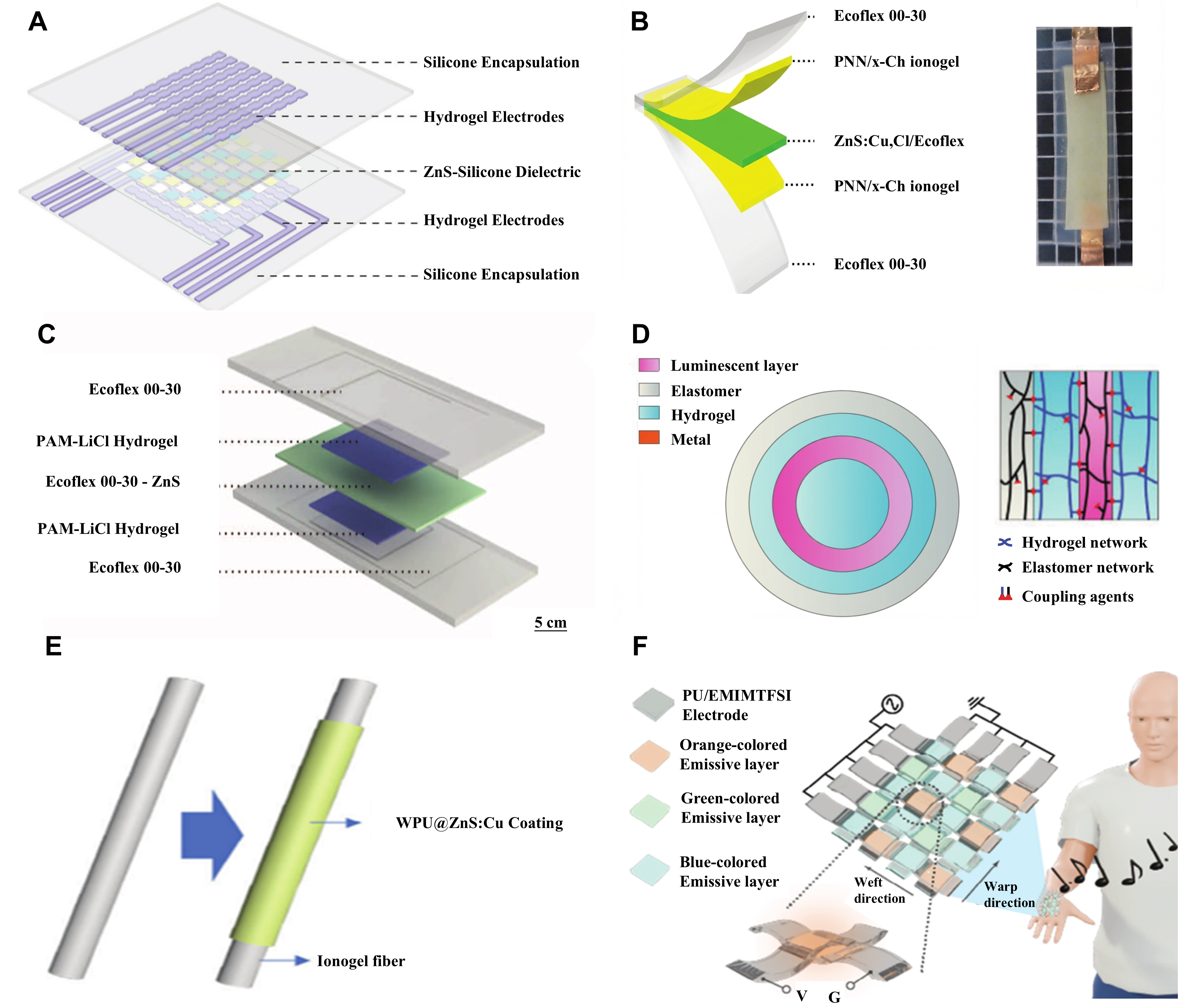
Figure 3. Schematic diagrams of different ion-conducting device morphologies. (A) Exploded view of the m-HLEC. This figure is quoted with permission from Wiley[80]; (B) Illustrated structure (left) and photograph (right) of the stretchable ACEL device. This figure is quoted with permission from Wiley[83]; (C) Exploded view of the HLEC. This figure is quoted with permission from the American Association for the Advancement of Science[12]; (D) Ionotronic luminescent fiber. This figure is quoted with permission from Wiley[88]; (E) Weavable DOU-IG-30@ZnS:Cu fiber structure. This figure is quoted with permission from Wiley[93]; (F) Schematic illustration showing the configuration of the stretchable multicolored textile sound display for wearable devices. This figure is quoted with permission from Wiley[98]. PNN/x-Ch: Poly(N-isopropylacrylamide-co-N,N’-diethylacrylamide)/crosslinked-chitosan; PAM: polyacrylamide; PU: polyurethane; EMITFSI: 1-ethyl-3-methylimidazolium bis(trifluoromethylsulfonyl)imide; m-HLEC: multicolor hyperelastic light-emitting capacitor; ACEL: Alternating-current electroluminescence.
Thin film/sheet devices
Thin film/sheet is the fundamental morphology of ion-conductive stretchable light-emitting devices, featuring regular structure, mature preparation processes, and excellent luminescence uniformity. The core development directions include improving stretchability limits, expanding functional integration, and realizing large-scale fabrication, mainly adopting an “electrode-luminescent layer-electrode” sandwich structure.
Basic Stretchable and Large-Area Fabrication devices focusing on core performance optimization are tailored for diverse application scenarios. Yang et al. reported a device using Li+/agar/polyacrylamide (PAAm) ionic double-network (DN) hydrogel as the ionic conductive medium, with an elongation at break exceeding 1,600%[74]. It can be knotted and bent, maintaining stable performance after five cycles of 1,000% stretching. Employing a “hydrogel electrode-PDMS/ZnS:Cu luminescent layer-hydrogel electrode” sandwich structure, it enables patterned luminescence, suitable for flexible display scenarios. This design integrates high stretchability, high transparency, flexible sensing, and electroluminescence, with a simple preparation process. Gao et al. developed a polymer LEC (PLEC) using PEO/trimethylolpropane triacrylate/lithium trifluoromethanesulfonate (PEO/ETPTA/LiTf) as the ionic conductive medium, forming an interpenetrating polymer network (IPN) structure with a soluble alkyloxy phenyl substituted poly(1,4-phenylenevinylene) (SY-PPV)[75]. The thin-film sandwich structure with silver nanowire-polyurethane (AgNW-PUA) composite electrodes can withstand 140% uniaxial stretching and remains stable after 1,000 cycles at 50% strain, with a maximum luminance of 1,750 cd·m-2, balancing stretchability and high brightness requirements. Yu et al. used single-walled carbon nanotube-poly(tert-butylacrylate) (SWNT-PtBA) as composite electrodes, and the luminescent layer contains (PEO dimethacrylate ether (PEO-DMA) ionic conductor and LiTf salt[76]. The device can be linearly stretched to 45% strain at 70 °C, and the original resistance can be recovered by annealing after cyclic stretching, featuring shape memory properties. The main component of the luminescent layer is a blue-emitting fluorene copolymer, emitting sky-blue light with uniform and polarized luminescence under stretching, and stable performance after folding. Liu et al. reported a fully stretchable active-matrix organic LEC (AMOLEC) array, using ionic conductive polymer and LiTf as the ionic conductive system, with ethoxylated trimethylopropane triacrylate (ETT-15) assisting ion conduction[77]. The device adopts dimethacrylate-functionalized per-fluoropolyether (PFPE-DMA) elastomer dielectric and crosslinked modified semiconductors, capable of withstanding 30% strain, supporting bending and twisting. The transistors remain stable after 1,000 cycles of 100% stretching. Xie et al. developed a solvent-free ion-conductive stretchable light-emitting device using LiClO4/(ethylene glycol)9 methyl ether acrylate (mPEGA) and n-butyl acrylate (nBA) [P(mPEGA-b-nBA)] as ionic conductive electrodes, with an elongation at break exceeding 800% and maintaining a luminance of 100 cd·m-2 at 500% strain[78]. The luminescent layer is a ZnS:Cu/poly (styrene-b-butyl acrylate-b-styrene) (SBAS) composite system, achieving a maximum luminance of 450 cd·m-2 under a 1 kHz AC electric field with excellent stability. This design breaks through the performance bottlenecks of traditional ACEL devices but has the drawback of high driving voltage.
Large-area fabrication technology promotes the practical application of stretchable devices. Sekitani et al. developed a composite elastic conductor of SWNT/fluorinated rubber/imidazolium ion-based ionic liquid, with a conductivity of up to 102 S·cm-1 and a maximum stretchability of 118%[79]. Large-area active-matrix OLED is prepared by screen printing, which can be stretched by 30%-50% without electrical damage, and the OLED brightness exceeds 5000 cd·m-2 at 15 V. Through the “ionic liquid + jet milling” strategy, the team achieved uniform dispersion of SWNT in fluorinated rubber, developing a highly conductive and stretchable printable elastic conductor, successfully integrating a 16 × 16 pixel active-matrix OLED display, breaking the wiring bottleneck of large-area stretchable electronic devices. Yang et al. used PAAm hydrogel containing lithium chloride (LiCl) as ionic electrodes and Very High Bond (VHB, polyisobutylene-based elastomer) as the dielectric layer, realizing giant stretchable electroluminescence with 1,500% area strain and a luminance of 9.4 cd·m-2[73]. This design breaks the limitations of traditional devices to achieve stable electroluminescence with ultra-large area strain of 1,500%, featuring flexible material selection and avoiding high-voltage electrolysis risks, but has the problems of low luminescence brightness and excessively high driving voltage.
Multicolor emission of stretchable devices can be achieved through photopatterning, material doping, and other technologies. Combined with touch-sensing functions, it expands HMI applications. Li et al. studied a multicolor hyperelastic light-emitting capacitor (m-HLEC) using LiCl-based PAAm hydrogel as ionic conductive electrodes and ZnS-silicone composite system as the luminescent layer[80]. Prepared by photopatterning and transfer printing processes, it can achieve 200% bidirectional stretching. The luminescent layer realizes red, green, and blue three-color output through different doped ZnS, and the luminance increases monotonically with tensile strain. The device integrates a 64-pixel multicolor display and multi-touch sensing functions, showing application potential in wearable devices and soft robotics. This design is compatible with existing technologies and has stable interlayer bonding, but has the shortcomings of limited pixel resolution, dependence on passive matrix addressing, and high driving voltage. Liu et al. designed a five-layer structured ion-conductive stretchable light-emitting device using high-κ dielectric gel [with acryloyl morpholine-4-vinyl-1,3-dioxolan-2-one (ACMO-VEC) copolymer as the framework and propylene carbonate-ethylene carbonate (PC-EC) as the swelling liquid] as the dielectric matrix and deep eutectic solvent (DES) gel electrodes[31]. The device can withstand a maximum stretchability of 600%, and the luminescent performance remains stable after thousands of cycles of stretching. The luminescent layer is ZnS:Cu-doped APEL(the dielectric gels with polyvinyl pyrrolidone additive could be mixed with ZnS to prepare the emitting layer, called APEL), realizing multicolor luminescence through fluorescent electrodes with a maximum luminance of 1,944.7 cd·m-2. This five-layer structure achieves a synergistic breakthrough, combining ultra-low turn-on voltage (13 V), ultra-high stretchability, and multicolor wireless dynamic display, with excellent device cycling and environmental stability. However, it has the drawback of reduced brightness due to the inserted layers, which slightly limits overall performance.
Self-healing or wide-temperature-range luminescent capabilities can be endowed to devices through molecular design or structural optimization, improving service life in complex environments. Tan et al. developed a healable, low-field illuminating optoelectronic stretchable device (HELIOS) using poly(vinylidene fluoride-co-hexafluoropropene) P(VDF-HFP) fluoroelastomer containing the ionic liquid 1-ethyl-3-methylimidazolium bis(trifluoromethylsulfonyl)imide (EMITFSI) as ionic electrodes[81]. The device can achieve 800% tensile strain, exhibits mechanical and electronic self-healing capabilities, and reaches a maximum luminance of 1,460 cd·m-2, making it suitable for soft robotics, wearable devices, and related applications. This design achieves the excellent synergy of low turn-on voltage (23 V), high stretchability, and high brightness. Liang et al. reported an all-layer self-healing EL device using polyacrylic acid (PAA)/NaCl hydrogel as electrodes and polyurethane (PU)/ZnS/boron nitride (BN) composite material as the luminescent layer[82]. Self-healing at room temperature is achieved through hydrogen bonding, with a luminescent efficiency of 83.2% after 10 non-fixed-point healings and 57.7% after 20 fixed-point healings. The maximum luminance reaches 70.5 cd·m-2 under a 3 V·μm-1, 500 Hz driving field. The team innovatively developed an all-layer hydrogen bond-mediated room-temperature self-healing ionic conductive stretchable EL device, achieving high healing efficiency, providing a new idea for damage-tolerant flexible electronics. Xuan et al. adopted a DN poly(N-isopropylacrylamide-co-N,N’-diethylacrylamide)/crosslinked-chitosan (PNN/x-Ch) ionogel as electrodes and a ZnS:Cu,Cl/Ecoflex composite material as the luminescent layer[83]. They realized an ACEL device with a stretchability of 1,200%, stable luminescence at 200 °C, and no obvious luminance attenuation after 1,000 stretching cycles, enhancing its applicability in extreme environments. This device achieves the synergistic breakthrough of ultra-high stretchability, thousands of cycles of stability, and wide-temperature-range stable luminescence, but has a low luminance upper limit. Zhang et al. designed a device using butyl acrylate/4-hydroxybutyl acrylate/ethoxyethoxyethyl acrylate(BA/HBA/EOEOEA) copolymer solid ionogel (SIG) containing lithium bis(trifluoromethane sulfonimide) (LiTFSI) as ionic conductive electrodes[84]. This device can be stretched to 250% and remains stable after 1,000 cycles of 30% stretching, with strong interlayer adhesion. The middle luminescent layer is a ZnS:Cu/PDMS composite system, which emits stable blue light under 300 V/400 Hz AC voltage. It shows no attenuation when stored in air for 30 days, heated at 100 °C, or exposed to water, and can quickly self-heal while maintaining luminescence after slight cutting, making it suitable for wearable warning and human motion monitoring scenarios.
Some devices integrate sensing and luminescent functions to achieve “perception-feedback” integration, typically applied in e-skin. Kwon et al. developed a porous ionogel-based ECL ionoskin using EMITFSI ionic liquid as the conductive medium and porous poly (ethyl acrylate-ran-styrene-ran-divinylbenzene) (PEA-r-PS-r-PDVB) as the framework[85]. The device has good stretchability and elasticity, withstanding 6,000 press-release cycles and maintaining stable performance. The luminescent intensity is linearly related to the applied pressure, enabling naked-eye recognition of pressure changes, and is expected to become a key component of future sensory ionoelectronics. Larson et al. proposed a hyperelastic light-emitting capacitor (HLEC) using PAAm-LiCl ionic hydrogel as electrodes and ZnS:Cu/Ecoflex as the luminescent layer, with a stretchability of 487% and a luminescent efficiency of 43.2 mlm·W-1[12]. It perceives pressure and tensile deformation through capacitance changes, successfully integrated into the skin of soft robots. This design achieves the synergy of ultra-stretchability, luminescence, and tactile/proprioceptive integration, providing a solution for bionic e-skin, but has the shortcomings of lower luminescent efficiency than commercial ACEL devices and high driving voltage. Yang et al. reported a biomimetic skin with cellulose nanocrystal@poly[2-(methacryloyloxy) ethyl] dimethyl-(3-sulfopropyl) ammonium hydroxide-co-acrylamide] [CNC@P(SBMA-co-AM)] zwitterionic nanocomposite hydrogel as the core, adopting a “hydrogel electrode-ZnS/Cu/PDMS luminescent layer-hydrogel electrode” sandwich structure[86]. The hydrogel has an elongation at break exceeding 1,000%, stable luminescence under stretching, and strong adhesion. It can emit blue and yellow two-color light, with luminance increasing with voltage and frequency, and can monitor human movements such as finger bending and limb motion, with stable signals after multiple stretching cycles, applicable to human motion state collection. Wang et al. reported a device using bacterial cellulose (BC)-polymerized deep eutectic solvent (PDES) composite material as the ionic conductor[87]. Relying on the interpenetrating network formed by the BC 3D nanofiber network and PDES, the maximum tensile strain reaches 290%, and good mechanical properties are maintained after storage at 70% humidity for 120 days. Adopting a “BC-PDES transparent electrode-ZnS/Cu/PDMS luminescent layer-BC-PDES transparent electrode” three-layer structure, it can be cut into patterns such as stars and animals, emitting stable light under high-frequency AC voltage driving, with no luminance attenuation during bending and twisting. It can also accurately detect limb movements and handwriting actions, with stable signals after 1,000 cycles of 60% strain, suitable for flexible patterned display scenarios.
While thin film/sheet devices benefit from mature preparation processes, they face a critical trade-off between stretchability and electro-optical performance - devices achieving giant stretchability often suffer from low luminescence brightness and excessively high driving voltages. Additionally, current designs face limitations in pixel resolution and rely on passive matrix addressing, which complicates high-density display integration. Although significant progress has been made in large-area fabrication through techniques such as screen printing, manufacturing yield continues to face challenges due to issues of material uniformity - such as phosphor aggregation and electrode thickness fluctuations - as well as interfacial adhesion stability problems (insufficient interface adhesion can lead to interlayer delamination). While long-term operational reliability is hindered by material degradation (e.g., ion conductor solvent loss, phosphor oxidation), mechanical fatigue, and poor environmental adaptability. Cost control also remains a hurdle owing to expensive high-performance materials, high encapsulation costs, and energy-intensive fabrication processes.
Fiber/filament devices
Fiber/filament devices feature a one-dimensional structure, capable of bending, twisting, and weaving, serving as the core unit connecting thin film devices and textile devices. The core research focuses on balancing miniaturization, high stretchability, luminescence uniformity, and mechanical stability, and these devices are mainly fabricated by extrusion, dip-coating, coaxial spinning, and other processes.
Single-core/coaxial fibers adopt a core-shell structure design, with ionic conductors as core electrodes, and luminescent layers and dielectric layers coated sequentially. Their preparation processes are optimized to improve performance stability. Yang et al. prepared ionic luminescent fibers through multi-step dip-coating, with a core of PAAm/LiCl hydrogel electrode, an intermediate layer of ZnS:Cu/PDMS luminescent layer, and an outer layer of PDMS dielectric layer[88]. Strong adhesion between hydrogel and elastomer is achieved by silane coupling agents, with a stretchability of 250% and maintaining peak stress and luminescence brightness after 10,000 stretching cycles. This device breaks through the integration challenge of hydrogel and hydrophobic elastomer, realizing high stretchability, stable luminescence after thousands of cycles, and diverse configurations such as fibers, fabrics, expanding the design space for wearable ionic electronic devices. Zhang et al. prepared super-stretchable electroluminescent fiber (SEF) through one-step extrusion, with an inner core of PVA and PEO hydrogel electrode (ionic conductivity 0.29 S·cm-1) and an outer layer of ZnS powder-doped silicone elastomer, achieving a stretchability of 800% ,and a maximum luminance of 242.6 cd·m-2, remaining stable after 1,000 cycles[89]. The team innovatively prepared super-SEFs through one-step extrusion, realizing high stretchability, multicolor luminescence, and dynamic display, suitable for wearable scenarios, providing a new paradigm for smart electronic textiles. Yin et al. reported a core-shell structured ionic conductive stretchable light-emitting hydrogel fiber device, with a core of LiCl-doped PAAm hydrogel as the ionic conductive core and an outer layer coated with polystyrene-block-polyisoprene-block-polystyrene (PSPI) copolymer (a thermoplastic elastomer) dielectric shell[90]. The maximum tensile strain exceeds 2,000%, with stable performance after cyclic stretching, and stretchability far superior to similar devices with PDMS coating. The device supports electroluminescence (EL) and photoluminescence (PL). EL type emits light under AC voltage by doping ZnS phosphor in the PSPI shell, remaining stable luminescence when stretched to 9 times the original length; PL type emits pink light under blue light excitation by doping CdTe/ZnS QDs, suitable for smart textiles, wearable electronics, and other scenarios.
Strategies such as DN hydrogels and ionic liquid composites can enhance the stretchability and luminescent performance of fiber devices, as well as enable functional integration. Go et al. prepared poly (N-hydroxyethyl acrylamide-co-Am)/crosslinked chitosan (PHA/x-CS) DN ionic hydrogel electrode fibers, and the luminescent layer adopts a dual-doping system of ZnS:Cu,Cl (blue-green) and ZnS:Mn,Cl (orange)[91]. The device structure is “Ecoflex encapsulation layer-hydrogel electrode-luminescent layer-hydrogel electrode-Ecoflex encapsulation layer”, with a stretchability of 1,400% and a maximum luminance of 271 cd·m-2 at 30 kHz and 400 V. Multicolor switching and light patterning are achieved by independently controlling different luminescent units, showing great potential in interactive displays, soft robots, and camouflage equipment. Wang et al. reported a device using sodium alginate-polyacrylamide-1-ethyl-3-methylimidazole chloride (SA-PAM-EmimCl) ionic-covalent DN gel as the ionic conductive electrode, capable of withstanding a breaking elongation of 580%, remaining stable after 900 stretching cycles at 200% strain, and supporting bending and folding with excellent interface adhesion[92]. The luminescent layer is a ZnS:Cu/epoxy resin composite material, and luminescent pixels are formed at fiber crossing points, with a maximum luminance of 198 cd·m-2 at 70 V and 1,000 Hz. This design provides a practical solution for flexible displays but has the shortcomings of insufficient gel fiber strength, easy performance attenuation due to long-term water loss, and the need for further reduction of driving voltage. Tan et al. used cross-linked ionogel fibers based on dimethylglyoximeurethane (DOU) groups (DOU-IG fibers) containing EMITFSI ionic liquid as the ionic conductive core, realizing a device with an elongation at break of 705%, which can be stretched to 300% and quickly recovered, with stable performance under repeated cyclic deformation, and can be woven into textile structures[93]. The luminescent unit is an assembled structure of “DOU-IG-30 fiber-DOU-IG-30@ZnS:Cu fiber”, with a maximum luminance of 171.5 cd·m-2, emitting light at fiber contacts, and can be woven into patterns such as “Z”, suitable for wearable HMI scenarios. The team innovatively proposed a dynamic covalent cross-linking DOU group strategy, realizing multifunctional ionogel fibers that can be continuously melt-spun. Using these fibers, they successfully constructed integrated ionic electronic devices, including sensing and luminescent displays, providing a new paradigm for electronic textiles. Fu et al. designed a coaxial structured Scalable Hydrogel-clad Ionotronic Nickel-core Electroluminescent (SHINE) fiber device using polyvinyl alcohol-sodium tetraborate decahydrate/sodium alginate-calcium chloride/LiCl/glycerol (PVA-B/SA-C/LiCl/Gly) hygroscopic hydrogel as the ionic conductive electrode, which can withstand 25% strain, tolerate bending, twisting, and knotting, with all-layer self-healing capability[94]. The luminescent layer is ZnS-doped poly(vinylidene fluoride-co-hexafluoropropylene) (PVDF-HFP), with a maximum luminance of 1,068 cd·m-2, supporting multicolor luminescence. It can be woven into interactive display patterns, making it suitable for wearable HMI and soft-robot navigation applications. The team innovatively developed all-layer self-healing and magnetically actuated integrated SHINE fibers, realizing high brightness, large-scale fabrication, and long-term luminescence stability, providing a multifunctional platform for soft robots and interactive displays, but has the drawback of a tensile strain of only 25%. Liu et al. reported a fiber device prepared by multi-core-shell DIW, with an outer electrode of PVA/PEO/LiCl ionogel, an inner electrode of Ag/TPU composite material, a luminescent layer of ZnS-based phosphor/dragon skin (DS) composite ink, and an outer layer wrapped with a DS encapsulation layer[95]. The device has a maximum tensile strain of 450%, tight interlayer adhesion, and can tolerate bending and twisting deformations. It can emit green, blue, and orange three-color light, with luminance increasing with voltage and frequency, and can be printed into 1D, 2D, and 3D arbitrary patterns, suitable for wearable electronics, flexible displays, and other scenarios. Li et al. reported a recyclable and coaxial structured healing electro-optical fiber (HEOF) device prepared by one-step coaxial wet spinning, using dynamic-healable thermo-plastic polyurethane (DHPU) as the matrix, a core of DHPU/ionic liquid (EMITFSI) ionogel, and a shell layer doped with CaZnOS/ZnS:Mn2+ or ZnS:Cu phosphor[96]. The device has a breaking elongation of 584%, can be stably stretched to 200% strain, with a mechanical healing efficiency of 94%, and can be dissolved and recycled in ethanol within 30 minutes. It achieves two-color luminescence under UV excitation, with luminance unaffected by stretching and healing, and a luminescent healing efficiency of 99%, suitable for wearable electronics, insect monitoring, electro-optical hybrid encryption transmission, and other scenarios.
A major challenge in fiber/filament devices is the mechanical mismatch and poor adhesion between hydrophilic hydrogels and hydrophobic elastomers. This mismatch can lead to interlayer delamination, directly affecting large-scale manufacturing yield. Specific designs struggle with insufficient gel fiber strength, performance attenuation caused by long-term water loss (dehydration), and mechanical fatigue (e.g., electrode network fracture after cyclic stretching). Some high-performance fibers also exhibit limited tensile strain (e.g., only 25%), while material uniformity issues (e.g., ZnS phosphor aggregation, electrode thickness fluctuation) further reduce manufacturing yield. Environmentally, hydrogel-based fibers are sensitive to humidity (high-humidity short circuit, low-humidity cracking) and low temperatures (freezing-induced conductivity loss). To address manufacturing yield and cost, recent advances have moved toward continuous manufacturing methods such as one-step extrusion and continuous melt spinning, moving away from slower batch dip-coating processes, but high costs of high-performance materials (e.g., ionic liquids, carbon nanotubes) and energy-intensive fabrication/encapsulation processes still require further optimization and resolution.
Fabric/textile devices
Fabric/textile devices are large-scale application forms of fiber devices, integrating luminescent fibers with traditional textile materials through weaving technology, featuring breathability, wearability, and large-area display functions. They are a research hotspot in the field of wearable electronics, with core directions including dynamic display, functional integration, and engineering production.
Using luminescent fibers as warp/weft yarns, large-area stretchable luminescence is achieved through industrial weaving processes, focusing on optimizing luminescence uniformity and wearing comfort. Zhang et al. constructed a device based on polypyrrole (PPy)-modified spandex fabric using LiCl-containing PAAm hydrogel as the ionic conductive medium (conductivity approximately 3.17 S·cm-1), which can withstand 100% strain and maintain 98.5% luminance after 100 cycles of stretching[97]. The luminescent layer is a ZnS phosphor/silicone elastomer composite material, achieving a maximum luminance of 70.7 cd·m-2 under alternating current (AC) electric field driving, supporting multicolor luminescence, and can detect pressure and provide visual feedback. Shi et al. used fibers made of ionic liquid-doped polyurethane gel as ionic conductive weft yarns, and silver-plated yarns coated with ZnS phosphor as luminescent warp yarns; they are woven with cotton yarns into a fabric morphology, which can tolerate bending, stretching, and pressing, and remains stable after 1,000 cycles of deformation and repeated machine washing; warp-weft interweaving forms uniform EL units, with a fabric size of 6 m × 25 cm containing 5 × 10⁵ luminescent units[36]. Multicolor luminescence can be achieved through ZnS doping, with an average luminance of 122 cd·m-2, enabling dynamic pixel regulation, suitable for wearable display and communication scenarios. The team innovatively adopted warp-weft weaving technology to fabricate a large-area display fabric measuring 6 m × 25 cm. This fabric integrates 5 × 10⁵ uniform luminescent units, providing a practical solution for wearable HMI.
Functional expansion of stretchable fabrics, such as HMI or sound-light synergy, can be achieved through specific designs. Yang et al. prepared luminescent fabrics by assembling luminescent layer-coated hydrogel fibers and pure PDMS-coated hydrogel fibers in rows and columns[88]. Pixels are formed at fiber crossing points, and only crossing pixels emit light when voltage is applied, with movable pixels. A resolution of 320 × 240 can be achieved through passive matrix addressing, and the fabric can tolerate repeated bending and stretching without affecting luminescent performance, suitable for wearable displays and smart clothing. Zhang et al. wove SEF with wool into a textile display capable of stretching up to 207% without affecting luminescence, even under twisting[89]. The display can dynamically show numbers 0-9, achieve multicolor luminescence through circuit control, and support communication with computers and brain-computer interfaces. Oh et al. coated woven fibers with phosphated EcoTX on PU/EMITFSI ionic electrodes to fabricate stretchable, multicolor textile sound displays with a stretchability exceeding 200%[98]. The textile device tolerated bending and twisting and continued to function normally under 30% stretching. A maximum luminance of 319 cd·m-2 is achieved at 400 V and 15 kHz, with frequency-tunable green-blue two-color luminescence. The textile type can realize 5 × 4 pixel multicolor display (green, orange, blue), synchronously emit sound with no attenuation of light-acoustic performance under deformation. This fabric innovatively realizes sound-light synchronization function, featuring high stretchability, 5 × 4 pixel multicolor display, and stable light-acoustic performance under deformation, suitable for wearable interaction scenarios, providing a new solution for smart textile human-machine interfaces.
The primary challenge for textiles is durability under practical wear conditions, specifically maintaining performance after repeated deformation, machine washing, and material degradation (e.g., hydrogel dehydration, elastomer aging, ZnS oxidation) as well as poor environmental adaptability (humidity sensitivity, low-temperature conductivity loss). Achieving high-resolution displays is also difficult; while warp-weft weaving can create large arrays, pixel addressing often relies on passive matrix schemes which limit resolution, and active matrix integration is hindered by interface stability issues. For large-scale manufacturing yield, the focus has shifted to industrial weaving processes, but balancing luminescence uniformity (plagued by ZnS phosphor aggregation and coating thickness fluctuation) with weaving speed remains a key focus, alongside high costs from expensive materials (e.g., ionic liquids, doped ZnS), energy-intensive fabrication, and high encapsulation requirements.
Cross-form-factor integration can overcome the application limitations of a single form factor. At present, it has enabled the seamless integration and functional enhancement of “luminescent fibers-functional fabrics”. Specifically, via multi-step dip-coating or one-step extrusion processes, hydrogels (ionic conductors) are combined with hydrophobic elastomers (dielectric layers) in a composite manner featuring high adhesion and high stretchability to fabricate luminescent fibers with coaxial or core-shell structures; such fibers are further woven into functional fabrics equipped with movable pixel units, which can be dynamically regulated through fiber recombination and boast excellent potential for resolution development. At the material level, the challenge of interfacial wettability between hydrogels and elastomers has been addressed by means of silane coupling agents and other strategies, forming a transparent and robust interlayer adhesion between the two; this material system is compatible with the entire processes of fiber preparation and fabric weaving, thus ensuring cross-form-factor performance consistency. In terms of functional integration, such fabrics can not only dynamically display patterns and digital information but also achieve cross-module integration with external signal terminals, thereby laying a practical foundation for application scenarios such as wearable communication.
Material systems
In Ion-Conductive Stretchable Light-Emitting Devices, ionic conductive materials play a crucial role - serving both as transparent electrodes for charge transport and as electrolyte layers for modulating optoelectronic performance. Currently, the core challenge in this field is how to maintain high ionic mobility (high conductivity) while overcoming environmental instability (volatility/hygroscopicity) and mechanical mismatch. Next, based on the ion transport medium within the material, the existing solutions will be divided into three categories: (1) Hydrogels [Figure 4A] and Organohydrogels [Figure 4B]; (2) Ionogels [Figure 4C and D]; (3) Solvent-free Ionic Conductive Elastomers (ICEs) [Figure 4E and F].
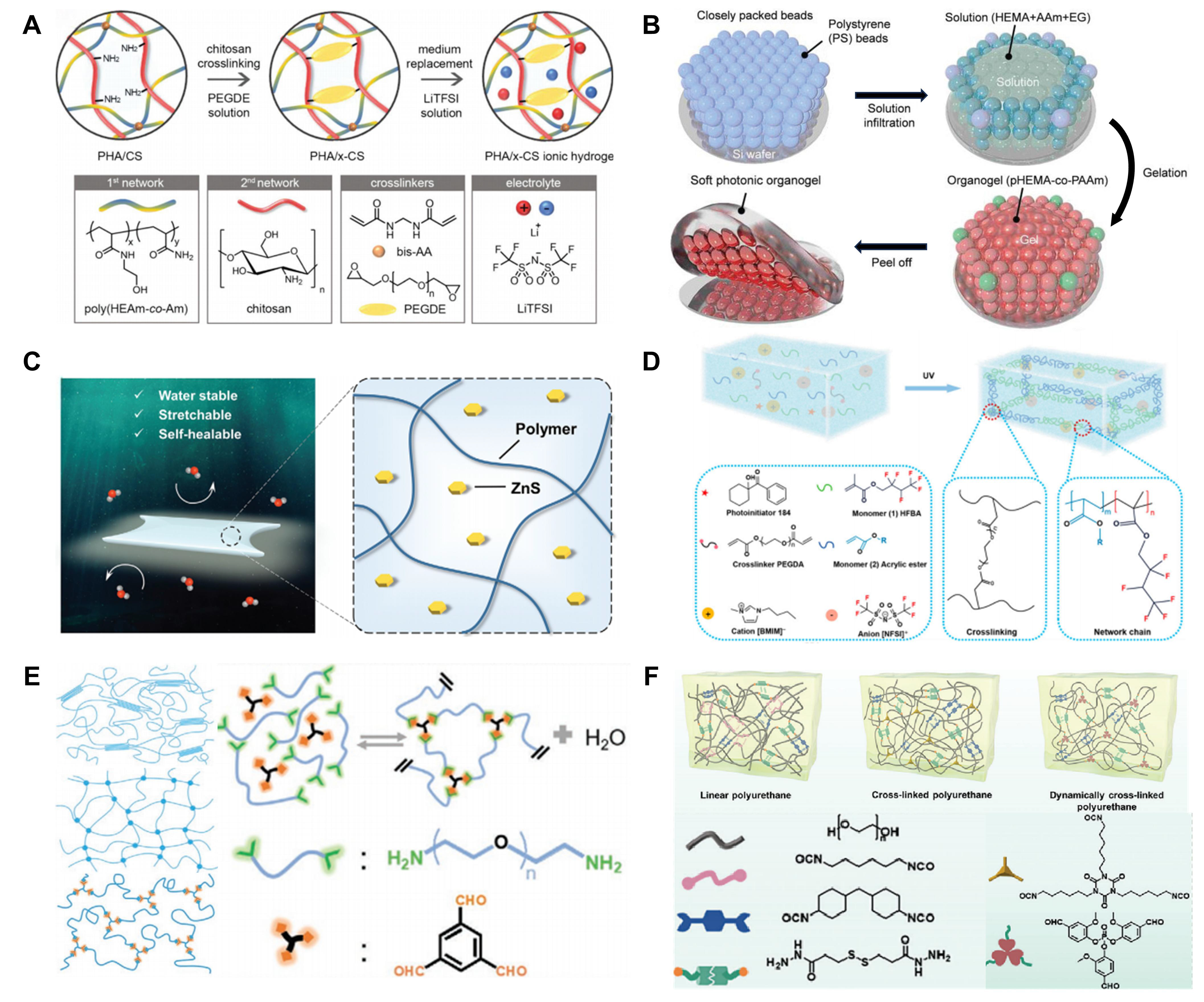
Figure 4. Materials for Stretchable Ionic Conductor Light-Emitting Devices. (A) Hydrogels. This figure is quoted with permission from Wiley[91]; (B) Organohydrogels. This figure is quoted with permission from Wiley[101]; (C and D) Ionogels. Figure 4C is quoted with permission from Wiley[108] and Figure 4D is quoted with permission from MDPI[109]; (E and F) Solvent-free Ionic Conductive Elastomers. These figures are quoted with permission from Wiley[114,115]. PEGDE: Poly(ethylene glycol) diglycidyl ether; PHA/x-CS: poly (N-hydroxyethyl acrylamide-co-Am)/crosslinked chitosan; PEGDA: Poly(ethylene glycol) diacrylate;PHA/CS: Poly(N-hydroxyethyl acrylamide-co-acrylamide)/chitosan; poly(HEAm-co-Am): Poly(N-hydroxyethyl acrylamide-co-acrylamide);pHEMA-co-pAAm: Poly(2-hydroxyethyl methacrylate-co-acrylamide); HEAm: N-hydroxyethyl acrylamide; Am/AAm: Acrylamide (Used interchangeably depending on the cited source); HEMA: 2-hydroxyethyl methacrylate;LiTFSI: Lithium bis(trifluoromethanesulfonyl)imide; EG: ethylene glycol; UV: ultraviolet.
Hydrogels and organohydrogels
These materials utilize solvents (water or organic solvents) as carriers for ion transport, possessing extremely high intrinsic conductivity and optical transparency. Research focus has shifted from early simple aqueous systems to solving volatility and freezing issues through solvent engineering, as well as enhancing dielectric performance through network design.
As a foundational work in this field, Keplinger et al. selected PAAm as the polymer network and dissolved high concentrations of LiCl or sodium chloride to prepare ionic conductors that are highly transparent in the visible range and capable of withstanding high voltages (> 10 kV) and wide frequencies (> 10 kHz)[16]. This work systematically revealed for the first time the unique advantage of ionic conductors over electronic conductors [such as indium tin oxide(ITO) and silver nanowires] under stretching - specifically, their sheet resistance increases far less than that of electronic conductors with increasing strain - establishing their core status in transparent flexible actuators and light-emitting devices.
To further address the issue of device failure caused by hydrogel fracture under high strain, Go et al. proposed a DN toughening strategy[91]. They interpenetrated poly(N-hydroxyethylacrylamide-co-acrylamide) with a physically crosslinked chitosan network and soaked it in a LiTFSI solution. The prepared hydrogel not only maintained excellent transmittance (> 99%) but also achieved an astounding fracture elongation of over 1,400% and a high conductivity of 1.95 S·m-1. This result demonstrated that through the design of a sacrificial network for energy dissipation, crack propagation can be effectively prevented, thereby constructing ultra-stretchable ACEL devices capable of adapting to extreme deformations. Building on this,Fang et al. adopted a biomimetic approach inspired by the microstructure of human skin to design an Agar/PAAm DN hydrogel featuring surface microstructures[99]. This microstructured design not only endowed the material with exceptional mechanical robustness but also significantly enhanced interfacial contact stability, offering a universal structural solution to the challenge of interfacial delamination in multilayer stretchable devices under large deformations.
Addressing the inherent limitations of hydrogels drying out in air and freezing at low temperatures, organogels emerged. Wanget al. discarded water solvents and instead used propylene carbonate (PC), which has a high boiling point and high dielectric constant, to dissolve lithium perchlorate (LiClO4), using PMMA as the backbone to develop a completely water-free, transparent ionic conductive organogel[100]. This material effectively addressed the solvent volatility problem, allowing ACEL devices based on it to work stably in air for long periods and maintain luminescence even when stretched to 700%, defining a new standard for “extremely stretchable” light-emitting devices.
In terms of multifunctional integration, Kimet al. utilized a binary solvent system of ethylene glycol (EG) and water to construct a poly(HEMA-co-AAm) organohydrogel[101]. Leveraging the low vapor pressure of EG, this material not only achieved long-term resistance to drying but also served as a non-volatile matrix filled within a photonic crystal structure, successfully constructing a synesthetic soft device integrating “visual color change” and “auditory sound generation”, showcasing the potential of ionic conductors in complex multimodal interaction interfaces. Zhu et al. further optimized the organohydrogel formulation by using binary solvents to disrupt hydrogen bond crystallization, preparing an anti-freezing gel that remains unfrozen, highly conductive, and flexible at -20 °C[102]. They integrated this material as an electrode with a single-electrode triboelectric nanogenerator (TENG) to realize a self-powered anti-freezing light-emitting system, greatly broadening the application range of stretchable optoelectronic devices in harsh cold environments such as polar expeditions.
Yabuta et al. explored the mechanism of EFC based on the valence change of europium (Eu) complexes[103]. By utilizing polyethylene glycol (PEG) oligomers as the ion transport medium, they achieved reversible fluorescence modulation. This work enriches the optical interaction modalities of soft light-emitting devices, demonstrating that within organogel systems, multi-dimensional control of color and fluorescence - -extending beyond simple intensity modulation - can be realized through the ionic regulation of metal center valence states.
Beyond serving as electrodes, gels are also used as emitting layer matrices. Liuet al. recently reported a breakthrough work where they synthesized a novel gel based on the copolymer of 4-acryloylmorpholine (ACMO) and 4-vinyl-1,3-dioxolan-2-one (VEC), denoted as P(ACMO-co-VEC) ,using PC/EC as solvents[31]. This gel possesses an ultra-high dielectric constant (high-κ) of 56.8 (@ 1 kHz), far exceeding traditional elastomers. This characteristic allowed the ACEL device to achieve a record-low turn-on voltage of 13 V (0.19 V·µm-1) and an ultra-high luminance of 1,944.7 cd·m-2 under a low electric field. This work solved the safety hazard caused by the excessive driving voltage of traditional stretchable light-emitting devices, providing a brand-new material solution for low-power, wearable high-brightness displays.
Ionogels
Ionogels utilize ionic liquids (ILs) to replace molecular solvents, fundamentally solving volatility issues and endowing materials with extremely wide electrochemical windows and thermal stability. They are the preferred choice for high-performance light-emitting devices (especially Electrochemical Luminescence types).
In fundamental mechanism research, Moonet al. deeply investigated the specific impact of alkyl chain length in 1-alkyl-3-methylimidazolium bis(trifluoromethylsulfonyl)imide ([AMI][TFSI])-based ionogelsionogels on ECL device performance. Experiments revealed that as the alkyl chain on the imidazole cation grows, ionic mobility decreases, leading to increased turn-on voltage and slower luminescence response[104]. This discovery established a quantitative link between the microscopic structure of ionic liquids and macroscopic luminescent performance, providing important theoretical guidance for the rational design of electrolyte molecules in ECL devices.
In the exploration of the ultimate limits of device miniaturization, Yonemoto et al. fabricated LECs based on nanogap electrodes (Nano-LEC)[105]. By filling the nanoscale electrode gaps with ionic liquid, they revealed the ionic liquid-assisted carrier injection mechanism at the molecular level and achieved an ultra-low threshold voltage of approximately 2 V. This work not only validates the effectiveness of ionic conductive materials at the nanoscale but also provides an important physical model for the future development of ultra-low-power molecular-scale soft light sources.
To enhance wearability and comfort, Xuet al. adopted a unique “bottlebrush” polymer composite with ionic liquids[106]. The steric hindrance of the bottlebrush polymer side chains weakens inter-chain entanglement, giving the ionogel an extremely low Young’s modulus - comparable to biological tissue - while maintaining good elasticity. This design not only significantly reduced the mechanical impedance at the interface when contacting human skin but also maintained excellent ionic conductivity, making it an ideal material for constructing biocompatible human-machine interfaces.
Traditional ionogels are hydrophilic and susceptible to environmental humidity. Shi et al. pioneered the synthesis of an ionogel based on poly (ethyl acrylate) and a hydrophobic ionic liquid,1-butyl-2,3-dimethylimidazolium bis(trifluoromethylsulfonyl)imide ([BMMIm][TFSI])[107]. This material demonstrated excellent hydrophobicity and tolerance to extreme temperatures, maintaining stable ion transport even underwater or in acidic/alkaline environments, successfully demonstrating its reliability in the actuation of underwater soft robots.
Building on this, Liuet al. introduced a fluorinated polymer network to develop a self-healing hydrophobic ionogel[108]. Benefiting from the low surface energy of fluorine atoms and ion-dipole interactions, this material can operate stably for long periods in deep-sea, high-pressure, and high-salinity environments, and it can automatically repair its luminescent function after damage. Fan et al. further prepared an all-around ionogel combining high transparency (> 98%), resistance to water/hexane solvent washout, and a wide temperature range (-60 to 350 °C) by copolymerizing fluorinated monomers , specifically hexafluorobutyl methacrylate (HFBA) with fluorinated ionic liquids[109]. These works collectively prove that the “fluorination strategy” is the most effective pathway to enhance the environmental adaptability of ionogels for all-weather, all-terrain applications.
To address the issue of uneven large-area light emission caused by the low conductivity of ionic conductors, physical composite strategies have been widely adopted. In early attempts, Itoh et al.[110] proposed the physical gelation of ionic liquids using oxide nanoparticles (such as TiO2). This approach not only successfully transformed liquid ionic liquids into quasi-solid-state light-emitting gels, but the introduction of nanoparticles also served to enhance light scattering.
In the latest large-scale device designs, Fang et al. proposed an innovative hybrid electrode structure[111]. They used Liquid Metal to construct a highly conductive skeleton filled with transparent ionic nanocomposite gel. This hybrid structure maintained a high transmittance of 81.6% while reducing sheet resistance from thousands of ohms to the level of a few ohms, effectively eliminating the internal voltage drop (I*R drop) effect in large-size display panels and achieving large-area, high-brightness uniform luminescence.
Furthermore, in LEC applications, Yasujiet al. visualized the doping process of ionic liquids in the emitting layer using spectroscopic means, revealing how ion migration controls the turn-on delay and distribution of the emission zone[112]; Ertlet al. optimized the interaction between iridium complexes and ionic liquids, achieving high-stability red light emission, further expanding the potential of ionogels in high-end displays[113].
Solvent-free ionic conductive elastomers
To eliminate the risk of liquid-component leakage and enable fully integrated device fabrication, all-solid-state, solvent-free elastomers based on polymer-salt complexes have emerged as a cutting-edge research frontier.
In all-solid-state systems, high strength often implies low segmental mobility (i.e., low conductivity). Zhang et al. proposed a “dry” PEO-based elastomer (DC-PEO) crosslinked by dynamic imine bonds (Schiff base)[114]. The introduction of dynamic bonds effectively suppressed PEO crystallization and promoted segmental motion in amorphous regions, allowing the material to achieve a high room-temperature conductivity of 2.04 × 10⁻⁴ S·cm-1 in a completely solvent-free state, while maintaining 563% high stretchability and self-healing capability. Based on this material, they constructed all-solid-state, self-healing EL devices and TENG sensors, proving that solvent-free systems are fully capable of meeting the requirements of high-performance soft iontronic devices while eliminating leakage risks.
To further enhance the mechanical robustness of all-solid-state materials, Wanget al. designed a supramolecular elastomer based on polyurethane and lithium salts[115]. They ingeniously introduced multiple dynamic interactions such as hydrogen bonds, disulfide bonds, and metal-ligand coordination into the molecular chain, achieving an excellent synergy between high strength (1.48 MPa) and high toughness, along with room-temperature self-healing capabilities. This work demonstrated that the synergistic action of multiple dynamic bonds can overcome the traditional bottleneck limiting both the mechanical strength and conductive performance of all-solid-state ionic conductors. Importantly, this improvement is achieved without introducing any plasticizers.
Despite their safety and stability, solvent-free ICEs face inherent limitations regarding ion migration rates and interfacial compatibility. Unlike hydrogels where solvent molecules facilitate rapid ion transport, the conductivity of ICEs relies heavily on polymer segmental motion, which often restricts high-frequency response. Furthermore, the lack of solvent-induced wetting can lead to high interfacial impedance when integrated with emissive layers.
To address these challenges, current research has predominantly focused on chemical molecular engineering (e.g., dynamic covalent bonds). However, composite or hybrid strategies are emerging as a powerful alternative to simultaneously enhance conductivity and mechanical robustness. For instance, Wang et al. demonstrated a “soft-soft” composite strategy by utilizing liquid metal droplets to initiate polymerization and form conductive bridges, effectively decoupling ionic conductivity from mechanical stiffness[116]. More recently, nanofiller-reinforced systems, such as MXene/poly(ionic liquid) composite elastomers, have been reported to provide additional high-speed ion transport pathways via surface charges, achieving a breakthrough in overcoming the conductivity-strength trade-off[117]. Developing such hybrid strategies to optimize both bulk transport and interfacial contact represents a critical frontier for next-generation solid-state displays.
While hydrogels, ionogels, and solvent-free elastomers each offer distinct advantages, the trajectory of materials development over the next five years will likely prioritize the synergistic optimization of existing systems rather than the discovery of entirely new ionic conduction media. For hydrogels and organohydrogels, the primary challenge remains balancing extreme environmental tolerance (e.g., anti-freezing and anti-drying properties) with biocompatibility. Future efforts must focus on locking volatile solvents within robust networks without compromising ionic mobility. For ionogels, research should pivot toward reducing the cost of ionic liquids and enhancing mechanical tunability to match soft biological tissues. Finally, for emerging solvent-free ionic conductive elastomers (ICEs), the most critical performance limitation to address is the intrinsic trade-off between mechanical robustness and ionic conductivity. Breaking this coupling through molecular engineering - such as dynamic supramolecular decoupling - will be the key to realizing high-frequency, fast-response solid-state ionotronics.
CHALLENGES AND PROSPECTS
Stretchable light-emitting devices based on ionic conduction exhibit remarkable potential owing to their unique physicochemical properties. These devices typically integrate redox-active luminophores within soft ionic conductive matrices - such as gels or elastomers - which not only overcome the mechanical fragility of conventional rigid displays under dynamic deformation but also offer simplified structures, low power consumption, and high compatibility with flexible electronics fabrication. Such attributes make them ideal platforms for printed electronics and large-area manufacturing. The comprehensive landscape of these devices, spanning their current deployment, persistent challenges, and prospective applications, is illustrated in Figure 5. Compared with OLEDs that require complex multilayer architectures and precise electrode work-function matching, these ionic devices typically adopt a sandwich configuration, substantially relaxing constraints on film thickness uniformity and surface roughness. Furthermore, their ability to operate at low alternating voltages while remaining insensitive to electrode work functions greatly expands the library of compatible transparent electrode materials, including metal nanowires and carbon nanotubes.
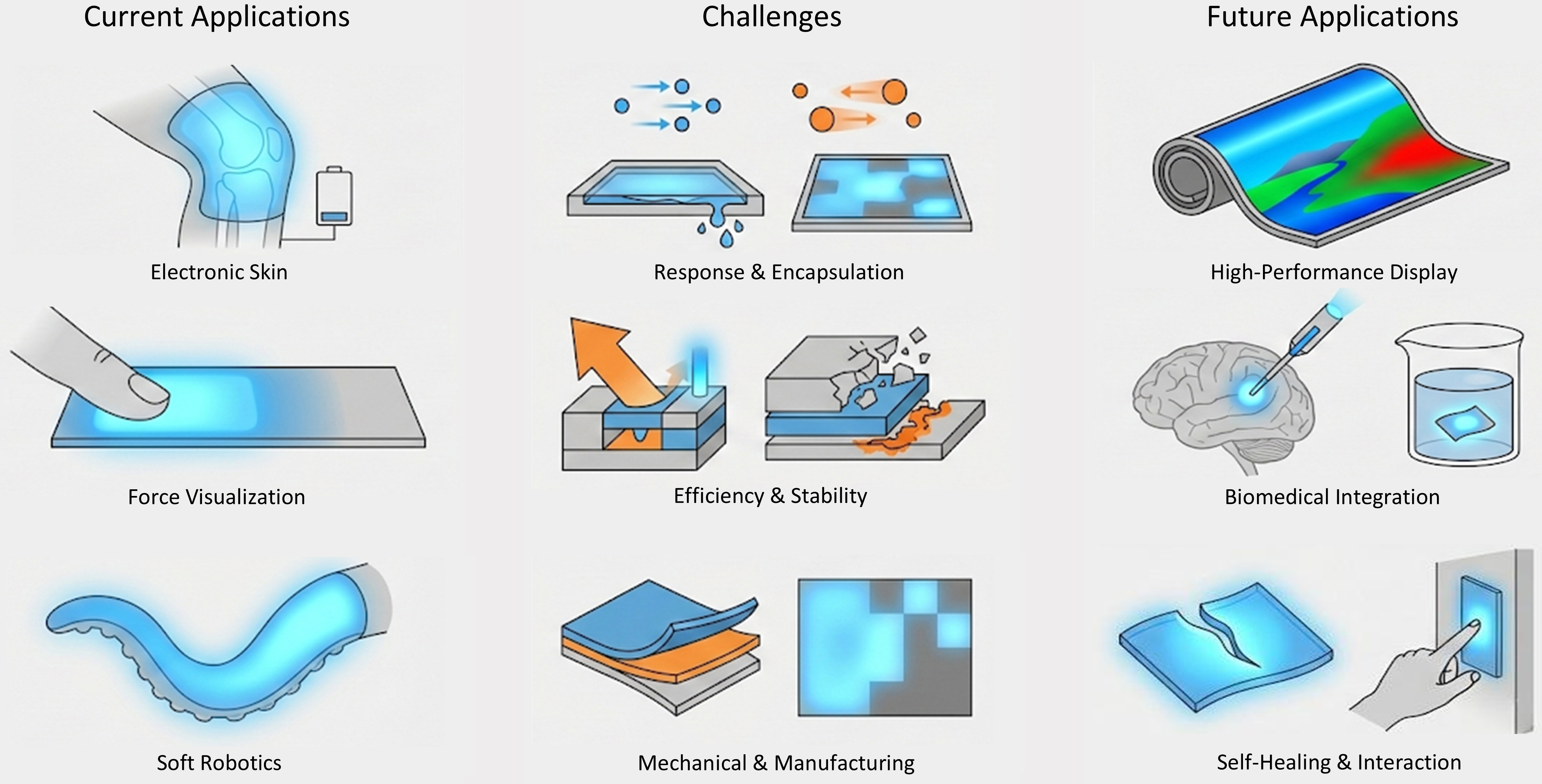
Figure 5. Prospects of ion-conductive stretchable light-emitting devices.
In the realms of wearable electronics and e-skin, devices utilizing ion gels or hydrogel electrolytes achieve stretchability far surpassing that of traditional light-emitting materials. They can conformally adhere to dynamic curvilinear surfaces, such as human skin or joints, thereby transducing mechanical stimuli - including pressure and strain - directly into real-time luminescent signals. This capability offers novel visualization pathways for health monitoring, prosthetic sensory feedback, and augmented reality (AR) interactions. Regarding biomedical applications and integrated devices, the mixed electronic/ionic transport characteristics inherent to conductive polymers and ionic media facilitate efficient coupling with ionic signals within biological tissues, paving the way for the development of low-impedance, highly biocompatible implantable light-emitting probes. Such devices must meet stringent in vivo stability requirements, including a low Young’s modulus (< 100 kPa) to match soft tissue, minimal immunogenicity, and long-term structural integrity within physiological saline environments[118]. Recent studies involving neural devices equipped with OLEDs have demonstrated robust tissue integration and effective modulation of neural activity via optical stimulation in murine models, validating the potential of flexible light-emitting devices as interfaces for optogenetic stimulation. In the field of soft robotics and autonomous systems, these devices not only function as flexible epidermal layers for visual feedback but can also be endowed with self-healing capabilities through the incorporation of dynamic bonds (e.g., hydrogen bonds or metal coordination bonds), significantly enhancing system durability in complex environments. The integration of artificial intelligence and machine learning is poised to inject new momentum into this field; for instance, by mimicking biological neural information processing, e-skins could be endowed with rapid object recognition capabilities. This would augment real-time feedback and adaptability in scenarios such as robotic grasping and prosthetic control, advancing tactile sensing systems toward greater efficiency, biomimicry, and practicality[119,120].
However, despite this promising outlook, the transition of this technology from the laboratory to mass commercialization faces a series of formidable scientific, engineering, and non-technical challenges. At the scientific level, the photoelectric conversion efficiency of current devices remains generally inferior to mature OLED technology. This is particularly evident in blue-emitting materials, where the highest reported External Quantum Efficiency (EQE) hovers between 5% and 8%[42], creating a significant bottleneck in achieving efficient, balanced full-color displays. This performance gap is attributed primarily to the scarcity of efficient blue electrochemical luminescent materials and energy dissipation during ion transport, rather than fundamental theoretical limits. This gap may be narrowed through optimized molecular design of luminophores - such as the development of TADF materials - and architectural improvements, including multilayer or host-guest doping systems. Furthermore, many luminophores (e.g., ruthenium complexes, QDs) are prone to structural degradation during long-term electrochemical cycling. Additionally, interfacial side reactions induced by ion migration can lead to luminance decay and electrode corrosion, severely compromising device longevity. The inherently slower rate of ion migration compared to electron transport also constrains response speed; high-frequency driving can induce charge accumulation and concentration polarization, which not only diminishes reaction kinetics but may also generate Joule heating, accelerating material aging.
From an engineering perspective, stability and encapsulation represent critical hurdles. Water-based or liquid electrolytes are susceptible to volatilization or leakage, and while ion gels offer improvements, they remain sensitive to environmental humidity. Achieving reliable oxygen and moisture barrier encapsulation under repeated mechanical deformation remains a major engineering challenge. During cyclic stretching, conventional barrier layers are prone to cracking or delamination, which significantly increases gas permeability and accelerates device degradation. Therefore, encapsulation materials must simultaneously provide effective environmental protection while deforming synchronously with the underlying functional layers.Regarding manufacturing processes, although techniques such as printing and electrospinning offer potential for mass production, persistent issues such as pixel crosstalk and low yield remain prevalent in the context of large-area uniform film formation, nanoscale precision control, and multi-pixel array integration. Additionally, modulus mismatch between the light-emitting layer and the electrode layer can induce interfacial delamination or crack propagation during cyclic stretching, thereby undermining mechanical durability. Beyond technical bottlenecks, the field lacks unified standards for performance characterization and testing. Disparate evaluation methodologies utilized by different research groups regarding brightness, efficiency, and stretchable lifespan impede objective performance comparison and technological advancement.
CONCLUSION
In summary, stretchable ionic-conduction light-emitting devices represent a transformative direction in flexible electronics, with the potential to reshape HMI and healthcare. While challenges in efficiency, longevity, and scalability remain, continued advances at the intersection of materials science and micro/nanoengineering - specifically in luminophore design, interfacial stabilization, and eco-friendly materials - are steadily progressing. Future research will focus on constructing multifunctional integrated systems, ultimately advancing an intelligent interaction paradigm that seamlessly integrates humans, machines, and environments.
DECLARATIONS
Authors’ contributions
Conceptualization and supervision: Hou, C.
Made substantial contributions to writing the paper: Du, Z.; Wang, Z.; Wang S.
Investigation, original draft, and figure editing: Du, Z.; Wang, Z.; Wang S.; Liu, Z.
Manuscript revision: Li, Z.; Hou, C.
Availability of data and materials
Not applicable.
AI and AI-assisted tools statement
Not applicable.
Financial support and sponsorship
This work was funded by the Hubei Provincial Natural Science Foundation of China (Grant No. 2025AFD615) and the Science, Technology and Innovation Commission of Shenzhen Municipality (Grant No. JCYJ20240813153401002).
Conflicts of interest
All authors declared that there are no conflicts of interest.
Ethical approval and consent to participate
Not applicable.
Consent for publication
Not applicable.
Copyright
© The Author(s) 2026.
REFERENCES
1. Pyun, K. R.; Park, J. J.; Ahn, J.; et al. Skin-integrated soft wearable xr interfaces for seamless and realistic user experience. Chem. Rev. 2025, 125, 11567-665.
2. Prunkl, C. Human autonomy in the age of artificial intelligence. Nat. Mach. Intell. 2022, 4, 99-101.
3. Wang, S.; Xu, J.; Wang, W.; et al. Skin electronics from scalable fabrication of an intrinsically stretchable transistor array. Nature 2018, 555, 83-8.
4. Zeng, K.; Shi, X.; Tang, C.; Liu, T.; Peng, H. Design, fabrication and assembly considerations for electronic systems made of fibre devices. Nat. Rev. Mater. 2023, 8, 552-61.
5. Lee, Y.; Cho, H.; Yoon, H.; et al. Advancements in electronic materials and devices for stretchable displays. Adv. Mater. Technol. 2023, 8, 2201067.
6. Pennetta, C.; Trefan, G.; Reggiani, L. Scaling law of resistance fluctuations in stationary random resistor networks. Phys. Rev. Lett. 2000, 85, 5238-41.
7. Mohd Radzuan, N. A.; Sulong, A. B.; Sahari, J. A review of electrical conductivity models for conductive polymer composite. Int. J. Hydrogen. Energy. 2017, 42, 9262-73.
8. Liu, W.; Wang, G.; Wang, S. Intrinsically stretchable electroluminescent materials and devices. CCS. Chem. 2024, 6, 1360-79.
10. Lei, C.; He, J.; Chen, W.; Kong, X.; Wen, L. Biotic iontronics: foundations for the direct biotic-abiotic communication and modulation. Iontronics 2026, 2, 8.
11. Xu, C. From nature’s masters of camouflage to engineered optics: cephalopod-inspired materials and technologies. J. Mater. Chem. C. 2025, 13, 21275-301.
12. Larson, C.; Peele, B.; Li, S.; et al. Highly stretchable electroluminescent skin for optical signaling and tactile sensing. Science 2016, 351, 1071-4.
13. Bisri, S. Z.; Shimizu, S.; Nakano, M.; Iwasa, Y. Endeavor of iontronics: from fundamentals to applications of ion-controlled electronics. Adv. Mater. 2017, 29, 1607054.
14. Schott, C. M.; Schneider, P. M.; Song, K. T.; et al. How to assess and predict electrical double layer properties. implications for electrocatalysis. Chem. Rev. 2024, 124, 12391-462.
15. Jayathilaka, W. A. D. M.; Chinnappan, A.; Tey, J. N.; Wei, J.; Ramakrishna, S. Alternative current electroluminescence and flexible light emitting devices. J. Mater. Chem. C. 2019, 7, 5553-72.
16. Keplinger, C.; Sun, J. Y.; Foo, C. C.; Rothemund, P.; Whitesides, G. M.; Suo, Z. Stretchable, transparent, ionic conductors. Science 2013, 341, 984-7.
17. Yiming, B.; Jia, Z.; Creton, C. Stretchable ionic conductors: balancing mechanical properties and ionic conductivity. Chem. Rev. 2025, 125, 10457-91.
18. Someya, T.; Bao, Z.; Malliaras, G. G. The rise of plastic bioelectronics. Nature 2016, 540, 379-85.
19. Wang, M. Ionogels: From Properties and Synthesis to Toughening, Patterning, and Applications. Chem. Rev. 2025, 125, 11815-39.
20. Zhang, Z.; Bao, Z. High luminescent polymers for stretchable displays. Natl. Sci. Rev. 2023, 10, nwac093.
22. Park, J. M.; Lim, S.; Sun, J. Y. Materials development in stretchable iontronics. Soft. Matter. 2022, 18, 6487-510.
23. Wang, M.; Hu, J.; Dickey, M. D. Tough ionogels: synthesis, toughening mechanisms, and mechanical properties - a perspective. JACS. Au. 2022, 2, 2645-57.
24. Son, D.; Kang, J.; Vardoulis, O.; et al. An integrated self-healable electronic skin system fabricated via dynamic reconstruction of a nanostructured conducting network. Nat. Nanotechnol. 2018, 13, 1057-65.
25. Li, P.; Jiao, Y.; Huang, J.; Chen, S. Electric double layer effects in electrocatalysis: insights from ab initio simulation and hierarchical continuum modeling. JACS. Au. 2023, 3, 2640-59.
26. Liu, Y.; Peng, P.; Qian, H.; Wang, Z. L.; Wei, D. Nanoconfined iontronics and its electronic applications. Nano. Research. Energy. 2025, 4, e9120156.
27. Jiang, W.; Lee, S.; Zan, G.; Zhao, K.; Park, C. Alternating current electroluminescence for human-interactive sensing displays. Adv. Mater. 2024, 36, e2304053.
28. Li, X.; Wang, Z. L.; Wei, D. Scavenging energy and information through dynamically regulating the electrical double layer. Adv. Funct. Mater. 2024, 34, 2405520.
29. Li, X.; Cheng, T.; Wang, Z. L.; Wei, D. Neuromimetic circuits enabled by dynamic regulation of the electrical double layer. npj. Flex. Electron. 2025, 9, 66.
30. Kim, C. Y.; Myung, J. H.; Sun, J. Y.; Yu, W. R. Highly stretchable, conductive, and transparent PDMS island-continuous PEDOT:PSS matrix composite electrodes. Adv. Mater. Technol. 2023, 8, 2300129.
31. Liu, Z.; Liu, Z.; Lei, X.; Yang, Y.; Jing, T. Ultra low-field-emission stretchable electroluminescent devices enabled by a transparent and high-κ dielectric gel. Nat. Commun. 2025, 16, 11190.
32. Von Szczepanski, J.; Wolf, J.; Hu, W. H.; et al. High-permittivity polysiloxanes for bright, stretchable electroluminescent devices. Adv. Opt. Mater. 2024, 12, 2400132.
33. Zhu, Y.; Hong, A.; Yoon, S.; et al. Bright bifacial white-light illumination by highly deformable electroluminescent devices based on transparent ionic-hydrogel electrodes and quantum-dot color conversion. Small 2024, 20, e2400704.
34. Park, J.; Singh, S.; Yoon, J. 3D printing of deformable multicolor alternating-current electroluminescent devices through rational design of functional inks. Small 2025, 21, e2502435.
35. Yao, Y.; Hui, Y.; Wang, Z.; Chen, H.; Zhu, H.; Zhou, N. Granular ionogel particle inks for 3d printed tough and stretchable ionotronics. Research. (Wash. D. C). 2023, 6, 0104.
36. Shi, X.; Zuo, Y.; Zhai, P.; et al. Large-area display textiles integrated with functional systems. Nature 2021, 591, 240-5.
37. Kirch, A.; Park, S. R.; Ràfols-Ribé, J.; et al. Impact of the electrode material on the performance of light-emitting electrochemical cells. ACS. Appl. Mater. Interfaces. 2025, 17, 5184-92.
38. Leong, K. K.; Kim, H. J.; Morice, K.; et al. Metal-free benzothioxanthene imide based dyes for organic light‐emitting electrochemical cells. Adv. Opt. Mater. 2024, 12, 2401700.
39. Schlingman, K.; Chen, Y.; Carmichael, R. S.; Carmichael, T. B. 25 years of light-emitting electrochemical cells: a flexible and stretchable perspective. Adv. Mater. 2021, 33, e2006863.
40. Youssef, K.; Li, Y.; O'keeffe, S.; Li, L.; Pei, Q. Fundamentals of materials selection for light-emitting electrochemical cells. Adv. Funct. Mater. 2020, 30, 1909102.
41. Tang, S.; Sandström, A.; Lundberg, P.; et al. Design rules for light-emitting electrochemical cells delivering bright luminance at 27.5 percent external quantum efficiency. Nat. Commun. 2017, 8, 1190.
42. Lundberg, P.; Tsuchiya, Y.; Lindh, E. M.; Tang, S.; Adachi, C.; Edman, L. Thermally activated delayed fluorescence with 7% external quantum efficiency from a light-emitting electrochemical cell. Nat. Commun. 2019, 10, 5307.
43. Mindemark, J.; Tang, S.; Li, H.; Edman, L. Ion transport beyond the polyether paradigm: introducing oligocarbonate ion transporters for efficient light-emitting electrochemical cells. Adv. Funct. Mater. 2018, 28, 1801295.
44. Filiatrault, H. L.; Porteous, G. C.; Carmichael, R. S.; Davidson, G. J.; Carmichael, T. B. Stretchable light-emitting electrochemical cells using an elastomeric emissive material. Adv. Mater. 2012, 24, 2673-8.
45. Tang, S.; Dos Santos, J. M.; Ràfols‐ribé, J.; Wang, J.; Zysman‐colman, E.; Edman, L. Introducing MR-TADF emitters into light-emitting electrochemical cells for narrowband and efficient emission. Adv. Funct. Mater. 2023, 33, 2306170.
46. Xu, J.; Sandström, A.; Lindh, E. M.; Yang, W.; Tang, S.; Edman, L. Challenging conventional wisdom: finding high-performance electrodes for light-emitting electrochemical cells. ACS. Appl. Mater. Interfaces. 2018, 10, 33380-9.
47. Zimmermann, J.; Porcarelli, L.; Rödlmeier, T.; Sanchez‐Sanchez, A.; Mecerreyes, D.; Hernandez‐Sosa, G. Fully printed light-emitting electrochemical cells utilizing biocompatible materials. Adv. Funct. Mater. 2017, 28, 1705795.
48. Gellner, S.; Auroux, E.; Ràfols-ribé, J.; et al. Stretchable light-emitting electrochemical cells fabricated by spray-coating. J. Mater. Chem. C. 2025, 13, 14518-26.
49. Chen, Z.; Xu, H.; Pan, C.; Bao, R. Electrochemiluminescent devices: structural composition, preparation process and applications for flexible/stretchable displays. Wearable. Electronics. 2025, 2, 149-70.
50. Kim, T.; Choi, H.; Choi, H.; Kim, J. S.; Kim, D. H.; Jeong, U. Skin-inspired electrochemical tactility and luminescence. Electrochim. Acta. 2022, 415, 140259.
51. Kim, W.; Lee, K.; Choi, S.; et al. Electrochemiluminescent tactile visual synapse enabling in situ health monitoring. Nat. Mater. 2025, 24, 925-34.
52. Zhu, X.; Zheng, L.; Liu, J.; Xiao, K. Soft iontronics for neuromorphic vision: from biological mechanisms to bio-integrated applications. Adv. Mater. Technol. 2025, 11, e01963.
53. Moon, H. C.; Lodge, T. P.; Frisbie, C. D. Solution-processable electrochemiluminescent ion gels for flexible, low-voltage, emissive displays on plastic. J. Am. Chem. Soc. 2014, 136, 3705-12.
54. Hwang, H.; Park, S. Y.; Kim, J. K.; Kim, Y. M.; Moon, H. C. star-shaped block copolymers: effective polymer gelators of high-performance gel electrolytes for electrochemical devices. ACS. Appl. Mater. Interfaces. 2019, 11, 4399-407.
55. Kwon, D.; Myoung, J. Ion gel-based flexible electrochemiluminescence full-color display with improved sky-blue emission using a mixed-metal chelate system. Chem. Eng. J. 2020, 379, 122347.
56. Chen, Z.; Zhou, R.; Huang, J.; et al. Straininsensitive pre-stretch-stabilized polymer/gold hybrid electrodes for electrochemiluminescent devices. Adv. Funct. Mater. 2024, 34, 2406434.
57. Song, J. H.; Kim, Y. T.; Cho, S.; et al. Surface-embedded stretchable electrodes by direct printing and their uses to fabricate ultrathin vibration sensors and circuits for 3D structures. Adv. Mater. 2017, 29, 1702625.
58. Hong, K.; Kwon, Y. K.; Ryu, J.; Lee, J. Y.; Kim, S. H.; Lee, K. H. Self-supporting ion gels for electrochemiluminescent sticker-type optoelectronic devices. Sci. Rep. 2016, 6, 29805.
59. Hong, K.; Cho, K. G.; Lim, D. C.; Lee, J. Y.; Lee, K. H. Light emitting fabrics based on luminophore dye-doped ion gel electrolyte microfibers. Dyes. Pigm. 2018, 154, 188-93.
60. Kim, S.; Kim, J. H.; Park, Y. H.; Kim, J. T.; Seol, S. K.; Pyo, J. All-printed electrically driven lighting via electrochemiluminescence. Adv. Mater. Technol. 2024, 9, 2302190.
61. Lee, J. I.; Choi, H.; Kong, S. H.; et al. Visco-poroelastic electrochemiluminescence skin with piezo-ionic effect. Adv. Mater. 2021, 33, e2100321.
62. Gu, C.; Jia, A. B.; Zhang, Y. M.; Zhang, S. X. Emerging electrochromic materials and devices for future displays. Chem. Rev. 2022, 122, 14679-721.
63. Li, M.; Wang, S.; Shen, R.; Xie, Y.; Zhang, Y.; Zhang, S. X. Intrinsically multi-color device based on dynamic cooperation of molecular switches and metal ions. Mater. Interfaces. 2025.
64. Wang, X.; Wen, L.; Ren, J.; et al. Gel-type electrofluorochromic devices for advanced optoelectronic applications. Gels 2025, 11, 673.
65. Yang, B.; Bai, H.; Li, C.; Zhang, Y. M.; Zhang, S. X. Biomimetic exploration and reflection on switchable coordination and narrow-band electrofluorochromic devices. Adv. Sci. (Weinh). 2024, 11, e2407219.
66. Adams, T. J.; Brotherton, A. R.; Molai, J. A.; et al. Obtaining reversible, high contrast electrochromism, electrofluorochromism, and photochromism in an aqueous hydrogel device using chromogenic thiazolothiazoles. Adv. Funct. Mater. 2021, 31, 2103408.
67. Kim, Y.; Kim, E.; Clavier, G.; Audebert, P. New tetrazine-based fluoroelectrochromic window; modulation of the fluorescence through applied potential. Chem. Commun. (Camb). 2006, 3612-4.
68. Chen, Q.; Shi, Y.; Sheng, K.; Zheng, J.; Xu, C. dynamically cross-linked hydrogel electrolyte with remarkable stretchability and self-healing capability for flexible electrochromic devices. ACS. Appl. Mater. Interfaces. 2021, 13, 56544-53.
69. Zhang, Y.; Guo, M.; Li, G.; et al. Ultrastable viologen ionic liquids-based ionogels for visible strain sensor integrated with electrochromism, electrofluorochromism, and strain sensing. CCS. Chem. 2023, 5, 1917-30.
70. Huang, R.; Cao, N.; Gu, G.; Jia, X.; Chao, D. A bifunctional electrochromic/electrofluorochromic ionic liquid enables displayable smart windows with high energy efficiency. Adv. Funct. Mater. 2025, 35, e11224.
71. Chou, H. H.; Nguyen, A.; Chortos, A.; et al. A chameleon-inspired stretchable electronic skin with interactive colour changing controlled by tactile sensing. Nat. Commun. 2015, 6, 8011.
72. Park, H.; Kim, D. S.; Hong, S. Y.; et al. A skin-integrated transparent and stretchable strain sensor with interactive color-changing electrochromic displays. Nanoscale 2017, 9, 7631-40.
73. Yang, C. H.; Chen, B.; Zhou, J.; Chen, Y. M.; Suo, Z. Electroluminescence of giant stretchability. Adv. Mater. 2016, 28, 4480-4.
74. Yang, B.; Yuan, W. Highly stretchable and transparent double-network hydrogel ionic conductors as flexible thermal-mechanical dual sensors and electroluminescent devices. ACS. Appl. Mater. Interfaces. 2019, 11, 16765-75.
75. Gao, H.; Chen, S.; Liang, J.; Pei, Q. Elastomeric light emitting polymer enhanced by interpenetrating networks. ACS. Appl. Mater. Interfaces. 2016, 8, 32504-11.
76. Yu, Z.; Niu, X.; Liu, Z.; Pei, Q. Intrinsically stretchable polymer light-emitting devices using carbon nanotube-polymer composite electrodes. Adv. Mater. 2011, 23, 3989-94.
77. Liu, J.; Wang, J.; Zhang, Z.; et al. Fully stretchable active-matrix organic light-emitting electrochemical cell array. Nat. Commun. 2020, 11, 3362.
78. Xie, P.; Mao, J.; Luo, Y. Highly bright and stable electroluminescent devices with extraordinary stretchability and ultraconformability. J. Mater. Chem. C. 2019, 7, 484-9.
79. Sekitani, T.; Nakajima, H.; Maeda, H.; et al. Stretchable active-matrix organic light-emitting diode display using printable elastic conductors. Nat. Mater. 2009, 8, 494-9.
80. Li, S.; Peele, B. N.; Larson, C. M.; Zhao, H.; Shepherd, R. F. A stretchable multicolor display and touch interface using photopatterning and transfer printing. Adv. Mater. 2016, 28, 9770-5.
81. Tan, Y. J.; Godaba, H.; Chen, G.; et al. A transparent, self-healing and high-κ dielectric for low-field-emission stretchable optoelectronics. Nat. Mater. 2020, 19, 182-8.
82. Liang, G.; Liu, Z.; Mo, F.; et al. Self-healable electroluminescent devices. Light. Sci. Appl. 2018, 7, 102.
83. Dinh Xuan, H.; Timothy, B.; Park, H. Y.; et al. Super stretchable and durable electroluminescent devices based on double-network ionogels. Adv. Mater. 2021, 33, e2008849.
84. Zhang, M.; Chen, R.; He, Z.; et al. A stretchable and self-healable all-in-one iontronic elastomer for luminescent caution and multiple perceptions. Polymer 2022, 249, 124837.
85. Kwon, J. H.; Kim, Y. M.; Moon, H. C. Porous ion gel: a versatile ionotronic sensory platform for high-performance, wearable ionoskins with electrical and optical dual output. ACS. Nano. 2021, 15, 15132-41.
86. Yang, B.; Yuan, W. Highly stretchable, adhesive, and mechanical zwitterionic nanocomposite hydrogel biomimetic skin. ACS. Appl. Mater. Interfaces. 2019, 11, 40620-8.
87. Wang, M.; Li, R.; Feng, X.; et al. Cellulose nanofiber-reinforced ionic conductors for multifunctional sensors and devices. ACS. Appl. Mater. Interfaces. 2020, 12, 27545-54.
88. Yang, C.; Cheng, S.; Yao, X.; Nian, G.; Liu, Q.; Suo, Z. Ionotronic luminescent fibers, fabrics, and other configurations. Adv. Mater. 2020, 32, e2005545.
89. Zhang, Z.; Cui, L.; Shi, X.; et al. Textile display for electronic and brain-interfaced communications. Adv. Mater. 2018, 30, e1800323.
90. Yin, T.; Wu, L.; Wu, T.; et al. Ultrastretchable and conductive core/sheath hydrogel fibers with multifunctionality. J. Polym. Sci. B. Polym. Phys. 2019, 57, 272-80.
91. Go, Y.; Park, H. Y.; Zhu, Y.; et al. Optically transparent and mechanically robust ionic hydrogel electrodes for bright electroluminescent devices achieving high stretchability over 1400%. Adv. Funct. Mater. 2023, 33, 2215193.
92. Wang, T.; Chu, Y.; Fang, Y.; Liu, Z. Stretchable alternating current electroluminescent fiber based on transparent and highly conductive dual-network imidazolium chloride ion-gel electrodes for wearable display applications. J. Mater. Chem. C. 2025, 13, 3482-92.
93. Tan, H.; Sun, L.; Huang, H.; et al. Continuous melt spinning of adaptable covalently cross-linked self-healing ionogel fibers for multi-functional ionotronics. Adv. Mater. 2024, 36, e2310020.
94. Fu, X.; Wan, G.; Guo, H.; et al. Self-healing actuatable electroluminescent fibres. Nat. Commun. 2024, 15, 10498.
95. Liu, D.; Ren, J.; Wang, J.; et al. Customizable and stretchable fibre-shaped electroluminescent devices via mulitcore-shell direct ink writing. J. Mater. Chem. C. 2020, 8, 15092-8.
96. Li, W.; Lu, Z.; Zhang, Y.; et al. Recyclable and healable electro-optical fiber for sensing and information transmission. Adv. Funct. Mater. 2025, 35, 2423596.
97. Zhang, Z.; Shi, X.; Lou, H.; et al. A stretchable and sensitive light-emitting fabric. J. Mater. Chem. C. 2017, 5, 4139-44.
98. Oh, S. J.; Choi, S. E.; Woo, I.; Yoon, J. U.; Bae, J.; Bae, J. W. Stretchable multicolored electroluminescent sound display for wearable and interactive textiles. Adv. Funct. Mater. 2025, 35, 2420432.
99. Fang, L.; Cai, Z.; Ding, Z.; et al. Skin-inspired surface-microstructured tough hydrogel electrolytes for stretchable supercapacitors. ACS. Appl. Mater. Interfaces. 2019, 11, 21895-903.
100. Wang, J.; Yan, C.; Cai, G.; Cui, M.; Lee-Sie Eh, A.; See Lee, P. Extremely stretchable electroluminescent devices with ionic conductors. Adv. Mater. 2016, 28, 4490-6.
101. Kim, D. Y.; Choi, S.; Cho, H.; Sun, J. Y. Electroactive soft photonic devices for the synesthetic perception of color and sound. Adv. Mater. 2019, 31, e1804080.
102. Zhu, Y.; Xia, Y.; Wu, M.; Guo, W.; Jia, C.; Wang, X. Wearable, freezing-tolerant, and self-powered electroluminescence system for long-term cold-resistant displays. Nano. Energy. 2022, 98, 107309.
103. Yabuta, R.; Kobayashi, N.; Nakamura, K. Electrofluorochromism based on the valence change of europium complexes in electrochemical devices with Prussian blue as the counter electrode. Phys. Chem. Chem. Phys. 2024, 26, 28800-7.
104. Moon, H. C.; Lodge, T. P.; Frisbie, C. D. Electrochemiluminescent displays based on ion gels: correlation between device performance and choice of electrolyte. J. Mater. Chem. C. 2016, 4, 8448-53.
105. Yonemoto, R.; Ueda, R.; Otomo, A.; Noguchi, Y. Light-emitting electrochemical cells based on nanogap electrodes. Nano. Lett. 2023, 23, 7493-9.
106. Xu, P.; Challa, S.; Zhang, Z.; et al. Ultrasoft, elastic, and ionically conductive polyethylene glycol/ionic liquid bottlebrush ionogels. Mater. Horiz. 2025, 12, 7425-38.
107. Shi, L.; Jia, K.; Gao, Y.; et al. Highly stretchable and transparent ionic conductor with novel hydrophobicity and extreme-temperature tolerance. Research. (Wash. D. C). 2020, 2020, 2505619.
108. Liu, Y.; Sun, L.; Feng, W.; Jin, Z.; Wang, C. A stable, self-healable, and stretchable dielectric polymer for electroluminescent device working underwater. Adv. Funct. Mater. 2024, 34, 2402453.
109. Fan, X.; Feng, W.; Wang, S.; Chen, Y.; Zheng, W. J.; Yan, J. Fluorine-containing ionogels with stretchable, solvent-resistant, wide temperature tolerance, and transparent properties for ionic conductors. Polymers. (Basel). 2024, 16, 1013.
111. Fang, T.; Zhang, J.; Cao, S.; et al. Hybrid liquid metal/ionic nanocomposite transparent electrodes for highly stretchable electroluminescent matrix displays. Adv. Funct. Mater. 2025, 35, 2417982.
112. Yasuji, K.; Sakanoue, T.; Yonekawa, F.; Kanemoto, K. Visualizing electroluminescence process in light-emitting electrochemical cells. Nat. Commun. 2023, 14, 992.
113. Ertl, C. D.; Momblona, C.; Pertegás, A.; et al. Highly stable red-light-emitting electrochemical cells. J. Am. Chem. Soc. 2017, 139, 3237-48.
114. Zhang, P.; Guo, W.; Guo, Z. H.; et al. Dynamically crosslinked dry ion-conducting elastomers for soft iontronics. Adv. Mater. 2021, 33, e2101396.
115. Wang, C.; Duan, X.; Li, X.; et al. A self-healing solid-state ion-conductive elastomer with high mechanical robustness and high conductivity for soft ionotronics. Adv. Funct. Mater. 2024, 34, 2402815.
116. Wang, M.; Lai, Z.; Jin, X.; Sun, T.; Liu, H.; Qi, H. Multifunctional liquid-free ionic conductive elastomer fabricated by liquid metal induced polymerization. Adv. Funct. Mater. 2021, 31, 2101957.
117. Li, Y.; Zhang, H.; Chang, J.; et al. Solvent-free MXene/poly(ionic liquid) composite elastomers with simultaneously improved mechanical and electrical properties for sensing and photothermal applications. Nano. Lett. 2025, 25, 9976-84.
118. Kim, D.; Yokota, T.; Suzuki, T.; et al. Ultraflexible organic light-emitting diodes for optogenetic nerve stimulation. Proc. Natl. Acad. Sci. U. S. A. 2020, 117, 21138-46.
119. Chen, L.; Karilanova, S.; Chaki, S.; et al. Spike timing-based coding in neuromimetic tactile system enables dynamic object classification. Science 2024, 384, 660-5.
Cite This Article
 Open Access
How to Cite
Download Citation
Export Citation File:
Type of Import
Tips on Downloading Citation
Citation Manager File Format
Type of Import
Direct Import: When the Direct Import option is selected (the default state), a dialogue box will give you the option to Save or Open the downloaded citation data. Choosing Open will either launch your citation manager or give you a choice of applications with which to use the metadata. The Save option saves the file locally for later use.
Indirect Import: When the Indirect Import option is selected, the metadata is displayed and may be copied and pasted as needed.
About This Article
Copyright

Data & Comments
Data
0





Comments
Comments must be written in English. Spam, offensive content, impersonation, and private information will not be permitted. If any comment is reported and identified as inappropriate content by OAE staff, the comment will be removed without notice. If you have any queries or need any help, please contact us at [email protected].