

Electronic structure modulation through superexchange in spinel oxides for simultaneous NOx and propane removal
 0
Graphical Abstract
Abstract
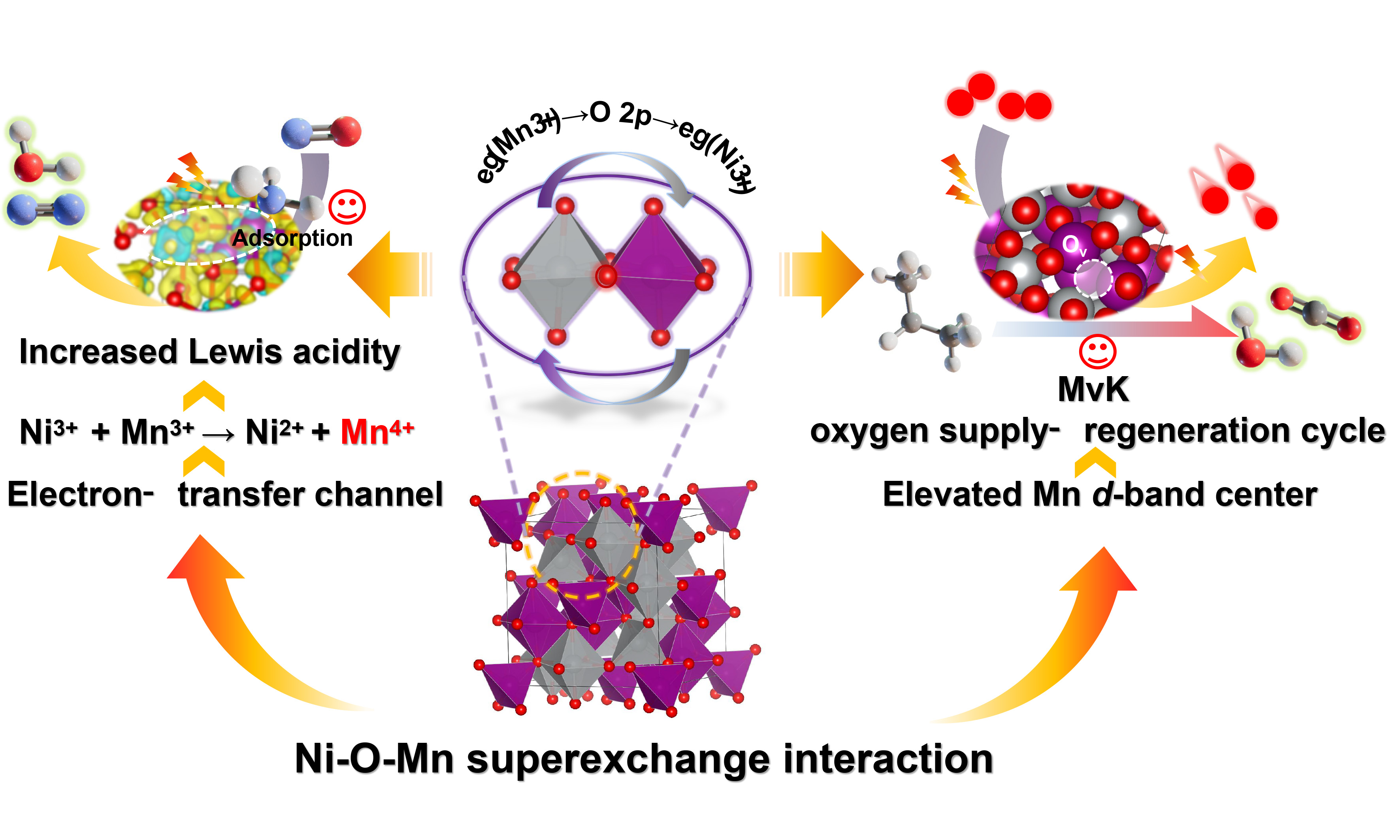
The coexistence of nitrogen oxides (NOx) and volatile organic compounds (VOCs) in industrial flue gases remains a significant challenge for air pollution control, necessitating the development of bifunctional catalysts capable of simultaneous removal. Herein, a series of Mn-based spinel catalysts was synthesized to investigate the role of A-O-Mn superexchange interactions in the simultaneous removal of NOx and C3H8. These interactions modulated the electronic structure of the catalysts and were associated with improved overall catalytic performance. Among the investigated catalysts, NiMn2O4 exhibited the best performance, achieving 91.4% C3H8 conversion and 92.8% NOx conversion simultaneously at 220 °C, along with the highest N2 selectivity and satisfactory SO2 resistance. Comprehensive experimental characterizations and density functional theory (DFT) calculations revealed that the superior catalytic performance originated from the Ni-O-Mn superexchange interaction. This interaction induced strong Nioct-O-Mnoct orbital connectivity, forming an efficient electron-transfer channel that stabilized surface Mn4+ species and enhanced Lewis acidity, thereby promoting the adsorption and activation of both NH3 and C3H8. Concurrently, the superexchange significantly elevated the Mn d-band center, lowering the oxygen vacancy formation energy
Keywords


 Download PDF
INTRODUCTION
The coexistence of nitrogen oxides (NOx) and volatile organic compounds (VOCs) in industrial flue gases has emerged as a critical challenge for air pollution control[1,2]. These pollutants are not only toxic and carcinogenic themselves but also serve as key precursors to ozone (O3) and particulate matter (PM2.5)[3-6]. Catalytic oxidation for the removal of VOCs and selective catalytic reduction (SCR) for NOx removal are widely recognized as the most effective end-of-pipe control technologies[7,8]. Consequently, the development of bifunctional catalysts capable of simultaneously and efficiently removing NOx and VOCs has become a frontier topic in the field of multipollutant simultaneous control.
Transition metal oxide catalysts have demonstrated considerable potential for simultaneous removal applications[9]. Manganese-based spinel oxides, in particular, have attracted substantial attention due to their excellent redox properties and wide range of accessible oxidation states, exhibiting great promise in both low-temperature SCR and the catalytic oxidation of VOCs[10,11]. Spinel oxides with the general formula AB2O4 consist of tetrahedral [AO4] and octahedral [BO6] coordination units, whose unique crystal structure endows them with high tunability in both chemical composition and electronic structure[12,13]. The A and B sites can simultaneously accommodate multiple transition metal cations, providing a versatile platform for tailoring catalytic performance through elemental doping strategies[14,15]. Previous studies have reported improved catalytic VOCs oxidation and NOx removal after the incorporation of two or more transition metals into spinel lattices, commonly attributing the improvement to synergistic interactions among the metals[16-18]. For instance, CoMn2O4, NiMn2O4, and CuMn2O4 spinels exhibited a pronounced A-site metal dependence in the synergistic catalytic degradation of benzene and toluene, with CuMn2O4 demonstrating far superior catalytic activity to CoMn2O4 and NiMn2O4[12]. Zhao et al. systematically investigated Mn-based spinels with different A-site metals (Cr, Fe, Co, Ni) for NH3-SCR and chlorobenzene oxidation, and reported that CrMn2O4 exhibited the best performance in both reactions[11]. However, the microscopic mechanisms by which A-site metals influence catalytic performance remain insufficiently understood.
In recent years, superexchange interaction has attracted considerable attention as an emerging strategy for modulating the electronic structure of transition metal oxides[19,20]. Superexchange interaction refers to the indirect exchange coupling between two transition metal ions mediated through an oxygen bridge (M1-O-M2), which effectively regulates the valence states, spin states, and orbital occupations of metal ions[21,22]. In the field of battery materials, Zheng et al. have demonstrated that superexchange interaction can modulate the Ni/Mn spin states and trigger the Ni t2g/O 2p reductive coupling mechanism, significantly enhancing the cycling stability of materials[23]. In the catalytic field, Wu et al. reported that the Fe3+-O-Mn3+ superexchange interaction in Fe2-xMnxO3 perovskite induced a threefold increase in the reaction rate constant for hexabromocyclododecane (HBCD) catalytic oxidation, accompanied by a valence change from Fe3+ + Mn3+ to Fe2+ + Mn4+[24]. More recently, Liu et al. identified two superexchange interactions in Mn-Cu spinels that depend on the geometric configuration of the metal sites[25]. The toluene-specific reaction rate increased fivefold in association with Mnoct-O-Cutet interactions, whereas Mnoct-O-Cuoct interactions had an inhibitory effect. Although previous work primarily focused on the oxidation of individual VOCs, extending this superexchange strategy to the simultaneous removal of NOx and C3H8 is more complex, requiring a delicate balance between oxidation capability and effective NH3 utilization. These findings indicate that superexchange interaction can fundamentally influence the redox properties of catalysts by modulating metal-oxygen bond strength, inducing surface electron redistribution, and activating oxygen species. Nevertheless, the interplay between A-O-Mn superexchange interactions and the orbital-level electronic structure of Mn-based spinels remains inadequately explored. Specifically, critical questions remain about how different A-site cations modulate the Mn d-band and O p-band centers, how this modulation affects orbital overlap and Mn–O bond covalency, and how these changes govern reaction pathways and catalytic performance in the simultaneous removal of NOx and C3H8.
Herein, we successfully synthesized a series of AMn2O4 (A = Co, Ni, Cu, Zn) catalysts alongside a CeMn2Ox for the simultaneous removal of NOx and C3H8. Experimental characterization and density functional theory (DFT) calculations were combined to systematically elucidate the mechanistic origins of A-O-Mn superexchange interactions and their orbital-level regulation of electron transfer and oxygen-species activation. This work aims to establish a robust structure-activity relationship that can guide the rational design of high-performance spinel catalysts for the simultaneous removal of NOx and C3H8.
EXPERIMENTAL
Catalyst preparation
The AMn2O4 catalysts (A = Co, Ni, Cu, Zn) alongside a CeMn2Ox mixed-oxide reference sample were prepared by an oxalate precipitation method.
Catalyst characterization
Scanning electron microscopy (SEM), transmission electron microscopy (TEM), energy-dispersive X-ray spectroscopy (EDS) mapping, electron paramagnetic resonance (EPR), Brunauer-Emmett-Teller (BET) analysis, O2/NH3 temperature-programmed desorption (TPD), H2 temperature-programmed reduction (TPR), X-ray diffraction (XRD), Raman spectroscopy, DFT calculations, and in situ diffuse reflectance infrared Fourier transform spectroscopy (DRIFTS) were used to characterize the catalysts, as described in the Supplementary Materials.
Catalyst activity test
Activity measurements were performed at atmospheric pressure in a fixed-bed quartz reactor with an inner diameter of 6 mm; further details are provided in the Supplementary Materials.
Theoretical calculations
Spin-polarized DFT calculations were carried out in the Vienna Ab initio Simulation Package (VASP), using the Perdew-Burke-Ernzerhof (PBE) functional within the generalized gradient approximation (GGA)[26-28]. The projector augmented-wave (PAW) method was used to describe the ionic cores and valence electrons, with a plane-wave kinetic energy cutoff of 450 eV[29]. A Gaussian smearing width of 0.05 eV was applied to the partial occupancies of the Kohn-Sham orbitals. Self-consistency was reached when the change in electronic energy fell below
To accurately describe the strongly correlated 3d electrons, the DFT+U method (Dudarev’s approach, LDAUTYPE=2) was employed with LMAXMIX=4, and spin polarization (ISPIN=2) was enabled. The effective Hubbard U values (Ueff = U - J) and initial magnetic moments (MAGMOM) were set as follows: Ueff = 3.9-4.0 eV and an initial magnetic moment of 4.0 μB for Mn; Ueff = 6.0 eV and an initial magnetic moment of 1.0 μB for both Cu and Ni; and no U correction and an initial magnetic moment of 0.0 μB for Zn and O.
The oxygen chemical potential was calculated using a spin-polarized isolated O2 molecule as the reference state. The O2 molecule was placed in a 15 × 15 × 15 Å cubic supercell with Γ-point sampling. Spin polarization (ISPIN=2) was enabled to ensure convergence to a triplet state with a total magnetic moment of approximately 2 μB. Structural optimization used a 450 eV cutoff energy and a force convergence criterion of 0.02 eV/Å.
18O2 isotope experiment
In situ DRIFTS coupled with online mass spectrometry (MS) was used to track propane oxidation with 18O2, as detailed in the Supplementary Materials.
RESULTS AND DISCUSSION
The structures and morphologies of AMn2O4
The XRD patterns in Figure 1A confirm that the synthesized catalysts possess spinel structures. All diffraction peaks of CoMn2O4 were well indexed to the tetragonal spinel structure[31,32] with reference to the Joint Committee on Powder Diffraction Standards (JCPDS) Powder Diffraction File (PDF)#00-055-0685, while CuMn2O4 and NiMn2O4 exhibited diffraction features characteristic of cubic spinel phases (JCPDS PDF#04-005-6874 and JCPDS PDF#00-001-1110, respectively)[25,33]. For ZnMn2O4, the reflections were readily assigned to a tetragonal spinel structure (JCPDS PDF#97-001-5305)[34]. For CeMn2Ox, the diffraction pattern indicated the coexistence of cubic fluorite-type CeO2 (PDF#97-002-8709) and tetragonal spinel Mn3O4 (PDF#04-002-3815)[35]. In addition to the XRD results, inductively coupled plasma (ICP) measurements [Supplementary Table 1] reveal that the elemental compositions of the catalysts closely match the nominal 1:2 A-to-Mn molar ratio, further confirming the formation of the spinel framework. SEM and TEM were used to examine the morphology and microstructure of the synthesized samples. As shown in Figure 1B and Supplementary Figure 1, all as-prepared samples consist of aggregated particles with irregular shapes. The EDS maps in Figure 1B showed a uniform distribution of the elements. TEM images in Figure 1B also confirmed the formation of the spinel phase. For CoMn2O4, lattice fringes with spacings of 0.247, 0.153, and 0.242 nm were indexed to the (311), (404), and (222) facets, respectively. The 0.210 and 0.240 nm lattice fringes were associated with the (400) and (222) planes of NiMn2O4, respectively. For CuMn2O4, the observed spacings of 0.249 and 0.481 nm corresponded to the (311) and (111) planes, respectively. Lattice fringes at 0.247, 0.484, and 0.300 nm were associated with the (211), (101), and (112) planes of ZnMn2O4, respectively. The lattice fringe spacings of 0.246, 0.308, and 0.310 nm were associated with the (202), (112), and (111) planes of Mn3O4 and CeO2, respectively. These findings were consistent with the XRD data and confirmed the successful synthesis of the spinel catalysts. All AMn2O4 catalysts displayed type IV N2 adsorption-desorption isotherms with characteristic H3 hysteresis loops [Figure 1D], indicating a predominance of mesopores[36,37]. NiMn2O4 had the largest BET surface area [Supplementary Table 2], which may provide more active sites for simultaneous C3H8 and NOx removal.
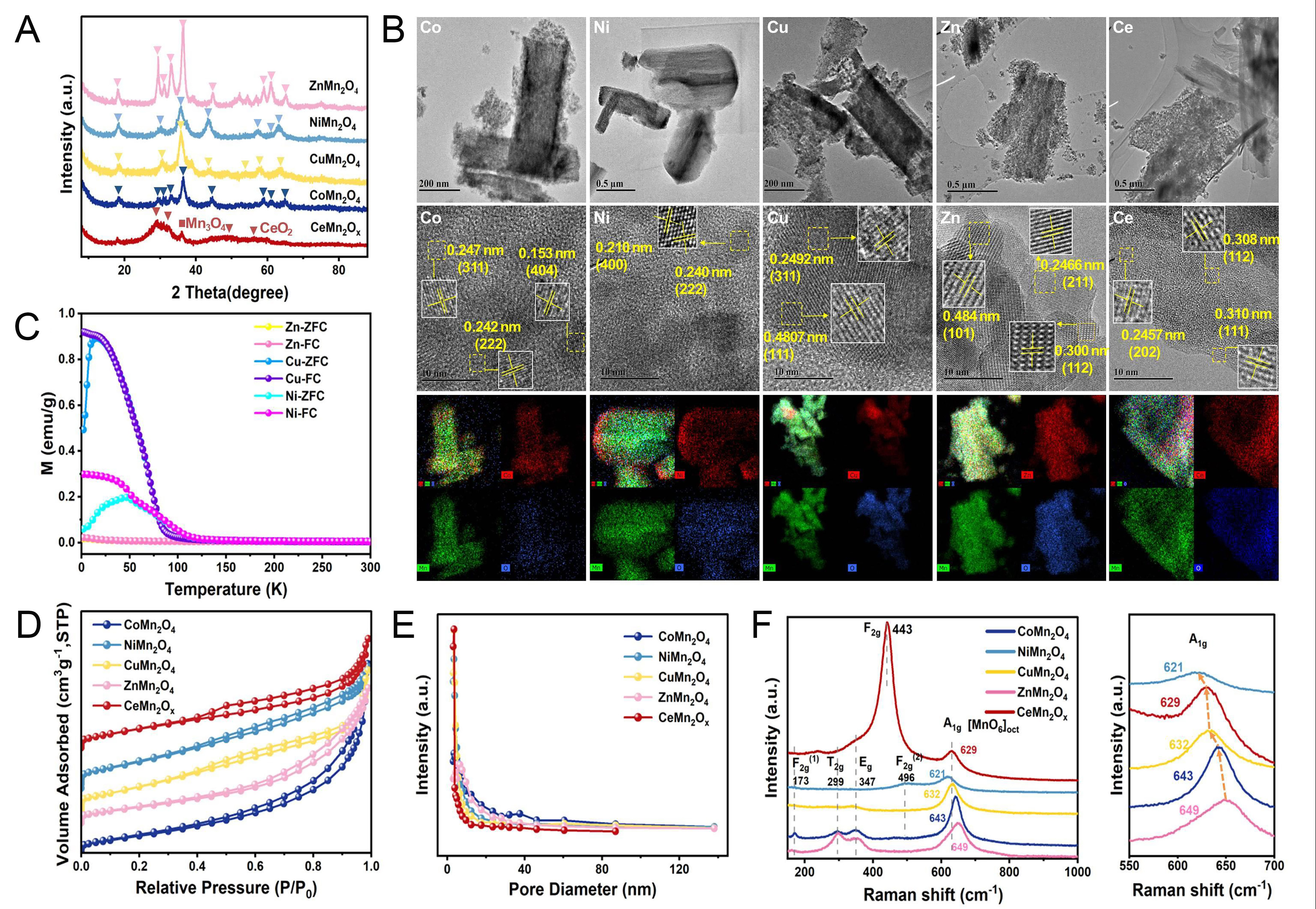
Figure 1. (A) XRD patterns; (B) TEM and elemental mapping images; (C) ZFC and FC magnetization curves for AMn2O4 samples (A = Ni, Cu, or Zn); (D) N2 adsorption-desorption isotherms; (E) pore-size distribution; and (F) Raman spectra of AMn2O4. ZFC: Zero-field-cooled; FC: field-cooled.
We further investigated the structure of AMn2O4 catalysts using Raman spectroscopy [Figure 1F]. The Raman spectra of all as-prepared samples correspond to the typical vibration modes of the spinel structure. The Raman features at 173, 299, 347 and 496 cm-1 were assigned to the F2g(1), T2g, Eg and F2g(2) modes[38]. The peak at 439 cm-1 was attributable to the F2g mode of fluorite-structured CeO2[16]. Notably, the A1g characteristic peak was observed in the 620-650 cm-1 range for the Mn-based spinel catalysts with various A-site metal dopants (Co, Ni, Cu, Zn, Ce). The A1g modes arise from symmetric Mn–O stretching within MnO6 octahedra ([MnO6]oct), a characteristic vibration of the spinel structure[36]. The doping of different A-site metals induced a red shift in the Mn–O symmetric stretching peak. The red shift indicated a weakening of the Mn–O bond that facilitated its cleavage and thereby promoted the formation and migration of oxygen species, ultimately enhancing the catalytic activity[37]. Among the samples, NiMn2O4 exhibited the lowest A1g peak wavenumber (621 cm-1), which was consistent with its superior catalytic performance in the activity tests.
Catalytic performance
The simultaneous removal performance of NOx and C3H8 over the AMn2O4 catalysts is shown in Figure 2, with the corresponding activity evaluation data summarized in Supplementary Table 3. In the absence of SO2, the catalytic activity of the prepared catalysts varied significantly with the A-site metal. Notably, the NiMn2O4 catalyst exhibited the best overall performance, achieving 91.42% C3H8 conversion and 92.83% NOx conversion simultaneously at 220 °C, along with the highest N2 selectivity. Although CoMn2O4 showed the lowest T90 (the temperature required to achieve 90% C3H8 conversion) for C3H8 oxidation, its N2 selectivity was inferior. This is attributed to the excessively strong oxidizing properties of CoMn2O4, which promoted the over-oxidation of NH3. Therefore, the moderate redox properties of NiMn2O4 are more favorable for the simultaneous reaction. Furthermore, the CO2 selectivity approached 100% for all samples, particularly at higher temperatures (200-300 °C) [Figure 2B], suggesting satisfactory deep mineralization of C3H8 over the synthesized AMn2O4 catalysts. The apparent activation energies (Ea) obtained from the Arrhenius equation provided further support for these findings. The relatively low activation energies of NiMn2O4 explain its high catalytic performance in the simultaneous removal of both pollutants, which is consistent with the findings from the activity tests. The impact of 40 ppm SO2 on the catalyst’s performance was shown in Supplementary Figure 2. At 220 °C, the NOx conversion over NiMn2O4 reached 93.84%, while the C3H8 conversion decreased to 80.79%. Compared with the SO2-free condition, the T90 for C3H8 increased by 6 °C, and the CO2 selectivity slightly declined. However, the denitrification activity window significantly broadened [the temperature required to achieve 90% NOx conversion (T90): 150-300 °C vs. 150-222 °C], indicating enhanced denitrification activity. Moreover, the N2 selectivity was notably improved under sulfur-containing conditions, which could be attributed to the combination of SO2 with NH3 that suppressed the over-oxidation of NH3 and reduced the formation of the by-product N2O, thus enhancing N2 selectivity. Stability tests conducted in the presence of SO2 revealed that after SO2 was cut off, the conversions of NOx and C3H8 both remained above 95%, and the N2 selectivity exceeded 90%. Collectively, these findings demonstrate the superior SO2 tolerance of the NiMn2O4 catalyst. SO2 exerts a pronounced negative effect on the oxidation activity and selectivity of C3H8 at low temperatures, while considerably boosting the NH3-SCR performance.
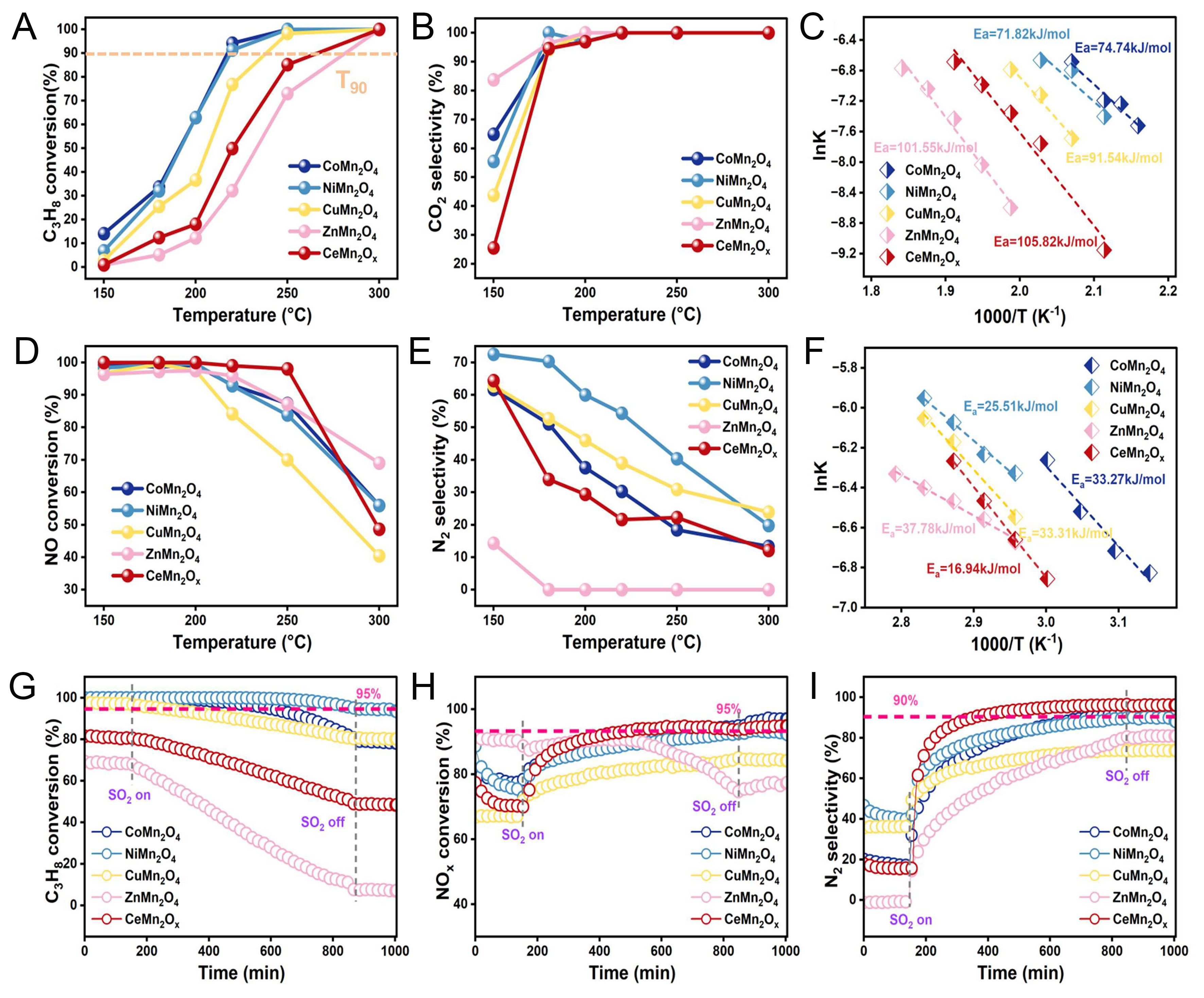
Figure 2. (A and D) C3H8 and NO conversions; (B and E) CO2 and N2 selectivities; (C and F) Arrhenius plots of C3H8 oxidation and NH3-SCR; and (G-I) stability tests on AMn2O4. Reaction conditions: 500 ppm NH3, 500 ppm NO, 500 ppm C3H8, 40 ppm SO2 (when used), 5 vol% O2, N2 as the balance gas, 30,000 mL g-1 h-1. Stability-test temperature: 250 °C. SCR: Selective catalytic reduction.
Furthermore, the water resistance of NiMn2O4 was evaluated under simultaneous-removal conditions. Upon introducing water vapor at 3 vol%, the NO conversion increased from 87.4% to 95.2%, whereas the C3H8 conversion decreased from 97.9% to 87.7% [Supplementary Figure 3]. One possible explanation for the increased NO conversion is that H2O dissociation formed surface hydroxyl groups, providing additional Brønsted acid sites that could facilitate NH3 adsorption and activation. Water adsorption may also have partially occupied strongly oxidizing sites, thereby suppressing the non-selective over-oxidation of NH3. In contrast, competitive adsorption of H2O and C3H8 on the active sites may have contributed to the temporary decrease in C3H8 conversion[39]. After the water feed was discontinued, both conversions recovered to their initial levels, indicating that the effects of water were reversible under the tested conditions. Furthermore, transient experiments were performed to investigate the interplay between propane and NOx. The detailed data and discussion in Supplementary Figure 4 demonstrate that NiMn2O4 can accommodate propane oxidation and NH3-SCR simultaneously with limited performance penalties under the tested conditions.
Superexchange-modulated electronic structure and surface acidity
To investigate the reasons for the optimal activity of NiMn2O4, we examined the surface chemical states via X-ray photoelectron spectroscopy (XPS) [Figure 3] and further verified the spin-mediated magnetic exchange coupling and local coordination environment via X-ray absorption fine structure (XAFS) [Supplementary Figure 5] and zero-field-cooled/field-cooled (ZFC/FC) measurements [Figure 1C and Supplementary Figure 6], as detailed in the Supplementary Materials. The Curie-Weiss fitting was performed on the FC magnetic susceptibility data (200-280 K) to evaluate the magnetic interactions, with the calculated θ, μeff, and R2 values presented in Supplementary Tables 4 and 5. The Mn 2p3/2 spectra were deconvoluted using a multiplet-splitting fitting approach with physically constrained binding energies and relative intensities. Independent Mn 3s XPS [Supplementary Figure 7] and Mn K-edge X-ray absorption near-edge structure (XANES) measurements further validated the valence states. The binding energy shifts observed upon elemental doping further indicate the electronic interaction between Mn and the dopants[40,41]. The Mn4+/Mn ratio [Supplementary Table 6] followed the order of NiMn2O4 > CoMn2O4 > CuMn2O4 > CeMn2Ox > ZnMn2O4, indicating that the Ni-O-Mn superexchange interaction most effectively stabilized Mn4+. In the spinel crystal, strong electronic interactions between octahedral Mn3+ and Ni3+ induce electron rearrangement via superexchange mediated by bridging oxygen atoms, consistent with the reaction Mn3+ + Ni3+ → Mn4+ + Ni2+. Along the octahedral-O-octahedral backbone of the spinel, this superexchange facilitates indirect electron migration from the degenerate eg orbitals of Mn3+ to the eg orbitals of Ni3+, consequently raising and maintaining the surface Mn4+ concentration [Figure 4]. Based on the electron localization function (ELF) and charge density difference (CDD) analyses, the superior superexchange interactions of NiMn2O4 can be rationalized. The ELF analysis revealed that NiMn2O4 exhibited the most diffuse electron distribution along the Mn–O direction, as reflected by the lowest ELF values in the Mn–O bonding region [Figure 3G]. This indicated that the bridging oxygen electrons underwent the highest degree of delocalization, which originated from the electronic connectivity established by the Ni-O-Mn superexchange network. This high degree of delocalization reduced structural relaxation and lowered the energy barrier for lattice oxygen activation. (Further discussion regarding the modulation of oxygen species activation via Ni-O-Mn superexchange interactions is provided in Section “Superexchange-modulated oxygen species activation”.) The CDD analysis further corroborated this interpretation [Figure 3H]. In NiMn2O4, pronounced charge depletion was observed at both Nioct and Mnoct sites, with both extending toward the bridging oxygen, thereby forming a contiguous Nioct-O-Mnoct charge-transfer channel. This three-center charge connectivity provided direct electronic evidence for the Ni-O-Mn superexchange interaction. Moreover, NiMn2O4 exhibited the strongest charge depletion at the Mnoct site. In contrast, CuMn2O4 and ZnMn2O4 exhibited charge transfer largely confined to local Mnoct–O bonds with weaker charge depletion than NiMn2O4. Consequently, the Ni-O-Mn superexchange interaction in NiMn2O4 establishes an efficient electron transfer channel that stabilizes the surface Mn4+ species and increases their proportion, thereby providing the strongest acid sites, which are predominantly Lewis acid sites and promote the adsorption and activation of NH3 and C3H8[42].
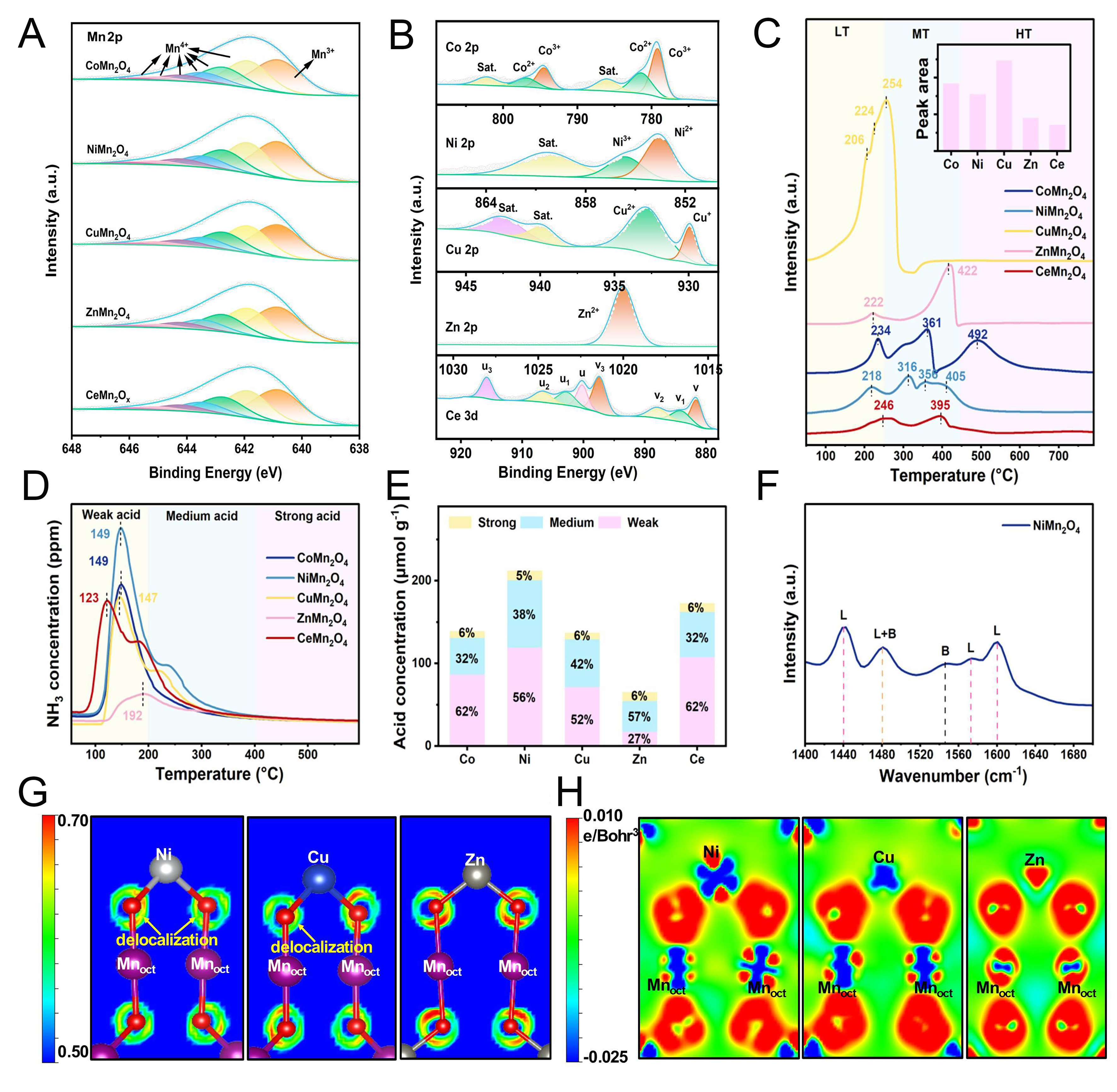
Figure 3. XPS spectra of (A) Mn 2p and (B) A-site metal 2p (A = Co, Ni, Cu, or Zn) and Ce 3d for the investigated catalysts; (C) H2-TPR profiles of AMn2O4; (D and E) NH3-TPD profiles; (F) Py-IR spectra of NiMn2O4; (G) ELF plots; and (H) charge-density-difference maps (charge accumulation and depletion are shown in red and blue, respectively). XPS: X-ray photoelectron spectroscopy; TPR: temperature-programmed reduction; TPD: temperature-programmed desorption; Py-IR: pyridine-adsorption Fourier-transform infrared; ELF: electron localization function; LT: low temperature; MT: medium temperature; HT: high temperature.
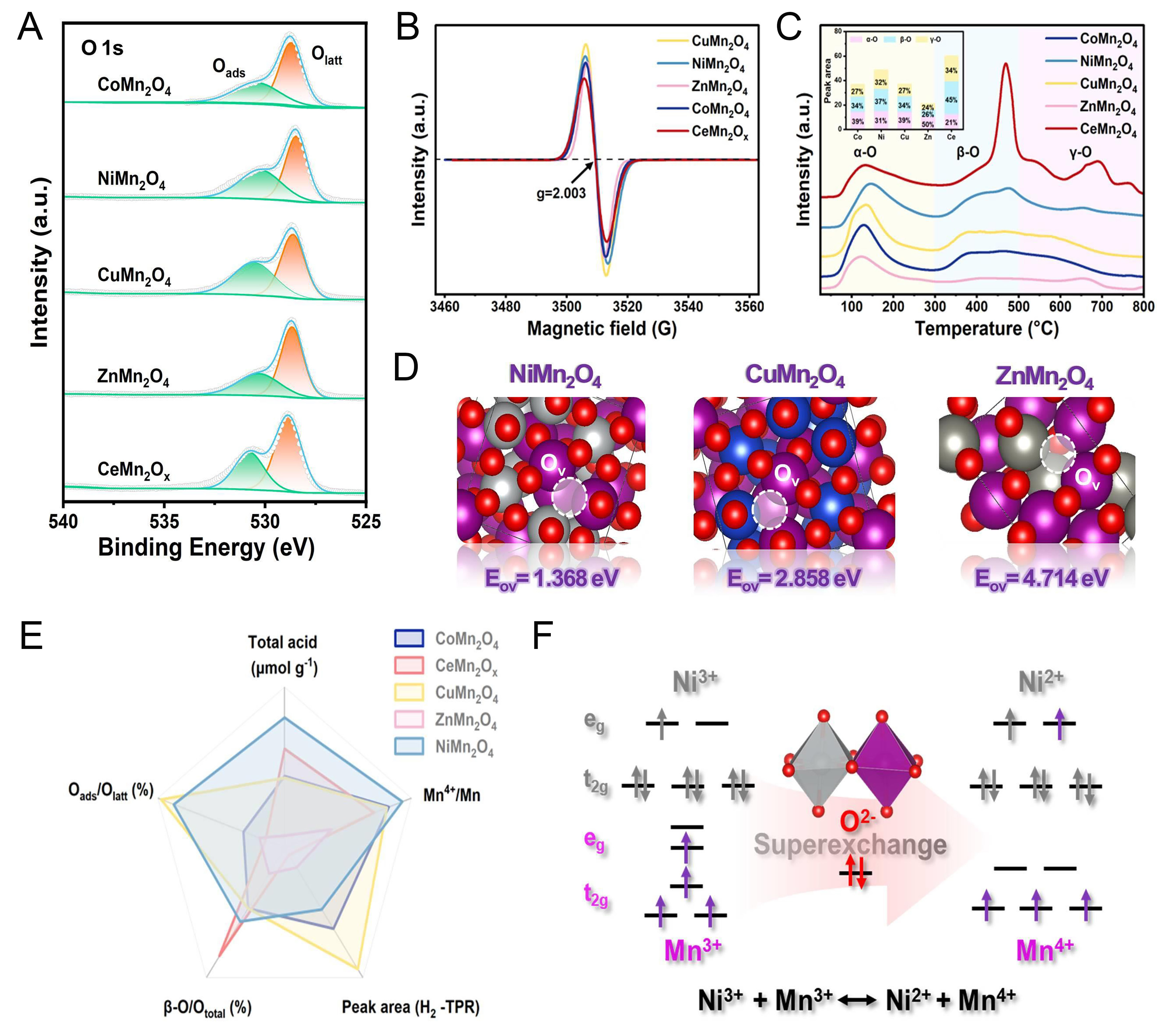
Figure 4. (A) O 1s XPS spectra, (B) EPR spectra, and (C) O2-TPD profiles of AMn2O4; (D) oxygen-vacancy formation energies of AMn2O4; (E) radar plot comparing catalyst performance; and (F) schematic illustration of the Ni-O-Mn superexchange interaction. XPS: X-ray photoelectron spectroscopy; EPR: electron paramagnetic resonance; TPD: temperature-programmed desorption.
The acid sites of the catalysts were characterized by NH3-TPD [Figure 3D and E]. The NH3 desorption profiles were divided into three temperature regions corresponding to weak (< 200 °C), medium (200-400 °C), and strong (> 400 °C) acid sites[43]. Among all the samples, NiMn2O4 exhibited the highest total acidity [Figure 3E and Supplementary Table 7], which promoted the adsorption and conversion of both C3H8 and NH3. To account for differences in specific surface area, we have additionally normalized the NH3-TPD-derived uptake by the BET surface area according to qarea = qmass/SBET. The corrected results are presented in Supplementary Table 8. NiMn2O4 exhibits the highest measured total NH3 uptake on both a mass basis (212.2 μmol·g-1) and a BET surface-area basis (1.1 μmol·m-2). Thus, its higher mass-based uptake cannot be attributed solely to its larger BET surface area. To identify the acid-site types, we also conducted pyridine-adsorption Fourier-transform infrared (Py-IR) measurements [Figure 3F]. The analysis indicates that approximately 88% of the quantified acid sites on NiMn2O4 are Lewis acid sites [Supplementary Table 9].
H2-TPR was further used to assess the redox properties of the AMn2O4 spinel oxides [Figure 3]. Three distinct reduction peaks were observed for CoMn2O4 at 234, 361, and 492 °C. The peak at the lowest temperature was attributed to overlapping reductions of Mn4+ → Mn3+ and Co3+ → Co2+, while the peaks at 361 and 492 °C were assigned to Mn3+ → Mn2+ and Co2+ → Co0 reductions, respectively[44]. For NiMn2O4, reduction peaks were observed at 218, 316, 356, and 405 °C and were attributed to Mn4+ → Mn3+, Mn3+ → Mn2+, and Ni2+ → Ni0 reduction processes, respectively[45]. CuMn2O4 showed reduction peaks at 206, 224, and 254 °C, substantially lower than those of other samples. The low-temperature peaks (206 and 224 °C) were attributed to the overlapping of Cu2+ → Cu0 and Mn4+ → Mn3+ reduction, that the peak at 254 °C corresponds to Mn3+ → Mn2+[46]. This reduction consumed substantial hydrogen and converted Cu2+ to metallic Cu0 at low temperatures. This deep reduction disrupted the Cu-O-Mn bridging connectivity and consequently suppressed the synergistic Cu+/Cu2+ and Mn4+/Mn3+ redox cycle, ultimately leading to inferior catalytic performance despite the high apparent reducibility. In contrast, although NiMn2O4 showed higher reduction temperatures than CuMn2O4, its reduction peaks corresponded predominantly to the reversible Mn4+/Mn3+ redox cycle rather than irreversible deep reduction, indicating efficient and sustainable cycling of Mn oxidation states. The peaks of ZnMn2O4 at 222 and 422 °C were attributed to the stepwise reduction of Mn species from Mn4+ to Mn3+ and then to Mn2+. The reduction peaks of CeMn2Ox at 246 and 395 °C were assigned to Mn4+ → Mn3+ reduction and the coupled reduction of Mn3+ → Mn2+ and Ce4+ → Ce3+, respectively[47].
Superexchange-modulated oxygen species activation
In the Mars-van Krevelen (MvK) cycle, C3H8 oxidation involves consumption of lattice oxygen, formation of vacancies, and replenishment by gaseous O2. In this section, we discuss how superexchange interactions modulate the activation of oxygen species and consequently influence catalytic activity.
The oxygen vacancy formation energy (Evac) was quantitatively evaluated by DFT calculations. As shown in Figure 4 and Supplementary Table 10, the Evac values followed the order of ZnMn2O4 (4.714 eV) > CuMn2O4 (2.858 eV) > NiMn2O4 (1.368 eV). The substantially lower Evac of NiMn2O4 indicated that its lattice oxygen was the easiest to extract thermodynamically. This extraction step is the first and most energy-demanding of the MvK cycle, and therefore it is most readily initiated on NiMn2O4. This low Evac arose from the electronic delocalization enabled by the Ni-O-Mn superexchange network. In contrast, ZnMn2O4 lacked any effective superexchange pathway due to the d10 electronic configuration of Zn2+. The electronic network remained highly localized, affording no channel to disperse the excess charge following oxygen departure. Consequently, it suffered from the highest Evac and the most constrained lattice oxygen mobility, consistent with its inferior catalytic performance.
The O 1s XPS spectra [Figure 4A] at 528.56-529.59 and 530.23-531.52 eV were assigned to surface lattice oxygen (Olatt) and adsorbed oxygen species (Oads), respectively[48]. As shown in Supplementary Table 6, CuMn2O4 exhibited the highest Oads/Olatt ratio, while NiMn2O4 showed a slightly lower value. Consistent with this observation, the EPR results [Figure 4B] indicated that oxygen-vacancy concentrations followed the order CuMn2O4 > NiMn2O4 > CoMn2O4 > ZnMn2O4 > CeMn2Ox. However, the oxygen vacancy concentration alone was insufficient to explain the catalytic activity trend. Notably, although CuMn2O4 possessed the highest Oads/Olatt ratio and the strongest EPR signal, its actual catalytic performance was inferior to that of NiMn2O4, because its vacancies originated from Jahn-Teller distortion and served primarily to relieve lattice strain. CuMn2O4 exhibited a considerably higher Evac than NiMn2O4. Upon oxygen removal, the excess electrons became trapped at adjacent metal sites due to the absence of a delocalization pathway, incurring a substantial structural relaxation energy. Once vacancies are formed, their replenishment relies on oxygen mobility, as evaluated by O2-TPD.
O2-TPD was used to evaluate oxygen mobility in the AMn2O4 samples [Figure 4C]. The desorption features in the ranges of 50-300, 300-500, and above 500 °C were assigned to surface-adsorbed oxygen species (α-O), surface lattice oxygen species (β-O), and bulk lattice oxygen species (γ-O), respectively[49,50]. Remarkably, the β-O/Ototal ratio, which represents the most readily mobilizable oxygen species for the MvK mechanism, followed the order of CeMn2Ox > NiMn2O4 > CoMn2O4 ≈ CuMn2O4 > ZnMn2O4. Although CeMn2Ox possessed the strongest oxygen storage and release capacity, it exhibited the lowest oxygen-vacancy concentration and Mn4+ proportion, thus lacking efficient adsorption and activation sites for reactants. Although CuMn2O4 had the highest oxygen-vacancy concentration, these vacancies primarily stabilized the lattice rather than participating effectively in the catalytic cycle. The abundance of oxygen vacancies did not translate into effective oxygen release and migration. In contrast, the Ni-O-Mn superexchange interaction moderately weakened the Mn–O bond strength in NiMn2O4, resulting in both moderate oxygen mobility and a suitable oxygen vacancy concentration, thereby enabling lattice oxygen to efficiently participate in the reaction through a consumption-replenishment cycle (i.e., the MvK mechanism).
In summary, the Ni-O-Mn superexchange interaction exerts multifaceted control over oxygen species in NiMn2O4. It maintains an optimal vacancy concentration, minimizes the energy penalty for lattice oxygen extraction, and promotes the mobility of Olatt. This integrated regulation ensures the most favorable oxygen dynamics for the MvK cycle, ultimately conferring superior catalytic activity upon NiMn2O4. The radar chart [Figure 4E] summarizes the preceding sections and shows that NiMn2O4 exhibited balanced performance across all evaluated dimensions, with particularly high values for Mn4+ concentration, surface acidity, and oxygen mobility, which are key descriptors governing catalytic efficiency.
Orbital origin of Ni-O-Mn superexchange interaction
To gain deeper insight into the intrinsic mechanism behind the Ni-O-Mn superexchange effect, DFT simulations were performed to obtain surface-projected density of states (PDOS) of O 2p and Mn/A (Ni, Cu, Zn) 3d for NiMn2O4, CuMn2O4, and ZnMn2O4 [Figure 5A-C], together with schematic sketches of the relevant band centers. In NiMn2O4, the Mn 3d and O 2p orbitals exhibited pronounced overlap in the energy region immediately below the Fermi level, while the Ni 3d orbitals also contributed to this energy window, establishing a continuous Ni-O-Mn orbital connectivity that enabled three-center electron transfer from Mn to Ni through the bridging oxygen. In CuMn2O4, the Cu 3d states likewise fell within this energy window, yet the Mn–O overlap was comparatively weaker than in NiMn2O4. In ZnMn2O4, by contrast, the Zn 3d states were located deep below EF owing to the fully filled d10 configuration of Zn2+, so that no effective orbital channel participated in the near-EF window and the superexchange pathway was essentially absent. Ni substitution induced strong Nioct-O-Mnoct superexchange electronic interactions and shifted the Mnoct d-band center upward relative to the Fermi level [Figure 5D]. Specifically, the Mn d-band center in NiMn2O4 was calculated to be -0.785 eV relative to the Fermi level, substantially higher than the values for CuMn2O4 (-1.124 eV) and ZnMn2O4 (-1.487 eV) [Supplementary Table 10]. An upshifted d-band center brought the Mn 3d states closer to the Fermi level and increased the filling of the Mn 3d-O 2p antibonding states, thereby weakening the Mnoct–O bond[51]. Integrated crystal orbital Hamilton population (ICOHP) analysis provided further support for this electronic modulation [Supplementary Figure 8]. The -ICOHP values followed the order NiMn2O4 < CuMn2O4 < ZnMn2O4, confirming that the covalent bonding of Mnoct–O was the weakest in NiMn2O4. The weakest Mnoct–O bond directly rationalized the lowest Evac of NiMn2O4 and the most facile lattice oxygen extraction. In addition, the Ni-O-Mn superexchange network enabled extensive electronic delocalization upon oxygen removal, as evidenced by the ELF [Figure 3G] and CDD [Figure 3H] analyses, which further dispersed excess electrons and reduced the structural relaxation energy, additionally stabilizing the oxygen-vacancy state. Consequently, the weakened Mnoct–O bonds in NiMn2O4 facilitated oxygen extraction and replenishment during the catalytic cycle, consistent with the superior lattice-oxygen-involving MvK activity of NiMn2O4.
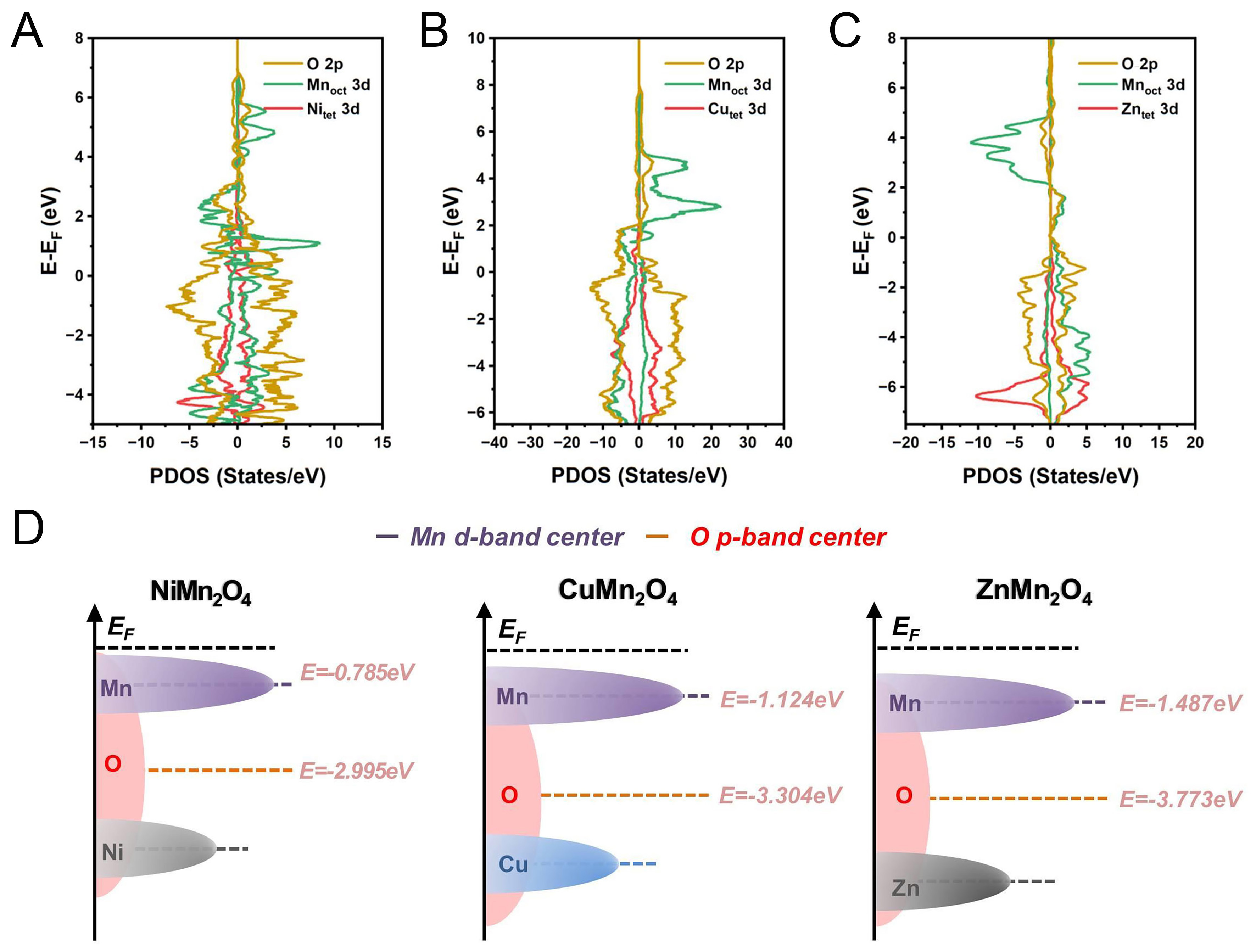
Figure 5. (A-C) Surface PDOS of O 2p and Mn/A (Ni, Cu, Zn); (D) Schematic of AMn2O4 electronic structures with Mn 3d-band and O 2p band centers. PDOS: Projected density of states.
Reaction mechanism
Mechanism of NH3-SCR
The evolution of surface species during NH3-SCR over NiMn2O4 was investigated by in situ DRIFTS, using sequential reactions of NO + O2 with pre-adsorbed NH3 and of NH3 with pre-adsorbed NO + O2. In the in situ DRIFTS spectra of NO + O2 adsorption [Figure 6A], several vibrational bands were observed at 1,218, 1,280, 1,553, 1,564, and 1,630 cm-1 as the adsorption time progressed. The bands at 1,218 and 1,630 cm-1 were assigned to the symmetric and asymmetric vibrations of bridging nitrate species, respectively[2]. The 1,280 cm-1 band was assigned to symmetric stretching of monodentate nitrate, whereas the 1,553 and 1,564 cm-1 bands were attributed to bidentate nitrate species[52]. The presence of these bands indicated that NO was oxidized on the catalyst surface, forming various nitrate adsorption species. The NO-derived bands became progressively stronger as the adsorption time increased. After NO + O2 adsorption reached saturation, the gas stream was switched to NH3 [Figure 6B and C]. The nitrate bands gradually diminished and eventually disappeared, accompanied by a concurrent enhancement of NH3-related adsorption bands. These changes suggested a reaction between NH3 and pre-adsorbed nitrate species, consistent with the Langmuir-Hinshelwood (L-H) mechanism.
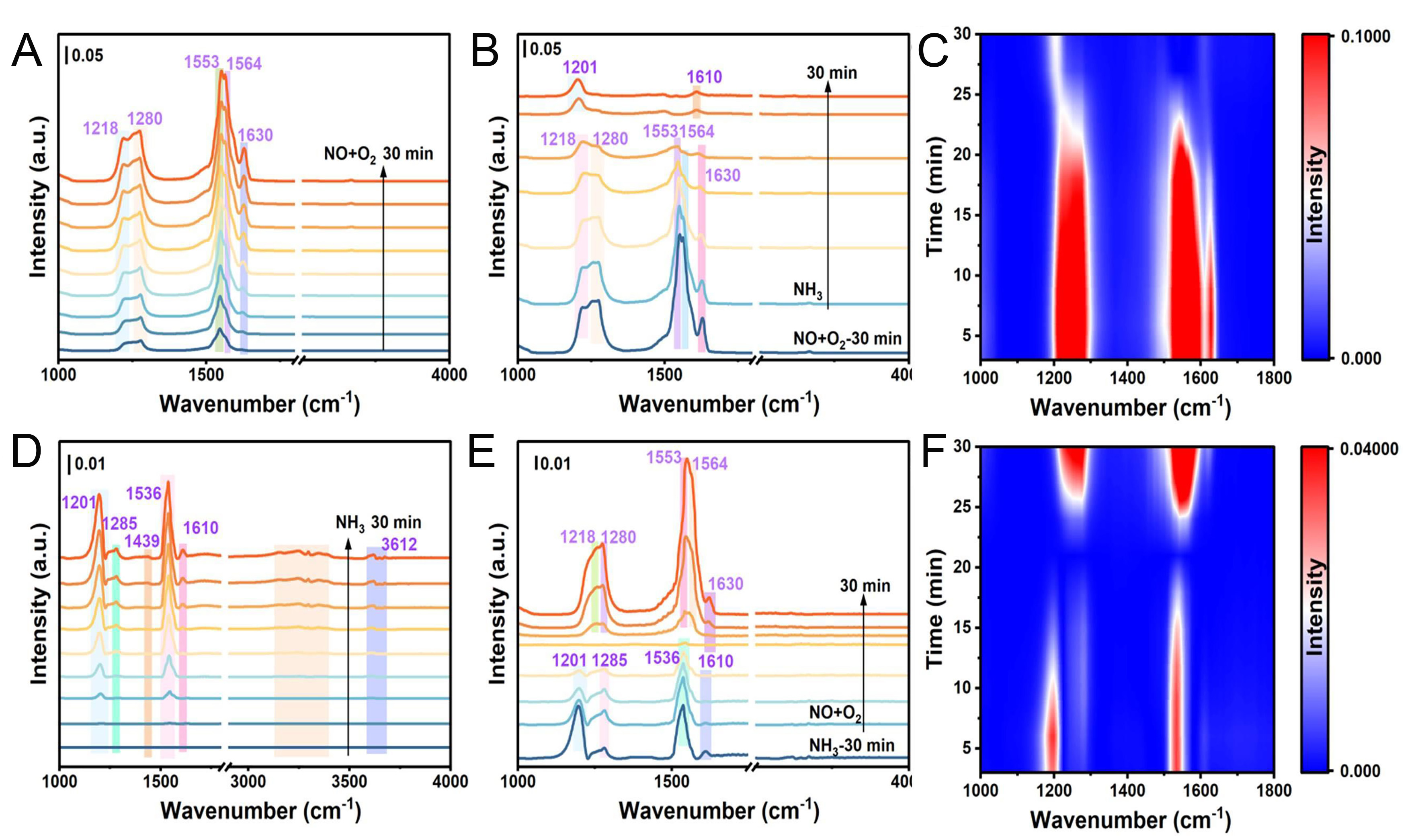
Figure 6. In situ DRIFTS spectra recorded at 230 °C during co-adsorption of 500 ppm NO + O2 (A) and adsorption of 500 ppm NH3 (D) over the NiMn2O4 catalyst; in situ DRIFTS spectra and corresponding 2D contour maps showing NH3 reacting with pre-adsorbed NO + O2 (B and C) and NO + O2 reacting with pre-adsorbed NH3 (E and F) over the NiMn2O4 catalyst. DRIFTS: Diffuse reflectance infrared Fourier transform spectroscopy.
Conversely, when the gas introduction order was reversed, NH3 was first introduced onto the catalyst [Figure 6D]. The bands at 1,201, 1,285, and
Mechanism of C3H8 oxidation
Taking NiMn2O4 as an example, we investigated the oxidation mechanism of C3H8 by in situ DRIFTS. The adsorption spectra of C3H8 over NiMn2O4 at
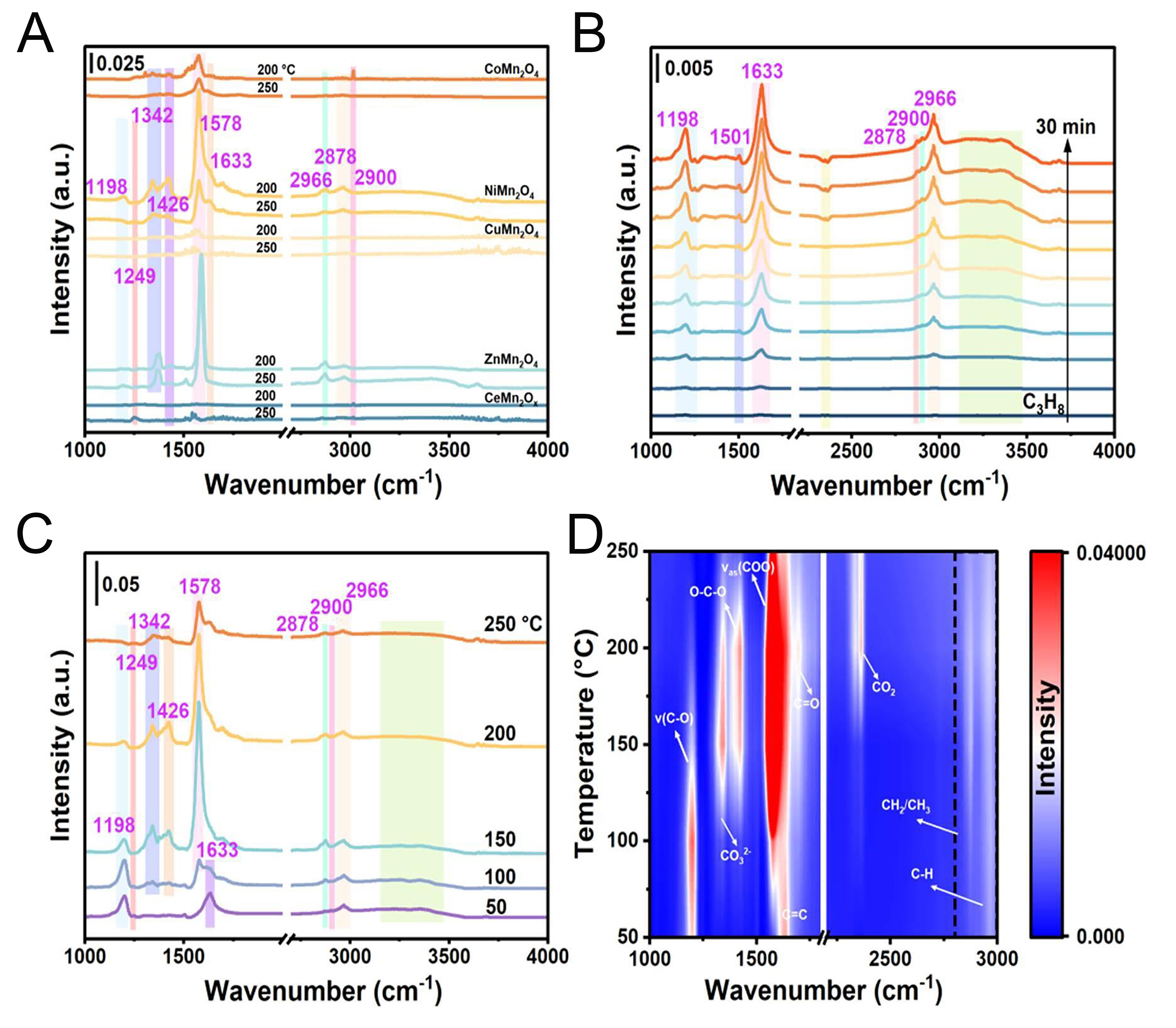
Figure 7. In situ DRIFTS spectra comparing C3H8 oxidation over AMn2O4 catalysts at 200 and 250 °C (A), C3H8 adsorption over NiMn2O4 at 50 °C (B), and C3H8 oxidation over NiMn2O4 from 50 to 250 °C (C), with the corresponding intensity plot shown in (D). DRIFTS: Diffuse reflectance infrared Fourier transform spectroscopy.
O2 was subsequently added to the feed to study C3H8 catalytic oxidation over the catalyst at different temperatures [Figure 7C and D]. The propylene C=C stretching band at 1,633 cm-1[57] gradually weakened and eventually disappeared as the temperature increased. Concurrently, oxygen-containing intermediates appeared, including carbonate (1,342, 1,426 cm-1) and carboxylate (1,578 cm-1) species[58,59]. The carboxylate content initially increased and then decreased: at lower temperatures, continuous C3H8 oxidation generated carboxylates that accumulated on the surface, leading to an increase in band intensity. Upon further temperature elevation, the carboxylates underwent deep oxidation to CO2 and H2O, with the consumption rate exceeding the formation rate, resulting in a subsequent decrease in band intensity.
Based on these observations, the reaction pathway for C3H8 catalytic oxidation can be summarized as follows: C3H8 adsorption and dissociation → dehydrogenation to propylene → oxidation to carboxylates/carbonates → deep oxidation to CO2 and H2O. A comparative study of C3H8 oxidation over different spinel catalysts was conducted at 200 and 250 °C [Figure 7A]. The types of surface-generated intermediates during C3H8 oxidation were similar across the catalysts. However, at 250 °C, the characteristic carboxylate peaks over NiMn2O4 decreased significantly, and NiMn2O4 showed the least accumulation of intermediates, indicating that the oxygen-containing intermediates underwent deep oxidation more effectively over this catalyst.
To further investigate the MvK mechanism in C3H8 oxidation, C3H8 oxidation experiments were performed over 18O2-pretreated NiMn2O4, with the reaction monitored by in situ DRIFTS coupled with online MS. During pretreatment, the Olatt of the catalyst was labeled with 18O at 450 °C. Signals at mass-to-charge ratios (m/z) of 18, 20, 44, 46, and 48 were monitored in real time.
Compared with the 16O2-pretreated sample, the 18O2-pretreated catalyst exhibited red shifts in the C-O stretching band of surface carbonate species and the asymmetric stretching band of carboxylate COO- species [Figure 8]. For example, the band shifted from 1,576 to 1,567 cm-1. This isotope-induced shift indicates that the pre-labeled 18O was incorporated into surface oxygen-containing intermediates[60]. This also indicates that lattice 18O participates in C3H8 oxidation even in the presence of gas-phase 16O2.
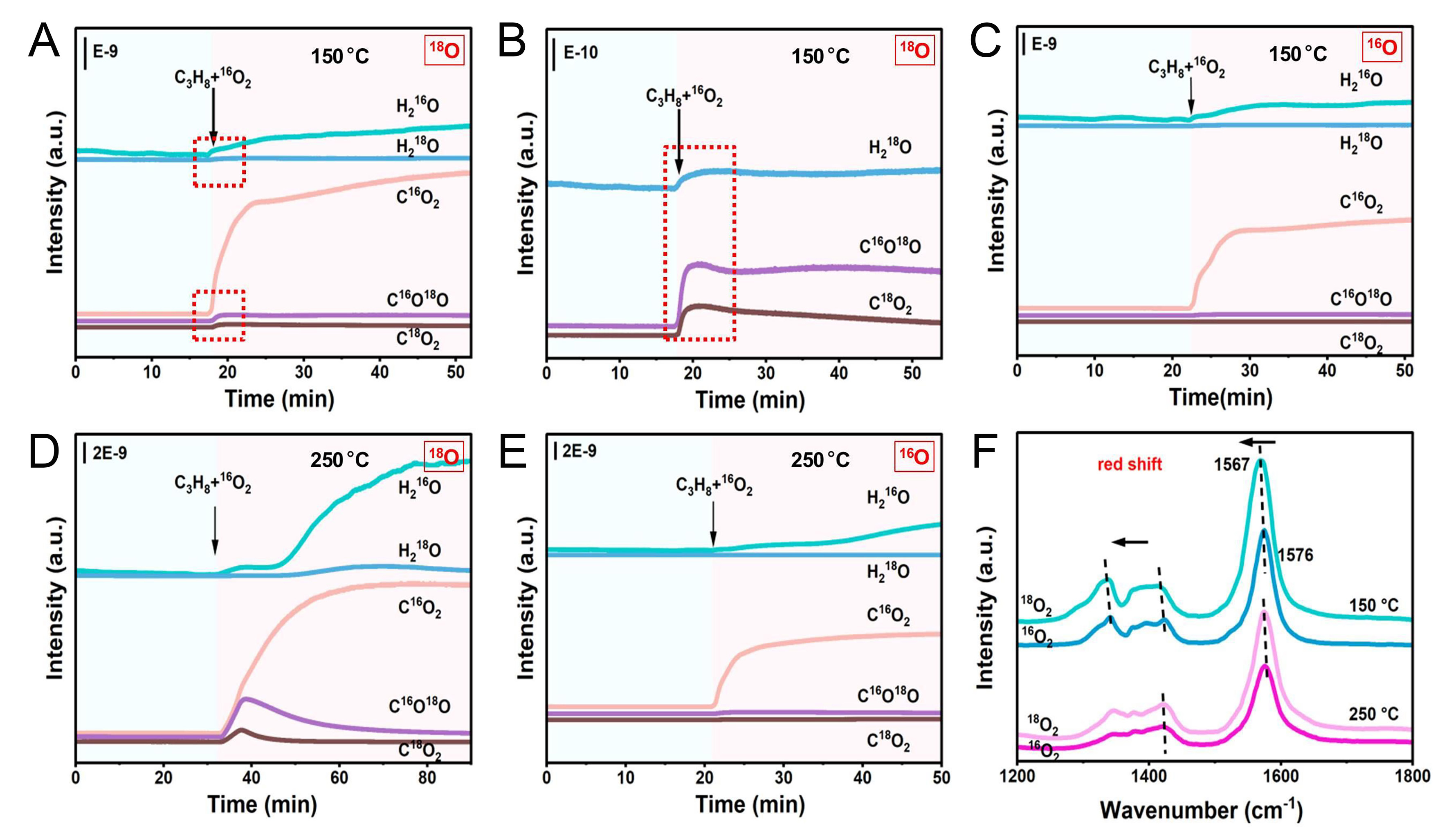
Figure 8. Time-dependent MS signals of the outlet gas at 150 °C over NiMn2O4 pretreated with 18O2 (A and B) and 16O2 (C); (D and E) Time-dependent MS signals of the outlet gas at 250 °C over NiMn2O4 pretreated with 18O2 (D) and 16O2 (E); (F) In situ DRIFTS spectra of surface species at 150 and 250 °C showing the red shift of characteristic bands. MS: Mass spectrometry; DRIFTS: diffuse reflectance infrared Fourier transform spectroscopy.
MS showed that the 16O2-pretreated reference sample primarily generated signals at m/z = 44 and 18, corresponding to CO2 and H2O containing 16O, respectively. For the 18O2-pretreated sample, the signals of 18O-containing products (m/z = 46, 48, and 20) were weak at 150 °C, indicating a relatively low rate of lattice-18O migration or participation in the reaction at this temperature. At 250 °C, the signals at m/z = 46, 48, and 20 increased markedly, demonstrating more extensive participation of lattice 18O in propane oxidation. The m/z = 48 signal, assigned to C18O2, decreased first, followed by a gradual decline in the m/z = 46 signal, assigned to C16O18O. This behavior is consistent with the progressive consumption of pre-labeled surface 18O, followed by the incorporation of gas-phase 16O into the products. Meanwhile, the m/z = 44 signal, assigned to C16O2, initially increased and then approached a steady level. The signal of 18O-containing water (m/z = 20) first increased and then decreased, whereas that of 16O-containing water (m/z = 18) gradually increased. Together, the DRIFTS and isotopic MS observations indicate that C3H8 oxidation over NiMn2O4 follows the MvK mechanism: C3H8 reacts with Olatt, and gaseous O2 replenishes the vacancies created by CO2 desorption. Thus, feed O2 mainly contributes to CO2 formation indirectly through lattice-oxygen replenishment rather than by direct participation in the initial oxidation step.
CONCLUSIONS
In summary, this study successfully developed a series of AMn2O4 (A = Co, Ni, Cu, Zn) spinel catalysts and a CeMn2Ox mixed-oxide reference sample for the simultaneous catalytic elimination of NOx and C3H8, and systematically elucidated the pivotal role of A-O-Mn superexchange interactions in governing the catalytic performance. Among the investigated catalysts, NiMn2O4 exhibited the best overall performance, achieving 91.4% C3H8 conversion and 92.8% NOx conversion simultaneously at 220 °C, along with the highest N2 selectivity and satisfactory resistance to SO2.
Comprehensive experimental characterizations and DFT calculations revealed that the superior catalytic performance of NiMn2O4 originates from the Ni-O-Mn superexchange interaction, which exerts multifaceted control over the electronic structure and oxygen species. Specifically, the Ni-O-Mn superexchange induces strong orbital connectivity across the Ni-O-Mn network, enabling efficient electron transfer that stabilizes surface Mn4+ species and enhances Lewis acidity, thereby promoting the adsorption and activation of both NH3 and C3H8. Concurrently, this superexchange interaction elevates both the Mn d-band center and the O p-band center, which weakens the Mn–O bond strength and lowers the Evac, while maintaining electronically robust Mn–O bonds in the ground state. Collectively, these effects establish a highly efficient oxygen consumption-replenishment cycle that sustains the MvK mechanism with the lowest energy penalty for lattice oxygen extraction. This work provides an electronic-level understanding of the origins of A-O-Mn superexchange interactions in spinel lattices, informing the design of spinel oxides that exploit bimetallic synergy and offering a strategy for developing high-performance spinel catalysts with tailored electronic structures for the simultaneous removal of NOx and VOCs.
DECLARATIONS
Authors’ contributions
Made substantial contributions to the conception and design of the study and performed data analysis and interpretation: Wu, J.; Ma, S.; Han, Y.; Liu, K.; Cui, Y.
Writing, review, and editing; conceptualization; methodology; supervision; and project administration: Hou, Y.; Bao, W.; Wang, J.; Huang, Z.
Availability of data and materials
All data required to support the conclusions of this paper are included in the manuscript and the Supplementary Materials. Additional data related to this paper can be obtained from the corresponding authors.
AI and AI-assisted tools statement
Not applicable.
Financial support and sponsorship
This work was financially supported by the National Natural Science Foundation of China (22472192, U23A20100), the Central Guiding Local Technology Development (YDZJSX2024D077) and the Key Research and Development Program of Shanxi Province (202302090301013, 202302090301015, 202502090301009).
Conflicts of interest
All authors declared that there are no conflicts of interest.
Ethical approval and consent to participate
Not applicable.
Consent for publication
Not applicable.
Copyright
© The Author(s) 2026.
Supplementary Materials
REFERENCES
1. Sun, C.; Ye, L.; Lu, P.; et al. Synergistic removal of acetone and NOx by Ag modified Mn/HZSM-5 catalyst. Chem. Eng. J. 2025, 505, 159622.
2. Mi, J.; Liu, H.; Yang, S.; et al. Dual activation of molecular NO and O2 on a Pr-doped CeO2-TiO2 catalyst for the simultaneous catalytic purification of NOx and toluene. Environ. Sci. Technol. 2025, 59, 11321-9.
3. Lyulyukin, M. N.; Kolinko, P. A.; Selishchev, D. S.; Kozlov, D. V. Hygienic aspects of TiO2-mediated photocatalytic oxidation of volatile organic compounds: air purification analysis using a total hazard index. Appl. Catal. B:. Environ. 2018, 220, 386-96.
4. Liu, B.; Ji, J.; Zhang, B.; et al. Catalytic ozonation of VOCs at low temperature: a comprehensive review. J. Hazard. Mater. 2022, 422, 126847.
5. Lin, B.; Guo, Z.; Tang, J.; Chen, P.; Ye, D.; Hu, Y. Modulating the microstructure and surface acidity of MnO2 by doping-induced phase transition for simultaneous removal of toluene and NOx at low temperature. Environ. Sci. Technol. 2024, 58, 10398-408.
6. Wang, Y.; Ma, X.; Liu, H.; et al. Promoting effect of hydroxyl groups on the CO-SCR activity of Ir-Mo bimetallic catalysts under O2 and SO2. Greenverse. Sci. 2026, 1, 9.
7. Long, Y.; Su, Y.; Xue, Y.; Wu, Z.; Weng, X. V2O5-WO3/TiO2 catalyst for efficient synergistic control of NOx and chlorinated organics: insights into the arsenic effect. Environ. Sci. Technol. 2021, 55, 9317-25.
8. Zhu, X.; Yuan, X.; Song, Z.; Peng, Y.; Li, J. A dual-balance strategy via phosphate modification on MnO2-CeO2 for NOx and chlorobenzene synergistic catalytic control. Appl. Catal. B:. Environ. 2024, 342, 123364.
9. Dong, C.; Yang, C.; Ren, Y.; et al. Local electron environment regulation of spinel CoMn2O4 induced effective reactant adsorption and transformation of lattice oxygen for toluene oxidation. Environ. Sci. Technol. 2023, 57, 21888-97.
10. Yang, Y.; Si, W.; Peng, Y.; et al. Defect engineering on CuMn2O4 spinel surface: a new path to high-performance oxidation catalysts. Environ. Sci. Technol. 2022, 56, 16249-58.
11. Zhao, L.; Yang, Y.; Liu, J. Insight into the reaction mechanism of NH3-SCR and chlorobenzene oxidation over Mn-based spinel catalysts. J. Hazard. Mater. 2025, 492, 138113.
12. Xing, X.; Li, Z.; Wang, Y.; et al. Synergistic catalytic degradation of benzene and toluene on spinel MMn2O4 (M Co, Ni, Cu) catalysts. J. Environ. Sci. 2025, 154, 238-51.
13. Jiang, X.; Liu, Z.; Liang, J.; et al. Surface oxygen vacancy induced selective conversion of syngas to propane over ZnM2O4 spinel/SAPO-34 composite catalysts. Appl. Catal. B:. Environ. Energy. 2025, 367, 125126.
14. Sun, Y.; Liao, H.; Wang, J.; et al. Covalency competition dominates the water oxidation structure-activity relationship on spinel oxides. Nat. Catal. 2020, 3, 554-63.
15. Pan, W.; Wei, Y.; Yang, W.; Fang, D. Recent advance of spinel-based catalysts for selective catalytic reduction of NOx. J. Energy. Inst. 2025, 123, 102301.
16. Liu, R.; Jia, X.; Li, L.; et al. Regulating the Cu-Ce interaction of CuCeOx/SAPO-34 catalysts to achieve a wide reaction temperature window for the collaborative synergistic removal of NOx and toluene at low temperatures and reaction mechanisms. J. Hazard. Mater. 2025, 492, 138103.
17. Gevers, L. E.; Enakonda, L. R.; Shahid, A.; et al. Unraveling the structure and role of Mn and Ce for NOx reduction in application-relevant catalysts. Nat. Commun. 2022, 13, 2960.
18. Zheng, F.; Lu, J.; Chen, J.; Ren, E.; Qu, H. Bifunctional action of NaOH etching on MOFs-derived spinel CoMn2O4 for low-temperature toluene oxidation: nanoparticle disaggregation and MnO bond modulation. Chem. Eng. J. 2025, 522, 167221.
19. Zhou, Y.; Sun, S.; Xi, S.; et al. Superexchange effects on oxygen reduction activity of edge-sharing [CoxMn1-xO6] octahedra in spinel oxide. Adv. Mater. 2018, 30, 1705407.
20. Wu, Y.; She, T.; Wang, Y.; et al. Enhancing cationic superexchange interaction via adjustive lattice distortion in cobalt-based perovskite for improved Fenton-like decontamination. Appl. Catal. B:. Environ. 2024, 343, 123569.
21. Luo, J.; Sun, S.; He, Z.; Zhu, G.; Huang, H.; Ma, R. Microwave-induced dual-responsive spinel (CoxMn1-xFe2O4) target-triggered non-radical pathways of peroxymonosulfate: superexchange interaction and synergistic mechanism. Appl. Catal. B:. Environ. Energy. 2024, 359, 124497.
22. Chen, F.; Zhao, R.; Zhao, H.; et al. Axial Co-O-Cu pairs enable superexchange interaction for efficient CoIV=O formation toward water purification. J. Am. Chem. Soc. 2025, 147, 43086-97.
23. Zheng, C.; Wang, Y.; Mao, H.; et al. Superexchange interaction regulates Ni/Mn spin states triggering Ni-t2g/O-2p reductive coupling enabling stable lithium-rich cathode. Nat. Commun. 2025, 16, 3900.
24. Wu, M.; Chen, C.; Duo, J.; et al. Super-exchange interaction enables Fe2-xMnxO3 perovskite with excellent catalytic oxidation activity toward hexabromocyclododecane under humidity. J. Hazard. Mater. 2024, 479, 135691.
25. Liu, X.; Ren, Z.; Zhang, Y.; et al. Deciphering the mechanistic origins of geometric-site-dependent bimetallic superexchange interactions in spinel oxides to boost VOCs catalytic oxidation. Appl. Catal. B:. Environ. Energy. 2026, 381, 125908.
26. Kresse, G.; Furthmüller, J. Efficient iterative schemes for ab initio total-energy calculations using a plane-wave basis set. Phys. Rev. B. 1996, 54, 11169-86.
27. Perdew, J. P.; Burke, K.; Ernzerhof, M. Generalized gradient approximation made simple. Phys. Rev. Lett. 1996, 77, 3865-8.
28. Kresse, G.; Joubert, D. From ultrasoft pseudopotentials to the projector augmented-wave method. Phys. Rev. B. 1999, 59, 1758-75.
30. Grimme, S.; Antony, J.; Ehrlich, S.; Krieg, H. A consistent and accurate ab initio parametrization of density functional dispersion correction (DFT-D) for the 94 elements H-Pu. J. Chem. Phys. 2010, 132, 154104.
31. Dong, C.; Qu, Z.; Qin, Y.; Fu, Q.; Sun, H.; Duan, X. Revealing the highly catalytic performance of spinel CoMn2O4 for toluene oxidation: involvement and replenishment of oxygen species using in situ designed-TP techniques. ACS. Catal. 2019, 9, 6698-710.
32. Guo, Z. Y.; Li, C. X.; Gao, M.; et al. Mn-O covalency governs the intrinsic activity of Co-Mn spinel oxides for boosted peroxymonosulfate activation. Angew. Chem. Int. Ed. Engl. 2021, 60, 274-80.
33. Ma, S.; Hou, Y.; Yang, Y.; et al. Mechanism of SO2 effect on the simultaneous removal of NOx and propane over bifunctional NiMn2O4-CeO2 catalysts. J. Hazard. Mater. 2024, 480, 136473.
34. Hou, S.; Fang, D.; Li, Q.; et al. Structure and activity relationships of AMn2O4 (A = Mg and Zn) spinels in selective catalytic reduction of NOx with NH3. Sep. Purif. Technol. 2024, 345, 127230.
35. Ma, S.; Hou, Y.; Li, Y.; et al. Regulation of A-site cations in AMn2Ox spinel catalysts on the deep oxidation of light alkanes VOCs. Fuel 2023, 334, 126785.
36. Wang, X. T.; Ouyang, T.; Wang, L.; Zhong, J. H.; Ma, T.; Liu, Z. Q. Redox-inert Fe3+ ions in octahedral sites of Co-Fe spinel oxides with enhanced oxygen catalytic activity for rechargeable zinc-air batteries. Angew. Chem. Int. Ed. Engl. 2019, 58, 13291-6.
37. Gu, W.; Li, C.; Qiu, J.; Yao, J. Facile fabrication of flower-like MnO2 hollow microspheres as high-performance catalysts for toluene oxidation. J. Hazard. Mater. 2021, 408, 124458.
38. Aadil, M.; Taki, A. G.; Zulfiqar, S.; et al. Gadolinium doped zinc ferrite nanoarchitecture reinforced with a carbonaceous matrix: a novel hybrid material for next-generation flexible capacitors. RSC. Adv. 2023, 13, 28063-75.
39. Wang, X.; Zhou, X.; Hua, M.; et al. Recent advances in the strategies of developing water-resistant catalysts for the removal of atmospheric pollutants. Greenverse. Sci. 2026, 1, 15.
40. Li, K.; Li, T.; Dai, Y.; Quan, Y.; Zhao, J.; Ren, J. Highly active urchin-like MCo2O4 (M = Co, Cu, Ni or Zn) spinel for toluene catalytic combustion. Fuel 2022, 318, 123648.
41. Biesinger, M. C.; Payne, B. P.; Grosvenor, A. P.; Lau, L. W.; Gerson, A. R.; Smart, R. S. Resolving surface chemical states in XPS analysis of first row transition metals, oxides and hydroxides: Cr, Mn, Fe, Co and Ni. Appl. Surf. Sci. 2011, 257, 2717-30.
42. Feng, C.; Xiong, G.; Jiang, F.; et al. Assembly of sphere-structured MnO2 for total oxidation of propane: structure-activity relationship and reaction mechanism determination. Sep. Purif. Technol. 2022, 284, 120269.
43. Wang, Y.; Bi, Y.; Ji, G.; et al. Acid-activated α-MnO2 for photothermal co-catalytic oxidative degradation of propane: activity and reaction mechanism. J. Hazard. Mater. 2024, 478, 135447.
44. Shan, C.; Zhang, Y.; Zhao, Q.; et al. New insight into opposite oxidation behavior in acetone and propane catalytic oxidation over CoMn based spinel oxides. Chem. Eng. J. 2023, 476, 146550.
45. Shadravan, V.; Bukas, V. J.; Gunasooriya, G. T. K. K.; et al. Effect of manganese on the selective catalytic hydrogenation of COx in the presence of light hydrocarbons over Ni/Al2O3: an experimental and computational study. ACS. Catal. 2020, 10, 1535-47.
46. Qin, Y.; Fan, S.; Gao, J.; Tadé, M. O.; Liu, S.; Li, X. Effect of Cu-doped Co-Mn spinel for boosting low-temperature NO reduction by CO: exploring the structural properties, performance, and mechanisms. ACS. Appl. Mater. Interfaces. 2023, 15, 11885-94.
47. Lu, S.; Guo, X.; Xu, X.; et al. POM-promoted synergistic catalysis of NO and chlorobenzene over amorphous MnCeOx catalysts: activation of lattice oxygen, role of acid site, catalytic mechanism. J. Hazard. Mater. 2025, 495, 138873.
48. Kang, D.; Shi, Q.; Zhang, C.; et al. Synergistic removal of NOx and CB by Co-MnOx catalysts in a low-temperature window. Chem. Eng. J. 2023, 476, 146369.
49. Xu, W.; Chen, X.; Chen, J.; Jia, H. Bimetal oxide CuO/Co3O4 derived from Cu ions partly-substituted framework of ZIF-67 for toluene catalytic oxidation. J. Hazard. Mater. 2021, 403, 123869.
50. Deng, Y.; Shang, Y.; Huang, T.; et al. Reversing the HCl/Cl2 selectivity for efficient catalytic elimination of dichloromethane by incorporation of Ti4+ into CeO2 lattice. Appl. Catal. B:. Environ. Energy. 2025, 373, 125338.
51. Zhou, Y.; Sun, S.; Wei, C.; et al. Significance of engineering the octahedral units to promote the oxygen evolution reaction of spinel oxides. Adv. Mater. 2019, 31, e1902509.
52. Chu, P.; Zhang, L.; Wang, Z.; et al. Regulation lattice oxygen mobility via dual single atoms for simultaneously enhancing VOC oxidation and NOx reduction. Environ. Sci. Technol. 2024, 58, 17475-84.
53. Liu, J.; Li, X.; Zhao, Q.; et al. Mechanistic investigation of the enhanced NH3-SCR on cobalt-decorated Ce-Ti mixed oxide: in situ FTIR analysis for structure-activity correlation. Appl. Catal. B:. Environ. 2017, 200, 297-308.
54. Wang, M.; Naman, N.; Shen, Y.; et al. Synergistic catalytic removal of NOx and chlorinated aromatics via atomically dispersed asymmetric Mn-O-Ce sites on montmorillonite. Appl. Catal. B:. Environ. Energy. 2025, 378, 125594.
55. Liu, Z.; Liu, H.; Feng, X.; Ma, L.; Cao, X.; Wang, B. Ni-Ce-Ti as a superior catalyst for the selective catalytic reduction of NOx with NH3. Mol. Catal. 2018, 445, 179-86.
56. Wu, S.; Feng, C.; Dong, F.; et al. Tailored CoNiOx@CuVOx core-shell catalyst exhibiting strong charge transfer and SO2 tolerance for efficient elimination of propane. Appl. Catal. B:. Environ. Energy. 2025, 372, 125293.
57. Li, G.; Li, N.; Sun, Y.; et al. Efficient defect engineering in Co-Mn binary oxides for low-temperature propane oxidation. Appl. Catal. B:. Environ. 2021, 282, 119512.
58. Zhu, W.; Li, Y.; Liu, H.; Yan, Y.; Liang, C. Boosting catalytic oxidation of propane over CeO2-supported Co3O4 catalyst with strong interfacial interaction and electron transfer. J. Catal. 2024, 434, 115529.
59. Du, S.; Hu, J.; Peng, D.; et al. Simultaneous removal of ethane and NOx over Ce-MnO2 catalysts: insights into dual-functional mechanisms and temperature-dependent interactions. J. Catal. 2025, 450, 116281.
Cite This Article
 Open Access
How to Cite
Wu, J.; Hou, Y.; Ma, S.; Han, Y.; Liu, K.; Cui, Y.; Bao, W.; Wang, J.; Huang, Z. Electronic structure modulation through superexchange in spinel oxides for simultaneous NOx and propane removal. Greenverse Sci. 2026, 1, 19. https://dx.doi.org/10.20517/greenvsci.2026.24
Download Citation
If you have the appropriate software installed, you can download article citation data to the citation manager of your choice. Simply select your manager software from the list below and click on download.
Export Citation File
Type of Import
Tips on Downloading Citation
Citation Manager File Format
Type of Import
Direct Import: When the Direct Import option is selected (the default state), a dialogue box will give you the option to Save or Open the downloaded citation data. Choosing Open will either launch your citation manager or give you a choice of applications with which to use the metadata. The Save option saves the file locally for later use.
Indirect Import: When the Indirect Import option is selected, the metadata is displayed and may be copied and pasted as needed.
About This Article
Special Topic
Copyright

Data & Comments
Data
0








Comments
Comments must be written in English. Spam, offensive content, impersonation, and private information will not be permitted. If any comment is reported and identified as inappropriate content by OAE staff, the comment will be removed without notice. If you have any queries or need any help, please contact us at [email protected].