

Selective persulfate activation over iron-alloy-based carbon aerogels
 0

Graphical Abstract
Abstract
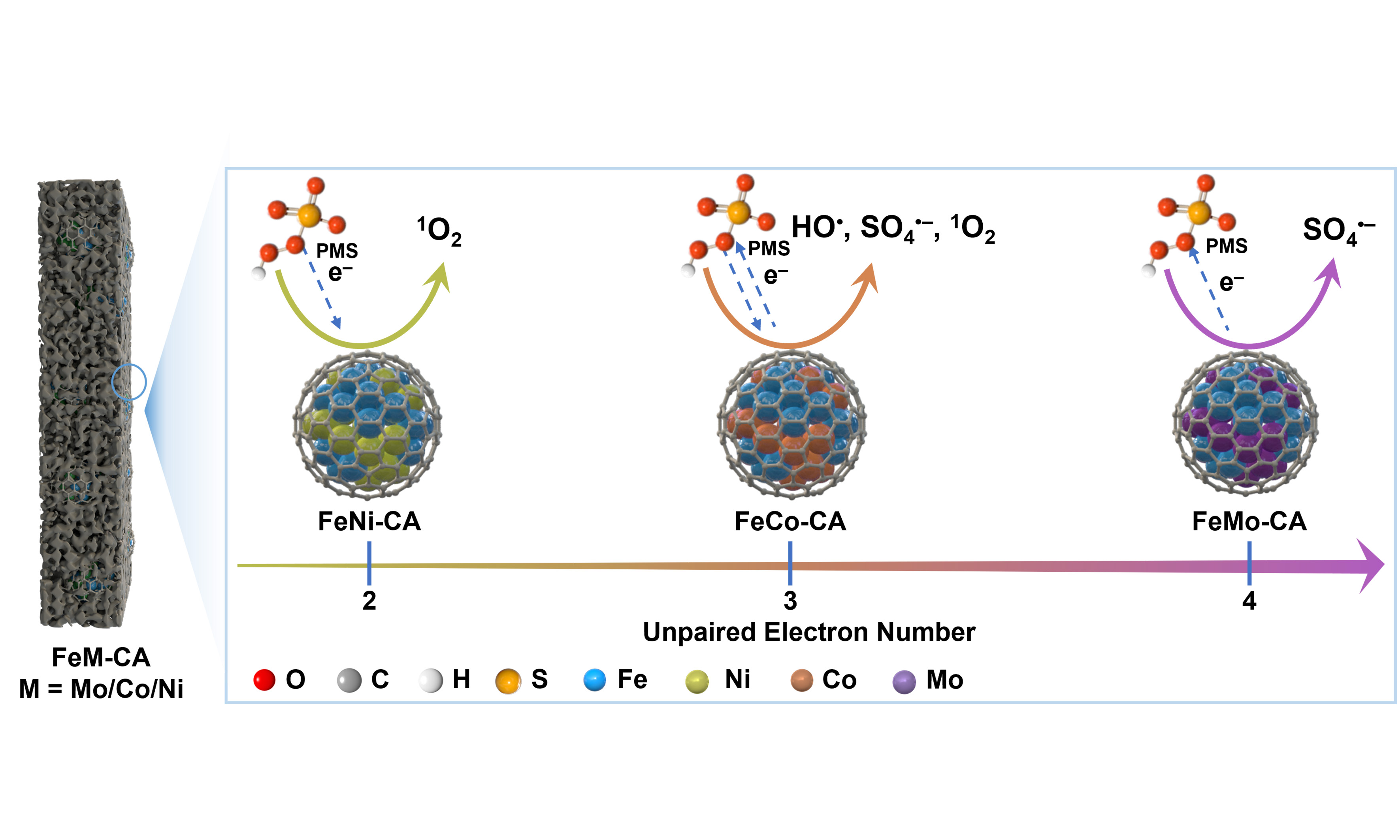
Emerging contaminants (ECs) have raised concerns because of their high biotoxicity and environmental persistence, which pose significant threats to ecosystems and public health. Peroxymonosulfate-based advanced oxidation processes (PMS-AOPs) offer an efficient strategy for the degradation of ECs by generating diverse reactive oxygen species (ROS). Nevertheless, high-temperature pyrolysis of carbon-based materials can produce diverse surface-active sites that are difficult to control, making it challenging to regulate PMS activation pathways and selectively generate ROS. Hence, this work developed integrated Fe-based alloy-doped carbon aerogels (FeM-CA, M = Mo/Co/Ni) as cathodes to electro-activate PMS. Electron paramagnetic resonance (EPR) and quenching experiments indicated that the FeMo-CA/PMS and FeNi-CA/PMS systems selectively generated SO4•- and 1O2, respectively, while HO•, SO4•-, and 1O2 coexisted in the FeCo-CA/PMS system. Additionally, temperature-dependent magnetic susceptibility measurements and in situ Raman spectroscopy collectively demonstrated that the introduced secondary metals modulated the electron density of alloy centers, thereby regulating the PMS activation pathways. Particularly, FeMo-CA, with abundant unpaired electrons (3.87), promoted the cleavage of the O–O bond in PMS via a radical pathway, generating SO4•-. In contrast, electron-deficient FeNi-CA, with fewer unpaired electrons (2.05), tended to withdraw electrons from PMS, inducing a non-radical route dominated by 1O2. FeCo-CA, with an intermediate number of unpaired electrons (2.84), supported the coexistence of radical and non-radical pathways, thereby generating multiple ROS. Furthermore, the catalytic performance and anti-interference capability of FeCo-CA were assessed, demonstrating its promising potential for practical water treatment. This study provided a theoretical basis for catalyst design for selective PMS activation based on the electronic structure of active sites.
Keywords


 Download PDF
INTRODUCTION
In recent years, emerging contaminants (ECs), such as perfluorinated compounds, antibiotics and other synthetic chemicals, pose potential threats to ecosystems and human health due to their environmental persistence and bioaccumulation potential[1-3]. Unlike conventional pollutants, which are often present at high concentrations, ECs are frequently detected at trace levels (ng·L-1-μg·L-1) in complex water matrices[4]. Current water-treatment technologies, including biological processes, membrane separation, adsorption, and disinfection, are insufficient to completely eliminate ECs. Advanced oxidation processes (AOPs) are effective in degrading and mineralizing nonbiodegradable, toxic organic pollutants by generating highly reactive oxygen species (ROS, e.g., HO•) through the activation of oxidants such as hydrogen peroxide, persulfates, peracetic acid, and ozone. These processes are widely used in water purification[5-10]. However, HO• reactivity is markedly limited in real water matrices because background constituents, including natural organic matter (NOM) and coexisting inorganic anions (carbonate and phosphate), competitively quench HO•. Consequently, selective degradation of target contaminants in complex aqueous environments is still a scientific challenge.
Peroxymonosulfate-based advanced oxidation processes (PMS-AOPs) have emerged as promising strategies for water treatment and can generate diverse ROS via both radical and non-radical pathways to efficiently eliminate organic contaminants[11-13]. In the radical pathway, energy input or electron transfer cleaves the peroxo bond (O–O) in PMS, thereby producing HO• and/or SO4•- to degrade pollutants (Eqs. 1-3). By contrast, the non-radical pathway offers moderate oxidizing power, high selectivity, and robust matrix tolerance. It may involve the generation of singlet oxygen (1O2; Eqs. 4-6), high-valent metal-oxo species (HVMOs), electron-transfer pathways (ETPs), the direct oxidative transfer process (DOTP), and the organic carbon transfer process (OCTP)[14-16]. Nevertheless, most PMS-AOP systems have been reported to involve the coexistence and interplay of radical and non-radical pathways, which can limit the selective removal of target contaminants in complex water matrices[17-22]. Therefore, it is critical to achieve the selective generation of desired ROS in PMS-AOPs systems.
To date, various catalysts have been developed for PMS activation, such as carbon-based materials, metal-based catalysts, and single-atom catalysts[23-27]. Among these materials, carbon-based materials serve as primary catalysts for PMS activation because of their tunable microenvironments, excellent conductivity, and chemical stability[28]. However, carbon-based materials possess diverse surface-active sites, such as heteroatoms, defects, and functional groups, that originate from the inherently difficult-to-control high-temperature pyrolysis or carbonization processes, thereby severely hampering selective PMS activation[29]. For instance, Deng et al. constructed Co-, S-, and O-codoped carbon nitride (CoCN-x) for PMS activation to generate various ROS simultaneously, including radicals (HO•, SO4•-, O2•-) and non-radical species (1O2, CoO2+, and electron transfer)[30]. Moreover, Wang et al. prepared CoFe encapsulated in N-doped carbon nanotubes (CoFe-N-CNTs) to activate PMS for pollutant degradation. In the CoFe-N-CNTs/PMS system, 1O2, HO•, SO4•-, and O2•- were detected, and electron transfer and DOTP pathways were also involved[31]. Thus, the rational design of carbon-based catalysts with well-defined and tunable active sites for highly selective ROS generation is critical[32,33]. Indeed, the selectivity of ROS generation is closely related to the electron density of active sites, which determines where oxygen atoms in PMS adsorb and the direction of electron transfer[34,35]. For instance, Zhang et al. developed an Fe single-atom catalyst supported on graphitic carbon nitride (Fe1/CN), with an Fe loading of 11.2 wt% for PMS activation. In Fe1/CN, the Fe atom in its oxidized state adsorbed the terminal oxygen atom of PMS, efficiently generating 1O2 with 100% selectivity, whereas the electron-rich Fe nanoparticles (NPs) in Fe NP/CN preferentially adsorbed an oxygen atom in the peroxo bond, generating HO• and SO4•-[36]. Collectively, modulating the electron density of active centers enables selective generation of ROS.
In this study, we constructed a series of Fe-based alloy-doped carbon aerogels (FeM-CA, M = Mo/Co/Ni) as cathodes to electro-activate PMS. The introduced secondary metals were employed to modulate the electron density of Fe, thereby regulating the PMS activation pathways. The morphologies of FeM-CA and the corresponding metal valence states were characterized by electron microscopy and X-ray absorption near-edge structure (XANES), respectively. Electron paramagnetic resonance (EPR) spectroscopy, quenching experiments, and chemical probes were collectively used to qualitatively and quantitatively identify the dominant ROS generated during PMS activation. Furthermore, the mechanisms underlying the different PMS activation pathways of FeM-CA were investigated using in situ Raman spectroscopy and temperature-dependent magnetic susceptibility measurements. Additionally, the performance of the FeM-CA/PMS systems was evaluated to assess their matrix tolerance and potential for water treatment. This work provided a theoretical foundation for the rational design of catalysts for PMS activation based on the electronic structure of active sites.
EXPERIMENTAL
Synthesis of FeM-CA
The Fe-based alloy-doped carbon aerogel (denoted as FeM-CA) was synthesized through a previously reported sol-gel method involving solvent exchange and pyrolysis processes[37]. The corresponding chemicals and reagents were listed in the Supplementary Text 1. Firstly, resorcinol, formaldehyde, water and sodium carbonate were thoroughly mixed at a molar ratio of 1:2.1:10.9:0.0008 to obtain a homogeneous solution. Then, a certain amount of metal acetylacetone precursors was gradually added to the solution. The mixture was poured into a rectangular glass mold with the dimensions of 15 cm × 5 cm × 3 cm. The polymerization and aging processes were carried out by maintaining the mold at 30, 50 and 90 °C for 24, 24 and 72 h, respectively. Subsequently, the wet gel was immersed in acetone for 3 days to remove water within the network. The aerogel was air-dried, and then calcined in a tubular furnace at 850 °C for 4 h under a nitrogen flow of 200 mL·min-1 with a heating rate of 2.5 °C·min-1. Finally, the obtained carbon aerogel was treated in 1 mol·L-1 H2SO4 at 80 °C for 8 h to remove unstable metal species. The dimensions of the as-synthesized FeM-CA were 5.0 cm × 2.0 cm × 0.2 cm with a mass of approximately 1.0 g.
Experimental setup
The electrochemical degradation experiments were conducted in a 50-mL cuboidal glass cell, with the as-prepared FeM-CA and Pt foil serving as the cathode and anode, respectively. The direct-current (DC) power supply was set to deliver a constant current of 20 mA during the electrochemical tests. The amperometric i-t measurement was conducted in a three-electrode system, with the as-prepared FeM-CA, Pt foil and Ag/AgCl serving as the working, counter and reference electrodes, respectively. Solutions containing each simulated wastewater contaminant at 10 mg·L-1, including bisphenol A (BPA), benzoic acid (BA), sulfamethoxazole (SMX), tetracycline (TC), and ciprofloxacin (CIP), were treated separately in 40 mL of 4 mM PMS solution. Methanol (100 mM), tert-butanol (TBA, 100 mM) and L-histidine (L-His, 5 mM) were used to quench HO•/SO4•-, HO• and 1O2, respectively. Moreover, BA, nitrobenzene (NB), and furfuryl alcohol (FFA) were selected as probes for SO4•-, HO•, and 1O2, respectively. Notably, separate experiments were conducted when BA was used as a target pollutant and as a ROS detection probe, respectively. The effects of coexisting ions (5 mM) were evaluated to assess the anti-interference ability of FeM-CA. BPA degradation in actual water samples (Wuquan Mountain spring water, tap water, lake water, snow water, and Yellow River water) was used to investigate the practical applicability of the FeM-CA electrode. Recycling tests were conducted by collecting the used electrode, washing it with deionized water, and drying it in a vacuum oven. All sample aliquots were collected at predetermined intervals and immediately quenched with Na2S2O3 to eliminate residual PMS.
RESULTS AND DISCUSSION
Physicochemical characterization of FeM-CA
The integrated FeM-CA electrodes were prepared via a classical sol-gel method [Figure 1A]. The polymerization reaction between resorcinol and formaldehyde under a weakly alkaline environment provided a stable carbon framework for the carbon aerogel. Transition metal NPs promoted the formation of graphitic carbon layers at high temperature, thereby increasing the degree of carbon graphitization and boosting the conductivity of the electrodes. The as-prepared FeM-CA was used as the cathode to electrochemically activate PMS for ROS generation. Subsequently, scanning electron microscopy (SEM) and transmission electron microscopy (TEM) images provided detailed views of all FeM-CA electrodes [Supplementary Text 2]. As illustrated in Figure 1 and Supplementary Figure 1, FeMo-CA, FeCo-CA, and FeNi-CA all exhibited interconnected aerogel network structures in which the alloy NPs were embedded in the carbon layers. The NPs displayed lattice fringes with a spacing of 0.38 nm. For FeMo-CA, the interplanar distance of 0.22 nm was assigned to the (400) planes of the FeMo alloy, and the energy dispersive spectroscopy (EDS) mapping images showed uniform distributions of Fe and Mo [Figure 1B and C]. The lattice-fringe spacings of 0.20 and 0.17 nm observed in Figure 1D and F were attributed to the (011) and (110) facets of the FeCo and FeNi alloys, respectively. The EDS maps of FeCo-CA and FeNi-CA showed that the Fe, Co, and Ni elements were uniformly distributed in the alloy NPs [Figure 1E and 1G]. The contents of metals in FeM-CA were summarized in Supplementary Table 1. Moreover, the X-ray diffraction (XRD) patterns proved that the as-prepared FeM-CA electrodes exhibited well-crystallized alloy diffraction peaks [Supplementary Figure 2], in accordance with the TEM results. The diffraction peaks at 43.7° and 50.9° were assigned to the (101) and (110) planes of the FeNi alloy (PDF#96-901-0018). The prominent peaks at 2θ values of 39.5° and 44.8° corresponded to the (400) plane of FeMo (PDF#96-231-0324) and the (011) plane of FeCo (PDF#96-152-4168), respectively. Accordingly, the Brunauer-Emmett-Teller (BET) surface areas of FeMo-CA, FeNi-CA, and FeCo-CA were 536.8992, 666.3775, and 647.6627 m2·g-1, respectively [Supplementary Figure 3]. Moreover, all isotherms were classified as Type II isotherms, indicating the coexistence of mesopores and macropores in these carbon aerogels. This result suggested that the introduction of different secondary metals significantly regulated the surface area of the carbon aerogels, consequently affecting the effective contact area between active sites and PMS.

Figure 1. (A) Schematic illustration of the preparation of the FeM-CA electrode; (B1) TEM images; (B2) lattice fringe of carbon; (B3) Intensity line profile; and (C1 and C2) EDS maps of FeMo-CA; (D1) TEM images; (D2) lattice fringe of carbon; (D3) Intensity line profile; and (E1 and E2) EDS maps of FeCo-CA; (F1) TEM images; (F2) lattice fringe of carbon; (F3) Intensity line profile; and (G1 and G2) EDS maps of FeNi-CA. ROS: Reactive oxygen species; PMS: peroxymonosulfate; CA: carbon aerogel; TEM: transmission electron microscopy; EDS: energy dispersive spectroscopy.
The chemical state and coordination environment of metal species in FeM-CA were investigated at the atomic level using XANES at the atomic level. The Fe K-edge XANES profiles of FeM-CA were similar to those of Fe foil but differed from those of the iron oxides [Figure 2A]. To quantitatively analyze the above absorption-edge shifts, valence-state fitting was carried out on the Fe K-edge XANES data. The average valence states of Fe in all FeM-CA electrodes were close to zero [Figure 2B], indicating that Fe was predominantly present as metallic alloy NPs rather than oxides or single-atom sites. Accordingly, the valence states of Ni and Co were fitted to zero, indicating strong electronic hybridization between Fe and Co/Ni and the formation of an alloy phase [Supplementary Figures 4 and 5]. In stark contrast, Mo exhibited a distinctly positive valence of +1.89, indicating electron transfer between Fe and Mo [Supplementary Figure 6]. Subsequently, Fourier-transform k3-weighted extended X-ray absorption fine structure (FT-EXAFS) analysis was performed to investigate the local coordination environment of Fe species in FeM-CA. As shown in Figure 2C, the characteristic peak at 2.2 Å was attributed to the Fe–Fe coordination. Similarly, the dominant M–M peaks were observed in the FT-EXAFS spectra collected at the Mo, Co, and Ni K-edges [Figure 2D-F], consistent with the K-edge XANES results described above. Notably, compared with pure metal foils, these M–M peaks exhibited slight shifts in their R values, which were attributable to interactions between Fe and the secondary metals (Co, Ni, and Mo). The wavelet-transform analysis of the k2-weighted EXAFS spectra was used to further confirm the Fe coordination structure in FeM-CA. As expected, the maximum intensity at k ≈ 8 Å-1 corresponded to Fe–Fe coordination [Figure 2G and Supplementary Figure 7]. In addition, the corresponding wavelet-transform EXAFS (WT-EXAFS) spectra at the Co, Mo, and Ni K-edges collectively confirmed the alloy structures in FeMo-CA, FeCo-CA, and FeNi-CA [Supplementary Figures 8-10].
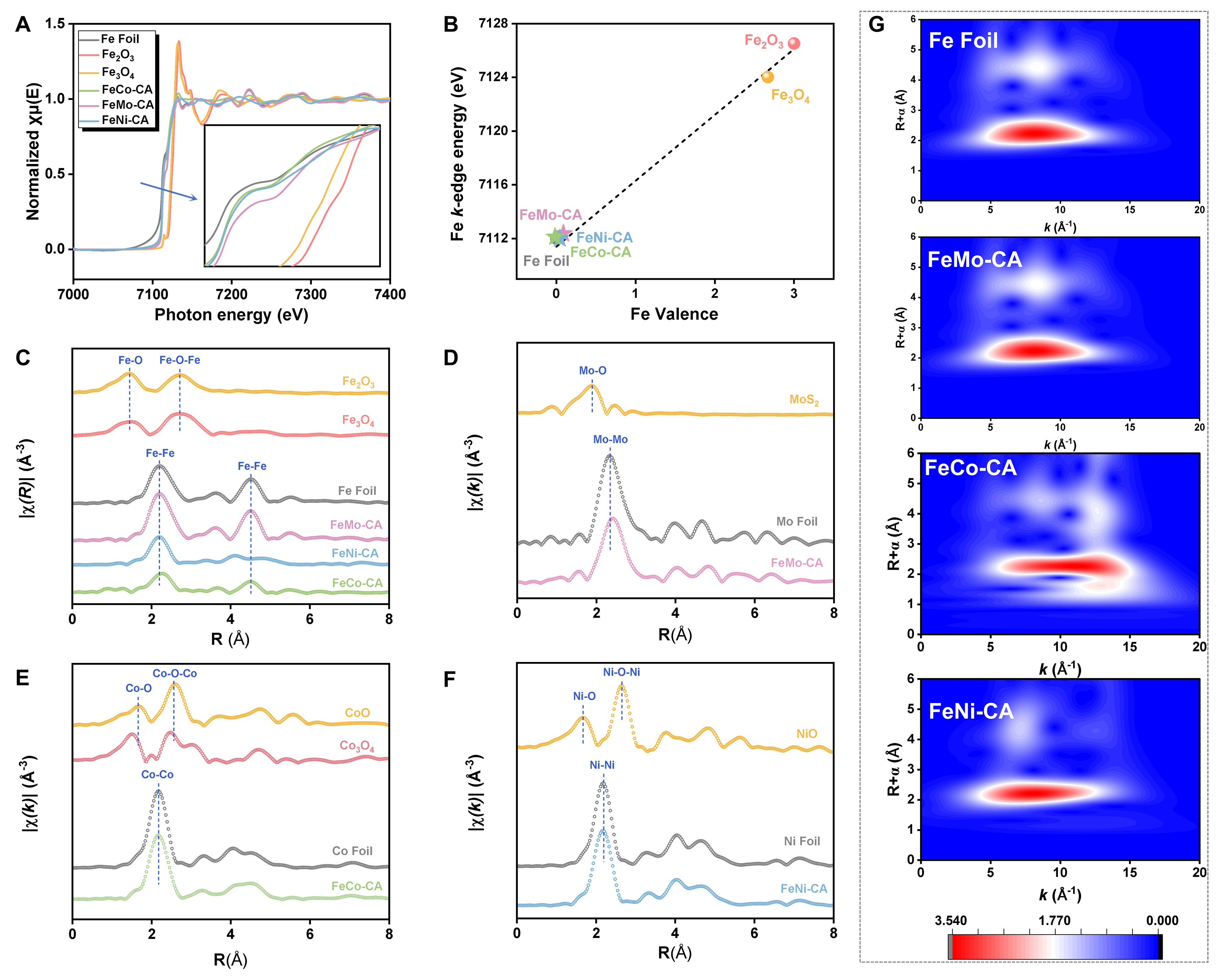
Figure 2. (A) Fe K-edge XANES spectra, (B) valence states and (C) FT-EXAFS spectra at the Fe K-edge in R space for FeCo-CA, FeMo-CA, FeNi-CA, standard Fe foil, Fe2O3 and Fe3O4; FT-EXAFS spectra in R space at the (D) Mo K-edge for FeMo-CA, (E) Co K-edge for FeCo-CA, and (F) Ni K-edge for FeNi-CA; (G) WT-EXAFS spectra at the Fe K-edge for Fe foil, FeMo-CA, FeCo-CA, and FeNi-CA. XANES: X-ray absorption near-edge structure; FT-EXAFS: Fourier-transform k3-weighted extended X-ray absorption fine structure; WT-EXAFS: wavelet-transform EXAFS.
Identification and quantitation of ROS in FeM-CA/PMS system
EPR was employed to identify ROS generated in FeM-CA/PMS systems using 5,5-dimethyl-1-pyrroline-N-oxide (DMPO) and 2,2,6,6-tetramethyl-4-piperidinol (TEMP) as spin-trapping agents [Supplementary Text 3]. Clearly, only a typical triplet signal of the TEMP-1O2 adduct (1:1:1; hyperfine coupling constants AN = AH = 1.7 mT) was detected in the FeNi-CA/PMS system [Figure 3A and B]. Additionally, a remarkable DMPO-SO4•- adduct signal (hyperfine coupling constants AN = 1.3 mT, AH = 0.9 mT, AH = 1.5 mT and AH = 0.08 mT) was observed in FeMo-CA/PMS system, while the weak TEMP-1O2 signal was attributed to the sluggish self-decomposition of PMS[38]. These results indicated that 1O2 and SO4•- were selectively generated by FeNi-CA and FeMo-CA, respectively. In the FeCo-CA/PMS system, a strong four-line spectrum induced by HO• (1:2:2:1; hyperfine coupling constants AN = AH = 1.5 mT), together with a DMPO-SO4•- signal and a TEMP-1O2 signal, demonstrated that HO•, SO4•-, and 1O2 were generated simultaneously. To further verify the main ROS in FeM-CA/PMS systems, methanol, L-His, and TBA were used as the scavengers for HO•/SO4•-, 1O2, and HO•, respectively[39]. TBA was employed as a selective scavenger for HO• because its second-order reaction rate constant of TBA with HO• (k = 3.8 × 10⁸ M-1 s-1) was several orders of magnitude higher than that with SO4•- (k = 4 × 10⁵ M-1 s-1). Methanol acts as a universal radical scavenger because it reacts rapidly with HO• (k = 9.7 × 10⁸ M-1 s-1) and SO4•− (k = 3.2 × 10⁷ M-1 s-1)[40]. Notably, the SO4•- and 1O2 signals disappeared after methanol and L-His were added, further confirming that SO4•- and 1O2 were the dominant ROS in the FeMo-CA/PMS and FeNi-CA/PMS systems, respectively [Figure 3C and D]. Moreover, the intensities of the HO•, SO4•- and 1O2 signals decreased in the presence of TBA, methanol, and L-His, providing strong evidence for the coexistence of diverse ROS in the FeCo-CA/PMS system [Figure 3E and F]. Subsequently, BA, FFA, and NB were selected as probes to quantify the steady-state concentrations ([ROS]ss) of SO4•-, 1O2, and HO•, respectively [Figure 3G, Supplementary Text 4 and Supplementary Table 2]. As shown in Figure 3H, the measured [1O2]ss in the FeNi-CA/PMS reached 1.99 × 10⁻¹¹ M, which was higher than that in the FeCo-CA/PMS system (1.32 × 10⁻¹¹ M) and pure PMS (6.50 × 10⁻¹² M) systems. Meanwhile, the obtained [SO4•-]ss in the FeMo-CA/PMS system (5.03 × 10⁻¹² M) was 4.2-fold higher than that in the FeCo-CA/PMS (1.19 × 10⁻¹² M) system. Moreover, the [HO•]ss in the FeCo-CA/PMS system was 4.72 × 10⁻¹³ M, which was lower than the concentrations of the other ROS. Taken together, the FeNi-CA and FeMo-CA selectively activated PMS via non-radical (1O2) and radical pathways (SO4•-), respectively, while the FeCo-CA enabled the simultaneous generation of multiple ROS (SO4•-, HO•, and 1O2).
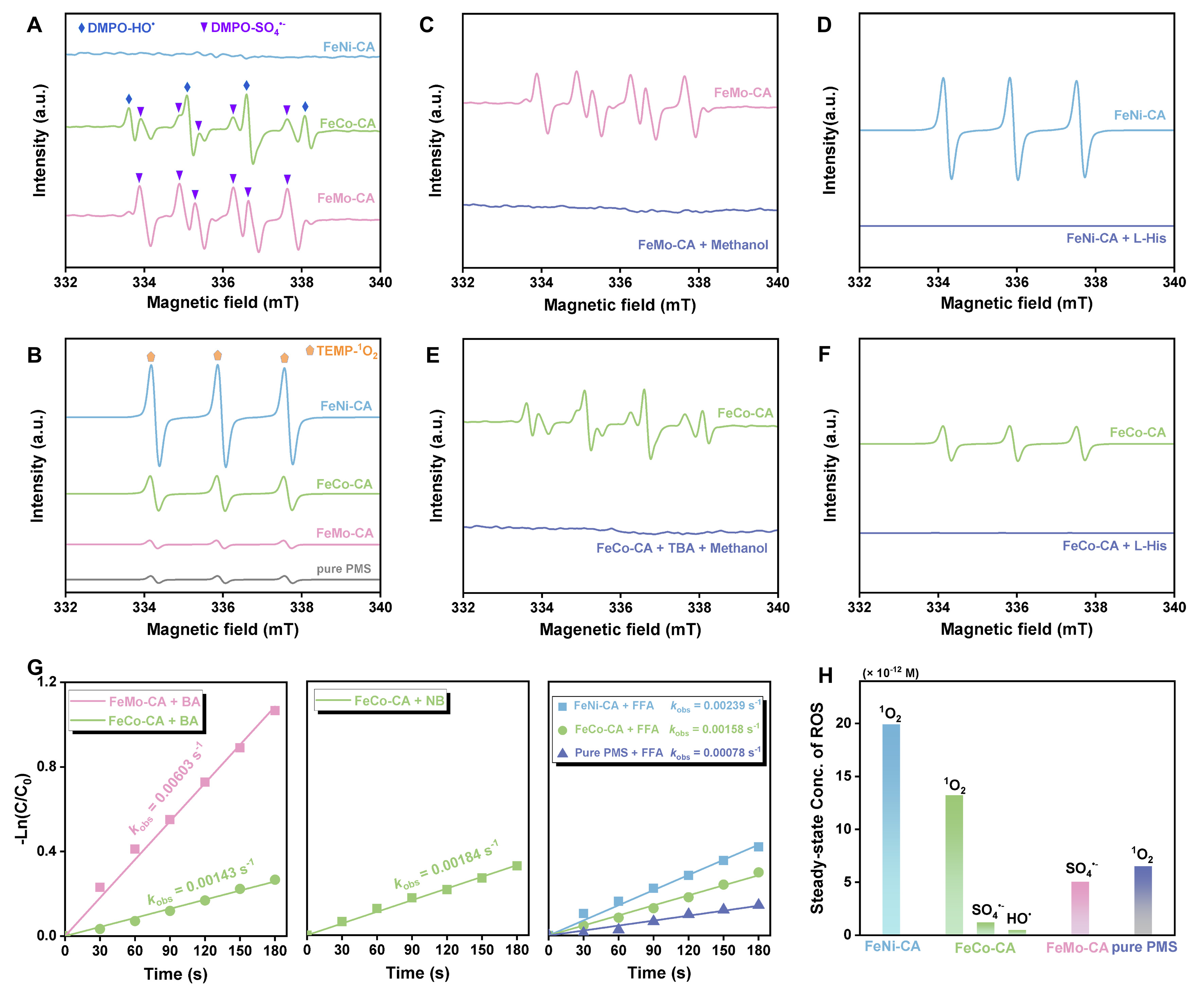
Figure 3. EPR spectra of the FeCo-CA, FeMo-CA, and FeNi-CA using (A) DMPO and (B) TEMP as spin-trapping agents; Quenching experiments for (C) FeMo-CA, (D) FeNi-CA, and (E and F) FeCo-CA; (G) Pseudo-first-order kinetic constants (kobs) of the selected probe compounds and (H) steady-state concentrations of ROS in the FeCo-CA/PMS, FeMo-CA/PMS, FeNi-CA/PMS, and pure PMS systems. DMPO: 5,5-dimethyl-1-pyrroline-N-oxide; CA: carbon aerogel; L-His: L-histidine; TEMP: 2,2,6,6-tetramethyl-4-piperidinol; PMS: peroxymonosulfate; TBA: tert-butanol; BA: benzoic acid; FFA: furfuryl alcohol; EPR: electron paramagnetic resonance; ROS: reactive oxygen species.
Mechanistic insights into PMS activation over FeM-CA cathodes
To clarify the role of the carbon layer in PMS activation, in situ Raman spectroscopy was used to monitor the dynamic evolution of the carbon-framework microstructure within FeM-CA. As illustrated in Supplementary Figure 11, the characteristic signals of D (~1,350 cm-1) and G (1,580 cm-1) bands were observed in all FeM-CA electrodes and were assigned to the sp3-related defects in carbon and sp2-hybridized graphitic carbon, respectively. The ID/IG values followed the order: FeMo-CA (0.94) < FeCo-CA (1.03) < FeNi-CA (1.14), indicating that FeNi-CA possessed the most abundant defects, while FeMo-CA exhibited the highest degree of graphitization. After PMS was added, no significant shifts in the D and G bands were observed in any of the FeM-CA electrodes, and the ID/IG ratios remained stable over the 0-300 s reaction period, suggesting that the carbon structure remained stable during the reaction. These findings confirmed that the carbon skeletons were not involved in PMS activation [Figure 4A-C]. The slight increases in the intensities of the D and G bands mainly arose from the interfacial electronic response. Subsequently, PMS evolution on the surface of the FeM-CA cathodes was investigated. As illustrated in Figure 4D-F, three characteristic peaks were observed in the spectrum of pure PMS. The peaks at 880 and 1,060 cm-1 were assigned to the stretching vibrations of the O–O bond and SO3- group of PMS (HSO5-), respectively, whereas the peak at 980 cm-1 was attributed to the symmetric stretching vibration of the S=O bond in SO42-. Notably, the intensities of the peaks assigned to the O–O bond and SO3- group decreased sharply, whereas the intensity of the S=O band increased, indicating that PMS was efficiently decomposed in all FeM-CA electrodes. In addition, a red shift of the SO3- peak occurred in the FeMo-CA/PMS system, resulting in an increase in electron-cloud density in SO3- and a decrease in the S–O bond order [Supplementary Figure 12A]. This result indicated that the FeMo alloy tended to transfer electrons to PMS, promoting O–O bond cleavage and the generation of SO4•- radicals[41]. In contrast, the blue shift of the SO3- peak in the FeNi-CA/PMS system was attributed to a decrease in electron cloud density and an increase in S–O bond polarity, suggesting that the FeNi alloy tended to withdraw electrons from PMS, thereby facilitating 1O2 generation via a non-radical pathway [Supplementary Figure 12B]. As shown in Supplementary Figure 12C, the preferential blue shift in the FeCo-CA/PMS system was attributed to the higher steady-state concentration of non-radical 1O2 than that of the radicals (SO4•- and HO•) shown in Figure 3H. These observations were consistent with the aforementioned identification and quantitative analysis of ROS, providing evidence for the distinct PMS activation mechanisms of the three FeM-CA electrodes.
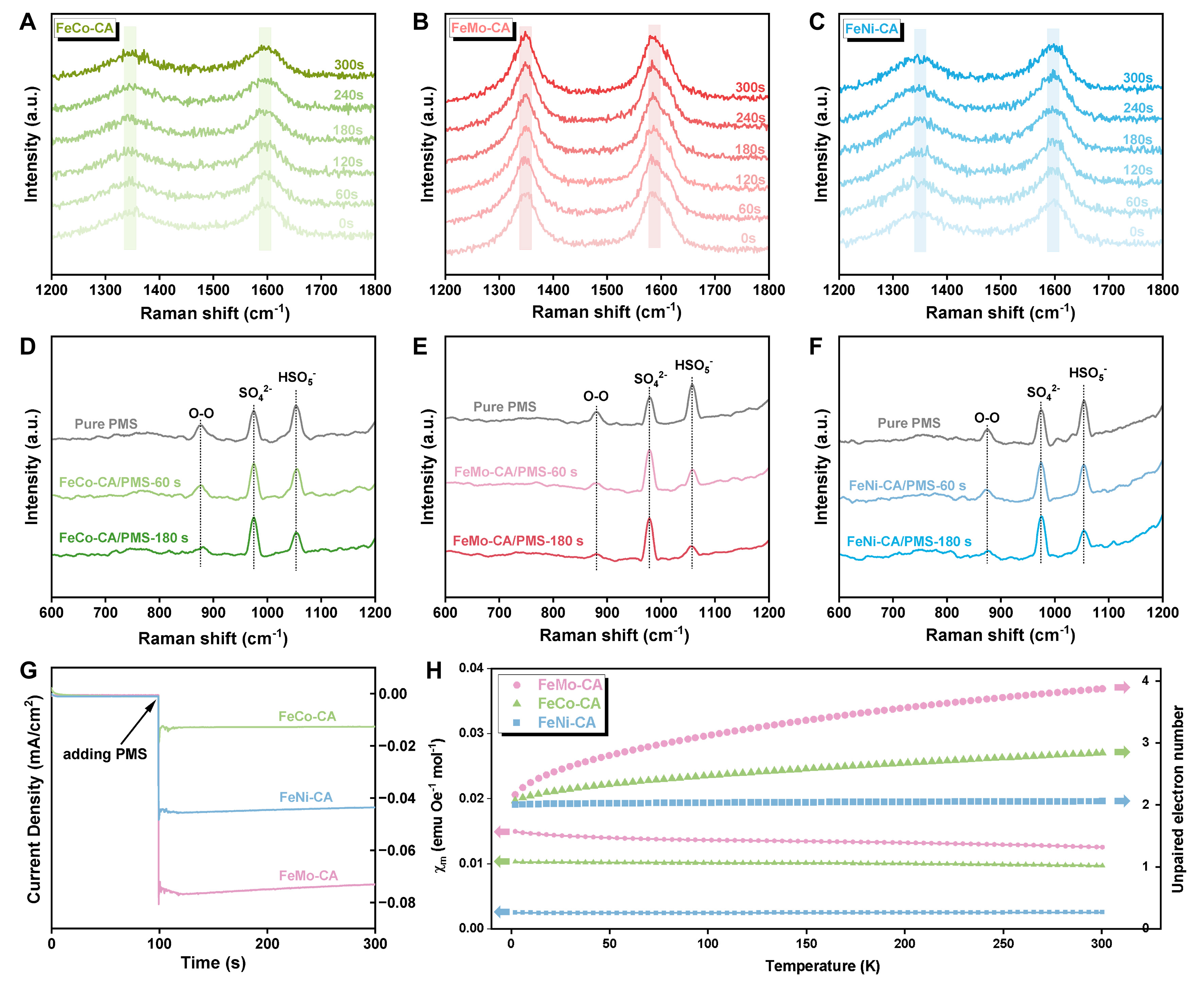
Figure 4. In situ Raman spectra of (A) FeCo-CA, (B) FeMo-CA, and (C) FeNi-CA during PMS activation at different reaction times; In situ Raman spectra of (D) FeCo-CA/PMS, (E) FeMo-CA/PMS, and (F) FeNi-CA/PMS systems at reaction times of 60 and 180 s; (G) Amperometric i-t curves of FeCo-CA, FeMo-CA, and FeNi-CA after PMS addition; (H) M-T curves and the calculated numbers of unpaired electrons in the d orbits of FeCo-CA, FeMo-CA, and FeNi-CA. PMS: Peroxymonosulfate; CA: carbon aerogel.
Subsequently, to elucidate the mechanism of PMS activation from an electrochemical perspective, amperometric i-t curves were recorded for FeCo-CA, FeMo-CA, and FeNi-CA to monitor the current responses after PMS injection [Figure 4G]. Specifically, FeMo-CA exhibited a cathodic current response of -0.073 mA·cm-2 after adding PMS, which was 1.7- and 7.3-fold greater in magnitude than the responses for FeCo-CA (-0.043 mA·cm-2) and FeNi-CA (-0.01 mA·cm-2), respectively. A more negative current indicated faster electron transfer from the electrode to PMS. In other words, FeMo-CA, which possessed more available electrons, could rapidly transfer electrons to PMS, thereby generating SO4•- via a radical pathway. Conversely, electron-deficient FeNi-CA displayed a tendency to accept electrons from PMS, thereby producing 1O2 via a non-radical route. These observations were highly consistent with the above in situ Raman and EPR results.
In theory, the selectivity of ROS generation was related to the electronic structure of active sites. Therefore, temperature-dependent magnetic susceptibility [molar magnetic susceptibility multiplied by temperature (χmT)] was measured to calculate the effective magnetic moment and the average number of unpaired electrons in three FeM-CA electrodes[42]. As depicted in Figure 4H, the numbers of unpaired electrons in FeMo-CA, FeCo-CA, and FeNi-CA were 3.87, 2.84, and 2.05, respectively. The number of unpaired electrons in the three FeM-CA electrodes was closely related to the d-electron count of the secondary metal. As the d-electron count of the secondary metal increased from Mo (4d55s1) to Co (3d74s2) and Ni (3d84s2), the d-band filling of the alloy gradually rose. The 4d orbitals of Mo exhibited greater spatial extension than the 3d orbitals of Co and Ni. Hybridization between Fe 3d and Mo 4d induced prominent d-band splitting and spin-state reconstruction. The FeMo alloy had the highest number of unpaired electrons among the three samples and acted as a potent electron donor to PMS, thereby driving the radical pathway. However, Ni possesses the largest number of 3d valence electrons. The FeNi alloy showed the highest d-band filling of the three samples, where a large fraction of spin orbitals is filled by paired electrons. Thus, FeNi-CA, which had the fewest unpaired electrons, activated PMS through a non-radical pathway dominated by 1O2. Furthermore, Co has more 3d electrons than Fe. The FeCo alloy featured a higher d-band filling level than FeMo, with more spin-up orbitals occupied and a lower population of unpaired electrons. Therefore, FeCo-CA, which had an intermediate number of unpaired electrons, exhibited both radical and non-radical pathways. These findings further demonstrated that selective ROS generation was closely linked to the electronic structure of active sites.
Application potential of FeM-CA/PMS for water purification
Several parameters were used to comprehensively evaluate the application potential of FeM-CA for water treatment, including degradation kinetics, factors affecting performance, and recyclability. BPA, a typical EC with endocrine-disrupting activity, was selected as a model pollutant to assess the electrochemical performance of the as-prepared FeM-CA electrodes for PMS activation [Supplementary Text 3]. As illustrated in Figure 5A, the FeCo-CA/PMS system achieved approximately 100% BPA degradation within 150 s, exceeding the degradation achieved by the FeNi-CA/PMS (~89%) and FeMo-CA/PMS (~60%) systems. The corresponding pseudo-first-order kinetic constant (kobs) followed the order: FeMo-CA/PMS (0.006 s−1) < FeNi-CA/PMS (0.015 s−1) < FeCo-CA/PMS (0.027 s−1) (Figure 5B). The lower degradation rate in the FeMo-CA/PMS system was attributed to the lower steady-state concentration of SO4•-. Moreover, the total organic carbon (TOC) removal efficiency in the FeCo-CA/PMS system (95.2%) was higher than the efficiencies in the FeNi-CA/PMS (64.7%) and FeMo-CA/PMS (31.3%) systems (Figure 5C). Accordingly, FeCo-CA exhibited excellent degradation and mineralization performance in water treatment, benefiting from the synergistic dual-pathway mechanism involving both radical and non-radical ROS. In addition, various ECs were further used to explore the broad-spectrum applicability of FeCo-CA/PMS system, including SMX, TC, CIP and BA. As depicted in Figure 5D, complete removal of various ECs was achieved within 8 min. Differences in degradation among pollutants were probably attributable to the electron-donating or electron-withdrawing properties of their substituent groups. Furthermore, the effects of coexisting anions and water matrices on BPA degradation were investigated to assess the practical applicability of the FeCo-CA/PMS system. As expected, the most common anions clearly promoted BPA removal in the FeCo-CA/PMS system, including Cl−, CO32−, SO42− and NO3−. This effect was attributed to the high steady-state concentration of 1O2, indicating the system’s superior anti-interference capability (Figure 5E). Moreover, the introduced ions enhanced the electrical conductivity of the solution, consequently accelerating the degradation kinetics of BPA. However, the BPA degradation efficiency decreased from 100% to 76% in the presence of H2PO4- because H2PO4- strongly quenches radicals (HO• and SO4•-)[43]. In addition, water samples with complex matrices were used to assess the environmental adaptability of the FeCo-CA/PMS system, including Wuquan Mountain spring water, tap water, lake water, snow water, and Yellow River water. As shown in Figure 5F, BPA removal reached 100% in the different natural water samples within 10 min, although this was slower than in deionized water (150 s). This difference was attributed to coexisting organic and inorganic substances that quenched the radicals. Furthermore, the FeCo-CA/PMS system maintained BPA removal efficiencies of 95%–100% over 10 cycles, with negligible leaching of Fe and Co from the cathodes (< 0.1 mg L-1). No obvious differences were observed between the XRD patterns of fresh and used FeCo-CA [Supplementary Figure 13]. These results collectively demonstrated the excellent stability of FeCo-CA in water purification. Taken together, the FeCo-CA/PMS system retained high removal efficiency in complex water matrices, highlighting its anti-interference capability and potential for practical water remediation.
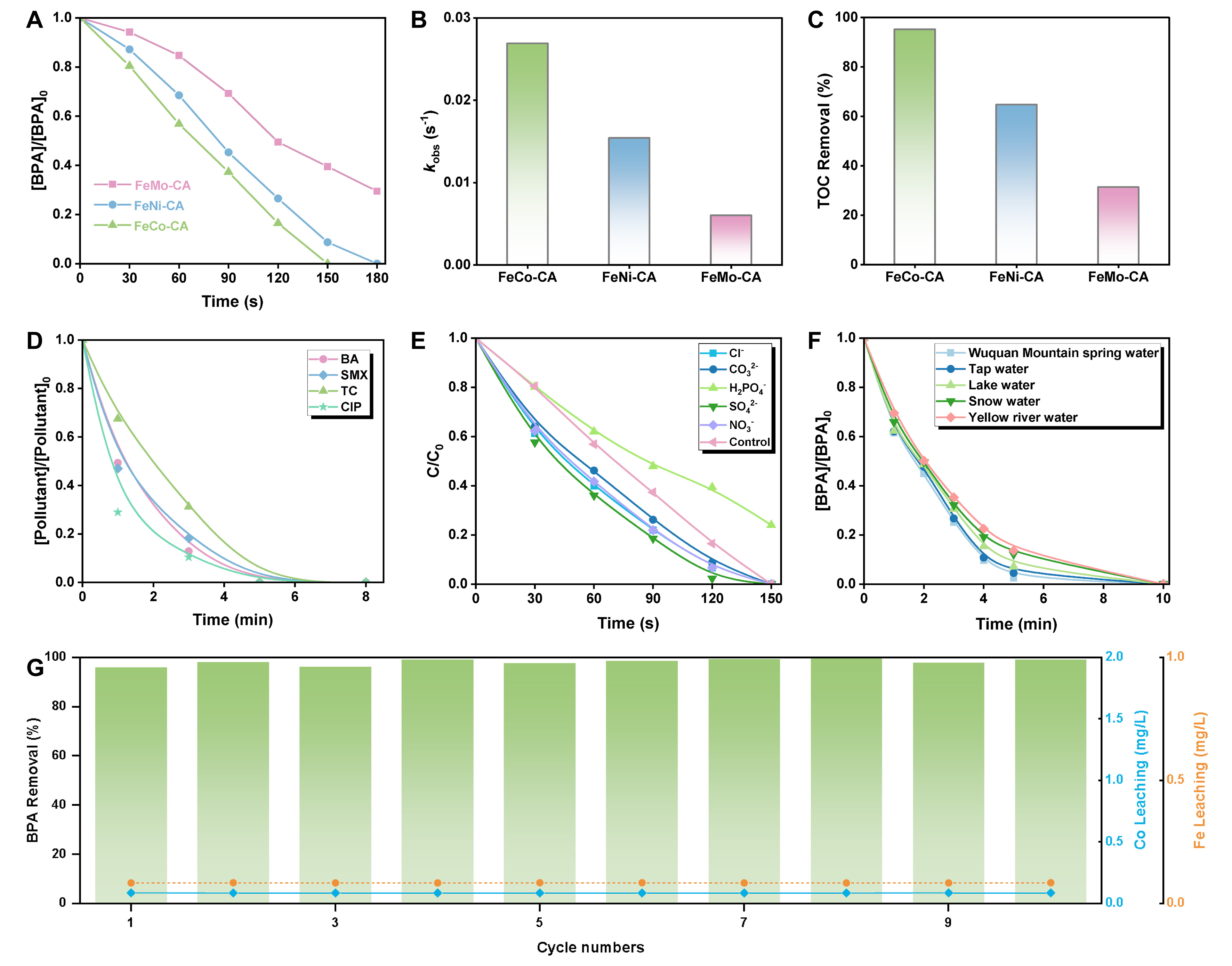
Figure 5. (A) BPA degradation performance, (B) the corresponding pseudo-first-order kinetic constants (kobs) and (C) TOC removal efficiency in the FeCo-CA/PMS, FeMo-CA/PMS, and FeNi-CA/PMS systems; (D) Degradation performance of various pollutants, (E) effects of coexisting anions, and (F) effects of water matrices on BPA degradation in the FeCo-CA/PMS system; (G) Cycling performance of BPA degradation and metal leaching in the FeCo-CA/PMS system. Reaction conditions: [Current] = 20 mA, [PMS] = 4 mM, [BPA]0 = [BA]0 = [SMX]0 = [TC]0 = [CIP]0 = 10 mg·L-1, [anions]0 = 5 mM. TOC: Total organic carbon; BA: benzoic acid; SMX: sulfamethoxazole; TC: tetracycline; CIP: ciprofloxacin; BPA: bisphenol A; PMS: peroxymonosulfate; CA: carbon aerogel.
CONCLUSIONS
In this work, Fe-based alloy-doped carbon aerogels (FeM-CA, M = Mo/Co/Ni), prepared via a typical sol-gel method, were used as cathodes to electro-activate PMS for ROS generation. SEM and TEM images, together with EDS maps, showed interconnected network structures in which alloy NPs were encapsulated by the carbon aerogel. XANES profiles demonstrated that the average valence states of Fe in all FeM-CA electrodes were close to 0. Accordingly, the valence states of Ni, Co and Mo were 0, 0, and +1.89, respectively, indicating the electronic hybridization between Fe and Co/Ni/Mo and the formation of an alloy phase. EPR and quenching experiments indicated that SO4•- and 1O2 were the dominant ROS in the FeMo-CA/PMS and FeNi-CA/PMS systems, respectively, while HO•, SO4•- and 1O2 coexisted in the FeCo-CA/PMS system. Furthermore, temperature-dependent magnetic susceptibility measurements combined with in situ Raman spectroscopy indicated that the introduction of secondary metals (Mo, Co, and Ni) modulated the electron density of Fe, thereby regulating the PMS activation pathways. Specifically, the electron-rich FeMo-CA, with abundant unpaired electrons, facilitated the cleavage of the O–O bond in PMS to selectively generate SO4•-. In contrast, the electron-deficient FeNi-CA, which had fewer unpaired electrons, tended to accept electrons from PMS, thereby inducing a non-radical pathway dominated by 1O2. FeCo-CA, which had an intermediate number of unpaired electrons, exhibited both radical and non-radical pathways, resulting in the simultaneous generation of multiple ROS (HO•, SO4•-, and 1O2). Moreover, the FeCo-CA/PMS system showed superior performance in pollutant degradation, matrix tolerance, and long-term stability, highlighting its potential for practical water remediation. This work provided a novel strategy and a theoretical basis for the precise regulation of ROS generation in PMS-AOP systems.
DECLARATIONS
Authors’ contributions
Conceptualization, data curation, formal analysis, visualization, and writing - original draft: Chen, M.
Data curation, methodology, validation, formal analysis, investigation, visualization, and writing - original draft: Dou, Y.
Formal analysis: Liu, X.; Li, Y.
Conceptualization, supervision, project administration, funding acquisition, and writing - review & editing: Zhao, H.
Availability of data and materials
All data required to support the conclusions of this paper are included in the manuscript and the Supplementary Materials. Additional data related to this paper can be obtained from the corresponding author upon request.
AI and AI-assisted tools statement
Not applicable.
Financial support and sponsorship
This work was supported by the National Natural Science Foundation of China (Project Nos. 22476152 and 22122606) and the National Key R&D Program of China (No. 2024YFA1211002).
Conflicts of interest
Zhao, H. is an Editorial Board Member of Greenverse Science. She was not involved in any aspect of the editorial process, including reviewer selection, manuscript handling, or decision-making. The other authors declare that there are no conflicts of interest.
Ethical approval and consent to participate
Not applicable.
Consent for publication
Not applicable.
Copyright
© The Author(s) 2026.
Supplementary Materials
REFERENCES
1. Cui, H. L.; Gao, S. H.; Wang, H. C.; et al. Big data integration for environmental risk assessment of emerging contaminants. Nat. Sustain. 2026, 9, 196-206.
2. Liu, T.; Zhang, Y.; Shan, Z.; et al. Covalent organic framework membrane for efficient removal of emerging trace organic contaminants from water. Nat. Water. 2023, 1, 1059-67.
3. Wang, S.; Dong, H.; Shao, B.; et al. High-valent iron species (Fe(IV)/Fe(V)) for selective oxidation of emerging contaminants: mechanisms, applications, and future directions. Environ. Sci. Technol. 2025, 59, 23005-23.
4. Su, W.; Liu, W.; Wu, H.; et al. Chlorination-properties-performance of polyamide nanofiltration membranes for the rejection of emerging contaminants. Water. Res. 2025, 284, 124030.
5. Chen, Y.; Li, Q.; Su, R.; et al. Oxygen vacancies-mediated the peracetic acid activation to selectively generate 1O2 for water decontamination. Water. Res. 2025, 282, 123765.
6. Hao, Y.; Zhang, Y.; Wang, J.; Zhang, H.; Sun, L.; Cui, M. Micro-nanobubbles-assisted advanced oxidation processes and their inactivation effect on Gymnodinium catenatum: O3/H2O2/UV multi-oxidant system. Chem. Eng. J. 2025, 520, 166123.
7. Marino, L.; Gagliano, E.; Santoro, D.; Roccaro, P. Fluorescence sensor enabled control of contaminants of emerging concern in reclaimed wastewater using ozone-based treatment processes. Water. Res. 2025, 268, 122616.
8. Tong, Y.; Wang, X.; Zhang, Y.; Xu, J.; Sun, C. Reactive species in peracetic acid-based AOPs: a critical review of their formation mechanisms, identification methods and oxidation performances. Water. Res. 2025, 272, 122917.
9. Wang, W. M.; Wang, W. L.; Gan, L.; et al. Self-replenishing neutral Fenton-like treatment for emerging contaminants through single Fe atom electron configuration regulation. Water. Res. 2025, 276, 123251.
10. Zhang, X.; Wang, Z.; Hu, J. Performance comparison of O3 and O3/Peroxymonosulfate (PMS) advanced oxidation processes for the antibiotics removal in wastewater treatment. J. Hazard. Mater. 2025, 496, 139248.
11. Chen, H.; Yin, R.; Zhu, M. How to enhance persulfate processes by external-field effects: from fundamentals to applications. Water. Res. 2025, 274, 123026.
12. Li, N.; Ye, J.; Dai, H.; et al. A critical review on correlating active sites, oxidative species and degradation routes with persulfate-based antibiotics oxidation. Water. Res. 2023, 235, 119926.
13. Wu, Y.; Huang, D.; Li, D.; Qian, X.; Niu, J. From ambiguity to application: deciphering non-radical pathways in heterogeneous persulfate activation. Adv. Mater. 2026, 38, e16166.
14. Chen, Z.; Wang, J.; Yang, B.; et al. Organic carbon transfer process in advanced oxidation systems for water clean-up. Nat. Water. 2025, 3, 334-44.
15. Li, Z.; Ji, X.; Li, Q.; et al. Asymmetric coordination engineering of MXene-based metal arrays for oriented generation of high-valent metal-oxo species from peroxymonosulfate for fast water decontamination. Angew. Chem. Int. Ed. 2026, 65, e22714.
16. Zhang, Y. J.; Huang, G. X.; Winter, L. R.; et al. Simultaneous nanocatalytic surface activation of pollutants and oxidants for highly efficient water decontamination. Nat. Commun. 2022, 13, 3005.
17. Wang, Z.; Zuo, Q.; Deng, F.; et al. Beyond passive degradation: pre-adsorbed pollutants as electronic modulators for enhanced PMS activation on single-atom iron sites. Appl. Catal. B:. Environ. Energy. 2026, 392, 126725.
18. Liu, Y.; Zhang, G.; He, T.; et al. Planar-axial synergistic modulation of FeSA-O/P-NC single-atom catalyst for high-efficiency PMS activation in sulfonamides degradation. Appl. Catal. B:. Environ. Energy. 2026, 382, 125967.
19. Yao, X.; Li, R.; Shen, L.; Zhao, L.; Lin, H. A novel magnetically induced Co@NC-modified electrochemical membrane for continuous peroxymonosulfate activation: achieving ultrafast and cost-effective purification with elucidation of mechanism and application potential. Water. Res. 2025, 287, 124436.
20. Yuan, K.; Chen, D.; Ma, S.; et al. Breaking the Schottky barrier by strain effect: N-doped zero-valent iron for dual-pathway synergistic peroxymonosulfate activation. Adv. Funct. Mater. 2026. , 36, e28553.
21. Jing, J.; Wu, H.; Wang, X.; et al. Anode-cathode synergistic filter activating peroxymonosulfate at multiple active sites for highly efficient and economical water purification. Environ. Sci. Technol. 2025, 59, 11919-34.
22. Liu, J.; Sun, Z.; Wu, Z.; Shi, J.; Dong, G.; Deng, H. Cu, N co-regulation of Fe sites steers PMS oxidation toward a matrix-tolerant nonradical pathway via local symmetry perturbation and interfacial electron transfer. Chem. Eng. J. 2026, 550, 182787.
23. Kang, H.; Chen, Y.; Cheng, M.; et al. State-of-the-art structural regulation methods and quantum chemistry for carbon-based single-atom catalysts in advanced oxidation process: critical perspectives into molecular level. Adv. Mater. 2025, 37, 2505128.
24. Li, N.; Hao, Y.; Liang, L.; et al. A critical review on persulfate-based catalytic systems: deactivation mechanisms and regulation strategies. Water. Res. 2026, 302, 126193.
25. Liu, Y.; Zhou, A.; Duan, C.; Tian, J.; Wang, J. Dynamic structural evolution of carbon catalysts during persulfate activation rewires nonradical pathways for water decontamination. Water. Res. 2026, 301, 126100.
26. Yu, G.; Zhang, J.; Wei, H.; Zhao, W.; Zhu, M. Tailored Ni-O-Ni dimers drive radical/non-radical pathways in peroxymonosulfate oxidation processes to remove emerging contaminants. Sci. China. Chem. 2026, 69, 1548-57.
27. Ye, F.; Wang, J. R.; Ding, Y.; et al. Photoswitching-modulated interfacial electron transfer in single-atom Co-TiO2 for enhanced pollutant mineralization in persulfate-based AOPs. Environ. Sci. Technol. 2025, 59, 17869-80.
28. Wang, Y.; Liu, Y.; Zhang, H.; et al. Carbonaceous materials in structural dimensions for advanced oxidation processes. Chem. Soc. Rev. 2025, 54, 2436-82.
29. Weng, Z.; Lin, Y.; Guo, S.; et al. Site engineering of covalent organic frameworks for regulating peroxymonosulfate activation to generate singlet oxygen with 100% selectivity. Angew. Chem. Int. Ed. Engl. 2023, 62, e202310934.
30. Deng, Y.; Wang, S.; Zhou, T.; et al. Highly-separated Co anchored on S, O-doped carbon nitride for enhanced peroxymonosulfate activation: insights into radical and non-radical pathways. Chem. Eng. J. 2024, 497, 154580.
31. Wang, Z.; Fang, Y.; Yang, Y.; Qiu, B.; Li, H. Vacancies-rich MOFs-derived magnetic CoFe encapsulated in N-doped carbon nanotubes as peroxymonosulfate activator for p-arsanilic acid removal. Chem. Eng. J. 2023, 454, 140474.
32. Zhang, J.; Yu, G.; Zhang, Q.; et al. Spin-selection-favored peroxymonosulfate activation on reaction-induced Co-N1O2 sites enables 1O2-biased yet radical-parallel oxidation. Natl. Sci. Rev. 2026, 13, nwag334.
33. Yu, G.; Zhao, W.; Wei, H.; et al. Bridge-bonded Mn-O-Mn interfaces decouple PMS adsorption from activation toward singlet-oxygen-selective water decontamination. Appl. Catal. B:. Environ. Energy. 2026, 399, 127100.
34. Chen, M.; Yang, T.; Lei, Q.; Gan, X.; Mao, S.; Zhao, H. Constructing tandem Fenton-like reaction systems based on structure adaption to boost water contaminant mineralization efficiency. Angew. Chem. Int. Ed. Engl. 2025, 64, e202416921.
35. Yang, P.; Cao, Z.; Long, Y.; et al. Regulating the local electronic structure of copper single atoms with unsaturated B,O-coordination for selective 1O2 generation. ACS. Catal. 2023, 13, 12414-24.
36. Zhang, L. S.; Jiang, X. H.; Zhong, Z. A.; et al. Carbon nitride supported high-loading Fe single-atom catalyst for activation of peroxymonosulfate to generate 1O2 with 100% selectivity. Angew. Chem. Int. Ed. Engl. 2021, 60, 21751-5.
37. Xiao, F.; Wang, Z.; Fan, J.; Majima, T.; Zhao, H.; Zhao, G. Selective electrocatalytic reduction of oxygen to hydroxyl radicals via 3-electron pathway with FeCo alloy encapsulated carbon aerogel for fast and complete removing pollutants. Angew. Chem. Int. Ed. Engl. 2021, 60, 10375-83.
38. Zhao, Y.; An, H.; Feng, J.; Ren, Y.; Ma, J. Impact of crystal types of AgFeO2 nanoparticles on the peroxymonosulfate activation in the water. Environ. Sci. Technol. 2019, 53, 4500-10.
39. Zhang, J.; Liu, W.; Liu, B.; Duan, X.; Ao, Z.; Zhu, M. Is single-atom catalyzed peroxymonosulfate activation better? Coupling with metal oxide may be better. Chin. J. Catal. 2024, 59, 137-48.
40. Zhang, M.; Xiao, C.; Yan, X.; et al. Efficient removal of organic pollutants by metal-organic framework derived Co/C yolk-shell nanoreactors: size-exclusion and confinement effect. Environ. Sci. Technol. 2020, 54, 10289-300.
41. Liang, X.; Wang, D.; Zhao, Z.; Li, T.; Gao, Y.; Hu, C. Coordination number dependent catalytic activity of single-atom cobalt catalysts for Fenton-Like reaction. Adv. Funct. Mater. 2022, 32, 2203001.
42. Zhao, Z.; Hu, M.; Nie, T.; et al. Improved electronic structure from spin-state reconstruction of a heteronuclear Fe-Co diatomic pair to boost the Fenton-like reaction. Environ. Sci. Technol. 2023, 57, 4556-67.
Cite This Article
 Open Access
How to Cite
Chen, M.; Dou, Y.; Liu, X.; Li, Y.; Zhao, H. Selective persulfate activation over iron-alloy-based carbon aerogels. Greenverse Sci. 2026, 1, 19. https://dx.doi.org/10.20517/greenvsci.2026.19
Download Citation
If you have the appropriate software installed, you can download article citation data to the citation manager of your choice. Simply select your manager software from the list below and click on download.
Export Citation File
Type of Import
Tips on Downloading Citation
Citation Manager File Format
Type of Import
Direct Import: When the Direct Import option is selected (the default state), a dialogue box will give you the option to Save or Open the downloaded citation data. Choosing Open will either launch your citation manager or give you a choice of applications with which to use the metadata. The Save option saves the file locally for later use.
Indirect Import: When the Indirect Import option is selected, the metadata is displayed and may be copied and pasted as needed.
About This Article
Copyright

Data & Comments
Data
0








Comments
Comments must be written in English. Spam, offensive content, impersonation, and private information will not be permitted. If any comment is reported and identified as inappropriate content by OAE staff, the comment will be removed without notice. If you have any queries or need any help, please contact us at [email protected].