

Sodium-sulfur batteries break the voltage ceiling
 0
0 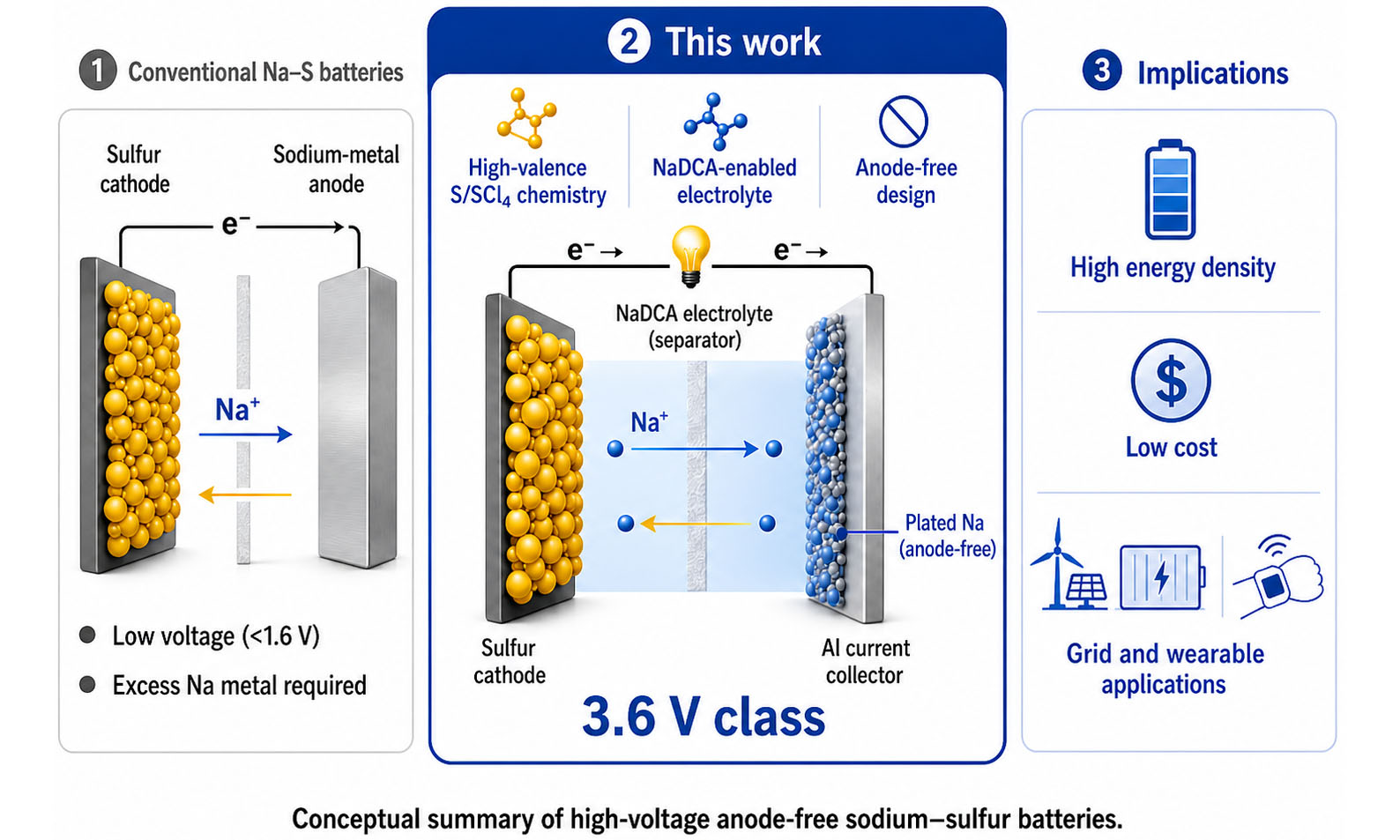


 Download PDF
Room-temperature sodium-sulfur batteries have long been attractive because they are based on earth-abundant and low-cost elements, but their practical development has been constrained by low operating voltage, sluggish sulfur redox kinetics, polysulfide-related parasitic reactions, and the frequent need for excess sodium metal. In a recent Nature study, Geng et al. reported a high-voltage anode-free sodium-sulfur battery based on reversible sulfur/sulfur tetrachloride chemistry in a chloroaluminate electrolyte[1]. This work provides a notable example of how electrolyte chemistry can not only transport ions but also redefine cathode redox pathways and enable anode-free cell operation.
The study is important because it challenges two conventional assumptions in Na-S battery chemistry: that sulfur cathodes are intrinsically limited to low-voltage conversion reactions (typically below 1.6 V versus Na/Na+), and that sodium metal must be preloaded in excess to sustain cycling, which adds inactive mass and raises safety concerns[2-4]. By accessing high-valence sulfur redox chemistry, the authors achieve a 3.6 V-class Na-S battery, substantially higher than the typical discharge voltage of room-temperature Na-S systems. At the same time, sodium is plated onto an aluminum current collector during operation, reducing the need for a sodium-metal reservoir. However, as with many early-stage battery concepts, the work also raises important questions. The reported high energy and power densities are based on electrode mass and should not be directly interpreted as commercial cell- or pack-level values. Practical viability will depend on electrolyte amount, areal loading, separator and packaging mass, long-term cycling stability, safety, moisture tolerance, manufacturing compatibility, and full life-cycle cost.
As shown in Figure 1A and B, the electrolyte plays the central role in this chemistry. In conventional battery design, the electrolyte is generally expected to conduct ions while suppressing parasitic reactions. Here, however, it functions as a reactive chemical medium. Sodium dicyanamide in a chloroaluminate electrolyte enables reversible sulfur chlorination at the cathode while simultaneously supporting sodium plating and stripping on an aluminum current collector. Moreover, the anode-free Na-S battery exhibited an impressive cycle life of 1,400 cycles at a charge capacity of 200 mAh g-1, whereas the battery with a NaCl-based electrolyte experienced rapid capacity decay within 20 cycles [Figure 1C]. This electrolyte-programmed battery architecture couples the cathode reaction, anode formation, and interphase chemistry through the liquid phase[1]. Although this strategy considerably expands the design space of Na-S batteries, it also imposes stringent demands on electrolyte stability, reversibility, and compatibility with practical cell components.
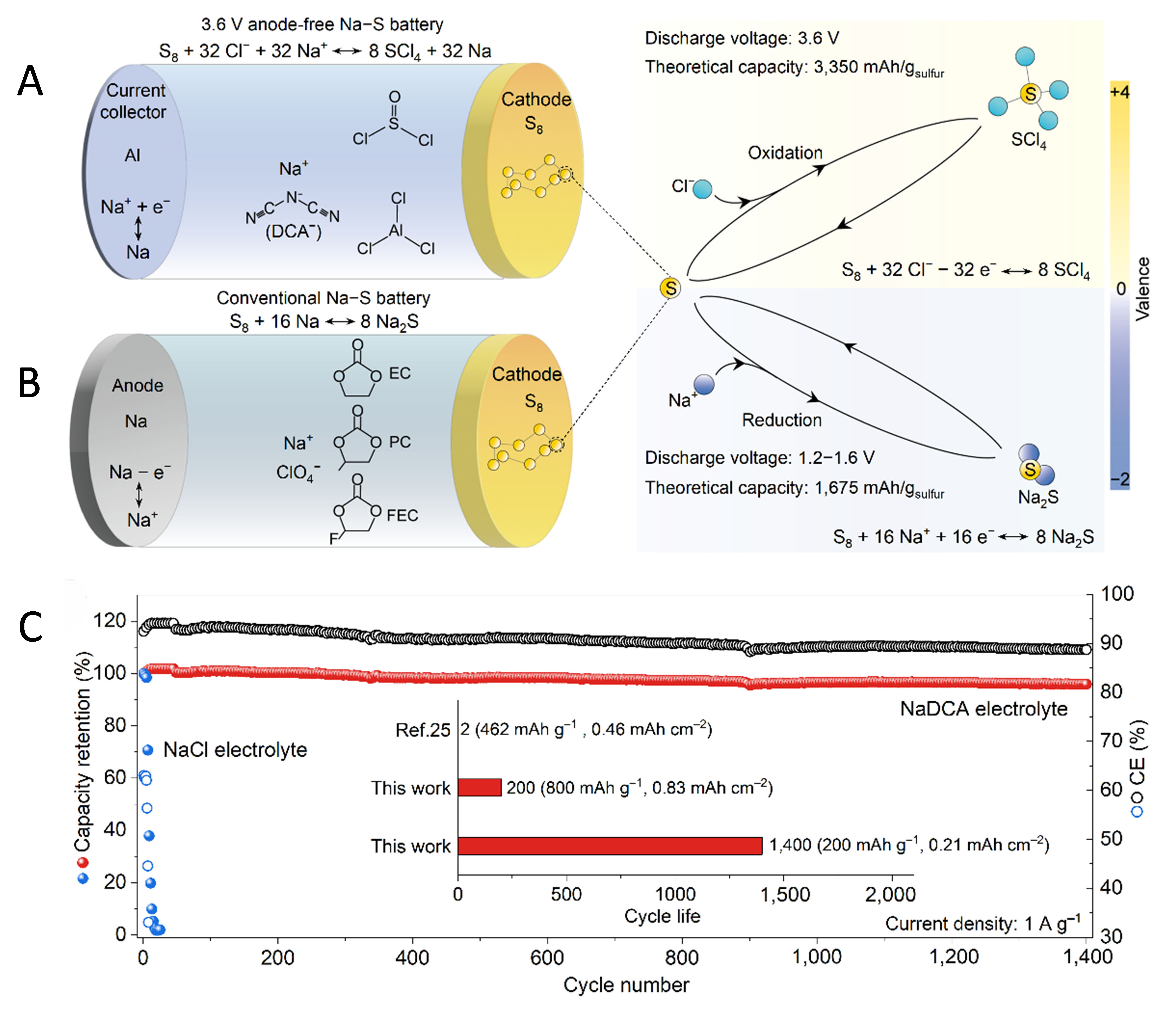
Figure 1. (A) Schematic illustration of the anode-free Na-S battery based on the S/SCl4 redox reaction with a chloroaluminate electrolyte comprising 8 M AlCl3 and 4.5 M NaDCA in SOCl2; (B) Schematic illustration of the conventional Na-S battery based on S/Na2S redox chemistry using a conventional organic electrolyte; (C) Cycling performance of anode-free Na-S batteries using NaDCA and NaCl electrolytes. Adapted with permission from Ref.[1]. Copyright ©2026 Springer Nature. NaDCA: sodium dicyanamide.
The reported performance is striking at the materials level. The authors demonstrate electrode-mass-based energy and power densities of 1,198 Wh kg-1 and 23,773 W kg-1, respectively. With a Bi-coordinated covalent organic framework catalyst, the energy density reaches 2,021 Wh kg-1 on the basis of total electrode mass[1]. These values highlight the potential of high-valence sulfur chemistry, but several caveats should be considered. Electrode-level metrics exclude electrolyte, separator, current collector, casing, tabs, safety components, and system-level inactive mass. Moreover, the long-term implications of sulfur chlorination, possible crossover of reactive intermediates, electrolyte consumption, and catalyst durability remain to be fully clarified. Therefore, this work should be viewed less as an immediate commercial energy-density benchmark and more as a new chemical strategy for overcoming the voltage limitation of room-temperature Na-S batteries.
The work is also timely from a resource and sustainability perspective. Grid storage requires battery chemistries that can be deployed at a very large scale without creating new supply-chain bottlenecks. Sodium and sulfur are attractive in this regard because they are abundant and inexpensive compared with lithium, cobalt, and nickel[5,6]. The authors estimate a materials-level cost of US$5.03 kWh-1 and demonstrate several steps toward practical relevance, including lean-electrolyte operation, scalable cathode fabrication, pouch cells, Ah-level cells, wide-temperature operation from -40 to 80 °C, and fiber-shaped cells for wearable electronics[1,7]. These demonstrations are encouraging, but materials-level cost and proof-of-concept pouch cells represent only early indicators of practicality. Pack-level cost, electrolyte handling, manufacturing yield, safety certification, recyclability, and calendar life will ultimately determine whether this chemistry can compete with established and emerging storage technologies.
Several challenges deserve particular attention before high-voltage anode-free Na-S batteries can be considered a practical platform:
• Cell-level validation. Future studies should move beyond electrode-mass-based metrics and report practical cell-level energy density, areal capacity, electrolyte-to-capacity ratio, current-collector and separator contributions, packaging mass, and long-term performance in realistic pouch-cell formats.
• Long-term anode-free cycling. Anode-free batteries are highly sensitive to sodium plating/stripping efficiency. Even small irreversible sodium losses can rapidly reduce capacity because there is no excess sodium reservoir. High Coulombic efficiency must therefore be sustained over extended cycling and under practical current densities.
• Electrolyte stability and safety. Although the electrolyte is non-flammable and the reported cells show encouraging abuse tolerance, chloroaluminate/SOCl2-based electrolytes may present challenges associated with corrosivity, moisture sensitivity, gas evolution, sealing, and large-scale handling.
• Mechanistic clarity. The reversibility of the S/SCl4 redox couple, the lifetime and transport of sulfur-chlorine intermediates, possible crossover processes, and the chemical evolution of the sodium/electrolyte interphase require deeper mechanistic study.
• Catalyst durability. The Bi-coordinated covalent organic framework improves sulfur redox performance, but its long-term structural and chemical stability under high-voltage, chlorinating, and strongly Lewis acidic electrolyte conditions remains an important question.
• Manufacturing compatibility. Scalable electrode preparation, separator selection, corrosion-resistant current collectors, electrolyte filling, sealing technology, moisture management, and quality control will determine whether this chemistry can be translated beyond proof-of-concept cells.
• Life-cycle and system-level assessment. The true advantage of the chemistry must be assessed at the pack level, including electrolyte recovery or neutralization, recyclability, environmental impact, supply-chain practicality, safety compliance, and total installed storage cost.
These limitations do not diminish the conceptual value of the work; rather, they define the next stage of inquiry. The study shows that sulfur, one of the oldest and least expensive battery materials, can be given a new electrochemical role through electrolyte-mediated high-valence redox chemistry. It also demonstrates that anode-free sodium batteries may be enabled when cathode chemistry, sodium plating, and interphase formation are designed together. These ideas could influence not only Na-S batteries but also broader alkali-metal-sulfur, sulfur-halogen, and halogen-mediated battery systems.
The most important message is therefore not that high-voltage anode-free Na-S batteries are ready for commercialization, but that their chemistry has been reopened. Future progress will require rigorous benchmarking under practical conditions, quantitative accounting of inactive components, operando characterization of sulfur-chlorine intermediates and sodium interphases, and systematic evaluation of safety, manufacturability, and life-cycle value. If these challenges can be addressed, high-voltage anode-free Na-S batteries may become a promising candidate for low-cost, resource-abundant energy storage. More broadly, this work reminds the battery community that mature chemistries can still yield unexpected opportunities when electrolyte design is used to create new reaction pathways rather than merely support existing ones.
DECLARATIONS
Acknowledgements
Prof. Sun acknowledges the support from the INRS Research Chair Programs. Prof. Zhang acknowledges the support from the Canada Research Chair Programs.
Authors’ contributions
Literature review, manuscript drafting, and editing: Cao, S., Liu, S.
Conceptualization, supervision, and manuscript review and editing: Zhang, G., Sun, S.
Availability of data and materials
Not applicable.
AI and AI-assisted tools statement
During the preparation of this work, the authors used ChatGPT Plus (OpenAI; GPT-5.6 Sol, released 2026-07-09) to assist in the design of the Graphical Abstract. All AI-assisted content was critically reviewed, verified, and edited by the authors, who take full responsibility for the accuracy and integrity of the published material.
Financial support and sponsorship
This work is supported by the Natural Sciences and Engineering Research Council of Canada (NSERC), Fonds de Recherche du Québec-Nature et Technologies (FRQNT), École de Technologie Supérieure (ÉTS), and Institut National de la Recherche Scientifique (INRS).
Conflicts of interest
Sun, S. is an Associate Editor of Energy Z but was not involved in any aspect of the editorial process for this manuscript, including reviewer selection, manuscript handling, or decision-making. The other authors declare no conflicts of interest.
Ethical approval and consent to participate
Not applicable.
Consent for publication
Not applicable.
Copyright
© The Author(s) 2026.
REFERENCES
1. Geng, S.; Yuan, B.; Zhao, X.; et al. High-voltage anode-free sodium-sulfur batteries. Nature 2026, 649, 353-9.
2. Zhao, L.; Tao, Y.; Zhang, Y.; et al. A critical review on room-temperature sodium-sulfur batteries: from research advances to practical perspectives. Adv. Mater. 2024, 36, e2402337.
3. Yao, W.; Liao, K.; Lai, T.; Sul, H.; Manthiram, A. Rechargeable metal-sulfur batteries: key materials to mechanisms. Chem. Rev. 2024, 124, 4935-5118.
4. Wu, Q.; Zhang, W.; Qin, M.; et al. Tellurium doped sulfurized polyacrylonitrile nanoflower for high-energy-density, long-lifespan sodium-sulfur batteries. Nano. Energy. 2024, 129, 110049.
5. Vaalma, C.; Buchholz, D.; Weil, M.; Passerini, S. A cost and resource analysis of sodium-ion batteries. Nat. Rev. Mater. 2018, 3, BFnatrevmats201813.
6. Tang, W.; Qi, R.; Wu, J.; et al. Engineering, understanding, and optimizing electrolyte/anode interfaces for all-solid-state sodium batteries. Electrochem. Energy. Rev. 2024, 7, 228.
Cite This Article
 Open Access
How to Cite
Download Citation
If you have the appropriate software installed, you can download article citation data to the citation manager of your choice. Simply select your manager software from the list below and click on download.
Export Citation File
Type of Import
Tips on Downloading Citation
Citation Manager File Format
Type of Import
Direct Import: When the Direct Import option is selected (the default state), a dialogue box will give you the option to Save or Open the downloaded citation data. Choosing Open will either launch your citation manager or give you a choice of applications with which to use the metadata. The Save option saves the file locally for later use.
Indirect Import: When the Indirect Import option is selected, the metadata is displayed and may be copied and pasted as needed.
About This Article
Copyright

Data & Comments
Data
0








Comments
Comments must be written in English. Spam, offensive content, impersonation, and private information will not be permitted. If any comment is reported and identified as inappropriate content by OAE staff, the comment will be removed without notice. If you have any queries or need any help, please contact us at [email protected].