

fig5

Challenges, strategies and prospects in interfaces between Li metal anode and polyether-based solid-state electrolytes

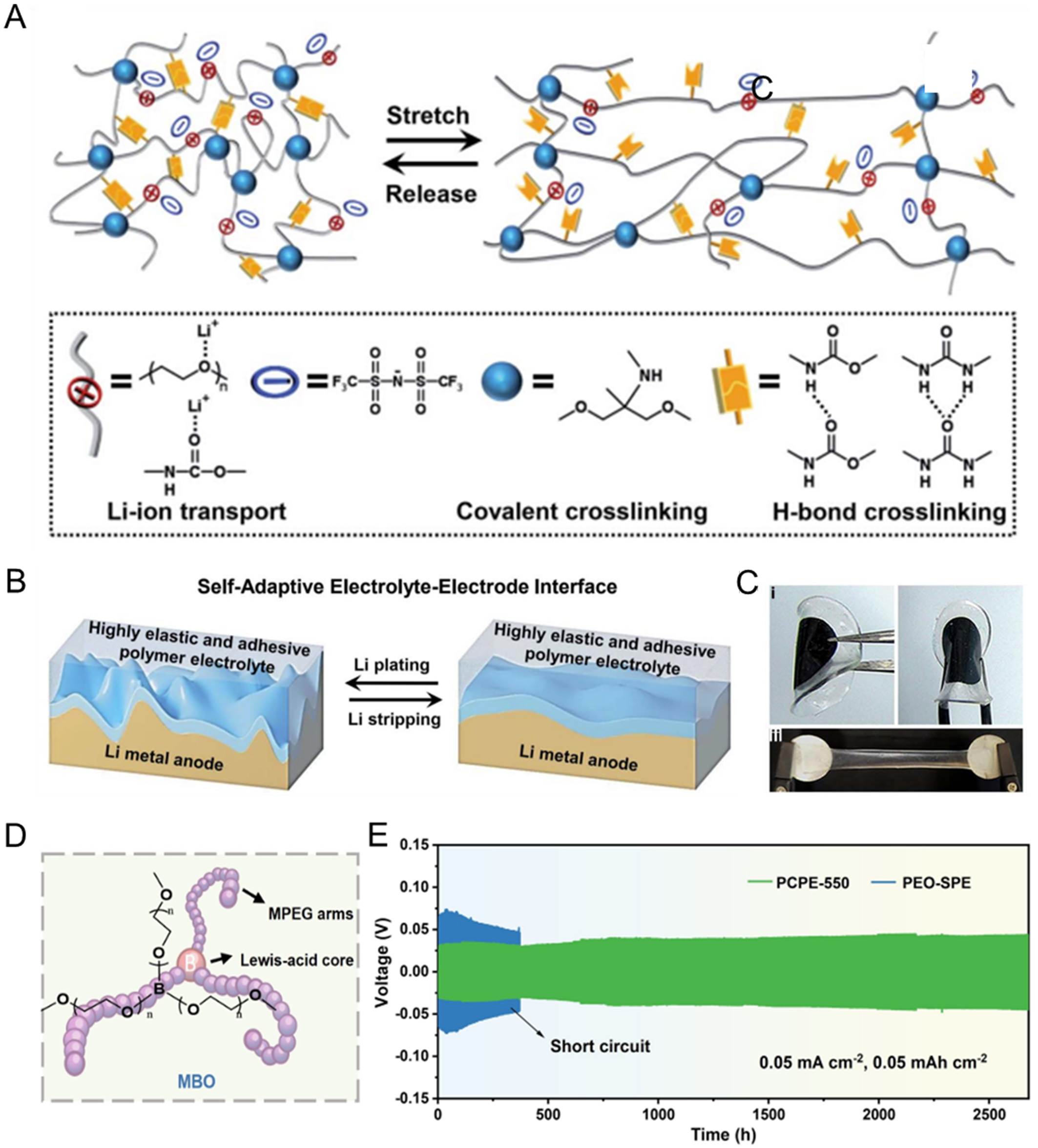
Figure 5. (A) Schematic illustration of the elastomeric polymer network of the PU electrolyte; (B) Schematic illustration of the self-adaptive electrolyte-electrode interface; (C) Photographs showing the adhesion of the PU-EO12/LiTFSI/TEG41% electrolyte to LiFePO4 cathode material. Figure 5A-C is reprinted with permission from Ref. [84], Copyright © 2021 Royal Society of Chemistry; (D) The chemical structure of electrolyte; (E) Long-term cycling performance of Li/Li symmetric cells using PCPE-550 and PEO-SPE at 0.05 mA·cm-2. Figure 5D and E is reprinted with permission from Ref. [85], Copyright © 2025 Wiley. PU: Polyurethane; EO: ethylene oxide; LiTFSI: lithium bis(trifluoromethanesulfonyl)imide; TEG: tetraethylene glycol dimethyl ether; PCPE: supramolecularly crosslinked polyether electrolyte; PEO: polyethylene oxide; SPE: solid polymer electrolyte; MPEG: methoxy-terminated polyethylene glycol; MBO: tri-armed boron-centered oligomer.

