


First-principles investigation of topological vanadium chalcogenide monolayers for synergistic sodium storage and sulfur conversion
 0
0 Abstract
An atomic-level understanding of anion and cation intercalation is essential for advancing alkali-metal-ion electrodes and anchoring metal polysulfides. Sodium batteries present a more sustainable alternative to lithium-based systems. Developing electrode materials that support both sodium-ion storage and sodium-polysulfide conversion, each in its
Keywords
INTRODUCTION
Though lithium-ion batteries (LIBs) have revolutionized large-scale energy storage, they still face constraints, namely escalating costs and limited lithium availability. To address these constraints and problems, sodium-ion batteries (NIBs) offer a promising alternative because sodium is abundant in the Earth’s crust (on the order of ~2-3 wt%, versus ~0.002 wt% for lithium), while retaining electrochemical behavior similar to that of LIBs[1-3]. Recent progress in layered oxides, polyanionic compounds, and Prussian blue cathodes, along with a hard carbon anode, has brought NIBs closer to commercialization[4,5]. However, the larger ionic radius of the Na+ ion results in relatively slow kinetics and reduced structural stability[6,7]. Likewise, potassium-ion batteries (KIBs) benefit from even greater abundance and a lower redox potential [-2.93 V vs. Standard Hydrogen Electrode (SHE)] but suffer from more severe kinetic barriers due to the even larger size of K+[8-10]. Developing electrode materials for Na+/K+ storage that match the electrochemical performance of conventional lithium-ion batteries is therefore a critical objective. Beyond intercalation chemistry, sulfur-anchoring cathodes have garnered considerable interest due to their high theoretical energy density
In this work, we explored four topological vanadium-based chalcogenides, namely V2WS4, V2WSe4, V2MoS4, and V2MoSe4, and their versatility across two distinct cell configurations: as anodes for NIBs and KIBs, and as sulfur hosts for Na-S cathodes. Here, K-ion storage is considered only as a comparative alkali-ion anode assessment to examine the structural tolerance and ion-storage versatility of V2AB4 monolayers toward larger alkali ions, whereas the sulfur-host and catalytic conversion analysis is restricted to Na-S battery chemistry. Our combined first-principles and ab initio molecular dynamics simulations reveal the thermal stability of the host, its interaction with Na ions and sulfur species, Na+ migration kinetics, and its catalytic activity toward polysulfide conversion, highlighting the practical relevance of these materials for future energy applications.
COMPUTATIONAL METHODS
All density functional theory (DFT) calculations were performed using the Vienna Ab initio Simulation Package (VASP) with the projector-augmented-wave (PAW) method to describe electron-ion interactions[42,43]. The generalized gradient approximation (GGA) with the Perdew-Becke-Johnson damping was applied with the DFT-D3 dispersion correction throughout[44]. To properly describe the van der Waals interactions within the interlayer of these layered V2AB4 structures, Becke-Johnson damping is used with the DFT-D3 dispersion correction throughout[45,46]. Given the presence of localized d-electrons on vanadium and other transition-metal (A = Mo, W) atoms, we have used the GGA+U[47] approach with Hubbard U corrections: U = 3.0 eV for V 3d states, 2.0 eV for Mo 4d states, and 1.0 eV for W 5d states[35]. A plane-wave energy cutoff of 520 eV was used for all structural relaxations and electronic-structure calculations. The two-dimensional monolayer structures are simulated using periodic slabs separated by a vacuum spacing of 25 Å along the z-direction to avoid spurious interactions between periodic images. The Brillouin zone sampling was carried out using Γ-centered Monkhorst-Pack k-point grids: a dense 12 × 12 × 1 mesh is employed for the primitive unit cells during structural optimization and self-consistent electronic structure calculations, and a 8 × 8 × 1 mesh for larger supercells. Electronic self-consistency was achieved when the total-energy difference between consecutive iterations fell below 1 × 10⁻⁵ eV, and the ionic relaxations were converged until the Hellmann-Feynman forces on all atoms were below 0.02 eV Å-1. Phonon dispersion spectra were obtained using the finite-displacement method implemented in the PHONOPY package, interfaced with VASP[48,49]. To assess thermal stability at finite temperatures, ab initio molecular dynamics (AIMD) simulations were performed in the canonical (NVT) ensemble using the Nose-Hoover thermostat[50,51]. Diffusion barriers and migration pathways of ions on the V2AB4 surfaces were calculated using the climbing-image nudged elastic band (CI-NEB) method[52]. To evaluate the V2AB4 materials as sulfur hosts for Na-S battery applications, the adsorption energies of relevant sulfur species were calculated, including elemental sulfur (S8), long-chain sodium polysulfides (Na2S8, Na2S6, and Na2S4), and short-chain species (Na2S2 and Na2S). To evaluate the thermodynamic feasibility of the sulfur reduction reaction (SRR), the Gibbs free-energy change for each elementary step was calculated under standard conditions. The calculations were performed at T = 298.15 K. The Gibbs free-energy change was evaluated using:
where ∆EDFT is the DFT reaction energy, ∆EZPE is the zero-point-energy correction, ΔS is the entropy change, and T is the temperature[53].
RESULTS AND DISCUSSION
Geometric and electronic characteristics
The overall concept of employing topological quantum materials for energy storage applications is illustrated in Figure 1A. This schematic highlights their potential across two distinct applications: metal-ion battery anodes and Na-S hosts. The four monolayers V2MoS4, V2MoSe4, V2WS4, and V2WSe4 obey the molecular formula V2AB4 and the space group P-42m. Each unit cell consists of three layers: a central V2A layer sandwiched between two chalcogen layers. Four chalcogen atoms coordinate each V and A atom to form tetrahedral units, as shown in Figure 1A. The optimized lattice constants for V2MoS4, V2MoSe4, V2WS4, and V2WSe4 are 5.72, 5.83, 5.74, and 5.82 Å, respectively, increasing from S to Se due to the larger atomic radius of Se. However, the W and Mo atoms contribute only a minor change due to their nearly identical atomic radii. In addition to structural characterization, the thermal and dynamical stability of V2MoS4, V2MoSe4, V2WS4, and V2WSe4 monolayers are investigated. Thermal stability was verified using AIMD simulations at 300 K and 500 K for 5 ps, as shown in Figure 1B and Supplementary Figures 1-3 of the Supplementary Materials. These simulations demonstrate that all monolayers maintain structural integrity with no bond breaking or phase transitions, confirming excellent thermal stability. Phonon dispersion calculations along the high-symmetry path reveal no imaginary frequencies across the entire Brillouin zone for all four materials, confirming their dynamical stability as depicted in Figure 1C. Overall, these materials possess dynamic, structural, and thermal stability, indicating potential for further electronic and battery applications.
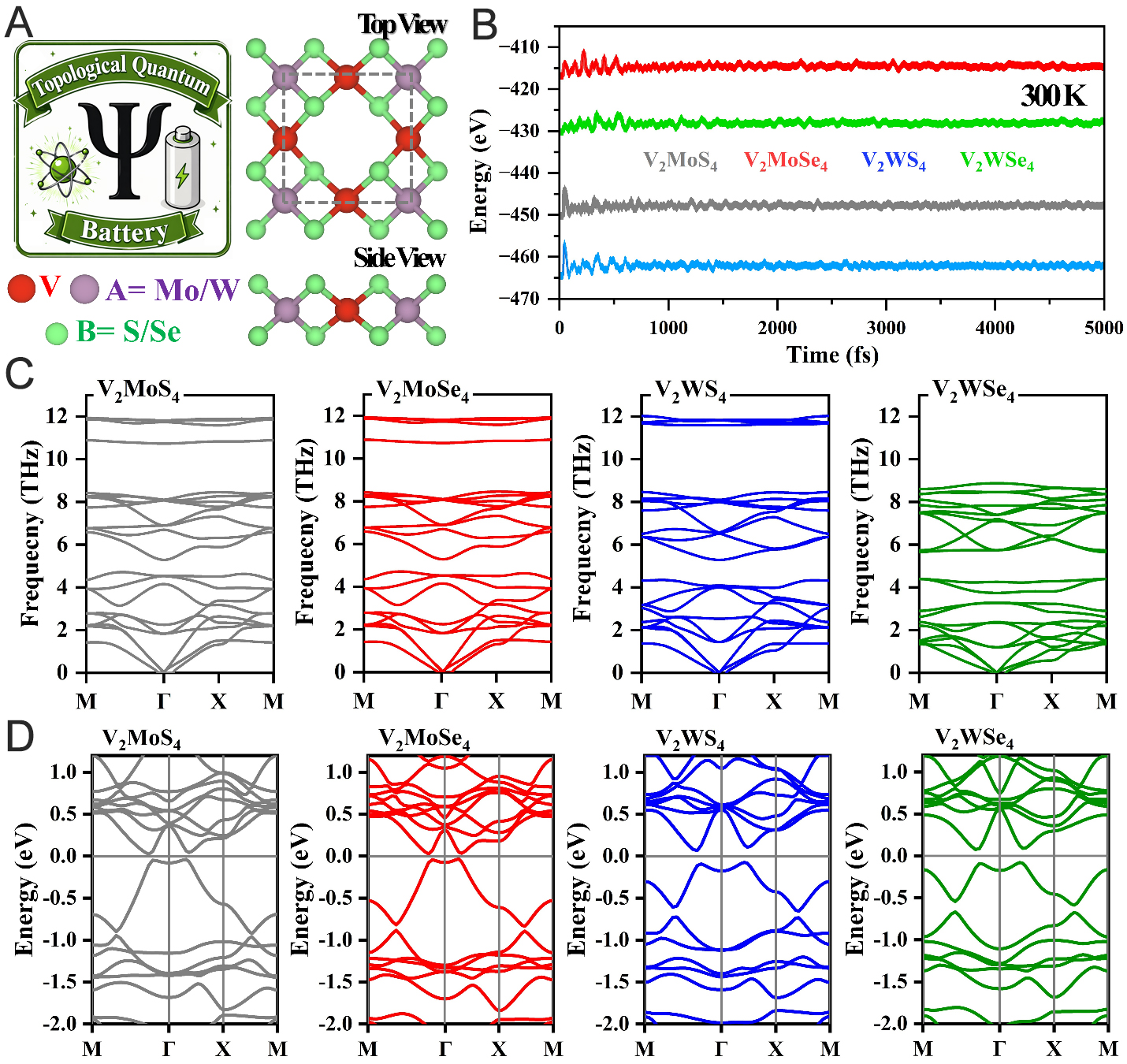
Figure 1. Geometric and electronic properties of vanadium-based topological chalcogenides: (A) schematic illustration of topological quantum materials for battery applications, along with the top and side views of four optimized crystal structures with stoichiometric formulas of V2AB4; (B) Potential energy fluctuations during AIMD simulations at 300 K for 5 ps; (C) phonon dispersion curve describing dynamic stabilities; and (D) topological band structures of V2MoS4, V2MoSe4, V2WS4, and V2WSe4 monolayers using the SOC method. SOC: Spin-orbit coupling; AIMD: ab initio molecular dynamics.
In addition, the electronic band gaps are investigated by calculating spin-polarized band structures with spin-orbit coupling (SOC) along high-symmetry paths in the Brillouin zone to examine the SOC-induced evolution of the electronic states [Figure 1D]. For V2MoS4, V2MoSe4, V2WS4, and V2WSe4, the band structures without SOC exhibit several band crossings near the Fermi level, mainly associated with spin-polarized Vd states hybridized with A-site (A = Mo, W) d states, where no obvious band gap is observed (see Supplementary Figure 4 in Supplementary Materials). After the inclusion of SOC, these degeneracies are lifted and finite gaps open at the high-symmetry points in Figure 1D. This gap opening originates from the SOC-induced splitting of the spin-polarized quadratic band touching of the degenerate V dxz/dyz orbitals, together with the band inversion between these Vd states and the A-site d states, producing a topologically nontrivial insulating electronic structure. These band-structure features spin-polarized d-orbital band crossings, band inversion between the V dxz/dyz and A-site (Mo/W) d orbitals, and the SOC-driven gap opening are characteristic of the pristine V2AB4 monolayers, whose nontrivial topological nature has been established in a prior study[35]. The high stability and favorable electronic structure position the V2AB4 vanadium chalcogenides as compelling candidates for ion-battery applications.
Na+/K+ ions anodic application
The suitability of V2AB4 surfaces as high-rate anodes was evaluated by systematically identifying three energetically favorable adsorption sites (a, b, and c) and examining their interactions with Na+ and K+ ions. The adsorption sites are defined as follows: site-a is located directly above the chalcogen B atom (S or Se), site-b is positioned above the A atom (Mo or W) coordinated by neighboring chalcogen atoms, and site-c is situated directly atop a V atom. Na+ and K+ atoms were initially placed approximately 2.5 Å above the monolayer plane, and the entire system was fully relaxed to determine equilibrium geometries and adsorption energies as depicted in Figure 2A. Adsorption energies for Na+ and K+ ions on all four V2AB4-type materials were calculated including van der Waals (vdW) corrections, with the corresponding values presented in Figure 2B. Site-a was identified as the most stable adsorption site for both Na+ and K+ ions, with adsorption energies ranging from -1.19 eV to -1.36 eV for Na+ and -1.36 eV to -1.83 eV for K+. Site-b was the second most stable site, exhibiting adsorption energies approximately 0.25-0.35 eV higher (less negative) than those of site-a, while site-c was the least favorable. The preference for site-a arises from its optimal coordination environment for the ions. At this site, both Na+ and K+ lie equidistant from six neighboring chalcogen atoms (three from the top layer and three from the bottom layer). This configuration provides the maximum possible electrostatic stabilization and charge transfer from the alkali metal to the substrate.
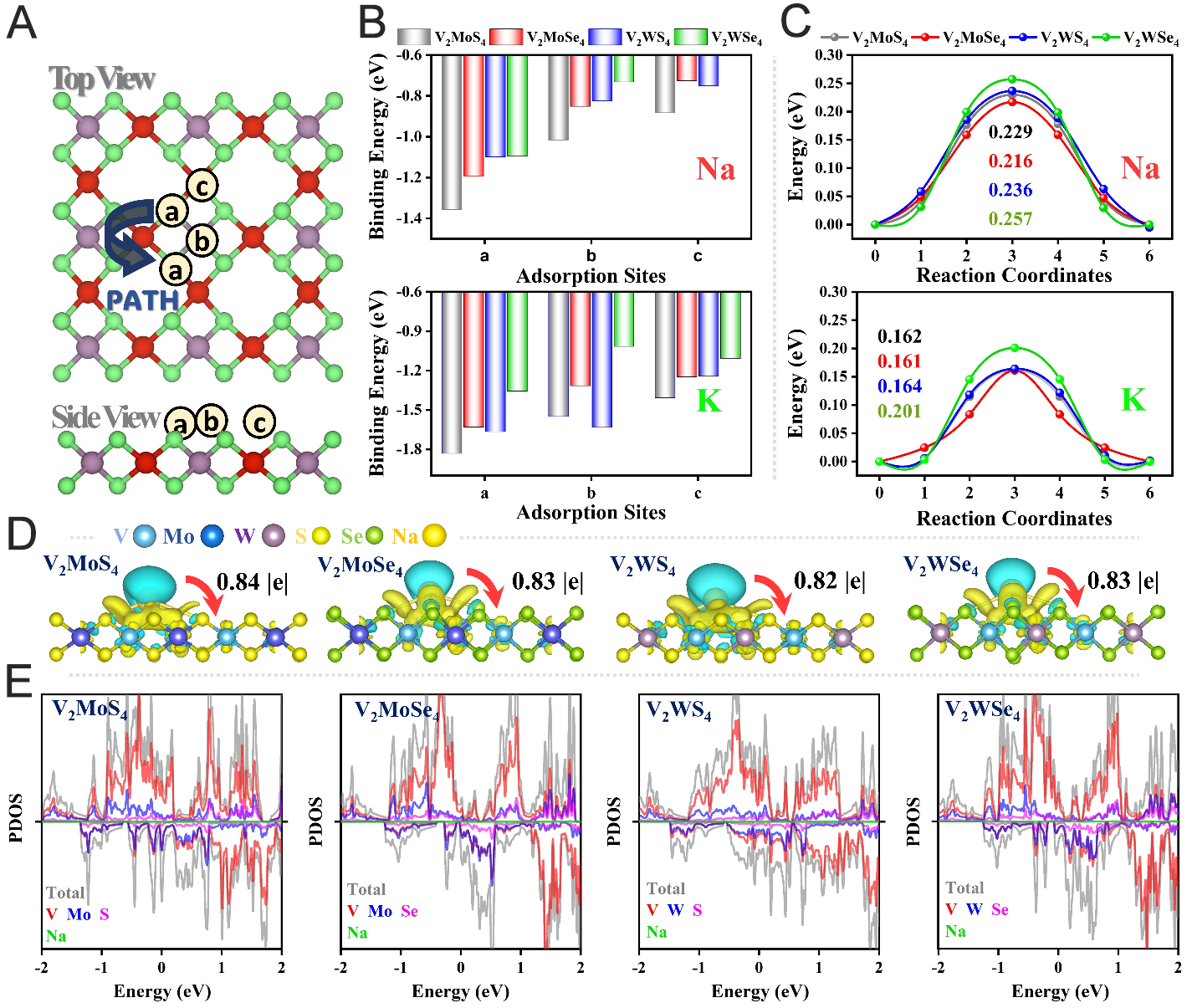
Figure 2. Sodium and potassium adsorption energetics, Diffusion Barrier, charge-transfer behavior, and the corresponding densities of states of V2AB4: (A) Geometric illustration of active energetic sites (a, b, and c), and (B) adsorption energies for Na+ and K+ ions on all four V2AB4-type monolayers; (C) CI-NEB energy profiles for V2MoS4, V2MoSe4, V2WS4, and V2WSe4; Visualization of (D) charge-density difference with corresponding Bader charge transfer from Na+ ions to V2AB4 surfaces (Yellow and cyan represent electron gain and electron loss, respectively, with the isosurface value of 0.002 e Å-3); (E) Na+ induced projected density of states (PDOS) on V2AB4 monolayers. CI-NEB: Climbing-image nudged elastic band.
Improved ion cycling stability is aided by rapid ion flux, which helps limit structural degradation during charge and discharge. The diffusion kinetics of Na+ and K+ ions on the V2AB4 (A = Mo/W, B = S/Se) monolayers are systematically studied by the CI-NEB method. Figure 2A illustrates that the most favorable diffusion pathway involves in-plane migration between two neighboring sites a through the transition site. Figure 2C presents the corresponding CI-NEB energy profiles for Na+ and K+ diffusion across V2MoS4, V2MoSe4, V2WS4, and V2WSe4, respectively. For Na+ ions, the migration barrier is found to be 0.229, 0.216, 0.236, and 0.257 eV for V2MoS4, V2MoSe4, V2WS4, and V2WSe4, respectively. These values are benchmarked against reported Na+ ion diffusion barriers of representative 2D anode candidates such as BiC (0.217)[54], Si3C (0.34 eV)[55], C18 (0.46)[56], Ti3C2 Mxene (0.09 eV)[57] VS2 (0.085 eV)[58], h-BAs (0.248 eV)[59], B-doped
Charge transfer from the metal ion to the host is important because it stabilizes ion storage and improves anode performance. To elucidate the interaction mechanism between Na+/K+ ions and the host materials, the charge density difference (Δρ) was calculated using the Equation (2) as shown below[64].
where
The electrochemical behavior of V2AB4 monolayers is schematically depicted in Figure 3A. In the figure above, reversible ion insertion and extraction at the anode and cathode, along with ion transport across the separator, are shown during the charge/discharge process. This schematic illustration provides a basic overview of the working principle of rechargeable batteries and a conceptual basis for evaluating the electrochemical performance of the proposed materials. Based on this framework, the electrochemical performance of electrode materials is evaluated by measuring their ion-storage capacity and open-circuit voltage (OCV). The studied layered topological material exhibits a high ion-storage capacity for Na+ and K+ ions, underscoring its potential for anodic energy storage applications. The ion-storage capability of V2AB4 (A = Mo or W, B = S or Se) monolayers is systematically evaluated by progressively increasing the concentration of Na+ or K+ ions in the host materials. The binding energies of Na+ and K+ ions decrease with increasing ion concentration, primarily due to repulsive interactions between adjacent ions. As depicted in Figure 3B, all systems exhibit negative binding energies over the entire adsorption range; thus, Na+/K+ uptake is thermodynamically favorable at high concentrations. The theoretical specific capacity was calculated according to the following Equation[65]:
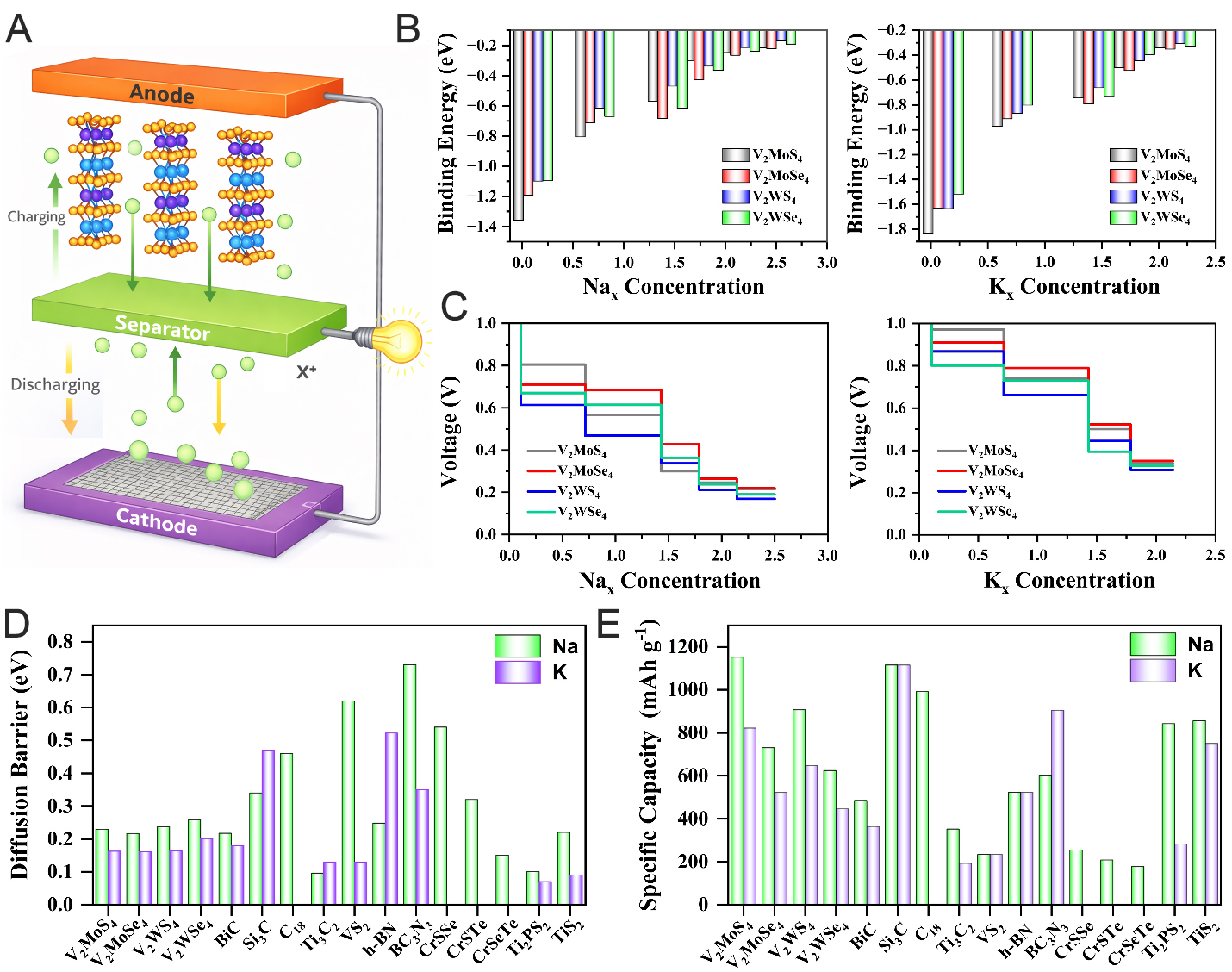
Figure 3. Sodium and potassium storage behavior and open-circuit voltage: (A) schematic of Na+/K+-ion transport during charge/discharge; (B) binding energies versus alkali concentration; (C) corresponding open-circuit voltage profiles; (D) comparison of Na+/K+ diffusion barriers; (E) comparison of theoretical specific capacities with representative anodes[54-63].
where n is the number of adsorbed Na+/K+ atoms, F is Faraday’s constant, and M is the molar mass of the pristine host material. Based on the maximum loading of Na+ atoms, the Na+ ion capacities are calculated to be 1,151 mAh g-1 for V8Mo4S16, 730 mAh g-1 for V8Mo4Se16, 907 mAh g-1 for V8W4S16, and 624 mAh g-1 for V8W4Se16. These values are substantially higher than that of hard carbon (~300 mAh g-1)[66] , the standard commercial sodium-ion anode, and are placed in comparison with computationally predicted 2D anodes evaluated under similar monolayer, full-surface-adsorption assumptions, including BiC (485 mAh g-1)[54], Si3C (1,115 mAh g-1)[55], C18 (991.32 mAh g-1)[56], Ti3C2 Mxene (351.8 mAh g-1)[57], VS2 (232 mAh g-1)[58], h-BAs (522 mAh g-1)[59], B-doped g-CN/BC3N3 (603.30 mAh g-1)[60] (CrSSe/CrSTe/CrSeTe: 260/198/177 mAh g-1)[61], Ti2PS2 (842 mAh g-1)[62], and TiS2 (479 mAh g-1)[63]. We note that these capacities represent ideal upper bounds derived from full monolayer coverage; the practically accessible capacity is expected to be lower owing to interlayer restacking, reduced electrochemically accessible surface area, irreversible adsorption at strong-binding sites, and electrode-level mass-loading constraints. The structural stability of fully sodiated and potassiated V2AB4 monolayers was further verified by AIMD simulations at maximum ion loading. The structures remained intact at high ion concentrations, without bond breaking or severe distortion, as shown in Supplementary Figure 7. Moreover, PDOS calculations for V2AB4 (A = Mo, W; B = S, Se) monolayers upon full Na+/K+ adsorption show a substantial increase in the density of states at the Fermi level, suggesting enhanced electrical conductivity [Supplementary Figure 8]. This is attributed to the strong charge transfer from Na+/K+ atoms to the substrate and the consequent contribution of alkali-metal states near the Fermi level, which increases the carrier density and promotes electronic conduction.
Another important parameter for battery operation is the OCV. The OCV during Na/K insertion is obtained using the following relation[67]:
where
The OCV shows a similar decreasing trend as ion coverage increases, consistent with the variation observed in the binding energies. The Na+ ion systems operate at lower voltages than their K-ion counterparts, which is generally favorable for anode applications, as it can lead to higher full-cell voltage and energy density. Overall, the combination of low diffusion barriers [Figure 3D] and high theoretical capacities [Figure 3E], relative to representative 2D anode materials, highlights the V2AB4 monolayers as promising anodes for next-generation Na+ and K+ ion batteries.
Interaction with electrolytes and salts
To further clarify the interfacial behavior of the V2AB4 monolayers in the Na+/K+ ion-anode environment, we analyzed their interactions with representative electrolyte species using adsorption-energy calculations.
Figure 4A schematically summarizes the electrolyte species considered and their modeled adsorption on the V2AB4 surfaces. The adsorption strength between electrolyte solvents/salts and the electrode surface provides useful information about molecular-level interfacial interactions. Accordingly, we evaluated the adsorption behavior of carbonate solvents and common Na+/K+ salts on the V2AB4 monolayers in the Na+/K+ ion-anode environment. The calculated adsorption energies are shown in Figure 4B. The adsorption energy values indicate favorable adsorption interactions between the electrolyte species and the V2AB4 surfaces, indicating strong molecular-level affinity in the optimized configurations. Figure 4C and Supplementary Figures 9-12 illustrate the optimized structural configurations of typical carbonate solvents, including diethyl carbonate (DEC), ethylene carbonate (EC), and fluoroethylene carbonate (FEC), and electrolyte salts, including sodium bis(fluorosulfonyl)imide (NaFSI), sodium hexafluorophosphate (NaPF6), potassium bis(fluorosulfonyl)imide (KFSI), and potassium hexafluorophosphate (KPF6), respectively, on V2AB4 (A = Mo/W, B = S/Se) monolayers. These adsorption-energy results describe the molecular-level interfacial interactions between V2AB4 and representative electrolyte species in Na+/K+ ion anode applications.
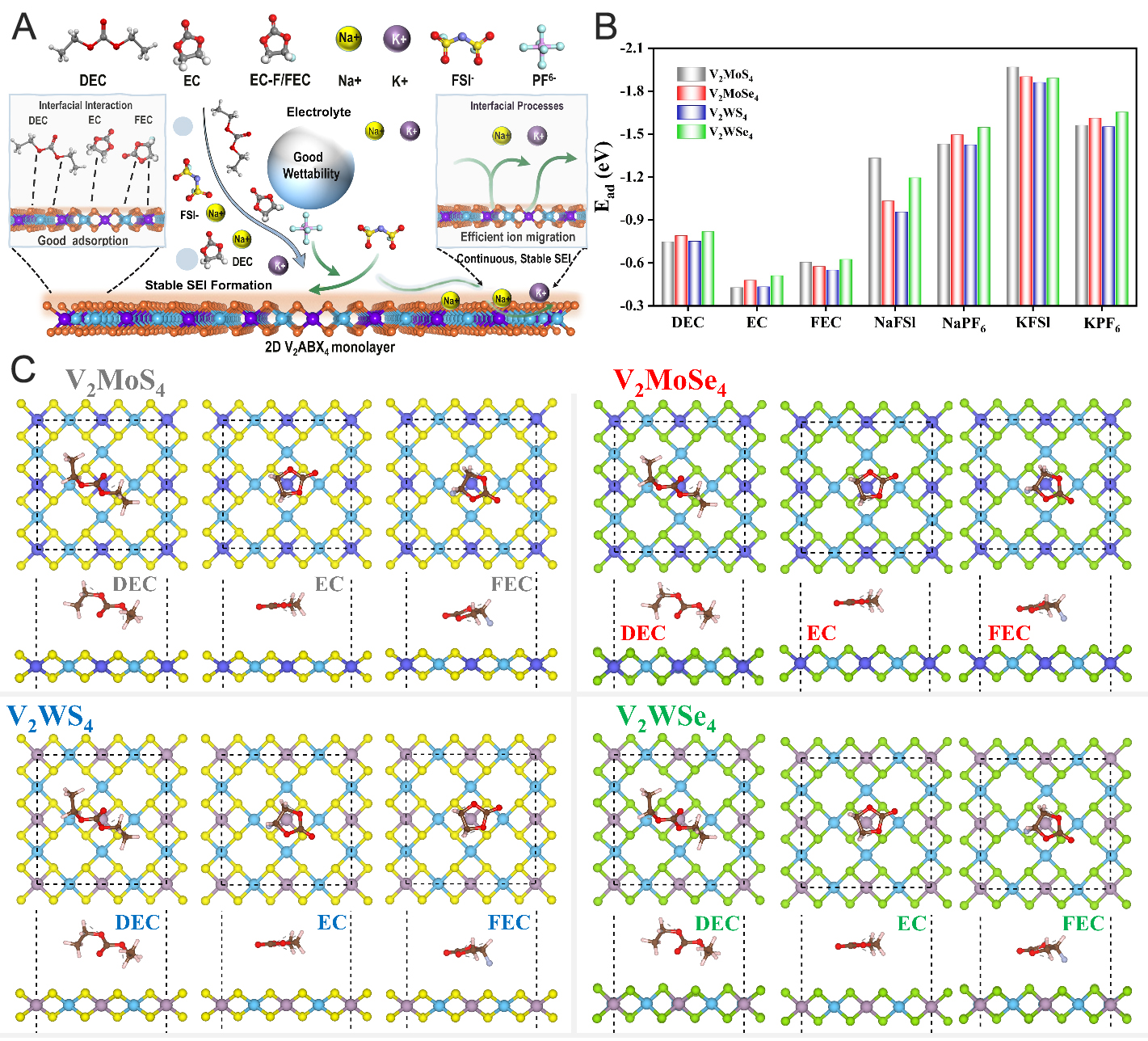
Figure 4. Electrolyte interaction with V2AB4 monolayers: (A) schematic representation of the interactions between representative electrolyte species and the V2AB4 surfaces; (B) corresponding adsorption energies of carbonate solvents and Na+/K+ salts on the V2AB4 substrates; (C) Top and side views of DEC, EC, and FEC adsorbed on V2MoS4, V2MoSe4, V2WS4, and V2WSe4 surfaces. DEC: Diethyl carbonate; EC: ethylene carbonate; FEC: fluoroethylene carbonate; NaFSI: sodium bis(fluorosulfonyl)imide; NaPF6: sodium hexafluorophosphate; KFSI: potassium bis(fluorosulfonyl)imide; KPF6: potassium hexafluorophosphate.
Sodium-polysulfide anchoring for sulfur cathode applications
In this section, we discuss electrochemical sodium-sulfur (Na-S) applications, particularly the reversible conversion of sulfur via sodium polysulfide species during charging and discharging. The reactions at the sulfur cathode are governed by ion transport, electron transfer, and phase conversion processes, which strongly influence reaction kinetics, cell-cycling stability, and sulfur utilization. In addition to anodic applications, the potential of V2AB4 monolayers as sulfur hosts is evaluated by examining the anchoring of sulfur and sodium polysulfide species, including elemental S8, long-chain sodium polysulfides Na2S8, Na2S6, and Na2S4, and short-chain species Na2S2 and Na2S. During discharge, these long-chain sodium polysulfides can dissolve in the liquid electrolyte, leading to the shuttle effect and capacity decay. A strong interaction between the host and polysulfides is necessary to immobilize these species and enable reversible reactions. For V2AB4 monolayers, adsorption energy data (see Figure 5A) indicate that all Na2Sn species are strongly adsorbed on all four topological materials. Specifically, the adsorption energies of Na2S6 and Na2S8 exceed 1.5 eV, which is sufficient to prevent shuttling. The higher adsorption energies on S-based materials are attributed to the greater electronegativity of sulfur atoms, which results in stronger interactions with polysulfides. In contrast, Se-containing materials exhibit moderate adsorption energies that remain suitable for anchoring. However, excessively strong anchoring can cause a sluggish discharge process. Short-chain species demonstrate stronger chemical interactions, whereas long-chain species exhibit predominantly physical interactions. The adsorption configurations of Na2Sn for all structures are shown in Supplementary Figures 13-16. The binding energies of these soluble species with common solvents, namely 1,2-dimethoxyethane (DME) and 1,3-dioxolane (DOL), were also calculated. The ether-based solvents (DME and DOL) considered here correspond specifically to the Na-S configuration, consistent with their standard use in Na-S chemistry. The interaction between soluble polysulfides and solvents is weaker than that with the V2AB4 monolayers. Collectively, the binding energies indicate strong binding and reversible conversion capability. The V2AB4 monolayers thus effectively immobilize sodium polysulfides, prevent their dissolution, and show significant promise as hosts for Na-S batteries.
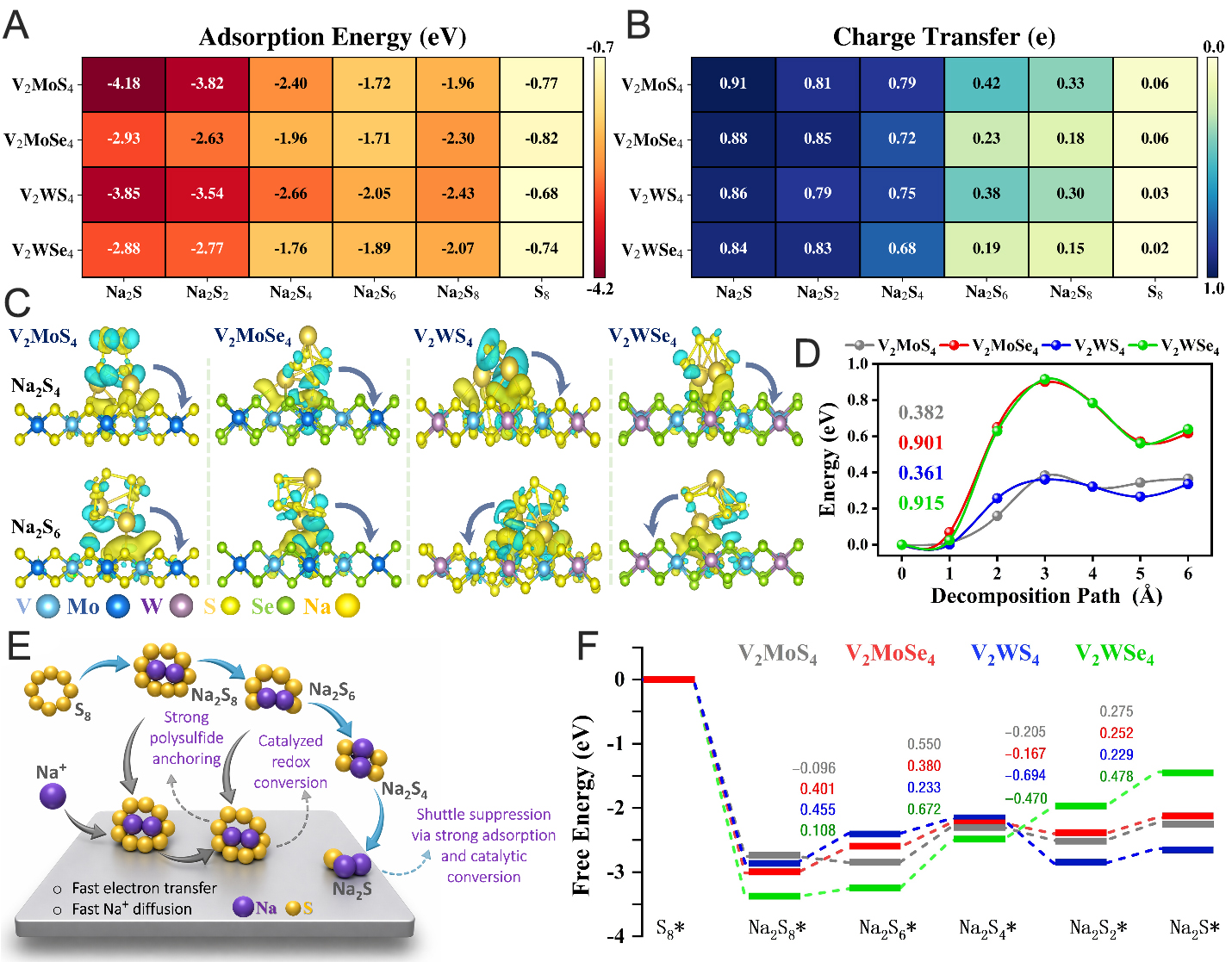
Figure 5. Insights into the sulfur cathode and anchoring role of V2AB4: (A) Adsorption energies of Na2Sn clusters (n = 1, 2, 4, 6, and 8) and S8; with the color scale representing the adsorption-energy values; (B) corresponding charge transfer to V2MoS4, V2MoSe4, V2WS4, and V2WSe4 hosts; with the color scale representing the transferred charge; (C) charge-density difference of intermediate-chain Na2S4 and long-chain Na2S6 polysulfides with all four topological materials. Yellow and cyan isosurfaces denote electron gain and electron loss, respectively. The atomic spheres represent V (light blue), Mo (dark blue), W (light purple), S (small yellow), Se (green), and Na (large yellow); (D) Decomposition energy barriers of Na2S adsorbed on the V2AB4 monolayers; (E) Schematic illustration of the catalytic mechanism, highlighting strong polysulfide anchoring, accelerated redox conversion, suppressed shuttle effect, and rapid electron transport. In panel (E), purple and golden-yellow spheres represent Na and S, respectively; (F) Gibbs free-energy profiles for the S8 to Na2S sulfur reduction reaction on all monolayers.
The interaction mechanism between Na2Sn clusters and V2AB4 monolayers was investigated using Bader charge analysis, as shown in Figure 5B. The results reveal a clear trend of increasing charge transfer with decreasing polysulfide chain length, ranging from approximately 0.15-0.33 e for long-chain Na2S8 and increasing to 0.84-0.91 e for the fully reduced Na2S across the V2AB4 systems. This indicates progressively stronger chemical interactions between the V2AB4 substrates and short-chain species. To further elucidate this behavior, charge-density difference plots are presented in Figure 5C and Supplementary Figures 17-20. These plots demonstrate a distinct charge distribution at the interface after adsorption. Charge accumulation occurs primarily at the surface atoms of V2AB4, while charge depletion is concentrated within the Na2Sn clusters, indicating electron transfer from the sodium polysulfides to the substrates. This charge redistribution is considerably more pronounced for short-chain species than for long-chain species. Overall, the charge-density difference and Bader charge analyses confirm that V2AB4 monolayers exhibit physicochemical interactions with sodium polysulfide intermediates, which are essential for suppressing the shuttle effect and improving the cycling stability of Na-S batteries. To further investigate the electronic properties of Na2Sn species adsorbed on the V2AB4 substrates, the PDOS was calculated and analyzed, as presented in Supplementary Figures 21-24. The electronic states near the Fermi level are dominated by V-3d and Mo/W-d orbitals, with contributions from S/Se-p states, indicating interfacial coupling and charge redistribution upon adsorption. Across all configurations, the continuous states around the Fermi level confirm the metallic character of the adsorbed system. Overall, these results confirm effective electronic coupling between the host material and the Na2Sn species, which facilitates redox reactions in Na-S batteries.
Next, the catalytic decomposition barrier of the discharge product Na2S is calculated using the CI-NEB method[52,68]. During charging of Na-S batteries, the final insoluble product, Na2S, exhibits low electronic conductivity and a high decomposition energy barrier, thereby increasing overpotential and slowing the reaction rate. The electrochemical performance of the Na-S battery system is governed by the decomposition kinetics of sodium sulfide (Na2S), which involve cleavage of Na-S bonds and migration of Na+ ions across the surface. The decomposition reaction, *Na2S → *NaS + Na+ + e-, proceeds through cleavage of a Na-S bond at the adsorption site, followed by migration of the released Na+ ion to a neighboring site. The decomposition energy barriers for Na2S adsorbed on the V2AB4 monolayers are shown in Figure 5D. The calculated decomposition energy barriers are 0.382, 0.901, 0.361, and 0.915 eV for V2MoS4, V2MoSe4, V2WS4, and V2WSe4, respectively. These values are significantly lower than the decomposition barrier for isolated Na2S in the gas phase and are comparable to, or lower than, those of many previously reported Na-S host materials, including Cr@NG (1.54 eV)[69], Fe@NG (1.16 eV)[69], COP (0.68 eV)[70] Co@NG (1.17 eV)[69], V@WSe2
The SRR with elementary steps is given below (* denotes the adsorbed species):
The Gibbs free-energy change of each elementary step was calculated using Equation (1), and the resulting profiles are presented in Figure 5F. Initially, the discharge process converts S8 into a series of soluble sodium polysulfides, including Na2S8, Na2S6, and Na2S4, which are subsequently reduced to short-chain molecules
CONCLUSION
This research highlights that the 2D topological monolayers V2MoS4, V2MoSe4, V2WS4, and V2WSe4 perform well in two distinct cell configurations as high-capacity sodium anodes and as catalytically efficient hosts for the Na-S cathode. These materials, particularly V2MoS4, exhibit a high theoretical capacity of ≈1,151 mAh g-1, a low diffusion barrier of ≈0.229 eV, and a moderate open-circuit voltage of 0.21 V for sodium-ion anodes. Collectively, these metrics suggest that these materials are more competitive than conventional graphitic carbon electrodes. Benefiting from their topological electronic character, these surfaces provide strong anchoring for sodium polysulfides, thereby constraining the dissolution of long-chain sodium polysulfides in the liquid electrolyte (DME/DOL), suppressing the shuttle effect, and rendering the catalytic reactions for sulfur reduction energetically feasible. The calculated Gibbs free-energy changes (ΔGmax) range from 0.401 eV to 0.672 eV, while Na2S decomposition barriers range from 0.361 eV to 0.915 eV, confirming favorable thermodynamic and kinetic characteristics across all systems. The intact geometric structures of these materials at room temperature, together with their dynamic stability, provide a favorable environment for Na+ ion intercalation and sulfur reduction. This atomic-level study highlights the potential of these 2D topological vanadium chalcogenide materials as versatile electrode materials that combine high-capacity alkali-ion storage with efficient polysulfide conversion across two distinct cell configurations.
DECLARATIONS
Authors’ contributions
Conceptualization, methodology, investigation, formal analysis, data curation, visualization, writing - original draft, funding acquisition, supervision, project administration: Ghani, A.
Formal analysis, data curation, writing - review & editing: Ahmed, S.
Investigation, writing - review & editing: Bilal, M.
Validation, writing - review & editing: Murtaza, A.
Validation, resources, writing - review & editing: Du, H.
Methodology, validation, writing - review & editing: Muhammad, I.
Availability of data and materials
The data supporting the findings of this study are available within the article and its Supplementary Materials. Additional information can be obtained from the corresponding authors upon reasonable request.
AI and AI-assisted tools statement
Not applicable.
Financial support and sponsorship
The authors acknowledge the support from the Initiation Funds for High-level Talents Program of Xi’an International University (Grant No. XAIU2025116), the National Natural Science Foundation of China, including the Research Fund for International Young Scientists (RFIS-I, Grant No. W2433117), as well as the Ministry of Science and Technology of China (QN2022170004L).
Conflicts of interest
All authors declared that there are no conflicts of interest.
Ethical approval and consent to participate
Not applicable.
Consent for publication
Not applicable.
Copyright
© The Author(s) 2026.
Supplementary Materials
REFERENCES
1. Wu, Y.; Shuang, W.; Wang, Y.; et al. Recent progress in sodium-ion batteries: advanced materials, reaction mechanisms and energy applications. Electrochem. Energy. Rev. 2024, 7, 215.
2. Hirsh, H. S.; Li, Y.; Tan, D. H. S.; et al. Sodium-ion batteries paving the way for grid energy storage. Adv. Energy. Mater. 2020, 10, 2001274.
3. Chayambuka, K.; Mulder, G.; Danilov, D. L.; Notten, P. H. L. Sodium-ion battery materials and electrochemical properties reviewed. Adv. Energy. Mater. 2018, 8, 1800079.
4. Zhang, H.; Wang, L.; Zuo, P. Advances in sodium-ion battery cathode materials: exploring chemistry, reaction mechanisms, and prospects for next-generation energy storage systems. J. Mater. Chem. A. 2024, 12, 30971-1003.
5. Peng, B.; Zhou, Z.; Shi, J.; Huang, X.; Li, Y.; Ma, L. Earth-abundant Fe-Mn-based compound cathodes for sodium-ion batteries: challenges and progress. Adv. Funct. Mater. 2024, 34, 2311816.
6. Huang, H.; Wu, X.; Gao, Y.; et al. Polyanionic cathode materials: a comparison between Na-ion and K-ion batteries. Adv. Energy. Mater. 2024, 14, 2304251.
7. Zhang, H.; Gao, Y.; Liu, X.; et al. Long-cycle-life cathode materials for sodium-ion batteries toward large-scale energy storage systems. Adv. Energy. Mater. 2023, 13, 2300149.
8. He, X.; Iqbal, N.; Ghani, U.; Li, T. Potassium ion batteries: recent advancements in anodic, cathodic, and electrolytic materials. J. Alloys. Compd. 2024, 981, 173680.
9. Ma, M.; Chong, S.; Yao, K.; Liu, H. K.; Dou, S. X.; Huang, W. Advanced anode materials for potassium batteries: sorting out opportunities and challenges by potassium storage mechanisms. Matter 2023, 6, 3220-73.
10. Luo, G.; Feng, X.; Qian, M.; et al. State-of-art progress and perspectives on alloy-type anode materials for potassium-ion batteries. Mater. Chem. Front. 2023, 7, 3011-36.
11. Lei, Y. J.; Lu, X.; Yoshikawa, H.; et al. Understanding the charge transfer effects of single atoms for boosting the performance of Na-S batteries. Nat. Commun. 2024, 15, 3325.
12. He, J.; Bhargav, A.; Su, L.; Charalambous, H.; Manthiram, A. Intercalation-type catalyst for non-aqueous room temperature sodium-sulfur batteries. Nat. Commun. 2023, 14, 6568.
13. Lin, Z.; Liu, Z.; Fu, W.; Dudney, N. J.; Liang, C. Lithium polysulfidophosphates: a family of lithium-conducting sulfur-rich compounds for lithium-sulfur batteries. Angew. Chem. Int. Ed. 2013, 52, 7460-3.
14. Fan, F. Y.; Pan, M. S.; Lau, K. C.; et al. Solvent effects on polysulfide redox kinetics and ionic conductivity in lithium-sulfur batteries. J. Electrochem. Soc. 2016, 163, A3111-6.
15. Wang, Y.; Guo, T.; Alhajji, E.; et al. MXenes for sulfur-based batteries. Adv. Energy. Mater. 2023, 13, 2202860.
16. Ahmed, S.; Ghani, A.; Mehmood, R.; et al. Ultra-stable topological telluride monolayers for next-generation battery anodes and sulfur hosts. Adv. Sci. 2026, 13, e15841.
17. Muhammad, I.; Ahmed, S.; Yao, Z.; Khan, D.; Hussain, T.; Wang, Y. G. First-row transition metal carbide nanosheets as high-performance cathode materials for lithium-sulfur batteries. Nanoscale 2023, 16, 262-72.
18. Chen, X.; Peng, H.; Zhang, R.; et al. An analogous periodic law for strong anchoring of polysulfides on polar hosts in lithium sulfur batteries: S- or Li-binding on first-row transition-metal sulfides? ACS. Energy. Lett. 2017, 2, 795-801.
19. Chen, Z.; Lv, W.; Kang, F.; Li, J. Theoretical investigation of the electrochemical performance of transition metal nitrides for lithium-sulfur batteries. J. Phys. Chem. C. 2019, 123, 25025-30.
20. Yang, W.; Chen, D.; She, Y.; et al. Rational design of vanadium chalcogenides for sodium-ion batteries. J. Power. Sources. 2020, 478, 228769.
21. Xu, Y.; Ma, H.; Zhong, A.; et al. Unveiling the confined space charge storage mechanism in vanadium chalcogenides/carbon mixed conductor interface for potassium-ion batteries. Small. Methods. 2025, 9, e2500541.
22. Hossain, M.; Zhang, H.; Huangfu, Y.; et al. 2D metallic vanadium dichalcogenides and related heterostructures. Mater. Today. Adv. 2024, 21, 100451.
23. Liu, D.; Xie, S.; Zhan, Z.; et al. High crystalline VSe2@PANI collaborating with ether electrolyte to construct efficient sodium-ion storage interface. Chem. Eng. J. 2025, 524, 169039.
24. Ming, F.; Liang, H.; Lei, Y.; Zhang, W.; Alshareef, H. N. Solution synthesis of VSe2 nanosheets and their alkali metal ion storage performance. Nano. Energy. 2018, 53, 11-6.
25. Xia, W.; Liu, H.; Chen, Y.; et al. Linking D-band center modulation with rapid reversible sulfur conversion kinetics via structural engineering of VS2. Small 2025, 21, e2408304.
26. Huang, T.; Cheng, K.; Lin, C.; Fu, Y.; Lin, S.; Chen, Y. Two-dimensional metallic VTe2 demonstrating fast ion diffusion for aqueous zinc-ion batteries. Sustain. Energy. Fuels. 2022, 6, 4626-35.
27. Yang, C.; Ou, X.; Xiong, X.; et al. V5S8-graphite hybrid nanosheets as a high rate-capacity and stable anode material for sodium-ion batteries. Energy. Environ. Sci. 2017, 10, 107-13.
28. Syed, W. A.; Kakarla, A. K.; Bandi, H.; Shanthappa, R.; Yu, J. S. Improved rate and cycling capability of V2O5@MoS2 nanocomposites as an advanced cathode material for rechargeable aqueous zinc-ion batteries. Sustain. Mater. Technol. 2024, 40, e00968.
29. Ortiz, B. R.; Gomes, L. C.; Morey, J. R.; et al. New kagome prototype materials: discovery of KV3Sb5,RbV3Sb5, and CsV3Sb5. Phys. Rev. Mater. 2019, 3, 094407.
30. Ortiz, B. R.; Teicher, S. M. L.; Hu, Y.; et al. CsV3Sb5: A Z2 topological kagome metal with a superconducting ground state. Phys. Rev. Lett. 2020, 125, 247002.
31. Cho, S.; Ma, H.; Xia, W.; et al. Emergence of new van hove singularities in the charge density wave state of a topological kagome metal RbV3Sb5. Phys. Rev. Lett. 2021, 127, 236401.
32. Pokharel, G.; Teicher, S. M. L.; Ortiz, B. R.; et al. Electronic properties of the topological kagome metals YV6Sn6 and GdV6Sn6. Phys. Rev. B. 2021, 104, 235139.
33. Hu, Y.; Ma, J.; Li, Y.; et al. Phonon promoted charge density wave in topological kagome metal ScV6Sn6. Nat. Commun. 2024, 15, 1658.
34. Zhang, Y.; Zhang, X.; Liu, G.; et al. Accelerating sulfur conversion kinetics by topological semimetal electrocatalysts Pd3Sn for high-performance Li-S batteries. Adv. Funct. Mater. 2025, 35, 2417750.
35. Jiang, Y.; Wang, H.; Bao, K.; Liu, Z.; Wang, J. Monolayer V2MX4: a new family of quantum anomalous hall insulators. Phys. Rev. Lett. 2024, 132, 106602.
36. Crossland, C. J.; Hickey, P. J.; Evans, J. S. O. The synthesis and characterisation of Cu2MX4 (M = W or Mo; X = S, Se or S/Se) materials prepared by a solvothermal method. J. Mater. Chem. 2005, 15, 3452.
37. Chen, W.; Chen, H.; Zhu, H.; et al. Solvothermal synthesis of ternary Cu2MoS4 nanosheets: structural characterization at the atomic level. Small 2014, 10, 4637-44.
38. Tan, C.; Yu, P.; Hu, Y.; et al. High-yield exfoliation of ultrathin two-dimensional ternary chalcogenide nanosheets for highly sensitive and selective fluorescence DNA sensors. J. Am. Chem. Soc. 2015, 137, 10430-6.
39. Bainsla, L.; Zhao, B.; Behera, N.; et al. Large out-of-plane spin-orbit torque in topological Weyl semimetal TaIrTe4. Nat. Commun. 2024, 15, 4649.
40. Liu, Z. L.; Wu, X.; Shao, Y.; et al. Epitaxially grown monolayer VSe2: an air-stable magnetic two-dimensional material with low work function at edges. Sci. Bull. 2018, 63, 419-25.
41. van Efferen, C.; Berges, J.; Hall, J.; et al. A full gap above the Fermi level: the charge density wave of monolayer VS2. Nat. Commun. 2021, 12, 6837.
42. Kresse, G.; Furthmüller, J. Efficient iterative schemes for ab initio total-energy calculations using a plane-wave basis set. Phys. Rev. B. 1996, 54, 11169.
43. Kresse, G.; Joubert, D. From ultrasoft pseudopotentials to the projector augmented-wave method. Phys. Rev. B. 1999, 59, 1758-75.
44. Perdew, J. P.; Burke, K.; Ernzerhof, M. Generalized gradient approximation made simple. Phys. Rev. Lett. 1996, 77, 3865-8.
45. Grimme, S.; Antony, J.; Ehrlich, S.; Krieg, H. A consistent and accurate ab initio parametrization of density functional dispersion correction (DFT-D) for the 94 elements H-Pu. J. Chem. Phys. 2010, 132, 154104.
46. Grimme, S.; Ehrlich, S.; Goerigk, L. Effect of the damping function in dispersion corrected density functional theory. J. Comput. Chem. 2011, 32, 1456-65.
47. Dudarev, S. L.; Botton, G. A.; Savrasov, S. Y.; Humphreys, C. J.; Sutton, A. P. Electron-energy-loss spectra and the structural stability of nickel oxide: an LSDA+U study. Phys. Rev. B. 1998, 57, 1505-9.
48. Togo, A.; Tanaka, I. First principles phonon calculations in materials science. Scr. Mater. 2015, 108, 1-5.
49. Togo, A.; Chaput, L.; Tanaka, I. Distributions of phonon lifetimes in Brillouin zones. Phys. Rev. B. 2015, 91.
50. Nosé, S. A unified formulation of the constant temperature molecular dynamics methods. J. Chem. Phys. 1984, 81, 511-9.
51. Hoover, W. G. Canonical dynamics: equilibrium phase-space distributions. Phys. Rev. A. Gen. Phys. 1985, 31, 1695-7.
52. Henkelman, G.; Uberuaga, B. P.; Jónsson, H. A climbing image nudged elastic band method for finding saddle points and minimum energy paths. J. Chem. Phys. 2000, 113, 9901-4.
53. Jayan, R.; Islam, M. M. Mechanistic insights into interactions of polysulfides at VS2 interfaces in Na-S batteries: a DFT study. ACS. Appl. Mater. Interfaces. 2021, 13, 35848-55.
54. Ghani, A.; Ahmed, S.; Murtaza, A.; et al. Bi-C monolayer as a promising 2D anode material for Li, Na, and K-ion batteries. Phys. Chem. Chem. Phys. 2023, 25, 4980-6.
55. Wang, Y.; Li, Y. Ab initio prediction of two-dimensional Si3C enabling high specific capacity as an anode material for Li/Na/K-ion batteries. J. Mater. Chem. A. 2020, 8, 4274-82.
56. Younis, U.; Muhammad, I.; Kawazoe, Y.; Sun, Q. Design of tetracene-based metallic 2D carbon materials for Na- and K-Ion batteries. Appl. Surf. Sci. 2020, 521, 146456.
57. Er, D.; Li, J.; Naguib, M.; Gogotsi, Y.; Shenoy, V. B. Ti3C2 MXene as a high capacity electrode material for metal (Li, Na, K, Ca) ion batteries. ACS. Appl. Mater. Interfaces. 2014, 6, 11173-9.
58. Putungan, D. B.; Lin, S. H.; Kuo, J. L. Metallic VS2 monolayer polytypes as potential sodium-ion battery anode via ab initio random structure searching. ACS. Appl. Mater. Interfaces. 2016, 8, 18754-62.
59. Khossossi, N.; Banerjee, A.; Benhouria, Y.; Essaoudi, I.; Ainane, A.; Ahuja, R. Ab initio study of a 2D h-BAs monolayer: a promising anode material for alkali-metal ion batteries. Phys. Chem. Chem. Phys. 2019, 21, 18328-37.
60. Xia, X.; Yin, H.; Zhang, Y.; Huang, S. Boron-doped g-CN monolayer as a promising anode for Na/K-ion batteries. Surf. Interfaces. 2023, 36, 102479.
61. Sahoo, S.; Kumari, P.; Ray, S. J. CrXY (X/Y = S, Se, Te) monolayers as efficient anode materials for Li and Na-ion batteries: a first-principles study. RSC. Adv. 2024, 14, 5771-81.
62. Ge, B.; Chen, B.; Li, L. Ternary transition metal chalcogenides Ti2PX2 (X = S, Se, Te) anodes for high performance metal-ion batteries: a DFT study. Appl. Surf. Sci. 2021, 550, 149177.
63. Samad, A.; Shafique, A.; Shin, Y. H. Adsorption and diffusion of mono, di, and trivalent ions on two-dimensional TiS2. Nanotechnology 2017, 28, 175401.
64. Khossossi, N.; Singh, D.; Banerjee, A.; et al. High-specific-capacity and high-performing post-lithium-ion battery anode over 2D black arsenic phosphorus. ACS. Appl. Energy. Mater. 2021, 4, 7900-10.
65. Shukla, V.; Araujo, R. B.; Jena, N. K.; Ahuja, R. The curious case of two dimensional Si2BN: a high-capacity battery anode material. Nano. Energy. 2017, 41, 251-60.
66. Stevens, D. A.; Dahn, J. R. High capacity anode materials for rechargeable sodium-ion batteries. J. Electrochem. Soc. 2000, 147, 1271-3.
67. Xiang, P.; Sharma, S.; Wang, Z. M.; Wu, J.; Schwingenschlögl, U. Flexible C6BN monolayers as promising anode materials for high-performance K-ion batteries. ACS. Appl. Mater. Interfaces. 2020, 12, 30731-9.
68. Henkelman, G.; Jónsson, H. Improved tangent estimate in the nudged elastic band method for finding minimum energy paths and saddle points. J. Chem. Phys. 2000, 113, 9978-85.
69. Jayan, R.; Islam, M. M. Single-atom catalysts for improved cathode performance in Na-S batteries: a density functional theory (DFT) study. J. Phys. Chem. C. 2021, 125, 4458-67.
70. Wang, L.; Wang, S.; Wu, L.; et al. CoP as a bidirectional catalyst: unlocking reaction dynamics in sodium-sulfur batteries. J. Power. Sources. 2025, 655, 238004.
71. Cao, B.; Liu, H.; Zhang, P.; et al. Flexible MXene framework as a fast electron/potassium-ion dual-function conductor boosting stable potassium storage in graphite electrodes. Adv. Funct. Mater. 2021, 31, 2102126.
72. Jayan, R.; Islam, M. M. Design principles of bifunctional electrocatalysts for engineered interfaces in Na-S batteries. ACS. Catal. 2021, 11, 15149-61.
73. Nahian, M. S.; Jayan, R.; Kaewmaraya, T.; Hussain, T.; Islam, M. M. Elucidating synergistic mechanisms of adsorption and electrocatalysis of polysulfides on double-transition metal MXenes for Na-S batteries. ACS. Appl. Mater. Interfaces. 2022, 14, 10298-307.
74. Zhang, E.; Hu, X.; Meng, L.; et al. Single-atom yttrium engineering janus electrode for rechargeable Na-S batteries. J. Am. Chem. Soc. 2022, 144, 18995-9007.
75. Fan, K.; Ying, Y.; Lin, Z.; Tsang, Y. H.; Huang, H. Building up an “elemental property-adsorption energy descriptor-decomposition barrier” three-tier model for screening biatom catalysts in sodium-sulfur batteries. Adv. Energy. Mater. 2023, 13, 2300871.
76. Wang, L.; Luo, X.; Cao, X.; et al. Dual pentagonal defects in metal-free carbon enable synergistic catalysis for sodium-sulfur batteries. J. Power. Sources. 2026, 668, 239376.
77. Li, C.; Yu, J.; Yang, D.; et al. Balancing electronic spin state via atomically-dispersed heteronuclear Fe-Co pairs for high-performance sodium-sulfur batteries. J. Am. Chem. Soc. 2025, 147, 8250-9.
Cite This Article
 Open Access
How to Cite
Download Citation
Export Citation File:
Type of Import
Tips on Downloading Citation
Citation Manager File Format
Type of Import
Direct Import: When the Direct Import option is selected (the default state), a dialogue box will give you the option to Save or Open the downloaded citation data. Choosing Open will either launch your citation manager or give you a choice of applications with which to use the metadata. The Save option saves the file locally for later use.
Indirect Import: When the Indirect Import option is selected, the metadata is displayed and may be copied and pasted as needed.
About This Article
Copyright

Data & Comments
Data
0











Comments
Comments must be written in English. Spam, offensive content, impersonation, and private information will not be permitted. If any comment is reported and identified as inappropriate content by OAE staff, the comment will be removed without notice. If you have any queries or need any help, please contact us at [email protected].