

Coordination engineering unlocks inactive sodium sites in phosphate cathodes
 0


 Download PDF
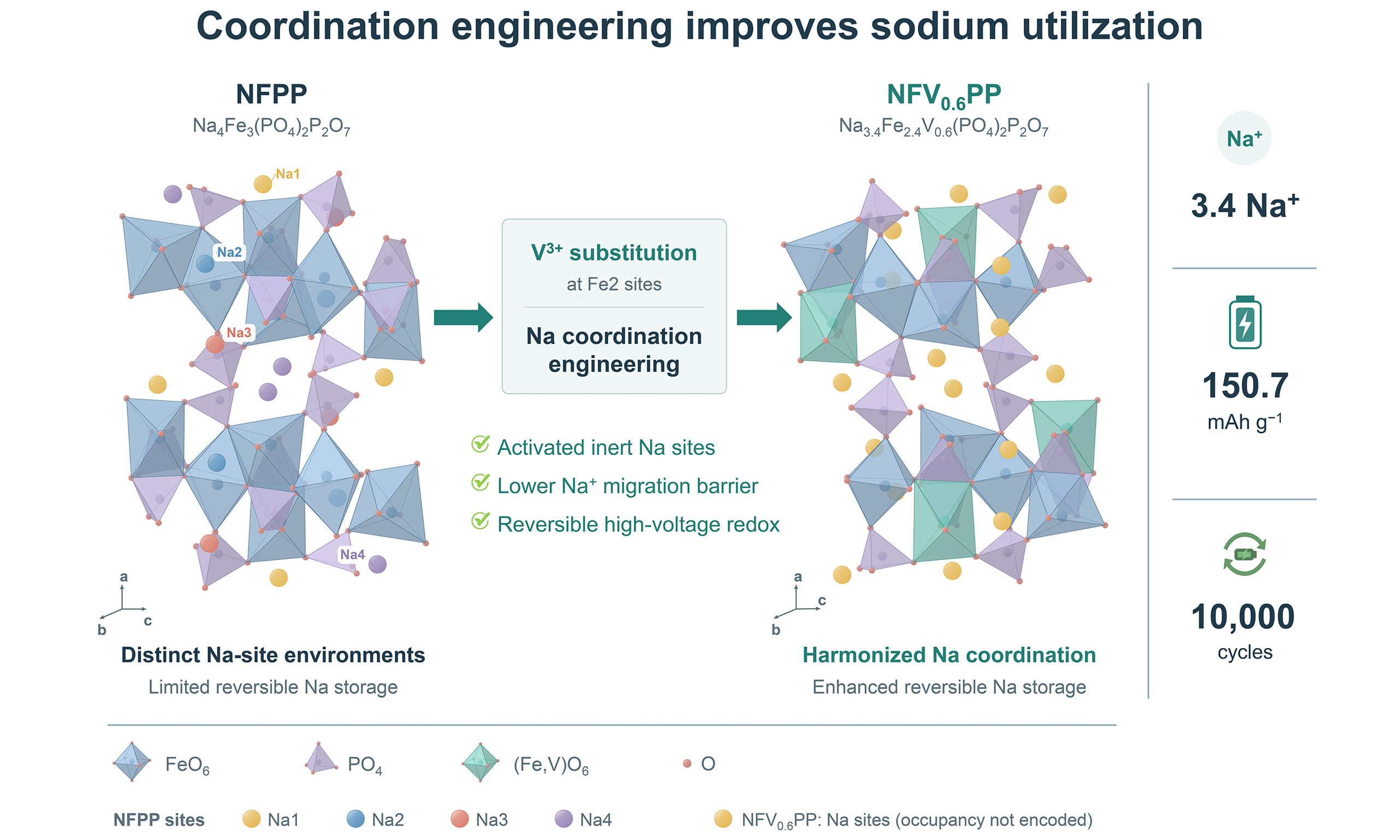
Iron-based polyanionic phosphate cathodes feature structural stability, intrinsic safety and elemental abundance, making them attractive candidates for sodium-ion batteries[1]. Among these materials, Na4Fe3(PO4)2P2O7 (NFPP) possesses a theoretical capacity of 129 mAh g-1, corresponding to the reversible extraction of three Na+ per formula unit[2]. However, NFPP generally delivers below 100 mAh g-1 in practical applications[3]. Although each formula unit contains four Na+, the theoretical and practical capacities are equivalent to the extraction of only three and ~2.4 Na+, respectively, suggesting that sodium utilization depends not merely on the total Na content but also on the accessibility of individual Na sites. To date, strategies such as defect engineering[4] and cation substitution[5] have been extensively explored to improve the electrochemical performance of NFPP-based cathodes. Nevertheless, the capacity remains capped at three Na+, as these strategies still rely on Fe2+/Fe3+ redox and leave the remaining Na+ inactive. In a recent study published in Nature Energy, Li and co-workers revealed that controlled V3+ substitution in Na4-xFe3-xVx(PO4)2P2O7 enhances the utilization of previously inactive Na sites[6]. By reshaping the local Na+ coordination environment, vanadium substitution enables deeper sodium extraction, allowing the optimized Na3.4Fe2.4V0.6(PO4)2P2O7 (NFV0.6PP) to deliver a substantially higher reversible capacity, even with a lower sodium content than NFPP[6].
The central advance of this work is the recognition that Na-site accessibility can be regulated through local coordination engineering. NFPP contains four crystallographically distinct Na sites (Na1-Na4), each holding one Na+ per formula unit[2]. Na1 and Na4 have direct diffusion channels, whereas Na2 and Na3 lack independent channels and limit sodium utilization in different ways[6]. Specifically, Na3 has been linked to the initial irreversible Na loss[7], while the sevenfold-coordinated Na2 site is generally considered electrochemically inactive[2]. Upon vanadium substitution, structural refinement indicates that V3+ preferentially occupies the Fe2 site, accompanied by compensating Na vacancies located predominantly at the Na2 site[6]. The resulting local distortions weaken Na-O interactions and reduce the energetic differences among the Na sites. These local changes are also reflected in the 23Na solid-state magic-angle-spinning nuclear magnetic resonance (ss-MAS NMR) spectra, in which the four resolved resonances of NFPP (Na1-Na4) progressively merge into a broad signal with increasing vanadium content[6]. This merging shows that the four Na sites are no longer spectroscopically distinct, a change the authors attribute to converging Na-site energies[6]. However, more varied local environments, which broaden the distribution of paramagnetic shifts and quadrupolar couplings, may also contribute[8]. These structural changes are associated with enhanced Na+ transport: calculations show that the Na2-to-Na1 migration barrier decreases from 0.615 to 0.221 eV[6], while molecular dynamics simulations indicate a more interconnected Na+ diffusion network. Collectively, these results point to improved accessibility of the Na2 site. Vanadium substitution also modifies charge compensation at high states of charge. X-ray absorption spectroscopy reveals a sequential charge-compensation process: Fe2+/Fe3+ redox dominates below ~3.9 V, beyond which vanadium is progressively oxidized from V3+ to V5+, providing the additional redox capacity required for deeper sodium extraction. In this high-voltage region, the oxygen K-edge spectra indicate that lattice oxygen also participates in charge compensation through enhanced metal-oxygen hybridization, whereas the bridging oxygen atoms of the pyrophosphate groups remain redox-inactive and stabilize the framework against oxygen loss. Consistently, no O2 evolution is detected from NFV0.6PP up to 4.9 V[6]. Meanwhile, the lattice strain induced by sodium extraction is accommodated by the rearrangement of metal-oxygen units and the rotation of pyrophosphate groups. This transient rearrangement, accompanied by a temporary decrease in Na+ diffusivity, occurs earlier in NFV0.6PP (~1.4 Na+ extracted) than in NFPP (~2.3 Na+), allowing this strain to be released before it accumulates. Accordingly, NFV0.6PP returns to its pristine structure upon discharge, as shown by the diffraction patterns and 23Na ss-MAS NMR spectra[6].
The improved Na-site accessibility is directly reflected in the enhanced electrochemical performance. Within 2.1-4.5 V at 0.1 C, NFV0.6PP delivers 128.5 mAh g-1 (~3 Na+), compared with 107.7 mAh g-1 for NFPP[6]. The first-cycle reversibility is also markedly improved, with the initial Coulombic efficiency rising from 83.7% to above 95%. Extending the voltage window to 2.0-4.9 V further increases the reversible capacity of NFV0.6PP to 150.7 mAh g-1, corresponding to all 3.4 Na+ per formula unit, as confirmed by inductively coupled plasma-mass spectrometry. The resulting energy density reaches 487 Wh kg-1 (based on the cathode active mass), 52.1% higher than the ~320 Wh kg-1 obtained for NFPP in its conventional 2.1-4.5 V window. Even in this narrower window, NFV0.6PP exceeds 400 Wh kg-1, indicating that the improvement does not arise from the wider voltage range alone[6]. Importantly, the enhanced electrochemical performance is maintained during long-term cycling, with NFV0.6PP retaining 82.1% of its initial capacity after 10,000 cycles at 5 C (2.1-4.5 V). The practical potential of this cathode design is further supported by a multilayer pouch cell, which exhibits 90.32% capacity retention over 600 cycles (1.0-4.5 V)[6].
The significance of this study lies in connecting compositional modification with the local structural factors that govern reversible sodium storage. Unlike previous defect engineering and cation substitution, which mainly improved kinetics and stability, V substitution here reshapes the local Na+ coordination and targets a specific Na site, thereby increasing the number of reversibly extractable Na+. Nevertheless, the individual contribution of this coordination effect remains difficult to disentangle, as the substitution simultaneously alters Na-site geometry, vacancy chemistry and redox behavior. Consequently, establishing clear relationships between local coordination environments, Na-site energetics and migration kinetics is critical for identifying the factors that most strongly govern sodium utilization. Beyond these mechanistic considerations, operation up to 4.9 V still faces practical challenges. Of particular concern is that CO2 evolution from carbonate electrolyte decomposition poses safety risks and calls for more oxidation-resistant electrolytes. In addition, the long-term stability within 2.0-4.9 V (only 40 cycles) requires further evaluation. Finally, the energy density of 487 Wh kg-1 is a material-level value, whereas the full and pouch cells were cycled only up to 4.5 V, so the capacity advantage of extracting more than three Na+ per formula unit remains to be demonstrated at the cell level[6].
Despite these challenges, this work demonstrates more broadly that the electrochemical accessibility of inactive Na sites within a phosphate framework can be modulated through local Na+ coordination environments. By establishing a correlation between Na-site geometry, reversible sodium utilization and structural response, this study provides mechanistic insight into unlocking additional capacity without compromising framework stability. Looking ahead, extending this concept to other polyanionic phosphate compositions requires identifying local structural environments that facilitate ion transport while preserving structural integrity during sodium extraction. These design principles can serve as a valuable foundation for developing phosphate cathodes with higher energy density, provided that the material-level gains can be maintained under practical full-cell conditions.
DECLARATIONS
Authors’ contributions
Conceptualization, literature review, and original draft preparation: Li, S.
Critical discussion: Jin, T.
Supervision, critical feedback, and manuscript revision: Zhang, C.; Jiao, L.
Availability of data and materials
Not applicable.
AI and AI-assisted tools statement
Not applicable.
Financial support and sponsorship
This work was supported by the National Natural Science Foundation of China (92472204, U25A20242, 22579089), Fundamental and Interdisciplinary Disciplines Breakthrough Plan of the Ministry of Education of China (JYB2025XDXM410), the Natural Science Foundation of Tianjin City (25JCQNJC01190), the “111 Center” (B25010), and the Fundamental Research Funds for the Central Universities (63261001).
Conflicts of interest
All authors declared that there are no conflicts of interest.
Ethical approval and consent to participate
Not applicable.
Consent for publication
Not applicable.
Copyright
© The Author(s) 2026.
REFERENCES
1. Ahsan, Z.; Cai, Z.; Wang, S.; et al. Recent development of phosphate based polyanion cathode materials for sodium-ion batteries. Adv. Energy. Mater. 2024, 14, 2400373.
2. Kim, H.; Park, I.; Seo, D. H.; et al. New iron-based mixed-polyanion cathodes for lithium and sodium rechargeable batteries: combined first principles calculations and experimental study. J. Am. Chem. Soc. 2012, 134, 10369-72.
3. Chen, M.; Hua, W.; Xiao, J.; et al. NASICON-type air-stable and all-climate cathode for sodium-ion batteries with low cost and high-power density. Nat. Commun. 2019, 10, 1480.
4. Zhao, A.; Yuan, T.; Li, P.; et al. A novel Fe-defect induced pure-phase Na4Fe2.91(PO4)2P2O7 cathode material with high capacity and ultra-long lifetime for low-cost sodium-ion batteries. Nano. Energy. 2022, 91, 106680.
5. Qi, X.; Dong, Q.; Dong, H.; et al. Copper-induced lattice distortion in Na4Fe3(PO4)2(P2O7) cathode enabling high power density Na-ion batteries with good cycling stability. Energy. Storage. Mater. 2024, 73, 103861.
6. Li, X.; Zhang, D.; Fan, X.; et al. Harmonized sodium coordination engineering for high-energy phosphate cathodes. Nat. Energy. 2026, 11, 915-25.
7. Wang, X.; Gu, J.; Zhang, Y.; et al. Tailoring local sodium coordination toward high initial coulombic efficiency Na4Fe3(PO4)2P2O7 cathODes. Adv. Mater. 2026, 38, e75014.
Cite This Article
 Open Access
How to Cite
Li, S.; Zhang, C.; Jin, T.; Jiao, L. Coordination engineering unlocks inactive sodium sites in phosphate cathodes. Energy Mater. 2026, 6, 600159. https://dx.doi.org/10.20517/energymater.2026.315
Download Citation
If you have the appropriate software installed, you can download article citation data to the citation manager of your choice. Simply select your manager software from the list below and click on download.
Export Citation File
Type of Import
Tips on Downloading Citation
Citation Manager File Format
Type of Import
Direct Import: When the Direct Import option is selected (the default state), a dialogue box will give you the option to Save or Open the downloaded citation data. Choosing Open will either launch your citation manager or give you a choice of applications with which to use the metadata. The Save option saves the file locally for later use.
Indirect Import: When the Indirect Import option is selected, the metadata is displayed and may be copied and pasted as needed.
About This Article
Copyright

Data & Comments
Data
0











Comments
Comments must be written in English. Spam, offensive content, impersonation, and private information will not be permitted. If any comment is reported and identified as inappropriate content by OAE staff, the comment will be removed without notice. If you have any queries or need any help, please contact us at [email protected].