

Plasma purification and redox-coupled restoration of spent layered cathodes
 0


 Download PDF
The rapid development of electric vehicles and electrochemical energy storage has sharply increased the lithium-ion battery (LIB) deployment and demand for critical resources such as Li, Ni, Co, and Mn metals and graphite[1]. Their uneven distribution and environmental burdens have intensified sustainability concerns[2]. As increasing numbers of batteries reach end of life, efficient recycling is becoming essential for resource security and closed-loop material use[3].
Conventional LIB recycling predominantly employs pyrometallurgical and hydrometallurgical routes, while bioleaching is being investigated as a low-temperature alternative. These extractive routes are often energy- or chemical-intensive and recover cathode materials mainly as metals or precursors, sacrificing their original crystal and particle architectures[4]. Direct recycling has therefore emerged as an alternative strategy by restoring degraded cathode materials through relithiation, structural reconstruction and surface repair, while avoiding extensive elemental separation and re-synthesis steps and reducing resource and energy demands[5]. However, two major bottlenecks still remain. First, surface contamination remains a critical challenge. Spent cathode powders typically contain residual conductive carbon, polyvinylidene fluoride (PVDF), lithium fluoride (LiF), and other fluorine-containing species, which form surface barriers and hinder Li+ and oxygen transport during regeneration[6]. Pretreatment strategies including thermal pyrolysis, grinding, solvent-assisted removal, oxidative treatment and plasma-assisted purification have been explored for decontamination. Thermal and oxidative approaches are energy-intensive; solvent-based methods add chemical use and processing complexity. Plasma-assisted approaches offer rapid, low-temperature decontamination, but their integration with direct regeneration and role in structural recovery remain insufficiently explored[7-10]. Second, structural recovery remains poorly understood. The coupled processes governing Li/O reinsertion, Ni-valence recovery, suppression of Li/Ni antisite disorder and reconstruction of rock-salt-like regions into ordered O3 layered structures remain insufficiently understood. Resolving these processes is critical for moving direct recycling from empirical relithiation toward more controllable and mechanism-guided regeneration.
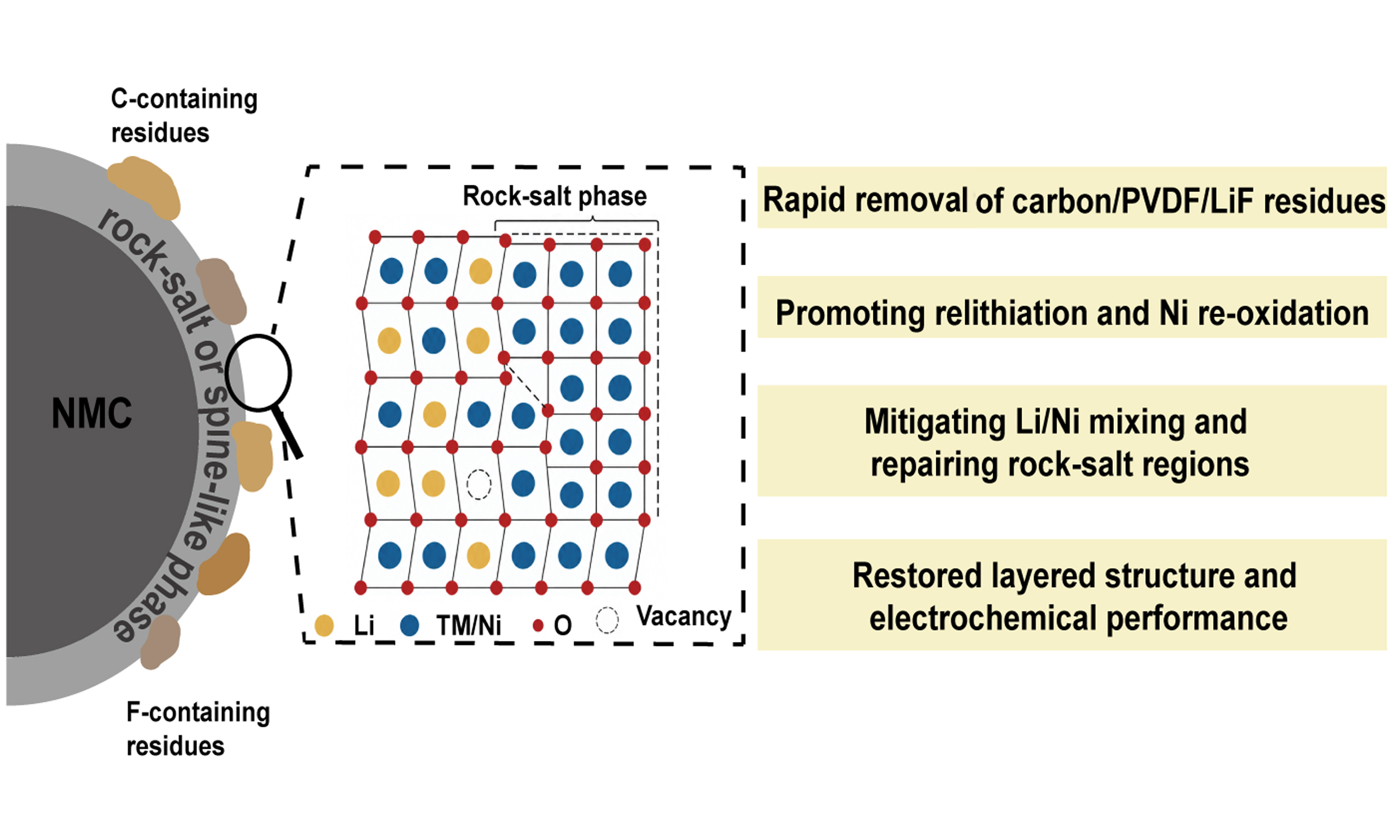
In a recent study published in Joule, Jing et al.[6] addressed these two unresolved issues within a single regeneration framework. The technological advance lies in integrating low-temperature plasma purification with direct regeneration to rapidly remove carbon- and fluorine-containing surface residues before relithiation, thereby alleviating interfacial barriers to subsequent ion transport. More importantly, the scientific advance is the time-resolved elucidation of structural recovery during recalcination. By combining in situ synchrotron X-ray diffraction (XRD) with X-ray absorption near-edge structure (XANES) and extended X-ray absorption fine structure (EXAFS) spectroscopy, the authors correlated the evolution of lattice parameters and Li/Ni disorder with the recovery of the Ni oxidation state. The near-synchronous decrease in the a-axis parameter and Li/Ni mixing provides evidence for a close coupling between Ni reoxidation and cation reordering. This connection extends the understanding of direct regeneration beyond end-point structural recovery to the dynamic evolution of redox chemistry and cation redistribution during recalcination.
The low-temperature plasma treatment developed in this study uses plasma-generated reactive species to oxidize residual carbon to CO2 and decompose PVDF into volatile fluorinated products, enabling rapid removal of carbon- and fluorine-containing contaminants within several seconds [Figure 1A]. Importantly, plasma purification removes diffusion barriers before relithiation, facilitating subsequent structural restoration. Notably, “low-temperature” refers only to plasma purification, while structural regeneration still requires recalcination at 700-720 °C. After relithiation and structural restoration, the regenerated lithium nickel manganese cobalt oxide (LiNixMnyCozO2, NMC) cathode NMC622 and NMC811 deliver specific capacities of 170 and 202 mAh g-1, respectively, when evaluated in Li half-cells within a voltage range of 2.8-4.3 V at 0.1 C. The regenerated NMC622 pouch cell retains 87% capacity after 1,100 cycles at 1 C, demonstrating long-term stability in a practical cell configuration. Techno-economic and environmental analyses indicate that the integrated process can reduce energy consumption and processing costs while simplifying recycling compared with conventional routes[6]. However, the generation of volatile fluorinated products during plasma treatment may introduce additional environmental and safety concerns, highlighting the need for appropriate off-gas control. Therefore, despite these advantages, throughput, energy efficiency, gas management and manufacturing integration require further evaluation to establish industrial applicability.
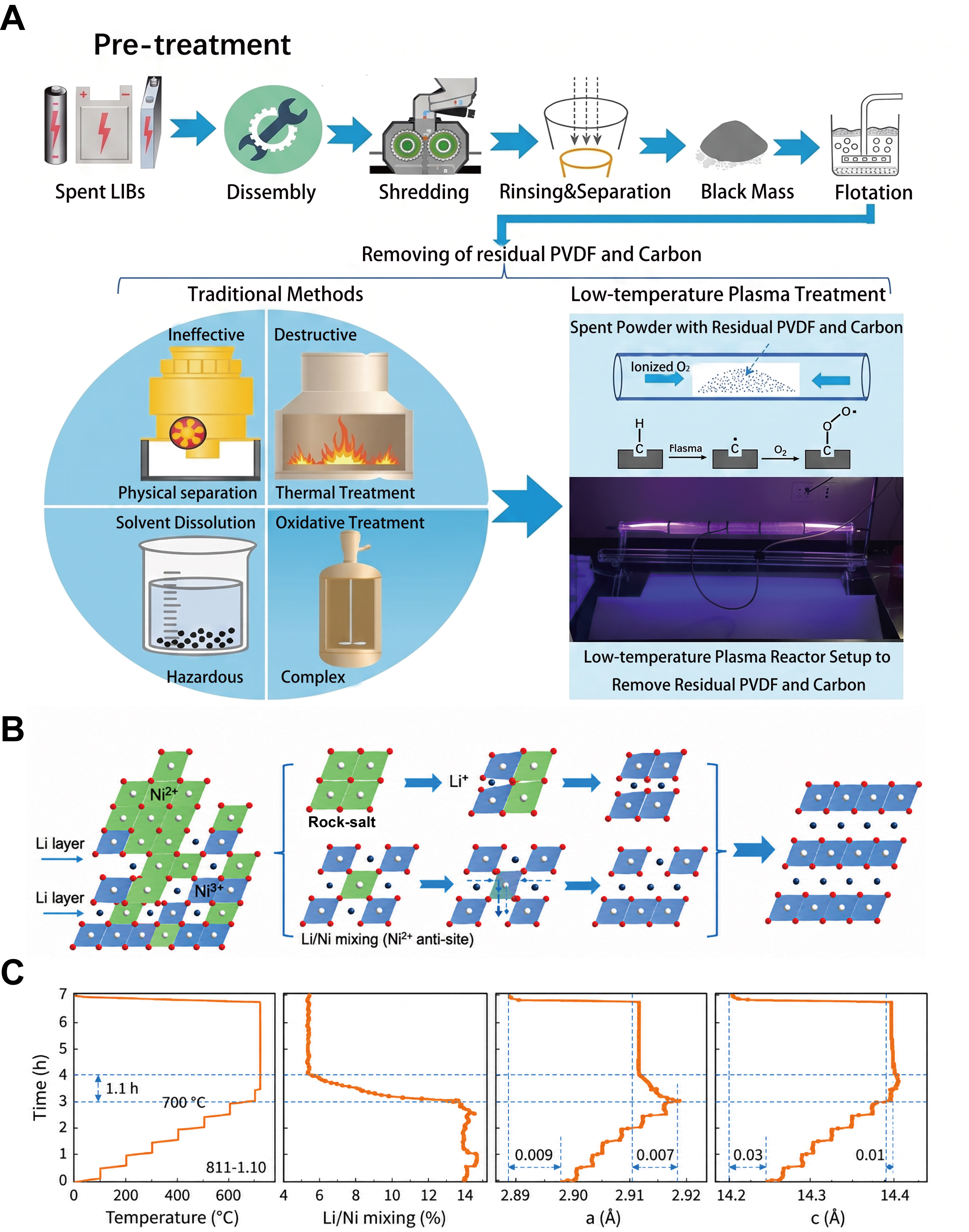
Figure 1. (A) Comparison of conventional pretreatment routes with low-temperature plasma-assisted purification for the removal of carbon and PVDF residues from spent cathode materials; (B) Schematic illustration of rock-salt phase reconstruction and Li/Ni disorder recovery associated with Ni oxidation; (C) Heating protocol of in situ variable-temperature XRD and temporal evolution of Li/Ni cation disorder and a- and c-axis lattice parameters of NMC811 during heat treatment. The Li/Ni cation-mixing fraction and lattice parameters were obtained from Rietveld refinement of the XRD patterns. This figure is reprinted with permission from Ref.[6]. Copyright © 2026 Elsevier. PVDF: polyvinylidene fluoride; XRD: X-ray diffraction.
Elucidating the structural recovery process of spent layered cathode materials during subsequent recalcination constitutes the most important scientific contribution of this work. Degraded NMC622 and NMC811 cathodes suffer from Li loss, Ni reduction, lattice expansion, and severe cation disorder. During thermal regeneration, in situ synchrotron XRD measurements capture a non-monotonic structural evolution: initial heating induces thermal expansion accompanied by a slight increase in Li/Ni disorder, whereas further heating triggers rapid a-axis contraction and progressive recovery of cation ordering above approximately 720 °C for NMC622 and 700 °C for NMC811. Together with XANES and EXAFS analyses, these results demonstrate that restoration of the Ni oxidation state and local atomic coordination environment are closely coupled with the re-establishment of transition-metal cation ordering. Jing et al. therefore propose that Ni2+ reoxidation may induce contraction of NiO6 octahedra, creating a less favorable environment for antisite Ni in the Li layers and facilitating its migration toward transition-metal sites. A related redox-assisted pathway is proposed for rock-salt-like regions, where Ni reoxidation may improve oxygen coordination and facilitate Li reinsertion, promoting reconstruction of the O3 layered structure [Figure 1B]. Notably, the lattice parameters respond differently during this recovery process. Whereas the a-axis contracts with Ni oxidation and cation reordering at elevated temperatures, the c-axis remains nearly unchanged, as thermal expansion offsets the contraction induced by Li reinsertion; substantial contraction only emerges upon cooling. Overall, the near-synchronous evolution of the a-axis and Li/Ni disorder establishes a temporal correlation between redox recovery and cation reordering [Figure 1C]. Beyond this crystallographic evolution, at the particle scale, these atomic-level processes also facilitate the recovery of surface morphology and microstructural integrity, signifying structural restoration across multiple length scales[6].
Recent studies have established important advances in direct regeneration of NMC, including mechanistic understanding of structural recovery, plasma-assisted impurity removal, scalable processing and pouch-cell validation[11,12]. Within this context, the distinctive contribution of Jing et al.[6] lies in integrating plasma-assisted purification with mechanistic understanding of structural restoration and practical process considerations. By investigating the co-evolution of Ni valence states, local coordination, a-axis lattice parameter and Li/Ni mixing, the study links redox recovery with cation reordering and provides a mechanistic framework for the reconstruction of Li/Ni antisite and rock-salt-type defects toward the layered O3 structure. Together with the demonstrated electrochemical recovery and potential resource-efficiency advantages, this integrated strategy offers important guidance for developing more controllable direct-recycling processes.
Looking ahead, direct recycling is expected to advance from well-defined single cathode systems toward feedstock-adaptive regeneration of heterogeneous end-of-life materials with varying compositions, degradation states and impurity contents. For plasma-assisted regeneration, further optimization of plasma energy efficiency, reactive-species chemistry and C/F removal kinetics, together with continuous reactor design, treatment uniformity, off-gas management and integration with subsequent recalcination, will be important for practical scale-up. Process-level environmental and techno-economic assessments under industrially relevant conditions are also needed to evaluate long-term sustainability. At the mechanistic level, multiscale in situ/operando characterization and theoretical modeling should clarify the coupling among relithiation, defect evolution, cation redistribution, redox chemistry and interfacial reconstruction. Future studies should further extend evaluations from powder and half-cell scales to high-loading electrodes, full-cells and pouch-cell systems, with emphasis on material reproducibility, safety and durability, so as to further promote the industrial implementation of direct recycling strategies.
DECLARATIONS
Authors’ contributions
Collected literature, organized viewpoints and wrote the original draft: Sun, Z.
Put forward critical comments, guided the writing and polished the manuscript: Ding, F.; Niu, C.
Availability of data and materials
Not applicable.
AI and AI-assisted tools statement
Not applicable.
Financial support and sponsorship
This work was supported by the National Key Research and Development Program of China (2023YFB3809300), the National Natural Science Foundation of China (22579152), the National Key Research and Development Program of Henan Province (231111240200), the Project of Zhongyuan Critical Metals Laboratory (GJJSGFYQ202508), and the Zhongyu Feima New Material Technology Innovation Center Project (No. 20240800A).
Conflicts of interest
All authors declare that there are no conflicts of interest.
Ethical approval and consent to participate
Not applicable.
Consent for publication
Not applicable.
Copyright
© The Author(s) 2026.
REFERENCES
1. International Energy Agency Home Page. Https://www.iea.org/ (2026-10-26).
2. Olivetti, E. A.; Ceder, G.; Gaustad, G. G.; Fu, X. Lithium-ion battery supply chain considerations: analysis of potential bottlenecks in critical metals. Joule 2017, 1, 229-43.
3. Harper, G.; Sommerville, R.; Kendrick, E.; et al. Recycling lithium-ion batteries from electric vehicles. Nature 2019, 575, 75-86.
4. Ciez, R. E.; Whitacre, J. F. Examining different recycling processes for lithium-ion batteries. Nat. Sustain. 2019, 2, 148-56.
5. Ma, X.; Meng, Z.; Bellonia, M. V.; et al. The evolution of lithium-ion battery recycling. Nat. Rev. Clean. Technol. 2025, 1, 75-94.
6. Jing, Y.; Zhao, P.; Liao, J.; et al. Restoration of spent layered cathodes via direct recalcination. Joule 2026, 10, 102350.
7. Ji, Y.; Kpodzro, E. E.; Jafvert, C. T.; Zhao, F. Direct recycling technologies of cathode in spent lithium-ion batteries. Clean. Technol. Recycl. 2021, 1, 124-51.
8. Hou, D.; Chen, J.; Bai, F.; et al. Efficient regeneration of waste LiFePO4 cathode material by short process low temperature plasma assisted nitrogen doped technology. J. Power. Sources. 2024, 613, 234845.
9. Ren, X.; Bu, X.; Tong, Z.; et al. Influences of plasma treatment parameters on the hydrophobicity of cathode and anode materials from spent lithium-ion batteries. Waste. Manag. 2024, 184, 120-31.
10. Beletskii, E. V.; Romanovski, V. Direct plasma solution recycling of cathode materials for lithium-ion batteries with simultaneous removal of contaminants and relithiation. J. Power. Sources. 2024, 624, 235576.
11. Chen, W.; Li, J.; Ji, H.; et al. Efficient and scalable direct regeneration of spent layered cathode materials via advanced oxidation. Adv. Mater. 2025, 37, e2416818.
Cite This Article
 Open Access
How to Cite
Sun, Z.; Ding, F.; Niu, C. Plasma purification and redox-coupled restoration of spent layered cathodes. Energy Mater. 2026, 6, 600148. https://dx.doi.org/10.20517/energymater.2026.280
Download Citation
If you have the appropriate software installed, you can download article citation data to the citation manager of your choice. Simply select your manager software from the list below and click on download.
Export Citation File
Type of Import
Tips on Downloading Citation
Citation Manager File Format
Type of Import
Direct Import: When the Direct Import option is selected (the default state), a dialogue box will give you the option to Save or Open the downloaded citation data. Choosing Open will either launch your citation manager or give you a choice of applications with which to use the metadata. The Save option saves the file locally for later use.
Indirect Import: When the Indirect Import option is selected, the metadata is displayed and may be copied and pasted as needed.
About This Article
Copyright

Data & Comments
Data
0











Comments
Comments must be written in English. Spam, offensive content, impersonation, and private information will not be permitted. If any comment is reported and identified as inappropriate content by OAE staff, the comment will be removed without notice. If you have any queries or need any help, please contact us at [email protected].