



Robust double-lock MXene anodes for stable sodium storage
 0
0 
Abstract
Although MXenes possess intrinsically high electrical conductivity and a layered architecture favorable for charge storage, their practical use is still hindered by severe nanosheet restacking, susceptibility to oxidation, limited electrochemically active sites, and slow ion-diffusion kinetics. Herein, a facile molecular grafting strategy is used to covalently anchor terephthalaldehyde (TPAL) within aminated Ti3C2 MXene interlayers, constructing a Ti3C2-TPAL composite with a well-defined double-lock effect. The first lock arises from imine-bond-based covalent anchoring between TPAL and aminated Ti3C2, which suppresses sheet restacking and interlayer slippage. The second lock arises from the rigid aromatic TPAL pillars, which enlarge the interlayer galleries and help maintain the spacing during repeated Na+ storage. This regulated architecture enables Ti3C2-TPAL to provide 57.0 mAh g-1 at 10 A g-1. During extended cycling at 5 A g-1, the electrode still outputs
Keywords
INTRODUCTION
As clean energy systems continue to expand, large-scale energy storage has become essential for smoothing the intermittent and fluctuating output of solar and wind power. In this context, sodium-ion batteries (SIBs) offer a practical route for stationary storage owing to the low cost, wide availability, and lithium-like electrochemical characteristics of sodium[1,2]. Consequently, SIBs demonstrate broad application prospects in smart grids, consumer electronics, and electric transportation. The electrochemical behavior of the anode directly affects the usable capacity, long-term stability, and high-rate response of SIBs. Its performance acts as a bottleneck restricting the industrialization process of SIBs. Anodes explored for SIBs can be broadly classified into carbonaceous materials[3,4], alloying-type systems[5,6], metal-based compounds[7-9], and two-dimensional (2D) layered structures[10,11]. However, the critical drawbacks of traditional carbon-based materials (low capacity), alloy-type materials (severe volume expansion), and metal compounds (poor conductivity) render them inadequate for the demands of high-performance SIB applications. Accordingly, designing advanced anodes and developing effective modification strategies have become key research directions in the SIB field[12,13].
As typical two-dimensional transition-metal carbides, nitrides, and carbonitrides, MXenes possess layered frameworks, metallic conductivity, mechanical robustness, and chemically tunable surface groups[14-17]. Since the first MXene was reported in 2011, this material family has been increasingly explored for SIB anodes[18]. Despite these advantages, MXene-based electrodes still suffer from inherent structural drawbacks that limit their practical performance. Specifically, van der Waals attraction between neighboring MXene layers promotes restacking, which reduces accessible surface area and active-site exposure while limiting fast Na+ diffusion within the interlayer channels[19-21]. Meanwhile, the limited diversity and low reactivity of surface terminations on MXenes lead to weak electrolyte compatibility and make the layered structure prone to collapse during repeated cycling[22,23], thereby compromising prolonged electrochemical durability. To address these issues, researchers have developed various modification strategies[24,25]. Among them, grafting modification is considered one of the most promising methods due to its ability to precisely regulate surface chemical properties, effectively inhibit sheet restacking, and introduce new active sites[26-28]. Compared with other organic cross-linkers, terephthalaldehyde (TPAL) offers several structural advantages for regulating MXene interlayers. Aliphatic dialdehydes, such as glutaraldehyde, can react with amino groups but their flexible chains may not provide sufficient rigidity to stabilize the interlayer spacing. Monofunctional aromatic aldehydes can introduce aromatic units but cannot effectively bridge adjacent MXene sheets. Other aromatic dialdehydes, such as phthalaldehyde or isophthalaldehyde, may also form imine linkages, but their different aldehyde positions lead to less linear molecular geometries. In contrast, TPAL contains two para-positioned aldehyde groups and a rigid benzene backbone, enabling covalent coupling with aminated Ti3C2 while serving as a molecular pillar to stabilize the expanded interlayer spacing. Therefore, TPAL was selected as a representative aromatic dialdehyde cross-linker to construct the double-lock interlayer structure. In principle, TPAL grafting may provide additional active sites, reinforce Na+ adsorption, and stabilize the electrode/electrolyte contact during cycling. Nevertheless, TPAL-grafted MXene anodes for SIBs remain insufficiently explored, and both the grafting process and the Na-storage behavior require further clarification.
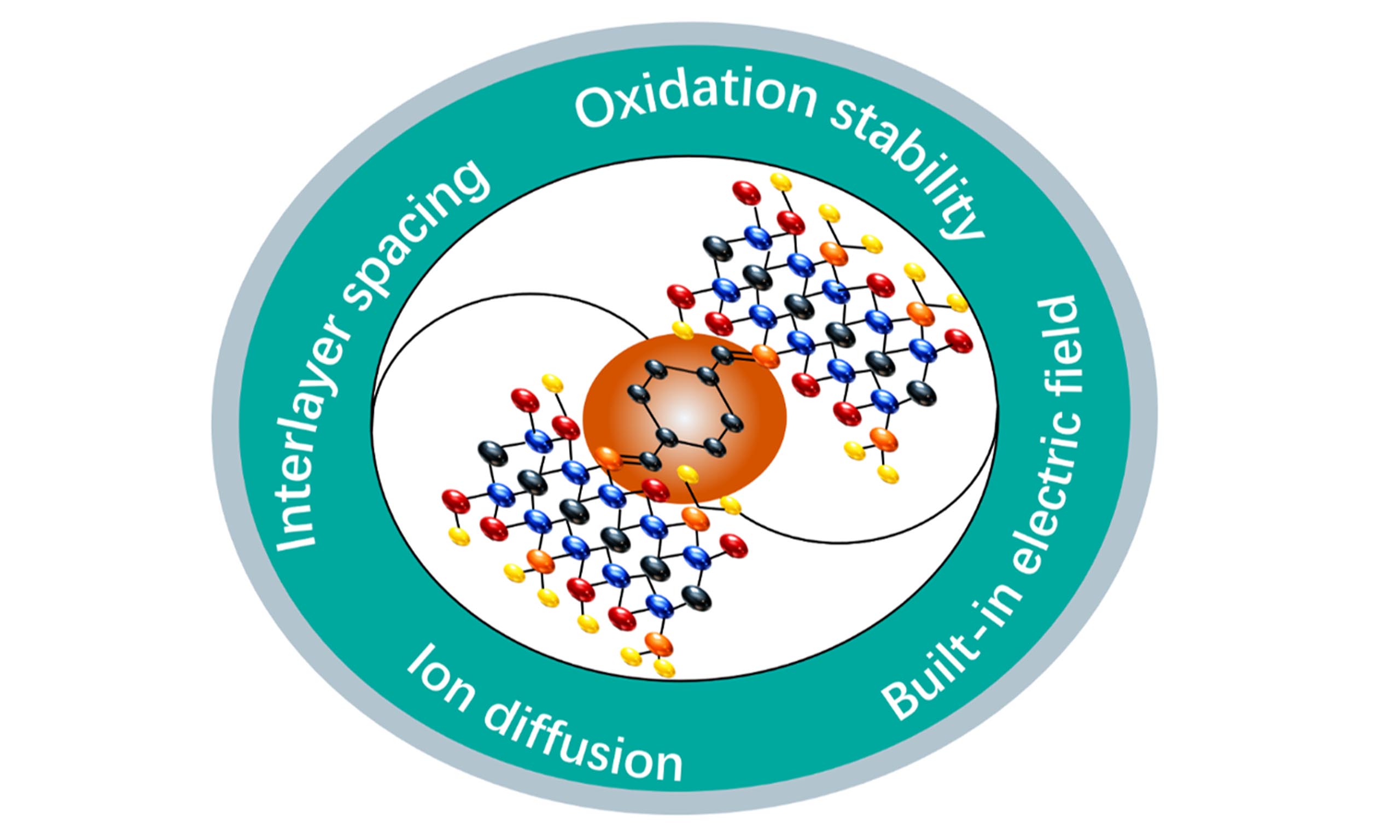
In this work, TPAL is covalently grafted within aminated Ti3C2 MXene interlayers to construct a Ti3C2-TPAL composite with a well-defined double-lock architecture. The double-lock effect is defined as the combination of covalent anchoring and rigid interlayer pillaring. The imine bonds formed between TPAL and aminated Ti3C2 serve as the first lock, chemically anchoring the MXene sheets and suppressing restacking or interlayer slippage. The rigid aromatic TPAL molecules serve as the second lock, acting as molecular pillars to enlarge and stabilize the Ti3C2 interlayer spacing. The improved oxidation resistance, interfacial charge redistribution, and enhanced Na+ transport kinetics are therefore discussed as consequences of this double-lock structure rather than as separate components of the double-lock effect. By combining in situ X-ray diffraction (XRD), Distribution of relaxation times (DRT) analysis, and simplified density functional theory (DFT) calculations, the role of TPAL in stabilizing the Ti3C2 interlayers and improving Na-storage kinetics is investigated from both experimental and theoretical perspectives. The coordinated regulation of the interlayer structure and Na-storage kinetics gives Ti3C2-TPAL favorable electrochemical performance in SIB half cells, including 57.0 mAh g-1 at 10 A g-1 and
EXPERIMENTAL
Preparation of MXene
Ti3C2 MXene was obtained from MAX through hydrofluoric acid (HF)-assisted selective Al extraction. Briefly, 3 g of Ti3AlC2 MAX was gradually dispersed in portions within 60 mL of 40% HF solution in a polytetrafluoroethylene container. The mixture was centrifuged (3,000 rpm, 5 min), and the resulting precipitate was rinsed with deionized water to a near-neutral supernatant pH. Finally, vacuum drying at 60 °C for 12 h yielded MXene powder.
Preparation of Ti3C2-TPAL
Ti3C2-NH2 was obtained by treating 300 mL of MXene dispersion (10 mg mL-1) with 2 g of NH4F under argon at 60 °C for 12 h. After thorough rinsing, the obtained Ti3C2-NH2 was vacuum-dried at 60 °C for 8 h. The dried Ti3C2-NH2 was then dispersed at 20 mg mL-1 and mixed with TPAL solution at 5 mg mL-1. 10 mL of Ti3C2-NH2 dispersion (20 mg mL-1) was mixed with 20 mL of TPAL solution (5 mg mL-1), corresponding to feeding masses of 200 mg for Ti3C2-NH2 and 100 mg for TPAL. The mixture was stirred at 50 °C and
Materials characterization
Field-emission scanning electron microscopy (FE-SEM, Hitachi SU8220) and high-resolution transmission electron microscopy (HRTEM, JEOL JEM-2100F) were employed to characterize the morphology and structure of the samples. Phase information was obtained from XRD measurements performed on a Shimadzu XRD-6100 diffractometer with Cu Kα radiation (λ = 1.5406 Å). Surface elemental composition and chemical states were investigated using X-ray photoelectron spectroscopy (XPS, Thermo Scientific K-Alpha, Al Kα source). Fourier-transform infrared spectroscopy (FTIR, Thermo Scientific Nicolet iS5) was conducted to identify surface functional groups and bonding characteristics. The zeta potential of the samples dispersed in aqueous media was measured at 25 °C using a Malvern Zetasizer Nano ZS90 to evaluate surface charge behavior and colloidal dispersion stability. N2 adsorption-desorption isotherms (Micromeritics ASAP 2460) were measured to obtain the Brunauer-Emmett-Teller (BET) specific surface area and pore-size distribution. The samples were degassed under vacuum at 120 °C for 8 h before testing.
Electrochemical measurements
Working electrodes were fabricated by mixing the active material, poly(vinylidene fluoride) (PVDF), and carbon black in N-methyl-2-pyrrolidone (99.9%) at a mass ratio of 80:10:10. After 6 h of stirring, the slurry was cast onto Cu foil and vacuum-dried at
Full cells employing a Ti3C2-TPAL anode and an NFPP cathode were assembled. For the full-cell assembly, the cathode was prepared by coating a slurry composed of sodium iron pyrophosphate (NFPP), carbon black, and PVDF (80:10:10 weight ratio) onto Al foil. For full-cell assembly, Ti3C2-TPAL anodes were first pre-activated in Na-metal half cells for 10 cycles and then charged to 2.5 V vs. Na/Na+ to obtain a desodiated state. The cells were disassembled in an Ar-filled glovebox without air exposure. The pre-activated anodes were not washed. Excess electrolyte on the electrode surface was gently removed using clean filter paper before assembling the Ti3C2-TPAL||NFPP full cells. This pre-activation step was used to form a relatively stable SEI on the Ti3C2-TPAL anode and reduce the influence of irreversible reactions during the initial full-cell cycling. By fixing the charge and discharge cut-off potentials of the NFPP cathode at 4.0 and 2.0 V, respectively, the full-cell operating window was determined to be 0.04-3.65 V. To ensure the cathode limited the energy density, the areal mass loadings were balanced at ~1.5 mg cm-2 for Ti3C2-TPAL and
Cyclic voltammetry (CV) and electrochemical impedance spectroscopy (EIS) measurements were performed. The tests were conducted on a CHI660E electrochemical workstation. For EIS, spectra were collected between 100 kHz and 0.1 Hz. Galvanostatic cycling was performed using a LAND CT3004A battery tester. Galvanostatic intermittent titration technique (GITT) measurements were also conducted on the same equipment. During the GITT measurement, the cell was subjected to a galvanostatic pulse of 0.1 A g-1 for
The gravimetric energy density (E, Wh kg-1) was obtained by integrating the discharge voltage against specific capacity[29]:
where Q (mAh g-1) denotes the discharge specific capacity and V (V) represents the instantaneous cell voltage during discharge. The power density was calculated based on the energy density and the total discharge time[30]:
where t (h) is the duration of the discharge process.
DFT calculations
All DFT calculations were performed using the Vienna Ab initio Simulation Package (VASP). The exchange-correlation interactions were treated using the Perdew-Burke-Ernzerhof (PBE) functional within the generalized gradient approximation (GGA). The projector augmented wave (PAW) method was used to describe electron-ion interactions, and the plane-wave cutoff energy was set to 520 eV. The optimized structures were obtained when the energy variation was below 10-5 eV and the atomic forces were smaller than 0.02 eV Å-1. The adsorption energy (Ea) for Na adsorption on the sample surface was defined as
In this equation, ENa + samples, Esamples, and ENa correspond to the total energies of the Na-adsorbed system, the clean substrate, and the bulk Na reference, respectively. To analyze the migration kinetics of Na+ ions, the climbing image nudged elastic band (CI-NEB) method was used to map out the minimum energy paths (MEPs) and identify transition states.
RESULTS AND DISCUSSION
The preparation route of Ti3C2-TPAL is illustrated in Figure 1A. Ti3C2 MXene was first obtained by treating the Ti3AlC2 precursor with HF, which selectively extracted Al from the MAX structure
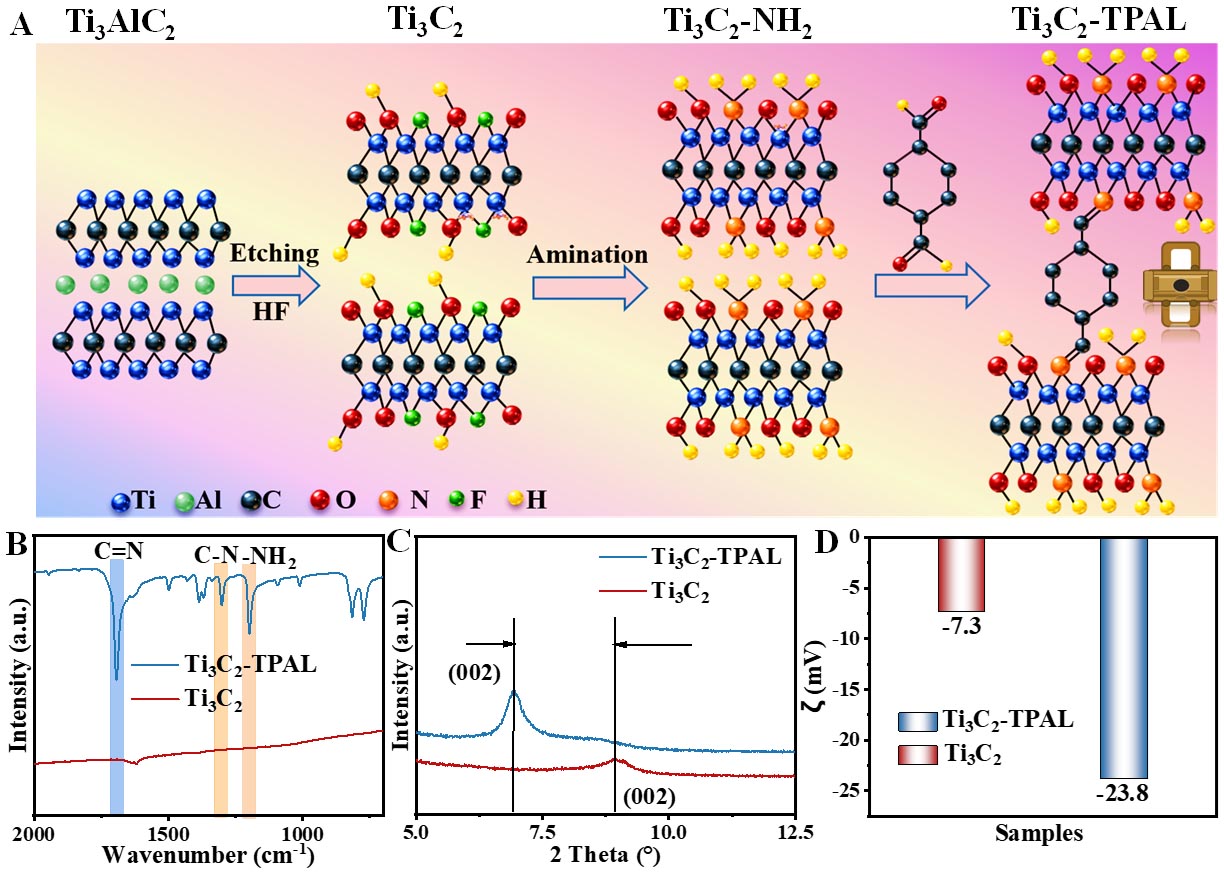
Figure 1. (A) Schematic of the preparation of Ti3C2-TPAL. (B) FTIR spectra, (C) XRD patterns, and (D) zeta potentials of Ti3C2-TPAL and Ti3C2.
The FTIR spectrum in Figure 1B shows that, compared with pristine Ti3C2, Ti3C2-TPAL exhibits characteristic peaks assigned to C=N (1,693.5 cm-1), C-N (1,301.2 cm-1), and amino-related vibrations, -NH2 (1,198.3 cm-1)[32], supporting the successful introduction of TPAL and the formation of imine-related bonding structures. To further distinguish chemical grafting from simple physical mixing, FTIR spectra of Ti3C2, Ti3C2-NH2, and the Ti3C2-NH2/TPAL physical mixture were added in
Ti3C2-TPAL exhibits a zeta potential of -23.8 mV [Figure 1D], whereas that of Ti3C2 is only -7.3 mV, indicating that the grafting of organic molecules increases the electronegativity of Ti3C2-TPAL. In electrolytes, Na+ ions are usually accompanied by a solvation sheath (surrounded by solvent molecules). To intercalate into the electrode material, Na+ ions must first shed these solvent molecules (desolvation), which is typically an energy-consuming and slow process. A strongly negatively charged surface can directly undergo electrostatic adsorption with bare Na+ ions, aiding in stripping solvent molecules and thereby accelerating interfacial reaction kinetics. In other words, grafting TPAL not only acts as a “pillar” in the Ti3C2 interlayers to expand the spacing but also significantly increases the electronegativity of Ti3C2. Analogous to acceleration devices on a widened highway, the negatively charged functional groups within the expanded interlayer spacing synergistically promote rapid Na+ ions migration and strong adsorption.
The morphological changes induced by TPAL modification were further investigated by SEM and transmission electron microscopy (TEM). The results show that the Ti3C2-TPAL composite completely inherits the 3D layered framework of Ti3C2
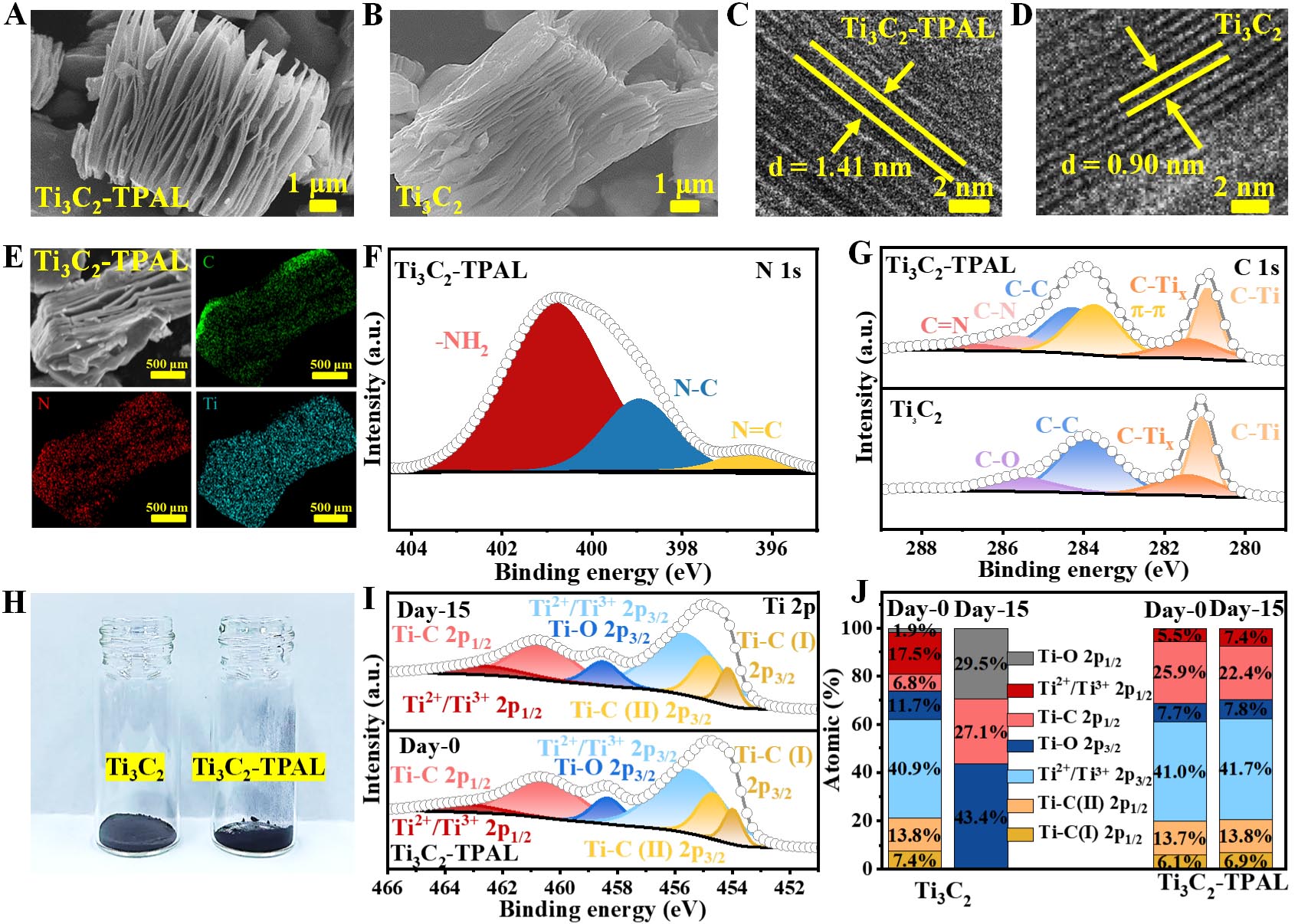
Figure 2. SEM images of (A) Ti3C2-TPAL and (B) Ti3C2. HRTEM images of (C) Ti3C2-TPAL and (D) Ti3C2. (E) SEM image and elemental mappings of Ti3C2-TPAL. High-resolution XPS spectra of Ti3C2-TPAL in the (F) N 1s and (G) C 1s regions. (H) Digital photographs of Ti3C2 and Ti3C2-TPAL after aging under ambient conditions. (I) Fitted Ti 2p XPS spectra and (J) relative atomic percentages of Ti species derived from Ti 2p fitting for Ti3C2 and Ti3C2-TPAL before and after aging.
The surface composition, valence states, and bonding environment of the composite were further analyzed by XPS. After TPAL grafting, no pronounced shift was observed in the main Ti 2p or O 1s peaks, suggesting that the Ti-C framework and oxygen-containing surface terminations of Ti3C2 were largely preserved. The main XPS changes are reflected in the N 1s and C 1s regions, where the C=N and C-N components confirm the formation of imine-related bonding structures between TPAL and aminated Ti3C2. As shown in
The resistance of Ti3C2-TPAL against ambient oxidation was preliminarily evaluated by comparing the color, morphology, and Ti 2p XPS spectra of Ti3C2 and Ti3C2-TPAL after exposure to the same air-aging conditions. Air aging experiments indicate that Ti3C2-TPAL maintains its original black color and intact 3D layered microscopic skeleton after 15 days of environmental exposure [Figure 2H, Supplementary Figure 6]; in contrast, pristine Ti3C2 not only faded to grayish-black but also saw its layered structure collapse due to oxidation, making the accordion structure unrecognizable. The relative content of the Ti-O 2p3/2 peak in the high-resolution Ti 2p spectrum serves as a key indicator for evaluating the oxidation degree of the Ti3C2 surface. Analysis shows that the Ti-O 2p3/2 content of aged Ti3C2-TPAL only slightly increased from 7.7 at% to 7.8 at% [Figure 2I and J]. Conversely, this component in pristine Ti3C2 surged from 11.7 at% to 43.4 at%, confirming deep oxidative destruction of its crystal structure. This comparison indicates that TPAL grafting can mitigate the oxidation of Ti3C2 under the present ambient exposure conditions, which may help preserve surface-active sites during short-term storage. The porous characteristics of Ti3C2 and Ti3C2-TPAL were further evaluated by N2 adsorption-desorption measurements [Supplementary Figure 7]. The BET surface area increases from 7.9354 m2 g-1 for pristine Ti3C2 to 37.3411 m2 g-1 for Ti3C2-TPAL, indicating that TPAL grafting improves the accessible surface area of the layered MXene structure. The corresponding pore-size distribution further shows a more pronounced pore-volume contribution in Ti3C2-TPAL, suggesting improved electrolyte-accessible channels after molecular grafting. These features can enhance electrolyte access and accelerate Na+ transport across the expanded MXene interlayers.
The Na-storage properties of Ti3C2-TPAL were examined in SIB half-cells over 0.01-2.5 V. The first three CV curves collected at 0.1 mV s-1 are shown in Figure 3A. In the first CV curve, the reduction current below
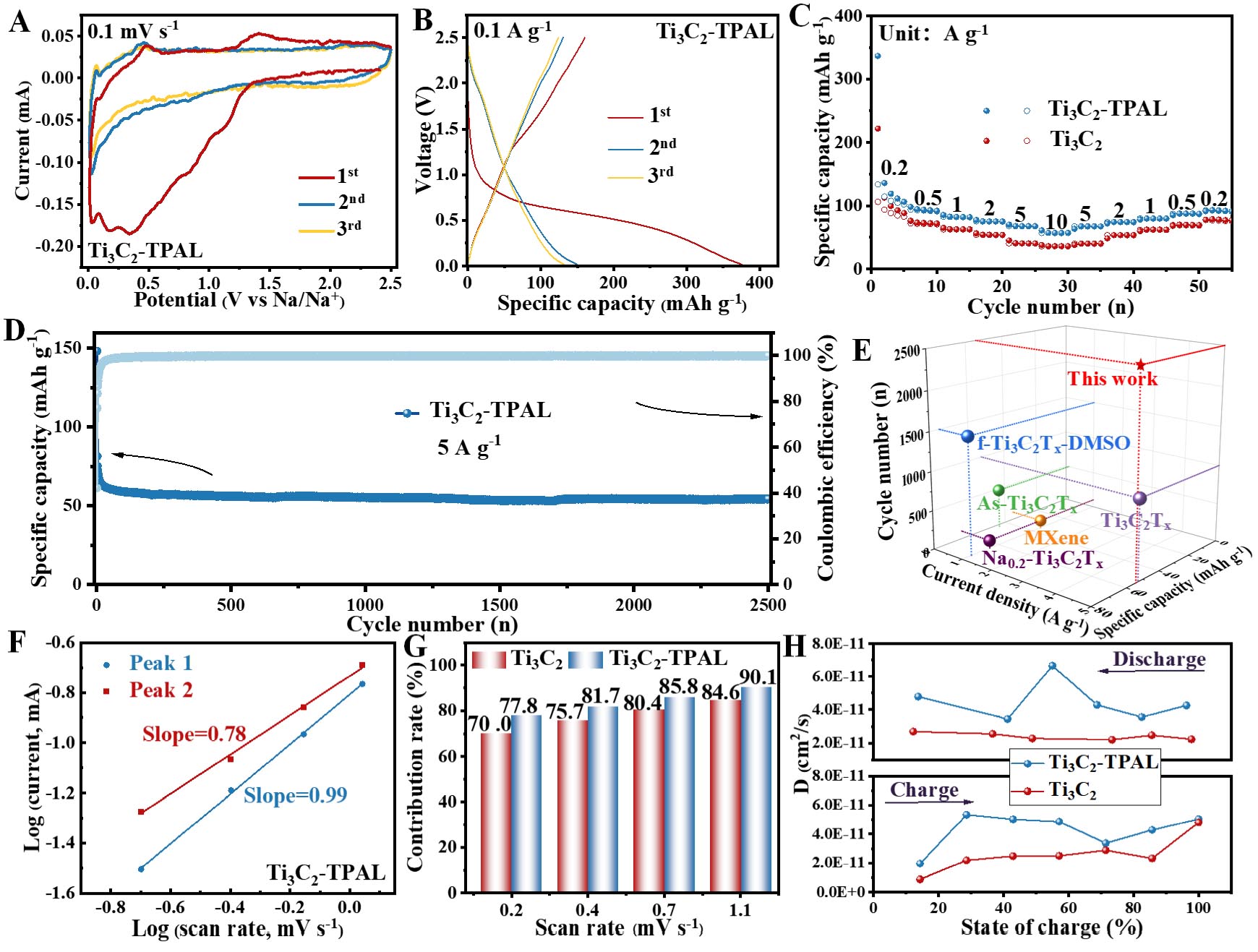
Figure 3. (A) CV curves recorded at a scan rate of 0.1 mV s-1, (B) galvanostatic charge-discharge plots tested at 0.1 A g-1, (C) rate capability under different current densities, and (D) long-cycle durability at 5 A g-1 of Ti3C2-TPAL. (E) Performance comparison with previously reported MXene-based anodes. (F) Relationship between peak current and scan rate of Ti3C2-TPAL. (G) Capacitive contribution fractions and (H) Na+ diffusion coefficients of Ti3C2-TPAL and Ti3C2.
Rate performance tests show that Ti3C2-TPAL delivers excellent high-rate capacities of 101.9, 91.1, 81.7, 74.9, 67.6, and 57.0 mAh g-1 at 0.2, 0.5, 1, 2, 5, and 10 A g-1 [Figure 3C], respectively, far exceeding those of the Ti3C2 anode. After the current density returns to 0.2 A g-1, the capacity recovers to 90.8 mAh g-1, indicating excellent rate and reversibility for Ti3C2-TPAL. Even after 2,500 cycles under a rate of 5 A g-1, a capacity of 54.3 mAh g-1 is preserved [Figure 3D], demonstrating the excellent long-cycling performance. For comparison, the long-term cycling performances of pristine Ti3C2 and Ti3C2-NH2 were further tested under the same current density and are provided in Supplementary Figure 9. Both control samples show lower capacities than Ti3C2-TPAL after long-term cycling, indicating that TPAL grafting provides additional structural stabilization beyond pristine Ti3C2 and the aminated intermediate. The rate capability and long-term cycling stability of Ti3C2-TPAL compare favorably with those of recently reported MXene-based anodes. [Figure 3E, Supplementary Table 1].
Electrochemical kinetic analysis further elucidates the impact of the imine-bond-based covalent anchoring between TPAL and Ti3C2 on optimizing battery performance. The CV curves exhibit similar shapes at scan rates from 0.2 to 1.1 mV s-1 [Supplementary Figure 10]. Despite minor peak shifts, the consistent shapes confirm a stable electrochemical mechanism. Compared to Ti3C2, the CV curves of Ti3C2-TPAL exhibit reduced polarization effects and enhanced reversibility. Furthermore, based on the relationship between the response current (i) and the scan rate (v)[38]:
The b value is commonly used to distinguish diffusion-limited and surface-capacitive behaviors, with values approaching 1.0 indicating a stronger capacitive response. As shown in Figure 3F, Ti3C2-TPAL exhibits b values of 0.99 and 0.78 for peak 1 and peak 2, respectively, which exceed those of pristine Ti3C2 (0.78 and 0.76). This comparison reveals that Na+ storage in Ti3C2-TPAL is mainly governed by surface-controlled pseudocapacitive processes. The pseudocapacitive-dominated Ti3C2-TPAL electrode enables fast Na+ uptake and release, thereby supporting its favorable high-rate response. The capacity fractions from capacitive and diffusion-limited processes were further quantified using[38]:
Here, k1v and k2v1/2 correspond to the surface-capacitive and diffusion-limited components, respectively. As presented in Figure 3G, the surface-capacitive fraction of Ti3C2-TPAL is 77.8% at 0.2 mV s-1 and rises to 90.1% as the scan rate reaches 1.1 mV s-1. This value is higher than that of pristine Ti3C2 under the same scan rate (84.6%), indicating faster surface-dominated Na+ storage kinetics after TPAL grafting. These kinetic results indicate that the Na-storage behavior of Ti3C2-TPAL is mainly governed by surface-controlled pseudocapacitive processes rather than typical bulk intercalation. Therefore, the capacity contribution is attributed primarily to fast Na+ adsorption/desorption at accessible surfaces and interfaces, assisted by limited Na+ insertion within the expanded Ti3C2 galleries. GITT tests show that Ti3C2-TPAL possesses higher diffusion coefficients during both charge and discharge processes [Figure 3H, Supplementary Figure 11]. Electrochemical kinetic test results indicate that grafting TPAL molecules increases reactive active sites and significantly boosts reaction kinetics. Functioning as rigid pillars, TPAL expands the Ti3C2 interlayer spacing to facilitate ion transport and minimize diffusion resistance. This synergistic effect effectively promotes the rapid and stable storage of Na+ ions.
In situ XRD and SEM were further utilized to verify the structural stability of Ti3C2-TPAL. Interestingly, the (002) characteristic peak of Ti3C2-TPAL remains stable at 6.9° during the charge-discharge process
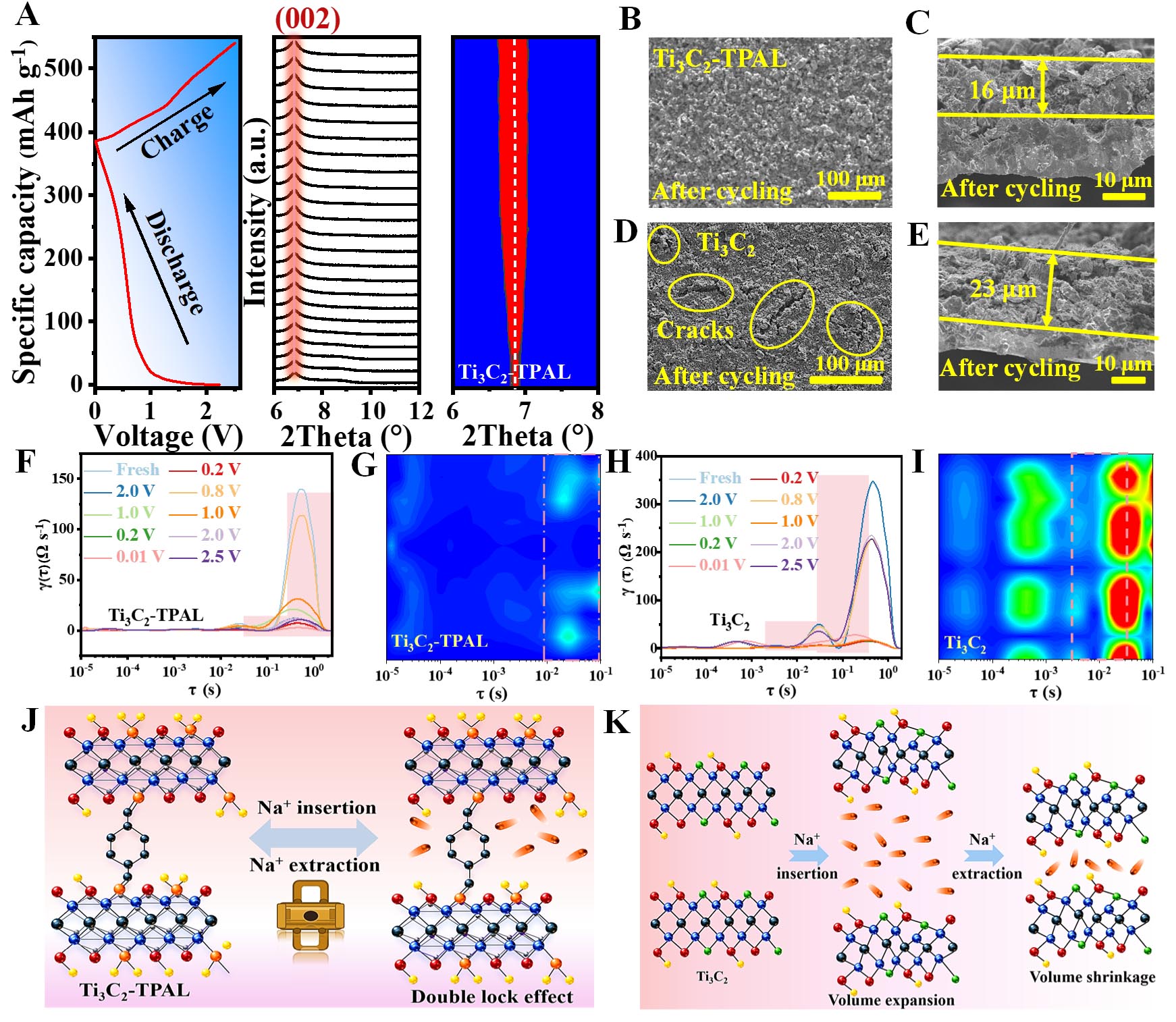
Figure 4. (A) Time-resolved in situ XRD results obtained when Ti3C2-TPAL undergoes sodiation and desodiation. SEM images of cycled (B and C) Ti3C2-TPAL and (D and E) Ti3C2 electrodes. DRT analysis of (F and G) Ti3C2-TPAL and (H and I) Ti3C2 during charge and discharge. Schematic illustrations of Na+ storage mechanisms in (J) Ti3C2-TPAL and (K) Ti3C2.
After prolonged cycling, Ti3C2-TPAL preserves a smooth and compact electrode surface comparable to the pristine state [Figure 4B, Supplementary Figure 13]. The electrode thickness changes moderately from 12 to 16 μm [Figure 4C], corresponding to a thickness increase of 33.3%. The moderate thickness increase of Ti3C2-TPAL after cycling may be mainly associated with SEI formation. By comparison, the cycled pristine Ti3C2 electrode shows pronounced surface cracking [Figure 4D], with its thickness increasing from 14 to 23 μm [Figure 4E], corresponding to a thickness expansion of 64.3%. The continuous expansion and contraction of Ti3C2 interlayer spacing are considered the main cause of Ti3C2 agglomeration or electrode cracks, which subsequently lead to cycling performance degradation.
DRT analysis allowed for resolving the EIS spectra into distinguishable relaxation processes
The charge-transfer time constant of Ti3C2-TPAL remains nearly unchanged at 0.020-0.025 s during charge and discharge [Figure 4F and G], which is lower than the 0.029-0.032 s of pristine Ti3C2 [Figure 4H and I]. This result confirms that the introduction of TPAL molecules lowers the charge transfer barrier, as schematically illustrated in Figure 4J and K. Furthermore, the DRT intensity plot can further reveal the stability of the electrode over long-term cycling. Compared to Ti3C2, the DRT intensity of Ti3C2-TPAL varies less during cycling [Supplementary Figure 15], highlighting the electrochemical stability of Ti3C2-TPAL. This not only corroborates the anchoring effect of TPAL on Ti3C2 sheets but also effectively inhibits structural accumulation and collapse. The stability of TPAL molecules during long-term cycling was also considered. Although partial cleavage of imine-related bonds cannot be completely excluded during repeated sodiation/desodiation, the stable long-term cycling behavior, nearly unchanged (002) peak position during in situ XRD measurements, reduced electrode deformation after cycling, and relatively stable DRT response suggest that the TPAL-assisted interlayer structure is largely maintained during cycling. Possible local bond cleavage or interfacial side reactions may still occur and should be further clarified by post-cycling spectroscopic analysis in future work. The Ti3C2-TPAL electrode demonstrates a unique “double-lock” effect: Based on the above structural and electrochemical evidence, the double-lock effect of TPAL can be assigned to covalent anchoring and interlayer pillaring. The covalent imine linkages restrict the restacking and slippage of Ti3C2 sheets, while the rigid aromatic TPAL pillars stabilize the enlarged interlayer spacing. This assignment is supported by the chemical-bonding evidence from FTIR/XPS, the enlarged interlayer spacing from XRD and HRTEM, the nearly unchanged (002) peak position during in situ XRD measurements, and the reduced electrode deformation after cycling. Therefore, the double-lock architecture contributes to the improved structural integrity and high-rate sodium-storage kinetics of Ti3C2-TPAL.
To provide trend-level theoretical insight into the possible influence of TPAL grafting on Na adsorption and migration, simplified DFT calculations were performed. It should be noted that the DFT models used here are simplified representations of Ti3C2 and Ti3C2-TPAL. Real Ti3C2Tx MXenes contain mixed surface terminations, such as -O, -OH, and -F, which may affect Na adsorption, diffusion barriers, electronic structure, and interlayer spacing. Therefore, the DFT results are used as auxiliary evidence rather than a complete description of the real Ti3C2Tx surface chemistry. Theoretical calculations indicate significant negative charge regions on the TPAL molecule surface [Figure 5A]. This feature enhances the electrostatic adsorption of Na+ ions, thereby suggesting potential active sites for Na+ storage within the Ti3C2-TPAL composite. Zeta potential test results further validate this theoretical prediction. The charge-density-difference maps are illustrated in Figure 5B and C. In these maps, electron-rich regions are shown in yellow, while electron-deficient regions are displayed in blue. Compared with the nearly uniform charge distribution on pristine Ti3C2, Ti3C2-TPAL exhibits more evident interfacial charge redistribution, suggesting modified local electronic interactions after TPAL grafting. The charge-density-difference maps suggest that TPAL grafting induces local interfacial charge redistribution rather than a uniform charge distribution. This interfacial polarization may contribute to improved Na+ affinity and charge-transfer behavior.
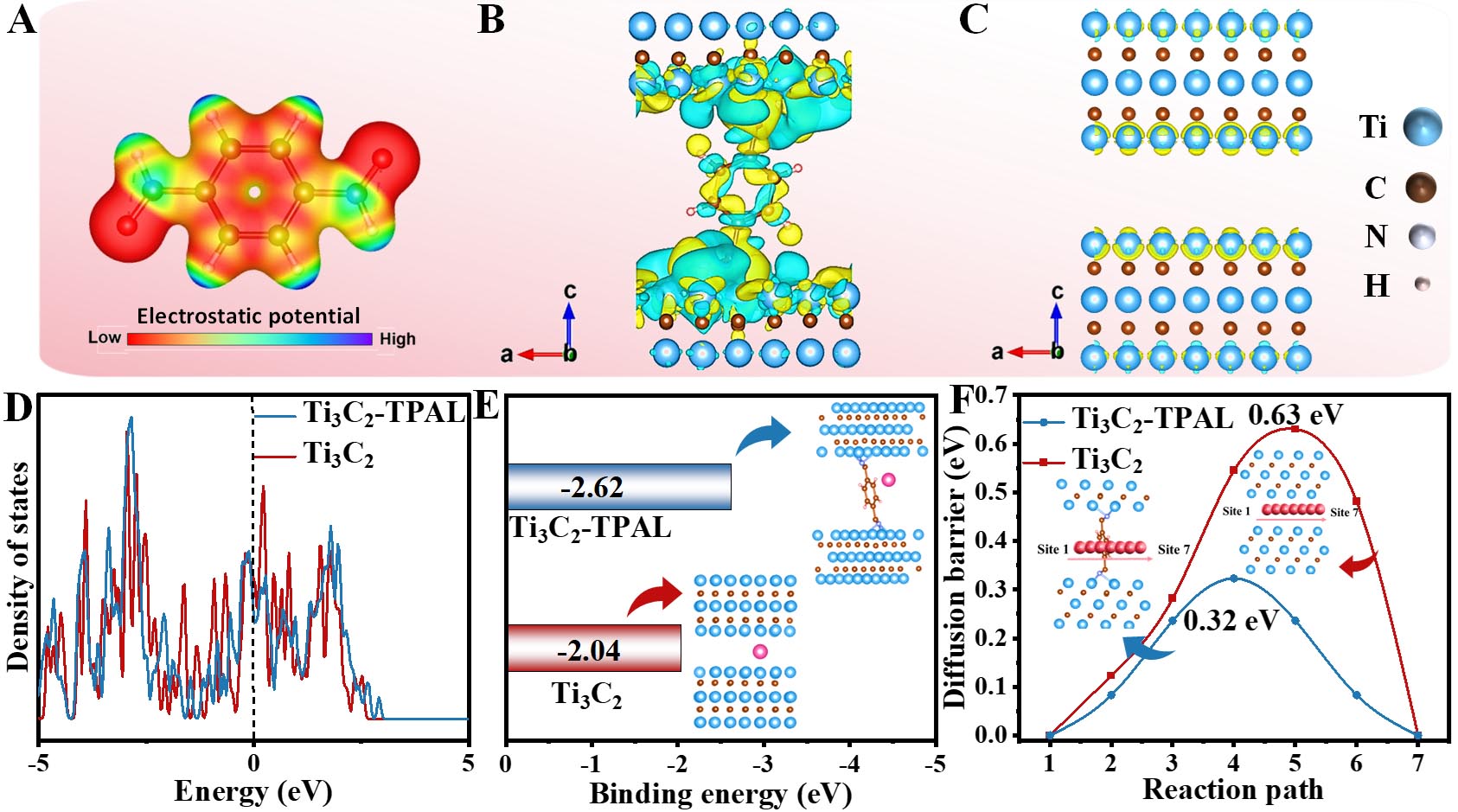
Figure 5. (A) The electrostatic potential layout calculated for TPAL molecule. Charge-density-difference maps of (B) Ti3C2-TPAL and (C) Ti3C2. (D) DOS profiles, (E) Na adsorption energies, and (F) migration energy barriers of Ti3C2-TPAL and Ti3C2.
In addition, density of states analysis indicates [Supplementary Figure 16] that Ti3C2-TPAL presents a continuous density of states at the Fermi level [Figure 5D]. The absence of a significant band gap indicates excellent electronic conductivity, ensuring superior electron transport efficiency and providing a guarantee for the optimization of Na+ ions storage kinetics. Adsorption energy calculation results [Figure 5E, Supplementary Figure 17] indicate that the Na+ ions adsorption energy of Ti3C2-TPAL is -2.62 eV, which is significantly lower than the -2.04 eV of Ti3C2. Lower adsorption energy implies a stronger and more stable adsorption effect of the material surface on Na+ ions, which can supply sufficient ion sources for the Na+ ions storage process. Na+ ions diffusion barrier calculation [Figure 5F, Supplementary Figure 18] shows that the Na+ ions diffusion barrier of Ti3C2-TPAL is only 0.32 eV, representing a reduction of ~49% compared to that of Ti3C2 (0.63 eV). The lower diffusion barrier can effectively reduce energy loss during Na+ ions diffusion, further confirming its excellent Na+ ions diffusion kinetics. The more negative Na adsorption energy of Ti3C2-TPAL indicates enhanced Na affinity and improved interfacial Na capture compared with pristine Ti3C2. However, stronger Na adsorption is not necessarily always beneficial, because excessively strong Na binding may restrict Na+ migration or induce irreversible Na trapping. Therefore, the adsorption energy should be considered together with the Na diffusion barrier. In the present simplified model, Ti3C2-TPAL shows both stronger Na adsorption and a lower diffusion barrier than Ti3C2, suggesting that TPAL-related interfacial regulation may improve Na+ capture without severely hindering Na+ transport. The Ti3C2-TPAL composite effectively promotes the improvement of electrochemical kinetics during the Na+ ions storage process through multi-dimensional synergistic mechanisms, including constructing abundant electronegative sites, abundant built-in electric fields, excellent electronic conductivity, and strengthening Na+ ions adsorption while weakening its diffusion barrier.
To systematically evaluate the electrochemical performance of Ti3C2-TPAL in practical applications, it was matched with NFPP cathode to construct a SIBs full battery system (Ti3C2-TPAL||NFPP, Figure 6A). Based on the half-cell voltage profiles of NFPP and Ti3C2-TPAL, the Ti3C2-TPAL||NFPP full cell was operated within 0.04-3.65 V [Supplementary Figure 19]. The full-cell capacity obtained in this work, together with energy and power densities, was normalized to the active material of the NFPP cathode. Under 5 A g-1, the initial charge and subsequent discharge capacities are 105.7 and 84.6 mAh g-1, respectively, corresponding to an initial Coulombic efficiency of 80.0% [Figure 6B]. Furthermore, the full battery also presents excellent rate performance. At current densities of 0.2, 0.5, 1, 2, 5, and 10 A g-1 [Figure 6C], the discharge specific capacities are 90.8, 88.4, 84.2, 75.2, 52.3, and 24.5 mAh g-1, respectively. When the current density recovers to
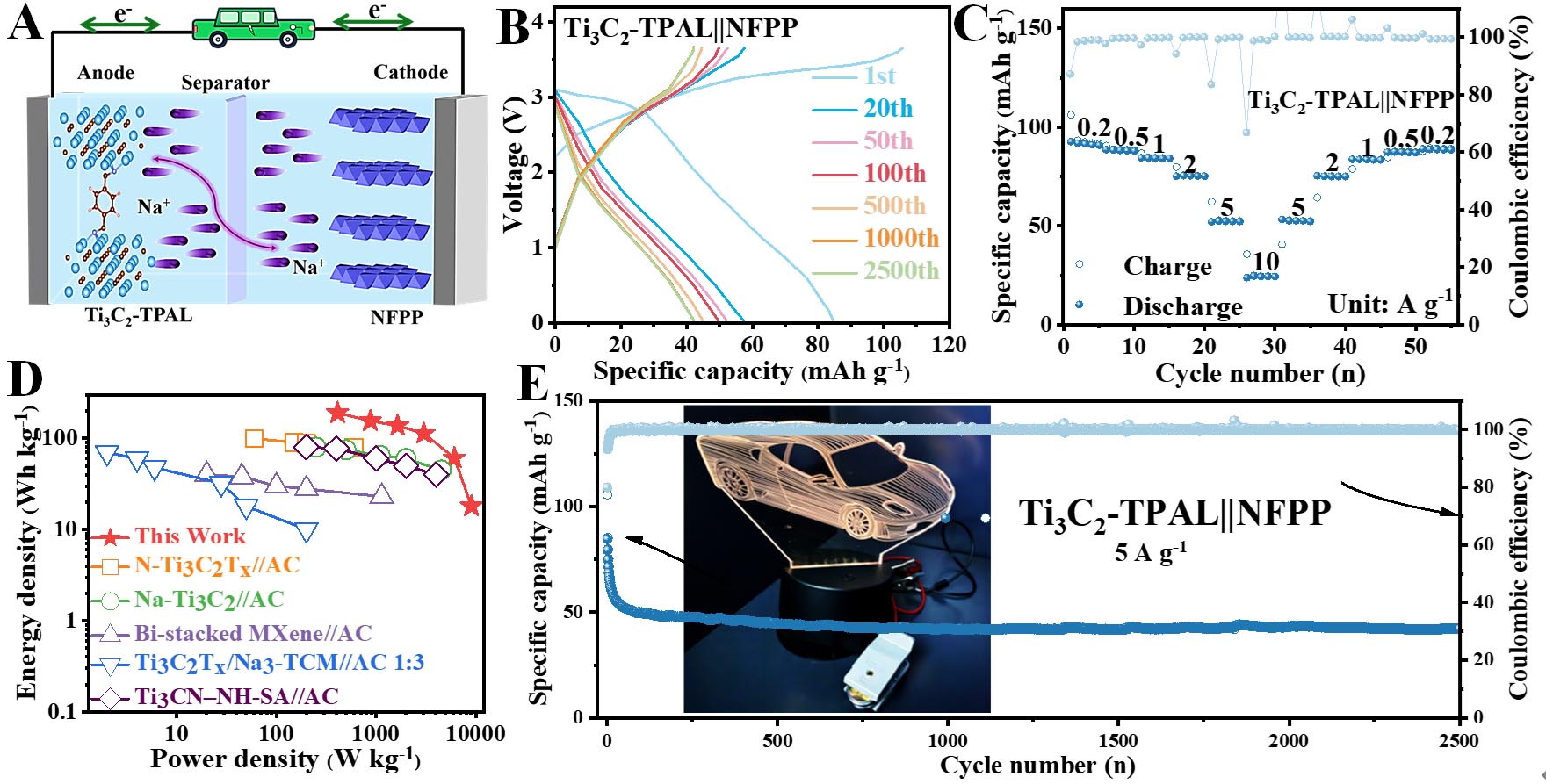
Figure 6. (A) Schematic illustration, (B) GCD profiles at 5 A g-1, and (C) rate capability of the Ti3C2-TPAL||NFPP full cell. (D) Ragone plot compared with reported full cells. (E) Long-term cycling stability of the Ti3C2-TPAL||NFPP full cell at 5 A g-1. Digital camera photograph of an LED powered by the full cell (Inset).
CONCLUSIONS
In summary, Ti3C2-TPAL was constructed through a molecular grafting strategy based on a well-defined double-lock architecture. The first lock originates from covalent imine anchoring between TPAL and aminated Ti3C2, which suppresses sheet restacking and interlayer slippage. The second lock arises from rigid aromatic TPAL pillaring, which enlarges and stabilizes the Ti3C2 interlayer spacing. These coupled structural effects contribute to the enhanced electrochemical performance of Ti3C2-TPAL, which delivers 57.0 mAh g-1 at 10 A g-1 and maintains 54.3 mAh g-1 after 2,500 cycles at 5 A g-1, showing competitive high-rate stability among reported MXene-based sodium-storage anodes. In situ XRD and DRT results indicate that TPAL grafting helps stabilize the Ti3C2 interlayers and reduce charge-transfer resistance. Simplified DFT calculations further provide trend-level support that TPAL-related interfacial regulation may enhance Na+ affinity and lower the Na migration barrier. Moreover, the assembled Ti3C2-TPAL||NFPP full battery demonstrates a cathode-mass-normalized energy density of 190.8 Wh kg-1 and a power density of
DECLARATIONS
Authors’ contributions
Paper writing and experimental, data analysis: Huang, X.; Fei, J.; Fan, L.
DFT calculation and review, core idea, data analysis, and supervision: Bi, H.; Bayaguud, A.; Zhang, Y.
Normal analyses: Zhang, L.; Sun, X.; Zhang, J.; Wei, C.
Availability of data and materials
The data supporting the findings of this study are available within this Article and its Supplementary Materials. Further data are available from the corresponding authors upon request.
AI and AI-assisted tools statement
Not applicable.
Financial support and sponsorship
This work was supported by the National Key R&D Program of China (2023YFB2405800), National Natural Science Foundation of China (22569019), Scientific Research Start-up Fund Project of Inner Mongolia University of Technology (DC2500002533 and DC2400003366), First-Class Discipline Scientific Research Special Project (YLXKZX-NGD-002), Science and Technology Planning Project of Hohhot (2023RC-LianHeTi-5), Natural Science Foundation of Inner Mongolia Autonomous Region of China (2025MS05111, 2025QN05006, 2026QC0348, and 2026QC0362), and Student Innovation and Entrepreneurship Training Program Project of Inner Mongolia University of Technology (2026380150 and 2026381577).
Conflicts of interest
Bi, H.; Bayaguud, A.; Zhang, Y. are the Guest Editors of the Special Issue "Beyond Lithium-Ion Batteries: Materials and Mechanisms for Sustainable Energy Storage" of the journal Energy Materials. They were not involved in any steps of editorial processing, notably including reviewers' selection, manuscript handling and decision making, while the other authors have declared that they have no conflicts of interest.
Ethical approval and consent to participate
Not applicable.
Consent for publication
Not applicable.
Copyright
© The Author(s) 2026.
Supplementary Materials
REFERENCES
1. Mariyappan, S.; Desai, P.; Morcrette, M.; Tarascon, J. From lab to market with sustainable sodium-ion batteries. Nat. Sustain. 2025, 9, 360-71.
2. Yang, P.; Wu, Z.; Wang, S.; et al. Synergetic coupling of redox-active sites on organic electrode material for robust and high-performance sodium-ion storage. Angew. Chem. Int. Ed. 2023, 62, e202311460.
3. Chen, Q.; Wen, Q.; Li, C.; et al. High-compaction spherical carbon with tunable rich pore structures for efficient sodium storage. Adv. Mater. 2025, 38, e15495.
4. Li, Y.; Vasileiadis, A.; Zhou, Q.; et al. Origin of fast charging in hard carbon anodes. Nat. Energy. 2024, 9, 134-42.
5. Chen, M.; Xiao, P.; Yang, K.; et al. Sn anodes protected by intermetallic FeSn2 layers for long-lifespan sodium-ion batteries with high initial coulombic efficiency of 93.8 %. Angew. Chem. Int. Ed. 2023, 62, e202219177.
6. Chen, Z.; Li, Y.; Wang, L.; et al. Durable alloy anode for Na-ion batteries with high volumetric energy density. Nat. Energy. 2026, 11, 449-59.
7. Li, Y.; Fan, X.; Wang, L.; et al. In situ-formed C-N anchors embedded into Sn-based negative electrodes for long-life Na-ion batteries. Nat. Commun. 2026, 17, 2476.
8. Li, M.; Li, C.; Lu, G.; et al. Manipulation of the anode interphase by multicomponent composite sodium for fast-charging and low-temperature sodium metal batteries. Adv. Funct. Mater. 2025, 35, 2422892.
9. Peng, Y. H.; Wang, Y. Y.; Wang, Z. Y.; Shao, G. S.; Hou, B. H. Decoupling dual regulatory roles and mechanisms of bismuth in low-carbon-content Sn anode for fast and stable sodium storage. Adv. Funct. Mater. 2025, 36, e13942.
10. Li, D.; Zhu, Y. J.; Cheng, L.; et al. A MXene modulator enabled high-loading iodine composite cathode for stable and high-energy-density Zn-I2 battery. Adv. Energy. Mater. 2024, 15, 2404426.
11. Fan, Q.; Chen, M.; Yang, Y.; et al. Unveiling the multifunctional potential of MXenes in rechargeable batteries beyond electrode active materials. Adv. Mater. 2025, 37, 2505584.
12. Rostami, S.; Park, Y. H.; Yun, I.; et al. Polymer-ligand functionalized MXene and hollow silica composite anode for improved sodium-ion batteries. Commun. Mater. 2026, 7, 89.
13. Zhong, Y.; Liang, W.; Lv, T.; et al. Facile One-step modification of biomass hard carbon: tailoring hierarchical microstructures for high-energy-density sodium-ion battery anode materials. Adv. Funct. Mater. 2026, 36, e75776.
14. Guo, J.; Ma, G.; Liu, G.; Dai, C.; Lin, Z. Ti2CTx MXene cathode host for enhanced zinc-bromine battery performance. Adv. Energy. Mater. 2024, 14, 2304516.
15. Zhang, P.; Wang, X.; Zhang, Y.; et al. Burgeoning silicon/MXene nanocomposites for lithium ion batteries: a review. Adv. Funct. Mater. 2024, 34, 2402307.
16. Xia, J.; Lv, M.; Zhang, S.; Xing, Y.; Zhou, G. Rational design of two-dimensional MXene-based materials for lithium-sulfur batteries. Mater. Sci. Eng. R. Rep. 2025, 164, 100985.
17. Lv, M.; Xia, J.; Zhang, S.; Wang, T.; Zhou, G.; Xing, Y. Multifunctional roles of MXenes in flexible lithium-sulfur batteries: mechanistic insights, computational perspectives, and future standards. EnergyChem 2026, 8, 100190.
18. Naguib, M.; Kurtoglu, M.; Presser, V.; et al. Two-dimensional nanocrystals produced by exfoliation of Ti3AlC2. Adv. Mater. 2011, 23, 4248-53.
19. Wang, X.; Wang, Y.; Ni, K.; et al. Fullerene intercalation of MXene toward super-long-cycle sodium ion storage. Adv. Funct. Mater. 2024, 34, 2400185.
20. Wu, Z.; Jiang, L.; Wang, S.; et al. Electrode design and interface engineering of MXenes promote energy storage applications. Commun. Mater. 2026, 7, 147.
21. Ali, H.; Al-Farraj, E. S.; Abu-Dief, A. M.; et al. Intercalation and delamination in MXene: unlocking structural evolution and functional applications. Coord. Chem. Rev. 2026, 557, 217716.
22. Zong, J.; Liang, Y.; Liu, F.; et al. Effect of combination model of MoTe2 and MXene layers on sodium ion storage. Adv. Mater. 2025, 37, 2503252.
23. Sai Bhargava Reddy, M.; Zaid, M.; Das, S.; Sudhakaran, S.; Aich, S.; Pol, V. G. Hierarchical MXene-derived NTP/C nanohybrids for cryogenic sodium-ion batteries. Adv. Funct. Mater. 2026, 36, e76436.
24. Li, Y.; Wang, L.; Sun, Z.; et al. Capacitance-enhanced battery: integrating high-density battery capacity with supercapacitive swiftness in an ultra-large MXene architecture. Adv. Mater. 2025, 37, e08336.
25. Li, Y.; Yuan, Z.; Li, D.; et al. Multi-interface combination of bimetallic selenide and V4C3Tx MXene for high-rate and ultrastable sodium storage devices. ACS. Nano. 2024, 18, 4733-45.
26. Kang, F.; Yan, L.; Cao, Y.; et al. Poly(p-benzoquinono)diimidazole-linked covalent organic framework as an efficient anode endues sodium-ion batteries with high performance and wide temperature adaptability. J. Am. Chem. Soc. 2025, 147, 26069-78.
27. Shen, Z.; Bo, Z.; Shi, R.; et al. Functional p-π conjugated organic layer empowers stable sodium metal batteries. Adv. Funct. Mater. 2025, 35, 2420573.
28. Moussaei, M.; Babazadeh-Mamaqani, M.; Roghani-Mamaqani, H.; Haddadi-Asl, V.; Riazi, H. Polymer grafting on MXene as a versatile nanoplatform: Synthesis and applications. Coord. Chem. Rev. 2025, 544, 216989.
29. Zhang, T.; Zhang, F.; Zhang, L.; et al. High energy density Li-ion capacitor assembled with all graphene-based electrodes. Carbon 2015, 92, 106-18.
30. Li, Z.; Wang, Y.; Zhao, F.; et al. Moss-like two-dimensional MBene-Ni/Co bimetallic metal-organic framework composite as efficient cathode for alkaline zinc batteries. J. Power. Sources. 2025, 633, 236437.
31. Li, C.; Tang, Y.; Wang, X.; Cheng, Y.; Wang, M. S. Sodiophilic hosts with pseudocapacitive kinetics for robust anode-free sodium metal batteries. Angew. Chem. Int. Ed. 2026, 65, e9106635.
32. Stuart, B. H. Organic molecules. In: Infrared spectroscopy: fundamentals and applications. Wiley; 2005. pp. 71-93.
33. Titantah, J. T.; Lamoen, D. First-principles characterization of amorphous carbon nitride systems: structural and electronic properties. Phys. Status. Solidi. 2006, 203, 3191-7.
34. Ashiq, A.; Walpita, J.; Vithanage, M. Functionalizing non-smectic clay via methoxy-modification for enhanced removal and recovery of oxytetracycline from aqueous media. Chemosphere 2021, 276, 130079.
35. Pazdera, J.; Issayeva, D.; Titus, J.; Gläser, R.; Deutschmann, O.; Jentys, A. Impact of the local environment of amines on the activity for CO2 hydrogenation over bifunctional basic - metallic catalysts. ChemCatChem 2022, 14, e202200620.
36. Beshkov, G.; Dimitrov, D.; Georgiev, S.; et al. XPS spectra of thin CNx films prepared by chemical vapor deposition. Diamond. Relat. Mater. 1999, 8, 591-4.
37. Okpalugo, T.; Papakonstantinou, P.; Murphy, H.; Mclaughlin, J.; Brown, N. High resolution XPS characterization of chemical functionalised MWCNTs and SWCNTs. Carbon 2005, 43, 153-61.
38. Ma, Y.; Liu, K.; Wang, K.; et al. Overcoming redox barriers in black phosphorus negative electrodes through lattice P-N engineering for fast-charging Li-ion batteries. Nat. Commun. 2026, 17, 5479.
39. Lee, M.; Park, J. H.; Park, Y. J.; et al. Borate-like terminations strengthen Mxene-silicon coupling for ultrafast and durable lithium storage. Adv. Funct. Mater. 2026, 36, e75140.
Cite This Article
 Open Access
How to Cite
Download Citation
Export Citation File:
Type of Import
Tips on Downloading Citation
Citation Manager File Format
Type of Import
Direct Import: When the Direct Import option is selected (the default state), a dialogue box will give you the option to Save or Open the downloaded citation data. Choosing Open will either launch your citation manager or give you a choice of applications with which to use the metadata. The Save option saves the file locally for later use.
Indirect Import: When the Indirect Import option is selected, the metadata is displayed and may be copied and pasted as needed.
About This Article
Special Topic
Copyright

Data & Comments
Data
0











Comments
Comments must be written in English. Spam, offensive content, impersonation, and private information will not be permitted. If any comment is reported and identified as inappropriate content by OAE staff, the comment will be removed without notice. If you have any queries or need any help, please contact us at [email protected].