

NH4BF4-assisted conversion of alkaline surface species enables air-stable Li5FeO4 cathode prelithiation additives
 0
Graphical Abstract
Abstract
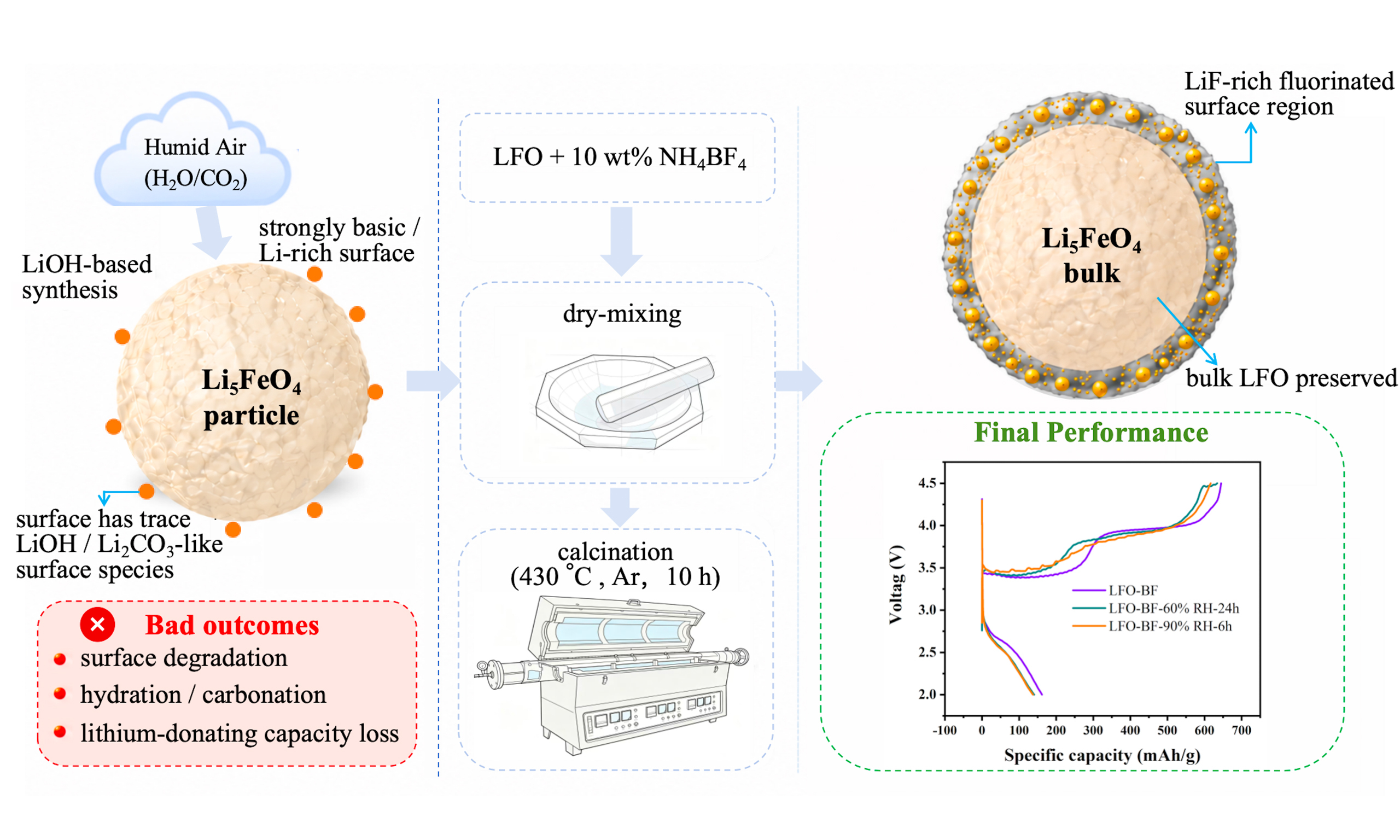
Li5FeO4 is a promising cathode prelithiation additive for compensating initial lithium loss in high-energy lithium-ion batteries, but its alkaline and air-reactive surface causes rapid degradation under humid air. Herein, we report a simple NH4BF4-assisted surface fluorination treatment that converts reactive Li-containing surface species into a LiF-rich fluorinated region while preserving the antifluorite Li5FeO4 bulk structure. This surface chemical conversion reduces LiOH-like surface species and suppresses the subsequent formation of hydrated hydroxide, carbonate, and LiFeO2-related degradation products during humid-air storage. As a result, the NH4BF4-treated Li5FeO4 (denoted as LFO-BF) maintains a high lithium-donating capacity after exposure to humid air, even under harsh humidity conditions, while pristine Li5FeO4 suffers severe capacity decay. Structural and gas-evolution analyses further show that LFO-BF retains the typical bulk delithiation pathway of active Li5FeO4 and substantially suppresses CO2 evolution and associated interfacial side reactions. When used in lithium nickel manganese cobalt oxide (NMC)//graphite full cells, LFO-BF provides effective lithium compensation and improves capacity retention. This work presents alkaline-surface conversion into a LiF-rich region as a non-carbon approach for developing humid-air-tolerant Li-rich antifluorite prelithiation additives.
Keywords


 Download PDF
INTRODUCTION
The loss of cyclable lithium during the first few cycles remains a major limitation for high-energy lithium-ion batteries. This problem is especially pronounced in cells using Si-containing graphite anodes, where solid electrolyte interphase formation and repair consume a large amount of active Li+. The resulting lithium inventory loss lowers the initial Coulombic efficiency and reduces the practical energy density of full cells[1-6]. Cathode prelithiation is a practical way to compensate for this loss[2,4,6-11]. In this approach, a lithium-rich sacrificial additive is incorporated into the positive electrode and releases extra Li+ during the first charge, while remaining broadly compatible with conventional electrode fabrication[12].
Li5FeO4 has attracted considerable attention as a cathode prelithiation additive. Its Li-rich antifluorite structure provides a large lithium reservoir, and multiple Li+ ions can be extracted during the initial charge. The material also contains low-cost elements and shows a delithiation voltage window that overlaps with many commercial cathode materials[4,5,13-15]. These features make Li5FeO4 a promising lithium donor for compensating the irreversible lithium loss of high-capacity anodes. A major limitation of Li5FeO4 is its poor air stability. This instability originates from the high chemical activity of the Li-rich antifluorite framework and the alkaline Li-containing species present at or near the particle surface. Upon exposure to humid air, Li5FeO4 readily reacts with H2O, CO2, and O2, producing LiOH, Li2CO3, Li2O, LiFeO2, and related degradation products[16,17]. These surface and structural degradation products are electrochemically inactive or kinetically unfavorable for Li+ extraction. They increase interfacial resistance and reduce the accessible lithium-donating capacity[16]. In electrode processing, alkaline residues may also increase slurry alkalinity and promote side reactions with the binder/solvent system, leading to gas evolution, binder degradation, or slurry gelation[16-18].
Considerable efforts have therefore been made to stabilize Li5FeO4. Carbon coating is the most widely used strategy. Conductive or dense carbon layers, including g-C3N4-derived layers, N/S-codoped carbon, and pitch-derived carbon coatings, can physically isolate Li5FeO4 from ambient air and, in some cases, improve electronic transport[19-21]. Lattice or defect regulation, such as Zr doping, Na incorporation, Co substitution, and related compositional designs, has also been used to improve Li+ migration, oxygen-redox activity, and charge capacity[18,22,23]. Fluorinated Li5FeO4 systems have further been reported, generally involving F-containing carbon layers or gradient fluorination, to suppress side reactions and improve delithiation kinetics[17]. These approaches have advanced the performance of Li5FeO4, but they mainly rely on external barrier construction, conductive encapsulation, or deliberate bulk lattice modification.
Despite these advances, most reported strategies focus on constructing protective barriers or regulating the bulk lattice. The intrinsic surface chemistry of Li5FeO4 has received less attention. In LiOH-based solid-state synthesis, an excess lithium precursor is usually used to compensate for lithium loss during calcination and to promote the formation of the antifluorite phase[16-18]. As a result, alkaline Li-containing species may remain on or near the particle surface after synthesis. These species can readily interact with moisture and CO2, accelerating hydration, carbonation, and subsequent surface reconstruction. Therefore, improving the air stability of Li5FeO4 should not rely only on physical isolation from air. A more direct strategy is to reduce the chemical reactivity of the surface itself by converting unstable alkaline Li species into a more stable lithium-containing phase. Such a surface conversion process could suppress the initial adsorption and reaction of humid air while preserving the lithium-donating bulk of Li5FeO4.
NH4BF4 provides a suitable precursor for this surface conversion. During heat treatment, NH4BF4 can decompose to generate volatile fluorine-containing species, including HF and BF3[24]. These species can react with alkaline Li-containing surface residues on Li5FeO4 and convert some of them into more stable fluorinated species. In this way, the highly reactive Li-rich surface can be chemically reconstructed into a less degradation-prone fluorinated surface region. Unlike continuous carbon encapsulation or intentional bulk fluorination, this strategy directly modifies the alkaline surface chemistry of Li5FeO4 and reduces its reactivity toward humid air.
Herein, we report a simple dry-mixing and calcination treatment of Li5FeO4 with NH4BF4. The NH4BF4-treated Li5FeO4 (denoted as LFO-BF) develops a LiF-rich fluorinated surface region, while the antifluorite Li5FeO4 bulk structure is largely preserved. This surface conversion suppresses humid-air-induced hydration and carbonation and maintains the lithium-donating function of Li5FeO4. After exposure to air at 60% relative humidity (RH) for 24 h, LFO-BF still delivers 634.3 mAh g-1, corresponding to 98.4% of its fresh charge capacity. Even after exposure to air at 90% RH for 6 h, it retains 616.7 mAh g-1, corresponding to 95.6% of the fresh LFO-BF capacity. Gas-evolution analysis further exhibits substantially lower CO2 evolution, consistent with suppressed carbonate accumulation and reduced CO2-generating interfacial side reactions. This work presents alkaline-surface conversion into a LiF-rich region as a non-carbon route for developing humid-air-tolerant Li-rich antifluorite prelithiation additives.
EXPERIMENTAL
Materials
Lithium hydroxide monohydrate (LiOH·H2O, 99.95%, Macklin), iron(III) oxide (Fe2O3, 99.5%, Macklin), and ammonium tetrafluoroborate (NH4BF4, 99.995%, Macklin) were used as received. Super P and polytetrafluoroethylene (PTFE) were purchased from Kejing. The electrolyte, 1 M lithium hexafluorophosphate (LiPF6) in ethylene carbonate (EC)/dimethyl carbonate (DMC) (1:1, v/v) was purchased from DoDo Chem and used as received. All moisture-sensitive samples were stored and handled in an Ar-filled glovebox when necessary.
Synthesis of Li5FeO4
Li5FeO4 (LFO) was synthesized by a high-temperature solid-state reaction[7]. LiOH·H2O and Fe2O3 were mixed at a molar ratio of 12:1 and ground thoroughly for 10 min. The obtained precursor was transferred into a tube furnace and calcined at 430 °C for 10 h under flowing Ar. The Ar flow rate was maintained at
Synthesis of NH4BF4-treated Li5FeO4
NH4BF4-treated Li5FeO4, denoted as LFO-BF, was prepared by dry mixing and calcination. Typically, LFO and NH4BF4 were directly mixed, with the mass of NH4BF4 corresponding to 10 wt% of the LFO mass. The mixture was ground thoroughly for 5 min and then transferred into a tube furnace. The powder was calcined at 430 °C for 10 h under flowing Ar, with an Ar flow rate of 500 mL min-1. After natural cooling under Ar, the obtained LFO-BF powder was transferred into an Ar-filled glovebox and ground before characterization and electrochemical testing.
Humid-air exposure tests
Humid-air exposure was carried out in a homemade controlled-temperature and humidity chamber. For each experiment, approximately 20 mg of powder was placed in a 10 mL glass vial and loosely distributed at the bottom without compaction. Identical sample mass, vial type, and loading procedure were used for all comparative measurements. Unless otherwise noted, the samples were exposed to air at 25 °C and 60% RH for 24 h. The exposed pristine LFO and LFO-BF samples are denoted as LFO-24h and LFO-BF-24h, respectively. For harsh-condition testing, LFO-BF was exposed to air at 25 °C and 90% RH for 6 h. For prolonged-exposure tests, LFO-BF was exposed at 25 °C and 60% RH for 72 h and 7 days using the same sample-loading configuration. After exposure, the samples were immediately transferred into an Ar-filled glovebox for electrode preparation or sealed for further characterization.
Materials characterization
The crystal structures of the samples were examined by X-ray diffraction (XRD, SmartLab 9, Rigaku Corporation, Japan) using Cu Kα radiation. The morphology and microstructure were characterized by scanning electron microscopy (SEM, SIGMA 500, ZEISS, Germany) and transmission electron microscopy/high-resolution transmission electron microscopy (TEM/HRTEM, JEM-F200, JEOL Ltd., Japan). X-ray photoelectron spectroscopy (XPS, K-Alpha, Thermo Fisher Scientific, USA) was used to analyze the surface chemical states of the samples. The binding energies were calibrated using the C 1s peak at 284.8 eV. For depth-profile measurements, powder samples were pressed into pellets and subjected to Ar+ ion sputtering at an ion energy of 2,000 eV with a medium ion-beam current. The nominal sputtering rate was approximately 0.3 nm s-1. Spectra were collected before sputtering and after successive sputtering intervals of 66 s, corresponding to estimated depths of approximately 0, 20, 40, and 60 nm. Fourier-transform infrared spectroscopy (FTIR, Nicolet iS50, Thermo Fisher Scientific, USA) was performed in transmission mode using KBr pellets. The sample powder and spectroscopic-grade KBr were mixed at a mass ratio of 1:200 and thoroughly ground before pelletization. All samples were prepared using the same sample/KBr ratio and identical grinding, pellet-preparation, and spectral-acquisition procedures to ensure consistent comparison of the hydroxyl- and carbonate-related absorption bands.
Surface alkalinity measurement
The extractable surface alkalinity of LFO and LFO-BF was compared by measuring the pH of their aqueous extracts. For each measurement, 20 mg of powder was added to 5.0 mL of deionized water and gently mixed for 1 min. The pH was then measured immediately using a calibrated pH meter (PH-10, LICHEN, China). A short and fixed extraction time was used to minimize further reaction of the samples with water during measurement. Three independent measurements were performed for each sample using freshly prepared powder dispersions, and the results are reported as mean ± standard deviation.
Electrode preparation and half-cell assembly
Fresh and humid-air-exposed LFO and LFO-BF samples were dried at 80 °C under vacuum prior to preparing working electrodes. The active material, Super P, and PTFE were mixed at a mass ratio of 8:1:1 and pressed into pellets in an Ar-filled glovebox. The mass loading of active material was approximately
CR2032 coin-type half cells were assembled in an Ar-filled glovebox using the prepared electrode as the working electrode, lithium metal as the counter/reference electrode, glass fiber as the separator, and
Ex situ XRD measurements
For ex situ XRD analysis, LFO-BF electrodes were charged to selected voltages of 3.9 V and 4.2 V in Li half cells. The cells were disassembled in an Ar-filled glovebox, and the electrodes were carefully retrieved and rinsed with DMC to remove residual electrolyte. After drying, the electrodes were loaded into a capillary to avoid air exposure prior to XRD measurement.
Differential electrochemical mass spectrometry
Gas evolution was monitored using a differential electrochemical mass spectrometer (DEMS, Prima BT, Thermo Fisher Scientific, UK), with the carrier-gas flow controlled by an EL-FLOW Base mass-flow controller (Bronkhorst High-Tech B.V., the Netherlands). The electrodes were assembled into customized DEMS cells using lithium metal as the counter/reference electrode and 1 M LiPF6 in EC/DMC (1:1, v/v) as the electrolyte. High-purity Ar was used as the carrier gas at a flow rate of 0.5 mL min-1. The DEMS cell, cold trap, and relevant gas-line connections were maintained inside an Ar-filled glovebox to minimize interference from ambient gases. After cell assembly, Ar was continuously passed through the cell until stable background signals were obtained. Mass-spectrometric data acquisition was then initiated and synchronized with the electrochemical measurement. The cells were charged from open-circuit voltage (OCV) to 4.5 V and subsequently discharged to 2.0 V at 50 mA g-1. O2 and CO2 were monitored at m/z = 32 and 44, respectively. After completion of discharge, the gas signals were continuously monitored for approximately 30 min to confirm that they remained stable at the background level. The mass-spectrometric signals were calibrated following established DEMS calibration procedures[25], and the gas-evolution rates were normalized to the mass of active material. The integrated gas amounts were obtained by integrating the calibrated evolution-rate profiles over the complete first-charge period.
Full-cell assembly and electrochemical testing
Lithium nickel manganese cobalt oxide (NMC)//graphite full cells were assembled to evaluate the lithium-compensation effect of LFO-BF. For the control cathode, NMC811, Super P, and PTFE were mixed at a mass ratio of 8:1:1. For the prelithiated cathode, LFO-BF was added at 4 wt% relative to the mass of NMC active material. Graphite electrodes were used as the anodes. The negative-to-positive (N/P) electrode capacity ratio was controlled at approximately 1.05. The electrolyte was 1 M LiPF6 in EC/DMC (1:1, v/v), and glass fiber was used as the separator. The cells were assembled in an Ar-filled glovebox and tested on a Neware battery testing system within a voltage range of 2.0-4.5 V. The initial charge/discharge profiles and cycling tests were collected at 30 mA g-1. The specific capacities of full cells were calculated based on the mass of NMC active material, excluding the mass of LFO-BF.
RESULTS AND DISCUSSION
Surface fluorination of Li5FeO4 induced by NH4BF4 treatment
LFO-BF was prepared by dry mixing Li5FeO4 with NH4BF4 followed by calcination, as illustrated in Figure 1A. The treatment condition was optimized by varying the calcination temperature and NH4BF4 content, with phase retention and retained first-charge capacity after humid-air exposure used as the main criteria [Supplementary Figures 1-4]. In the temperature series using 10 wt% NH4BF4, the treated samples largely retained the Li5FeO4 phase, and a weak LiF signal appeared after calcination. After humid-air exposure, these samples showed much weaker impurity features than LFO-24h. The XRD patterns mainly confirmed phase retention and LiF formation, whereas the electrochemical profiles were more sensitive to the treatment condition. Among the samples treated at 330, 430, and 530 °C, the 430 °C-treated sample delivered the highest retained charge capacity after exposure. The NH4BF4 content was then optimized at 430 °C. Although the 5, 10, and 15 wt% samples showed broadly similar phase features, their retained charge capacities differed after humid-air exposure. The 10 wt% sample gave the best balance between humid-air stability and lithium-donating capacity. Therefore, calcination with 10 wt% NH4BF4 at 430 °C for 10 h was selected as the optimized condition, and the corresponding sample is denoted LFO-BF.
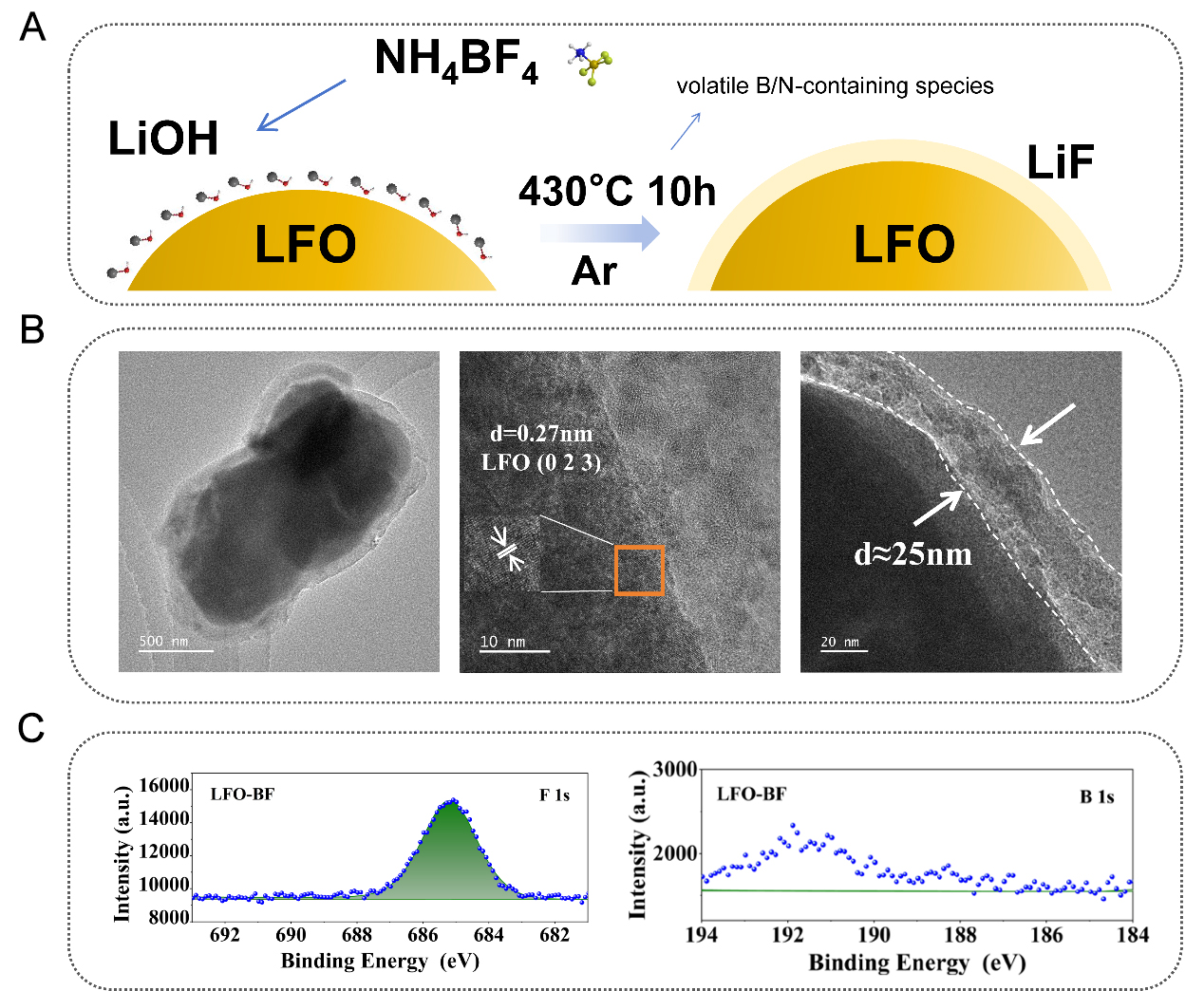
Figure 1. (A) Schematic illustration of the NH4BF4-assisted surface fluorination treatment of Li5FeO4, in which reactive alkaline Li-containing surface species are proposed to be converted into a LiF-rich surface region after calcination at 430 °C for 10 h under Ar; (B) TEM and HRTEM images of LFO-BF. The orange square marks the region used for local lattice-fringe analysis of the LFO phase, with a spacing of approximately 0.27 nm assigned to the (023) plane of LFO. The outer surface-modified region has a locally observed thickness of approximately 25 nm; (C) F 1s and B 1s XPS spectra of fresh LFO-BF. TEM: Transmission electron microscopy; HRTEM: high-resolution transmission electron microscopy; XPS: X-ray photoelectron spectroscopy; LFO-BF: NH4BF4-treated Li5FeO4.
The surface structure of LFO-BF was examined by TEM and HRTEM. The low-magnification TEM image shows that the treated particles retain their overall morphology [Figure 1B]. A surface-modified region can be distinguished near the particle edge, with a locally observed thickness of approximately 25 nm. HRTEM analysis further reveals clear lattice fringes with an interplanar spacing of approximately 0.27 nm, which can be assigned to the (023) plane of Li5FeO4. Local nanocrystalline domains are also observed within the modified surface region. These observations suggest that the NH4BF4 treatment mainly modifies the outer particle surface while leaving the crystalline LFO core largely intact.
XPS was used to identify the surface chemical species of fresh LFO-BF. The F 1s spectrum shows a dominant peak centered at approximately 685.2 eV, which can be assigned to LiF-like fluorinated lithium species [Figure 1C]. In the B 1s region, only a weak near-background signal is observed, and no distinct B-containing surface species can be resolved. This result suggests that boron-containing residues are not a major component of the outer surface after calcination. It should be noted that the 10 wt% NH4BF4 represents the nominal precursor addition rather than the amount of fluorinated species retained after calcination. NH4BF4 has been reported to decompose under inert conditions into volatile BF3, NH3, and HF species.[24] Consistently, an equimolar NH4BF4/LiOH model reaction at 430 °C yields LiF as the major crystalline fluorinated product, while the corresponding solid product shows only a weak B 1s signal close to the background [Supplementary Figure 5]. Based on these observations, LiF formation can be described by a simplified pathway involving thermal decomposition of NH4BF4 followed by reaction of the generated HF with alkaline Li species:
This simplified pathway explains the formation of LiF at the LFO surface and the limited retention of the initially added NH4BF4-derived components after calcination.
XPS depth profiling was further performed to examine the spatial distribution of the fluorinated species [Supplementary Figure 6]. The F 1s signal progressively decreases with increasing etching depth from 0 to
Suppressed humid-air degradation behavior of LFO-BF
The humid-air stability of LFO and LFO-BF was evaluated under 60% RH for 24 h unless otherwise noted. Four samples were compared: fresh LFO, exposed LFO (LFO-24h), fresh LFO-BF, and exposed LFO-BF (LFO-BF-24h). XRD was first used to examine the phase structures before and after exposure [Figure 2A]. Fresh LFO shows the characteristic reflections of antifluorite Li5FeO4. After NH4BF4 treatment, LFO-BF retains the main Li5FeO4 reflections, indicating that the antifluorite phase is largely preserved. A weak diffraction peak appears at around 38.8°, which can be indexed to the LiF (111) reflection. This weak LiF signal further supports the presence of crystalline LiF species, in agreement with the HRTEM and F 1s XPS results in Figure 1. Meanwhile, no obvious shift of the main Li5FeO4 reflections is observed, suggesting that no pronounced bulk lattice modification occurs under the optimized treatment condition. After humid-air exposure, pristine LFO undergoes pronounced phase degradation. The characteristic reflections of antifluorite Li5FeO4 are greatly weakened, accompanied by the emergence of impurity peaks assignable to LiOH·H2O, LiOH, Li2CO3 and LiFeO2-related phases[16,17]. In sharp contrast, LFO-BF-24h still retains clear Li5FeO4 reflections with no obvious impurity peaks detected. This comparison indicates that the NH4BF4-treated surface effectively mitigates the phase degradation of Li5FeO4 during humid-air storage.
Figure 2. (A) XRD patterns of LFO, LFO-BF, LFO-24h, and LFO-BF-24h. The characteristic reflections of degradation products and LiF are marked; (B) FTIR spectra of the four samples, highlighting the changes in LiOH- and Li2CO3-related bands; (C and D) SEM images of LFO before and after humid-air exposure; (E and F) SEM images of LFO-BF before and after humid-air exposure; (G) C 1s and O 1s XPS spectra of LFO, LFO-24h, LFO-BF, and LFO-BF-24h. XRD: X-ray diffraction; FTIR: Fourier-transform infrared spectroscopy; SEM: scanning electron microscopy; XPS: X-ray photoelectron spectroscopy; LFO-BF: NH4BF4-treated Li5FeO4.
FTIR provides complementary information on hydroxyl and carbonate species [Figure 2B]. Before exposure, fresh LFO exhibits a sharp O-H stretching band at around 3,676 cm-1, which is associated with LiOH-like surface species. This observation agrees with the excess-LiOH synthesis of Li5FeO4, which can leave alkaline Li-containing species at or near the particle surface. Carbonate-related absorptions at around 1,468 and
The SEM images further reveal the different surface evolution of LFO and LFO-BF during humid-air exposure. Fresh LFO shows aggregated particles with relatively blurred surfaces and poorly defined edges [Figure 2C]. This morphology is consistent with the presence of LiOH- and Li2CO3-related surface species indicated by FTIR. After exposure, LFO-24h becomes more severely degraded. The particle surface is covered by loose, flocculent deposits, and the particle boundaries become even less distinct [Figure 2D], indicating pronounced surface reaction with humid air. In contrast, LFO-BF displays a cleaner surface and more clearly defined particle edges after NH4BF4 treatment [Figure 2E]. This suggests that the treatment removes or converts part of the reactive surface species. After exposure, LFO-BF-24h still maintains the general particle morphology. Although slight surface roughening is observed, extensive flocculent deposits and severe boundary blurring are largely absent [Figure 2F]. These SEM observations agree with the XRD and FTIR results, confirming that the fluorinated surface region suppresses surface degradation during humid-air storage.
These XRD, FTIR, and SEM results consistently show that LFO-BF undergoes much weaker phase degradation, hydration/carbonation, and surface morphological deterioration during humid-air storage. XPS was then used to further probe the surface chemical evolution of LFO and LFO-BF, especially the accumulation of carbonate- and hydroxyl-related species after exposure. The C 1s spectra are shown in Figure 2G. For fresh LFO, the O-C=O component accounts for 22.9% of the fitted C 1s area. After exposure, this value increases sharply to 45.8% for LFO-24h [Figure 2G]. The large increase indicates substantial accumulation of carbonate species on the degraded LFO surface, consistent with the carbonate bands in FTIR and the Li2CO3-related peaks in XRD[16,17]. The change is much smaller for LFO-BF. Fresh LFO-BF shows an O-C=O contribution of 15.2%, and this value increases only slightly to 17.2% after exposure. The limited increase confirms that carbonate formation is strongly suppressed on the fluorinated surface. This is important for preserving the lithium-donating function, because degradation products can block delithiation and increase interfacial resistance[16]. The O 1s spectra provide further information on oxygen-containing surface species [Figure 2G][16,17]. For pristine LFO, humid-air exposure increases the carbonate- and hydroxyl-related oxygen components, consistent with the formation of Li2CO3 and LiOH-like degradation products. For LFO-BF, these changes are much less pronounced. The hydroxyl/carbonate-related components remain limited after exposure, further supporting the suppressed hydration and carbonation of the treated surface. To further evaluate the change in surface alkalinity induced by NH4BF4 treatment, the pH values of aqueous extracts prepared under identical conditions were measured. The pH decreases from 11.2 ± 0.3 for LFO to 9.7 ± 0.2 for LFO-BF, indicating a substantial reduction in extractable surface alkalinity after treatment. In addition, the F 1s and B 1s spectra of LFO-BF before and after exposure show little change [Supplementary Figure 7], indicating that the fluorinated surface region remains detectable during storage while no distinct B-containing species emerge after exposure. These spectroscopic and surface-alkalinity results consistently indicate that NH4BF4 treatment reduces reactive alkaline surface species and suppresses the subsequent accumulation of carbonate and hydroxide-related degradation products. This suppressed surface chemical evolution provides a clear basis for the improved phase stability of LFO-BF during humid-air exposure.
To determine whether the improved humid-air stability simply originates from the presence of LiF, pristine LFO was physically mixed with LiF and exposed under the same conditions. After exposure at 60% RH for
Preserved lithium-donating capacity and charge-induced structural evolution
The lithium-donating behavior of LFO and LFO-BF was evaluated in Li half cells. Fresh LFO delivers an initial charge capacity of 651.6 mAh g-1 [Figure 3A]. Fresh LFO-BF delivers a comparable initial charge capacity of 644.8 mAh g-1. The comparable first-charge capacities of LFO and LFO-BF indicate that NH4BF4 treatment largely preserves the accessible lithium reservoir of Li5FeO4. The charge profile of LFO-BF also retains the typical delithiation features of Li-rich antifluorite LFO, suggesting that the main lithium-donating reaction remains active after surface fluorination. The initial charge-discharge profiles collected at higher current densities of 60, 120, and 240 mA g-1 are provided in Supplementary Figure 9. After humid-air exposure, pristine LFO shows severe capacity decay [Figure 3B]. Its charge capacity decreases to
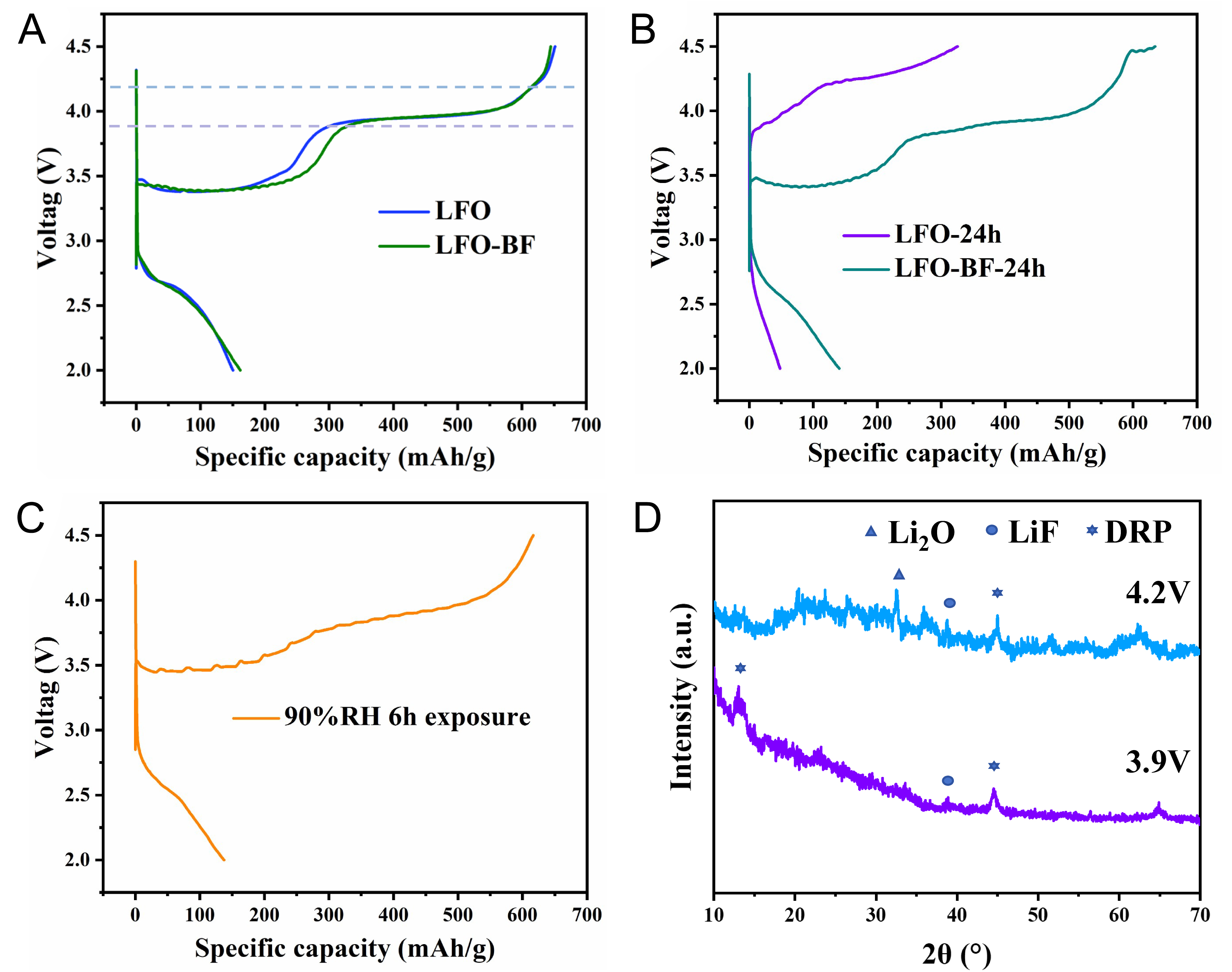
Figure 3. (A) Initial charge/discharge profiles of fresh LFO and LFO-BF; (B) Initial charge/discharge profiles of LFO and LFO-BF after exposure to 60% RH air for 24h; (C) Initial charge/discharge profile of LFO-BF after exposure to 90% RH air for 6 h; (D) Ex situ XRD patterns of LFO-BF electrodes charged to 3.9 and 4.2 V. Selected diffraction features assigned to Li2O, LiF, and the disordered rocksalt phase (DRP) are marked. RH: Relative humidity; XRD: X-ray diffraction; LFO-BF: NH4BF4-treated Li5FeO4.
Ex situ XRD was used to examine the charge-induced structural evolution of LFO-BF [Figure 3D]. After charging to 3.9 V, the Li5FeO4 reflections largely disappear, and rocksalt-like disordered diffraction features become dominant. This evolution is consistent with the reported delithiation pathway of Li5FeO4 from an antifluorite phase to a rocksalt-like delithiated product[17,26]. Upon further charging to 4.2 V, the diffraction features remain relatively weak and broad, reflecting the low crystallinity of the deeply delithiated electrode. Nevertheless, several discernible reflections can be assigned to Li2O, LiF, and the disordered rocksalt phase (DRP). Additional weak features are also observed but cannot be unambiguously assigned because of the complex and poorly crystalline nature of the charged electrode.
The half-cell and ex situ XRD results show that NH4BF4 treatment preserves the lithium-donating function of LFO-BF while maintaining the typical bulk delithiation pathway of Li5FeO4. The treated sample still undergoes the antifluorite-to-rocksalt-like transformation during the first charge and retains a high charge capacity after humid-air exposure.
Gas-evolution behavior and full-cell prelithiation performance
Gas evolution of fresh and humid-air-exposed LFO and LFO-BF was further examined by DEMS during the first charge-discharge cycle at 50 mA g-1 [Figure 4A-D]. Fresh LFO exhibits relatively limited gaseous O2 evolution accompanied by pronounced CO2 release [Figure 4A]. It should be noted that the amount of gaseous O2 detected by DEMS does not directly represent the overall extent of oxygen oxidation. During delithiation of Li-rich antifluorite materials, oxidized oxygen intermediates can either evolve as molecular O2 or participate in interfacial reactions with the electrolyte, thereby contributing to CO2 evolution[26]. After humid-air exposure, LFO-24h shows a substantially shortened charging duration, consistent with its reduced lithium-donating capacity, together with further decreased O2 evolution and increased CO2 release [Figure 4B]. In contrast, LFO-BF exhibits markedly higher detectable O2 evolution but much lower CO2 generation [Figure 4C]. Importantly, this characteristic gas-evolution behavior is largely retained after humid-air exposure, with LFO-BF-24h still showing pronounced O2 evolution and only limited CO2 release [Figure 4D]. Quantitative integration of the calibrated DEMS profiles further highlights these differences. The integrated O2 evolution amounts during the first charge are 33.8, 20.2, 132.5, and 117.1 µmol g-1 for LFO, LFO-24h, LFO-BF, and LFO-BF-24h, respectively, while the corresponding CO2 evolution amounts are 545.3, 607.4, 20.7, and 27.2 µmol g-1. After humid-air exposure, LFO-BF-24h therefore exhibits approximately 95.5% less CO2 evolution than LFO-24h, while retaining substantially higher detectable O2 evolution. The pronounced CO2 evolution of untreated LFO is consistent with the presence of carbonate-containing surface species and becomes further enhanced after humid-air exposure, in agreement with the XRD, FTIR, and XPS results. Nevertheless, high-voltage electrolyte oxidation and reactions between oxidized oxygen intermediates and the electrolyte may also contribute to CO2 generation. The strongly suppressed CO2 evolution of LFO-BF therefore indicates that the NH4BF4-derived surface modification substantially reduces CO2-generating interfacial side reactions during delithiation, consistent with previous observations for surface-modified fluorinated LFO[17]. Meanwhile, the higher detectable O2 evolution suggests that a larger fraction of oxidized oxygen species may evolve as gaseous O2 rather than being consumed through electrolyte-related side reactions.
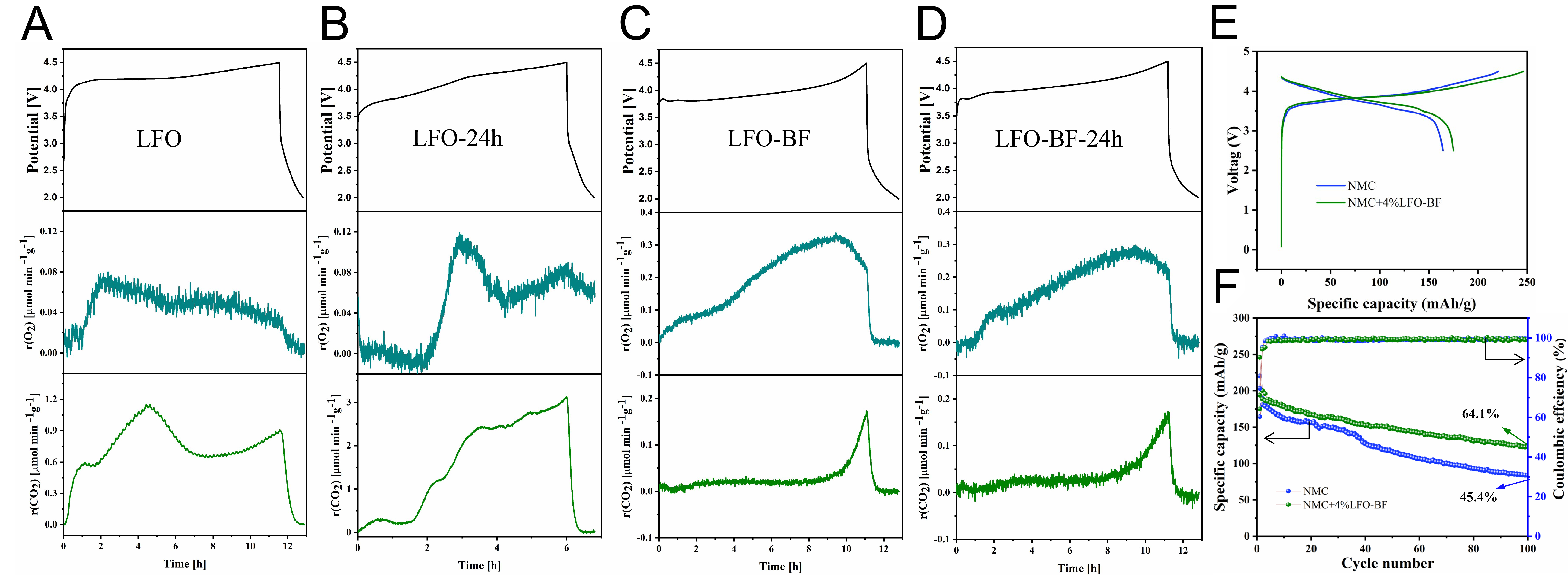
Figure 4. Gas-evolution behavior and full-cell lithium-compensation performance. (A-D) Electrochemical profiles and corresponding O2 and CO2 evolution rates of (A) LFO, (B) LFO-24h, (C) LFO-BF, and (D) LFO-BF-24h during the first charge-discharge cycle at 50 mA g-1, as measured by DEMS; (E) Initial charge/discharge profiles of NMC//graphite full cells with and without 4 wt% LFO-BF at 30 mA g-1; (F) Cycling performance and Coulombic efficiency of NMC//graphite full cells with and without 4 wt% LFO-BF, the black arrows indicating the corresponding y-axes: the upper arrow for Coulombic efficiency (right axis) and the lower arrow for capacity (left axis). DEMS: Differential electrochemical mass spectrometer; NMC: lithium nickel manganese cobalt oxide; LFO-BF: NH4BF4-treated Li5FeO4.
The lithium-compensation effect of LFO-BF was further examined in NMC//graphite full cells. The LFO-BF loading was first evaluated at 1, 3, 4, and 6 wt%, and 4 wt% was selected because it provided the most favorable balance between additional lithium compensation and reversible full-cell capacity
CONCLUSIONS
In summary, we developed a simple NH4BF4-assisted surface fluorination treatment to improve the humid-air stability of Li5FeO4 cathode prelithiation additives. This treatment converts reactive alkaline Li-containing surface species into a LiF-rich fluorinated region, while largely preserving the antifluorite bulk structure and lithium-donating function of Li5FeO4. The modified surface suppresses humid-air-induced hydration and carbonation, thereby reducing the formation of LiOH·H2O, Li2CO3, and LiFeO2-related degradation products. As a result, LFO-BF retains a high first-charge capacity of 634.3 mAh g-1 after 60% RH exposure for 24 h and 616.7 mAh g-1 after 90% RH exposure for 6 h. Ex situ XRD and DEMS further show that LFO-BF maintains the typical bulk delithiation pathway of Li5FeO4 while strongly suppressing CO2-generating side reactions during delithiation. In NMC//graphite full cells, LFO-BF improves cycling stability and capacity retention by supplying additional active lithium during the first charge. This work highlights alkaline-surface conversion into a LiF-rich region as an effective route to humid-air-tolerant Li-rich antifluorite prelithiation additives.
DECLARATIONS
Authors’ contributions
Conceptualization: Wang, D.
Investigation, sample preparation, data curation, and formal analysis: Wang, L.; Wang, W.; Feng, G.; Yu, J.; Zhang, P.
Writing - original draft: Wang, L.; Wang, D.
Writing - review and editing: Wang, D.; Zhang, Y.
Supervision and resources: Wang, D.; Zhang, Y.; Xu, X.; Liu, X.
All authors discussed the results and contributed to the revision and finalization of the manuscript.
Availability of data and materials
All detailed materials and methods supporting the results of this study are included in the article/Supplementary Materials. Further inquiries can be directed to the corresponding author(s).
AI and AI-assisted tools statement
During the preparation of this manuscript, the AI tool ChatGPT (version GPT-5.5, OpenAI, released 2026-04-23) was used solely for language editing. Google NotebookLM (Gemini 3.5 and Antigravity-based update, released 2026-06-08) was used to generate selected illustrative elements for the Graphical Abstract. The tools did not influence the study design, data collection, analysis, interpretation, or the scientific content of the work. All authors take full responsibility for the accuracy, integrity, and final content of the manuscript.
Financial support and sponsorship
This work was supported by the Guangdong Key Building Discipline Research Capability Enhancement Funds (2024ZDJS038), the National Natural Science Foundation of China (22569019 and 22005224), the Guangdong Basic and Applied Basic Research Funds (2024A1515030180), and the Scientific Research Start-up Fund Project of Inner Mongolia University of Technology (DC2500002533).
Conflicts of interest
All authors declared that there are no conflicts of interest.
Ethical approval and consent to participate
Not applicable.
Consent for publication
Not applicable.
Copyright
© The Author(s) 2026.
Supplementary Materials
REFERENCES
1. Zheng, J.; Liang, K.; Shi, K.; Qiu, Y. In situ synthesis and electrochemical properties of Fe/Li2O as a high-capacity cathode prelithiation additive for lithium ion batteries. Int. J. Electrochem. Sci. 2019, 14, 5305-16.
2. Sun, Y.; Lee, H.; Seh, Z. W.; et al. High-capacity battery cathode prelithiation to offset initial lithium loss. Nat. Energy. 2016, 1, 15008.
3. Peled, E.; Menkin, S. Review-SEI: past, present and future. J. Electrochem. Soc. 2017, 164, A1703-19.
4. Liu, X.; Liu, J.; Peng, J.; et al. Addressing the initial lithium loss of lithium ion batteries by introducing pre-lithiation reagent Li5FeO4/C in the cathode side. Electrochim. Acta. 2024, 481, 143918.
5. Kobayashi, H.; Nakamura, Y.; Nakayama, M.; Kodaki, S.; Matsuo, R.; Honma, I. Metastable cubic structure exceeds capacity limit of antifluorite Li5FeO4 cathode using small polarized oxygen redox. Adv. Energy. Mater. 2023, 13, 2203441.
6. Zhan, R.; Wang, X.; Chen, Z.; Seh, Z. W.; Wang, L.; Sun, Y. Promises and challenges of the practical implementation of prelithiation in lithium-ion batteries. Adv. Energy. Mater. 2021, 11, 2101565.
7. Lee, W.; Lee, H.; Byeon, Y.; et al. Modulating anion redox reactions and structural evolution through Fe-substitution in Li6CoO4 hyper-lithiated sacrificial cathodes. Adv. Energy. Mater. 2023, 13, 2302316.
8. Jin, L.; Shen, C.; Shellikeri, A.; et al. Progress and perspectives on pre-lithiation technologies for lithium ion capacitors. Energy. Environ. Sci. 2020, 13, 2341-62.
9. Sun, C.; Zhang, X.; Li, C.; Wang, K.; Sun, X.; Ma, Y. Recent advances in prelithiation materials and approaches for lithium-ion batteries and capacitors. Energy. Storage. Mater. 2020, 32, 497-516.
10. Zou, K.; Deng, W.; Cai, P.; et al. Prelithiation/presodiation techniques for advanced electrochemical energy storage systems: concepts, applications, and perspectives. Adv. Funct. Mater. 2021, 31, 2005581.
11. Wen, N.; Li, J.; Zhang, Z. Advancements in anti-fluorite cathode prelithiation materials for lithium-ion batteries: fundamental research and practical application. Small. Methods. 2025, 9, e01164.
12. Chen, Y.; Yang, M.; Zhu, Y.; et al. Converting Li-rich layered oxide cathode into non-shrinking sacrificial prelithiation agent. Adv. Mater. 2025, 37, e09827.
13. Su, X.; Lin, C.; Wang, X.; et al. A new strategy to mitigate the initial capacity loss of lithium ion batteries. J. Power. Sources. 2016, 324, 150-7.
14. Johnson, C. S.; Kang, S.; Vaughey, J. T.; Pol, S. V.; Balasubramanian, M.; Thackeray, M. M. Li2O removal from Li5FeO4: a cathode precursor for lithium-ion batteries. Chem. Mater. 2010, 22, 1263-70.
15. Zhang, L.; Dose, W. M.; Vu, A. D.; Johnson, C. S.; Lu, W. Mitigating the initial capacity loss and improving the cycling stability of silicon monoxide using Li5FeO4. J. Power. Sources. 2018, 400, 549-55.
16. Zhu, B.; Zhang, W.; Wang, Q.; et al. Understanding the air-exposure degradation chemistry of the sacrificial cathode additive Li5FeO4 for Li-ion batteries. Adv. Funct. Mater. 2024, 34, 2315010.
17. Wen, N.; Li, J.; Zhu, B.; Guo, J.; Zhang, Z. Unraveling the delithiation mechanism of air-stabilized fluorinated lithium iron oxide pre-lithiation material. Chem. Eng. J. 2024, 497, 154536.
18. Zhu, B.; Wen, N.; Wang, J.; Wang, Q.; Zheng, J.; Zhang, Z. Defect engineering of air-stable Li5FeO4 towards an ultra-high capacity cathode prelithiation additive. Chem. Sci. 2024, 15, 12879-88.
19. Liu, C.; Zhang, H.; Zhou, W.; et al. Air-stable Li5FeO4 additive enabled by carbon coating for energy-dense lithium-ion batteries. Nat. Commun. 2025, 16, 7694.
20. Zhu, B.; Zhang, W.; Li, Z.; Wang, Q.; Wen, N.; Zhang, Z. Effect of the N,S-codoped carbon layer on the rate performance of air-stable lithium iron oxide prelithiation additives. ACS. Appl. Mater. Interfaces. 2023, 15, 45290-9.
21. Zhu, B.; Zhang, W.; Li, Z.; et al. “Fe-locking” effect by g-C3N4 stabilizing lithium iron oxide pre-lithiation additives. J. Power. Sources. 2024, 592, 233944.
22. Zhu, B.; Zhang, W.; Wen, N.; et al. Structurally modulated advanced Na-doped antifluorite-based pre-lithiation reagents towards superior lithium compensation. Chem. Eng. J. 2025, 509, 161529.
23. Zhu, B.; Zhang, W.; Li, S.; et al. Lattice modulation on air-stable fe-based prelithiation materials with high capacity via triggering anionic redox activity. ACS. Appl. Mater. Interfaces. 2025, 17, 12448-57.
24. Göbbels, D.; Meyer, G. Aufbau und Abbau von (NH4)[BF4] und H3N-BF3. Z. anorg. allg. Chem. 2002, 628, 1799-805. https://onlinelibrary.wiley.com/doi/10.1002/1521-3749(200208)628:8%3C1799::AID-ZAAC1799%3E3.0.CO;2-L (accessed 2026-10-23).
25. Chen, Y.; Freunberger, S. A.; Peng, Z.; Bardé, F.; Bruce, P. G. Li-O2 battery with a dimethylformamide electrolyte. J. Am. Chem. Soc. 2012, 134, 7952-7.
26. Zhu, Y.; Xu, R.; Zheng, Y.; et al. Unravelling the oxygen evolution mechanism of lithium-rich antifluorite prelithiation agent based on anionic oxidation. Angew. Chem. Int. Ed. 2025, 64, e202502126.
Cite This Article
 Open Access
How to Cite
Wang, L.; Wang, W.; Feng, G.; Yu, J.; Zhang, P.; Xu, X.; Liu, X.; Zhang, Y.; Wang, D. NH4BF4-assisted conversion of alkaline surface species enables air-stable Li5FeO4 cathode prelithiation additives. Energy Mater. 2026, 6, 600146. https://dx.doi.org/10.20517/energymater.2026.190
Download Citation
If you have the appropriate software installed, you can download article citation data to the citation manager of your choice. Simply select your manager software from the list below and click on download.
Export Citation File
Type of Import
Tips on Downloading Citation
Citation Manager File Format
Type of Import
Direct Import: When the Direct Import option is selected (the default state), a dialogue box will give you the option to Save or Open the downloaded citation data. Choosing Open will either launch your citation manager or give you a choice of applications with which to use the metadata. The Save option saves the file locally for later use.
Indirect Import: When the Indirect Import option is selected, the metadata is displayed and may be copied and pasted as needed.
About This Article
Copyright

Data & Comments
Data
0












Comments
Comments must be written in English. Spam, offensive content, impersonation, and private information will not be permitted. If any comment is reported and identified as inappropriate content by OAE staff, the comment will be removed without notice. If you have any queries or need any help, please contact us at [email protected].