

Multifunctional organic molecules as electron-buffering layers for stabilizing Zn anodes
 0
0 Graphical Abstract
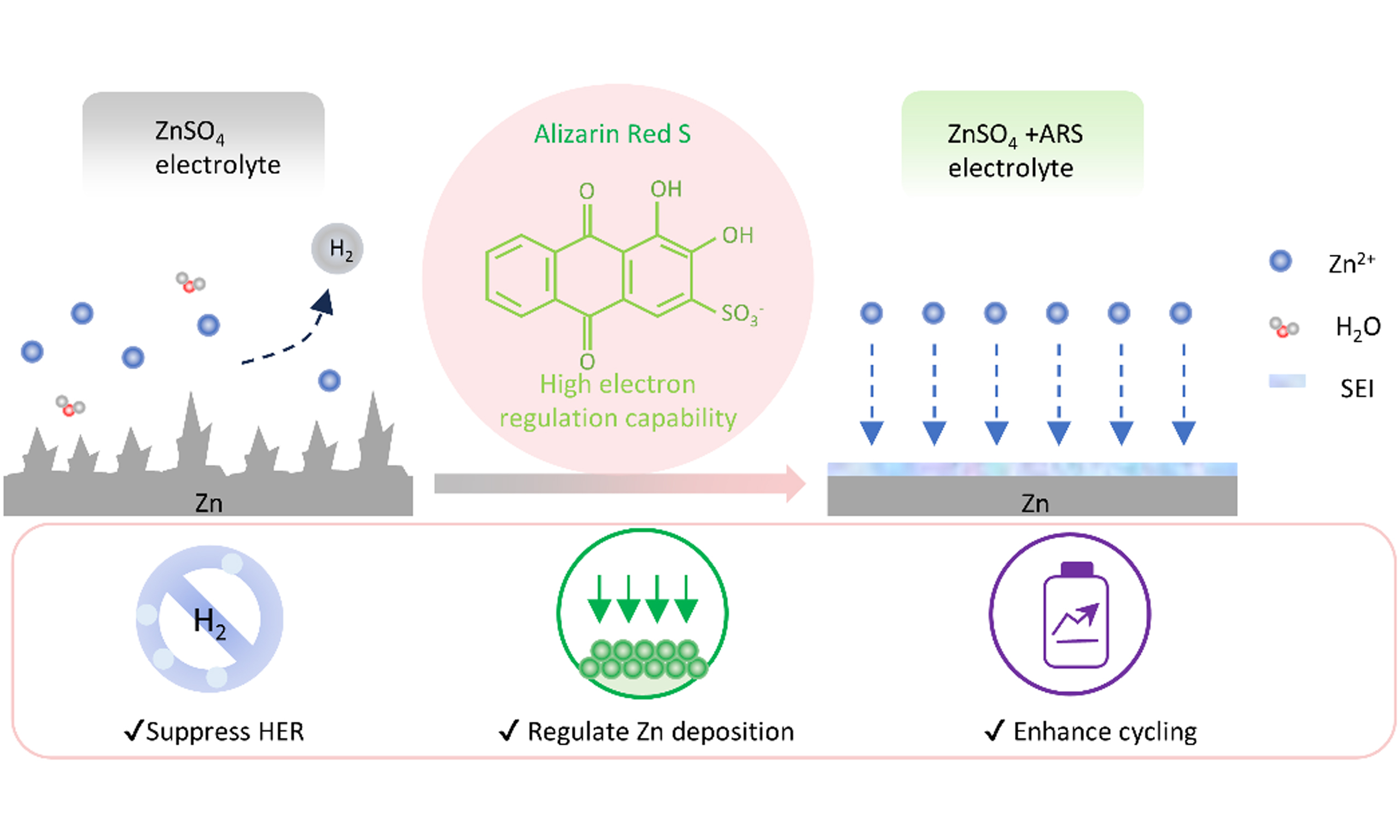
Abstract
Interfacial instability at the Zn anode represents a major obstacle to the advancement
Keywords


 Download PDF
REFERENCES
1. Zhao, Y.; Wang, Y.; Li, J.; et al. Thermodynamic and kinetic insights for manipulating aqueous Zn battery chemistry: towards future grid-scale renewable energy storage systems. eScience 2025, 5, 100331.
2. Lu, H.; Zhu, Y.; Du, Z.; Zhang, D.; Jin, Y. Aqueous zinc-iodine batteries for large-scale energy storage: challenges, strategies and perspectives. Adv. Funct. Mater. 2026, 36, e76322.
3. Poudel, M. B.; Anand, R.; Ojha, G. P.; et al. Nitrogen coordinated atomically dispersed manganese catalyzes oxygen reduction in practical zinc-air batteries and alkaline fuel cells. J. Power. Sources. 2026, 678, 239959.
4. Karim, O. L. A.; Poudel, M. B.; Bhandari, T.; Yoo, D. J. Integrating iron phthalocyanine and cobalt nanoparticles encapsulated N-doped CNTs as bifunction electrocatalyst for oxygen evolution reaction and oxygen reduction reaction in high-efficiency zinc-air battery. J. Alloys. Compd. 2026, 1071, 188725.
5. Poudel, M. B.; Balanay, M. P.; Lohani, P. C.; Sekar, K.; Yoo, D. J. Atomic engineering of 3D self-supported bifunctional oxygen electrodes for rechargeable zinc-air batteries and fuel cell applications. Adv. Energy. Mater. 2024, 14, 2400347.
6. Li, X.; Zhang, W.; Yu, J.; et al. Self-assembled protection layer induced by bifunctional additive for reversible aqueous zinc metal battery. Adv. Funct. Mater. 2024, 34, 2316474.
7. Yue, Q.; Zhu, H.; Chen, Y.; et al. Cation-anion cooperative additives in aqueous zinc-ion batteries: mechanistic insights and performance regulation. eScience. Energy. 2026, 2, 100038.
8. Wang, J.; Tang, B.; Wu, J.; et al. Revitalizing dendritic lithium with atomic modulator-decorated suspension electrolyte for durable lithium metal batteries. Sci. Adv. 2026, 12, eaef9111.
9. Zhang, J.; Liu, F.; He, R.; et al. Taming interfacial ion-dipole interactions with d-orbital delocalized electron catalysis expediates low-temperature Li metal batteries. Adv. Mater. 2026, 38, e10894.
10. Cheng, X.; Wang, W.; Tang, Z.; et al. Expediting desolvation-diffusion kinetics by self-cascade catalysis for durable low-temperature zinc metal batteries. Angew. Chem. Int. Ed. 2026, 65, e22417.
11. Wang, J.; Zhang, J.; Cheng, X.; et al. Electrode/electrolyte interface studies of rechargeable Li batteries with interface-specific sum frequency generation spectroscopy. J. Am. Chem. Soc. 2025, 147, 44633-51.
12. Hao, Z.; Yao, W.; Li, W.; et al. Insights on electrolyte engineering toward aqueous zinc-ion batteries. Energy. Mater. 2026, 6, 600036.
13. Wu, Z.; Huang, Z.; Zhang, R.; Hou, Y.; Zhi, C. Aqueous electrolyte additives for zinc-ion batteries. Int. J. Extrem. Manuf. 2024, 6, 062002.
14. Li, T.; Zhang, N.; Liu, B.; et al. Unlocking the critical role of cations doping in MnO2 cathode with enhanced reaction kinetics for aqueous zinc ion batteries. Adv. Funct. Mater. 2025, 35, 2423755.
15. Li, S.; Zhong, Y.; Huang, J.; et al. Regulating interfacial kinetics boosts the durable A h-level zinc-ion batteries. Energy. Environ. Sci. 2025, 18, 2599-609.
16. Wang, M.; Ma, J.; Meng, Y.; et al. In situ formation of solid electrolyte interphase facilitates anode-free aqueous zinc battery. eScience 2025, 5, 100397.
17. Zhao, M.; Lv, Y.; Xu, Y.; Yang, H.; Bo, Z.; Lu, J. Ordered zinc electrodeposition from single-crystal units to polycrystalline stacking within solid-electrolyte interphase in battery anodes. Nat. Commun. 2025, 16, 2843.
18. Dao, Y.; Li, M.; Zhang, M.; et al. Axial Coordination induced electron delocalization and p-p orbital hybridization in single-atom catalysts boosts Zn2+ desolvation for highly stable Zn anode. Adv. Sci. 2026, 13, e18148.
19. Xu, Y.; Zhu, J.; Feng, J.; et al. A rechargeable aqueous zinc/sodium manganese oxides battery with robust performance enabled by Na2SO4 electrolyte additive. Energy. Storage. Mater. 2021, 38, 299-308.
20. Wang, P.; Xie, X.; Xing, Z.; et al. Mechanistic insights of Mg2+ -electrolyte additive for high-energy and long-life zinc-ion hybrid capacitors. Adv. Energy. Mater. 2021, 11, 2101158.
21. Ding, Y.; Zhang, X.; Wang, T.; et al. A dynamic electrostatic shielding layer toward highly reversible Zn metal anode. Energy. Storage. Mater. 2023, 62, 102949.
22. He, Y.; Chen, Z.; Gao, Q.; Feng, J.; Hao, Z. Dynamic interface modulation of aqueous zinc-ion batteries by rational design of organic additives. Small 2025, 21, e06244.
23. Wang, C.; Zhang, D.; Yue, S.; et al. Organic electrolyte additives for aqueous zinc ion batteries: progress and outlook. Chem. Rec. 2024, 24, e202400142.
24. Tan, Y.; Xu, W.; Yang, F.; et al. Dynamic polyiodide-trapping and proton-capturing dual-network engineering for high-areal-capacity, long-cycling and high-temperature Zn-I2 batteries. Adv. Mater. 2026, 38, e22609.
25. Yang, X.; Li, W.; Chen, Z.; et al. Synchronous dual electrolyte additive sustains Zn Metal anode with 5600 h lifespan. Angew. Chem. Int. Ed. 2023, 62, e202218454.
26. Wang, K.; Li, Q.; Zhang, G.; et al. Interface regulation of the Zn anode by using a low concentration electrolyte additive for aqueous Zn batteries. Chem. Sci. 2023, 15, 230-7.
27. Tian, Z.; Liu, H.; Cheng, M.; et al. Ethanol as solvent additives with competitive effect for high-stable aqueous zinc batteries. ACS. Appl. Mater. Interfaces. 2024, 16, 21857-67.
28. Fan, L.; Hu, X.; Jiao, Y.; et al. Advances of designing effective and functional electrolyte system for high-stability aqueous Zn ion battery. Chem. Eng. J. 2024, 479, 147763.
29. Yu, H.; Chen, D.; Li, Q.; et al. In situ construction of anode-molecule interface via lone-pair electrons in trace organic molecules additives to achieve stable zinc metal anodes. Adv. Energy. Mater. 2023, 13, 2300550.
30. Cui, P.; Hu, J.; Luo, Y.; et al. Trace tea polyphenols enabling reversible dendrite-free zinc anode. J. Colloid. Interface. Sci. 2022, 624, 450-9.
31. Li, S.; Xu, Y.; Xu, X.; et al. Improved stability of zinc anodes by a trace amount of xylitol. J. Electron. Mater. 2024, 53, 408-17.
32. Chen, R.; Zhang, W.; Huang, Q.; et al. Trace amounts of triple-functional additives enable reversible aqueous zinc-ion batteries from a comprehensive perspective. NanoMicro. Lett. 2023, 15, 81.
33. Wang, F.; Liang, W.; Liu, X.; et al. A Bifunctional electrolyte additive features preferential coordination with iodine toward ultralong-life zinc-iodine batteries. Adv. Energy. Mater. 2024, 14, 2400110.
34. Zhou, C.; Zhang, H.; Duan, L.; et al. Bidirectional interfacial regulation for high performance zinc-iodine batteries. Energy. Storage. Mater. 2025, 83, 104711.
35. Sun, R.; Han, D.; Cui, C.; et al. A self-deoxidizing electrolyte additive enables highly stable aqueous zinc batteries. Angew. Chem. Int. Ed. 2023, 62, e202303557.
36. Cao, J.; Sun, Y.; Zhang, D.; et al. Interfacial double-coordination effect guiding uniform electrodeposition for reversible zinc metal anode. Adv. Energy. Mater. 2024, 14, 2302770.
37. Wang, Z.; Wang, J.; Kawashima, K.; Liu, Z.; Henkelman, G.; Mullins, C. B. Mass transfer limitation within molecular crowding electrolyte reorienting (100) and (101) texture for dendrite-free zinc metal batteries. Angew. Chem. Int. Ed. 2024, 63, e202407881.
38. Sharma, B. K.; Shaikh, A. M.; Chacko, S.; Kamble, R. M. Synthesis, spectral, electrochemical and theoretical investigation of indolo[2,3-b]quinoxaline dyes derived from anthraquinone for n-type materials. J. Chem. Sci. 2017, 129, 483-94.
39. Weng, H.; Zhang, Y.; Zhou, X.; et al. Building π-π-conjugated molecule adsorption layer on Zn anode for ultra-stable aqueous zinc-ion batteries. eScience 2026.
40. Liu, Y.; Li, J.; Zhu, J.; et al. The adsorption property and mechanism of phenyl/amine end-capped tetraaniline for alizarin red S. Colloid. Polym. Sci. 2018, 296, 1777-86.
41. Liao, X.; Zhu, L.; Chen, J.; et al. π-π stacking-directed crystallographic orientation of Zn elec-trodeposition for ultralong-life anodes. Adv. Mater. 2026, 38, e72888.
42. Li, Y.; Yang, Z.; Li, J.; et al. Molecular fence on the inner Helmholtz plane for highly reversible zinc metal anodes. eScience 2026, 6, 100556.
43. Wang, S.; Wang, S.; Wei, Z.; et al. A parts-per-million scale electrolyte additive for durable aqueous zinc batteries. Nat. Commun. 2025, 16, 1800.
44. Ma, Y.; Zhang, Q.; Liu, L.; et al. N,N-dimethylformamide tailors solvent effect to boost Zn anode reversibility in aqueous electrolyte. Natl. Sci. Rev. 2022, 9, nwac051.
45. Lu, Y.; Wang, Y.; Guo, C.; et al. Reconfiguring the Helmholtz plane with a trace polar additive for highly reversible zinc anodes. Inorg. Chem. Front. 2025, 12, 2719-30.
46. Yang, J.; Zhao, R.; Hu, Z.; et al. Blocking the passivation reaction via localized acidification and cation selective interface towards highly stable zinc anode. Energy. Storage. Mater. 2024, 70, 103449.
47. Li, Y.; Wu, P.; Zhong, W.; et al. A progressive nucleation mechanism enables stable zinc stripping-plating behavior. Energy. Environ. Sci. 2021, 14, 5563-71.
48. Wang, X.; Peng, H.; Sun, K.; et al. Melamine induced co-regulation of solvation structure and interface engineering to achieve dendrite-free Zn-ion hybrid capacitors. Energy. Storage. Mater. 2024, 66, 103208.
49. Bu, J.; Liu, P.; Ou, G.; et al. Interfacial adsorption layers based on amino acid analogues to enable dual stabilization toward long-life aqueous zinc iodine batteries. Adv. Mater. 2025, 37, e2420221.
50. Liu, K.; Sun, M.; Wu, Y.; et al. Binary electrolyte additive-reinforced interfacial molecule adsorption layer for ultra-stable zinc metal anodes. Adv. Mater. 2025, 37, e2420079.
51. Gan, X.; Zhang, C.; Ye, X.; Qie, L.; Shi, K. Unveiling the potential of redox electrolyte additives in enhancing interfacial stability for Zn-ion hybrid capacitors. Energy. Storage. Mater. 2024, 65, 103175.
52. Eisenberg, J. B.; Lee, K.; Yuan, X.; Schmidt, J. R.; Choi, K. S. The impact of electron donating and withdrawing groups on electrochemical hydrogenolysis and hydrogenation of carbonyl compounds. J. Am. Chem. Soc. 2024, 146, 15309-19.
53. Wu, Q.; Huang, J.; Zhang, J.; et al. Multifunctional cellulose nanocrystals electrolyte additive enable ultrahigh-rate and dendrite-free Zn anodes for rechargeable aqueous zinc batteries. Angew. Chem. Int. Ed. 2024, 63, e202319051.
54. Wei, X.; Mu, Y.; Chen, J.; et al. Optimizing Zn (100) deposition via crystal plane shielding effect towards ultra-high rate and stable zinc anode. Energy. Storage. Mater. 2025, 75, 104026.
55. Wang, K.; Qiu, T.; Lin, L.; Zhan, H.; Liu, X.; Sun, X. Solvation sheath regulation to induce sulfide solid–electrolyte interphase on Zn metal anode. ACS. Energy. Lett. 2024, 9, 1000-7.
56. Feng, K.; Chen, B.; Xi, B.; et al. Antioxidant interfaces enabled by self-deoxidizing and self-dehydrogenating redox couple for reversible zinc metal batteries. Adv. Energy. Mater. 2024, 14, 2401053.
57. Guo, G.; Ji, C.; Lin, J.; et al. Interfacial domino effect triggered by β-alanine cations realized highly reversible zinc-metal anodes. Angew. Chem. Int. Ed. 2024, 63, e202407417.
58. Lv, Y.; Huang, C.; Zhao, M.; et al. Synergistic anion-cation chemistry enables highly stable Zn metal anodes. J. Am. Chem. Soc. 2025, 147, 8523-33.
59. Yin, J.; Liu, H.; Li, P.; et al. Integrated electrolyte regulation strategy: trace trifunctional tranexamic acid additive for highly reversible Zn metal anode and stable aqueous zinc ion battery. Energy. Storage. Mater. 2023, 59, 102800.
60. Yue, Q.; Wan, Y.; Li, X.; et al. Restraining the shuttle effect of polyiodides and modulating the deposition of zinc ions to enhance the cycle lifespan of aqueous Zn-I2 batteries. Chem. Sci. 2024, 15, 5711-22.
Cite This Article
 Open Access
How to Cite
Yue, Q.; He, J.; Chen, Y.; Zhu, H.; Gao, T.; Xiao, D.; Qiu, L.; Li, X. Multifunctional organic molecules as electron-buffering layers for stabilizing Zn anodes. Energy Mater. 2026, 6, 600132. https://dx.doi.org/10.20517/energymater.2026.182
Download Citation
If you have the appropriate software installed, you can download article citation data to the citation manager of your choice. Simply select your manager software from the list below and click on download.
Export Citation File
Type of Import
Tips on Downloading Citation
Citation Manager File Format
Type of Import
Direct Import: When the Direct Import option is selected (the default state), a dialogue box will give you the option to Save or Open the downloaded citation data. Choosing Open will either launch your citation manager or give you a choice of applications with which to use the metadata. The Save option saves the file locally for later use.
Indirect Import: When the Indirect Import option is selected, the metadata is displayed and may be copied and pasted as needed.
About This Article
Copyright

Data & Comments
Data
0












Comments
Comments must be written in English. Spam, offensive content, impersonation, and private information will not be permitted. If any comment is reported and identified as inappropriate content by OAE staff, the comment will be removed without notice. If you have any queries or need any help, please contact us at [email protected].