

Boosting photoluminescence efficiency in Yb3+-doped CsPbCl3 nanocrystals via metal chloride post-treatment for high-performance luminescent solar concentrators
 0
0 
Graphical Abstract
Abstract
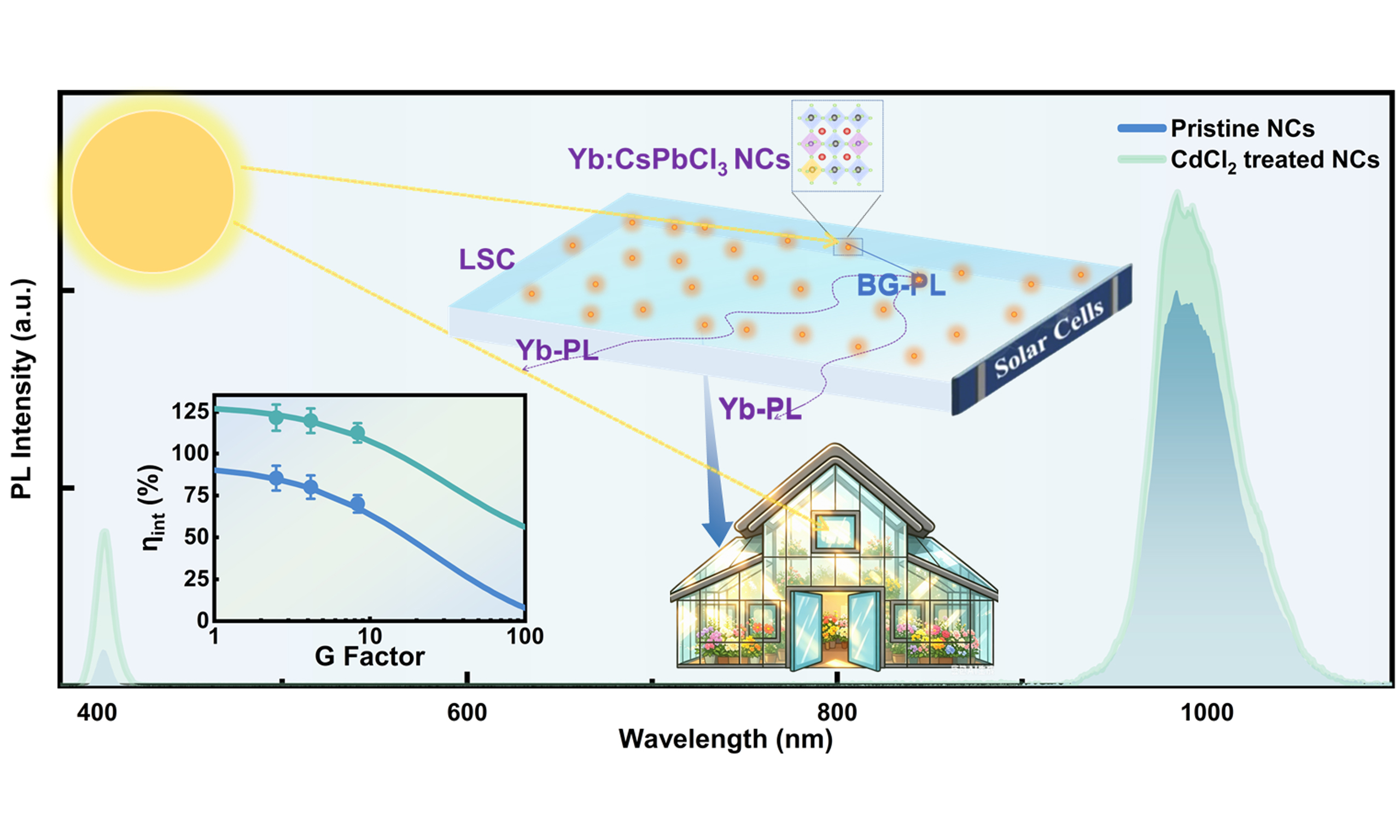
Yb3+-doped perovskite nanocrystals (NCs) featuring quantum-cutting capability exhibit enormous potential for luminescent solar concentrators (LSCs) due to their theoretically achievable 200% photoluminescence quantum yield (PLQY). However, their practical applications are still limited by defect-assisted nonradiative recombination, insufficient exciton-to-Yb3+ energy transfer efficiency, and poor operational stability. Herein, we demonstrate a CdCl2 post-treatment strategy to regulate the lattice structure and photoluminescence (PL) dynamics of Yb3+:CsPbCl3 NCs. As a result, the PLQY is significantly enhanced from 125.3% to 177.4%, accompanied by an increase in exciton to Yb3+ energy transfer efficiency from 75.9% to 86.4%. In addition, the treated NCs exhibit substantially improved photostability and thermal stability, with the thermal activation energy increasing from 61.8 ± 6.2 to 90.9 ± 2.4 meV. Compared with ZnCl2, NiCl2, and CuCl2 treatments, CdCl2 shows uniquely superior enhancement of the exciton to Yb3+ energy transfer efficiency and Yb3+ emission. Flexible LSCs fabricated based on the treated NCs exhibit high visible transparency and efficient near-infrared (NIR) photon waveguiding and concentrating capability, achieving an internal optical efficiency exceeding 120% and delivering enhanced photovoltaic performance when coupled with silicon solar cells. This work provides an effective strategy for developing high-performance Yb3+-doped perovskite NCs and flexible transparent LSCs for building-integrated photovoltaics.
Keywords


 Download PDF
INTRODUCTION
Luminescent solar concentrators (LSCs) have emerged as a promising technology for building-integrated photovoltaics, offering a viable pathway to transform conventional windows into power-generating architectural elements[1-10]. Lanthanide-doped perovskite nanocrystals (NCs), especially Yb3+-doped CsPbX3 (X = Cl, Br, I) NCs, have emerged as highly attractive emitters for LSCs because of their strong ultraviolet absorption, solution-processability, and unique quantum-cutting properties[11-17]. In Yb3+-doped perovskite NCs, one high-energy photon absorbed by the perovskite host can generate two near-infrared (NIR) photons through exciton to Yb3+ quantum-cutting, enabling a theoretical photoluminescence quantum yield (PLQY) limit of 200%[14,16,18,19]. Moreover, the large Stokes shift between ultraviolet absorption and Yb3+ NIR emission effectively suppresses reabsorption losses and closely matches the spectral response of silicon solar cells[20,21]. Luo et al. reported Yb3+:CsPbCl3 NC-based LSCs with internal optical efficiencies exceeding 100%, demonstrating the considerable potential of quantum-cutting perovskites for transparent photovoltaics[22]. More importantly, Crane and co-workers demonstrated that integrating Yb3+-doped quantum-cutting layers with silicon photovoltaic cells can provide substantial performance gains under real-world solar irradiance and elevated operational temperatures, highlighting the practical significance of Yb3+-doped perovskites for climate-resilient solar-energy harvesting[23].
Despite these advances, the luminescence performance and operational stability of Yb3+:CsPbCl3 NCs remain insufficient for practical LSC applications[21-23]. Post-synthetic metal-halide treatments have proven effective at improving the optical properties of perovskite NCs by passivating surface defects and modulating the lattice. For example, Yong et al. incorporated Ni2+ ions into CsPbCl3 NCs to enhance short-range structural order and eliminate vacancy defects, achieving a near-unity violet PLQY[24]. Li et al. developed a post-synthetic surface trap removal strategy using a ZnX2 hexane solution, successfully elevating the PLQYs of CsPbX3 quantum dots up to 95% via effective halide passivation[25]. Furthermore, Ji et al. achieved a pioneering near-unity red emission in Mn2+:CsPbCl3 NCs through a room-temperature CdCl2 post-treatment, demonstrating that CdCl2 can effectively promote carrier detrapping from defect states to excitonic states and thereby enhance radiative recombination[26]. However, the influence of metal-halide post-treatments on lanthanide-doped perovskite NCs remains insufficiently understood. In particular, because the Yb3+ sensitization process strongly depends on energy transfer from the exciton to Yb3+ and local lattice environments around dopant ions[27], the role of post-treatment chemistry in tuning the luminescent properties of Yb3+-doped perovskites is expected to differ substantially from that in undoped perovskites. Therefore, developing an effective post-treatment strategy to regulate exciton emission and Yb3+ sensitization is crucial for achieving high-performance quantum-cutting LSC materials.
Herein, we demonstrate that CdCl2 post-treatment provides an effective surface-lattice synergistic engineering strategy for enhancing the luminescence and stability of Yb3+:CsPbCl3 NCs. After CdCl2 post-treatment, the total PLQY of Yb3+:CsPbCl3 NCs is significantly increased from 125.3% to 177.4%, accompanied by substantial improvements in photostability and thermal stability. Compared with ZnCl2, NiCl2, and CuCl2 treatments, CdCl2 shows uniquely superior enhancement of the exciton to Yb3+ energy transfer efficiency and Yb3+ emission. Furthermore, the LSCs fabricated from treated NCs exhibit an internal optical efficiency of 121.6% and enhanced photovoltaic performance when coupled with silicon solar cells, demonstrating the potential of Yb3+-doped perovskite NCs for high-performance, transparent, and flexible photovoltaic applications.
EXPERIMENTAL
Synthesis of metal chloride-treated Yb3+:CsPbCl3 NCs
Yb3+-doped CsPbCl3 NCs were synthesized using a modified hot-injection method[28], followed by post-treatment with different metal chlorides at room temperature. Detailed information on materials, characterization methods, and device measurements is provided in the Supplementary Materials. Before NC synthesis, metal chloride ethanol solutions were prepared by dissolving 0.27 mmol of CdCl2, ZnCl2, NiCl2, and CuCl2 separately in 8 mL of anhydrous ethanol under continuous stirring until clear homogeneous solutions were obtained. The resulting solutions were stored at room temperature for subsequent post-treatment.
In a typical synthesis, Yb(OAc)3·4H2O (0.02 mmol), Pb(OAc)2·3H2O (0.20 mmol), CsOAc solution (0.28 mL, 1 mol L-1, prepared by dissolving CsOAc in absolute ethanol), oleic acid (1 mL), oleylamine (0.5 mL), and 1-octadecene (5 mL) were loaded into a 50 mL three-neck flask. The mixture was vacuum-degassed at 120 °C for 30 min. Subsequently, the system was heated to 240 °C under an argon atmosphere, followed by the rapid injection of a precursor solution consisting of trimethylsilyl chloride (TMS-Cl) (0.2 mL) and 1-octadecene (ODE) (0.5 mL). Immediately after injection, the reaction was quenched using an ice-water bath.
The crude product was purified by centrifugation at 5,000 rpm for 10 min. The precipitate was collected, redispersed in hexane, and centrifuged again at 5,000 rpm for 10 min. The supernatant containing purified Yb3+:CsPbCl3 NCs was collected for further use. For post-treatment, 0.5 mL of the purified NC solution was mixed with a desired amount of metal chloride ethanol solution, and the mixture was stirred at room temperature for 20 min to obtain metal-chloride-treated Yb3+:CsPbCl3 NCs.
Fabrication of Yb3+:CsPbCl3 NC-LSCs
Flexible LSCs were fabricated by embedding the synthesized NCs into a polydimethylsiloxane (PDMS) matrix. Typically, 1 mL of NC solution was mixed with 3 g of PDMS and 0.4 g of curing agent and magnetically stirred at 600 rpm for 30 min at room temperature to obtain a homogeneous mixture. The mixture was subsequently poured into a mold and cured in a vacuum oven at 50 °C for 2 h, yielding flexible Yb3+:CsPbCl3 NC-based LSCs.
RESULTS AND DISCUSSION
Figure 1 presents the optical, crystallographic, morphological, and surface chemical characterizations of untreated and CdCl2 post-treated Yb3+-doped CsPbCl3 NCs. As shown in Figure 1A, the untreated Yb3+:CsPbCl3 NCs exhibit a distinct absorption peak at 398 nm, corresponding to the first excitonic absorption peak of the CsPbCl3 host[14,19,29,30]. The photoluminescence (PL) spectrum displays two characteristic emission bands, a narrow blue emission centered at 405 nm, assigned to the band-edge (BG) recombination of the CsPbCl3 host, and a NIR emission centered at 985 nm, originating from the characteristic 2F5/2 → 2F7/2 transition of doped Yb3+ ions[16,21,23,29]. After CdCl2 post-treatment, the excitonic absorption peak slightly blue-shifts from 398 to 397 nm, while the host band-edge emission shifts from 405 to 404 nm [Figure 1B]. In contrast, the Yb3+-related NIR emission remains centered at 985 nm, indicating that the local crystal-field variation induced by CdCl2 treatment has a negligible influence on the energy level splitting of Yb3+ 4f states. Notably, CdCl2 post-treatment significantly enhances the luminescence intensity of the Yb3+:CsPbCl3 NCs, with the total PLQY (including excitonic and Yb3+ emission) increasing from 125.3% to 177.4%. The PLQY exceeding 100% suggests that the Yb3+ emission is associated with an efficient quantum-cutting process, in which one high-energy excitation absorbed by the CsPbCl3 host can generate more than one NIR photon through Yb3+ sensitization[31-33].
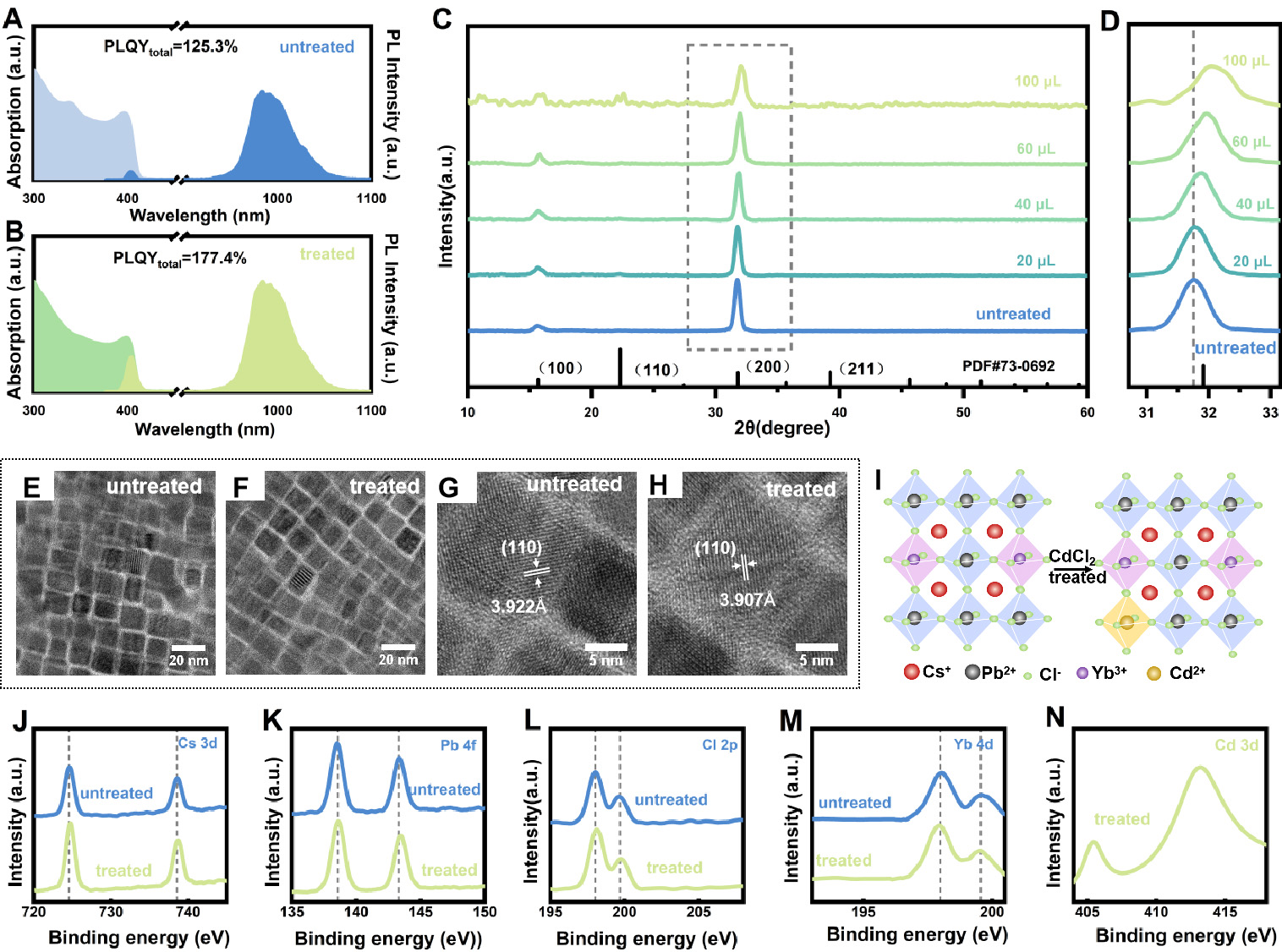
Figure 1. (A and B) UV-vis absorption and PL spectra of Yb3+:CsPbCl3 NCs before and after CdCl2 post-treatment; (C and D) XRD patterns of Yb3+:CsPbCl3 NCs treated with different amounts of CdCl2, together with an enlarged view around the (200) diffraction peak at approximately 31.8°. The standard XRD pattern (PDF#73-0692) of cubic CsPbCl3 is shown at the bottom as a reference; (E-H) TEM images of Yb3+-doped CsPbCl3 NCs before and after CdCl2 post-treatment (scale bar: 20 nm), along with the corresponding high-resolution TEM images (scale bar: 5 nm); (I) Schematic illustration of the lattice of Yb3+-doped CsPbCl3 NCs before and after CdCl2 post-treatment; (J-N) High-resolution XPS spectra of untreated (blue) and CdCl2 post-treated (green) Yb3+:CsPbCl3 NCs, including Cs 3d, Pb 4f, Cl 2p, Yb 4d, and Cd 3d regions. XRD: X-ray diffraction; NCs: nanocrystals; TEM: transmission electron microscopy; XPS: X-ray photoelectron spectroscopy; PLQY: photoluminescence quantum yield; UV-vis: ultraviolet-visible; PL: photoluminescence.
Figure 1C shows the X-ray diffraction (XRD) patterns of these Yb3+-doped CsPbCl3 NCs; they retain the structures of the parent cubic CsPbCl3 (PDF#73-0692). The NCs exhibit two distinct diffraction peaks at 15.7º and 31.8º, which can be indexed to the (100) and (200) crystal planes, respectively, indicating a (100) preferred orientation[30]. Importantly, no additional impurity peaks are detected after CdCl2 treatment, suggesting that the post-treatment does not induce secondary crystalline phases such as Cd-containing salts or lead-deficient by-products. However, with increasing CdCl2 addition, the diffraction peaks shift gradually to higher angles [Figure 1D], and Rietveld refinement confirms the slight contraction of the average lattice parameters after CdCl2 treatment [Supplementary Figure 1].
Transmission electron microscopy (TEM) further confirms that CdCl2 post-treatment preserves the morphology of the Yb3+:CsPbCl3 NCs. As shown in Figure 1E and F, both untreated and CdCl2-post-treated NCs exhibit uniform and well-dispersed cubic morphologies. The corresponding particle-size distributions [Supplementary Figure 2] show that the average particle size decreases slightly from 14.5 ± 2.5 nm to 13.6 ± 2.3 nm after CdCl2 post-treatment. This moderate size reduction is consistent with the slight blue shift observed in both the absorption and host PL spectra, suggesting that CdCl2 treatment may induce slight surface etching. High-resolution TEM images [Figure 1G and H] display clear lattice fringes, confirming the high crystallinity of both NCs. The lattice spacing assigned to the (110) planes decreases from 3.922 Å for untreated NCs to 3.907 Å after CdCl2 treatment. This reduction agrees well with the XRD peak shift toward higher diffraction angles and provides additional evidence for CdCl2-induced lattice contraction. A schematic illustration of the proposed lattice evolution before and after CdCl2 post-treatment is shown in Figure 1I.
X-ray photoelectron spectroscopy (XPS) was conducted to investigate the surface chemical states and elemental composition of the NCs. As shown in Figure 1J-N, the characteristic signals of Cs, Pb, Cl, and Yb are clearly observed in the untreated Yb3+:CsPbCl3 NCs, confirming the successful introduction of Yb3+ into the CsPbCl3 NCs. After CdCl2 post-treatment, an additional Cd signal appears, verifying the presence of Cd in the treated NCs. Meanwhile, the Cs 3d, Pb 4f, and Cl 2p peaks exhibit slight shifts toward higher binding energies, suggesting strengthened Pb-Cl interactions in the NCs, consistent with previous reports[29]. To further examine the elemental composition after CdCl2 treatment, the Yb and Cd contents of the NCs were determined by Energy Dispersive X-ray Spectroscopy (EDS) [Supplementary Table 1]. The Yb elemental content remains nearly constant at 1.72%-1.76%, whereas the Cd content progressively increases from 2.93% to 8.57% with increasing CdCl2 amount. These results indicate that Cd incorporation does not appreciably alter the Yb content under the present treatment conditions, allowing the effects of CdCl2 treatment to be evaluated at an essentially constant Yb doping level.
To further elucidate the role of CdCl2 post-treatment in regulating the photophysical properties of Yb3+:CsPbCl3 NCs, steady-state and time-resolved PL measurements were performed. As shown in Figure 2A, the PL intensities of the CsPbCl3 host (~405 nm) and Yb3+ emission (985 nm) are strongly dependent on the amount of CdCl2 used during post-treatment. When the CdCl2 amount is increased from 0 to 60 μL, the band-edge excitonic emission shows a 5.6-fold enhancement, and the NIR emission of Yb3+ exhibits a 1.35-fold increase relative to that of untreated NCs. The more pronounced enhancement of the host emission suggests that CdCl2 treatment effectively suppresses nonradiative recombination associated with surface defects[25,26]. Meanwhile, the increase in Yb3+ emission indicates that the improved host lattice environment also enhances the sensitization of Yb3+ centers[27]. However, when the CdCl2 amount is further increased to 100 μL, the excitonic and Yb3+ emissions show a slight decrease, suggesting that excessive CdCl2 treatment introduces additional structural defects that partially offset the benefits of defect passivation.

Figure 2. (A) Absorption and PL spectra of Yb3+:CsPbCl3 NCs post-treated with different amounts of CdCl2. Time-resolved PL decay curves of the excitons (B) and Yb3+ emissions (C), respectively; (D) Average PL lifetimes of the excitons and Yb3+ ions extracted from biexponential fitting; (E) PLQYs of the excitonic emission, Yb3+ near-infrared emission, and total emission, together with the exciton to Yb3+ energy transfer efficiencies (ηET), for Yb3+:CsPbCl3 NCs treated with different amounts of CdCl2; (F) Comparison of the average PL lifetimes of the excitons and Yb3+ ions, as well as the total PLQYs of Yb3+:CsPbCl3 NCs treated with different metal chlorides (CdCl2, ZnCl2, NiCl2, and CuCl2). PLQY: Photoluminescence quantum yield; NCs: nanocrystals; PL: photoluminescence.
The carrier recombination dynamics were then investigated by time-resolved PL spectroscopy. Figure 2B shows the band-edge PL decay curves of Yb3+:CsPbCl3 NCs treated with different amounts of CdCl2. The untreated NCs exhibited a biexponential decay behavior, consisting of a fast component associated with intrinsic excitonic recombination and a slower component arising from defect-related localized states or self-trapped excitons[14]. With increasing CdCl2 content, the decay gradually evolved from multiexponential to nearly single-exponential, indicating that the long-lived defect-related component was effectively suppressed. Figure 2C presents the corresponding Yb3+ decay curves, which become progressively slower with increasing CdCl2 treatment, indicating reduced nonradiative defects and a more favorable local environment around the Yb3+ centers. The decay curves were fitted using biexponential functions, and the average PL lifetimes are summarized in Supplementary Tables 2 and 3 and plotted in Figure 2D. The average Yb3+ lifetime increases from 1.92 ms for the untreated NCs to 2.27 ms at 60 μL CdCl2 and remains essentially unchanged at higher CdCl2 loading. In contrast, the average exciton lifetime decreases from 4.90 ns to 3.15 ns as the CdCl2 amount increases from 0 to 60 μL, reflecting the efficient removal of long-lived defect-related recombination channels. When the CdCl2 amount is further increased to 100 μL, the exciton lifetime slightly increases to 3.34 ns, suggesting that excess CdCl2 introduces new defect/trap states. The shortening of the host exciton lifetime and prolongation of the Yb3+ lifetime indicate that CdCl2 post-treatment not only suppresses defect/trap-assisted recombination but also promotes more efficient exciton funneling to Yb3+ centers.
The PLQY and exciton to Yb3+ energy transfer efficiency are summarized in Figure 2E. With increasing CdCl2 content, the PLQY of the host excitonic emission rose from 2.0% to 11.9%, confirming a substantial enhancement in band-edge radiative recombination. The Yb3+ PLQY increases from 123.3% to a maximum of 166.2% at 60 μL CdCl2, before decreasing slightly to 155.8% at 100 μL. As a result, the total PLQY rises from 125.3% for the untreated NCs to 177.4% at the optimal CdCl2 amount. In general, the PLQY of Yb3+ emission in Yb3+:CsPbCl3 NCs is determined by the exciton-to-Yb3+ energy-transfer efficiency (ηET) and the intrinsic radiative efficiency of the Yb3+ ions (ηYb)[33,34]. Because one quantum-cutting event can generate two NIR photons, the experimentally measured Yb3+ PLQY is twice the effective Yb3+ NIR emission efficiency (QYNIR). Accordingly, QYNIR can be expressed as follows[33,34]:
Here, kET is the exciton-to-Yb3+ energy-transfer rate constant, n is the number of optically active Yb3+ ions, and kBG-r and kBG-nr are the radiative and nonradiative recombination rate constants of the band-edge excitons, respectively. kYb-r and kYb-nr denote the radiative and nonradiative decay rate constants of the Yb3+ excited state, respectively, while τYb is the Yb3+ PL lifetime. Because these decay rates are sensitive to the local lattice environment surrounding the Yb3+ centers, the Yb3+ PL lifetime can be used to evaluate the intrinsic radiative efficiency of Yb3+. Thus, the exciton-to-Yb3+ energy-transfer efficiency can be estimated from the measured Yb3+ PLQY and PL lifetime. The ηET increases from 75.9% to 86.4% as the CdCl2 amount increases to 60 μL, and then decreases to 81% at 100 μL, as seen in Figure 2E. CdCl2 treatment increases the exciton-to-Yb3+ energy-transfer efficiency and simultaneously prolongs the Yb3+ lifetime to 2.27 ms, indicating more efficient population of the Yb3+ excited state together with reduced nonradiative decay of Yb3+, thereby contributing to the enhanced Yb3+ emission and PLQY. Transient absorption (TA) measurements were performed on the untreated and CdCl2-treated NCs to investigate their excited-state carrier dynamics [Supplementary Figure 3]. The average numbers of excitons generated per NC were estimated to be 0.081 and 0.077, respectively. Both values are well below 0.2, confirming that the measurements were conducted in the single-exciton regime[33,35]. Detailed calculations of the average exciton number are provided in the Supporting Information. Unlike undoped CsPbCl3 NCs, in which defect passivation primarily enhances host radiative recombination, Yb3+:CsPbCl3 NCs involve an additional exciton-to-Yb3+ energy-transfer pathway. Consequently, exciton-to-Yb3+ energy transfer directly competes with defect-assisted nonradiative recombination. Photoexcited excitons can be trapped by halide vacancies and localized defect states, resulting in long-lived defect-related recombination and substantial energy dissipation before energy transfer to Yb3+ occurs. CdCl2 treatment may modify the local lattice environment through Cd2+, while the introduced Cl- ions can passivate halide-vacancy-related defects[26,36]. As a result, the defect-assisted nonradiative decay channels are significantly suppressed, allowing a larger fraction of excitons to undergo energy transfer to Yb3+. To more clearly illustrate the relationship between exciton decay dynamics and energy-transfer efficiency, ηET and the average exciton lifetime are plotted as functions of the CdCl2 amount in Supplementary Figure 4. As the CdCl2 amount increases from 0 to 60 μL, the average exciton lifetime decreases from 4.90 to 3.15 ns, while ηET simultaneously increases, which is consistent with the PLQY evolution discussed above.
To evaluate whether this enhancement is specific to CdCl2, other metal chlorides, including ZnCl2, NiCl2, and CuCl2, were also used for post-treatment under similar conditions. Previous studies have reported that post-treatment with metal chlorides such as CuCl2 can improve the luminescence properties of undoped CsPbCl3 NCs by alleviating PbCl6 octahedral distortion through Cu2+ incorporation and passivating surface defects with additional Cl- ions[36]. However, in Yb3+-doped perovskite NCs, where the overall emission efficiency depends not only on defect passivation but also on the exciton to Yb3+ energy transfer process, the effects of these metal chlorides differ substantially.
Figure 2F compares the average lifetimes of the excitonic and Yb3+ emissions as well as the total PLQYs of untreated and metal-chloride-treated Yb3+:CsPbCl3 NCs. The detailed amount-dependent results for ZnCl2, NiCl2, and CuCl2 are provided in Supplementary Figures 5-9. Among all treatments, CdCl2 produced the longest Yb3+ lifetime (2.27 ms), the shortest exciton lifetime (3.15 ns), and the highest total PLQY (177.4%). In contrast, ZnCl2 led to only a modest increase in total PLQY to 133%, accompanied by a moderate increase in energy-transfer efficiency and a shortened exciton lifetime [Supplementary Figures 5-7A], while the Yb3+ lifetime remains nearly unchanged [Supplementary Figures 8-9A]. These results suggest that ZnCl2 mainly passivates surface defects without significantly improving the local lattice environment surrounding Yb3+ ions. NiCl2 increases the host excitonic emission while progressively decreasing the Yb3+ emission and ηET [Supplementary Figures 5-6B], indicating that the introduced Ni2+ ions suppress both exciton to Yb3+ energy transfer efficiency and Yb3+-related sensitization. CuCl2 continuously quenches both excitonic and Yb3+ emissions, and causes substantial reductions in Yb3+ lifetime and ηET [Supplementary Figures 6C and 9C]. This demonstrates that the incorporated Cu2+ introduces severe nonradiative recombination centers in Yb3+:CsPbCl3 NCs, and does not give rise to the luminescence enhancement effect observed in undoped CsPbCl3 NCs[36]. Overall, the markedly different optical responses to ZnCl2, NiCl2, CuCl2, and CdCl2 indicate that the luminescence enhancement is closely related to the nature of the metal cation rather than arising solely from the Cl- component.
To further understand the structural origin of the distinct optical responses induced by different metal chlorides, the XRD patterns of the treated samples were compared. After CdCl2, NiCl2, and CuCl2 treatment, the (200) diffraction peak shifts toward higher angles [Supplementary Figure 10], suggesting lattice contraction associated with the incorporation of smaller metal ions. In contrast, the essentially unchanged peak position after ZnCl2 treatment suggests a relatively limited degree of Zn2+ incorporation into the host lattice under the present treatment conditions. The distinct effect of CdCl2 may be related to the relatively small ionic-radius difference between Cd2+ and Pb2+, which may help limit local structural perturbation associated with Cd-related lattice modulation[37]. In addition, the closed-shell d10 electronic configuration of Cd2+ is less likely to introduce additional electronic states associated with partially filled d orbitals. These characteristics may contribute to the superior optical performance of the CdCl2-treated Yb3+:CsPbCl3 NCs.
To evaluate the effects of CdCl2 post-treatment on the photostability of Yb3+:CsPbCl3 NC films (without any encapsulation), time-dependent PL spectra were collected under continuous ultraviolet (UV) illumination. As shown in Figure 3A, the untreated NC film underwent pronounced photodegradation during 5 days of UV exposure. The peak intensity of the Yb3+ emission at 985 nm drops to 58% of its initial value, and the excitonic emission at 405 nm is almost entirely quenched. This rapid degradation indicates that the untreated NC film suffers from severe photoinduced defect formation and surface ligand detachment, which accelerates nonradiative recombination within the CsPbCl3 host and weakens the host to Yb3+ sensitization process[14]. In contrast, the CdCl2-treated NC film exhibits substantially improved resistance to photoinduced degradation [Figure 3B]. After 5 days of UV irradiation, the Yb3+ emission retains 90% of its initial intensity, and the excitonic emission remains essentially unchanged. This improvement can be attributed to the passivation of surface defects by Cl- and the stabilization of the local lattice by Cd2+[26], which together inhibit defect-state formation under UV illumination and preserve both host exciton recombination and Yb3+ sensitized emission. The evolution of the integrated total PL intensity as a function of irradiation time is summarized in Figure 3C. After 5 days of UV exposure, the untreated film retains only 56% of its initial emission intensity, whereas the CdCl2-treated film retains 91%. These results demonstrate that CdCl2 post-treatment significantly enhances the intrinsic photostability of Yb3+:CsPbCl3 NC films, even in the absence of encapsulation.
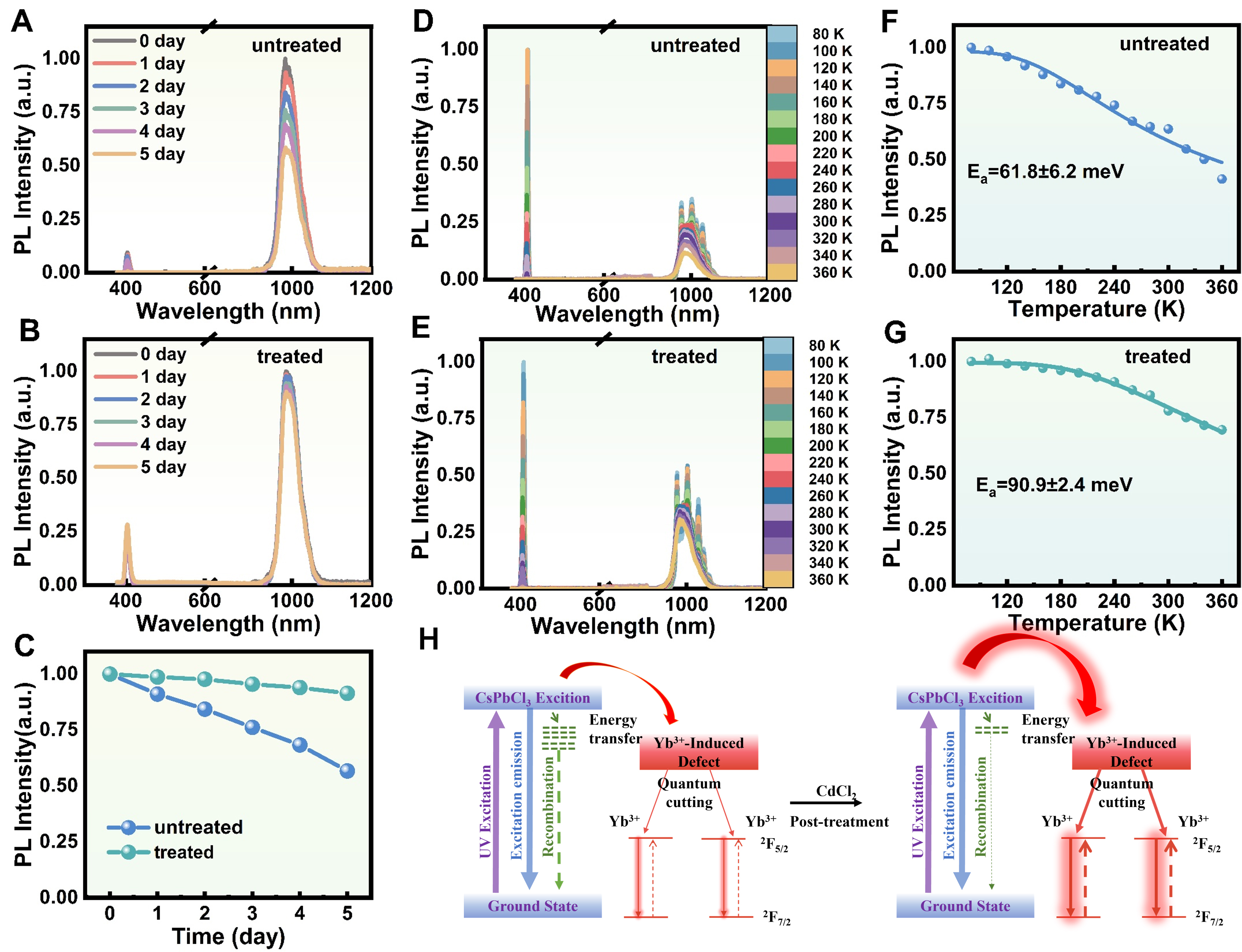
Figure 3. (A-C) PL spectra of untreated and CdCl2-treated Yb3+:CsPbCl3 NC films without encapsulation under continuous UV irradiation for different durations, along with the evolution of integrated total PL intensity versus irradiation time (normalized to unirradiated intensity); (D and E) Temperature-dependent PL spectra of untreated and CdCl2-treated Yb3+:CsPbCl3 NC films measured over the temperature range of 80-360 K; (F and G) Temperature-dependent integrated PL intensities of the Yb3+ emission, normalized to the emission intensity at 80 K; The solid lines represent fits to the Arrhenius equation; (H) Schematic illustration of the emission mechanism in Yb3+:CsPbCl3 NCs before and after CdCl2 treatment. PL: Photoluminescence; NC: nanocrystal; UV: ultraviolet.
The temperature-dependent PL of pristine and CdCl2-treated Yb3+:CsPbCl3 NCs was further examined over the temperature range of 80-360 K, as shown in Figure 3D and E. At 80 K, the Yb3+ near-infrared emission exhibits well-resolved splitting with distinct sub-peaks centered at approximately 975, 1,008, and 1,035 nm. As the temperature increases, these peaks gradually broaden and merge into a single asymmetric emission band due to thermal population redistribution and phonon-assisted broadening. The integrated PL intensities of Yb3+ emissions are summarized in Figure 3F and G. For the untreated NCs, the Yb3+ emission decreases monotonically with increasing temperature, showing a 59% intensity loss at 360 K relative to 80 K. In contrast, the CdCl2-treated NCs exhibit significantly improved thermal stability. The Yb3+ integrated intensity decreases much more weakly with increasing temperature, and the PL thermal quenching is limited to only 31% at 360 K. Further, to quantify the thermal stability of the Yb3+ emission, the temperature-dependent integrated intensities were analyzed using the Arrhenius equation[38]:
where I0 is the initial PL intensity, I(T) is the integrated PL intensity at temperature T, Ea is the activation energy for thermal quenching, kB is the Boltzmann constant, and A is a constant related to the host material. As shown by the solid lines in Figure 3F and G, the fitted curves agree well with the experimental data, indicating that the reduction in PL intensity is mainly dominated by thermally activated carrier escape. The untreated NCs exhibit a thermal-quenching activation energy (Ea) of 61.8 ± 6.2 meV, consistent with previous reports[38], whereas Ea increases significantly to 90.9 ± 2.4 meV after CdCl2 treatment. The higher Ea indicates that carriers must overcome a larger energy barrier to undergo thermal escape or to enter nonradiative decay pathways, thereby accounting for the reduced thermal quenching and improved thermal luminescence stability of the treated NCs. The proposed PL mechanism before and after CdCl2 treatment is schematically illustrated in Figure 3H. In the pristine Yb3+:CsPbCl3 NCs, photogenerated excitons can be trapped by defects or undergo nonradiative recombination, reducing the efficiency of exciton transfer to Yb3+ ions. After CdCl2 post-treatment, excitons are more efficiently funneled through shallow Yb3+-related sensitization states to the Yb3+ 2F5/2 excited state, followed by the characteristic 2F5/2-2F7/2 emission at 985 nm.
The practical feasibility of the synthesized Yb3+:CsPbCl3 NCs for large-area, flexible LSCs was demonstrated, as seen in Figure 4. As schematically illustrated in Figure 4A, the Yb3+-doped NCs were uniformly encapsulated into a PDMS matrix to construct the luminescent waveguide layer. Driven by the refractive index contrast at the PDMS/air interface, the isotropically emitted Yb3+ NIR photons were efficiently trapped via total internal reflection and guided to the edges for harvesting by the coupled silicon photovoltaic cells. The practical appearance of the NC-LSC is shown in Figure 4B. Under natural daylight, the NC-LSC remains highly transparent, allowing clear visualization of the white petals, yellow stamens, and green leaves, demonstrating excellent visible-light transmittance, a desirable property for building-integrated photovoltaic windows. Supplementary Figure 11 shows that CdCl2-treated NC-LSCs absorb primarily in the ultraviolet-blue region and are nearly transparent at the 985 nm emission of Yb3+, avoiding reabsorption-induced optical efficiency loss. To visually verify the optical waveguiding capability, an infrared camera was utilized to capture the emission profile under 365 nm UV excitation [Figure 4C]. A bright, concentrated NIR emission localized at the substrate edges was observed, directly confirming that the Yb3+ NIR photons are efficiently waveguided to the device edges. The PDMS-based LSCs also exhibit excellent mechanical flexibility, indicating strong potential for integration into flexible and smart optical windows. Crucially, the PL spectra of the NC solution and the corresponding LSC are nearly identical [Figure 4D], indicating their homogeneous solid-solution nature[21]. Compared with untreated Yb3+:CsPbCl3 NCs at the same loading (0.60 wt.%), the CdCl2-treated NC-LSC exhibits a lower optical density and a weaker absorption tail in the long-wavelength region, as shown in Supplementary Figure 12A, indicating that CdCl2 effectively suppresses NC aggregation in PDMS and the associated light scattering. Consequently, the visible transmittance is improved, and the parasitic optical losses are minimized, leading to a 30.5% enhancement in LSC emission intensity [Supplementary Figure 12B and C].
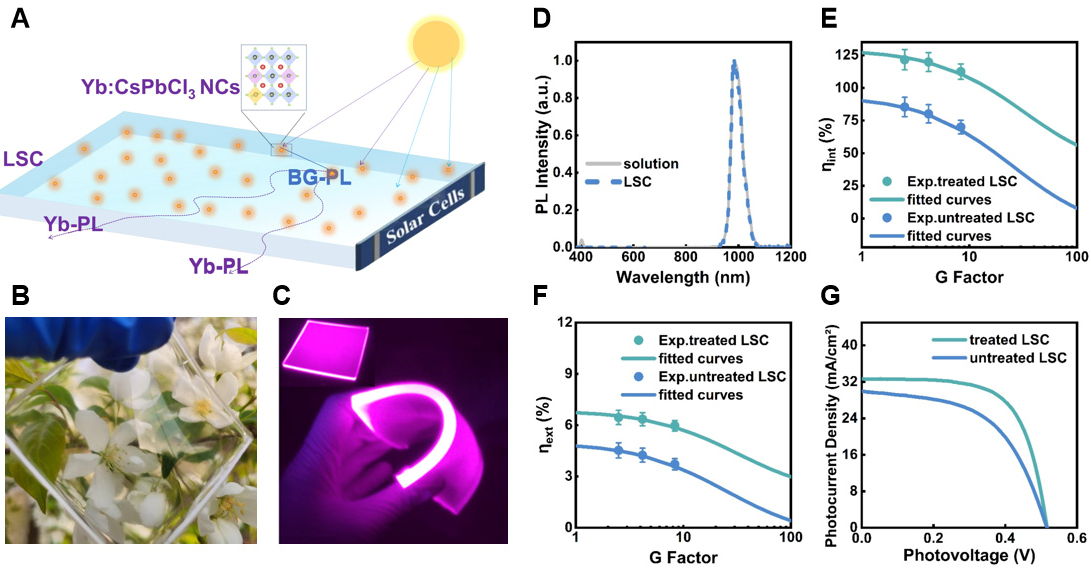
Figure 4. (A) Schematic illustration of the LSC integrated with a silicon solar cell; (B) Photograph of an LSC based on Yb3+-doped CsPbCl3 NCs under sunlight (dimension: 5 cm × 5 cm × 0.3 cm); (C) Photograph of the LSC captured by a near-infrared camera under ultraviolet light (365 nm) illumination. Photographs in Figure 4B and C were taken by the authors; (D) PL spectra of the CdCl2-treated Yb3+:CsPbCl3 NC solution and the corresponding LSC; (E and F) Internal optical efficiency (E) and external optical efficiency (F) of Yb3+:CsPbCl3 NC-LSCs before and after CdCl2 post-treatment. Error bars in (E and F) represent the standard deviation from three independently fabricated LSCs; (G) J-V curves of the silicon photovoltaic cells integrated with untreated and CdCl2-treated NC-LSCs. LSCs: Luminescent solar concentrators; NCs: nanocrystals; J-V: current density-voltage; PL: photoluminescence; BG: band gap.
The performance of the as-prepared NC-LSCs was calculated using an integrating sphere method [Supplementary Materials]. The internal optical efficiency (ηint) and external optical efficiency (ηext) of untreated and CdCl2-treated NC-LSCs with different geometric gain factors (G-factors) are shown in Figure 4E and F. At all device sizes, the CdCl2-treated NC-LSCs exhibit substantially higher efficiencies. For example, at G = 2.5, ηext increases from 4.5% to 6.4%, while ηint rises from 85.4% to 121.6%, respectively. Notably, the ηint value exceeding 100% directly reflects the efficient quantum-cutting process. Using a previously established scaling law [Supplementary Materials], the ηint and ηext of LSC with larger sizes can be projected. Notably, CdCl2 treatment enables more substantial optical efficiency enhancement for LSCs with larger sizes. The CdCl2-treated NC-LSCs consistently outperformed the untreated ones. These improvements originate from the combination of higher Yb3+ PLQY, more efficient exciton to Yb3+ energy transfer, and reduced scattering losses afforded by CdCl2 post-treatment. Supplementary Table 4 further benchmarks the LSCs developed in this work against previously reported perovskite-based LSCs. The CdCl2-treated Yb3+:CsPbCl3 NC-LSCs exhibited competitive comprehensive performance. The present devices combine a high total PLQY of 177.4%, an exciton-to-Yb3+ energy-transfer efficiency of 86.4%, excellent visible transparency, efficient NIR photon waveguiding, and an internal optical efficiency of 121.6%. Together with their improved photostability and thermal stability, these characteristics highlight the potential of CdCl2-treated Yb3+:CsPbCl3 NCs as high-performance emitters for flexible and transparent building-integrated photovoltaic systems. The optimized NC-LSCs were integrated with silicon photovoltaic cells and tested under standard AM 1.5G illumination. The resulting current density-voltage (J-V) and power-voltage (P-V) characteristics are depicted in Figure 4G and Supplementary Figures 13-14, with the corresponding photovoltaic parameters summarized in Supplementary Table 5. A clear enhancement in integrated device performance was observed for the CdCl2-treated NC-LSC compared to the untreated one, directly corroborating the upgraded optical efficiency shown in Figure 4E and F. These findings demonstrate that the CdCl2 post-treatment boosts NC emission efficiency and alleviates waveguided photon loss, ultimately yielding superior optical and photovoltaic performance in flexible Yb3+:CsPbCl3 NC- LSCs.
CONCLUSIONS
In summary, this work systematically investigated the effect of post-synthetic metal chloride treatment on the luminescent properties and device performance of Yb3+:CsPbCl3 NCs and their derived flexible LSCs. CdCl2 post-treatment substantially boosts the PLQY of Yb3+:CsPbCl3 NCs from 125.3% to 177.4%, accompanied by an obvious increase in the excitons to Yb3+ energy transfer efficiency from 75.9% to 86.4%. Compared with other common metal chloride treatments (ZnCl2, NiCl2, and CuCl2), CdCl2-treated Yb3+:CsPbCl3 NCs deliver the longest Yb3+ PL lifetime of 2.27 ms, the highest energy transfer efficiency and PLQY, verifying its unique superiority in promoting Yb3+ NIR emission. The treated NCs also exhibit markedly improved photostability and thermal stability, with reduced thermal quenching and increased activation energy for carrier escape. Flexible LSCs fabricated with the optimized CdCl2-treated Yb3+:CsPbCl3 NCs show excellent waveguiding and concentrating capability for NIR photons, achieving an internal optical efficiency exceeding 120%. This work demonstrates that CdCl2 post-treatment is a facile and effective strategy for constructing high-performance Yb3+-doped perovskite NCs, providing a promising emitting material for developing flexible, transparent LSCs for building-integrated photovoltaic applications.
DECLARATIONS
Authors’ contributions
Conceived the idea, conducted the majority of the experiments, performed data analysis, and wrote the manuscript: Yan, T.; Liu, Z.; Yuan, X.
Performed device testing and characterization: Liu, Z.; Zhang, S.
Assisted in experimental work and data interpretation: Song, L.; Ji, S.; Xing, K.
Writing - review and editing, supervision, conceptualization: Zhao, J.
Project administration, funding acquisition, formal analysis: Yuan, X.
Availability of data and materials
The data supporting the findings of this study are available within this Article and its Supplementary Materials. Further data are available from the corresponding authors upon request.
AI and AI-assisted tools statement
During the preparation of this manuscript, the AI tool Doubao (version V13.5.0, released 2026-04-23) was used to generate the small house graphic in the Graphical Abstract based on the authors’ descriptions. The AI tool Grammarly Business (Grammarly Inc., Microsoft Word add-in, accessed 2026-07) was used solely for language editing. These AI tools had no involvement in the research design, data collection, data analysis, result interpretation or any scientific content of this work. All authors take full responsibility for the accuracy, integrity, and final content of the manuscript.
Financial support and sponsorship
This work was supported by the Program for the Development of Science and Technology of Jilin Province (No. YDZJ202601ZYTS029) and Funding for Top Talent in Hebei Province (2025HBQZYCSB014).
Conflicts of interest
Zhao, J. is affiliated with Hebei Ledphor Optoelectronics Technology Co., Ltd, while the other authors have declared that they have no conflicts of interest.
Ethical approval and consent to participate
Not applicable.
Consent for publication
Not applicable.
Copyright
© The Author (s) 2026.
Supplementary Materials
REFERENCES
1. Baikie, T. K.; Allardice, J.; Dowland, S. A.; et al. Singlet fission luminescent solar concentrators. Nano. Lett. 2025, 25, 16204-11.
3. Wang, J.; Cai, T.; Chen, O. Cesium copper halide perovskite nanocrystal-based photon-managing devices for enhanced ultraviolet photon harvesting. Nano. Lett. 2023, 23, 4367-74.
4. Wang, Z.; Li, Z.; Qiu, Z.; et al. Stable and efficient perovskite-based luminescent solar concentrators enabled by Mn2+ doping and polymer modification of perovskite nanocrystals. Adv. Opt. Mater. 2025, 13, e00821.
5. Wei, M.; de Arquer, F. P. G.; Walters, G.; et al. Ultrafast narrowband exciton routing within layered perovskite nanoplatelets enables low-loss luminescent solar concentrators. Nat. Energy. 2019, 4, 197-205.
6. Bagherzadeh-khajehmarjan, E.; Nikniazi, A.; Olyaeefar, B.; Ahmadi-kandjani, S.; Nunzi, J. Bulk luminescent solar concentrators based on organic-inorganic CH3NH3PbBr3 perovskite fluorophores. Sol. Energy. Mater. Sol. Cells. 2019, 192, 44-51.
7. Zhang, Y.; Zhang, W.; Ye, Y.; Li, K.; Gong, X.; Liu, C. CsPbBr3 nanocrystal-embedded glasses for luminescent solar concentrators. Sol. Energy. Mater. Sol. Cells. 2022, 238, 111619.
8. Mendewala, B.; Nikolaidou, K.; Hoffman, C.; et al. The potential of scalability in high efficiency hybrid perovskite thin film luminescent solar concentrators. Solar. Energy. 2019, 183, 392-7.
9. Zhou, N.; Wang, D.; Bao, Y.; Zhu, R.; Yang, P.; Song, L. A review of perovskite nanocrystal applications in luminescent solar concentrators. Adv. Opt. Mater. 2023, 11, 2202681.
10. Wu, K.; Li, H.; Klimov, V. I. Tandem luminescent solar concentrators based on engineered quantum dots. Nature. Photon. 2018, 12, 105-10.
11. Wieliczka, B. M.; Möbs, J.; Noel, N. K.; Snaith, H. J. Assessing the opportunities of spectral shaping by quantum cutting for perovskite/silicon tandem solar cells. ACS. Energy. Lett. 2026, 11, 3664-75.
12. Wang, S.; Zhang, S.; Li, X.; Huang, D.; Yu, W. W.; Wang, L. Exciton localization engineering in thermally evaporated Yb-doped CsPbCl3 near-infrared light-emitting diodes. Adv. Mater. 2026, 38, e13853.
13. Sharma, M.; Cao, C.; Ramkissoon, P.; et al. Engineering energy harvesting pathways in Mn-Yb-doped perovskite nanocrystals. Adv. Opt. Mater. 2026, 14, e71437.
14. de Wit, J. W.; Sonneveld, L. L.; Meijerink, A. Shedding light on host-to-Yb3+ energy transfer in Cs2AgBiBr6:Yb3+ (nano)crystals. Chem. Mater. 2024, 36, 2857-66.
15. Pan, G.; Bai, X.; Yang, D.; et al. Doping lanthanide into perovskite nanocrystals: highly improved and expanded optical properties. Nano. Lett. 2017, 17, 8005-11.
16. Jing, Y.; Low, A. K. Y.; Liu, Y.; et al. Stable and highly emissive infrared Yb-doped perovskite quantum cutters engineered by machine learning. Adv. Mater. 2024, 36, e2405973.
17. Tran, M. N.; Cleveland, I. J.; Aydil, E. S. Reactive physical vapor deposition of Yb-doped lead-free double perovskite Cs2AgBiBr6 with 95% photoluminescence quantum yield. ACS. Appl. Electron. Mater. 2022, 4, 4588-94.
18. Liao, J.; Zhang, P.; Niu, X.; et al. Co-doping of stibium and rare earth (Nd, Yb) in lead-free double perovskite for efficient near-infrared emission. J. Alloys. Compd. 2022, 911, 164946.
19. Zhou, Y.; He, Z.; Ding, J.; et al. Highly photoluminescent Yb-doped CsPbBrI2 nanocrystals in ethylene vinyl acetate composite films for wide color gamut backlight displays. ACS. Appl. Nano. Mater. 2022, 5, 8942-9.
20. Tatarinov, D. A.; Skurlov, I. D.; Sokolova, A. V.; et al. Near-infrared two-photon excited photoluminescence from Yb3+-doped CsPbClxBr3-x perovskite nanocrystals embedded into amphiphilic silica microspheres. Nanoscale 2024, 16, 9011-20.
21. Cai, T.; Wang, J.; Li, W.; et al. Mn2+/Yb3+ codoped CsPbCl3 perovskite nanocrystals with triple-wavelength emission for luminescent solar concentrators. Adv. Sci. 2020, 7, 2001317.
22. Luo, X.; Ding, T.; Liu, X.; Liu, Y.; Wu, K. Quantum-cutting luminescent solar concentrators using ytterbium-doped perovskite nanocrystals. Nano. Lett. 2019, 19, 338-41.
23. Crane, M. J.; Kroupa, D. M.; Gamelin, D. R. Detailed-balance analysis of Yb3+:CsPb(Cl1-xBrx)3 quantum-cutting layers for high-efficiency photovoltaics under real-world conditions. Energy. Environ. Sci. 2019, 12, 2486-95.
24. Yong, Z. J.; Guo, S. Q.; Ma, J. P.; et al. Doping-enhanced short-range order of perovskite nanocrystals for near-unity violet luminescence quantum yield. J. Am. Chem. Soc. 2018, 140, 9942-51.
25. Li, F.; Liu, Y.; Wang, H.; Zhan, Q.; Liu, Q.; Xia, Z. Postsynthetic surface trap removal of CsPbX3 (X = Cl, Br, or I) quantum dots via a ZnX2/hexane solution toward an enhanced luminescence quantum yield. Chem. Mater. 2018, 30, 8546-54.
26. Ji, S.; Yuan, X.; Cao, S.; et al. Near-unity red Mn2+ photoluminescence quantum yield of doped CsPbCl3 nanocrystals with Cd incorporation. J. Phys. Chem. Lett. 2020, 11, 2142-9.
27. Yao, J.; Wang, D.; Yang, W.; Huang, K.; Xie, R.; Pradhan, N. Tailored doping in ionic crystals for the development of color-tunable metal halides through solid-state reactions. Chem. Mater. 2025, 37, 7431-8.
28. Zhao, K.; Ji, S.; Zhao, L.; et al. Enhanced near-infrared emission and stability of Yb-doped CsPbCl3 nanocrystals via amine ligand regulation for phosphor-converted light-emitting diodes. J. Alloys. Compd. 2025, 1036, 181832.
29. Zhang, X.; Zhang, Y.; Zhang, X.; et al. Yb3+ and Yb3+/Er3+ doping for near-infrared emission and improved stability of CsPbCl3 nanocrystals. J. Mater. Chem. C. 2018, 6, 10101-5.
30. Patra, B. K.; Agrawal, H.; Zheng, J. Y.; Zha, X.; Travesset, A.; Garnett, E. C. Close-packed ultrasmooth self-assembled monolayer of CsPbBr3 perovskite nanocubes. ACS. Appl. Mater. Interfaces. 2020, 12, 31764-9.
31. Sommer, D. E.; Gamelin, D. R.; Dunham, S. T. Defect formation in Yb-doped CsPbCl3 from first principles with implications for quantum cutting. Phys. Rev. Mater. 2022, 6, 025404.
32. Loh, S. M.; Jing, Y.; Sum, T. C.; Bruno, A.; Mhaisalkar, S. G.; Blundell, S. A. Mechanism of quantum cutting in Yb-doped CsPbCl3. J. Phys. Chem. Lett. 2025, 16, 2295-300.
33. Milstein, T. J.; Kroupa, D. M.; Gamelin, D. R. Picosecond quantum cutting generates photoluminescence quantum yields over 100% in ytterbium-doped CsPbCl3 nanocrystals. Nano. Lett. 2018, 18, 3792-9.
34. Yang, Y.; Chen, O.; Angerhofer, A.; Cao, Y. C. Radial-position-controlled doping of CdS/ZnS core/shell nanocrystals: surface effects and position-dependent properties. Chemistry 2009, 15, 3186-97.
35. Gao, T.; Wei, Z.; Gao, S.; Shi, J.; Sun, J. Defect-assisted auger recombination in graphitic carbon nitride revealed by excitation-density-dependent transient absorption spectroscopy. Opt. Lett. 2025, 50, 3792-5.
36. De, A.; Das, S.; Mondal, N.; Samanta, A. Highly luminescent violet- and blue-emitting stable perovskite nanocrystals. ACS. Materials. Lett. 2019, 1, 116-22.
37. van der Stam, W.; Geuchies, J. J.; Altantzis, T.; et al. Highly emissive divalent-ion-doped colloidal CsPb1-xMxBr3 perovskite nanocrystals through cation exchange. J. Am. Chem. Soc. 2017, 139, 4087-97.
Cite This Article
 Open Access
How to Cite
Yan, T.; Liu, Z.; Zhang, S.; Song, L.; Ji, S.; Xing, K.; Zhao, J.; Yuan, X. Boosting photoluminescence efficiency in Yb3+-doped CsPbCl3 nanocrystals via metal chloride post-treatment for high-performance luminescent solar concentrators. Energy Mater. 2026, 6, 600126. https://dx.doi.org/10.20517/energymater.2026.143
Download Citation
If you have the appropriate software installed, you can download article citation data to the citation manager of your choice. Simply select your manager software from the list below and click on download.
Export Citation File
Type of Import
Tips on Downloading Citation
Citation Manager File Format
Type of Import
Direct Import: When the Direct Import option is selected (the default state), a dialogue box will give you the option to Save or Open the downloaded citation data. Choosing Open will either launch your citation manager or give you a choice of applications with which to use the metadata. The Save option saves the file locally for later use.
Indirect Import: When the Indirect Import option is selected, the metadata is displayed and may be copied and pasted as needed.
About This Article
Special Topic
Copyright

Data & Comments
Data
0











Comments
Comments must be written in English. Spam, offensive content, impersonation, and private information will not be permitted. If any comment is reported and identified as inappropriate content by OAE staff, the comment will be removed without notice. If you have any queries or need any help, please contact us at [email protected].