



Wave-particle duality in ion transport toward a state-resonant energy transmission framework
 0
0 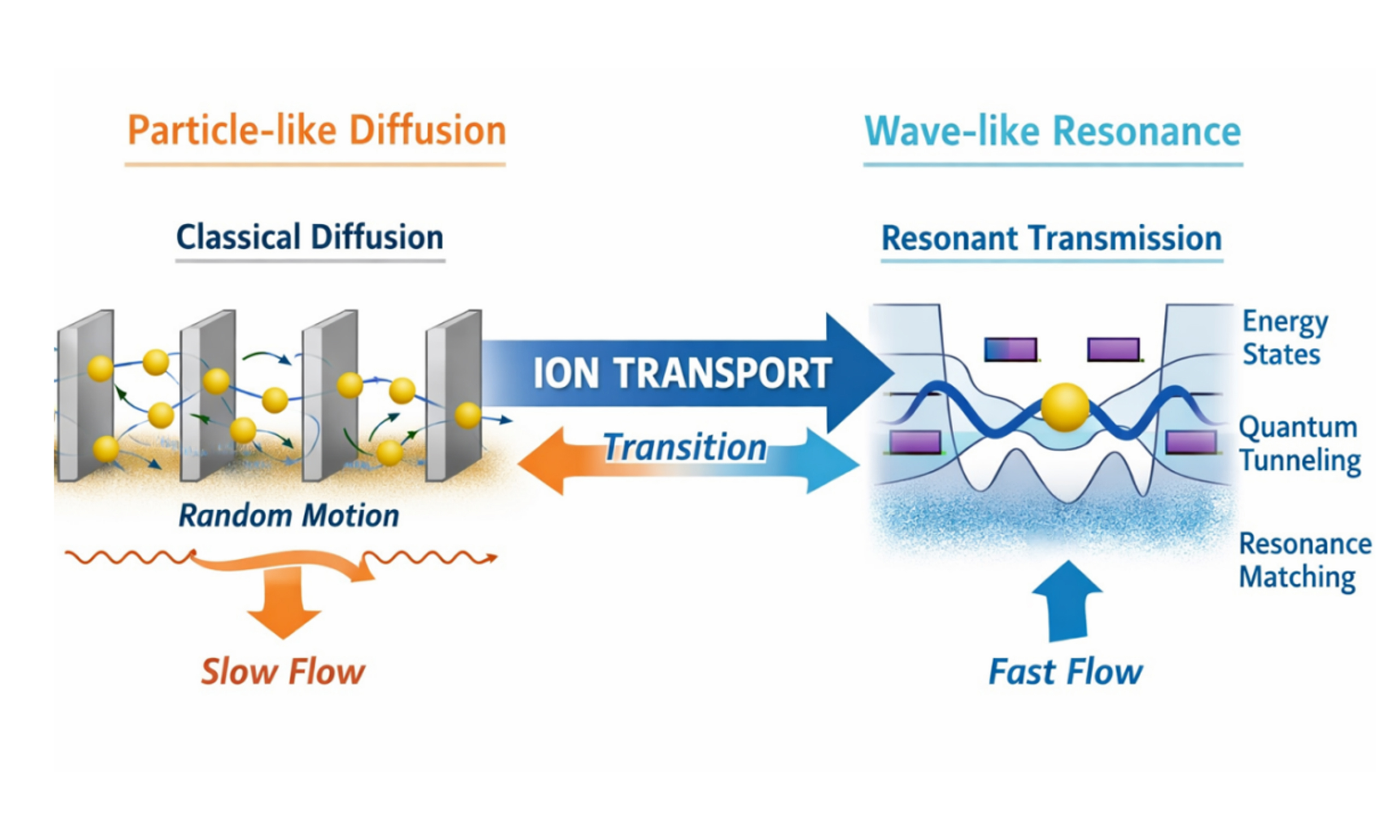
INTRODUCTION
Wave-particle duality (WPD) is foundational to modern physics, as established by Einstein and de Broglie[1,2]. By contrast, classical transport laws such as Ohm’s law, Fourier’s law, and Fick’s laws describe transport through gradient-driven particle motion in real space[3-5], while Arrhenius and reaction-rate approaches extend this picture by thermal activation over energy barriers[6,7]. These descriptions have been highly successful, but they also inherit an essentially particle-based view of realized transport processes.
Modern transport studies increasingly show that pathway existence alone is not always sufficient to explain realized transmission phenomena. Mesoscopic transmission concepts, resonant tunneling, and resonance-governed power transfer indicate that admissible states, coupling conditions, and intrinsic dynamical scales can become decisive[8-12]. Recent mathematical treatments of particle-wave mechanical systems further underscore the need to interpret particle-like and wave-like descriptions within a broader transport framework[13].
In the present article, transport is therefore reconsidered not solely as particle-like migration through real space, but also as a process that may be governed by wave-like/resonance-conditioned state admission. The aim is to provide a concise conceptual perspective for distinguishing two limiting pictures: classical diffusive migration and state-resonant transmission from the perspective of WPD. Ion transport is used as a representative and important application of this broader transmission picture, because transport in electrolytes, interfaces, and confined pathways often depends on selectivity, coupling, and dynamical-scale effects beyond a purely classical diffusion picture[14,15].
This perspective is especially relevant to electrochemical energy storage (EES) systems such as fuel cells, batteries, and electrolysis devices, where ionic motion and ion-electron coupled energy flow may evolve from classical diffusion toward resonance-conditioned transport. Recent developments in particle-wave mechanical analysis and contemporary ion-transport theory indicate that transport descriptions increasingly require attention to state sensitivity, confinement, and interface-conditioned realization, rather than pathway existence alone. Accordingly, the present article aims to bridge the long-standing particle-wave distinction with a more explicit transmission viewpoint, while keeping ion transport as a representative and practically important manifestation of the broader framework.
MINIMAL TRANSMISSION FRAMEWORK
A state-resonant energy transmission law (SRETL), Φ = ν0R(E)[16], is introduced to express the distinction described above. Here, Φ is defined at the most fundamental level as a transmission-event rate, ν0 is an intrinsic renewal or attempt frequency, and R(E) is a dimensionless state-admission function that determines whether transmission is physically realized under a given energy condition. In this sense, ν0 governs the cadence of possible transmission events, whereas R(E) governs their wave-conditioned admissibility. Classical diffusion corresponds to the limit in which admissibility is broad and weakly selective, whereas quantum transport emerges when admissibility becomes sharply resonance-selective.
This formulation is not intended as a fully projected macroscopic constitutive law for current density, heat flux, or mass flux. Instead, it provides a source-level organizing expression from which practical observables may be derived through projection onto the relevant transported quantity, together with the necessary density and geometric factors. This separation between event occurrence and physical transport reflects a first-principles requirement: a universal event law must be defined at the level of occurrence to remain dimensionally closed and transferable across systems, while specific transport expressions arise only at subsequent levels of physical specification.
A second point is that this framework distinguishes between levels of description that are often conflated in transport discussions. At the elementary level, realized transmission is treated as a state-admitted event. At a higher level, experimentally measured observables such as current, conductivity, and energy flow are interpreted as projected consequences that additionally depend on carrier density, geometry, coupling, and the transported physical quantity itself. In this way, the SRETL is used to organize the mechanism by which transmission is realized, whereas conventional transport coefficients remain necessary to quantify system-specific performance. Thus, transport realization depends on two coupled elements: an intrinsic dynamical renewal scale, represented by ν0, and a state-admission factor, represented by R(E), which determines whether the relevant transport state is effectively accessible, without yet constituting a fully closed constitutive theory for all macroscopic observables.
Within this perspective, classical diffusion corresponds to the particle-like limit in which R(E) is broad and weakly selective. Transport is then governed mainly by local hopping, drift, and barrier crossing along continuous pathways, and classical transport laws remain valid limiting descriptions. By contrast, resonant state transmission corresponds to the quantum wave-related limit in which R(E) becomes sharply selective, so that the decisive factor is not merely the existence of a pathway but whether a transmissible state is admitted. The key conceptual change is therefore not only mathematical but physical: WPD is treated here as relevant to realized transmission itself. Wave-like behavior is reflected not only through state selectivity, resonance conditioning, and intrinsic dynamical matching, but also through transmission across a spatially correlated network of admitted states, rather than through stepwise local migration alone. By contrast, particle-like behavior is reflected mainly through classical real-space hopping, drift, and barrier crossing. The present manuscript thus reframes WPD from a descriptive property of carriers to a guiding distinction between transport regimes.
For ion transport, this distinction is especially important. The existence of a geometrical pathway, defect-mediated route, or interfacial channel does not by itself guarantee realized transmission; the transport state must also become energetically and dynamically admissible. From this viewpoint, classical diffusion represents the pathway-dominated limit, whereas state-resonant transmission represents the admission-dominated limit. Within the SRETL framework, the quantum-like nature of the wave-dominant regime is expressed through a transition from broad ensemble transmission to resonant-state-selective admission. In this regime, ion transport is no longer controlled mainly by the statistical participation of many diffusive events or by stepwise local hopping, but by a set of admitted states forming a spatially correlated transmission network whose realization is enhanced under resonance. This selective and sharpened response is the physical basis for describing the process as wave-like and quantum-type. Figure 1 further illustrates the scientific principle behind.
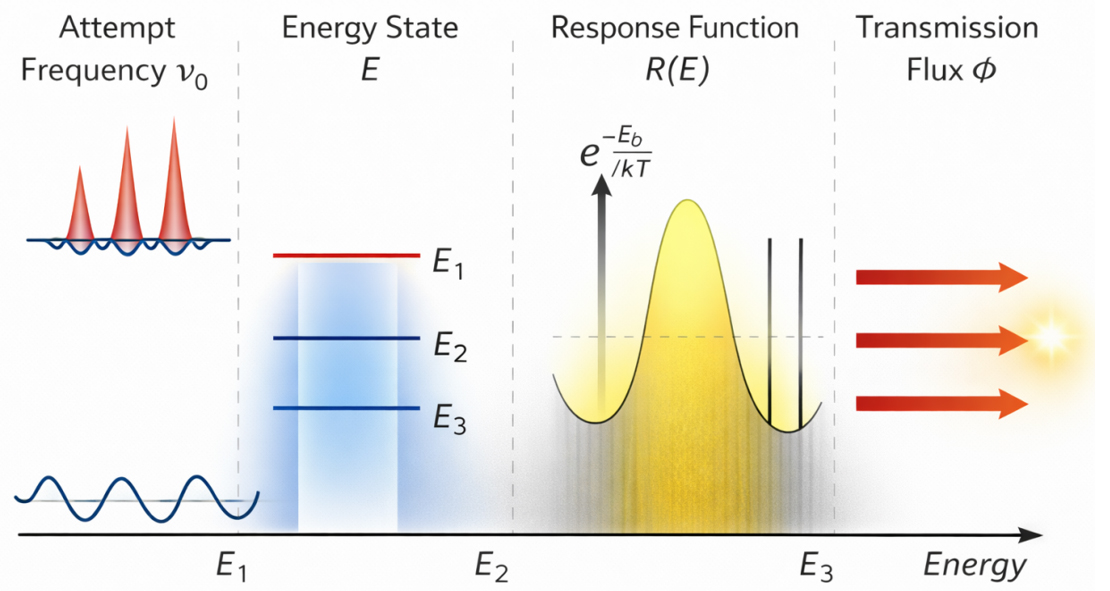
Figure 1. Energy-state transmission framework. Schematic illustration of transmission shifting from particle-like real-space migration toward energy-state admission under wave-/resonance-conditioned dynamics.
Therefore, transport becomes wave-related not simply because resonance is present, but because the transmission probability is governed by energy-state matching and dynamical admissibility rather than pathway availability alone. In this regime, resonance functions as a physical selection rule determining which states can actually transmit. In this sense, resonance acts as a selection law: it filters the full space of possible states and determines which transport states become effectively admitted. Quantum transport arises when this selection is no longer broad and statistical, but sharply controlled by discrete or quasi-discrete admitted states.
PROJECTION TO ION TRANSPORT
Ion transport provides a particularly important ground for the present framework because the realized transmission in electrolytes and interfaces often depends not only on pathway availability but also on state admissibility. In many electrolytes and electrochemical interfaces, transport is still discussed mainly with diffusion-based language. However, recent studies of solid-state ion transport and confined ion transport indicate that modern ion-transport behavior often depends on confinement, interfacial structure, and state-sensitive transmission conditions[14-16]. Wave-like ion transport, by contrast, corresponds to a regime in which transmission is conditioned by resonant or quasi-resonant state admission and proceeds through a spatially correlated network of admitted states, rather than through purely stepwise local migration. The point is not that all ion transport must be coherent or idealized, but that the realized transmission may increasingly depend on energy-state accessibility and dynamical matching rather than on pathway existence alone, as illustrated in Figure 2.
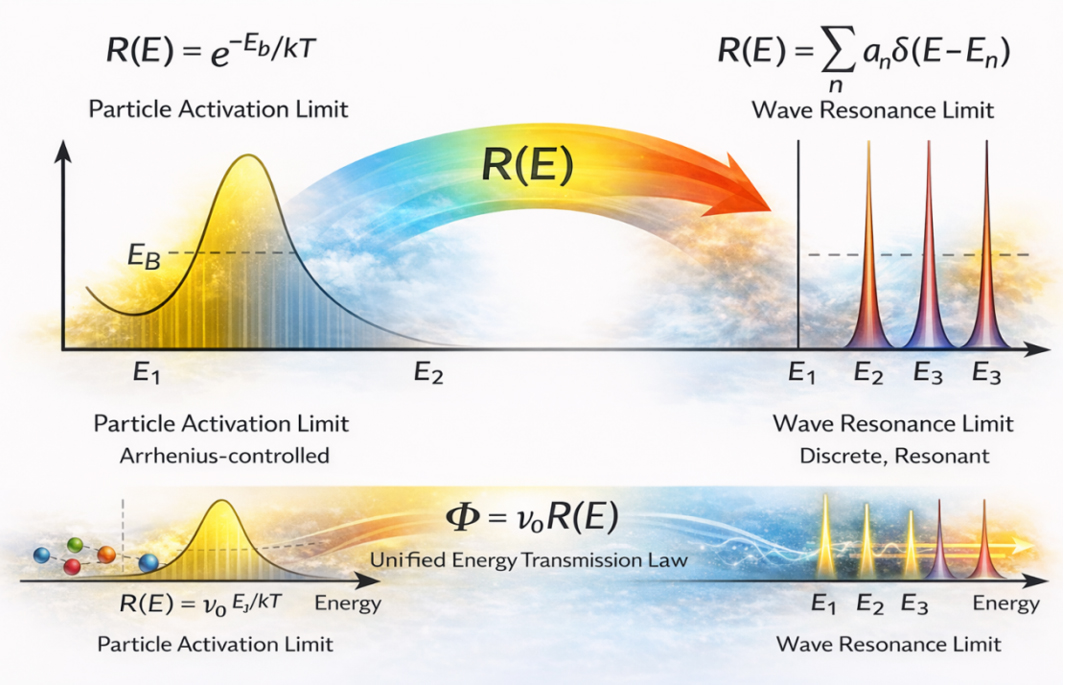
Figure 2. Unified energy response function bridging particle activation and wave-related resonance. A broad R(E) corresponds to diffusive/activated transport, whereas a sharply selective R(E) corresponds to state-resonant transmission.
This distinction is highly relevant to EES systems such as fuel cells, batteries, and electrolysis systems, where ionic transport, electronic coupling, and interfacial fields are often strongly intertwined. It is also relevant to broader materials contexts in which transport coefficients exhibit non-Arrhenius trends, anomalous effective activation energies, or frequency-sensitive behavior that suggests a transition away from a purely classical diffusion picture. Within this framework, ion transport is therefore not the only possible application, but it is one of the most important and physically transparent demonstrations.
Such a projection is useful because many contemporary ion-transport systems no longer behave as simple bulk media with one dominant activation barrier. Interfaces, defect landscapes, nanoscale confinement, mixed ionic-electronic coupling, and local field effects can all reshape which transport states are effectively realized. A recent study demonstrated that engineering oxygen vacancies as intrinsic lattice constituents reshapes the transport landscape and promotes wave-like, collective ion migration[17]. Under these conditions, the question is not only how many pathways exist, but also which states become dynamically admissible and whether their admission remains broad, selective, or resonant. Resonant transmission can be strongly enhanced under confined-state conditions. In general, resonant transmission can exceed diffusion-dominated transport by about an order of magnitude or more when state alignment and coherence conditions are favorable[18]. This broader view is increasingly relevant in modern ion-transport research, where confinement, interfaces, structural heterogeneity, and coupled ionic-electronic dynamics are often central to the realized behavior[19]. In such cases, transport may not be adequately captured by a purely pathway-based picture, because the effective transmission outcome can depend on whether particular states are activated, matched, or admitted under the relevant energetic and dynamical conditions. The present perspective is intended to make this distinction more explicit and thereby support more efficient engineering of EES systems.
OUTLOOK
This perspective offers a minimal framework for organizing transport thinking when classical particle-based descriptions become insufficient and when wave-like behavior, state selectivity, coupling, and intrinsic dynamical scales become physically decisive. It also explains why ion transport is emphasized without making the framework exclusive to EES systems. Ion transport is used as a focused and physically important manifestation because it clearly exhibits the tension between pathway-based migration and state-conditioned transmission, especially in fuel cells, batteries, and electrolysis devices. At the same time, the broader conceptual language may be useful wherever realized transport depends not only on path availability but also on whether a state becomes admitted under relevant energy and dynamical conditions. Future work should therefore test the framework quantitatively, examine how R(E) may be inferred from specific materials and spectra, and determine under what conditions classical transport transitions toward more sharply state-selective transmission behavior.
Thus, classical transport laws should be understood as limiting cases of a more general transmission principle. They remain valid and predictive when microscopic time scales are effectively hidden, but must be superseded when energy-state permission, rather than pathway existence alone, becomes decisive for realized transmission. The present framework provides a clear physical criterion for this transition, unifying classical and non-classical transport or quantum state transmission within a single conceptual structure[1,2,9,10]. The conceptual distinction between classical transport descriptions and energy-state-governed transmission is further clarified in Figure 3.
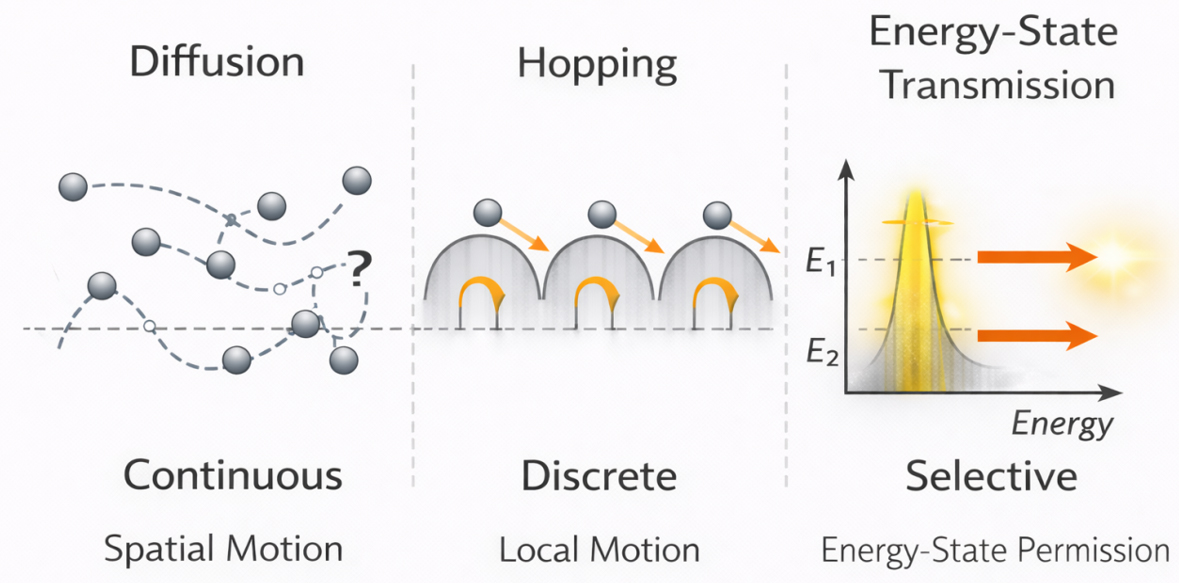
Figure 3. Energy-state transmission contrasted with hopping and diffusion models. The schematic highlights the distinction between classical pathway-based migration and transmission governed by admitted energy states.
In this sense, classical diffusion and resonant transmission should be regarded as two limiting manifestations within a broader transmission framework. Ion transport is emphasized here because it provides a concrete and important field in which this distinction may be tested, particularly in EES systems. Future work should further develop the mathematical projection from the minimal expression to measurable observables and should experimentally examine how confinement, coupling, and frequency sensitivity reshape realized transport.
DECLARATIONS
Authors’ contributions
The author solely contributed to the article.
Availability of data and materials
Not applicable.
AI and AI-assisted tools statement
During the preparation of this manuscript, the AI tool ChatGPT (version GPT-5.5, released 2026-04-23) was used solely for language editing. The tool did not influence the study design, data collection, analysis, interpretation, or the scientific content of the work. All authors take full responsibility for the accuracy, integrity, and final content of the manuscript.
Financial support and sponsorship
None.
Conflicts of interest
Zhu, B. is Co-Editor-in-Chief of the journal Energy Materials. Zhu, B. was not involved in any steps of the editorial process, notably including reviewer selection, manuscript handling, or decision making. The article was under a blind reviewing process.
Ethical approval and consent to participate
Not applicable.
Consent for publication
Not applicable.
Copyright
© The Author(s) 2026.
REFERENCES
1. Einstein, A. On a heuristic point of view concerning the production and transformation of light. Ann. Phys 1905, 17, 132-48. https://cir.nii.ac.jp/crid/1571135650150373888 (accessed 2026-04-30).
2. de Broglie, L. Recherches sur la théorie des quanta. Ann. Phys. 1924, 10, 22-128. https://cir.nii.ac.jp/crid/1571980075533806208 (accessed 2026-04-30).
3. Ohm, G. S. Die galvanische Kette, mathematisch bearbeitet. Berlin: T. H. Riemann; 1827. https://archive.org/details/bub_gb_tTVQAAAAcAAJ (accessed 2026-04-30).
4. Fourier, J. Théorie analytique de la chaleur. Paris: Chez Firmin Didot; 1822. https://archive.org/details/thorieanalytiq00four (accessed 2026-04-30).
6. Arrhenius, S. Über die reaktionsgeschwindigkeit bei der Inversion von rohrzucker durch Säuren. Z. Phys. Chem. 1889, 4, 226-48.
7. Hänggi, P.; Talkner, P.; Borkovec, M. Reaction-rate theory: fifty years after Kramers. Rev. Mod. Phys. 1990, 62, 251.
8. Zwanzig, R. Nonequilibrium statistical mechanics. Oxford: Oxford University Press; 2001. https://emu.tind.io/record/292513 (accessed 2026-04-30).
9. Landauer, R. Electrical resistance of disordered one-dimensional lattices. Philos. Mag. 2006, 21, 863-7. https://philpapers.org/rec/LANERO-4 (accessed 2026-04-30).
10. Datta, S. Electronic transport in mesoscopic systems; Cambridge: Cambridge University Press; 2013. https://www.cambridge.org/core/books/electronic-transport-in-mesoscopic-systems/1E55DEF5978AA7B843FF70337C220D8B (accessed 2026-04-30).
11. Van Der Vaart, N. C.; Godijn, S. F.; Nazarov, Y. V.; et al. Resonant tunneling through two discrete energy states. Phys. Rev. Lett. 1995, 74, 4702-5.
12. Kurs, A.; Karalis, A.; Moffatt, R.; Joannopoulos, J. D.; Fisher, P.; Soljačić, M. Wireless power transfer via strongly coupled magnetic resonances. Science 2007, 317, 83-6.
13. Hill, J. M. Mathematics of particle-wave mechanical systems. Cham: Springer; 2022. https://www.vitalsource.com/products/mathematics-of-particle-wave-mechanical-systems-james-m-hill-v9783031197932?srsltid=AfmBOor6O1d6d8LywwYIp9jhbScbk_W379i_bJSdfNUzFafs_cxxt_l9 (accessed 2026-04-30).
14. Fu, Z. H.; Chen, X.; Zhang, Q. Review on the lithium transport mechanism in solid‐state battery materials. WIREs. Comput. Mol. Sci. 2022, 13, e1621.
15. Liao, S.; Liu, Y.; Li, L.; Ding, L.; Wei, Y.; Wang, H. Theoretical framework for confined ion transport in two-dimensional nanochannels. Nat. Commun. 2025, 16, 6675.
16. Zhu, B. A state-resonant energy transmission law for energy materials and beyond. Energy. Z 2026, 2, 200001.
17. Rasool, S.; Anwar, M. F.; Sarfraz; et al. Superionic conduction through lattice engineering of fluorites stabilizing periodic oxygen vacancy network. Energy. Environ. Mater. 2026, 9, e70203.
18. Goorden, M. C.; Jacquod, P.; Weiss, J. Superconductivity-induced macroscopic resonant tunneling. Phys. Rev. Lett. 2008, 100, 067001.
Cite This Article
 Open Access
How to Cite
Download Citation
Export Citation File:
Type of Import
Tips on Downloading Citation
Citation Manager File Format
Type of Import
Direct Import: When the Direct Import option is selected (the default state), a dialogue box will give you the option to Save or Open the downloaded citation data. Choosing Open will either launch your citation manager or give you a choice of applications with which to use the metadata. The Save option saves the file locally for later use.
Indirect Import: When the Indirect Import option is selected, the metadata is displayed and may be copied and pasted as needed.
About This Article
Copyright

Data & Comments
Data
0











Comments
Comments must be written in English. Spam, offensive content, impersonation, and private information will not be permitted. If any comment is reported and identified as inappropriate content by OAE staff, the comment will be removed without notice. If you have any queries or need any help, please contact us at [email protected].