
fig2

A universal Ti<sub>3</sub>C<sub>2</sub> assisted strategy facilitates hole extraction of PEDOT:PSS anode interface layer for over 19% efficiency organic photovoltaics

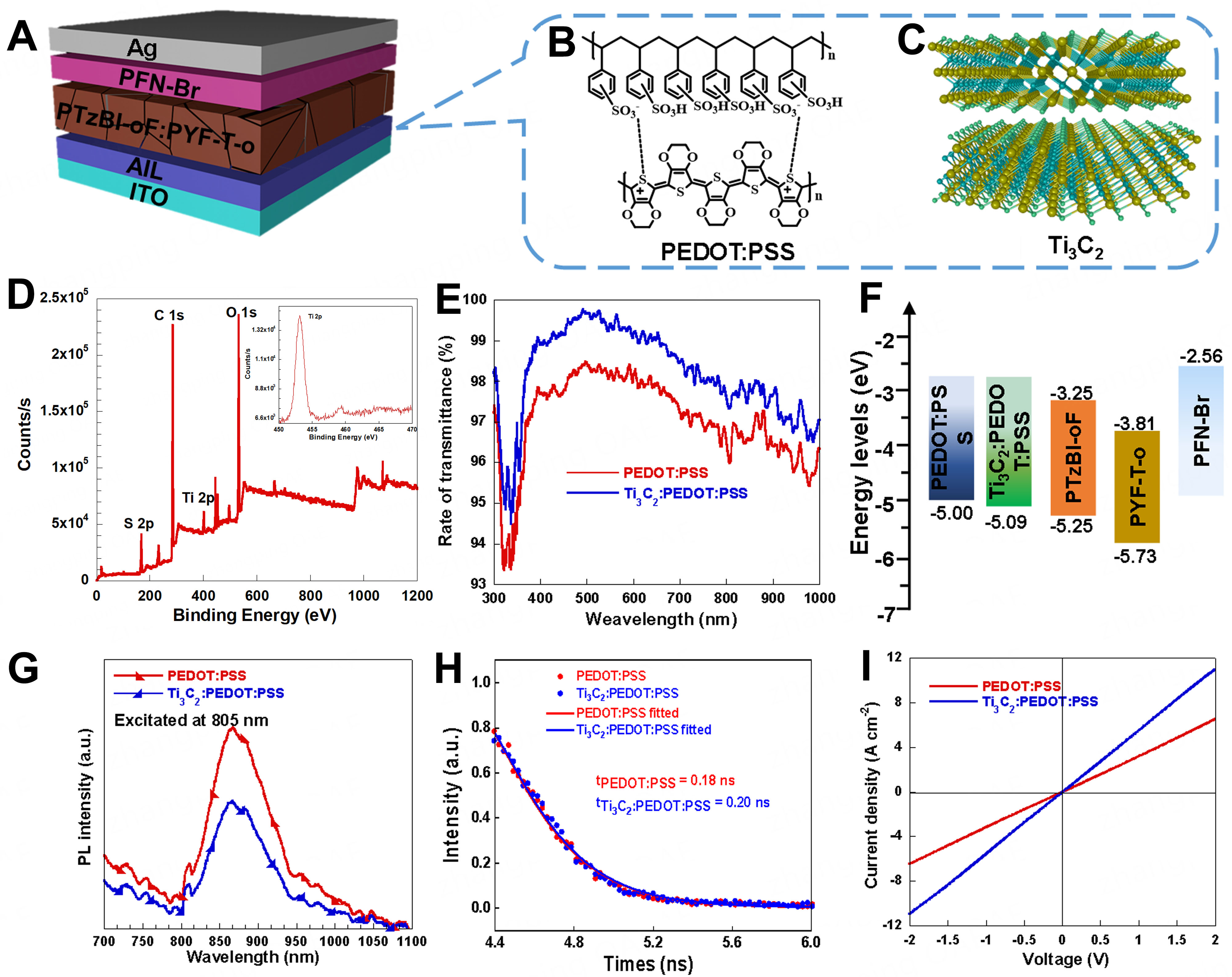
Figure 2. (A) Device structure of OPVs with Ti3C2:PEDOT:PSS hybrid AIL; (B) Chemical structures of PEDOT:PSS; (C) Schematic of Ti3C2 nanosheet; (D) XPS spectrum of Ti3C2:PEDOT:PSS hybrid AIL; (E) Transmittance of hybrid AIL with and without Ti3C2 at different wavelengths; (F) The energy level structures of PEDOT:PSS, Ti3C2:PEDOT:PSS, PTzBI-oF, PYF-T-o and PFN-Br; (G) PL and (H) TRPL spectrum of PTzBI-oF:PYF-T-o blend films with (or without) Ti3C2 in the PEDOT:PSS interlayer; (I) SCLC hole mobility for PTzBI-oF:PYF-T-o devices with (or without) Ti3C2 in the PEDOT:PSS interlayer. OPVs: Organic photovoltaics; PEDOT:PSS: poly(3,4-ethylenedioxythiophene):poly(styrenesulfonate); AILs: anode interfacial layers; PL: photoluminescence; TRPL: time-resolved photoluminescence.

Energy Materials
ISSN 2770-5900 (Online)
Follow Us

Portico

All published articles are preserved here permanently:

https://www.portico.org/publishers/oae/

Portico

All published articles are preserved here permanently:

https://www.portico.org/publishers/oae/