

Electrolysis-driven propane dehydrogenation via bromine-mediated strategy for 6000 h of excellent performance at ambient temperature
 0
0 


 Download PDF
Propene, as one of the most important light olefin feedstocks, is widely used for producing polymers and other chemicals, with a global market of over 217.74 billion dollars by the year of 2034[1]. Currently, the propane dehydrogenation (PDH) to propene attracts significant attention owing to the low-cost propane from the success of the shale gas revolution[2]. However, the activation of the C–H bond in propane requires harsh conditions up to 600 °C for reaching an industrially viable productivity. It not only causes serious energy consumption and rapid deactivation of the catalyst, but also induces various hydrocarbon by-products[3]. Therefore, an innovative PDH strategy with high propane conversion, superior propene selectivity and long-term stability under mild conditions is highly desired[4,5].
Promoting facile C–H activation in propane by sustainable electrochemistry for offering an efficient PDH shows great promise[6], as it allows breaking the PDH equilibrium limitation and operating at ambient temperatures (AT). Bhadouria et al. found that propane (C3H8) can be spontaneously activated on platinum at 0.3 V [vs. reversible hydrogen electrode (RHE)] under AT, but with an “average” adsorbate of C3H2*[7]. Besides that, introducing O2 gas as an oxidant, Liu et al. observed electrochemical PDH on a copper electrode, with a propane conversion rate of 11.6 μmol·cmCu-2·h-1 and a propene selectivity of 86% at AT[8]. However, the adsorption competition between propane and O2 on Cu, as well as the low propane solubility in electrolytes, are identified as the rate-determining steps. Altering the oxidant to liquid H2O2, the main product dramatically shifts to acetone (i.e., ~80% selectivity[9]) as the electrogenerated ·OH radicals directly convert propane to acetone via isopropanol. This indicates that electrolysis-driven PDH at AT is realizable, but with great challenges on developing efficient activators for C–H dissociation.
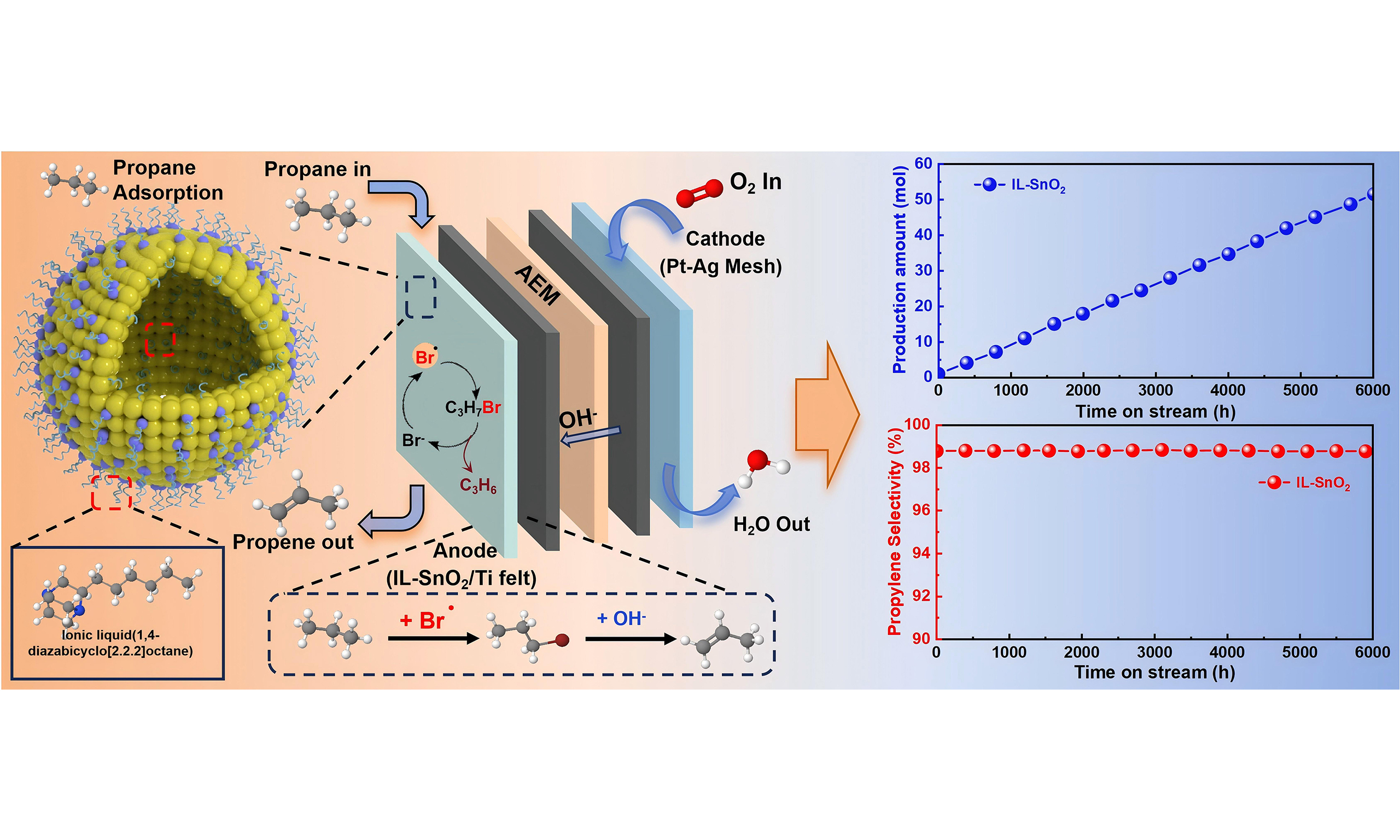
Recently, Yang et al. filled some of these gaps by proposing an innovative strategy, which uses electrogenerated bromine radicals (Br·) as the mediator to activate the C–H bond and produces propene by a tandem bromination - Br elimination reaction at AT [Figure 1A][10]. Briefly, using ionic liquid-SnO2 (IL-SnO2) as the anodic catalyst, Br- ions from the ionic liquid (IL; i.e., 1,4-diazabicyclo[2.2.2] octane/Br(CH2)nCH3) are electrochemically oxidized to bromine radicals (Br·). The Br· attacks the C–H of propane for the formation of a hydrocarbon intermediate (i.e., C3H7·), which spontaneously combines with the residual Br· to form C3H7Br. A further Br elimination of bromopropane with the hydroxide ions (OH-) in electrolytes (i.e., 1M NaBr in NaOH aqueous, pH~10) appears on the catalyst, releasing propene as the sole gas product. It overcomes the limitation of C–H activation in both the thermocatalytic route and the electrocatalytic oxidation route.
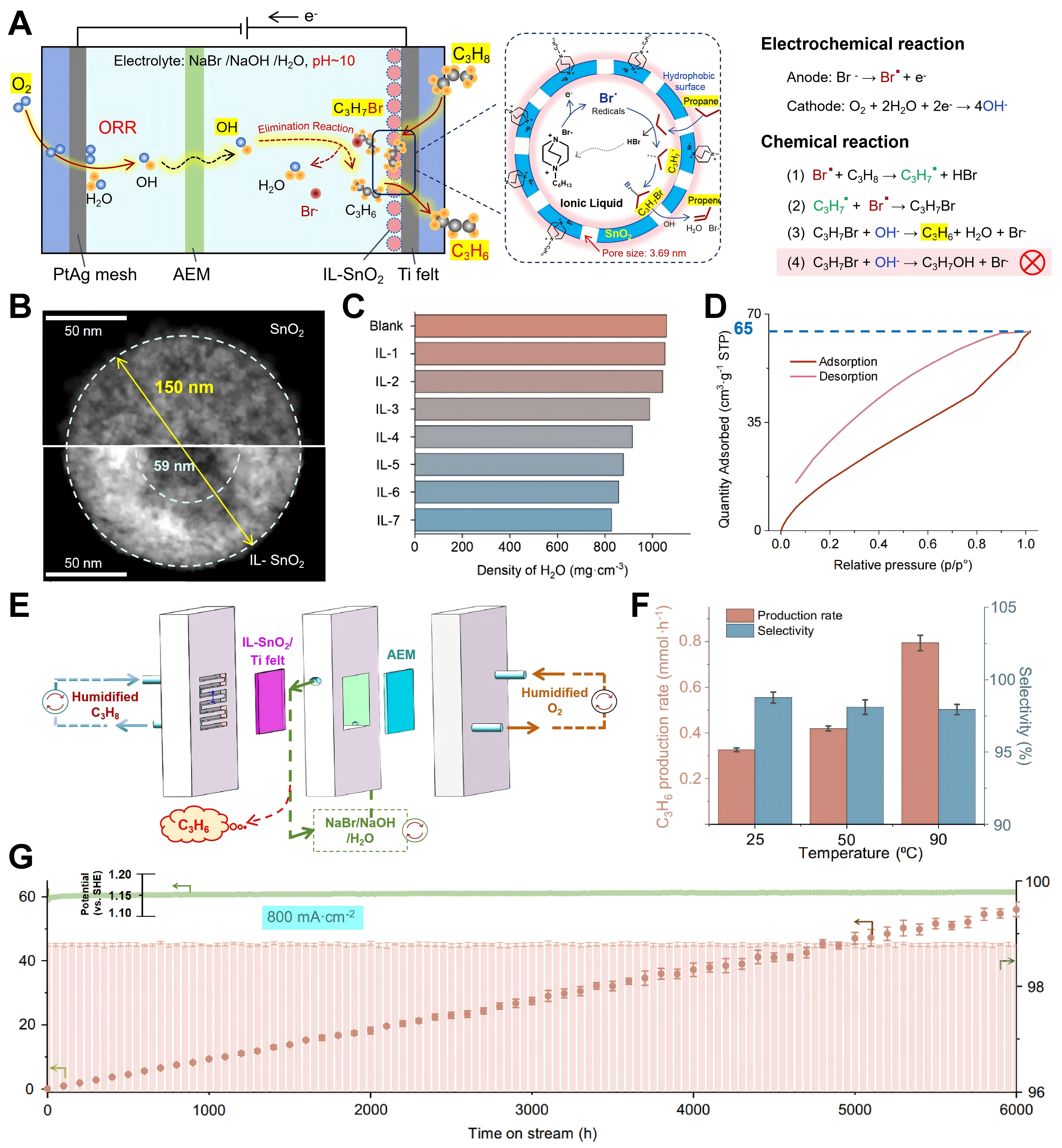
Figure 1. (A) Schematic diagram of the reaction process; (B) HAADF-STEM images of SnO2 (upper) and IL-SnO2 (bottom); (C) The calculated density of water on IL-SnO2 with different lengths of the alkyl chain; (D) The BET adsorption and desorption curves of C3H8 on IL-SnO2; (E) Schematic diagram of the flow reactor; (F) The production rate and selectivity of C3H6 at different temperatures in the flow reactor; (G) Stability test of IL-SnO2 under the constant current density of 800 mA·cm-2. (B-D) and (F and G) are reproduced with permission from Ref.[10], © 2026 The American Association for the Advancement of Science. HAADF-STEM: High-angle annular dark-field scanning transmission electron microscopy; IL: ionic liquid; BET: Brunauer–Emmett–Teller; ORR: oxygen reduction reaction; AEM: anion exchange membrane; SHE: standard hydrogen electrode.
A key finding of this work is developing an advanced catalyst (i.e., IL-SnO2 hollow spheres), which allows an efficient electrosynthesis of bromine radicals (Br·) to act as an initiator in PDH. Notably, Br· is an ideal species to activate the C–H bond, enabling spontaneous propane bromination (pKa ~4.92; Ka is the acid dissociation constant) to bromopropane (pKa ~8.85); however, keeping Br· radicals stable in alkaline electrolytes for reacting with propane is a challenge. They creatively proposed an IL decorated SnO2 catalyst with a hollow sphere structure (i.e., 150 nm of outer diameter, 59 nm of inner cavity diameter and a 3.69 nm mesopore in SnO2 skeleton) by a classical hydrothermal method [Figure 1B]. The ampholytic IL (i.e., a head of polar group of Br-N and a tail of non-polar group of alkyl chain) on SnO2 induces a hydrophobic surface of IL-SnO2 sphere, creating a water-deficient cavity for concentrating and stabilizing Br·/Br2 by preventing them from reacting with OH- during the electrocatalysis. Contrarily, a commercial benchmark of dimensionally stable anode (i.e., RuIrOx supported by Ti substrate) promotes hydroxyl radical (OH·) formation from the OH- electro-oxidation, instead of Br·, under the same conditions. They further evaluate the effect of the alkyl chain length [i.e., from -CH3 to -(CH2)6CH3] in IL molecular on the stability of Br·, revealing that a long alkyl chain (e.g., carbon number above 6) in IL intensively decreases the H2O density from 1,000 mg·cm-3 (i.e., on the pristine SnO2) to ~800 mg·cm-3 [Figure 1C] and promote a facile Br- oxidation to Br· at low over-potential of ~12.7 mV. Additionally, the hydrophobic property of IL-SnO2 also offers a high propane adsorption capacity above 65 mLpropane·gIL-SnO2-1 at 1 bar under AT [Figure 1D]. Here, the mesoporous hollow sphere of IL-SnO2 acts as a concentrator for the electrogenerated Br radicals and the propane reactant, enabling a spontaneous PDH in alkaline solution.
Significantly, the feasibility of the Br-mediated PDH approach for practical use was verified by using a gas diffusion electrode (GDE) and membrane-electrode assembly (MEA) in Figure 1E. It shows a temperature-dependent propene (C3H6) production rate and selectivity [Figure 1F], with 0.32 and 0.8 mmolpropane·h-1 at room temperature and 90 °C, respectively. High propene selectivity (~98.3%) with trace C3H6Br2 (i.e., ~0.2%) and C3H7Br (i.e., ~0.5%) was obtained, indicating that > 99% purity of propene could be obtained from the electrolyte chamber. Importantly, after 6,000 h of reaction at 800 mA·cm-2 [Figure 1G], the propene selectivity and the catalytic activity have negligible decrease, with a tiny increase rate (3.16 μV·h-1) of potential. It is superior to the commercial route (e.g., Oleflex from Honeywell UOP on Pt-Sn/Al2O3[2] shows 35%-45% propane conversion at above 600 °C with a catalytic stability below 10 h), revealing its high promise for acting as a next-generation PDH technology.
As comments and perspectives, Yang et al. innovated a Br-mediated strategy that enables electrocatalysis-driven PDH to have high value in industrial application[10]. However, several questions remain open: (1) A few puzzles still remain in the catalytic mechanism; e.g., Br- elimination between bromopropane (C3H7Br) and OH- theoretically prefers to give C3H7OH as the main product. Interestingly, the selectivity here shifts toward propene (C3H6). So, the reaction kinetics of Br elimination reaction warrants in-depth calculations and verification. (2) One prefers to believe that the Br-mediator PDH reaction mainly occurs at the inner cavity of IL-SnO2 hollow sphere, while further evidence of the Br- source for PDH reaction (e.g., isotopic labeling) and the rate-determining step of the reaction needs to be presented. (3) Partial Br2 and by-products are identified, indicating a loss of Br mediator during catalytic reaction. The formation of Br2, C3H6Br2 and C3H7Br by-products is essentially due to both a lack of C3H8 reactant and the sluggish hydrolysis of bromopropane. Further optimization on the diameter of the inner cavity of IL-SnO2 hollow sphere for concentrating C3H8 and on the thickness and pore size of SnO2 skeleton for altering the bromopropane hydrolysis process are highly desired to avoid the necessary replacement of the electrolyte every 500 h during stability test. (4) For the scalability of this technology, in addition to the pilot-scale electrode manufacture, a cell assemble stack needs to be designed and built under the consideration of the effect of mass transfer in GDE and MEA. It may be strongly promoted by the construction of commercial fuel cells. All these questions are required to be addressed before reaching industrialization for sustainable PDH.
DECLARATIONS
Acknowledgments
The authors acknowledged the Hubei Provincial Department of Education for the “Chutian Scholar” program and the “Wuhan Yingcai” program for their support on building our research team.
Authors’ contributions
Made substantial contributions to conception and design of the study and performed data analysis and interpretation: Wang, Z.; Su, B. L.
Performed data acquisition and provided administrative, technical, and material support: Wang, Z.; Liu, X. L.; Wang, B. Y.; Cheng, B. C.
Availability of data and materials
Not applicable.
AI and AI-assisted tools statement
Not applicable.
Financial support and sponsorship
This work was supported by the National Natural Science Foundation of China (Nos. 22293020, 22293022).
Conflicts of interest
Su, B. L. is the Editor-in-Chief of the journal Chemical Synthesis. Su, B. L. was not involved in any steps of editorial processing, notably including reviewers’ selection, manuscript handling, or decision-making. The other authors declare that there are no conflicts of interest.
Ethical approval and consent to participate
Not applicable.
Consent for publication
Not applicable.
Copyright
© The Author(s) 2026.
REFERENCES
1. Propylene market size, share & industry analysis, by derivative (polypropylene, propylene oxide, acrylonitrile, acrylic acid, cumene, and others), by application (packaging, automotive, construction, consumer goods, electrical & electronics, and others), and regional forecast. (2026-2034). https://www.fortunebusinessinsights.com/propylene-market-109718. (accessed 2026-09-08).
2. Tao, J.; Liu, S. L.; Li, Z. D.; et al. Ultrastable Pt clusters confined on CeO2 nano-islands for efficient low-temperature propane dehydrogenation over carbon nanotube. Chem. Eng. J. 2026, 540, 177477.
3. Li, Q.; Li, S.; Wang, J.; Wang, S.; Fan, W.; Dong, M. Progress of construction of metal-zeolite catalysts for propane dehydrogenation. Chem. Synth. 2025, 5, 83.
4. Jiao, J.; Yang, Y.; Yuan, M.; et al. Coke deposition mechanisms of propane dehydrogenation on different sites of Al2O3 supported PtSn catalysts. Chem. Synth. 2025, 5, 19.
5. Ma, Y.; Song, S.; Liu, C.; et al. Germanium-enriched double-four-membered-ring units inducing zeolite-confined subnanometric Pt clusters for efficient propane dehydrogenation. Nat. Catal. 2023, 6, 506-18.
6. Chen, S.; Chang, X.; Sun, G.; et al. Propane dehydrogenation: catalyst development, new chemistry, and emerging technologies. Chem. Soc. Rev. 2021, 50, 3315-54.
7. Bhadouria, A.; Heil, J. N.; Parab, D. E.; Greeley, J. P.; Tackett, B. M. Propane activation on Pt electrodes at room temperature: quantification of adsorbate identity and coverage. Angew. Chem. Int. Ed. Engl. 2025, 64, e202421613.
8. Liu, Q.; Li, H. C.; Li, C.; et al. Electrochemically promoted activation of light alkanes at ambient conditions. Angew. Chem. Int. Ed. 2025, 64, e202507417.
9. Hu, X.; Li, M.; Jiang, W.; et al. One-step electrochemical conversion of propane to acetone of 96% purity. Nat. Commun. 2025, 16, 8068.
Cite This Article
 Open Access
How to Cite
Download Citation
If you have the appropriate software installed, you can download article citation data to the citation manager of your choice. Simply select your manager software from the list below and click on download.
Export Citation File
Type of Import
Tips on Downloading Citation
Citation Manager File Format
Type of Import
Direct Import: When the Direct Import option is selected (the default state), a dialogue box will give you the option to Save or Open the downloaded citation data. Choosing Open will either launch your citation manager or give you a choice of applications with which to use the metadata. The Save option saves the file locally for later use.
Indirect Import: When the Indirect Import option is selected, the metadata is displayed and may be copied and pasted as needed.
About This Article
Copyright

Data & Comments
Data
0












Comments
Comments must be written in English. Spam, offensive content, impersonation, and private information will not be permitted. If any comment is reported and identified as inappropriate content by OAE staff, the comment will be removed without notice. If you have any queries or need any help, please contact us at [email protected].