
fig2
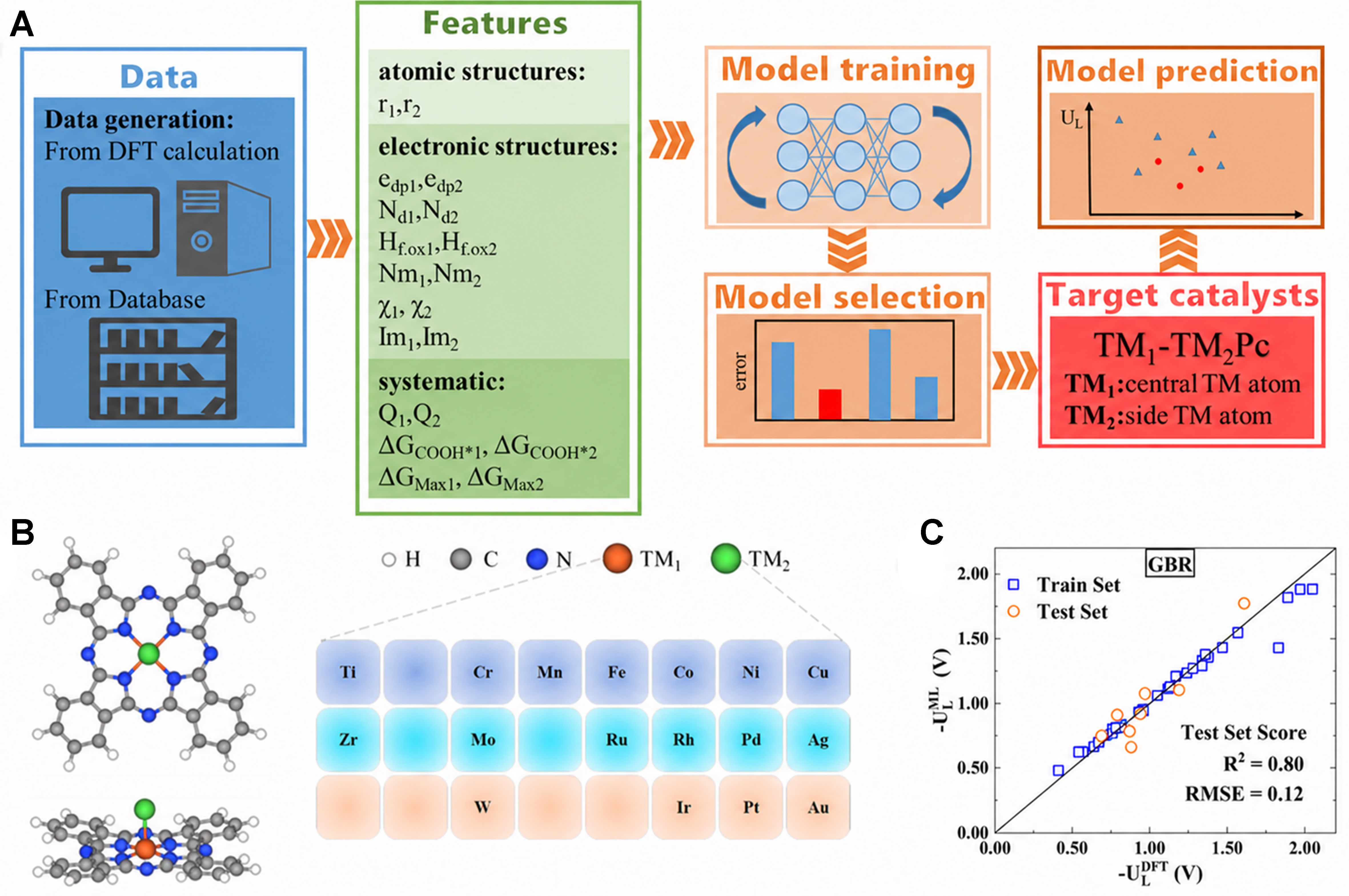
Figure 2. ML-accelerated prediction of catalytic activity for transition metal Pc DMSCs. (A) Workflow for predicting the limiting potential UL: DFT- and database-derived features spanning atomic (r1, r2), electronic (ed, Nd, Hf,ox, χ, Im), and thermodynamic (Q, ΔGCOOH*, ΔGMax) descriptors are used for model training, model selection, and prediction of target TM1–TM2 Pc DMPcs, where TM1 is the central and TM2 the side transition-metal atom; (B) Structure of the Pc DMSCs and the transition metals surveyed; (C) Parity plot for the best-performing GBR model: DFT-computed vs. ML-predicted limiting potential (-UL), with test-set R2 = 0.80 and RMSE = 0.12 V. (A-C) Reprinted (adapted) with permission from Ref.[57]. Copyright © 2021 American Chemical Society. ML: Machine-learning; Pc DMSCs: phthalocyanine dual-metal-site catalysts; DFT: density functional theory; GBR: gradient boosting regression; RMSE: root mean squared error.