
fig1
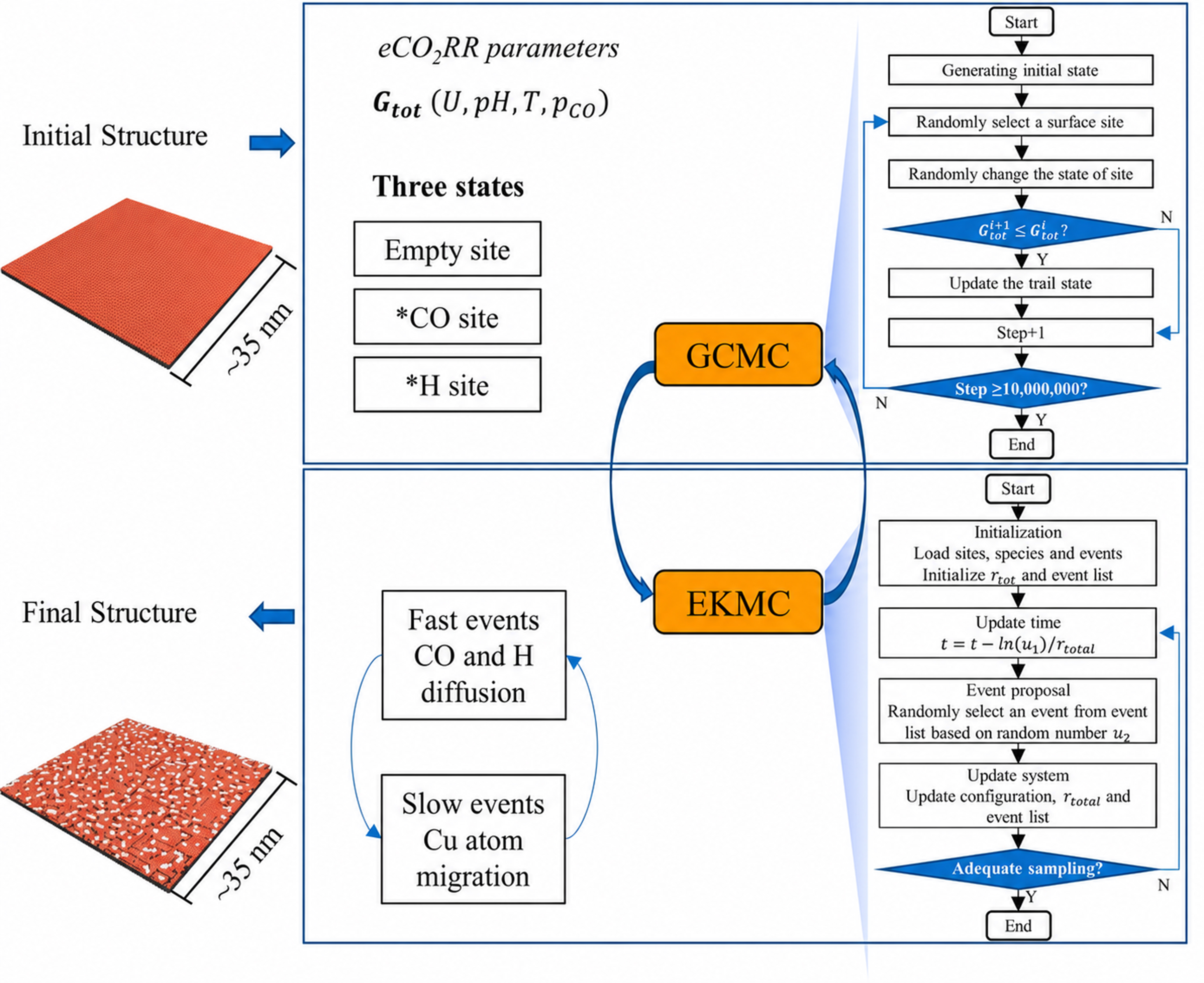
Figure 1. Coupled GCMC–EKMC workflow for simulating potential-dependent *CO/*H co-adsorption and Cu(100) surface reconstruction under eCO2R conditions. Top left: Initial ordered Cu(100) surface (~35 nm lateral dimension)[30]. Top right: The GCMC loop samples the occupancy of each surface site (empty, *CO-occupied, or *H-occupied) under fixed electrochemical parameters (U, pH, T, pCO) via Metropolis-criterion acceptance until convergence: a proposed move is accepted with probability min{1, exp(-ΔGtot/kBT)}, where ΔGtot = Gtoti+1 - Gtoti, so that moves lowering the total free energy are always accepted, and those raising it are accepted with Boltzmann probability[30]. Bottom left: Final reconstructed Cu(100) surface (~35 nm), in which adsorbate-driven Cu atom migration produces a disordered morphology qualitatively distinct from the initial slab[30]. Bottom right: The converged GCMC coverage is passed to an EKMC loop, which propagates the surface in time by distinguishing fast (CO and H diffusion) from slow (Cu migration) events[30]. All panels reproduced with permission from Ref.[30]. Copyright © 2026 American Chemical Society. GCMC–EKMC: Grand canonical Monte Carl and environmental kinetic Monte Carlo; eCO2R: electrochemical CO2 reduction.