

fig16
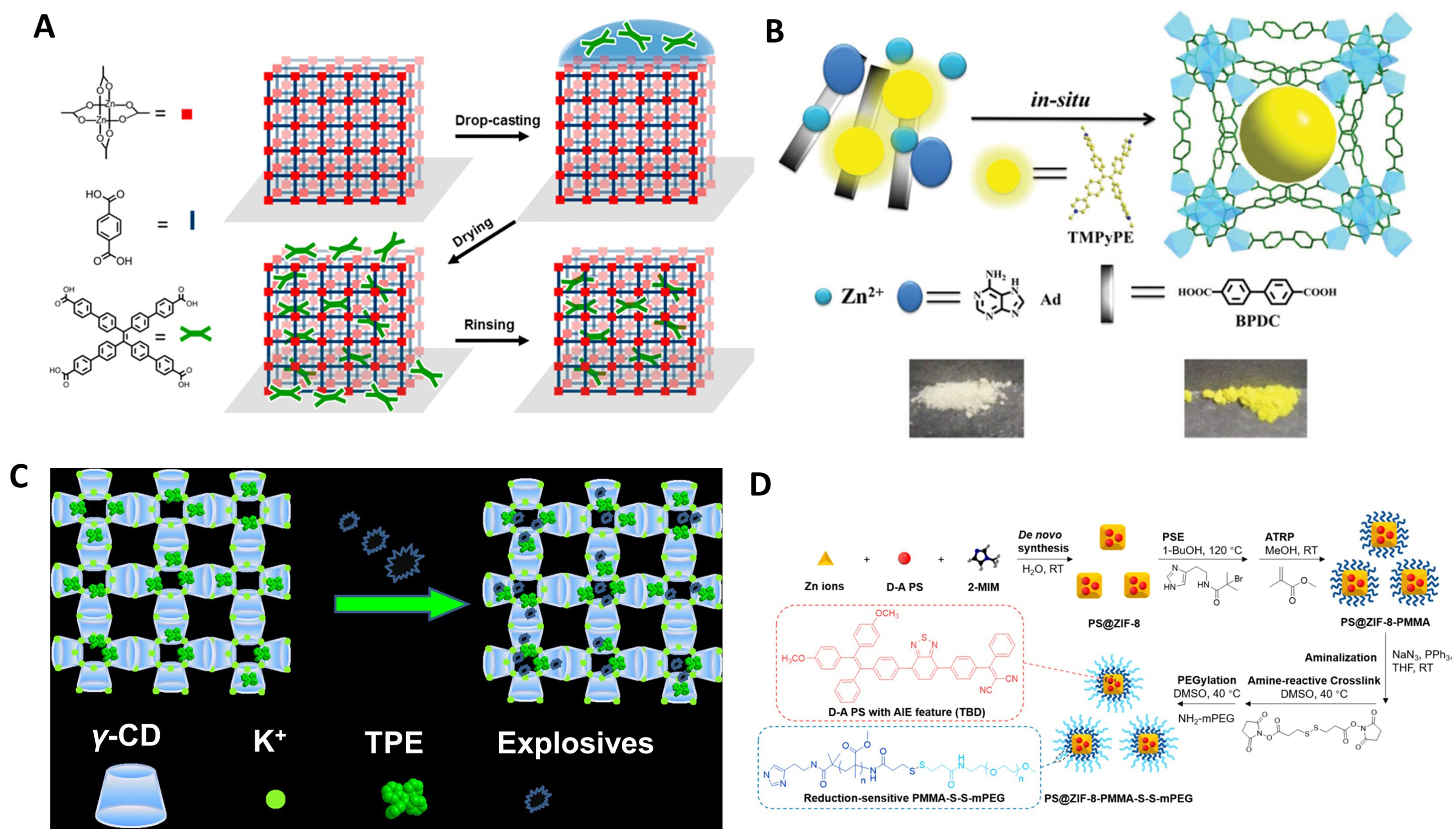
Figure 16. (A) The process of postfabrication SURMOF loading by drop-casting with ETTC[81], Copyright 2018, American Chemical Society; (B) Schematic illustration of the encapsulation of TMPyPE into bioMOF-1, and photographs showing the change of colours before and after encapsulation[243], Copyright 2019, Royal Society of Chemistry; (C) Schematic illustration of the TPE@γ-CD-MOF-K with explosive detection properties[244], Copyright 2020, American Chemical Society; (D) Synthetic schemes to PS@ZIF-8-PMMA-S-S-mPEG[207], Copyright 2020, American Chemical Society. SURMOF: Surface-anchored metal–organic framework; ETTC: 4’,4’’’,4’’’’’,4’’’’’’’-(ethene-1,1,2,2-tetrayl)tetrakis(([1,1’-biphenyl]-4-carboxylic acid)); TMPyPE: tetrakis[4-(1-methylpyridin-4-yl)phenyl]ethene; bioMOF: biological metal–organic framework; TPE: tetraphenylethylene; γ-CD: gamma-cyclodextrin; MOF: metal–organic framework; K: potassium; PS: polystyrene; ZIF: zeolitic imidazolate framework; PMMA: polymethyl methacrylate; S-S: disulfide bond; mPEG: methoxy polyethylene glycol; BPDC: biphenyl-4,4'-dicarboxylic acid; 2-MIM: 2-methylimidazole; RT: room temperature; PSE: postsynthetic exchange; ATRP: atom-transfer radical polymerization; TBD: 2-((4-(7-(4-(2,2-bis(4-methoxyphenyl)-1-phenylvinyl)phenyl)benzo[c][1,2,5]thiadiazol-4-yl)phenyl)(phenyl)methylene)malononitrile; DMSO: dimethyl sulfoxide; THF: tetrahydrofuran.