

Women’s power: how do female executives promote corporate low-carbon performances
 0
0 Graphical Abstract
Abstract
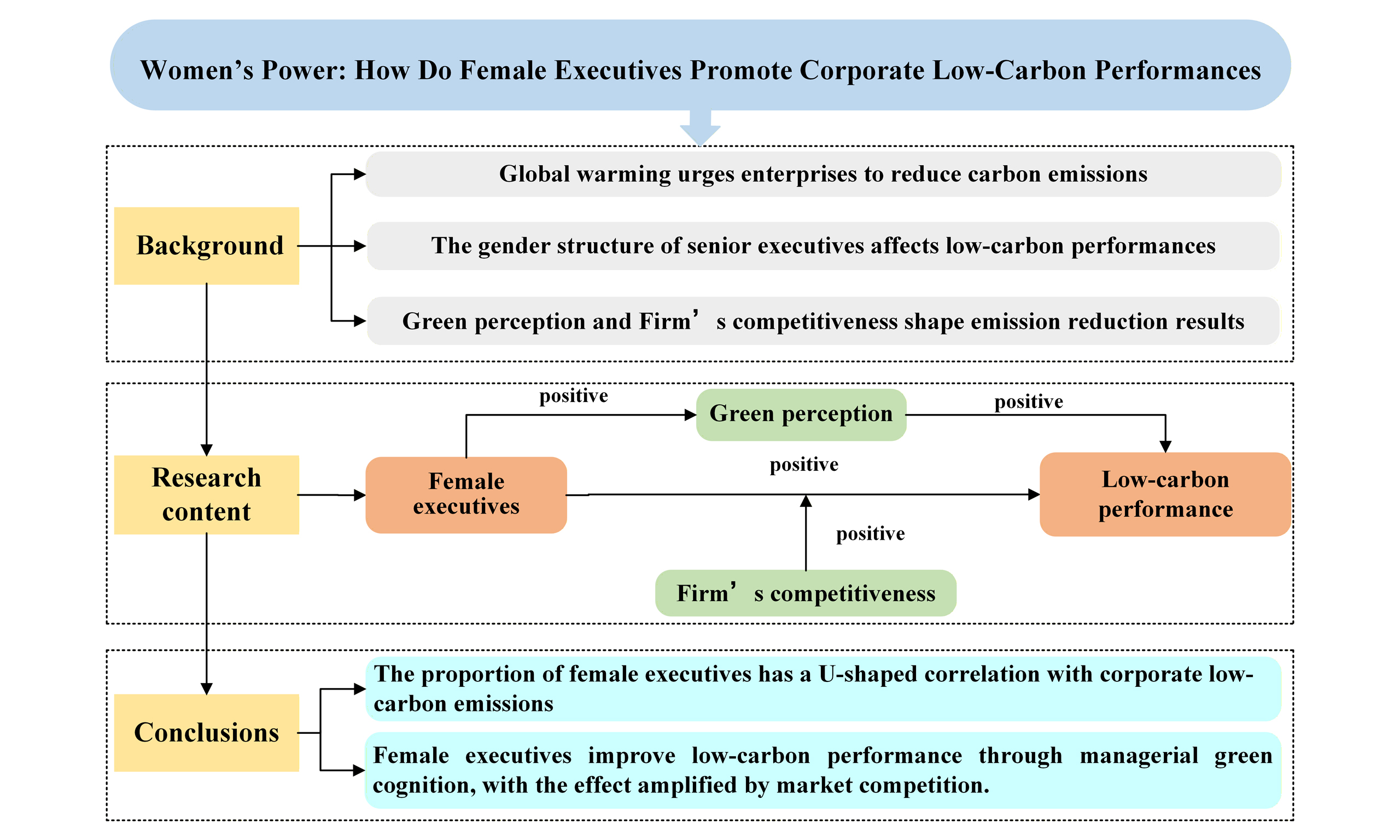
As gender equality and low-carbon development have become pressing social issues, researching how gender diversity among corporate executives influences a company’s low-carbon performance can help advance social progress and corporate sustainability. This study analyzes 5,413 Chinese listed companies from 2007 to 2024 to examine the impact of female executives on corporate low-carbon performance and the underlying mechanisms. Furthermore, this study explores the nonlinear relationships among these factors. The results indicate that the presence of female executives generally contributes to reducing corporate carbon emissions. Notably, a U-shaped relationship is observed between the proportion of female executives and corporate carbon emissions, suggesting that there is an optimal range for female executive participation in corporate low-carbon performance, and that achieving a more balanced gender structure is more beneficial. Mechanism analysis indicates that female executives enhance corporate low-carbon performance by fostering green awareness among executive teams, and this effect is amplified in highly competitive markets. Furthermore, heterogeneity analysis reveals that the emission-reduction effect of female executive participation is influenced by firm size and ownership structure, with more pronounced effects observed in large enterprises and state-owned enterprises.
Keywords


 Download PDF
INTRODUCTION
Global warming has triggered extreme weather events such as rising sea levels[1] and glacial melting[2], posing a threat to human security and the sustainable development of society. To address this global challenge, countries around the world have taken action, focusing on reducing carbon dioxide emissions. Through measures such as improving carbon markets[3], establishing carbon pricing[4], and imposing carbon border adjustment tariffs[5], they are accelerating the transition to a low-carbon economy. Against this backdrop, as a major contributor to global carbon emissions, China faces pressure from the international community to reduce emissions. At the same time, in support of global carbon reduction efforts and in line with its commitment to environmental protection, China has solemnly declared that it will “strive to reach peak carbon emissions before 2030 and achieve carbon neutrality before 2060”. This ambitious commitment highlights the challenges China faces in balancing emissions reduction with economic development and growing energy demand. China has successively implemented pilot policies for low-carbon cities[6] and carbon emissions trading[7]. The growth rate of carbon emissions has declined from 9.25% in 2010 to 0.53% in 2022. However, with the continued growth in energy demand and the inelastic demands of economic development, China’s total carbon emissions still show an upward trend[8]. As major sources of energy use and carbon emissions, they are key contributors to emission reductions and also bear the responsibility of leading the low-carbon transformation of society[9,10].
Corporate carbon reduction efforts are driven by both external and internal factors. From an external perspective, the tightening of environmental regulations[11-14], government policy subsidies and incentives[15,16], positive externalities resulting from industrial agglomeration[17], and environmental standards required by international export markets[18] have all contributed to varying degrees to corporate carbon reduction initiatives. Internally, organizational characteristics and corporate governance can drive green technological innovation and the optimal allocation of resources, thereby significantly improving a company’s carbon emissions performance[19,20]. Furthermore, the academic community has increasingly turned its attention to the link between executive team composition and a company’s low-carbon development. Existing research reveals that the green awareness level of executive teams[21,22], their risk preferences[23], explicit commitments to climate change[24], and the diversity of team culture[25] play a significant role in driving companies to formulate and implement low-carbon development strategies.
However, existing research still has gaps regarding how the gender composition of executive teams influences a company’s low-carbon performance. First, existing studies have primarily focused on the relationship between board gender composition and carbon disclosure[26-28], while limited evidence exists on how gender composition within top management teams affects firms’ actual carbon emission reductions, despite their important role in strategic execution. Second, existing research has not reached a consistent conclusion regarding the relationship between gender diversity and corporate environmental performance[29-31]. Some studies have found that gender diversity on the board helps reduce carbon emissions[32], but others have pointed out that female leaders’ risk-averse tendencies may limit improvements in environmental performance[33]. Although existing research has addressed the potential nonlinear relationship between gender diversity and environmental performance[29,31], it has primarily focused on gender composition at the board level, and the relationship between the gender composition of executive teams and actual corporate carbon emissions still needs to be examined. Finally, existing research on corporate carbon emissions relies heavily on indirect indicators such as environmental performance scores. However, comprehensive environmental indicators may struggle to accurately reflect a company’s actual carbon emissions levels due to offsetting effects between different dimensions and variations in weighting methods[33]. Furthermore, the weighting of these indicators often involves subjective interpretation, which may lead to measurement bias[29]. Therefore, examining the relationship between executive gender composition and low-carbon performance based on actual carbon emissions data can help provide more direct empirical evidence.
Based on the research questions outlined above, this paper examines the impact of the proportion of female executives on corporate low-carbon performance, and analyzes the underlying mechanisms from two dimensions: executives’ green awareness and corporate competitiveness. The contributions are as follows. First, this study extends research on the relationship between gender composition and corporate environmental performance from the board level to the executive team level, and provides direct evidence of the relationship between the proportion of female executives and low-carbon performance based on actual corporate carbon emissions data. Second, building on existing research that focuses on nonlinear relationships, this study expands the scope of analysis from board gender diversity to the proportion of women in executive teams, identifying the nonlinear characteristics of how executive team gender composition influences corporate low-carbon performance. Third, this study reveals the pathways and boundary conditions through which female executives influence corporate low-carbon performance by examining senior executives’ perceptions of environmental sustainability and corporate competitiveness, thereby deepening our understanding of how gender composition affects the corporate low-carbon transition process. In summary, when optimizing the composition of their executive teams, firms should reasonably allocate the proportion of female executives based on their specific circumstances and promote the positive role of gender diversity in the low-carbon transition by enhancing management’s green awareness and corporate competitiveness.
The remainder of this paper is structured as follows. Section "THEORETICAL ANALYSIS AND RESEARCH HYPOTHESES" presents the theoretical analysis and research hypotheses, examining the relationship and mechanisms between female executives and corporate carbon emissions from a theoretical perspective. Section "METHODOLOGY" describes the model and data. Section "RESULTS" reports the results. Section "CONCLUSIONS AND POLICY IMPLICATIONS" provides a conclusion. Based on the above analysis, the framework of this paper is illustrated in Figure 1.
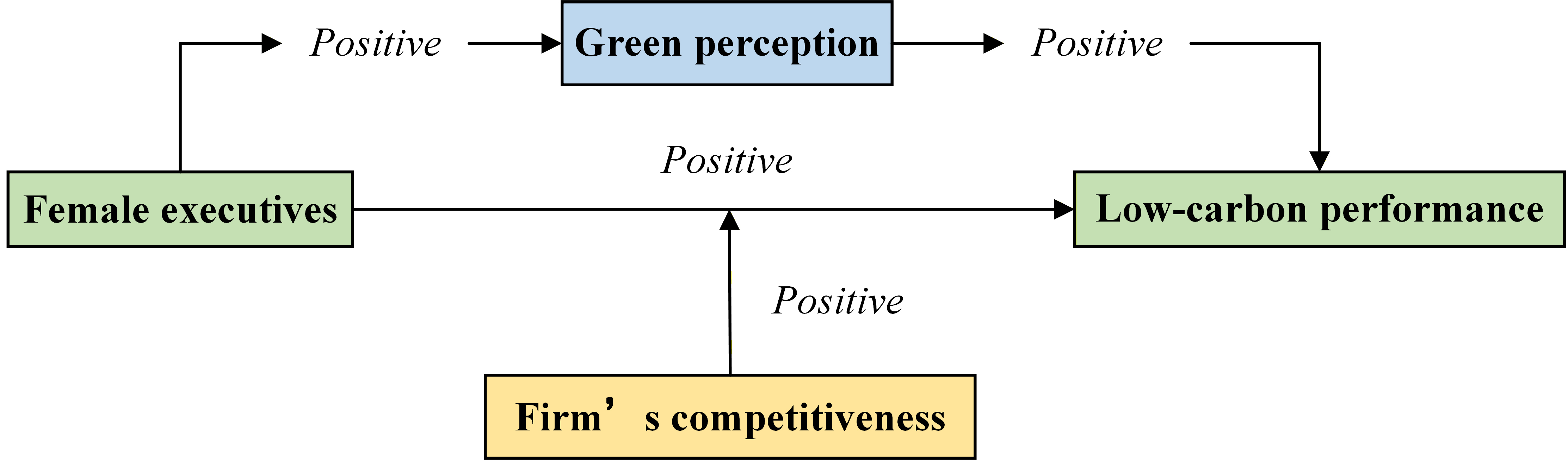
Figure 1. Theoretical framework.
THEORETICAL ANALYSIS AND RESEARCH HYPOTHESES
Female executives and corporate low-carbon performance
Gender role theory posits that long-standing social division of labor has shaped distinct gender role expectations, which in turn influence individuals’ value judgments and behavioral patterns[34]. Research has found that the cognitive differences reflected in the gender composition of executive teams may affect the extent to which companies prioritize environmental issues and their low-carbon strategies[35-37]. Furthermore, the executive pipeline theory suggests that the background characteristics of executive teams influence their cognitive foundations and strategic choices. Therefore, the participation of female executives may influence a company’s selection of low-carbon strategies by altering the information structure and cognitive foundations of the executive team.
From the perspective of stakeholder theory, a company’s low-carbon behavior is influenced not only by internal strategic choices but also by external stakeholders. Research indicates that female managers tend to prioritize social responsibility and long-term development goals and are more likely to incorporate environmental protection into corporate strategic decision-making processes[38-40]. The senior management team’s focus on environmental responsibility may prompt companies to respond more proactively to stakeholders’ environmental demands[33], encourage the adoption of renewable energy, and drive emissions reduction efforts[41,42].
At the team decision-making level, the participation of female executives can increase the diversity of perspectives within the executive team and facilitate the exchange of information and the integration of viewpoints. Female leaders tend to adopt collaborative management styles, which help foster an open organizational atmosphere and promote the dissemination of green concepts and green innovation activities[43]. Furthermore, the diverse perspectives brought by female executives can unlock a company’s potential for green technological innovation, improve resource utilization efficiency[44-47], and consequently reduce energy consumption and carbon emissions[48,49]. It should be noted that improving a company’s low-carbon performance does not conflict with its business objectives. Although the low-carbon transition may require increased short-term investment, it can create sustainable value by improving resource efficiency, reducing environmental risks, and strengthening long-term competitive advantages, thereby promoting the company’s long-term development.
H1a: Female executives can effectively promote a company’s low-carbon performance.
However, there is no simple linear relationship between the proportion of female executives and a company’s low-carbon performance[29,31]. Research indicates that the impact of gender composition on corporate behavior depends on the proportion of team members and the nature of their interactions; when one group of members holds a significant advantage, the cognitive benefits of gender diversity may be diminished[50]. The critical mass theory posits that once a minority group reaches a certain proportion, it can exert effective influence on organizational decision-making and drive the implementation of relevant strategies[51].
When the proportion of female executives is low, their participation can broaden the executive team’s information sources and cognitive perspectives, encouraging the firm to focus on environmental issues and adopt low-carbon actions. As the proportion of female executives increases, their influence gradually grows, further driving the implementation of the firm’s low-carbon strategies[26,52]. However, the role of gender composition does not depend on the proportion of female members alone, but rather on the effective interactions and complementary perspectives formed among members from diverse backgrounds. A balanced gender composition fosters the exchange of diverse perspectives and enhances a company’s ability to identify environmental opportunities and formulate low-carbon strategies[30,53]. When a team’s composition is overly concentrated toward one gender, the cognitive advantages derived from gender diversity may diminish, limiting the company’s ability to evaluate different options. Since reducing carbon emissions requires sustained investment and technological innovation, an imbalanced team composition may reduce the efficiency with which a company advances related initiatives[33].
H1b: There is a U-shaped relationship between the proportion of female executives and corporate carbon emissions; that is, as the proportion of female executives increases, corporate carbon emissions first decrease and then increase.
Mechanism analysis
The mediating role of green awareness levels
According to the top-tier theory, managers’ cognitive foundations serve as a key link connecting team characteristics to organizational strategic choices[54]. The differentiated perceptions of female executives may influence a company’s low-carbon transition by affecting the overall level of green awareness within the executive team.
At the individual level, female managers tend to focus on social responsibility and long-term development goals; this cognitive characteristic prompts them to pay greater attention to environmental factors during strategic decision-making[38]. At the same time, the participation of female executives can bring more diverse sources of information and cognitive perspectives to the executive team, helping the company identify environmental issues and develop a green development philosophy[55]. At the team level, the participation of female executives helps facilitate information exchange and the integration of perspectives within the executive team, promoting the dissemination of green concepts throughout the organization and thereby enhancing the team’s overall level of green awareness[47]. As the executive team’s level of green awareness increases, companies place greater emphasis on environmental goals and improve their environmental performance through green innovation and low-carbon practices[56-58].
H2: Female executives can effectively promote a company’s low-carbon performance by enhancing the green awareness of the executive team.
The moderating role of corporate competitiveness
From the resource-based view, corporate competitiveness reflects a company’s ability to acquire and allocate resources and serves as a crucial foundation for translating executives’ green awareness into actual low-carbon actions[59]. While female executives promote low-carbon transformation by enhancing organizational green awareness, whether this awareness can be further translated into actual emission reduction actions may depend on the firm’s own resource base and strategic execution capabilities. The behavioral characteristics of the executive team influence the firm’s strategic direction[57,60] and green technological innovation[61], while corporate competitiveness provides the necessary resource support for the implementation of relevant strategies.
Highly competitive firms typically possess stronger capabilities in resource integration and strategic execution, enabling them to further translate their executive teams’ green awareness into concrete low-carbon actions[62]. The executive teams of such firms are more likely to recognize the importance of green development to the company’s long-term competitive advantage and to integrate green concepts into corporate strategy[57]. At the same time, when faced with environmental pressures from suppliers, consumers, and other stakeholders, more competitive firms also possess stronger responsiveness[63], and resource acquisition capabilities, which support the implementation of green innovation activities[64]. In terms of green technological innovation, more competitive firms typically have more abundant innovation resources and external networks, enabling them to attract green technology talent and secure innovation support[60], thereby driving the optimization of production processes and technological upgrades, which further reduce carbon emissions[65-67]. In contrast, due to limited resource acquisition and strategic execution capabilities, less competitive firms—even if they possess a high level of green awareness—may struggle to promptly translate this into effective emission reduction actions. Therefore, firm competitiveness can amplify the promotional effect of female executives on corporate low-carbon performance.
H3: Firm competitiveness plays a positive moderating role between female executives and corporate low-carbon performance; that is, the stronger the firm’s competitiveness, the more significant the promotional effect of female executives on corporate low-carbon performance.
METHODOLOGY
Measurement of variables
Corporate low-carbon performance
This study measures low-carbon performance (Performance) based on a company’s carbon emissions level (CO2_emission). Reducing carbon emissions is a key indicator of a company’s low-carbon transition; the lower the carbon emissions level, the better the company’s low-carbon performance. Corporate carbon emissions primarily consist of direct and indirect emissions. Direct carbon emissions refer to greenhouse gases generated by a firm’s energy consumption during production processes, while indirect carbon emissions include greenhouse gas emissions resulting from purchased electricity and heat, as well as other miscellaneous carbon emissions.
Given the insufficient disclosure of data on other miscellaneous indirect carbon emissions by firms, and drawing on existing research[68], this study measures corporate carbon emissions based on two aspects: direct carbon emissions and indirect carbon emissions resulting from purchased electricity and heat. Data were sourced from carbon emissions disclosures in corporate environmental reports, corporate social responsibility reports, and annual reports; for companies that did not directly disclose their carbon emissions, this study made estimates based on the companies’ published energy consumption data and in accordance with the Greenhouse Gas Protocol[12]. Due to limitations in data availability, the scope of this study covers Scope 1 and Scope 2 emissions, excluding Scope 3 emissions. The calculated carbon emissions were log-transformed to mitigate the impact of outliers on the results.
Female executives
Existing research primarily uses two methods to measure the presence of female executives: one uses a dummy variable (0 or 1) to indicate whether a company has female executives[69], while the other uses the proportion of female executives among the company’s executive team to assess women’s representation in executive leadership[70]. Compared to dummy variables, the proportion provides a more nuanced portrayal of differences in women’s participation within executive teams. In this paper, we first use the proportion of female executives (Female_Ratio) to identify the optimal ratio of female executives that best facilitates a company’s low-carbon transition. Building on this, we further replace the core explanatory variable with the number of female executives (Female_amount) to test the robustness of the baseline findings.
Mechanism variables
Based on the theoretical framework and hypotheses outlined above, this paper introduces mediating and moderating variables to explore the mechanisms at play. Specifically, this paper examines the mediating effect from the perspective of executives’ green awareness (Green_perception) and analyzes the moderating effect from the perspective of corporate market competitiveness (Competition).
Executive green awareness refers to the degree of attention that a company’s management pays to issues related to environmental protection, green development, and low-carbon transition. Since management’s awareness is difficult to observe directly, this paper constructs a proxy indicator for executive green awareness based on environmental protection-related textual information in corporate annual reports[71]. Therefore, this study constructs a proxy measure of top management team green cognition based on environment-related textual information from firms’ annual reports. Drawing on existing research[72], this paper constructs a list of terms [Table 1] based on three dimensions: green competitive advantage, environmental responsibility, and external environmental pressures. It selects 19 keywords, including “low-carbon environmental protection”, “energy conservation and emissions reduction”, and “environmental policies”, uses Python to identify relevant terms in the annual reports of listed companies. The companies’ green awareness is then measured based on the frequency of these keywords. It should be noted that keyword frequency analysis primarily captures the level of attention paid to environmental issues in companies’ public disclosures and reflects executives’ green awareness at the textual level. Since this method relies on publicly disclosed corporate information, the measurement results may be influenced by corporate disclosure strategies and textual characteristics.
The construction of executives’ green perceptions[72]
| Dimension | Specific vocabulary |
| Green competitive advantage perception | Energy saving and emission reduction, Energy saving and environmental, Low-carbon environmental protection, Environmental protection governance, Environmental protection and environmental governance, Environmental protection and pollution control |
| Social responsibility awareness | Environmental strategy, Environmental concepts, Environmental education, Environmental training, Environmental technology development, Environmental facilities |
| External environmental pressure perception | Environmental management organization, Environmental protection policy, Environmental protection department, Environmental protection inspector, Environmental protection work, Environmental protection related laws and regulations, Environmental protection audit |
A firm’s market competitiveness refers to its ability to acquire, maintain, and enhance its market position, and is typically measured in terms of profitability, technological innovation, market share, and growth potential[73,74]. This study uses gross profit margin as a proxy for firm competitiveness. Gross profit margin reflects a firm’s product pricing power, cost control efficiency, and profit margins; it is a key indicator of operational efficiency and resource allocation capabilities, and is closely related to a firm’s competitive advantage. Although gross profit margin does not encompass competitiveness dimensions such as market share and innovation capacity, it reflects a firm’s operational efficiency, resource allocation capabilities, and the foundation for strategy implementation, and is therefore suitable as a proxy for firm competitiveness.
Control variables
This study draws on[12,75] to select the following control variables: firm size (Size), debt-to-asset ratio (Lev), return on assets (ROA), cash flow ratio (Cashflow), inventory-to-assets ratio (Inv), integration of executive and supervisory roles (Dual), equity-based checks and balances (Balance), and capital intensity (Cap). Among these, firm size and the debt-to-asset ratio control for the impact of a firm’s resource base and financial constraints on emissions reduction investments; return on assets and the cash flow ratio reflect a firm’s profitability and liquidity, which may influence its ability to invest in low-carbon technologies; the inventory-to-assets ratio controls for the potential impact of production fluctuations on energy consumption; the combination of executive and supervisory roles and the balance of equity interests capture the influence of corporate governance structures on strategic decision-making; and capital intensity reflects the constraints that a firm’s asset structure places on energy efficiency.
Sample and data sources
This study focuses on A-share listed companies from 2007 to 2024. During the sample selection process, the following observations were excluded: financial institutions with industry-specific characteristics; companies labeled with “ST” or “*ST”; and observations with severe data missingness. For observations with missing variables, this study retained only those observations in each regression model where all variables involved in that model had valid values. For variables containing zero or negative values, Ln(variable) denotes Ln(variable + 1). Ultimately, this study included a total of 5,413 listed companies, with a total of 57,548 observations. The primary data sources included the Wind database, the CSMAR database, and company annual reports.
Table 2 presents the descriptive statistics for the main variables. Among the firm-year observations, those with female executives accounted for 64.24% (36,970 observations), while those without female executives accounted for 35.76% (20,578 observations). At the descriptive statistical level, without controlling for other factors, the average carbon emissions for firms with female executives in a given year were 300,205, and the average carbon intensity was 0.4338—both lower than the 608,589 and 0.5542 recorded for firms without female executives in the same years.
Descriptive statistics
| Variables | Obs. | Mean | Std. Dev. | Min. | Max. |
| Female_amount | 57,548 | 1.028255 | 1.008919 | 0 | 4 |
| Female_ratio | 57,539 | 0.1715515 | 0.1701034 | 0 | 0.6666667 |
| CO 2_ emission | 32,785 | 416,146.6 | 1464,954 | 832.028 | 1.16e + 07 |
| CO 2_intensity | 32,393 | 0.4791444 | 0.5889218 | 0.0403 | 2.3605 |
| Green_perception | 50,201 | 3.149678 | 4.370198 | 0 | 23 |
| Competition | 56,295 | 0.2896064 | 0.1914691 | -0.11332 | 0.926225 |
| Size | 51,631 | 22.16019 | 1.285069 | 19.87755 | 26.07062 |
| Lev | 51,631 | 0.4180566 | 0.2071386 | 0.0564805 | 0.8872581 |
| ROA | 51,630 | 0.0390478 | 0.0641297 | -0.203375 | 0.20711 |
| Cashflow | 51,631 | 0.046649 | 0.0683959 | -0.1477692 | 0.2295797 |
| INV | 51,241 | 0.1379387 | 0.1240959 | 0.0004264 | 0.654397 |
| Dual | 51,631 | 0.2879665 | 0.4528198 | 0 | 1 |
| Balance | 51,630 | 0.3680625 | 0.2869169 | 0.0123511 | 0.9933446 |
| Cap | 50,813 | 14.57228 | 0.9278305 | 12.69048 | 17.42384 |
| No female executives | With female executives | ||||
| Observations (firm-years) | 20,578 | 36,970 | |||
| Carbon emissions (N) | 12,326 | 20,459 | |||
| Carbon emissions (mean) | 608,589 | 300,205 | |||
| Carbon intensity (N) | 12,192 | 20,201 | |||
| Carbon intensity (mean) | 0.5542 | 0.4338 | |||
Model
Baseline regression model
To examine the impact of the proportion of female executives on a company’s low-carbon performance, this paper employs a model incorporating industry fixed effects and time fixed effects to conduct baseline estimates. Compared with the random-effects model, the fixed-effects model can control for unobservable firm-level factors that do not change over time, thereby mitigating endogeneity issues caused by omitted time-invariant variables[76]. Based on this, this study establishes the following baseline model:
where, i represents the firm, t denotes the year; CO2_emissionit expressed as the logarithm of carbon emissions; Female_ratio refers to the percentage of female executives in a company; X represents a set of control variables. In addition, this study introduces industry fixed effects λi to control for characteristics of different industries that do not change over time, and time-specific fixed effects μt to address the issue of omitted variables that do not vary across firms but change over time. εit represents the random disturbance term. α and β represent a set of estimated coefficients; among all estimated coefficients, α1 is the primary coefficient of interest.
Nonlinear regression models
The baseline regression model examined the linear effect of the proportion of female executives on a firm’s low-carbon performance. However, the top-tier theory suggests that the level of diversity within the executive team has a nonlinear impact on organizational strategic decision-making[42]. To explore the optimal range for the proportion of female executives, this study introduces a squared term for the proportion of female executives based on the baseline model, constructing the following nonlinear regression model:
Mediation effect model
To investigate the mediating role of executives’ green awareness in the relationship between the proportion of female executives and a company’s low-carbon development, this study draws on the research frameworks presented in[77,78]. Using Equations (3) and (4), the mediation effect was tested within the baseline model.
where, Green_perception represents executives’ green awareness. If the coefficient α1 in Equations (3) and α2 in Equations (4) are significant, this proves the existence of a mediating effect. Otherwise, no mediating effect exists.
Moderation effect model
To investigate the moderating role of a firm’s market competitiveness, this study developed the following model based on the baseline model:
If the coefficient α3 in Equation (5) is significant, it indicates that market competitiveness plays a moderating role in the influence of female executives on a company’s low-carbon performance.
RESULTS
Baseline regression
Table 3 reports the results of the baseline regression analyzing the impact of the proportion of female executives on corporate low-carbon performance. Column (1) reports the regression results without control variables or fixed effects; Columns (2) through (4) progressively include control variables, industry fixed effects, and year fixed effects. In particular, Column (4) further employs cluster-robust standard errors for estimation. The results show that the coefficient for the proportion of female executives is consistently negative and significant at the 1% level, indicating that an increase in the proportion of female executives reduces corporate carbon emissions—that is, improves corporate low-carbon performance. Taking Example (4) as an illustration, there is a significant correlation between an increase in the proportion of female executives and a decrease in a company’s carbon emissions. Given that the average carbon emissions of the sample firms are approximately 416,000 metric tons, this effect corresponds to an average annual reduction of about 880 metric tons, indicating that the participation of female executives has a certain economic impact on a firm’s low-carbon performance.
Baseline results
| Dependent variable: Ln(CO2emission) | |||||
| (1) | (2) | (3) | (4) | (5) | |
| Ln(Female_Ratio) | -2.5217*** | -0.8126*** | -0.2190*** | -0.2190*** | |
| (-31.6735) | (-15.0898) | (-8.6516) | (-3.9440) | ||
| Female_ratio | -0.3460*** | ||||
| (-3.33) | |||||
| (Female_ratio)2 | 0.3610* | ||||
| (1.77) | |||||
| Size | 1.0633*** | 1.0612*** | 1.0612*** | 1.0615*** | |
| (137.4997) | (284.7657) | (108.2878) | (108.36) | ||
| Lev | 2.3879*** | 1.2844*** | 1.2844*** | 1.2832*** | |
| (35.3636) | (39.8051) | (16.6559) | (16.65) | ||
| ROA | 1.1854*** | 1.1583*** | 1.1583*** | 1.1630*** | |
| (8.4172) | (17.4532) | (10.0892) | (10.14) | ||
| Cashflow | 2.0747*** | 0.7362*** | 0.7362*** | 0.7335*** | |
| (15.7878) | (11.8357) | (7.6687) | (7.65) | ||
| INV | -0.5348*** | 1.4657*** | 1.4657*** | 1.4664*** | |
| (-5.2360) | (28.0791) | (9.1724) | (9.16) | ||
| Dual | -0.3454*** | -0.1113*** | -0.1113*** | -0.1104*** | |
| (-15.1855) | (-10.5219) | (-5.4468) | (-5.40) | ||
| Balance | -0.5581*** | -0.1190*** | -0.1190*** | -0.1180*** | |
| (-15.4726) | (-7.1106) | (-3.0915) | (-3.06) | ||
| Cap | -1.8572*** | -5.5762*** | -5.5762*** | -5.5699*** | |
| (-11.0555) | (-64.3503) | (-23.8877) | (-23.85) | ||
| _cons | 11.1130*** | -8.1100*** | 2.0289*** | 2.0289*** | 2.0121*** |
| (709.3802) | (-19.2148) | (9.1347) | (3.2878) | (3.26) | |
| Industry fixed effect | N | N | Y | Y | Y |
| Time fixed effect | N | N | Y | Y | Y |
| Cluster | N | N | N | Y | Y |
| N | 32,780 | 30,384 | 30,383 | 30,383 | 30,383 |
| R2 | 0.0297 | 0.6049 | 0.9172 | 0.9172 | 0.917 |
The above results indicate that the participation of female executives can significantly improve a company’s low-carbon performance. This finding is consistent with the top-tier theory, which posits that the characteristics of the executive team influence a company’s cognitive foundation and strategic choices. The participation of female executives may facilitate the integration of environmental issues into the corporate strategic decision-making process by enriching the team’s information sources and decision-making perspectives.
Nonlinearity test
As demonstrated earlier, the involvement of female executives improves a firm’s low-carbon performance; however, whether a higher proportion of female executives is always better requires further examination. To investigate whether a nonlinear relationship exists between the two, this study introduces a term representing the square of the proportion of female executives into the baseline model. The regression results are shown in column (5) of Table 3, and the curve shape is illustrated in Figure 2.
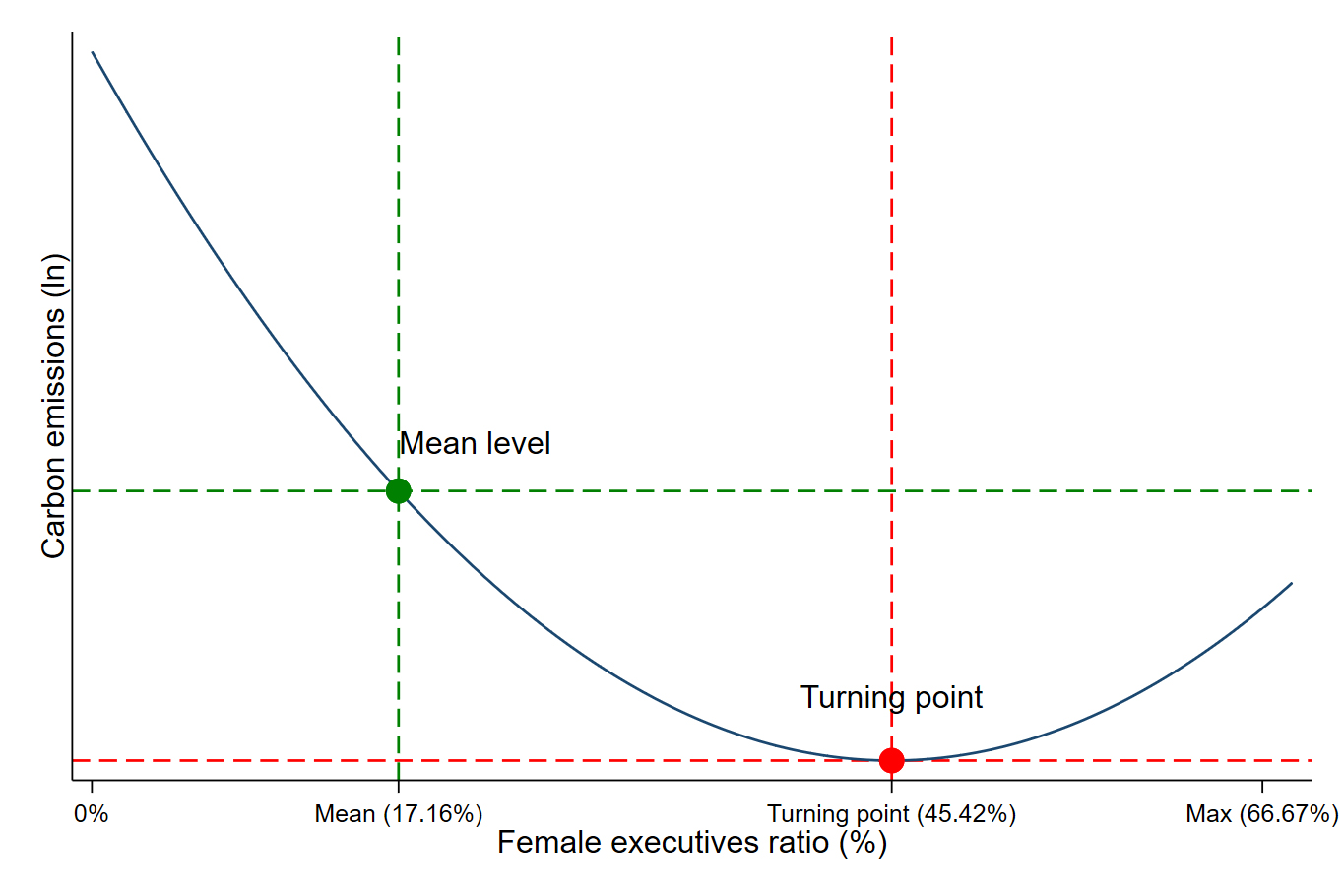
Figure 2. Nonlinear analysis. The fitted curve is based on a quadratic specification. The observed range of female executive ratio is 0%-66.67%, with a turning point of 45.42%.
Column (5) of Table 3 shows that the coefficient of the linear term is significantly negative at the 1% level, while the coefficient of the quadratic term is significantly positive at the 10% level. In Figure 2, the turning point of the curve is approximately 45.42%. There is a U-shaped relationship between the proportion of female executives and corporate carbon emissions, meaning that its impact on low-carbon performance follows an inverted U-shaped pattern. At stages where the proportion of female executives is low, increasing their participation can further reduce corporate carbon emissions and improve low-carbon performance; however, once the proportion of female executives exceeds a certain level, the marginal emission reduction effect gradually weakens. It should be noted that the mean proportion of female executives in the sample is 17.16%, with a maximum of 66.67%; most firms remain on the left side of the curve. Therefore, within the sample, an increase in the proportion of female executives is generally still associated with better low-carbon performance.
These results suggest that there is moderate room for adjustment in the impact of the proportion of female executives on low-carbon performance. When the proportion of female executives is low, increasing the number of female members helps enhance cognitive diversity within the executive team, bringing diverse experiences and perspectives into the strategic decision-making process, and strengthening the company’s focus on environmental issues. However, once the proportion of female executives exceeds a certain level, the team’s gender composition tends to become homogeneous, and the complementary information advantages derived from diversity may diminish, thereby affecting the company’s comprehensive evaluation of different strategic options. Therefore, the impact of the proportion of female executives on low-carbon performance does not simply depend on an increase or decrease in numbers, but rather on whether the gender composition of the executive team facilitates effective cognitive complementarity.
Endogeneity and instrumental variables regression
The results of the baseline regression may be affected by reverse causality and omitted variables. For example, companies with better low-carbon performance may be more inclined to optimize their governance structures and increase the proportion of female executives. To mitigate potential endogeneity issues, this study uses the one-period lagged value of the proportion of female executives as an instrumental variable and conducts a two-stage least squares estimation; the results are shown in Table 4. This instrumental variable was selected because the one-period lagged proportion of female executives is strongly correlated with the current proportion of female executives; as a pre-specified governance variable, it is relatively unlikely to be subject to reverse causation from current carbon emissions.
IV test
| First-stage | Second-stage | |
| (1) | (2) | |
| Ln(Female_ratio) | Ln(CO2_emission) | |
| IV | 0.8580*** | |
| (226.69) | ||
| Ln(Female_ratio) | -0.2347*** | |
| (-3.42) | ||
| Control variables | Y | |
| Industry fixed effect | Y | |
| Time fixed effect | Y | |
| Cluster | Y | |
| N | 28215 | |
| Kleibergen-Paap rk LM | 1387.169 | |
| Kleibergen-Paap Wald F | 51,389.65 | |
The results of the first stage show that the instrumental variable coefficient is 0.858 and is significant at the 1% level, indicating a strong correlation between the one-period lagged proportion of female executives and the current proportion of female executives. The Kleibergen-Paap rk LM statistic is significant, rejecting the insufficient identification hypothesis; the Wald F-statistic is well above the weak instrumental variable threshold, indicating that there are no apparent weak instrumental variable issues. The results of Stage 2 show that the coefficient for the proportion of female executives is -0.235, which is significant at the 1% level, suggesting that the negative relationship between female executive participation and a decline in corporate carbon emissions remains valid after controlling for potential endogeneity.
It should be noted that using the proportion of female executives one period behind as an instrumental variable still has certain limitations. Given the persistence of executive structure, this variable may be correlated with firms’ long-term governance characteristics, thereby posing potential challenges to the rejection of the restriction assumption. Therefore, this paper primarily uses the IV results as supplementary validation of the baseline findings.
Robustness tests
Substituting variables
To examine whether the study’s conclusions are influenced by the measurement methods of the variables, this paper conducts robustness tests by substituting core variables and control variables. Column (1) of
Robustness test
| Change Female_amount | Change CO2_intensity | Change control variables | Change sample | |
| (1) | (2) | (3) | (4) | |
| Ln(Female_amount) | -0.0775*** | |||
| (-5.1966) | ||||
| Ln(Female_ratio) | -0.0175*** | -0.2124*** | -0.1544** | |
| (-2.7926) | (-3.8111) | (-2.1679) | ||
| Constant | -53.0255*** | 0.4549*** | -52.8896*** | -52.9794*** |
| (-64.4326) | (5.2874) | (-64.0355) | (-54.1525) | |
| Control variables | Y | Y | Y | Y |
| Industry fixed effect | Y | Y | Y | Y |
| Time fixed effect | Y | Y | Y | Y |
| Cluster | Y | Y | Y | Y |
| N | 30,386 | 30,384 | 30,384 | 17,696 |
| R2 | 0.9169 | 0.9358 | 0.9168 | 0.9202 |
Narrowing the sample period
The COVID-19 pandemic that broke out at the end of 2019 altered the production and operations of some firms and may have affected their output scale and energy consumption levels, thereby distorting carbon emission measurements. To minimize the interference of abnormal economic activity during the pandemic on the estimation results, this study narrowed the sample period to pre-2019 and re-conducted the analysis. The results in Column (4) show that the negative relationship between the proportion of female executives and corporate carbon emissions remains stable even after excluding samples from the period affected by the pandemic.
Mechanism testing
This study examines the mechanism through which female executives influence corporate low-carbon performance from two perspectives: the mediating role of executives’ green awareness and the moderating role of corporate competitiveness. Existing studies have primarily focused on individual characteristics of managers, such as risk preferences and ethical orientations. Building on upper echelons theory, this study further examines green cognition within the top management team as an organizational-level cognitive mechanism. Meanwhile, firm competitiveness reflects a firm’s capacity for resource acquisition and strategic implementation, serving as an important condition for translating environmental cognition into low-carbon actions.
Green awareness serves as the mediating variable examined in this paper. Table 6 presents the results of the mediation analysis. Column (1) examines the effect of the proportion of female executives on the enhancement of green awareness. The results show that the coefficient for the proportion of female executives is 0.1628, which is significant at the 1% level, indicating that an increase in the proportion of female executives can significantly promote the enhancement of a company’s green awareness. Columns (2) and (3) further include the female executive variable and green perception variable, using the female executive ratio and the number of female executives, respectively, to measure female executive participation and examine the robustness of the mediation effects under different measurements. The results show that the coefficients for the improvement in green awareness are -0.0026 and -0.0024, respectively, both significant at the 5% level. This indicates that female executives can reduce corporate carbon emissions and drive low-carbon transformation by promoting the improvement of corporate green awareness. These results support H2.
Mechanism test
| Ln(Green_Perception) | Ln(CO2_emission) | Ln(CO2_emission) | Ln(CO2_emission) | |
| (1) | (2) | (3) | (4) | |
| Ln(Female_ratio) | 0.1628*** | -0.2570*** | 0.0754 | |
| (2.7980) | (-4.3376) | (0.7008) | ||
| Ln(Female_amount) | -0.0936*** | |||
| (-5.8012) | ||||
| Ln(Green_perception) | -0.0026** | -0.0024** | ||
| (-2.3576) | (-2.2647) | |||
| Ln(Competition) | -3.6322*** | |||
| (-35.2754) | ||||
| Ln(Female_ratio) × Ln(Competition) | -0.6142* | |||
| (-1.7214) | ||||
| Constant | -0.5844 | -53.6698*** | -53.8297*** | -52.4270*** |
| (-1.0229) | (-61.4795) | (-61.8917) | (-81.9817) | |
| Control variables | Y | Y | Y | Y |
| Industry fixed effect | Y | Y | Y | Y |
| Time fixed effect | Y | Y | Y | Y |
| Cluster | Y | Y | Y | Y |
| N | 43,746 | 28,645 | 28,647 | 30,366 |
| R2 | 0.0147 | 0.9012 | 0.9014 | 0.9471 |
Corporate competitiveness serves as the moderating variable examined in this study. Column (4) of Table 6 shows that the coefficient for the interaction term between the proportion of female executives and market competitiveness is -0.6142, which is significant at the 10% level. This indicates that corporate competitiveness reinforces the inhibitory effect of female executives on corporate carbon emissions. This suggests that whether green awareness can be translated into actual emission reduction actions depends on whether the firm possesses the corresponding resource base and implementation capacity. Firms with stronger competitiveness are more likely to allocate the necessary resources to low-carbon practices, thereby amplifying the emission-reduction effects of female executive participation. This result supports H3.
Heterogeneity test
Basic characteristics such as firm size and ownership structure may influence the effectiveness of female executives’ carbon emission reduction efforts. Therefore, this study conducts a heterogeneity analysis based on these two dimensions; the results of the grouped regression are presented in Table 7.
Heterogeneity test
| Dependent variable: Ln(CO2_emission) | ||||
| Scale heterogeneity | Ownership heterogeneity | |||
| Large-scaled | Small-scaled | SOE | NO_SOE | |
| (1) | (2) | (3) | (4) | |
| Ln(Female_ratio) | -0.2129** | -0.1967*** | -0.2054* | -0.1584*** |
| (-1.9900) | (-2.5841) | (-1.6485) | (-2.5940) | |
| Constant | -57.5277*** | -47.1362*** | -53.8414*** | -51.1000*** |
| (-31.5460) | (-23.7206) | (-34.9648) | (-56.2687) | |
| Control variables | Y | Y | Y | Y |
| Industry fixed effect | Y | Y | Y | Y |
| Time fixed effect | Y | Y | Y | Y |
| Cluster | Y | Y | Y | Y |
| N | 9,526 | 10,369 | 9,436 | 20,946 |
| R2 | 0.8823 | 0.8464 | 0.9238 | 0.8990 |
For the size heterogeneity analysis, firms are classified into large, medium, and small groups according to total assets. To capture the contrasting characteristics of firms at the two extremes of the size distribution, we focus on the comparison between large and small firms. The results show that the coefficient for the proportion of female executives in large enterprises is -0.2129, which is significant at the 5% level; in small enterprises, the coefficient is -0.1967, which is significant at the 1% level. Both sets of coefficients are significantly negative, indicating that the positive impact of female executive participation on corporate low-carbon performance exists across companies of all sizes, with relatively higher absolute values of the estimated coefficients observed in large firms.
From the perspective of the resource-based view, differences in firm size may affect the ability to implement green governance measures. Large enterprises typically possess more robust governance systems and more abundant resources, providing a stronger organizational foundation for female executives to participate in low-carbon decision-making. At the same time, large firms attract more external attention and face greater oversight pressure regarding their environmental governance practices, which may help translate the influence of female executives on low-carbon development into concrete governance measures. In contrast, small enterprises may be constrained by limitations in resource access and governance capacity, thereby restricting the scope for female executives to promote low-carbon practices.
For the ownership heterogeneity analysis, firms are classified into state-owned and non-state-owned enterprises according to the nature of their ultimate controller. The results show that the coefficient for the proportion of female executives in SOEs is -0.2054, which is significant at the 10% level; in non-state-owned enterprises, the coefficient is -0.1584, which is significant at the 1% level. Both groups exhibit significantly negative coefficients, but the effect is slightly stronger in SOEs.
From an institutional theory perspective, the nature of ownership affects the governance objectives and external constraints faced by firms. State-owned enterprises bear certain social responsibility objectives and face stricter environmental regulations and social oversight, making it easier to incorporate environmental governance requirements into the corporate decision-making process. At the same time, the stronger resource support capabilities of state-owned enterprises also help female executives promote low-carbon practices. Although non-state-owned enterprises enjoy greater operational flexibility, they may face certain constraints regarding long-term investments in environmental governance and resource support.
CONCLUSIONS AND POLICY IMPLICATIONS
Conclusions
Using data from 5,413 Chinese listed companies from 2007 to 2024, this study examines the impact of the proportion of female executives on corporate carbon emissions and its underlying mechanisms. The study found that an increase in the proportion of female executives generally reduces corporate carbon emissions, an effect achieved in part by enhancing the green awareness of the executive team. At the same time, a U-shaped relationship exists between the proportion of female executives and corporate carbon emissions, with the turning point of approximately 45.42%, indicating that there is an optimal range for the contribution of female executives to corporate low-carbon performance. Heterogeneity analysis revealed that the emissions-reduction effect of female executives is present across enterprises of different sizes and ownership structures, and is relatively stronger in large enterprises and state-owned enterprises. These results indicate that the participation of female executives can promote corporate low-carbon development, but its effect does not simply depend on the number of female executives; rather, it depends on the appropriate gender composition of the executive team and the firm’s own characteristics.
In terms of theoretical contributions, this study reveals the nonlinear nature of how female executive participation influences corporate low-carbon transition, demonstrating that the role of female executives does not simply depend on an increase in their proportion but is closely related to the gender composition of the executive team, thereby expanding our understanding of how gender diversity affects corporate environmental behavior. At the same time, this study explains the process by which female executives influence corporate carbon emissions from the perspective of the executive team’s green awareness, revealing the internal mechanisms through which gender composition affects corporate low-carbon transition.
In terms of practical insights, companies should incorporate the gender composition of their executive teams into their governance optimization efforts, refine mechanisms for cultivating and selecting female management talent, and increase opportunities for women to participate in strategic decision-making. When building executive teams, companies should focus on achieving a balanced gender composition and fostering effective interaction among members, thereby fully leveraging the role of diverse teams in identifying environmental risks and making green strategic decisions. In the practice of low-carbon transition, companies can incorporate carbon emission reduction targets into executive performance evaluation systems, clarify accountability, and refine resource allocation mechanisms to drive the transformation of green awareness into concrete emission reduction actions. At the same time, companies should refine their low-carbon management mechanisms in line with their specific governance characteristics. Large enterprises and state-owned enterprises can leverage their resource advantages to increase investment in green governance, thereby providing better support for female executives’ participation in low-carbon strategic decision-making.
Research limitations and future directions
This study still has certain limitations. First, the research is based on a sample of Chinese listed companies; China’s specific corporate governance structure and environmental regulatory system may affect the external validity of the conclusions. Future studies could conduct comparative analyses using data from other countries and regions. Second, green awareness is measured using text analysis methods, which reflect the level of environmental concern in companies’ public disclosures but may not fully capture managers’ actual perceptions. Future research could employ questionnaire surveys or experimental methods for more direct measurement. Third, although this study employs methods such as lagged variables and instrumental variables to mitigate endogeneity risks, it remains difficult to completely rule out the influence of factors such as omitted variables. Future research could further test causal relationships by incorporating more comprehensive data and identification methods.
DECLARATIONS
Authors’ contributions
Conceptualization, writing - review & editing: Dong, K.; Jia, R.
Data curation, methodology, software, writing - original draft preparation: Xu, S.
Conceptualization, supervision, writing - review & editing: Deng, Y.
Availability of data and materials
The data that support the findings of this study are available from the corresponding author upon reasonable request.
AI and AI-assisted tools statement
Not applicable.
Financial support and sponsorship
The article is supported by the National Natural Science Foundation of China (Grant No. 72503032).
Conflicts of interest
Dong, K. is an Editorial Board Member of the journal Carbon Footprints, but was not involved in any steps of editorial processing, notably including reviewer selection, manuscript handling, or decision-making, while the other authors have declared that they have no conflicts of interest.
Ethical approval and consent to participate
Not applicable.
Consent for publication
Not applicable.
Copyright
© The Author(s) 2026.
REFERENCES
1. Davis, P. E. D.; Nicholls, K. W.; Holland, D. M.; et al. Suppressed basal melting in the eastern Thwaites Glacier grounding zone. Nature 2023, 614, 479-85.
2. Song, F.; Zhang, G. J.; Ramanathan, V.; Leung, L. R. Trends in surface equivalent potential temperature: a more comprehensive metric for global warming and weather extremes. Proc. Natl. Acad. Sci. USA. 2022, 119, e2117832119.
3. Jang, Y.; Yang, J. Environmental policy and the evolution of nuclear trade network: insights from the European Union. Struct. Chang. Econ. Dyn. 2024, 68, 425-32.
4. Ahlvik, L.; Van Den Bijgaart, I. Screening green innovation through carbon pricing. J. Environ. Econ. Manag. 2024, 124, 102932.
5. Chen, Y.; Zhang, D.; Guo, K.; Ji, Q. Emission trading schemes and cross-border mergers and acquisitions. J. Environ. Econ. Manag. 2024, 124, 102949.
6. Zhu, X.; Li, D. How to promote the construction of low‐carbon cities in China? An urban complex ecosystem perspective. Sustain. Dev. 2024, 32, 4354-73.
7. Zhang, S.; Ma, X.; Cui, Q.; Liu, J. Does the low carbon transition impact urban resilience? Evidence from China’s pilot cities for carbon emission trading. Environ. Sci. Pollut. Res. 2024, 31, 11128-49.
8. Xu, S.; Deng, Y.; Nepal, R.; Jamasb, T. Geopolitical conflict and risk and the EU energy trading: a dynamic evolutionary networks analysis. Energy. Econ. 2026, 158, 109332.
9. Xia, X.; Zeng, X.; Wang, W.; Liu, C.; Li, X. Carbon constraints and carbon emission reduction: an evolutionary game model within the energy-intensive sector. Expert. Syst. Appl. 2024, 244, 122916.
10. Wang, B.; Huang, C.; Wang, H.; Liao, F. Impact factors in Chinese construction enterprises’ carbon emission-reduction intentions. Int. J. Environ. Res. Public. Health. 2022, 19, 16929.
11. Pei, Y.; Zhu, Y.; Liu, S.; Wang, X.; Cao, J. Environmental regulation and carbon emission: the mediation effect of technical efficiency. J. Clean. Prod. 2019, 236, 117599.
12. Deng, Y.; Dong, K.; Taghizadeh-Hesary, F.; Xue, J. How does environmental regulation affect the double dividend for energy firms? Evidence from China’s EPT policy. Econ. Anal. Policy. 2023, 79, 807-20.
13. Meng, L.; Liu, K.; He, J.; Han, C.; Liu, P. Carbon emission reduction behavior strategies in the shipping industry under government regulation: a tripartite evolutionary game analysis. J. Clean. Prod. 2022, 378, 134556.
14. Xu, S.; Zhao, X.; Taghizadeh-Hesary, F. Towards the environmental sustainability path: the role of fintech, renewable energy consumption, and climate policy uncertainty. Energy. Policy. 2025, 207, 114841.
15. Jiao, J.; Chen, Y.; Li, J.; Yang, S. Carbon reduction behavior of waste power battery recycling enterprises considering learning effects. J. Environ. Manag. 2023, 341, 118084.
16. Gui, H.; Xue, J.; Li, Y.; Chen, L. Research on carbon emissions reduction strategy considering government subsidy and free riding behavior. Environ. Eng. Sci. 2022, 39, 329-41.
17. Wang, J.; Sun, F.; Lv, K.; Wang, L. Industrial agglomeration and firm energy intensity: how important is spatial proximity? Energy. Econ. 2022, 112, 106155.
18. Barrows, G.; Ollivier, H. Foreign demand, developing country exports, and CO2 emissions: firm-level evidence from India. J. Dev. Econ. 2021, 149, 102587.
19. Chen, H.; Guo, W.; Feng, X.; et al. The impact of low-carbon city pilot policy on the total factor productivity of listed enterprises in China. Resour. Conserv. Recy. 2021, 169, 105457.
20. Wang, J.; Wang, L.; Qian, X. Revisiting firm innovation and environmental performance: new evidence from Japanese firm-level data. J. Clean. Prod. 2021, 281, 124446.
21. Bian, H.; Jin, F.; Tong, X. Carbon reduction consciousness, determinants and value of low-carbon transition: evidence from textual and empirical analysis of Chinese listed manufacturing enterprises. Int. Rev. Econ. Financ. 2023, 88, 1301-23.
22. Jiang, Y.; Hu, Y.; Asante, D.; Mintah Ampaw, E.; Asante, B. The effects of executives' low-carbon cognition on corporate low-carbon performance: a study of managerial discretion in China. J. Clean. Prod. 2022, 357, 132015.
23. Hossain, A.; Saadi, S.; Amin, A. S. Does CEO risk-aversion affect carbon emission? J. Bus. Ethics. 2022, 182, 1171-98.
24. Albitar, K.; Al-Shaer, H.; Liu, Y. S. Corporate commitment to climate change: th e effect of eco-innovation and climate governance. Res. Policy. 2023, 52, 104697.
25. Valls Martínez, M. D. C.; Santos-Jaén, M.; Soriano Román, R.; Martín-Cervantes, P. A. Are gender and cultural diversities on board related to corporate CO2 emissions? J. Clean. Prod. 2022, 363, 132638.
26. Caby, J.; Coron, C.; Ziane, Y. How does gender diversity in top management teams affect carbon disclosure and its quality: evidence from the technological industry. Technol. Forecast. Soc. Chang. 2024, 199, 123077.
27. Al-Shaer, H.; Zaman, M. Board gender diversity and sustainability reporting quality. J. Contemp. Account. Econ. 2016, 12, 210-22.
28. Abd Majid, N.; Jaaffar, A. H. The effect of women’s leadership on carbon disclosure by the top 100 global energy leaders. Sustainability 2023, 15, 8491.
29. Birindelli, G.; Iannuzzi, A. P.; Savioli, M. The impact of women leaders on environmental performance: evidence on gender diversity in banks. Corp. Soc. Responsib. Environ. Manag. 2019, 26, 1485-99.
30. Fan, P.; Qian, X.; Wang, J. Does gender diversity matter? Female directors and firm carbon emissions in Japan. Pac. Basin. Finance. J. 2023, 77, 101931.
31. Nuber, C.; Velte, P. Board gender diversity and carbon emissions: European evidence on curvilinear relationships and critical mass. Bus. Strateg. Environ. 2021, 30, 1958-92.
32. Konadu, R.; Ahinful, G. S.; Boakye, D. J.; Elbardan, H. Board gender diversity, environmental innovation and corporate carbon emissions. Technol. Forecast. Soc. Chang. 2022, 174, 121279.
33. Walls, J. L.; Berrone, P.; Phan, P. H. Corporate governance and environmental performance: is there really a link? Strateg. Manag. J. 2012, 33, 885-913.
34. Eagly, A. H. Sex differences in social behavior: a social-role interpretation. Hillsdale, NJ, US: Lawrence Erlbaum Associates, Inc.; 1987.
35. Bandiera, O.; Parekh, N.; Petrongolo, B.; Rao, M. Men are from mars, and women too: a bayesian meta‐analysis of overconfidence experiments. Economica 2022, 89, S38-70.
36. Campopiano, G.; Gabaldón, P.; Gimenez-Jimenez, D. Women directors and corporate social performance: an integrative review of the literature and a future research agenda. J. Bus. Ethics. 2022, 182, 717-46.
37. Williams, M.; Polman, E. Is it me or her? How gender composition evokes interpersonally sensitive behavior on collaborative cross-boundary projects. Organ. Sci. 2015, 26, 334-55.
38. Ward, S. J.; King, L. A. Gender differences in emotion explain women’s lower immoral intentions and harsher moral condemnation. Pers. Soc. Psychol. Bull. 2018, 44, 653-69.
39. Lu, J.; Herremans, I. M. Board gender diversity and environmental performance: an industries perspective. Bus. Strateg. Environ. 2019, 28, 1449-64.
40. Casprini, E.; Pucci, T.; Zanni, L. From growth goals to proactive organizational resilience: first evidence in women-led and non-women-led Italian wineries. Rev. Manag. Sci. 2022, 17, 1017-36.
41. He, X.; Jiang, S. Does gender diversity matter for green innovation? Bus. Strateg. Environ. 2019, 28, 1341-56.
42. Atif, M.; Hossain, M.; Alam, M. S.; Goergen, M. Does board gender diversity affect renewable energy consumption? J. Corp. Financ. 2021, 66, 101665.
43. Méndez-Picazo, M.; Galindo-Martín, M.; Castaño-Martínez, M. Effects of sociocultural and economic factors on social entrepreneurship and sustainable development. J. Innov. Knowl. 2021, 6, 69-77.
44. Foss, N.; Lee, P. M.; Murtinu, S.; Scalera, V. G. The XX factor: female managers and innovation in a cross-country setting. Lead. Q. 2022, 33, 101537.
45. Jiang, Y. G.; Asante, D.; Zhang, J.; Cao, M. J. The effects of environmental factors on low-carbon innovation strategy: a study of the executive environmental leadership in China. J. Clean. Prod. 2020, 266, 121998.
46. Lakhal, F.; Hamrouni, A.; Jilani, I.; Mahjoub, I.; Benkraiem, R. The power of inclusion: does leadership gender diversity promote corporate and green innovation? Res. Int. Bus. Financ. 2024, 67, 102128.
47. Tang, S.; Nadkarni, S.; Wei, L.; Zhang, S. X. Balancing the Yin and Yang: TMT gender diversity, psychological safety, and firm ambidextrous strategic orientation in Chinese high-tech SMEs. Acad. Manag. J. 2021, 64, 1578-604.
48. Horbach, J. Determinants of environmental innovation—New evidence from German panel data sources. Res. Policy. 2008, 37, 163-73.
49. Lee, C.; Wang, C. Financial development, technological innovation and energy security: evidence from Chinese provincial experience. Energy. Econ. 2022, 112, 106161.
50. Glass, C.; Cook, A. Do women leaders promote positive change? Analyzing the effect of gender on business practices and diversity initiatives. Hum. Resour. Manag. 2017, 57, 823-37.
51. Atif, M.; Alam, M. S.; Hossain, M. Firm sustainable investment: are female directors greener? Bus. Strateg. Environ. 2020, 29, 3449-69.
52. Post, C.; Rahman, N.; Rubow, E. Green governance: boards of directors’ composition and environmental corporate social responsibility. Bus. Soc. 2011, 50, 189-223.
53. Glass, C.; Cook, A.; Ingersoll, A. R. Do women leaders promote sustainability? Analyzing the effect of corporate governance composition on environmental performance. Bus. Strateg. Environ. 2015, 25, 495-511.
54. Wu, L.; Wang, C.; Ren, H.; Zhang, W. How does executive green cognition affect enterprise green technology innovation? The mediating effect of ESG performance. Heliyon 2024, 10, e34287.
55. Pan, L.; Mcnamara, G.; Devers, C. E.; Yonish, L. M. Taking a broader view: female directors, CEO strategic attention breadth, and firm performance. Organ. Sci. 2025, 36, 737-61.
56. Li, X.; Guo, F.; Wang, J. A path towards enterprise environmental performance improvement: how does CEO green experience matter? Bus. Strateg. Environ. 2023, 33, 820-38.
57. Yasir, M.; Majid, A.; Yasir, M.; Qudratullah, H. Promoting environmental performance in manufacturing industry of developing countries through environmental orientation and green business strategies. J. Clean. Prod. 2020, 275, 123003.
58. Nawaz Khan, A. Is green leadership associated with employees’ green behavior? Role of green human resource management. J. Environ. Plan. Manag. 2022, 66, 1962-82.
59. Li, G.; Wang, X.; Su, S.; Su, Y. How green technological innovation ability influences enterprise competitiveness. Technol. Soc. 2019, 59, 101136.
60. Wu, Q. Power play in carbon trading market: how status of executives with R&D background incentives companies’ low-carbon innovation. Energy. Policy. 2024, 188, 114049.
61. Sarwar, H.; Aftab, J.; Ishaq, M. I.; Atif, M. Achieving business competitiveness through corporate social responsibility and dynamic capabilities: an empirical evidence from emerging economy. J. Clean. Prod. 2023, 386, 135820.
62. Chen, C.; Yan, Y.; Jia, X.; Wang, T.; Chai, M. The impact of executives' green experience on environmental, social, and governance (ESG) performance: evidence from China. J. Environ. Manag. 2024, 366, 121819.
63. Ambec, S.; De Donder, P. Environmental policy with green consumerism. J. Environ. Econ. Manag. 2022, 111, 102584.
64. Chevrollier, N.; Van Lieshout, J. W. F. C.; Argyrou, A.; Amelink, J. Carbon emission reduction: understanding the micro‐foundations of dynamic capabilities in companies with a strategic orientation for sustainability performance. Bus. Strateg. Environ. 2023, 33, 968-84.
65. Chen, Z.; Zhang, Y.; Wang, H.; Ouyang, X.; Xie, Y. Can green credit policy promote low-carbon technology innovation? J. Clean. Prod. 2022, 359, 132061.
66. Chu, S. Are women greener? Board gender diversity and corporate green technology innovation in China. Int. Rev. Econ. Financ. 2024, 93, 1001-20.
67. Wang, S.; Li, J. How carbon emission trading mechanism and supply chain digitization affect manufacturing enterprises’ competitiveness? Evidence from China. J. Clean. Prod. 2024, 452, 142164.
68. Bolton, P.; Kacperczyk, M. Do investors care about carbon risk? J. Financ. Econ. 2021, 142, 517-49.
69. Kong, G.; Huang, J.; Kong, D.; Zhu, L. Female executives, industrial robots, and stock price crash risk. Financ. Res. Lett. 2023, 57, 104253.
70. Baixauli-Soler, J. S.; Belda-Ruiz, M.; Sanchez-Marin, G. Executive stock options, gender diversity in the top management team, and firm risk taking. J. Bus. Res. 2015, 68, 451-63.
71. Huang, H.; Long, R.; Chen, H.; Sun, K.; Li, Q. Exploring public attention about green consumption on Sina Weibo: using text mining and deep learning. Sustain. Prod. Consum. 2022, 30, 674-85.
72. Duriau, V. J.; Reger, R. K.; Pfarrer, M. D. A content analysis of the content analysis literature in organization studies: research themes, data sources, and methodological refinements. Org. Res. Methods. 2007, 10, 5-34.
73. Barney, J. B. Firm resources and sustained competitive advantage. Adv. Strateg. Manag. 1991, 17, 3-10.
74. Teece, D. J.; Pisano, G.; Shuen, A. Dynamic capabilities and strategic management. Strat. Mgmt. J. 1997, 18, 509-33.
75. Hu, R. F.; Xu, W. Q.; Yang, Y. L. The evolution of electric technology in the context of China's low-carbon transformation: a patent analysis. Int. J. Clim. Chang. Strateg. Manag. 2023, 15, 176-94.
76. Long, F.; Lin, F.; Ge, C. Impact of China's environmental protection tax on corporate performance: empirical data from heavily polluting industries. Environ. Impact. Assess. Rev. 2022, 97, 106892.
77. Chen, Y.; Fan, Z.; Gu, X.; Zhou, L. Arrival of young talent: the send-down movement and rural education in China. Am. Econ. Rev. 2020, 110, 3393-430.
Cite This Article
 Open Access
How to Cite
Dong, K.; Xu, S.; Deng, Y.; Jia, R. Women’s power: how do female executives promote corporate low-carbon performances. Carbon Footprints 2026, 5, 50. https://dx.doi.org/10.20517/cf.2026.96
Download Citation
If you have the appropriate software installed, you can download article citation data to the citation manager of your choice. Simply select your manager software from the list below and click on download.
Export Citation File
Type of Import
Tips on Downloading Citation
Citation Manager File Format
Type of Import
Direct Import: When the Direct Import option is selected (the default state), a dialogue box will give you the option to Save or Open the downloaded citation data. Choosing Open will either launch your citation manager or give you a choice of applications with which to use the metadata. The Save option saves the file locally for later use.
Indirect Import: When the Indirect Import option is selected, the metadata is displayed and may be copied and pasted as needed.
About This Article
Copyright

Data & Comments
Data
0











Comments
Comments must be written in English. Spam, offensive content, impersonation, and private information will not be permitted. If any comment is reported and identified as inappropriate content by OAE staff, the comment will be removed without notice. If you have any queries or need any help, please contact us at [email protected].