

Multi-regional decomposition of direct and indirect carbon emissions in ASEAN
 0
0 
Graphical Abstract
Abstract
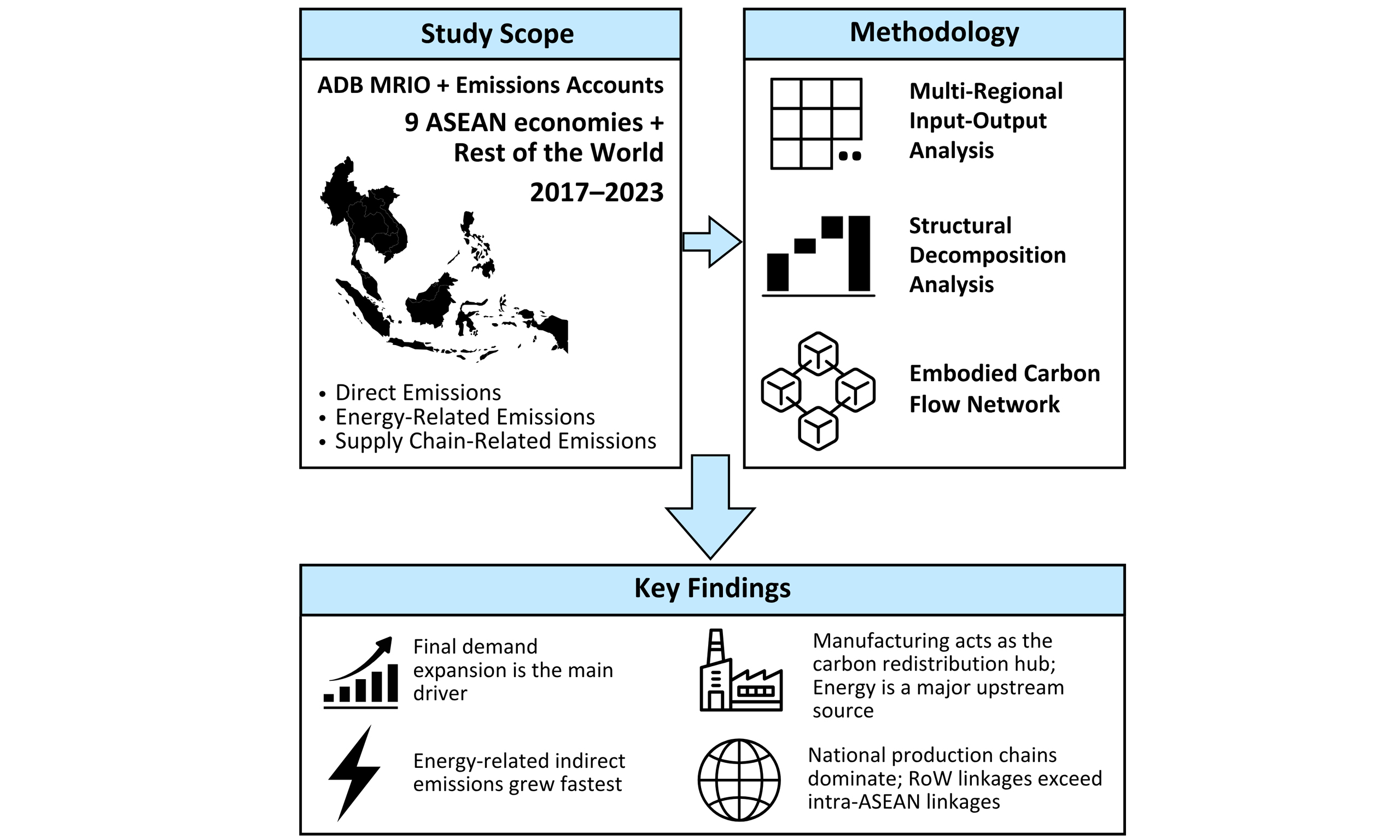
As Association of Southeast Asian Nations (ASEAN) economies deepen their role in regional and global production networks, carbon responsibility is increasingly shared across production, consumption, and trade systems. This study assesses direct and indirect carbon emissions across nine ASEAN economies from 2017 to 2023 using an environmentally extended multi-regional input-output framework with Logarithmic Mean Divisia Index (LMDI)-based structural decomposition analysis (SDA). Direct, energy-related indirect, and supply chain-related emissions were quantified using Asian Development Bank multi-regional input-output tables and environmental satellite accounts. Emission changes were decomposed into emission intensity, economic system structure, final demand structure, and total final demand effects. Embodied carbon flow matrices traced carbon transfers through intermediate transactions, final demand, ASEAN economies, and the Rest of the World (RoW). Results show that direct emissions increased by 19.76% (2,363.10 to 2,829.95 MtCO2e), while indirect emissions increased by 7.83% (4,003.85 to 4,317.47 MtCO2e), with energy-related indirect emissions showing the highest growth rate among the indirect categories at 16.72% (1,176.48 to 1,373.17 MtCO2e). LMDI-based SDA results indicate that emissions growth was mainly driven by global final demand expansion, while negative emission intensity effects partly offset emission increases in all three categories. Country-sector hotspots included Indonesia’s energy and mining sectors, and Vietnam’s manufacturing sector. Embodied carbon flow results identify manufacturing as the central carbon redistribution hub and energy as a major upstream source. National production chains dominated ASEAN embodied flows, while RoW-linked exchanges were larger than intra-ASEAN exchanges. These findings highlight the need for coordinated regional and country-specific strategies targeting cleaner energy systems, industrial networks, and material supply chains.
Keywords


 Download PDF
REFERENCES
1. Friedlingstein, P.; O’sullivan, M.; Jones, M. W.; et al. Global carbon budget 2024. Earth. Syst. Sci. Data. 2025, 17, 965-1039.
2. World Trade Organization. Trade and climate change. 2021. https://www.wto.org/english/news_e/news21_e/clim_03nov21-6_e.pdf (accessed 2026-09-16).
3. ASEAN statistical highlights 2025. 2025. https://www.aseanstats.org/publication/ash2025/ (accessed 2026-09-16).
4. Osabohien, R.; Jaffar, A. H.; Adeleke, O. K.; Karakara, A. A. Global value chain participation, globalisation-Energy Nexus and sustainable development in ASEAN. Res. Glob. 2024, 9, 100253.
5. Munir, Q.; Lean, H. H.; Smyth, R. CO2 emissions, energy consumption and economic growth in the ASEAN-5 countries: a cross-sectional dependence approach. Energy. Economics. 2020, 85, 104571.
6. Lau, H. C.; Lin, X. Pathways to achieve rapid decarbonization of ASEAN. In Offshore Technology Conference, Houston, Texas, USA; Paper OTC-32016-MS.
7. Adil, L.; Eckstein, D.; Künzel, V.; Schäfer, L. Climate risk index 2026 | Germanwatch e.V. Climate Risk Index 2026: Who suffers most from extreme weather events? Weather-related loss events in 2024 and 1995 to 2024. https://www.germanwatch.org/en/93310 (2026-09-18).
8. Bhatia, P.; Cummis, C.; Brown, A.; Rich, D.; Draucker, L.; Lahd, H. Corporate value chain (Scope 3) accounting and reporting standard: supplement to the GHG Protocol corporate accounting and reporting standard. 2011. https://ghgprotocol.org/sites/default/files/standards/Corporate-Value-Chain-Accounting-Reporing-Standard_041613_2.pdf (accessed 2026-09-16).
9. Nishimura, K.; Hondo, H.; Uchiyama, Y. Estimating the embodied carbon emissions from the material content. Energy. Convers. Manag. 1997, 38, S589-94.
10. Miller, R. E.; Blair, P. D. Input-output analysis: foundations and extensions, 2th ed.; Cambridge University Press; 2009.
11. Leontief, W. W. Quantitative input and output relations in the economic systems of the United States. Rev. Econ. Stat. 1936, 18, 105.
12. Hertwich, E. G.; Wood, R. The growing importance of scope 3 greenhouse gas emissions from industry. Environ. Res. Lett. 2018, 13, 104013.
13. Cayamanda, C. D.; Aviso, K. B.; Biona, J. B. M.; et al. Mapping a low-carbon future for the Philippines: scenario results from a fractional programming input-output model. Process. Integr. Optim. Sustain. 2017, 1, 293-9.
14. Su, B.; Ang, B.; Li, Y. Input-output and structural decomposition analysis of Singapore’s carbon emissions. Energy. Policy. 2017, 105, 484-92.
15. Nguyen, H. T.; Aviso, K. B.; Le, D. Q.; Tokai, A. Main drivers of carbon dioxide emissions in Vietnam trajectory 2000-2011: an input-output structural decomposition analysis. J. Sustain. Dev. 2018, 11, 129.
16. Rum, I. A.; Tukker, A.; Hoekstra, R.; Koning, A. D.; Yusuf, A. A. Exploring carbon footprints and carbon intensities of Indonesian provinces in a domestic and global context. Front. Environ. Sci. 2024, 12, 1325089.
17. Wu, J.; Cui, C.; Mei, X.; Xu, Q.; Zhang, P. Migration of manufacturing industries and transfer of carbon emissions embodied in trade: empirical evidence from China and Thailand. Environ. Sci. Pollut. Res. Int. 2023, 30, 25037-49.
18. Sandu, S.; Yang, M.; Mahlia, T. M. I.; et al. Energy-related CO2 emissions growth in ASEAN countries: trends, drivers and policy implications. Energies 2019, 12, 4650.
19. Zhang, J.; Fan, Z.; Chen, Y.; Gao, J.; Liu, W. Decomposition and decoupling analysis of carbon dioxide emissions from economic growth in the context of China and the ASEAN countries. Sci. Total. Environ. 2020, 714, 136649.
20. Chen, J.; Wu, S.; Li, Q. The evolution and influencing factors of trade-embodied CO2 emissions transfer from China’s provinces to ASEAN countries. Front. Clim. 2025, 7, 1679132.
21. Leontief, W. Environmental repercussions and the economic structure: an input-output approach. Rev. Econ. Stat. 1970, 52, 262.
22. Herendeen, R. A. Input-output techniques and energy cost of commodities. Energy. Policy. 1978, 6, 162-5.
23. Ang, B. The LMDI approach to decomposition analysis: a practical guide. Energy. Policy. 2005, 33, 867-71.
24. Dietzenbacher, E.; Los, B. Structural decomposition techniques: sense and sensitivity. Econ. Syst. Res. 1998, 10, 307-24.
25. Ang, B. Decomposition analysis for policymaking in energy: which is the preferred method? Energy. Policy. 2004, 32, 1131-9.
26. Lan, J.; Malik, A.; Lenzen, M.; Mcbain, D.; Kanemoto, K. A structural decomposition analysis of global energy footprints. Appl. Energy. 2016, 163, 436-51.
27. Ang, B. W.; Choi, K. Decomposition of aggregate energy and gas emission intensities for industry: a refined divisia index method. Energy. J. 1997, 18, 59-73.
28. Ang, B.; Liu, F. A new energy decomposition method: perfect in decomposition and consistent in aggregation. Energy 2001, 26, 537-48.
29. Ang, B.; Liu, N. Handling zero values in the logarithmic mean Divisia index decomposition approach. Energy. Policy. 2007, 35, 238-46.
30. Asian Development Bank. ADB multiregional input-output tables at current prices. 2025. https://kidb.adb.org/globalization/current (accessed 2026-09-16).
31. Asian Development Bank. Environmentally extended multiregional input-output tables (air emissions). 2025. https://kidb.adb.org/globalization/adb_environmentally_extended_multiregional_inputoutput_tables (accessed 2026-09-16).
32. Asian Development Bank. ADB multiregional input-output tables at constant prices. 2025. https://kidb.adb.org/globalization/constant (accessed 2026-09-16).
33. ASEAN. Forging a new era: timor-leste admitted into ASEAN. 2025. https://asean.org/forging-a-new-era-timor-leste-admitted-into-asean/ (accessed 2026-09-16).
34. Lumbreras, S.; Ciller, P. Interpretable optimization: why and how we should explain optimization models. Appl. Sci. 2025, 15, 5732.
35. OECD. Greenhouse Gas Footprints (GHGFP) 2025 edition: emissions embodied in production by scope. 2026. https://data-explorer.oecd.org/vis?tm=GHGFP&snb=10&df[ds]=dsDisseminateFinalDMZ&df[id]=DSD_ICIO_GHG_SCOPE_2025%40DF_ICIO_GHG_SCOPE_2025&df[ag]=OECD.STI.PIE&df[vs]=1.0&dq=A.SCOPE_GHG.AUS...&pd=2022,&to[TIME_PERIOD]=false (accessed 2026-08-01).
36. Yamano, N.; Lioussis, M.; Cimper, A. Measuring greenhouse gas footprints in global production networks: new perspectives on emissions embodied in production chains and final demand patterns. OECD Science, Technology and Industry Working Papers. 2024.
37. Le, Quéré. C.; Jackson, R. B.; Jones, M. W.; et al. Temporary reduction in daily global CO2 emissions during the COVID-19 forced confinement. Nat. Clim. Chang. 2020, 10, 647-53.
38. Jackson, R. B.; Friedlingstein, P.; Le, Quéré. C.; et al. Global fossil carbon emissions rebound near pre-COVID-19 levels. Environ. Res. Lett. 2022, 17, 031001.
39. Liu, Y.; Zhu, J.; Tuwor, C. P.; Ling, C.; Yu, L.; Yin, K. The impact of the COVID-19 pandemic on global trade-embodied carbon emissions. J. Clean. Prod. 2023, 408, 137042.
40. Chontanawat, J. Driving forces of energy-related CO2 emissions based on expanded IPAT decomposition analysis: evidence from ASEAN and four selected countries. Energies 2019, 12, 764.
41. Hagenaars, R. H.; Heijungs, R.; de Koning, A.; Tukker, A.; Wang, R. The greenhouse gas emissions of pharmaceutical consumption and production: an input-output analysis over time and across global supply chains. Lancet. Planet. Health. 2025, 9, e196-206.
42. International Energy Agency. Indonesia energy mix. 2026. https://www.iea.org/countries/indonesia/energy-mix#where-does-indonesia-get-its-energy (accessed 2026-09-16).
43. Maulidia, M.; Bridle, R. Toward a more responsible critical minerals supply chain supporting indonesia’s energy transition: implementing environmental, social, and governance standards for the nickel industry. International Institute for Sustainable Development. 2025. https://www.iisd.org/system/files/2025-12/critical-minerals-energy-transition-indonesia.pdf (accessed 2026-09-16).
44. Bui Minh, T.; Nguyen Ngoc, T.; Bui Van, H. Relationship between carbon emissions, economic growth, renewable energy consumption, foreign direct investment, and urban population in Vietnam. Heliyon 2023, 9, e17544.
45. Asian Development Bank. Viet Nam: economy. 2026. https://www.adb.org/where-we-work/viet-nam/economy (accessed 2026-09-16).
46. World Bank. Viet Nam 2045-growing greener: pathways to a resilient and sustainable future. 2025.
47. Li, J.; Qamri, G. M.; Tang, M.; Cheng, Y. Connecting the sustainability: how renewable energy and digitalization drive green global value chains. J. Environ. Manage. 2025, 380, 124779.
48. Huang, L.; Krigsvoll, G.; Johansen, F.; Liu, Y.; Zhang, X. Carbon emission of global construction sector. Renew. Sustain. Energy. Rev. 2018, 81, 1906-16.
49. Medina, A. F. Indonesia’s construction market: growth drivers and 2030 forecast. ASEAN Briefing. 2025. https://www.aseanbriefing.com/news/indonesias-construction-market-growth-drivers-and-2030-forecast/ (accessed 2026-09-16).
50. Tam, N. V. Carbon pricing and triple-bottom-line outcomes in Vietnamese construction: The mediating roles of innovation and collaboration. Energy. Build. 2025, 347, 116322.
51. Ninpanit, P.; Malik, A.; Wakiyama, T.; Geschke, A.; Lenzen, M. Thailand’s energy-related carbon dioxide emissions from production-based and consumption-based perspectives. Energy. Policy. 2019, 133, 110877.
52. Yang, Y.; Park, Y.; Smith, T. M.; Kim, T.; Park, H. S. High-resolution environmentally extended input-output model to assess the greenhouse gas impact of electronics in South Korea. Environ. Sci. Technol. 2022, 56, 2107-14.
53. Owen, A.; Steen-olsen, K.; Barrett, J.; Wiedmann, T.; Lenzen, M. A structural decomposition approach to comparing mrio databases. Econ. Syst. Res. 2014, 26, 262-83.
54. Steen-olsen, K.; Owen, A.; Hertwich, E. G.; Lenzen, M. Effects of sector aggregation on CO2 multipliers in multiregional input-output analyses. Econ. Syst. Res. 2014, 26, 284-302.
55. Rafiq, A.; Gheewala, S. H. From cycling to climate benefit: a perspective on redefining CO2 utilization for reduction and storage. Carbon. Footprints. 2026, 6, 6.
56. Salmerón, M.; Cherubini, F.; Dias de Souza, N. R. Life-cycle environmental analysis of combined biochar and agrivoltaic systems in Andalusian olive groves. Carbon. Footprints. 2026, 5, 17.
57. Rahmaditio, R.; Wang, K.; Purba, D. C.; Zuhaira, N. Nickel’s climate cost and Indonesia’s push for cleaner production. World Resources Institute. 2026. https://www.wri.org/technical-perspectives/nickels-climate-cost-and-indonesias-push-cleaner-production (accessed 2026-09-16).
58. Ritchie, H.; Rosado, P. Vietnam: energy country profile. Our World in Data. 2025. https://ourworldindata.org/profile/energy/vietnam (accessed 2026-09-16).
59. Truong, B. How the EU carbon border adjustment mechanism impacts Vietnam. Vietnam Briefing. 2023. https://www.vietnam-briefing.com/news/carbon-boredr-adjustment-mechanism-vietnam.html/ (accessed 2026-09-16).
60. ASEAN strategy for carbon neutrality. 2023. https://asean.org/wp-content/uploads/2023/08/Brochure-ASEAN-Strategy-for-Carbon-Neutrality-Public-Summary-1.pdf (accessed 2026-09-16).
61. Action plan for sustainable agriculture in ASEAN. 2024. https://asean.org/wp-content/uploads/2024/11/Action-Plan-for-Sustainable-Agriculture__.pdf (accessed 2026-09-16).
62. GIZ. Promotion of sustainable agricultural value chains in ASEAN (ASEAN AgriTrade). 2019. https://www.giz.de/de/downloads/giz2023-en-ASEAN-AgriTrade.pdf (accessed 2026-09-16).
63. GIZ. (2024). Advancing climate-responsive agricultural value chains in the ASEAN region: promotion of sustainable agricultural value-chains in ASEAN II (ASEAN AgriTrade II). 2024. https://www.giz.de/en/projects/promotion-sustainable-agricultural-value-chains-asean-ii-asean-agritrade-ii (accessed 2026-09-16).
64. ASEAN Centre for Energy. ASEAN renewable energy long-term roadmap. 2025. https://aseanenergy.org/publications/asean-renewable-energy-long-term-roadmap (accessed 2026-09-16).
65. ASEAN. ADB and World Bank Group launch the ASEAN Power Grid financing initiative with the ASEAN Secretariat and the ASEAN Centre for Energy (ACE). 2025. https://asean.org/adb-and-world-bank-group-launch-the-asean-power-grid-financing-initiative-with-the-asean-secretariat-and-the-asean-centre-for-energy-ace/ (accessed 2026-09-16).
Cite This Article
 Open Access
How to Cite
Teng, J. R. C.; Tan, R. R.; Li, M.; Gue, I. H. V. Multi-regional decomposition of direct and indirect carbon emissions in ASEAN. Carbon Footprints 2026, 5, 49. https://dx.doi.org/10.20517/cf.2026.74
Download Citation
If you have the appropriate software installed, you can download article citation data to the citation manager of your choice. Simply select your manager software from the list below and click on download.
Export Citation File
Type of Import
Tips on Downloading Citation
Citation Manager File Format
Type of Import
Direct Import: When the Direct Import option is selected (the default state), a dialogue box will give you the option to Save or Open the downloaded citation data. Choosing Open will either launch your citation manager or give you a choice of applications with which to use the metadata. The Save option saves the file locally for later use.
Indirect Import: When the Indirect Import option is selected, the metadata is displayed and may be copied and pasted as needed.
About This Article
Special Topic
Copyright

Data & Comments
Data
0












Comments
Comments must be written in English. Spam, offensive content, impersonation, and private information will not be permitted. If any comment is reported and identified as inappropriate content by OAE staff, the comment will be removed without notice. If you have any queries or need any help, please contact us at [email protected].