

fig5
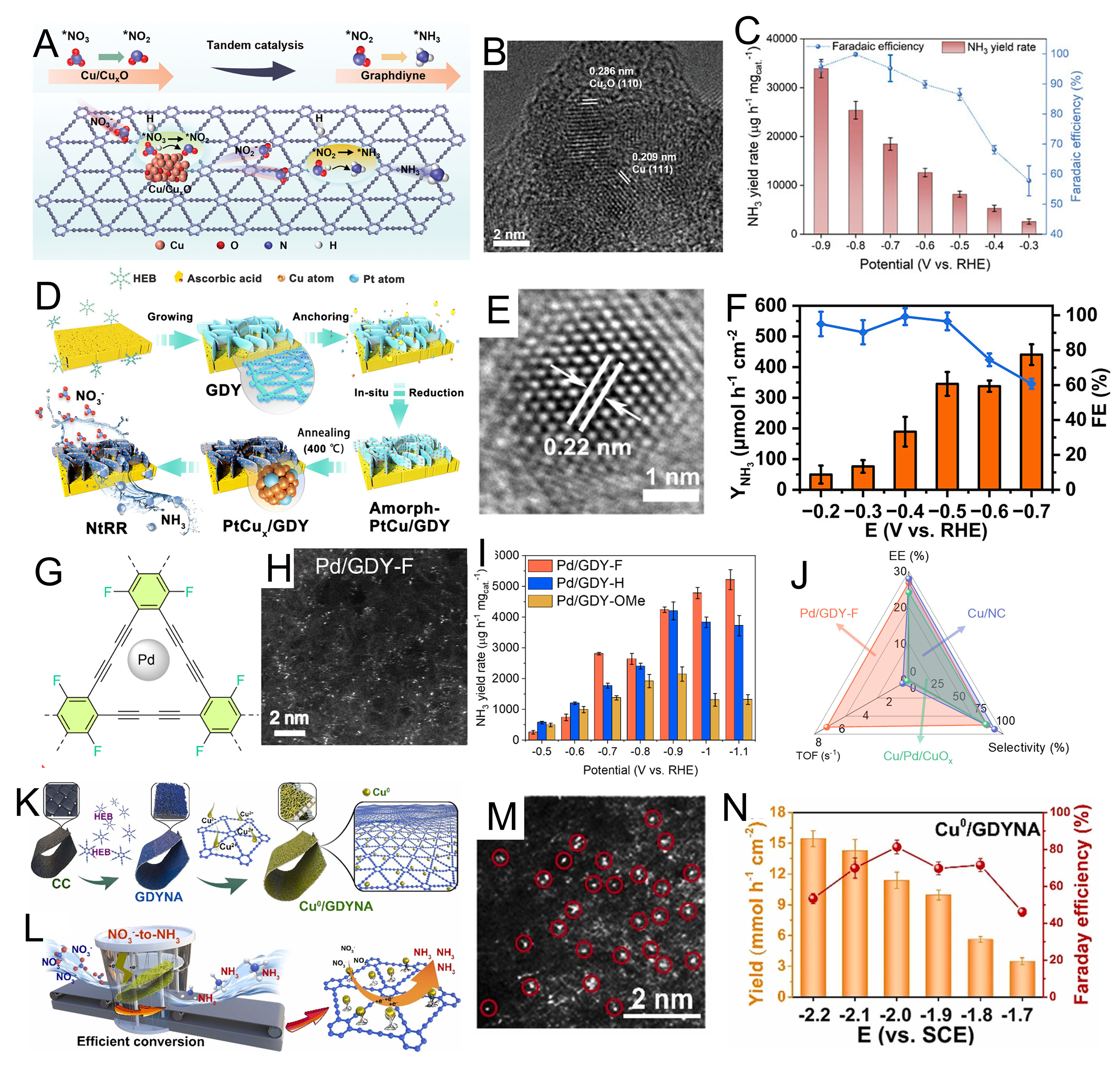
Figure 5. (A) Proposed reaction scheme for the NtRR on Cu/CuxO/GDY; (B) HRTEM image of Cu/CuxO/GDY; (C) YNH3 and FEs of Cu/CuxO/GDY at selected potentials[85];(A-C) are reprinted with permission from reference[85]. Copyright 2024 Wiley-VCH GmbH; (D) Schematic illustration of PtCux/GDY synthesis; (E) HRTEM image of PtCux/GDY; (F) PtCux/GDY YNH3 and FE at varied potentials[86]; (D-F) are reprinted with permission from reference[86]. Copyright 2024 American Chemical Society; (G) Chemical structure of Pd/GDY-F; (H) AC-HAADF-STEM image of Pd/GDY-F; (I) Rate of NH3 production in the NtRR for Pd/GDY-R (R = F, H, OMe); (J) Comparison of catalytic performance between Pd/GDY-F and other catalysts[87]; (G-J) are reproduced without modification from reference[87]. Reproduced under a CC BY-NC-ND 4.0 license; (K) Schematic of the synthesis route and (L) the NtRR process of Cu0/GDYNA; (M) HAADF-STEM image of Cu0/GDYNA; (N) YNH3 and FEs of Cu0/GDYNA catalysts at different potentials[88]; (K-N) are reprinted with permission from reference[88]. Copyright 2022 Elsevier. GDY: Graphdiyne; NtRR: nitrate reduction reaction; RHE: reversible hydrogen electrode; TOF: turnover frequency; EE: energy efficiency; CC: carbon cloth; GDYNN: GDY nanosheets; SCE: saturated calomel electrode; HRTEM: high resolution transmission electron microscopy; FE: Faradaic efficiency; AC-HAADF-STEM: aberration-corrected high-angle annular dark-field scanning transmission electron microscopy.

