

Beyond free hydroxyl radicals: harnessing surface-bound hydroxyl species for selective electrochemical water remediation
 0
0 


 Download PDF
MOVING BEYOND THE HYDROXYL RADICAL PARADIGM
Electrochemical oxidation has become a widely explored strategy for removing refractory organic contaminants from water. By generating oxidizing species directly at electrode surfaces, it provides an electricity-driven route for pollutant transformation with limited chemical addition[1]. For decades, this field has been guided by the assumption that efficient anodic oxidation relies on the continuous production of freely diffusing hydroxyl radical (•OH). This view has promoted the development of wide-window anodes, such as boron-doped diamond, Ti4O7, PbO2, SnO2 and doped metal oxides, which are expected to form •OH before oxygenated intermediates evolve into O2[2-5]. Yet more •OH does not always mean more useful oxidation. At high anodic potentials, oxygen evolution and electrolyte oxidation compete for current; in complex waters, short-lived •OH can be lost to diffusion, radical scavenging and secondary reactions before reaching dilute pollutants[6]. These constraints call for closer attention to the interfacial fate of hydroxyl species.
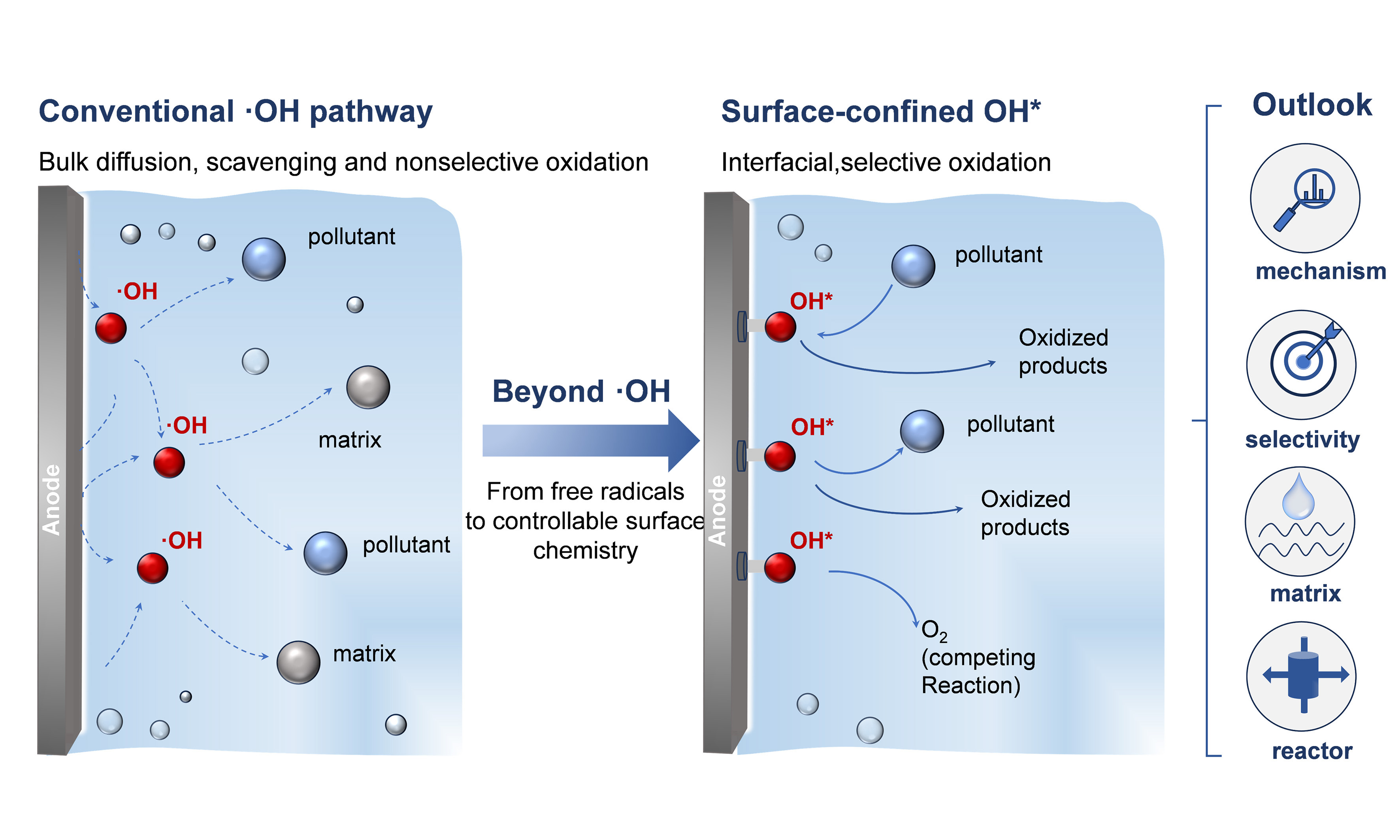
More fundamentally, the radical-yield paradigm can obscure the identity of the actual oxidizing pathway. Hydroxyl-related signals obtained from spin trapping, fluorescent probes, scavenging tests or product analysis do not by themselves establish whether pollutant oxidation is mediated by freely diffusing •OH or by hydroxyl species retained at the electrode surface[7-9]. In this Perspective, we use surface-bound hydroxyl species (OH*) to denote hydroxyl-containing oxidizing states retained at the electrode interface and surface-confined OH* oxidation to denote pollutant transformation occurring within this interfacial reaction zone. These terms are distinct from freely diffusing •OH, although the two populations can originate from connected water-oxidation pathways and may interconvert. The key question therefore shifts from “how can we generate more •OH?” to “under what conditions can the formation, state and fate of hydroxyl species be directed toward useful pollutant transformation?” Figure 1 summarizes this conceptual distinction between freely diffusing •OH oxidation and surface-confined OH* oxidation.
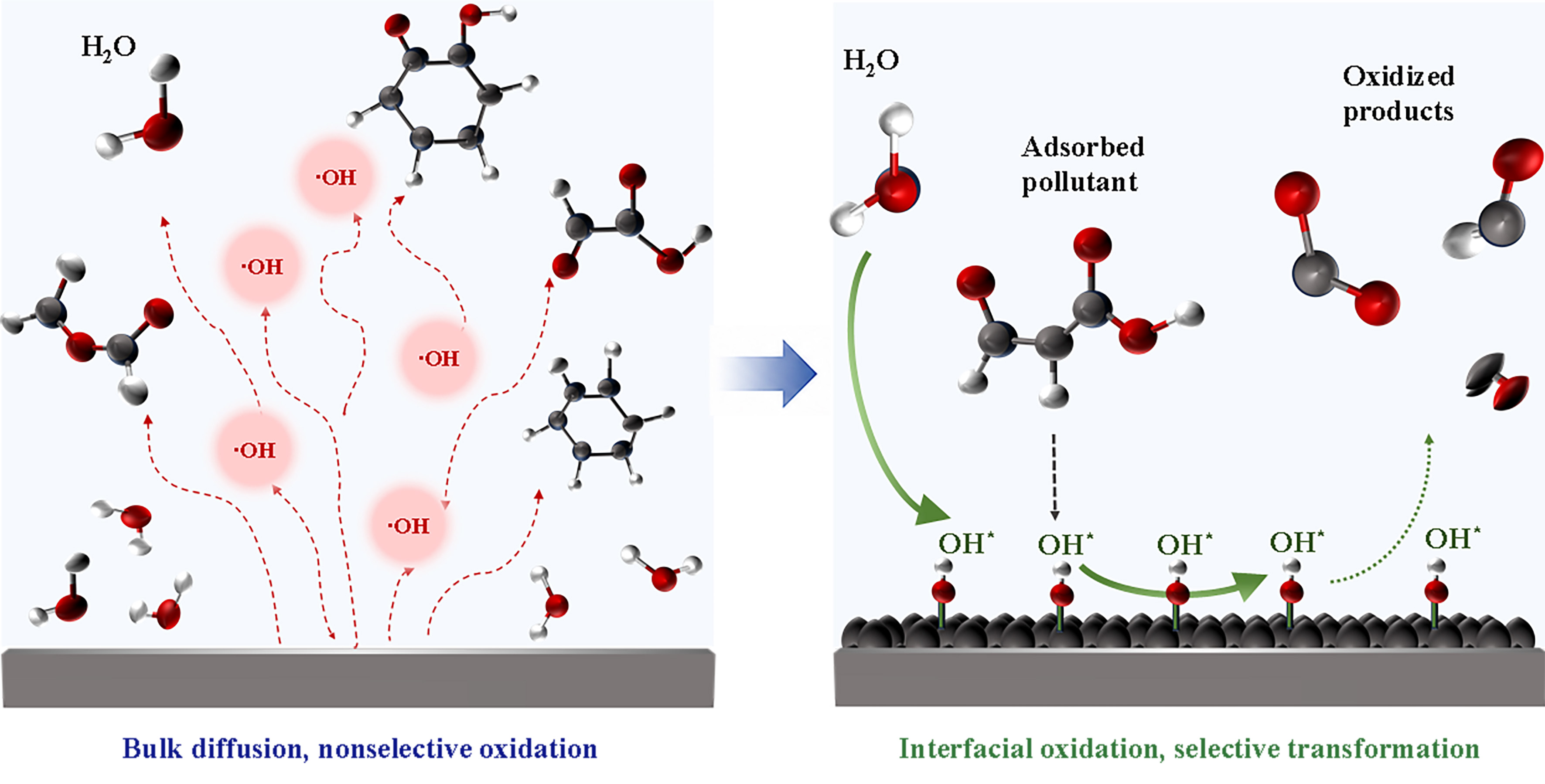
Figure 1. Paradigm shift from free •OH oxidation to OH* catalysis in electrochemical water remediation.
SURFACE-BOUND HYDROXYL SPECIES AS INTERFACIAL CATALYTIC OXIDANTS
Surface-bound OH* is not a new chemical concept. In oxygen evolution electrocatalysis, OH*, O* and OOH* are routinely treated as water-oxidation intermediates whose adsorption energies shape catalytic trends[10]. Surface hydroxyls, oxygen vacancies and lattice-oxygen pathways have also been widely discussed in heterogeneous catalysis and photocatalysis. The point here is not to claim the discovery of OH*, but to reinterpret this transient water-oxidation intermediate as an interceptable oxidizing state for electrochemical water remediation. During water adsorption and deprotonation, OH* remains structurally and electronically coupled to metal centers, oxygen vacancies, carbon defects or other interfacial sites. This coupling allows OH* to react with a nearby adsorbed or electronically connected pollutant before it proceeds toward O*, OOH* and O2, or loses surface confinement as a radical-like species[11]. The applied potential further regulates its formation, coverage and lifetime, making OH* a controllable interfacial state rather than a passive intermediate.
The selectivity of OH*-mediated oxidation should be attributed to interfacial kinetic discrimination rather than to the intrinsic nature of OH* itself. A surface-bound hydroxyl species can remain highly reactive, but its finite reaction distance makes pollutant access decisive[12]. Preferential adsorption may enrich selected pollutants, molecular orientation may place vulnerable bonds close to OH*, and electronic coupling may facilitate interfacial charge transfer. Molecules that cannot access the hydroxylated site are naturally excluded from the dominant reaction zone. Thus, selectivity emerges from the coupled competition among pollutant adsorption, OH* formation, interfacial oxidation, radical release and oxygen evolution[13]. Any apparent energetic benefit should not be interpreted as bypassing water activation, but as improving the productive use of a surface intermediate before it is further driven toward O2 or released into solution.
This framework is consistent with the classical active/non-active anode theory while shifting attention to the branching behavior of surface-bound hydroxyl species. In the Comninellis framework, weakly bound active oxygen on non-active anodes favors strong oxidation, whereas more strongly bound oxygen species on active anodes participate in selective conversion and oxygen evolution[14]. This framework clarifies the value of surfaces that do not sit at either classical extreme. Weak OH* binding favors radical release, whereas strong OH* binding favors further oxidation toward O*, OOH* and O2. Effective OH*-mediated remediation requires a surface that retains OH* long enough to react with nearby pollutants, while avoiding excessive stabilization that drives oxygen evolution. Moderately active surfaces may therefore be useful when OH* binding, pollutant adsorption and interfacial charge transfer are kinetically matched. Figure 2 summarizes these competing fates and the corresponding design levers for directing OH* toward pollutant-coupled oxidation.
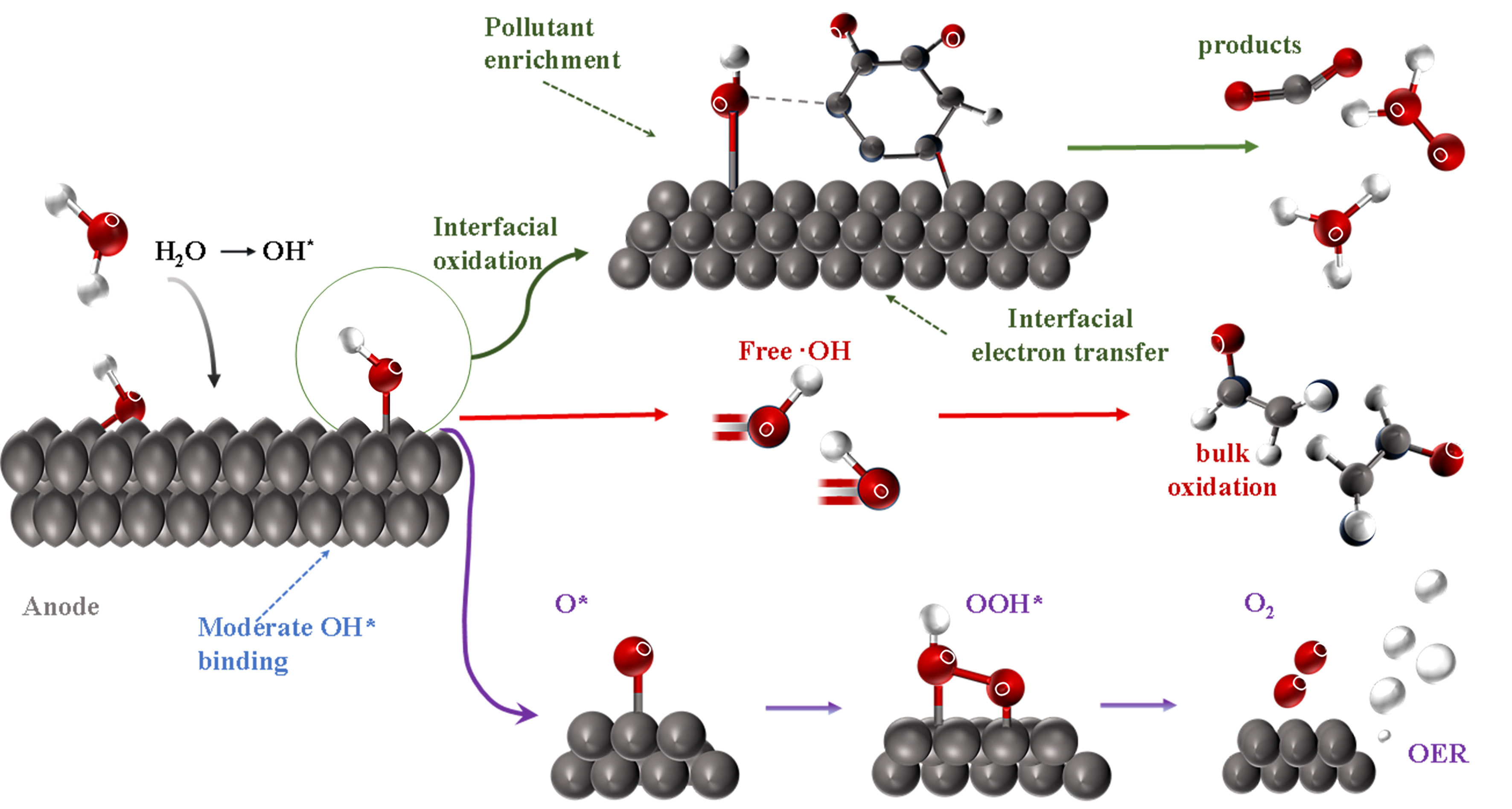
Figure 2. Design principles for regulating the fate of surface-bound hydroxyl species. OER: Oxygen evolution reaction.
ENGINEERING THE FATE OF OH*: ADSORPTION, COUPLING AND DYNAMIC CONVERSION
To harness surface hydroxyl chemistry, the central design objective should be to regulate the fate of OH*. If OH* binding is too weak, the surface cannot efficiently activate water or retain hydroxyl species long enough for interfacial oxidation. If OH* binding is too strong, hydroxylated sites may become blocked, pollutant adsorption may be inhibited and oxygen evolution may be favored through further oxidation to O* and OOH*[15]. The optimal surface should maintain OH* in a reactive but not inert state. This optimum differs from that required for oxygen evolution. In oxygen evolution reaction (OER) catalysis, the goal is to proceed through OH*, O* and OOH* toward O2 formation. In water remediation, the goal is to intercept the hydroxylated state and use it for pollutant oxidation before it proceeds to oxygen evolution. Electrode materials should therefore be designed to tune the electronic structure of hydroxyl-binding sites. Transition metal oxides, spinel oxides, Magnéli-phase titanium suboxides, doped PbO2, mixed-metal oxides and functionalized carbon materials can all provide different OH* binding environments. Dopants, vacancies, metal-oxygen covalency and conductive networks should not be viewed as independent structural parameters, but as interconnected factors that define the local reaction landscape of surface hydroxyl species[16].
Because OH* is surface-confined, pollutant accessibility is equally decisive. A surface may generate highly reactive OH*, but if target molecules cannot approach the hydroxylated sites, the oxidizing equivalent will be diverted toward oxygen evolution, hydroxyl recombination or other nonproductive reactions. OH*-based oxidation therefore requires pollutant-hydroxyl coupling interfaces. Hydrophobic regions can enrich aromatic or halogenated pollutants near the anode surface. π-conjugated carbon layers can interact with electron-rich aromatic contaminants. Molecular recognition sites can selectively capture trace pollutants from complex matrices. Porous and flow-through electrodes can force pollutants through reactive interfacial regions rather than relying on random diffusion[17,18]. Conductive carbon layers, redox-active interlayers and molecularly imprinted conductive films may further serve as electron-transfer bridges that bring pollutants into communication with OH*. In this way, the anode integrates water activation, pollutant enrichment and interfacial electron transfer rather than simply releasing oxidants into solution. Here, “selectivity” should be interpreted as interfacial-access selectivity rather than an intrinsic chemoselectivity of OH*: target molecules react preferentially only when they are enriched, oriented or electronically coupled within reach of OH*, while competing solutes are excluded or weakly coupled.
A central question remains: should OH* be retained on the surface, or should it be released as free •OH? There is unlikely to be a universal optimum. Greater OH* retention can favor short-range pollutant-coupled oxidation only when target access and product release remain sufficiently fast; excessive retention can instead block sites or feed subsequent oxygen-evolution steps. Conversely, free •OH remains advantageous when deep and comparatively nonselective mineralization of concentrated waste streams is the treatment objective. Potential pulsing and other dynamic operation modes may provide a route to tune surface coverage, pollutant adsorption and oxygenated-intermediate conversion over time. The relevant design variable is therefore the branching ratio among pollutant-coupled OH* utilization, •OH release and oxygen evolution, rather than an absolute choice between OH* and •OH.
IDENTIFYING, VALIDATING AND APPLYING SURFACE-CONFINED OH* OXIDATION
Mechanistic identification and falsifiable evidence
Despite its promise, surface-confined OH* oxidation cannot become a mature design principle without reliable mechanistic identification. Current evidence often relies on scavenging tests, electron paramagnetic resonance (EPR), fluorescent probes or indirect product analysis, but each approach can generate false-positive or non-unique signals. Alcohol scavengers can support the involvement of diffusible radicals but cannot fully exclude surface reactions. Potassium iodide (KI) has been used as a surface-accessible hydroxyl scavenger in heterogeneous electrochemical systems, yet iodide is itself electroactive and can perturb surface adsorption and direct electron-transfer pathways, so inhibition by KI is not uniquely diagnostic of OH*. Likewise, 5,5-Dimethyl-1-pyrroline N-oxide (DMPO)-OH signals can arise from direct electrochemical oxidation of the spin trap at potentials below the onset of water oxidation, complicating quantitative interpretation of EPR data. Terephthalic acid is comparatively resistant to direct anodic oxidation and is therefore a useful •OH probe, but its hydroxylation product still does not by itself establish whether the reaction occurred in solution or at the electrode surface[19].
Practical identification should therefore rely on staged, orthogonal controls. For spin trapping, researchers should record the electrochemistry of the spin trap itself, collect spectra at potentials below and above water oxidation, include open-circuit/no-current controls, compare more than one trapping reagent where possible, and test whether the scavenger or trap is directly oxidized at the working electrode. For surface-enhanced Raman or infrared spectroscopy, potential-step or difference spectra should be collected under catalytic turnover, and assignments should be strengthened through isotopic substitution such as D2O or H2(18)O and by correlation with product formation. H2(18)O labeling can track incorporation of water-derived oxygen into products or evolved O2 by mass spectrometry, whereas D2O kinetic isotope effects can probe proton-coupled steps but cannot alone identify OH*. Electrochemical impedance spectroscopy and transient-current measurements can reveal adsorption-related pseudocapacitance or characteristic relaxation times associated with formation and decay of surface states, but these signals are chemically nonspecific and should be correlated with operando spectroscopy[20]. Constant-potential simulations and explicit-water molecular dynamics can further test whether the proposed OH* state is stable and reactive under the measured potential and electrolyte composition. No single method resolves the entire pathway; the objective should be to test a defined, falsifiable mechanism rather than accumulate indirect indicators[21].
Real-water matrix effects and mitigation
Surface confinement does not automatically ensure tolerance to complex water matrices. Natural organic matter may compete with target pollutants for adsorption, consume surface reactive species and foul porous interfaces. Carbonate and bicarbonate can alter interfacial pH and convert released •OH into carbonate radicals, while chloride can compete for anodic charge and generate reactive chlorine species, chlorate, perchlorate or halogenated byproducts under strongly oxidative conditions. Other ions may also modify the double layer or occupy surface sites[22]. Thus, constituents that quench freely diffusing radicals can also reshape OH* coverage, pollutant accessibility and product distribution at hydroxylated interfaces. Matrix tolerance should therefore be claimed only when pollutant-coupled interfacial oxidation remains dominant in real waters, with mineralization, toxicity evolution, surface fouling and halogenated byproducts carefully evaluated.
Surface-confined OH* chemistry may be most useful when indiscriminate bulk oxidation is inefficient or unnecessary, such as trace micropollutant removal from municipal, hospital or industrial effluents with high background loads. Local pollutant enrichment and interfacial oxidation could direct hydroxyl reactivity toward target compounds, while controlled partial oxidation may reduce toxicity, remove specific functional groups, improve biodegradability or generate separable products. These advantages are pathway-dependent rather than intrinsic to all surface-bound hydroxyl species. Their practical realization also requires reactor designs that continuously deliver pollutants to hydroxylated sites and remove products under flow conditions. Flow-through, three-dimensional or membrane-electrode systems can shorten diffusion distances, regulate ion transport and sustain an interfacial reaction zone where pollutant enrichment, charge transfer and hydroxyl activation occur together[23].
Key questions remain. Descriptors combining OH* binding, pollutant adsorption, electronic coupling and mass transfer are needed to predict when interfacial selectivity will emerge and persist in real waters. The hypothesis is experimentally testable: blocking pollutant adsorption or increasing pollutant-to-surface distance should suppress OH*-mediated oxidation even when bulk radical signals remain similar. Hydroxyl radicals remain indispensable for deep oxidation and mineralization, but surface-confined OH* offers a complementary pathway in which water activation, pollutant binding and charge transfer are deliberately coupled.
DECLARATIONS
Authors’ contributions
Formal analysis, investigation, methodology, validation, writing-original draft: Liu, Y.
Writing-review & editing, validation: Liu, Z.; Wu, Z.
Supervision, conceptualization, writing-review & editing, funding acquisition: Liu, G.
Availability of data and materials
Not applicable.
AI and AI-assisted tools statement
During the preparation of this manuscript, the AI tool OpenAI GPT-5.5 (version 5.5, released 2026-04-23) was used solely for language editing. The tool did not influence the study design, data collection, analysis, interpretation, or the scientific content of the work. All authors take full responsibility for the accuracy, integrity, and final content of the manuscript.
Financial support and sponsorship
This work was supported by the National Natural Science Foundation of China (Grant No. 52570080).
Conflicts of interest
All authors declared that there are no conflicts of interest.
Ethical approval and consent to participate
Not applicable.
Consent for publication
Not applicable.
Copyright
© The Author(s) 2026.
REFERENCES
1. Li, W.; Song, G.; Sun, J.; Zhou, M. Electrochemical advanced oxidation processes towards carbon neutral wastewater treatment: a review. Chem. Eng. J. 2024, 480, 148044.
2. Xie, J.; Zhang, C.; Waite, T. D. Hydroxyl radicals in anodic oxidation systems: generation, identification and quantification. Water. Res. 2022, 217, 118425.
3. Shu, Y.; Hu, M.; Zhou, M.; et al. Emerging electrocatalysts for electrochemical advanced oxidation processes (EAOPs): recent progress and perspectives. Mater. Chem. Front. 2023, 7, 2528-53.
4. Sun, Y.; Bai, S.; Wang, X.; Ren, N.; You, S. Prospective life cycle assessment for the electrochemical oxidation wastewater treatment process: from laboratory to industrial scale. Environ. Sci. Technol. 2023, 57, 1456-66.
5. Wei, R.; Pei, S.; Yu, Y.; Zhang, J.; Liu, Y.; You, S. Water flow-driven coupling process of anodic oxygen evolution and cathodic oxygen activation for water decontamination and prevention of chlorinated byproducts. Environ. Sci. Technol. 2023, 57, 17404-14.
6. Wu, Y.; Chen, X.; Chen, Z.; Crittenden, J. C.; Wang, Z.; Tong, X. Confinement improves mass transfer and chemical reactivity in electrified membranes for micropollutant degradation. Adv. Funct. Mater. 2025, 35, 2423827.
7. Jing, Y.; Chaplin, B. P. Mechanistic study of the validity of using hydroxyl radical probes to characterize electrochemical advanced oxidation processes. Environ. Sci. Technol. 2017, 51, 2355-65.
8. Xie, J.; Ma, J.; Zhao, S.; Waite, T. D. Flow anodic oxidation: towards high-efficiency removal of aqueous contaminants by adsorbed hydroxyl radicals at 1.5 V vs SHE. Water. Res. 2021, 200, 117259.
9. Braxton, E.; Fox, D. J.; Breeze, B. G.; et al. Electron paramagnetic resonance for the detection of electrochemically generated hydroxyl radicals: issues associated with electrochemical oxidation of the spin trap. ACS. Meas. Sci. Au. 2022, 3, 21-31.
10. Li, J. Oxygen evolution reaction in energy conversion and storage: design strategies under and beyond the energy scaling relationship. Nanomicro. Lett. 2022, 14, 112.
11. Xie, J.; Ma, J.; Zhang, C.; Waite, T. D. Direct electron transfer (DET) processes in a flow anode system-energy-efficient electrochemical oxidation of phenol. Water. Res. 2021, 203, 117547.
12. Barroso-Martínez, J. S.; Romo, A. I. B.; Pudar, S.; Putnam, S. T.; Bustos, E.; Rodríguez-López, J. Real-time detection of hydroxyl radical generated at operating electrodes via redox-active adduct formation using scanning electrochemical microscopy. J. Am. Chem. Soc. 2022, 144, 18896-907.
13. Yang, Z.; Qian, J.; Shan, C.; Li, H.; Yin, Y.; Pan, B. Toward selective oxidation of contaminants in aqueous systems. Environ. Sci. Technol. 2021, 55, 14494-514.
14. Comninellis, C. Electrocatalysis in the electrochemical conversion/combustion of organic pollutants for waste water treatment. Electrochim. Acta. 1994, 39, 1857-62.
15. Man, I. C.; Su, H. Y.; Calle-Vallejo, F.; et al. Universality in oxygen evolution electrocatalysis on oxide surfaces. ChemCatChem 2011, 3, 1159-65.
16. Liang, J. J.; Du, C. Y.; Xian, Y. J.; et al. Accelerating *OH desorption via electron‐delocalized CuTd2+-O-CoOh3+ for water purification. Adv. Funct. Mater. 2025, 35, 2503514.
17. Cai, J.; Niu, B.; Zhao, H.; Zhao, G. Selective photoelectrocatalytic removal for group-targets of phthalic esters. Environ. Sci. Technol. 2021, 55, 2618-27.
18. Pan, Y.; Guo, J.; Han, Y.; et al. Unlocking efficient electrocatalytic removal of trace emerging contaminants via synchronized pollutant enrichment and electron delivery. Nat. Commun. 2026, 17, 1430.
19. Lei, Y.; Yu, Y.; Lei, X.; et al. Assessing the use of probes and quenchers for understanding the reactive species in advanced oxidation processes. Environ. Sci. Technol. 2023, 57, 5433-44.
20. Wu, J. H.; Yu, H. Q. Confronting the mysteries of oxidative reactive species in advanced oxidation processes: an elephant in the room. Environ. Sci. Technol. 2024, 58, 18496-507.
21. Zuo, S.; Wu, Z. P.; Zhang, H.; Lou, X. W. Operando monitoring and deciphering the structural evolution in oxygen evolution electrocatalysis. Adv. Energy. Mater. 2022, 12, 2103383.
22. Yang, Y. Recent advances in the electrochemical oxidation water treatment: spotlight on byproduct control. Front. Environ. Sci. Eng. 2020, 14, 85.
Cite This Article
 Open Access
How to Cite
Liu, Y.; Liu, Z.; Wu, Z.; Liu, G. Beyond free hydroxyl radicals: harnessing surface-bound hydroxyl species for selective electrochemical water remediation. Catal. Energy Environ. 2026, 1, 3. https://dx.doi.org/10.20517/cee.2026.09
Download Citation
If you have the appropriate software installed, you can download article citation data to the citation manager of your choice. Simply select your manager software from the list below and click on download.
Export Citation File
Type of Import
Tips on Downloading Citation
Citation Manager File Format
Type of Import
Direct Import: When the Direct Import option is selected (the default state), a dialogue box will give you the option to Save or Open the downloaded citation data. Choosing Open will either launch your citation manager or give you a choice of applications with which to use the metadata. The Save option saves the file locally for later use.
Indirect Import: When the Indirect Import option is selected, the metadata is displayed and may be copied and pasted as needed.
About This Article
Special Topic
Copyright

Data & Comments
Data
0








Comments
Comments must be written in English. Spam, offensive content, impersonation, and private information will not be permitted. If any comment is reported and identified as inappropriate content by OAE staff, the comment will be removed without notice. If you have any queries or need any help, please contact us at [email protected].