

The surgeon behind the algorithm: Why Intraoperative AI Literacy is a patient safety imperative
 0
0 


 Download PDF
INTRODUCTION AND BACKGROUND
Artificial intelligence (AI) is entering the surgical operating room. AI-assisted guidance systems are increasingly being developed and evaluated to support anatomical identification, document safety-critical steps, and provide real-time intraoperative decision support[1-5]. A 2025 international survey of surgeons reported growing awareness of AI, participation in AI-related training, and a strong willingness to integrate AI into surgical practice despite persistent gaps in formal knowledge and education[6]. What has not advanced at the same pace is preparation for using these systems safely in practice.
Intraoperative decision-making in surgery depends on the surgeon’s ability to interpret anatomy under conditions of uncertainty. In procedures such as laparoscopic cholecystectomy, where critical structures may be obscured by inflammation, fibrosis, or anatomical variation, the consequences of misidentification can be severe and irreversible.
AI-assisted guidance systems introduce a new variable into this process. By presenting anatomical overlays, structural labels, and confidence scores in real time, these systems offer interpretive outputs that may influence surgical decision-making at moments when independent judgment is most critical. The central safety question is therefore not only whether AI can identify anatomy accurately, but also whether surgeons are prepared to evaluate its guidance, recognise its limits, and reject it when clinical judgment requires.
To the authors’ knowledge, no established competency framework currently defines the competencies needed by surgeons to use intraoperative AI guidance safely in clinical practice[7,8]. Drawing on evidence from surgical AI research and the human factors literature, this paper proposes Intraoperative AI Literacy (IAIL) as a candidate framework for organising these competencies and guiding their future training and assessment.
Intraoperative AI guidance is not yet part of routine surgical practice. The systems discussed in this paper remain largely at the stage of technical development, feasibility testing, and early clinical validation[4,9,10]. As such, the framework proposed here is anticipatory rather than descriptive. It is not a response to an established pattern of harm from routine clinical use; rather, it identifies competency gaps that may arise as intraoperative AI systems move towards routine clinical use. Others may reasonably propose different competencies or conclude that more is required than the five domains proposed here.
THE PROBLEM WITH TRUSTING THE SCREEN
Surgeons have always used tools that provide information. A cholangiogram, a fluoroscopic image, or a frozen section may guide intraoperative decision-making, but none of these tools determines the operative decision. They provide findings that the surgeon must interpret in context.
Intraoperative AI guidance, however, will differ from these well-established information tools in two important ways. First, AI may present its output as an already interpreted judgment. An overlay, label, or confidence score can create the appearance of certainty, not only for the surgeon but also for the wider operating team. Second, surgeons may have limited knowledge of how the AI system reached its conclusion: what cases it was trained on, which patient populations were represented in its training data, and where its reliability may degrade. Using AI safely will therefore require surgeons to judge when its output should be trusted and when it should not.
The most mature work in AI-assisted laparoscopic cholecystectomy comes from Mascagni et al.[1,2,4,5], together with independent work from several other groups[11-16].
The initial development study of the EndoDigest platform demonstrated that automatically extracted video clips successfully documented the critical view of safety (CVS) in 91% of laparoscopic cholecystectomy cases[1]. In the subsequent multicentre validation study, this proportion decreased to 75% when the platform was evaluated across four independent centres, reflecting substantial variation in surgical workflows[2].
In a separate retrospective analysis of 11 laparoscopic cholecystectomy videos containing bile duct injuries, 45% of the injury-causing interactions occurred outside both the AI-defined Go and No-Go zones[17].
Madani et al. developed GoNoGoNet to flag safe and dangerous zones of dissection, finding that it changed surgeon decisions in more than one in four cases, mostly in a safer direction[12,13]. Ward et al. trained AI to assess gallbladder inflammation from the opening laparoscopic view and predict operative difficulty before the first cut[14]. Golany et al. demonstrated surgical phase recognition with 89% accuracy overall, with performance declining to 81% in the most complex cases[15].
Across studies, countries, and technical approaches, the same pattern emerges: AI performs best when an operation is relatively straightforward and becomes less dependable as anatomy is distorted, inflammation becomes severe, or procedural complexity increases. These are precisely the circumstances in which surgeons most need reliable guidance and have the strongest reason to verify it independently.
This pattern is not confined to hepatobiliary surgery. In urology, a convolutional neural network has been applied to intraoperative video during robot-assisted radical prostatectomy to segment the bladder, prostate, and seminal vesicle-vas deferens in real time[18]. The authors note, however, that the clinical utility of such segmentation during live surgery remains largely unknown[18]. In colorectal surgery, a deep learning model has been developed to highlight areolar tissue as a landmark for the total mesorectal excision plane[19]. The model was derived from a single-centre feasibility study involving 32 patients, and the authors identify the limited quantity and quality of training data as constraints on generalisability[19]. Both systems therefore remain at an early stage of clinical evaluation.
These studies share a common limitation. Many current surgical AI models are developed from datasets assembled at one or a small number of centres for a single procedure, and therefore reflect the patient populations, operative techniques, and imaging conditions of those institutions[10,18,19]. Performance demonstrated in these settings does not necessarily establish performance elsewhere. A surgeon treating a population that differs from the population on which an AI model was trained may therefore receive systematically less reliable guidance. Yet the system itself may provide no clear indication that its performance has degraded.
The safety problem, then, is not simply whether AI can identify anatomy accurately under ideal conditions. It is whether surgeons are trained to recognise when a case falls outside the conditions in which a system was developed and validated, to interpret its output with appropriate caution, and, when necessary, to discount or reject its guidance.
SURGERY HAS BEEN HERE BEFORE
This is not the first time surgery has faced a technological transition that changed how surgeons see anatomy, interpret information, and make decisions in the operating room.
When laparoscopic cholecystectomy was introduced in the late 1980s and early 1990s, bile duct injuries increased compared with open surgery[20]. The problem was not simply one of technical skill. The operative view had changed. Anatomy appeared on a two-dimensional screen, spatial orientation became less intuitive, and surgeons were working in a visual environment for which their training had not prepared them. The most common cause of injury was misidentification of one structure as another. The surgical response was the CVS, introduced by Strasberg in 1995[20]. Rather than relying on impression or confidence, it provided surgeons with a structured check before cutting: a way of verifying what they were seeing before acting on it.
A similar transition occurred with robotic surgery. Formal training pathways, simulation programmes, and credentialing systems gradually developed to support this transition[21].
The World Health Organization (WHO) Surgical Safety Checklist reinforced the same principle more broadly: a simple structured verification step was associated with reductions in mortality and postoperative complications across diverse hospital settings[22].
The pattern is familiar. A transformative technology enters the operating room, new demands on surgeon judgment emerge that the existing training infrastructure did not anticipate, and the field eventually develops formal training standards, structured safety frameworks, and oversight mechanisms to meet them. The training response may lag behind the technology, and in some cases the field catches up only after preventable harm has occurred.
AI-assisted guidance systems may represent the next iteration of this pattern.
LESSONS FROM HIGH-STAKES AUTOMATION
Across multiple safety-critical domains, the human factors literature has consistently shown that automation changes how people make decisions and supervise complex systems. As reliance on automation increases, maintaining independent judgment, recognising system limitations, and knowing when to intervene become increasingly important[23-25].
Similar challenges have been recognised in fields such as aviation and nuclear power, where operators are required to supervise automated systems while remaining prepared to question or override them when necessary. Safe integration also requires training, clear operational procedures, and continued human oversight[23-25].
Aviation provides the most extensively documented example of how a high-stakes field recognised these risks and developed a systematic response. As cockpit automation matured, accident investigations repeatedly identified failures in the interaction between pilots and automated systems, including overreliance on automation, loss of situational awareness, and difficulty transitioning to manual control when automation behaved unexpectedly or could no longer manage the situation. The Air France Flight 447 and Boeing 737 MAX accidents illustrate some of the complex human factors associated with highly automated systems[26,27]. Aviation’s response was not to limit automation but to develop structured frameworks for its safe management, including regulatory oversight, simulator-based training, recurrent competency assessment, and explicit training in intervention and manual control.
Surgeons using intraoperative AI guidance systems will increasingly operate within a comparable human-machine environment. Frameworks for automation awareness, failure recognition, trust calibration, and override decision-making will therefore be needed. The risk is not simply that AI may produce unreliable guidance, but that the surgeon may not recognise it quickly enough to intervene safely[23-25]. This suggests that safe integration of AI-assisted surgery will depend not only on technological performance but also on the surgeon’s ability to supervise, interpret, question, and override AI guidance, when necessary, in the operating room.
IAIL: TRAINING FOR THE TRANSITION
This paper proposes IAIL as a candidate competency framework comprising five core abilities: to interpret AI guidance in the operating room, evaluate its applicability to the operative context, act on it when appropriate, override it when clinical judgment indicates otherwise, and retain accountability for all operative decisions. The five domains that operationalise these abilities are defined in Table 1 and positioned at the bottom of Figure 1. IAIL has not undergone expert consensus, formal validity assessment, or clinical evaluation. It is therefore presented as a framework for testing and refinement rather than for adoption. Supplementary Figure 1 illustrates how these competencies may be applied when AI guidance conflicts with the surgeon’s direct operative assessment.
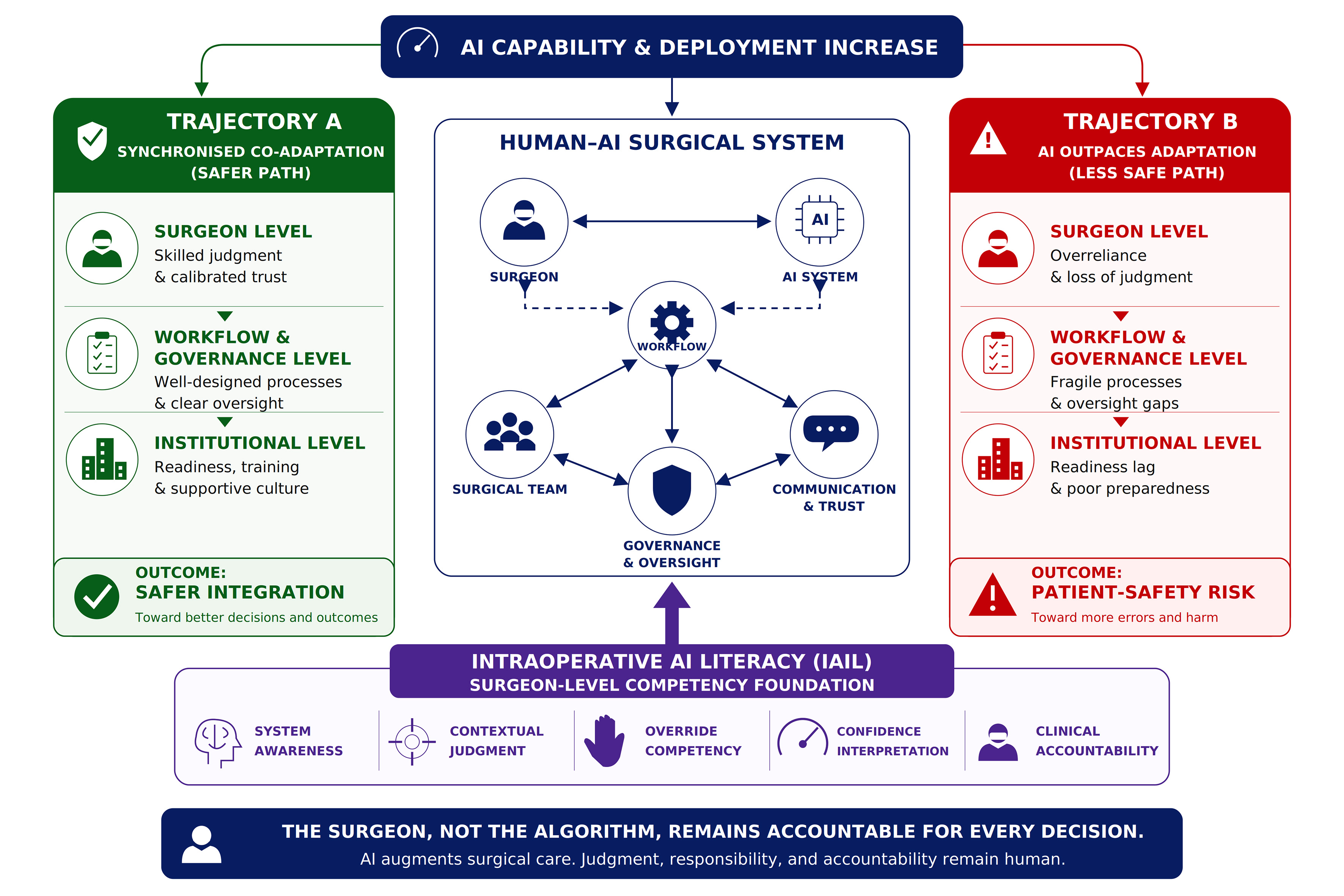
Figure 1. Human-AI co-adaptation in AI-assisted surgery: two conceptual patient-safety trajectories. The figure illustrates how increasing AI capability may follow either a safer or less safe trajectory depending on how surgeons and the surrounding surgical system adapt to its use. These trajectories are presented as a conceptual framework rather than empirically derived categories. The central Human-AI Surgical System includes workflow, governance, team, and communication elements that influence how AI guidance is integrated into operative care. The five domains of IAIL are shown at the base of the figure as the surgeon-level competency foundation proposed in this paper. While workflow, governance, and institutional factors contribute to safe adoption, the primary focus of this manuscript is the surgeon competencies required to interpret, verify, question, and override AI guidance appropriately. AI: Artificial intelligence; IAIL: Intraoperative AI Literacy.
The five domains of IAIL, with corresponding surgeon requirements, observable practice indicators, and supporting evidence
| IAIL domain | What it requires of the surgeon | What it looks like in practice | Evidence base |
| IAIL-1 System Awareness (Know the System)[2,10] | The surgeon understands the patient populations, operative conditions, and anatomical scenarios under which the AI system was trained and validated, including situations where reliability may decline | Can identify clinical situations in which the AI system may be unreliable and independently verifies anatomical findings before accepting AI guidance in those cases | Mascagni et al.[2]: performance variation across validation centres; Singh and Kavoussi[10]: AI generalisation limits (surgical AI evidence) |
| IAIL-2 Contextual Judgment (Use Context)[3,4,10,17] | The surgeon integrates AI guidance within the full operative context, including inflammation, distorted anatomy, prior surgery, anatomical variation, and patient-specific complexity, rather than assuming AI output as universally applicable | Before acting on AI guidance in a difficult case, can explicitly justify why the system’s output should or should not be trusted in that specific operative setting | Mascagni et al.[3,4]: context-dependent CVS achievement; Khalid et al.[17]: context-dependent decision support; Singh and Kavoussi[10]: contextual judgment (surgical AI evidence) |
| IAIL-3 Override Competency (Override Wisely)[23,24,26,27] | The surgeon is able to reject or disengage AI guidance when it conflicts with independent clinical judgment, despite the cognitive influence of visible AI recommendations or confidence markers | Demonstrates the ability to safely override AI guidance in simulation or real operative review, clearly articulates the clinical reasoning, and shows comfort transitioning back to fully independent decision-making | BEA[26], JATR[27]: consequences of absent override training; Bainbridge[23]: skill degradation; Mosier et al.[24]: automation bias suppresses override (aviation and human factors evidence; no surgical data) |
| IAIL-4 Confidence Interpretation (Read Confidence)[2,24,25] | The surgeon understands that AI confidence scores represent statistical certainty within the model, not guaranteed clinical correctness, particularly in cases outside the system’s validated environment | Can identify scenarios in which a high-confidence AI output should not be accepted without independent anatomical confirmation or additional intraoperative assessment | Mascagni et al.[2]: unchanged confidence scores despite accuracy drop; Mosier et al.[24]: automation bias; Parasuraman and Riley[25]: trust calibration (surgical AI evidence and human factors) |
| IAIL-5 Clinical Accountability (Own the Decision)[25,28] | The surgeon understands that responsibility for intraoperative decision-making remains with the operating surgeon, including decisions informed by AI guidance | Can justify clinical decisions independent of AI output and maintain responsibility for operative actions regardless of whether AI guidance was followed | EU AI Act Article 14[28]: human oversight requirement; Parasuraman and Riley[25]: human responsibility in automation supervision (regulatory requirement and human factors principle) |
Although the safe adoption of AI-assisted surgery will depend on factors beyond surgeon competency, including workflow, governance, institutional readiness, system performance, and the wider implementation context, this paper focuses specifically on the surgeon-level competencies required to interact safely with intraoperative AI guidance. Competency, AI literacy, human factors, and governance overlap, but this paper uses them in a specific sense. IAIL operates at the level of surgeon competency, meaning the ability to act safely on the basis of an understanding of how a system produces its output. It assumes AI literacy, draws on evidence from human factors, and is intended to function within governance structures rather than to replace them[28].
These competencies apply to two distinct groups. Surgical trainees may increasingly encounter AI guidance during their formative years and could acquire these competencies progressively, alongside the operative skills they already develop through structured training programmes. Surgeons already in independent practice are in a different position. They may encounter these systems without having trained alongside them and, in many cases, without structured institutional preparation. The competencies proposed here are intended to apply to both groups, though the route to acquiring them may differ. For trainees, this may mean progressive integration into existing curricula through careful consideration of IAIL or other competency frameworks, if these are subsequently validated and adopted. For surgeons in practice, it may require continuing education and structured courses when these systems are introduced into clinical practice.
The relevance of these competencies may also extend across surgical specialities. A model trained to segment the total mesorectal excision plane can highlight areolar tissue as a visual landmark for the appropriate dissection plane[19]. Whether that guidance is appropriate in an individual case remains a matter of surgical judgment informed by the wider operative and oncological context. A model trained to recognise anatomy during robot-assisted radical prostatectomy can identify relevant anatomical structures[18]. Whether neurovascular bundle preservation is appropriate in an individual patient, however, depends on clinical factors beyond anatomical identification, including tumour stage, the estimated risk of extracapsular extension, and baseline erectile function[29]. In each case, the model contributes anatomical information, while the surgeon contributes clinical judgment. The same distinction is apparent in these examples and may extend to other applications, although this has not been formally tested.
DISCUSSION
Most surgical AI research has focused on algorithmic performance, including accuracy, validation, and segmentation capability[9,10]. Far less research has examined how surgeons respond to AI output: whether they trust it, question it, or set it aside[10,30].
There is the question of what the surgeon can actually check. Deep learning models give an answer without showing how they arrived at it[9]. A surgeon looking at an anatomical overlay produced by an AI model has no way to ask why and cannot question the answer in the way they would question an assistant. Whether surgeons will compensate by checking the anatomy themselves, or accept what they are shown because further checking takes effort, is not yet known.
The way model output is displayed may influence how it is received by the surgeon. A confident overlay, or a high confidence score displayed alongside it, may present the surgeon with an answer before they have formed their own judgment[24,25]. In other high-risk fields, operators tend to place greater trust in an automated recommendation than in the same advice from a colleague, and experience does not appear to eliminate this tendency[23,24]. Whether the same occurs in surgery has yet to be established.
Each IAIL domain responds to a specific practical challenge identified above. A case may involve a patient or presentation that was not represented in the data used to develop the model, so surgeons need to know the conditions under which a system was developed and validated. Inflammation or scarring may make the operative field look different from the training data, so surgeons need to judge whether the output fits the surgery in front of them. A model confidence score may look reassuring, but surgeons need to know what the score actually means. AI guidance may also conflict with the surgeon's own judgment, so surgeons need to be able to override it. Whatever decision is made, the surgeon must be able to account for it. Accordingly, the five domains in Table 1 were not simply drawn up first and then matched to problems. Rather, they emerged from the sequence of judgments a surgeon may need to make when deciding whether and how to use AI guidance in the operating room.
The final domain in Table 1, Clinical Accountability, deserves particular attention. If a model labels a structure with high confidence, the surgeon accepts it without independent verification, and the patient is injured, it may still not be clear where responsibility lies. Although governance and regulation remain under development in many jurisdictions, some current frameworks, such as the EU AI Act, assign oversight responsibilities to the hospital and the operating surgeon but say little about how responsibility should be divided when a surgeon follows plausible guidance that later proves to be wrong[28,31]. In practice, much of that responsibility may still fall to the surgeon. Such responsibility is only fair if the surgeon was trained to judge the AI guidance in the first place. A surgeon who has never been taught to recognise when a model is operating outside the conditions under which it was developed and validated could therefore be held unfairly responsible for a judgment nobody prepared them to make. Training in these competencies is therefore not simply desirable: it is what allows the surgeon to carry that responsibility.
If the IAIL competencies are to be taught, they must also be assessed. The ability to override AI guidance is particularly difficult to evaluate in live practice because the situations that call for it are uncommon and cannot be scheduled. Simulation offers one approach. A simulated procedure in which AI guidance is deliberately incorrect at a defined point would allow the timing, accuracy, and reasoning of the surgeon's response to be recorded. Structured credentialing pathways, such as those established for robotic surgery, provide another possible approach, though their content would differ substantially[21]. Neither approach has yet been tested for this purpose.
Embedding these competencies will not be straightforward. Curriculum time is finite, faculty would need to understand the material themselves, and validated tools for assessing these competencies have not yet been established. Institutions will vary in their ability to provide this training, and access to AI systems will differ between regions, so programmes will begin from different levels of readiness.
This proposal has several limitations. The clinical evidence on intraoperative AI remains concentrated in laparoscopic cholecystectomy, where computer vision applications have advanced furthest[1-5]. Emerging work in colorectal and urological surgery suggests that comparable issues arise elsewhere, but the evidence remains preliminary and is derived from small, single-centre studies[18,19]. Whether IAIL is transferable across other specialities, AI modalities, or operative contexts has not been tested. Furthermore, parts of the rationale for IAIL have been extrapolated from aviation and other high-reliability industries rather than derived directly from surgical data[23-27]. The framework has also not undergone expert consensus, formal validity assessment, or clinical evaluation, and the questions it raises remain open. Addressing them will require prospective evaluation of IAIL across different operative environments, patient populations, and training systems.
CONCLUSION
IAIL is not a framework for doubt. It is a framework for responsible use.
This paper has proposed IAIL as a candidate competency framework for surgeons who may work with intraoperative AI guidance systems as they enter clinical practice. It is offered for testing rather than adoption. Whether the five domains proposed here are the right ones is a question for the field to answer. What is clearer is that the question needs to be asked now, while these systems are still being developed.
DECLARATIONS
Acknowledgments
The authors thank Eshal Khattak (Medical Student, St. George’s University School of Medicine, & Northumbria University, UK) for her assistance with literature review and manuscript preparation.
Authors’ contributions
Conceived the study, conducted the literature review, and wrote the original manuscript: Rahman M
Reviewed the manuscript critically for important intellectual content and approved the final version for submission: Lin CCW, Huang WSW, Ou JJ, Lin MCH
Provided scientific oversight, critical intellectual revision, and editorial guidance throughout the development of the manuscript: Dallemagne B
All authors have read and agreed to the final version of the manuscript.
Availability of data and materials
Not applicable.
AI and AI-assisted tools statement
During the preparation of this manuscript, the AI tool ChatGPT (OpenAI) was used to assist with structural organisation and language editing. Figure 1 and Supplementary Figure 1 were conceptualised entirely by the authors, with the same tool used to render the visual layout from the authors’ specifications, including the illustrative operative image in Supplementary Figure 1. The tool did not influence the study design, data collection, analysis, interpretation, or the scientific content of the work. All authors take full responsibility for the accuracy, integrity, and final content of the manuscript.
Financial support and sponsorship
None.
Conflicts of interest
Lin CCW is an Editorial Board Member of the journal Artificial Intelligence Surgery. Lin CCW was not involved in any stage of the editorial process, including reviewer selection, manuscript handling, or decision-making. The other authors declared that there are no conflicts of interest.
Ethical approval and consent to participate
Not applicable.
Consent for publication
Not applicable.
Copyright
© The Author(s) 2026.
Supplementary Materials
REFERENCES
1. Mascagni P, Vardazaryan A, Alapatt D, et al. Artificial intelligence for surgical safety: automatic assessment of the critical view of safety in laparoscopic cholecystectomy using deep learning. Ann Surg. 2022;275:955-61.
2. Mascagni P, Alapatt D, Laracca GG, et al. Multicentric validation of EndoDigest: a computer vision platform for video documentation of the critical view of safety in laparoscopic cholecystectomy. Surg Endosc. 2022;36:8379-86.
3. Mascagni P, Rodríguez-Luna MR, Urade T, et al. Intraoperative time-out to promote the implementation of the critical view of safety in laparoscopic cholecystectomy: a video-based assessment of 343 procedures. J Am Coll Surg. 2021;233:497-505.
4. Mascagni P, Alapatt D, Lapergola A, et al. Early-stage clinical evaluation of real-time artificial intelligence assistance for laparoscopic cholecystectomy. Br J Surg. 2024;111:znad353.
5. Mascagni P, Alapatt D, Sestini L, et al. Computer vision in surgery: from potential to clinical value. Npj Digit Med. 2022;5:163.
6. Arboit L, Schneider DN, Collins T, et al. Surgeons’ awareness, expectations, and involvement with artificial intelligence: a survey pre and post the GPT era. Eur J Surg Oncol. 2025;51:110525.
7. Till H, Elsayed H, Escolino M, Esposito C, Shehata S, Singer G. Artificial intelligence (AI) competency and educational needs: results of an AI survey of members of the European Society of Pediatric Endoscopic Surgeons (ESPES). Children. 2024;12:6.
8. Escobar-Castillejos D, Barrera-Animas AY, Noguez J, Magana AJ, Benes B. Transforming surgical training with AI techniques for training, assessment, and evaluation: scoping review. J Med Internet Res. 2025;27:e58966.
9. Ruiz NI, Cardona Salazar I, Naranjo Palacio LX, Agudelo Agudelo C, Ledesma Parra AM, Flores Rodriguez JC. Accuracy and reliability of artificial intelligence in surgical decision-making: a literature review. Cureus. 2025;17:e95337.
10. Singh Z, Kavoussi L. Redefining surgical expertise in the age of artificial intelligence. Front Sci. 2026;4:1868404.
11. Petracchi EJ, Olivieri SE, Varela J, et al. Use of artificial intelligence in the detection of the critical view of safety during laparoscopic cholecystectomy. J Gastrointest Surg. 2024;28:877-9.
12. Madani A, Namazi B, Altieri MS, et al. Artificial intelligence for intraoperative guidance: using semantic segmentation to identify surgical anatomy during laparoscopic cholecystectomy. Ann Surg. 2022;276:363-9.
13. Laplante S, Namazi B, Kiani P, et al. Validation of an artificial intelligence platform for the guidance of safe laparoscopic cholecystectomy. Surg Endosc. 2023;37:2260-8.
14. Ward TM, Hashimoto DA, Ban Y, Rosman G, Meireles OR. Artificial intelligence prediction of cholecystectomy operative course from automated identification of gallbladder inflammation. Surg Endosc. 2022;36:6832-40.
15. Golany T, Aides A, Freedman D, et al. Artificial intelligence for phase recognition in complex laparoscopic cholecystectomy. Surg Endosc. 2022;36:9215-23.
16. Endo Y, Tokuyasu T, Mori Y, et al. Impact of AI system on recognition for anatomical landmarks related to reducing bile duct injury during laparoscopic cholecystectomy. Surg Endosc. 2023;37:5752-9.
17. Khalid MU, Laplante S, Masino C, et al. Use of artificial intelligence for decision-support to avoid high-risk behaviors during laparoscopic cholecystectomy. Surg Endosc. 2023;37:9467-75.
18. Park SG, Park J, Choi HR, et al. Deep learning model for real‑time semantic segmentation during intraoperative robotic prostatectomy. Eur Urol Open Sci. 2024;62:47-53.
19. Igaki T, Kitaguchi D, Kojima S, et al. Artificial intelligence-based total mesorectal excision plane navigation in laparoscopic colorectal surgery. Dis Colon Rectum. 2022;65:e329-33.
20. Strasberg SM, Hertl M, Soper NJ. An analysis of the problem of biliary injury during laparoscopic cholecystectomy. J Am Coll Surg. 1995;180:101-25.
21. Gupta A, Chennatt JJ, Singla T, Rajput D, Bindal V. Training and credentialing in Robotic Surgery in India: current perspectives. J Minim Access Surg. 2022;18:497-504.
22. Haynes AB, Weiser TG, Berry WR, et al. A surgical safety checklist to reduce morbidity and mortality in a global population. N Engl J Med. 2009;360:491-9.
24. Mosier KL, Skitka LJ, Heers S, Burdick M. Automation bias: decision making and performance in high-tech cockpits. Int J Aviat Psychol. 1998;8:47-63.
25. Parasuraman R, Riley V. Humans and automation: use, misuse, disuse, abuse. Hum Factors. 1997;39:230-53.
26. Bureau d’Enquêtes et d’Analyses (BEA). Final Report on the Accident on 1 June 2009 to the Airbus A330-203 Operated by Air France, Flight AF447. Paris: BEA; 2012. Available from: https://bea.aero/en/investigation-reports/notified-events/detail/accident-to-the-airbus-a330-203-registered-f-gzcp-and-operated-by-air-france-occured-on-06-01-2009-in-the-atlantic-ocean/. [Last accessed on 8 Oct 2026].
27. Joint Authorities Technical Review (JATR). Boeing 737 MAX Flight Control System: Observations, Findings, and Recommendations. Washington DC: FAA; 11 October 2019. Available from: https://www.faa.gov/sites/faa.gov/files/2021-08/Final_JATR_Submittal_to_FAA_Oct_2019.pdf. [Last accessed on 8 Oct 2026].
28. European Parliament and Council of the European Union. Regulation (EU) 2024/1689 laying down harmonised rules on artificial intelligence (Artificial Intelligence Act), Article 14: Human Oversight. Off J Eur Union. 2024. Available from: https://eur-lex.europa.eu/eli/reg/2024/1689/oj/eng. [Last accessed on 8 Oct 2026].
29. Vis AN, van den Bergh RCN, van der Poel HG, et al. Selection of patients for nerve sparing surgery in robot‐assisted radical prostatectomy. BJUI Compass. 2021;3:6-18.
30. Cahill RA, Duffourc M, Gerke S. The AI-enhanced surgeon - integrating black-box artificial intelligence in the operating room. Int J Surg. 2025;111:2823-26.
Cite This Article
 Open Access
How to Cite
Rahman M, Lin CW, Ou JJ, Lin MH, Dallemagne B, Huang WW. The surgeon behind the algorithm: Why Intraoperative AI Literacy is a patient safety imperative. Art Int Surg. 2026;6:516-25. https://dx.doi.org/10.20517/ais.2026.68
Download Citation
If you have the appropriate software installed, you can download article citation data to the citation manager of your choice. Simply select your manager software from the list below and click on download.
Export Citation File
Type of Import
Tips on Downloading Citation
Citation Manager File Format
Type of Import
Direct Import: When the Direct Import option is selected (the default state), a dialogue box will give you the option to Save or Open the downloaded citation data. Choosing Open will either launch your citation manager or give you a choice of applications with which to use the metadata. The Save option saves the file locally for later use.
Indirect Import: When the Indirect Import option is selected, the metadata is displayed and may be copied and pasted as needed.
About This Article
Copyright

Data & Comments
Data
0









Comments
Comments must be written in English. Spam, offensive content, impersonation, and private information will not be permitted. If any comment is reported and identified as inappropriate content by OAE staff, the comment will be removed without notice. If you have any queries or need any help, please contact us at [email protected].