

fig1
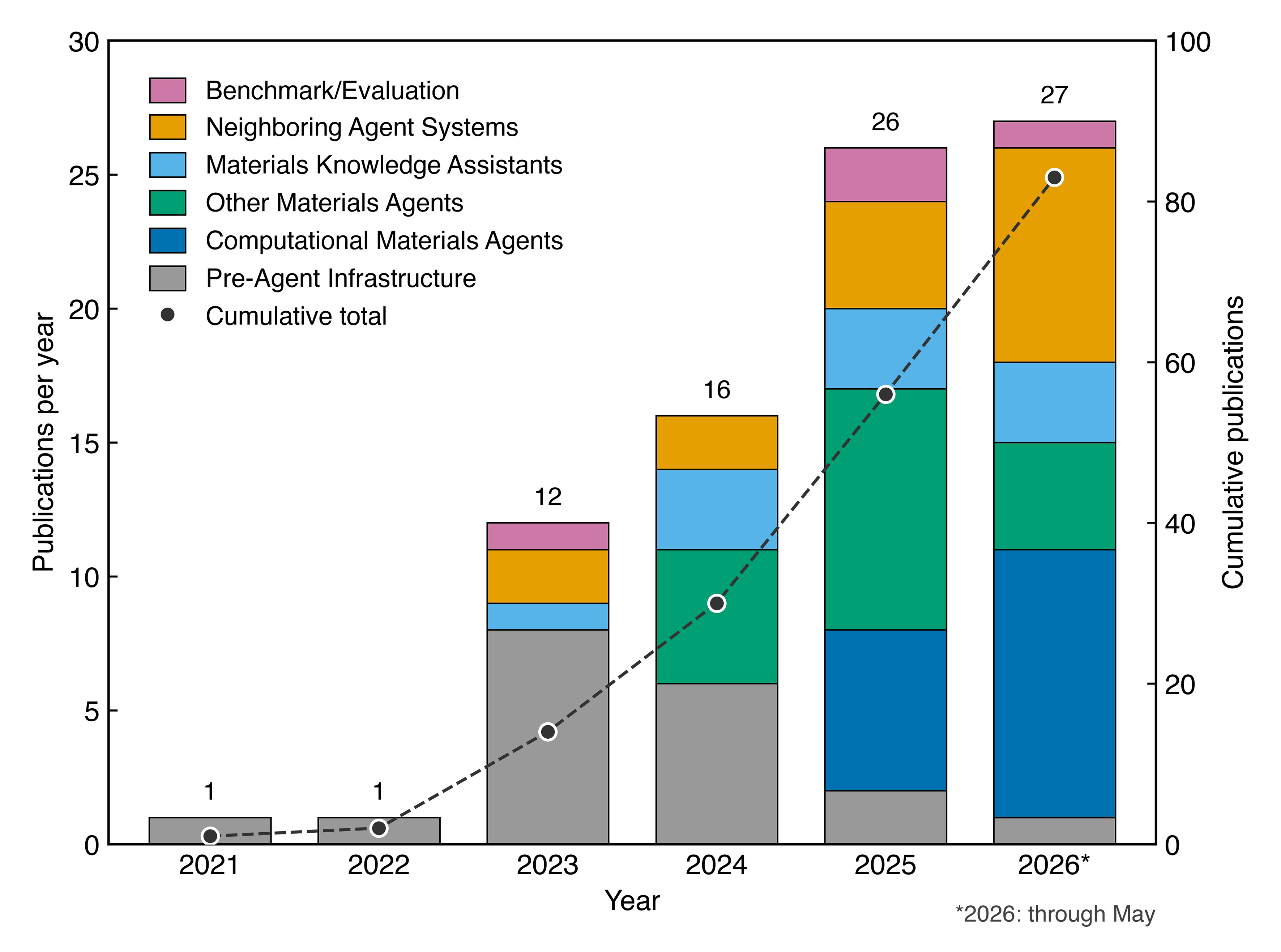
Figure 1. Curated publication landscape of materials-agent studies by year and category. Stacked bars show the annual number of included works from 2021 through May 2026. Works are grouped into benchmark/evaluation studies, neighboring agent systems, pre-agent infrastructure, materials knowledge assistants, other materials agents, and computational materials agents. Open circles connected by a dotted line show the cumulative number of works. The distribution highlights a shift from early pre-agent infrastructure toward rapidly expanding agent-based systems after 2023. Computational materials agents have become a major component of recent studies. Studies were identified by searching arXiv and Google Scholar using combinations of the terms “materials agent”, “computational materials agent”, “atomistic simulation agent”, and “materials agent benchmark”. Retrieved records were screened for direct relevance to materials-agent systems, executable scientific workflows, or agent evaluation. Reviews and perspectives were excluded. Duplicate preprint and journal versions were counted only once, and each included study was assigned to a single primary category based on its principal contribution.