

Generative AI for atomistic nanomaterial reconstruction: from static structures to conditioned ensembles
 0
0 


 Download PDF
INTRODUCTION
As structure-property relationships in functional nanomaterials have been widely explored[1,2], a common strategy is to identify the representative geometric structure that best explains observed material properties[3-5]. This focus has generally motivated the identification of ground-state or low-energy structures[2,6-8]. However, this paradigm does not fully capture the behavior of nanomaterials under realistic operating conditions. Nanomaterial surfaces and interfaces may continuously restructure in response to adsorbates[9,10], electrolyte environments[11], temperature[12], support interactions[13], and electrochemical potentials[14]. Here, we use “reconstruction” to refer to such atomistic rearrangement under operating conditions. As a result, experimentally measured behavior often cannot be attributed to a single stable configuration but instead reflects contributions from condition-dependent ensembles of microstates.
The dynamic structural ensemble reframes the central question in nanomaterial reconstruction studies. The focus therefore shifts from a single stable structure to understanding how accessible states interconvert under operating conditions[15,16]. Operando characterization provides essential information, but the measured signals are often indirect, time-averaged, making atomic-scale evolution difficult to interpret. For computational modeling, the challenge lies in identifying relevant structures within a vast and unknown configurational space that remains costly to explore at the first-principles level[17]. Therefore, a practical approach should efficiently generate structures, sample metastable microstates, and validate structural distributions under realistic conditions[18].
Recent advances in artificial intelligence (AI) and machine learning (ML) are opening new routes for exploring nanomaterial reconstruction. Generative models can learn structural patterns, propose candidate configurations, and sample complex distributions under physical, chemical, or experimental constraints[19-22]. Related advances in AI-assisted structure generation, multiscale materials modeling, dynamic electrocatalyst simulations, generative materials design, and AI-Agent workflows[23-28] further motivate integrated approaches to nanomaterial reconstruction.
In this Perspective, we consider reconstruction as an ensemble problem rather than the identification of a single representative structure. We discuss how generative models, combined with machine learning interatomic potentials (MLIPs), density functional theory (DFT), and operando measurements, can be used to explore dynamic structural ensembles under operating conditions. We further highlight the challenges in sampling, validation, and integration with experiment. Finally, we outline future opportunities for developing more reliable and physically grounded reconstruction workflows.
RECONSTRUCTION AS A STRUCTURE-GENERATION AND ENSEMBLE-INFERENCE PROBLEM
Nanomaterial surfaces under operating conditions cannot be fully represented by a single stable structure, as atomic rearrangements or even surface atom dissolution may cause multiple interconverting microstates[29-31]. These microstates differ in defect structures, adsorption configurations, and local coordination environments. Their relative populations depend on different operating conditions[3,10,30,32].
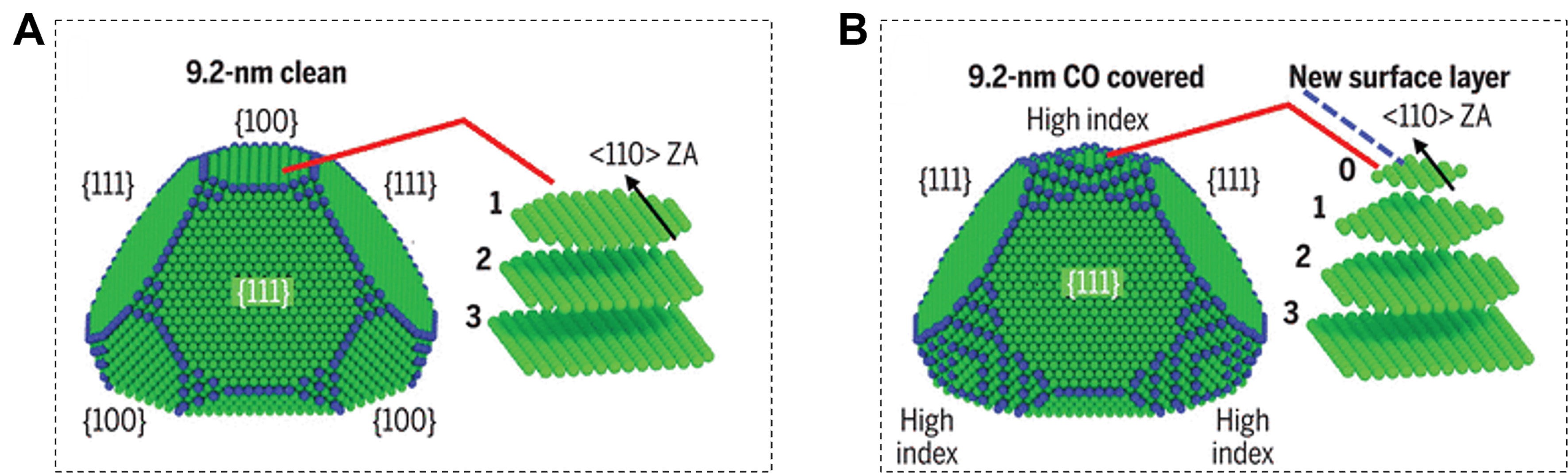
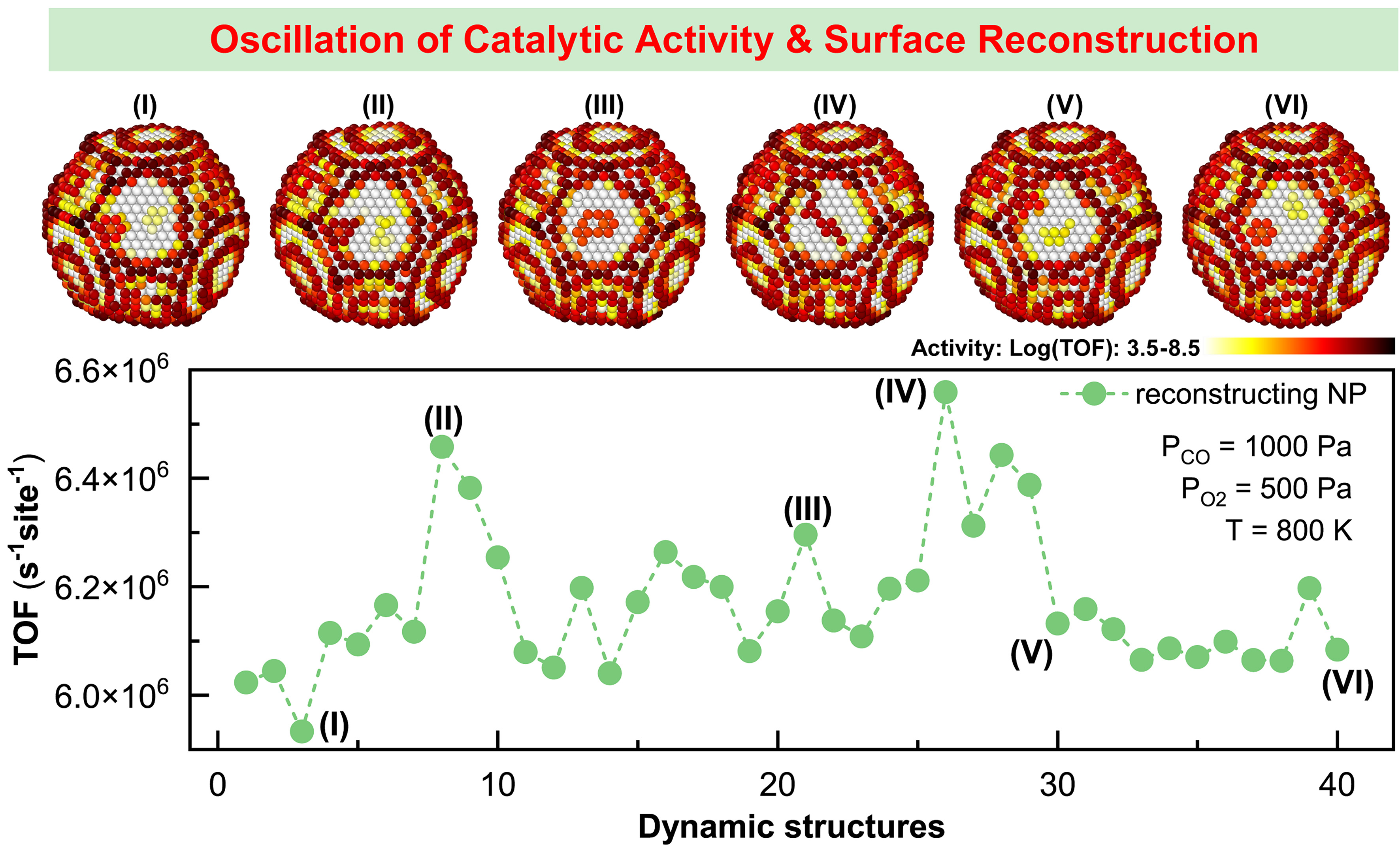
For example, Pt nanoparticles retain a clean surface under vacuum [Figure 1A], whereas CO adsorption induces high-index facets and the formation of new surface layers under CO conditions [Figure 1B]. Li et al. further theoretically revealed that even when Pt nanoparticles reach a dynamic structural equilibrium under CO conditions, their surfaces continue to undergo local structural fluctuations, including the transient formation and dispersion of small clusters [Figure 2][15]. These local structural changes are accompanied by fluctuations in catalytic activity, showing that the observed activity reflects an evolving structural ensemble rather than a single static morphology.
Theoretical reconstruction modeling can therefore be formulated as the inference of conditional probability distributions over metastable structures under operating conditions. The structural distribution can be described by P(X|c), where c denotes the relevant external conditions, such as temperature, pressure, electrode potential, pH, and others. Dynamic processes such as activation, deactivation, or phase transitions additionally require a distribution P(τ|c) over reconstruction pathways[28,34].
A GENERATIVE-MODEL-BASED WORKFLOW FOR RECONSTRUCTION ENSEMBLE PREDICTION
We summarize the common generative model-based workflow integrating generative models, MLIPs, and DFT/ab initio molecular dynamics (AIMD) for reconstruction studies through three coupled functions: candidate generation, accelerated sampling, and validation. Generative models broaden the structural search space under operating conditions[35,36]. MLIPs enable efficient sampling and high-throughput calculations[18,37]. DFT/AIMD together with experimental constraints can refine and validate representative structures. This generate-accelerate-validate loop in Figure 3 delivers sets of (quasi-)steady-state structures rather than a single optimal configuration. Table 1 summarizes the main technical approaches discussed in this Perspective and their limitations.
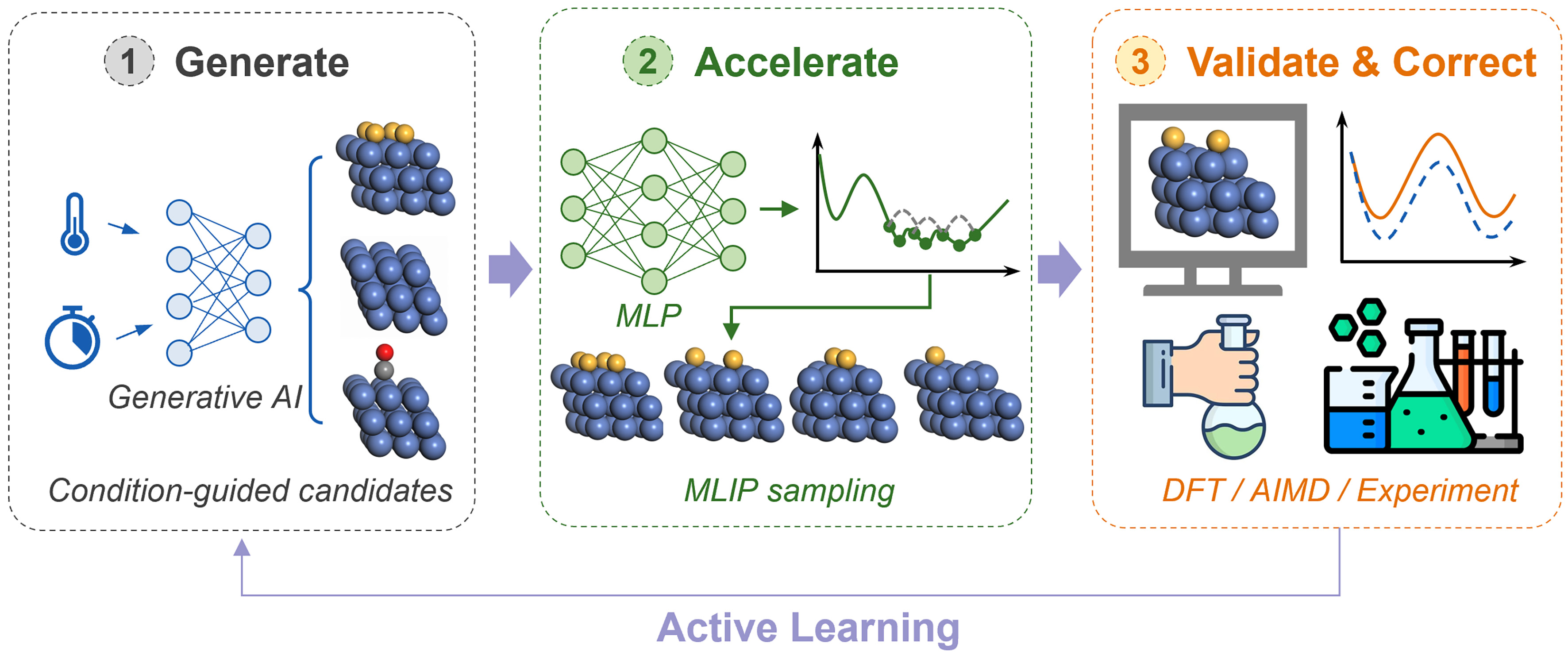
Figure 3. Generate-accelerate-validate workflow for nanomaterial reconstruction under operating conditions. Generative models propose condition-dependent candidate structures, MLIPs accelerate configurational sampling, and DFT/AIMD together with experimental observations validate and refine the structural ensemble. The validated information is fed back to improve subsequent sampling and ensemble inference through active learning. AI: Artificial intelligence; MLIPs: machine learning interatomic potentials; DFT: density functional theory; AIMD: ab initio molecular dynamics.
Generative and statistical approaches for ensemble modeling
| Approach | Treatment of physical probabilities | Main limitation |
| Diffusion models[38-40] | Proposal distribution only; requires reweighting | Data bias; invalid or unstable candidates |
| GFlowNets[41,42] | Sampling reward; no transition rates | Trajectories are not physical dynamics |
| Boltzmann generators[43] | Explicit equilibrium populations via importance weights | Needs reliable energy model |
| Bayesian reweighting[44,45] | Experimental-data-constrained update of prior ensemble weights | Limited by initial ensemble completeness |
| MLIP[18,37] | Enables extended MD and rare-event sampling with near-DFT accuracy | DFT budget; transferability |
| Enhanced sampling[18] | Enhanced free-energy landscapes; reweighting for statistical weights | CV/bias design; computational cost |
Stage I - generate & cover
A conditional generative model can be used to build a diverse pool of physically plausible structures, such as compositions, lattice parameters, defects, or adsorbate patterns. MatterGen provides one concrete example of conditional structure generation under chemical, symmetry, and property constraints[46]. This diffusion-based model was applied to inorganic material design, where experimental validation of one MatterGen-designed material demonstrated a measured property within 20% of the intended target. However, MatterGen was developed primarily for periodic bulk crystals, whereas nanomaterial reconstruction often involves finite particles, variable atom numbers, adsorbate coverages, or grand-canonical composition exchange with the environment. These features are not explicitly represented in conventional bulk-crystal generation benchmarks and must therefore be explicitly considered in surface/interface reconstruction.
Stage II - acceleration
MLIPs extend configurational sampling beyond the time and space scales accessible to direct first-principles calculations. Combined with molecular dynamics, enhanced sampling[18], or grand-canonical sampling[34,47], MLIPs enable broader exploration of accessible microstates. For example, Perego and Bonati proposed a data-efficient active learning scheme (DEAL) using an augmented sampling process for ammonia decomposition on Fe-Co alloy surfaces[18]. Here, configurations with high uncertainty were selectively labeled by DFT and added to the training set. The resulting reactive MLIPs were then used to accelerate reaction-path exploration and kinetic sampling.
Stage III - validate & correct
Representative structures are refined with DFT/AIMD to improve the predicted energetics, barriers, and derived observables. The resulting information can be fed back to update the MLIP and guide subsequent sampling. For example, Wang et al. developed a multiscale framework combining grand-canonical Monte Carlo, neural-network molecular dynamics, and first-principles microkinetic modeling to resolve catalyst restructuring at the atomic scale[34]. Beyond first-principles refinement, experimental validation is essential, but operando measurements typically provide indirect, ensemble-averaged signals[29]. Relevant observables, such as X-ray absorption near-edge structure/extended X-ray absorption fine structure (XANES/EXAFS) spectra[29], pair distribution functions, or microscopy images[48], provide experimental constraints on the structural ensemble. Corresponding signals can be simulated for candidate structures and combined according to the current ensemble weights. Comparison with experiments can then be used to update these weights through Bayesian or maximum-entropy reweighting[44,45], while considering uncertainties in both the calculated and measured signals.
TECHNICAL APPROACHES FOR GENERATIVE AI IN ENSEMBLE MODELING
After formulating reconstruction as the inference of a conditional structural distribution P(X|c), the practical challenge is to generate plausible structures under given operating conditions, infer their relative populations, and identify possible reconstruction pathways. Generative AI can contribute to these targets through structure generation, probabilistic ensemble inference, and sequence-based pathway exploration, as summarized in Figure 4A. Figure 4B schematically shows two representative generative schemes[38-40,43]. Diffusion-based models progressively add noise to an initial structure x0 through a fixed forward Markov chain and generate candidate structures through a learned reverse denoising process (indicated by dashed arrows)[38-40,43].
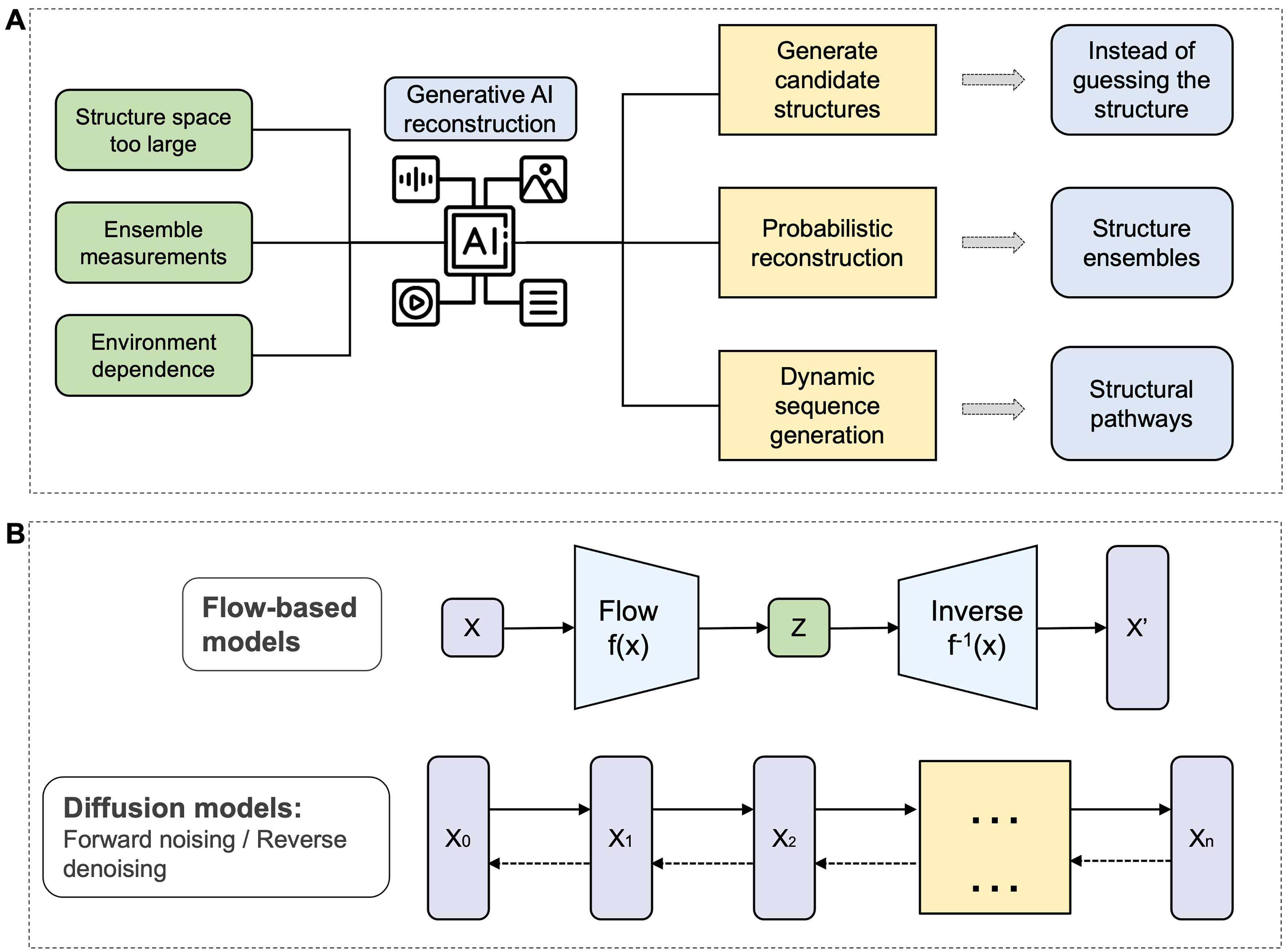
Figure 4. Roles of generative AI in nanomaterial reconstruction. (A) Conceptual roles of generative AI, including candidate structure generation, probabilistic ensemble inference, and reconstruction-pathway sampling; (B) Representative flow-based and diffusion-based generative schemes for structure generation. Flow-based models learn transformations between structural and latent representations[38-40,43]. Diffusion models progressively perturb structures with noise and learn a reverse denoising process to generate candidate structures[38-40,43]. AI: Artificial intelligence.
Structure generation with diffusion models
E(3)-equivariant diffusion models provide a framework for atomic structure generation by considering geometric symmetry of three-dimensional space during the denoising process[38]. Diffusion models have also been extended to jointly generate lattice parameters and atomic coordinates[39]. However, unconstrained generation can produce structures with little physical relevance[26,49], motivating the incorporation of physical priors and experimental constraints. Rønne et al. developed a diffusion model specifically for surface structure discovery by introducing substrate coordination and confinement along the surface-normal direction[40]. This work demonstrates how diffusion models can be adapted from periodic bulk crystals to surface reconstruction and condition-dependent structural exploration.
Probabilistic ensemble inference
Probabilistic ensemble inference aims to estimate structural distributions and relative populations under specified operating conditions. Within this framework, ensemble reweighting uses experimental measurements to update the statistical weights assigned to an initial set of candidate structures. Boltzmann generators can facilitate sampling of thermodynamic ensembles[43], whereas Bayesian maximum-entropy methods can update the weights of candidate structures using experimental constraints[44]. Notably, reweighting can only redistribute the populations among structures already included in the candidate set. Therefore, generative models can be used beforehand to broaden the candidate set and improve the coverage of experimentally relevant structures.
Sequence-based pathway exploration
Sequence-based generative models such as Generative Flow Networks (GFlowNets)[41] build structures step by step and sample multiple candidates according to a defined reward. For example, Crystal-GFlowNet sequentially samples crystal structures under compositional and geometric constraints, using rewards (e.g., low formation energy) to explore a broad range of candidate structures[41,42]. For nanomaterial reconstruction, this strategy could be useful for exploring metastable states and proposing possible connections between them. However, trajectories generated by sequence-based generative models are not physical dynamical pathways and therefore do not directly provide transition barriers or rates. Candidate states and transitions proposed by these generative models must be further evaluated using physics-based pathway calculations (e.g., nudged-elastic-band calculations[50]), enhanced-sampling methods[18], and subsequent kinetic modeling.
OUTLOOK
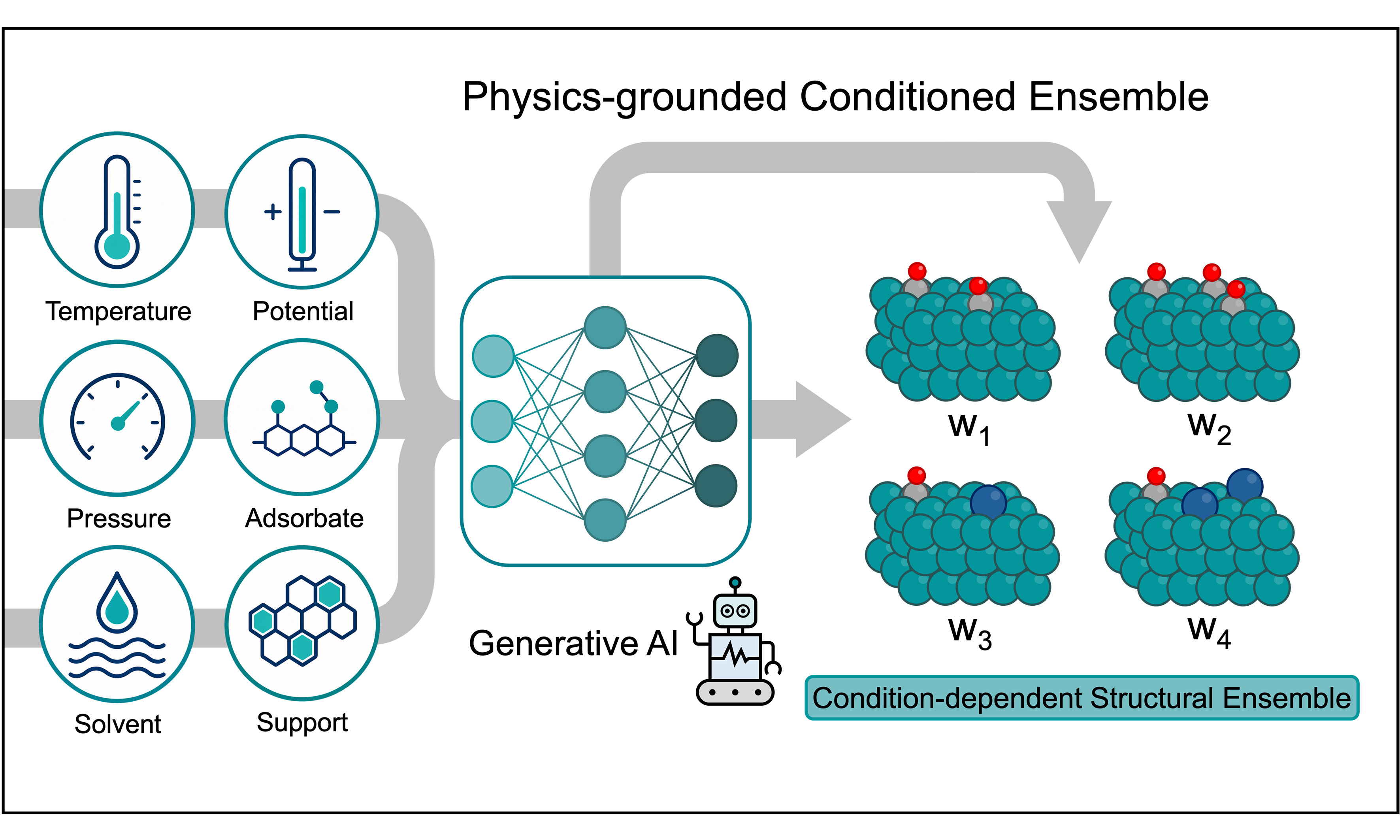
Overall, future efforts on atomic-scale reconstruction of nanomaterial surfaces and interfaces should move beyond isolated structure screening toward condition-dependent structural ensembles and reconstruction pathways[29,51,52], together with explicit uncertainty quantification. A central challenge is to represent operating conditions in a physically meaningful way. Temperature, pressure, chemical potential, solvent, electric-double-layer effects, and other external factors should be incorporated through physically appropriate representations or constraints. Such physics-grounded conditioning is critical for transferable ensemble prediction.
A practical route forward is to integrate conditional generative models[46] with MLIP-accelerated dynamics[18,37], first-principles and experimental validation[29,48], and uncertainty-aware ensemble reweighting[44,45]. Within this framework, agents based on large language models (LLMs) can integrate prior knowledge of nanomaterial design from the literature[27], while multimodal models can integrate heterogeneous structural and chemical representations[53]. Such agentic and multimodal systems can therefore serve as an orchestration and information-integration layer for physics-grounded structure generation and validation.
Current AI-assisted approaches to studying nanomaterial reconstruction still suffer from limited and biased training data, incomplete sampling of slow reconstruction processes, difficulty in simultaneously incorporating multiple physical and experimental constraints, and limited interpretability. Addressing these issues will require closer integration of thermodynamics, kinetics, and uncertainty quantification. Ultimately, the goal is not only to generate plausible nanostructures, but also to obtain evidence-consistent ensemble predictions that explain how nanomaterials restructure under realistic conditions and how such restructuring controls their functional properties.
DECLARATIONS
Authors’ contributions
Analyzed and interpreted the literature, prepared figures, and drafted the manuscript: Liang, K.
Conceived the review scope, provided supervision, revised the manuscript, and guided the overall structure: Li, X. Y.
Availability of data and materials
Not applicable.
AI and AI-assisted tools statement
Not applicable.
Financial support and sponsorship
This work was supported by the National University of Singapore Start-up Grant (A-0010269-00-00).
Conflicts of interest
Both authors declared that there are no conflicts of interest.
Ethical approval and consent to participate
Not applicable.
Consent for publication
Not applicable.
Copyright
© The Author(s) 2026.
REFERENCES
1. Zhao, Z. J.; Liu, S.; Zha, S.; et al. Theory-guided design of catalytic materials using scaling relationships and reactivity descriptors. Nat. Rev. Mater. 2019, 4, 792-804.
2. Nørskov, J. K.; Bligaard, T.; Rossmeisl, J.; Christensen, C. H. Towards the computational design of solid catalysts. Nat. Chem. 2009, 1, 37-46.
3. Tao, F.; Salmeron, M. Surface restructuring and predictive design of heterogeneous catalysts. Science 2024, 386, eadq0102.
4. Zheng, S.; Zhang, X. M.; Liu, H. S.; et al. Active phase discovery in heterogeneous catalysis via topology-guided sampling and machine learning. Nat. Commun. 2025, 16, 2542.
5. Qu, M. R.; Liu, H.; Feng, S. H.; et al. Temperature-dependent mechanism evolution on RhRu3Ox for acidic water oxidation. Nat. Commun. 2025, 16, 9261.
6. Lu, S.; Wang, Y.; Liu, H.; Miao, M.; Ma, Y. Self-assembled ultrathin nanotubes on diamond (100) surface. Nat. Commun. 2014, 5, 3666.
7. Wang, Q.; Oganov, A. R.; Zhu, Q.; Zhou, X. F. New reconstructions of the (110) surface of rutile TiO2 predicted by an evolutionary method. Phys. Rev. Lett. 2014, 113, 266101.
8. Bunting, R. J.; Cheng, X.; Thompson, J.; Hu, P. Amorphous surface PdOX and its activity toward methane combustion. ACS Catal. 2019, 9, 10317-23.
9. Amirbeigiarab, R.; Tian, J.; Herzog, A.; et al. Atomic-scale surface restructuring of copper electrodes under CO2 electroreduction conditions. Nat. Catal. 2023, 6, 837-46.
10. Xu, L.; Papanikolaou, K. G.; Lechner, B. A. J.; et al. Formation of active sites on transition metals through reaction-driven migration of surface atoms. Science 2023, 380, 70-6.
11. Ma, X.; Yang, T.; He, D.; et al. Carbonate shell regulates CuO surface reconstruction for enhanced CO2 electroreduction. Nat. Synth. 2025, 4, 53-66.
12. Zhang, S.; Shan, J.; Zhu, Y.; et al. WGS catalysis and in situ studies of CoO1-x, PtCon/Co3O4, and PtmCom’/CoO1-x nanorod catalysts. J. Am. Chem. Soc. 2013, 135, 8283-93.
13. Frey, H.; Beck, A.; Huang, X.; van Bokhoven, J. A.; Willinger, M. G. Dynamic interplay between metal nanoparticles and oxide support under redox conditions. Science 2022, 376, 982-7.
14. Dai, W.; Wan, K.; Pang, K.; et al. In-depth understanding and precise modulation of surface reconstruction during heterogeneous electrocatalysis: from model to practical catalyst. Chem 2025, 11, 102345.
15. Li, X. Y.; Ou, P.; Duan, X.; et al. Dynamic active sites in situ formed in metal nanoparticle reshaping under reaction conditions. JACS Au 2024, 4, 1892-900.
16. Li, X. Y.; Zhu, B.; Gao, Y. Exploration of dynamic structure-activity relationship of a platinum nanoparticle in the CO oxidation reaction. J. Phys. Chem. C. 2021, 125, 19756-62.
17. Van Speybroeck, V. Challenges in modelling dynamic processes in realistic nanostructured materials at operating conditions. Philos. Trans. A. Math. Phys. Eng. Sci. 2023, 381, 20220239.
18. Perego, S.; Bonati, L. Data efficient machine learning potentials for modeling catalytic reactivity via active learning and enhanced sampling. npj Comput. Mater. 2024, 10, 291.
19. Yang, J.; Ye, K.; Xie, S.; et al. Diffusion model-guided inverse design of bimetallic catalysts for ammonia decomposition. J. Am. Chem. Soc. 2026, 148, 537-46.
20. Zheng, Y.; Li, Z.; Song, Z. A generative machine learning model for the 3D reconstruction of material microstructure and performance evaluation. Comput. Methods. Appl. Mech. Eng. 2024, 430, 117224.
21. Park, H.; Onwuli, A.; Walsh, A. Exploration of crystal chemical space using text-guided generative artificial intelligence. Nat. Commun. 2025, 16, 4379.
22. Yang, C.; Wang, L.; Zhu, J.; Ou, P. Heterogeneous catalyst design by generative models. J. Mater. Inf. 2025, 5, 46.
23. Ridwan, O. G.; Pitié, S.; Raj, M. S.; et al. AI-assisted rapid crystal structure generation towards a target local environment. npj Comput. Mater. 2026, 12, 64.
24. Mortazavi, B. Recent advances in machine learning‐assisted multiscale design of energy materials. Adv. Energy. Mater. 2025, 15, 2403876.
25. Lian, Z.; Dattila, F.; López, N. Stability and lifetime of diffusion-trapped oxygen in oxide-derived copper CO2 reduction electrocatalysts. Nat. Catal. 2024, 7, 401-11.
26. Park, H.; Li, Z.; Walsh, A. Has generative artificial intelligence solved inverse materials design? Matter 2024, 7, 2355-67.
27. Takahara, I.; Mizoguchi, T.; Liu, B. Accelerated inorganic materials design with generative AI agents. Cell Rep. Phys. Sci. 2025, 6, 103019.
28. De Breuck, P. P.; Wang, H. C.; Rignanese, G. M.; Botti, S.; Marques, M. A. L. Generative AI for crystal structures: a review. npj Comput. Mater. 2025, 11, 370.
29. Yoon, A.; Bai, L.; Yang, F.; et al. Revealing catalyst restructuring and composition during nitrate electroreduction through correlated operando microscopy and spectroscopy. Nat. Mater. 2025, 24, 762-9.
30. Kok, J.; Albertini, P. P.; Leemans, J.; Buonsanti, R.; Burdyny, T. Overcoming copper stability challenges in CO2 electrolysis. Nat. Rev. Mater. 2025, 10, 550-63.
31. Vavra, J.; Ramona, G. P. L.; Dattila, F.; et al. Solution-based Cu+ transient species mediate the reconstruction of copper electrocatalysts for CO2 reduction. Nat. Catal. 2024, 7, 89-97.
32. Shi, X.; Lin, X.; Luo, R.; et al. Dynamics of heterogeneous catalytic processes at operando conditions. JACS Au 2021, 1, 2100-20.
33. Avanesian, T.; Dai, S.; Kale, M. J.; Graham, G. W.; Pan, X.; Christopher, P. Quantitative and atomic-scale view of CO-induced Pt nanoparticle surface reconstruction at saturation coverage via DFT calculations coupled with in situ TEM and IR. J. Am. Chem. Soc. 2017, 139, 4551-8.
34. Wang, H. Y.; Chen, J. L.; Qi, X. Z.; et al. Operando cluster catalysis via coupled surface-subsurface dynamics. J. Am. Chem. Soc. 2025, 147, 42972-83.
35. Luo, X.; Wang, Z.; Gao, P.; et al. Deep learning generative model for crystal structure prediction. npj Comput. Mater. 2024, 10, 254.
36. Zhang, D.; Chen, Y.; Liu, C.; et al. Accelerating catalyst materials discovery with large artificial intelligence models. Angew. Chem. Int. Ed. Engl. 2026, 65, e26150.
37. Ang, S. J.; Wang, W.; Schwalbe-Koda, D.; Axelrod, S.; Gómez-Bombarelli, R. Active learning accelerates ab initio molecular dynamics on reactive energy surfaces. Chem 2021, 7, 738-51.
38. Hoogeboom, E.; Satorras, V. G.; Vignac, C.; Welling, M. Equivariant diffusion for molecule generation in 3D. In Proceedings of the 39th International Conference on Machine Learning; PMLR, 2022; Vol. 162, pp. 8867-87. Available online: https://proceedings.mlr.press/v162/hoogeboom22a.html. (accessed 11 September 2026).
39. Klipfel, A.; Fregier, Y.; Sayede, A.; Bouraoui, Z. Vector field oriented diffusion model for crystal material generation. In Proceedings of the AAAI Conference on Artificial Intelligence, 2024; pp. 22193-201.
40. Rønne, N.; Aspuru-Guzik, A.; Hammer, B. Generative diffusion model for surface structure discovery. Phys. Rev. B 2024, 110, 235427.
41. Bengio, Y.; Lahlou, S.; Deleu, T.; Hu, E. J.; Tiwari, M.; Bengio, E. GFlowNet foundations. J. Mach. Learn. Res. 2023, 24, 1-55. Available online: https://jmlr.org/papers/v24/22-0364.html (accessed 11 September 2026).
42. Hernandez-Garcia, A.; Duval, A.; Volokhova, A.; et al. Crystal-GFN: sampling crystals with desirable properties and constraints. arXiv 2023, arXiv:2310.04925. Available online: https://doi.org/10.48550/arXiv.2310.04925 (accessed 11 September 2026).
43. Noé, F.; Olsson, S.; Köhler, J.; Wu, H. Boltzmann generators: sampling equilibrium states of many-body systems with deep learning. Science 2019, 365, eaaw1147.
44. Crehuet, R.; Buigues, P. J.; Salvatella, X.; Lindorff-Larsen, K. Bayesian-maximum-entropy reweighting of IDP ensembles based on NMR chemical shifts. Entropy 2019, 21, 898.
45. Stöckelmaier, J.; Oostenbrink, C. Combining simulations and experiments - a perspective on maximum entropy methods. Phys. Chem. Chem. Phys. 2025, 27, 14704-17.
46. Zeni, C.; Pinsler, R.; Zügner, D.; et al. A generative model for inorganic materials design. Nature 2025, 639, 624-32.
47. Chen, J. L.; Jiang, X. C.; Feng, L.; et al. Collectivity effect in cluster catalysis under operational conditions. Nat. Commun. 2025, 16, 9144.
48. Chee, S. W.; Lunkenbein, T.; Schlögl, R.; Roldán Cuenya, B. Operando electron microscopy of catalysts: the missing cornerstone in heterogeneous catalysis research? Chem. Rev. 2023, 123, 13374-418.
49. Szymanski, N. J.; Bartel, C. J. Establishing baselines for generative discovery of inorganic crystals. Mater. Horiz. 2025, 12, 8000-11.
50. Henkelman, G.; Uberuaga, B. P.; Jónsson, H. A climbing image nudged elastic band method for finding saddle points and minimum energy paths. J. Chem. Phys. 2000, 113, 9901-4.
51. Newton, M. A. Dynamic adsorbate/reaction induced structural change of supported metal nanoparticles: heterogeneous catalysis and beyond. Chem. Soc. Rev. 2008, 37, 2644-57.
52. Duan, M.; Yu, J.; Meng, J.; Zhu, B.; Wang, Y.; Gao, Y. Reconstruction of supported metal nanoparticles in reaction conditions. Angew. Chem. Int. Ed. Engl. 2018, 57, 6464-9.
Cite This Article
 Open Access
How to Cite
Liang, K.; Li, X.Y. Generative AI for atomistic nanomaterial reconstruction: from static structures to conditioned ensembles. AI Agent 2026, 2, 22. https://dx.doi.org/10.20517/aiagent.2026.21
Download Citation
If you have the appropriate software installed, you can download article citation data to the citation manager of your choice. Simply select your manager software from the list below and click on download.
Export Citation File
Type of Import
Tips on Downloading Citation
Citation Manager File Format
Type of Import
Direct Import: When the Direct Import option is selected (the default state), a dialogue box will give you the option to Save or Open the downloaded citation data. Choosing Open will either launch your citation manager or give you a choice of applications with which to use the metadata. The Save option saves the file locally for later use.
Indirect Import: When the Indirect Import option is selected, the metadata is displayed and may be copied and pasted as needed.
About This Article
Copyright

Data & Comments
Data
0









Comments
Comments must be written in English. Spam, offensive content, impersonation, and private information will not be permitted. If any comment is reported and identified as inappropriate content by OAE staff, the comment will be removed without notice. If you have any queries or need any help, please contact us at [email protected].