
fig8
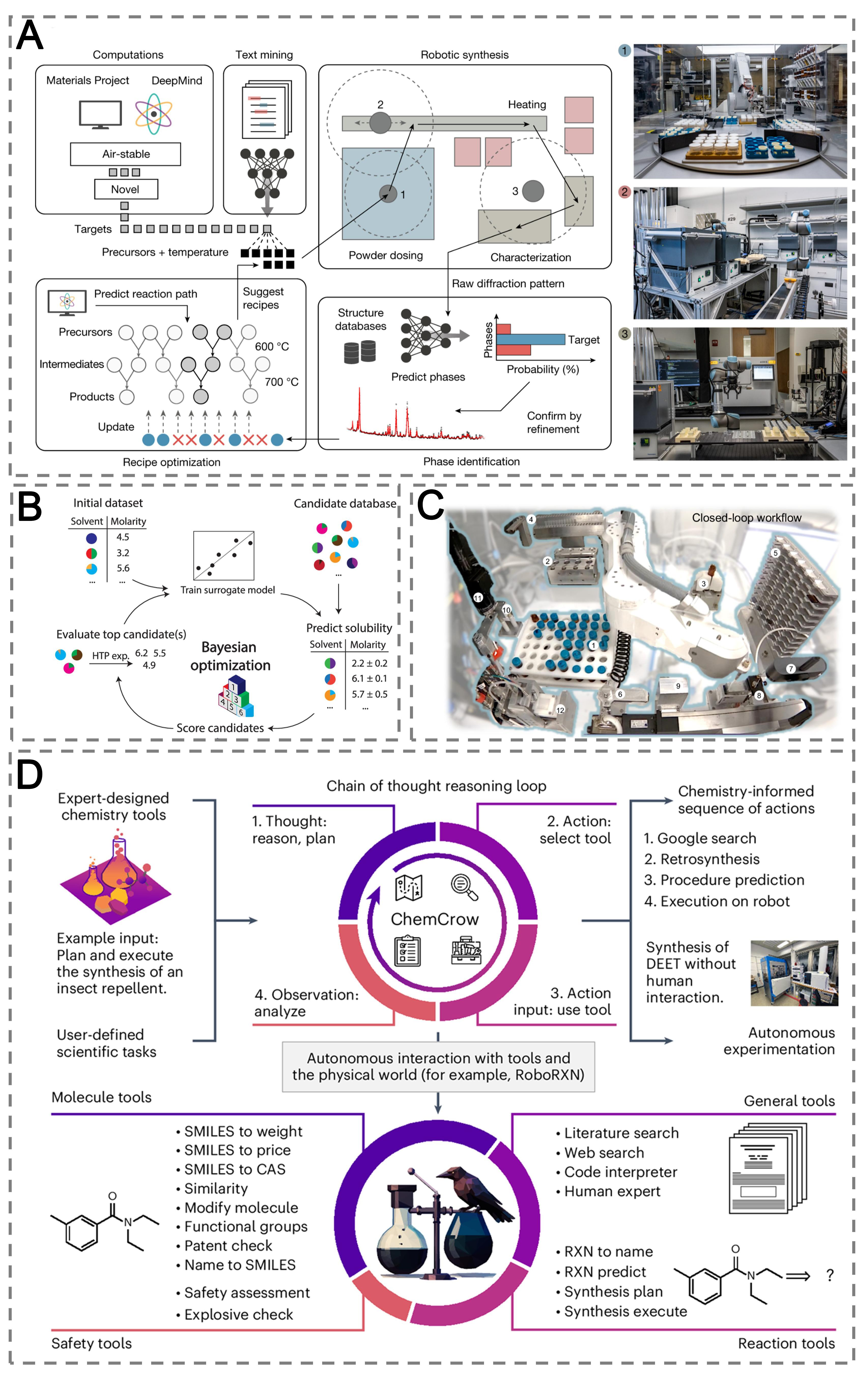
Figure 8. AI agents and data-driven frameworks for autonomous experimentation in solid material research. (A) A-Lab, a self-driving laboratory integrating computation, text mining, robotic synthesis, and automated characterization into a closed-loop workflow for solid materials discovery. Reproduced with permission from ref.[124]. Copyright 2023, Springer Nature; (B) Schematic of the BO algorithm for accelerated screening of binary solvents with targeted anolyte solubility. Reproduced with permission from ref.[149]. Copyright 2024, Springer Nature; (C) (1) solution storage rack, (2) solution heating and mixing module, (3) capping and uncapping system, (4) pipette rack, (5) substrate rack, (6) substrate gripper, (7) imaging station, (8) blade-coating station, (9) blade cleaning station, (10) annealing station, (11) thickness characterization station, (12) electrical characterization station. Polybot platform for automated fabrication and optimization of electronic thin films. Reproduced with permission from ref.[150]. Copyright 2025, Springer Nature; (D) ChemCrow, an LLM-based chemistry agent that leverages multiple expert-designed tools to autonomously plan and execute chemical syntheses. Reproduced with permission from ref.[122]. Copyright 2024, Springer Nature. HTP: High-throughput; CAS: Chemical Abstracts Service; DEET: N,N-Diethyl-meta-toluamide, (Robo)RXN: IBM RXN for Chemistry; SMILES: simplified molecular input line entry system; A-Lab: an autonomous laboratory; AI: artificial intelligence; BO: Bayesian optimization; LLM: large language model.