
fig7
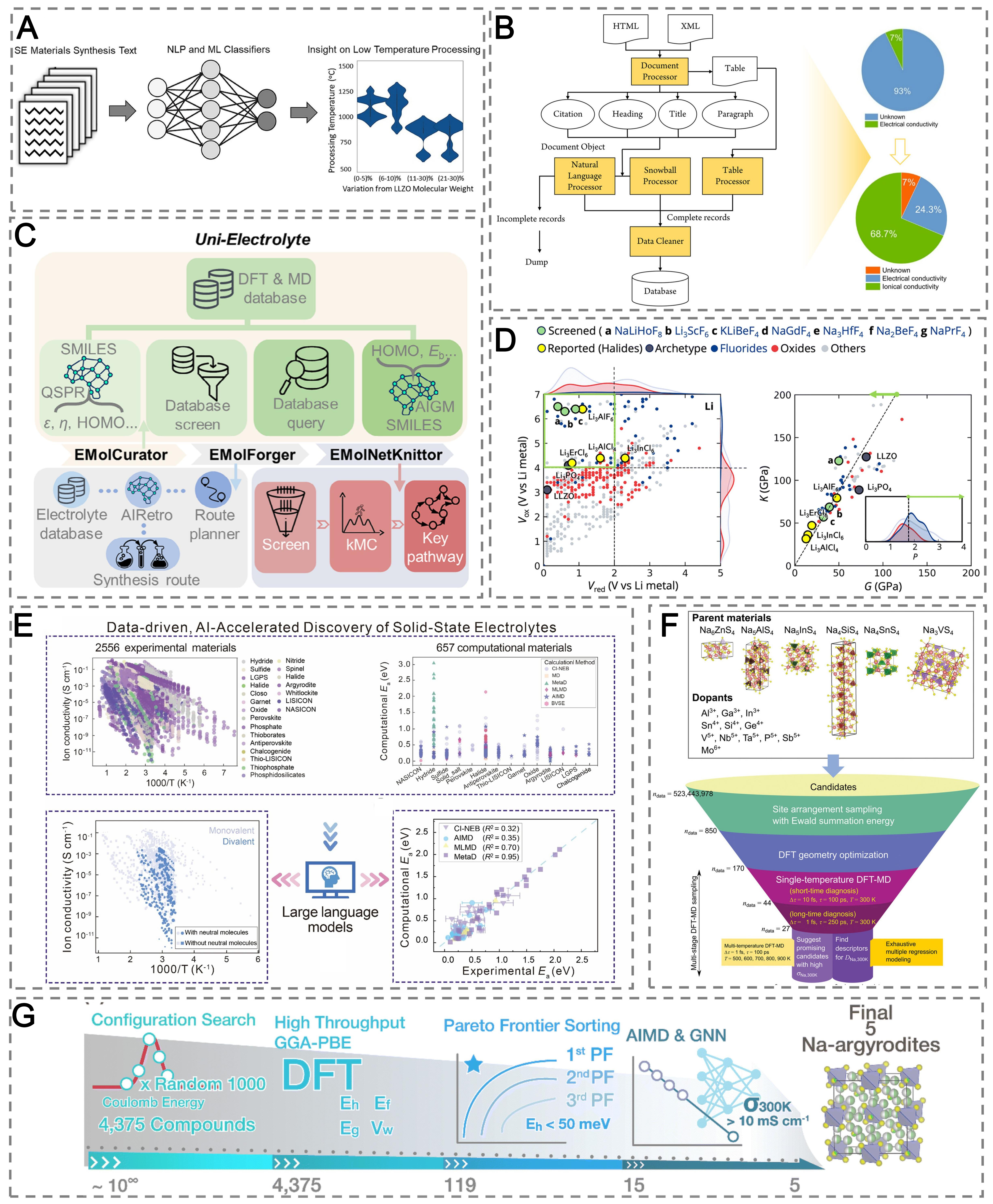
Figure 7. AI agents for knowledge mining and data-driven discovery of SE. (A) Text-mining framework identifying low-temperature processing routes for garnet-type electrolytes. Reproduced with permission from ref.[125]. Copyright 2020, Elsevier; (B) Automated NLP pipeline extracting ionic conductivity values from > 3,000 literature and the application. Reproduced with permission from ref.[126]. Copyright 2023, American Chemical Society; (C) Uni-Electrolyte agent integrating literature mining, computational databases, and kinetic modeling for closed-loop electrolyte design. Reproduced with permission from ref.[119]. Copyright 2025, Wiley-VCH; (D) Data-mining workflow for fluoride-based SEs combining electrochemical and mechanical screening. Reproduced with permission from ref.[127]. Copyright 2024, Royal Society of Chemistry; (E) Integrated LLMs to reveal mechanisms in SE based on the DDSE database. Reproduced with permission from ref.[117]. Copyright 2025, Wiley-VCH; (F) High-throughput discovery of Na-based sulfides using crystallographic databases and multi-stage DFT-MD simulations, uncovering three solid-solution series with high Na+ conductivity. Reproduced with permission from ref.[128]. Copyright 2022, Wiley-VCH; (G) A schematic representation of the computational screening sequence for Na-argyrodite SEs. Reproduced with permission from ref.[129]. Copyright 2025, Royal Society of Chemistry. SE: Solid electrolyte; NLP: natural language processing; ML: machine learning; DFT: density functional theory; MD: molecular dynamics; AIMD: ab initio molecular dynamics; GNN: graph neural network; AI: artificial intelligence; LLM: large language model; DDSE: Dynamic Database of Solid-state Electrolytes.