fig5
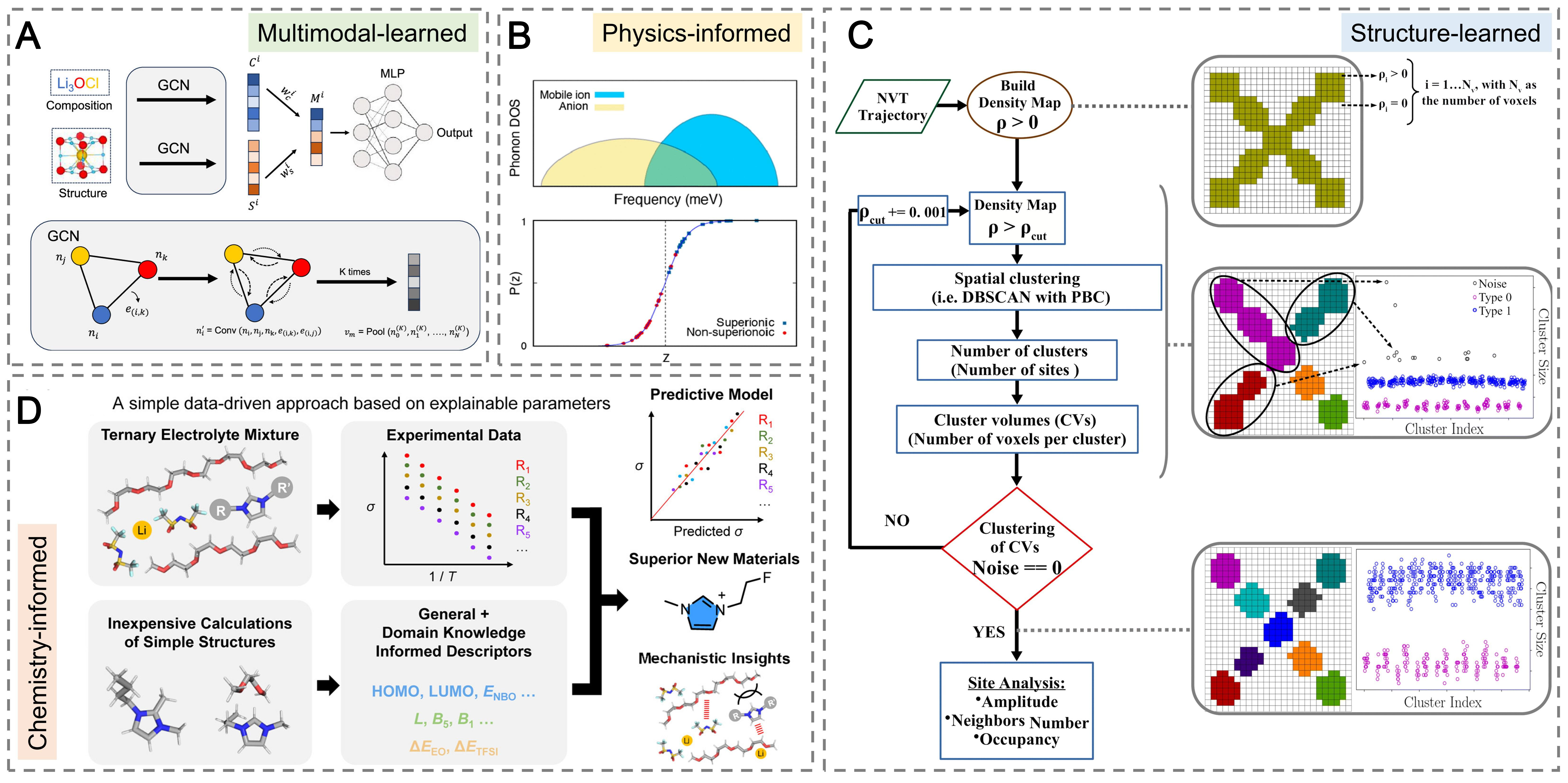
Figure 5. Representative descriptor paradigms enabling ML-driven SE discovery. (A) Multimodal-learned descriptors using the COSNet framework, where composition and structure graphs are encoded by GCNs and fused via attention into a unified representation for property prediction. Reproduced with permission from ref.[84]. Copyright 2024, American Chemical Society; (B) Physics-informed phonon descriptors for enhanced prediction of superionic conductors. Reproduced with permission from ref.[85]. Copyright 2024, American Chemical Society; (C) Structure-learned descriptors derived from graph neural networks (GNNs)-based clustering of Ga/Sc-doped LLZO, revealing dopant-site effects on Li+ transport. Reproduced with permission from ref.[86]. Copyright 2024, Royal Society of Chemistry; (D) Chemistry-informed descriptors capturing polymer-salt-IL interactions for random-forest prediction of ion conduction in solid polymer electrolytes. Reproduced with permission from ref.[87]. Copyright 2025, American Chemical Society. GCN: Graph convolutional neural network; PBC: periodic boundary conditions COSNet: Composition-Structure Bimodal Network; ML: machine learning; SE: solid electrolyte; LLZO: Li7La3Zr2O12; IL: ionic-liquid.