

fig4
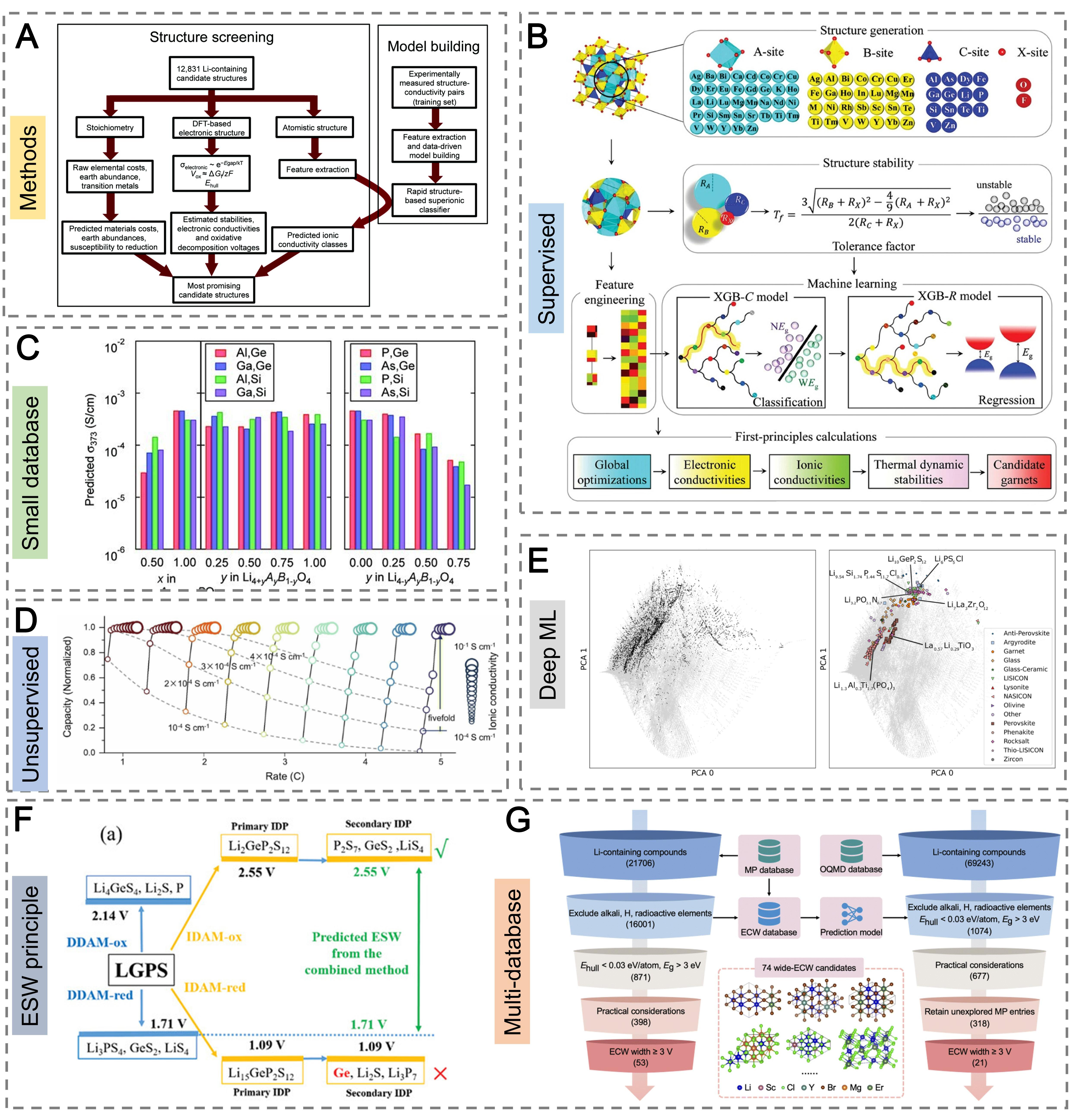
Figure 4. Evolution of ML applications in SE discovery. (A) Logistic regression screening of 12,831 Li-containing compounds using ML. Reproduced with permission from ref.[27]. Copyright 2017, Royal Society of Chemistry; (B) SVR prediction of ionic conductivity in LISICON-type electrolytes using a small database. Reproduced with permission from ref.[75]. Copyright 2013, Wiley-VCH; (C) ML framework accelerated garnet-based SE screening supervised by the MP database. Reproduced with permission from ref.[76]. Copyright 2021, Elsevier; (D) Unsupervised learning extended to Hofmann complexes, with ML-guided synthesis validated in Li||SPAN cells. Reproduced with permission from ref.[77]. Copyright 2025, Springer Nature; (E) Distribution of the lithium-ion-conductor dataset in the ICSD compositional space. Reproduced with permission from ref.[78]. Copyright 2023, Springer Nature; (F) Analysis of the electrochemical decomposition of LGPS. Reproduced with permission from ref.[79]. Copyright 2022, Wiley-VCH; (G) Workflow of high-throughput screening of Li-containing compounds in the MP and OQMD databases. Reproduced with permission from ref.[80]. Copyright 2025, Royal Society of Chemistry. DFT: Density functional theory; PCA: principle component analysis; XGB-C: XGBoost classifier; XGB-R: XGBoost regressor; ML: machine learning; ESW: electrochemical stability window; LGPS: Li10GeP2S12; SE: solid electrolyte; SVR: support-vector regression; LISICON: lithium super ionic conductor; MP: Materials Project; ICSD: Inorganic Crystal Structure Database; OQMD: Open Quantum Materials Database.