fig3
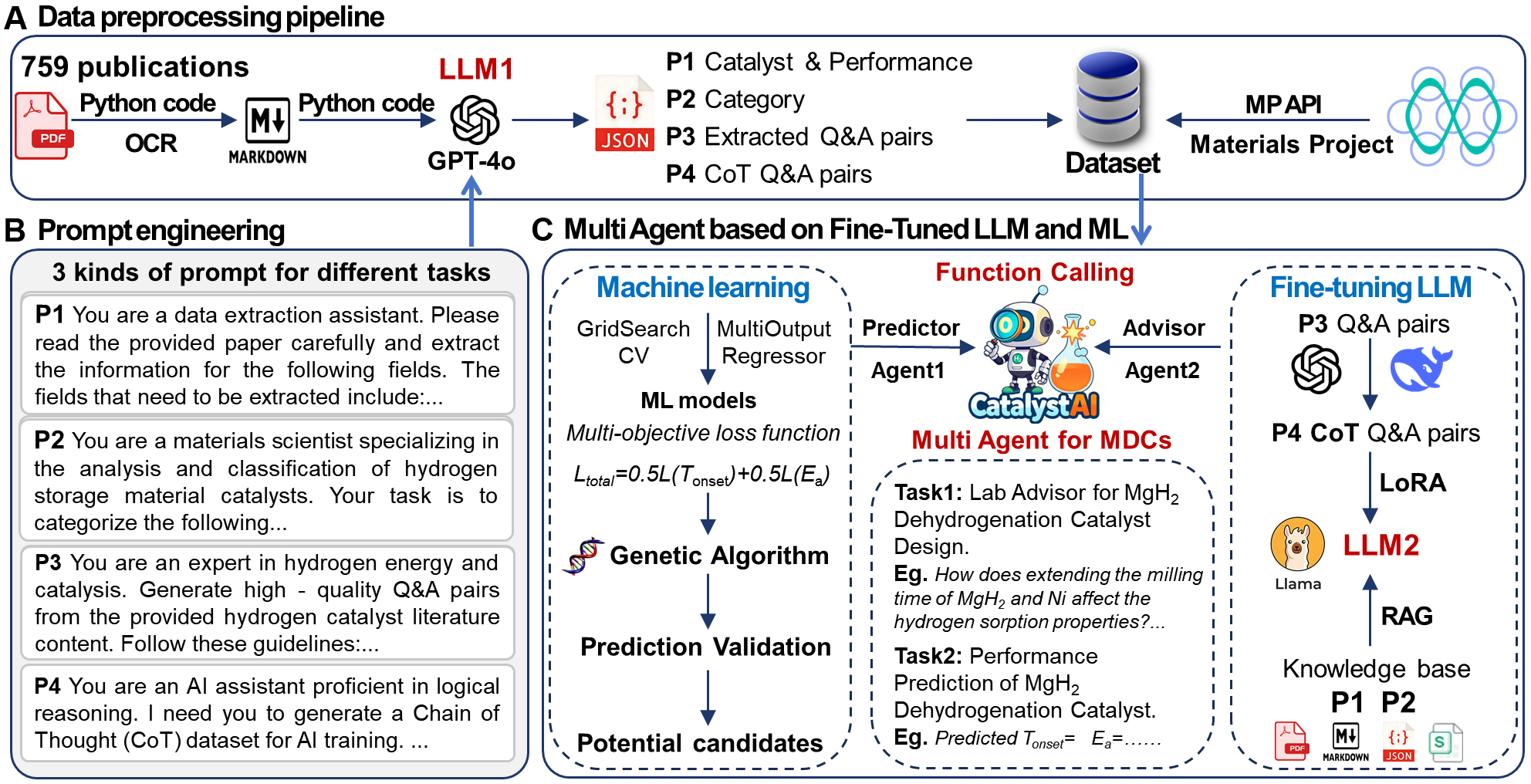
Figure 3. Schematic of the LLM-driven machine learning framework for MgH2 catalyst design. (A) Data preprocessing pipeline. Depicts the workflow converting 759 publications into a structured dataset via OCR and GPT-4o. P1 (catalyst performance), P2 (category), P3 (Q&A pairs), and P4 [Chain-of-Thought (CoT) data] represent information types extracted and integrated with the Materials Project API; (B) Prompt engineering. Details the four specific prompt strategies: P1 for parameter extraction; P2 for catalyst classification; P3 for Q&A pair generation; and P4 for CoT dataset construction; (C) Multi-Agent System (CatalystAI). Illustrates the integration of Agent 1 (Machine Learning) utilizing Genetic Algorithms for candidate prediction, and Agent 2 (Fine-tuned LLM) enhanced by LoRA and RAG for advisory tasks. Function-calling techniques connect the two agents to enable interactive catalyst design. Adapted with permission from Yao et al.[15] (© 2025, Chongqing University); change made: no changes made. LLM: Large language model; OCR: optical character recognition; Q&A: question and answer; API: application programming interface; RAG: retrieval-augmented generation; GPT-4o: generative pre-trained transformer 4 omni.