

Goal-directed minimally invasive treatment of hepatocellular carcinoma across the disease course: a scenario-based clinical framework
 0
0 Graphical Abstract
Abstract
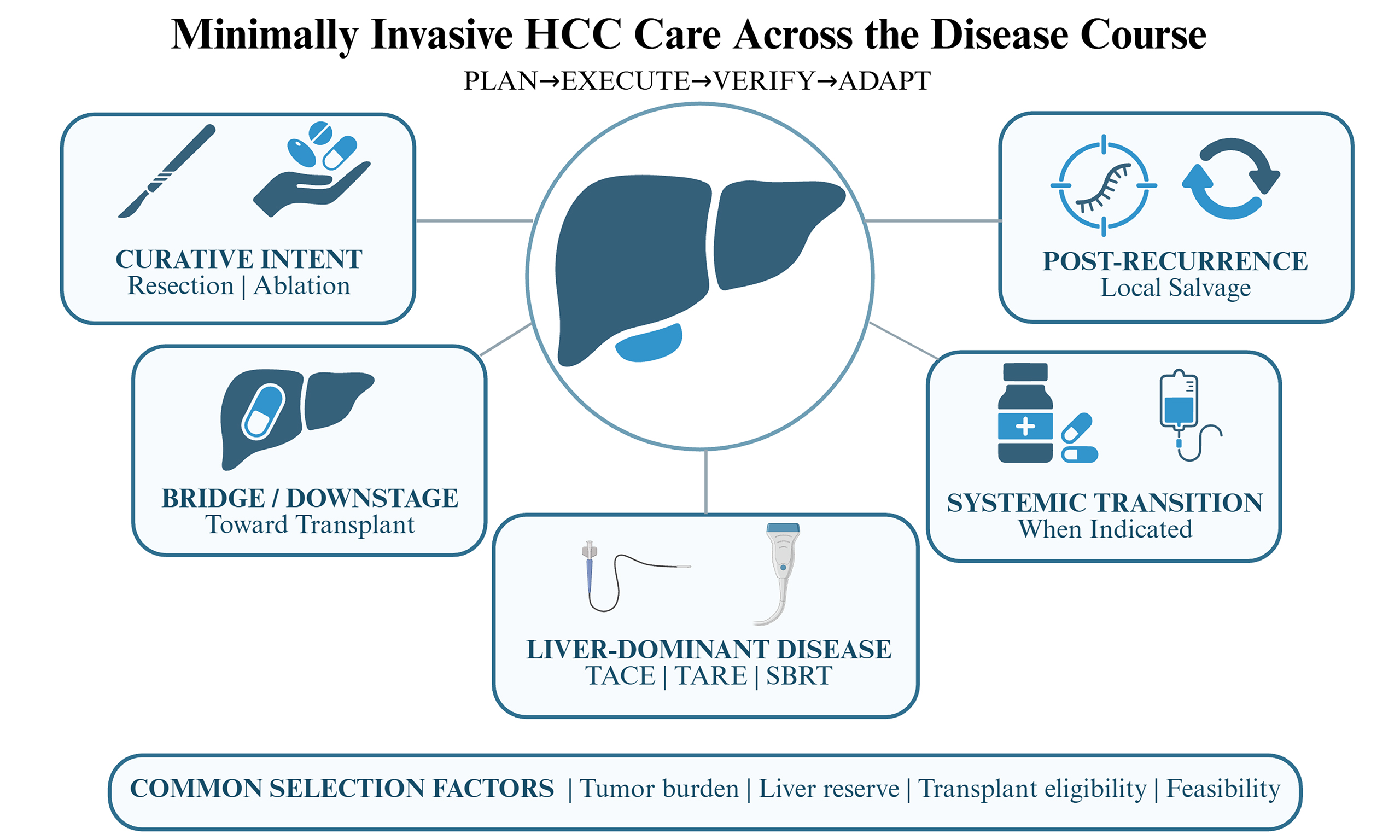
Minimally invasive treatment for hepatocellular carcinoma (HCC) is evolving from isolated procedures into a longitudinal pathway linking local control, liver-function preservation, and future treatment options. This review synthesizes recent evidence on positioning these therapies according to treatment intent, technical feasibility, biologic selection, and integration with systemic therapy. The evidence is organized into five scenarios: curative-intent treatment, bridging or downstaging to transplantation, unresectable liver-dominant disease, post-recurrence salvage, and transition to systemic therapy. Randomized studies in mixed liver-tumor populations support faster recovery after laparoscopic resection, whereas HCC-specific randomized data have not demonstrated a survival advantage for surgery over radiofrequency ablation (RFA) for small tumors; this does not establish equivalence. Robotic platforms may extend minimally invasive surgery to selected complex cases. RFA remains the benchmark for small tumors, while microwave ablation and combined locoregional approaches extend the boundary of local radicality. Navigation, software-based margin assessment, and real-time imaging are also moving ablation toward a closed-loop quality-control model. In unresectable liver-dominant disease, selected transarterial chemoembolization (TACE)-based sequences and combinations have improved progression-free survival or disease control in trial-defined populations, but LEAP-012 and EMERALD-1 have not demonstrated an overall-survival benefit. Candidate selection extends beyond tumor geometry to tumor biology and host reserve, although artificial intelligence, biomarkers, histotripsy, and experimental platforms remain at different stages. The central challenge is no longer expansion of technical capability alone. It is disciplined sequencing: choosing the right local therapy for the right patient at the right point in the disease course without prematurely exhausting liver reserve.
Keywords


 Download PDF
INTRODUCTION
Hepatocellular carcinoma (HCC) remains a leading cause of cancer-related death worldwide. In routine practice, many patients present with cirrhosis, portal hypertension, impaired liver reserve, or an anticipated need for repeated treatment. Under these conditions, tumor control and preservation of liver function are inseparable from the outset. The value of minimally invasive treatment therefore lies not only in reducing surgical or percutaneous trauma. It also lies in delivering oncologic control with less physiologic stress, faster recovery, and better preservation of future local or systemic options[1-3].
Over the past decade, minimally invasive HCC treatment has expanded far beyond a narrow focus on resection and ablation. The field now includes more complex minimally invasive resections, improved thermal-ablation strategies, broader bridging and downstaging pathways, and a wider range of localized nonthermal control options[4-7]. This expansion has changed not only what can be done locally, but also how local therapy is positioned within the overall disease course. Local treatment is increasingly used within transplant pathways, post-recurrence salvage, planned multimodal intensification, and key transition points to systemic therapy. It is no longer best understood as an isolated destructive intervention. This review therefore examines minimally invasive HCC treatment as a longitudinal care pathway. It emphasizes clinical positioning, verification of local treatment radicality, biologic and host stratification, and the points at which local and systemic therapies intersect.
The review is organized around five recurring clinical scenarios: curative-intent treatment, bridging or downstaging to transplantation, unresectable liver-dominant disease, post-recurrence salvage, and transition from locoregional to systemic therapy. Across these scenarios, four linked questions recur: what is the treatment goal, how can it be delivered reliably, how should tumor response and the effects on hepatic reserve be assessed, and what should happen next[2,8-10]?
Rather than seeking a single superior minimally invasive modality, this disease course perspective examines how local treatment can serve a defined purpose while preserving access to surveillance, corrective local therapy, transplantation, or systemic therapy. Systemic treatment is discussed only when it is combined or sequenced with local treatment, or when locoregional therapy no longer serves an achievable clinical goal.
APPROACH TO EVIDENCE SYNTHESIS
We searched PubMed/MEDLINE on August 29, 2026, using a predefined publication window from July 31, 2021, through July 31, 2026. The search combined terms for HCC with minimally invasive resection, hepatectomy, laparoscopy, robotics, ablation, transarterial therapy, radioembolization, radiation segmentectomy, stereotactic body radiotherapy, transplantation, downstaging, recurrence, and salvage. Reference lists of relevant guidelines, reviews, and pivotal trials were also examined, and targeted title or DOI searches were used for technical studies not readily identified by the broad query. Earlier landmark sources were retained when needed to define established practice. Sponsor or conference updates were considered only when a clinically relevant outcome was not yet available in a peer-reviewed full report and were identified as such.
Evidence was interpreted according to the clinical question and study design. Guidelines and consensus statements informed the overall clinical framework. Comparative claims relied primarily on HCC-specific randomized trials, followed by prospective multicenter studies and systematic reviews or meta-analyses. Retrospective, propensity-matched, single-arm, and mixed-histology studies were used for narrower technical or sequencing questions, with their populations and design constraints considered in the interpretation. The sources were synthesized narratively because they addressed different populations, interventions, endpoints, and stages of clinical development.
A CLINICAL FRAMEWORK FOR SEQUENCING MINIMALLY INVASIVE HCC TREATMENT
Planning. Treatment begins with the clinical state and intended outcome, not with a device or platform. Assessment includes Barcelona Clinic Liver Cancer stage, tumor number and distribution, proximity to vessels or bile ducts, Child-Pugh class or albumin-bilirubin grade, clinically significant portal hypertension, performance status, future liver remnant, transplant eligibility, comorbidity, patient priorities, and institutional expertise[2,3,7,8,11,12]. Portal vein tumor thrombus represents malignant vascular invasion and should be distinguished from bland or non-neoplastic portal vein thrombosis[11]. The treatment goal, the endpoint that will define success, and a feasible contingency plan are established together.
Execution. Once the objective is clear, treatment is judged against a modality-specific technical endpoint. Resection aims for an oncologically appropriate margin-negative result with an acceptable effect on liver function; an anatomical approach may be useful in selected tumors. Ablation requires a safe trajectory, complete tumor coverage, and a margin adapted to the surrounding anatomy. Transarterial therapy requires selective delivery while limiting injury to non-tumoral liver. The clinical value of a platform lies in how reliably it delivers the intended treatment rather than in its novelty alone[9,13,14].
Verification. Technical completion matters only when it is connected to the intended clinical benefit. After resection, pathology, margin status, postoperative liver function, and complications are considered together. After ablation or non-radiation embolic therapy, contrast-enhanced computed tomography or magnetic resonance imaging assesses residual viable tumor and the intended treatment area. LI-RADS 2024 provides treatment-specific response categories and a separate approach for radiation-treated lesions, while equivocal findings still require clinical context[9,10]. Local response, local progression-free survival, recurrence-free survival, progression-free survival, and overall survival describe different aspects of outcome and should be interpreted according to the endpoint reported.
Adaptation. The verified result determines the next course. Complete local control with stable liver function supports surveillance or continuation of a planned transplant pathway. Residual disease that remains safely treatable may lead to overlapping ablation, re-resection, or selective embolization. New vascular invasion, extrahepatic progression, persistent nonresponse, loss of selective treatability, or declining hepatic reserve should prompt restaging and a change in strategy. Figure 1 shows this shared reasoning loop, and Table 1 applies it to the five clinical scenarios[2,8,10].
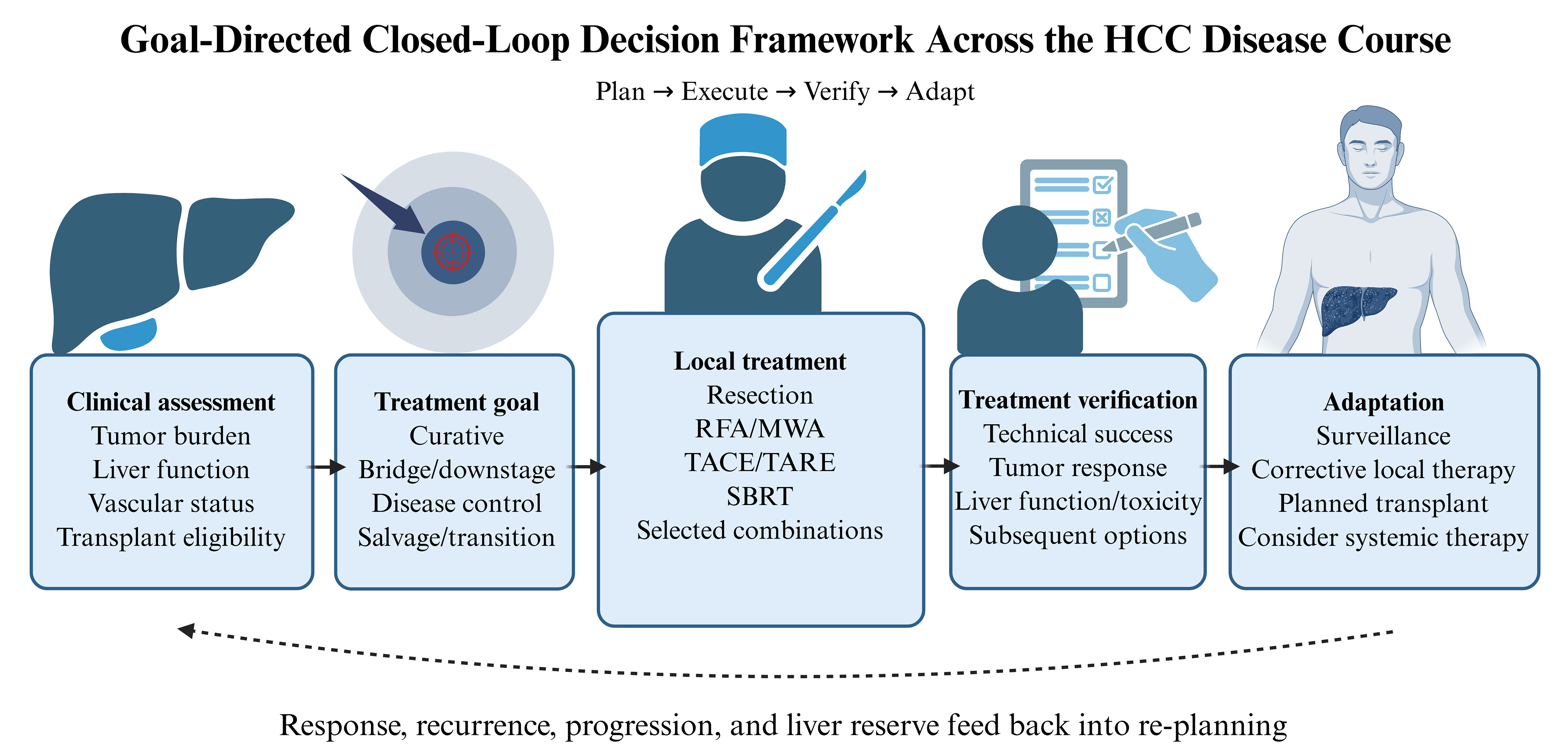
Figure 1. A goal-directed loop for minimally invasive HCC treatment across the disease course. Figure 1 summarizes the shared reasoning loop. Treatment intent and clinical context guide a modality-specific intervention. Response, toxicity, liver function, and remaining options then determine whether care proceeds to surveillance, corrective local treatment, transplantation, or systemic therapy. The arrows show how each outcome informs the next assessment. Created in BioRender. CAO, R. (2026) https://BioRender.com/36kf48q. HCC: Hepatocellular carcinoma; RFA: radiofrequency ablation; MWA: microwave ablation; TACE: transarterial chemoembolization; TARE: transarterial radioembolization; SBRT: stereotactic body radiation therapy.
Clinical goals, verification endpoints, and possible next steps across five HCC scenarios
| Clinical scenario | Goal and key planning variables | Execution endpoint | Verification | Possible next step |
| Curative intent[13,15-22] | Complete local control; location, liver reserve, CSPH, FLR, transplant potential | R0/appropriate resection or complete safety-adjusted ablation | Pathology, viable enhancement, coverage, liver function | Surveillance, corrective local therapy, or transplant assessment |
| Bridging/downstaging[12,23-26] | Prevent progression while on the wait-list or reach an accepted transplant state; burden, AFP dynamics, waiting time | Completion of the planned bridging or downstaging treatment without compromising transplant eligibility | Viable tumor, response stability, AFP, liver reserve | Remain listed, proceed with selected retreatment, or reassess transplant eligibility |
| Unresectable liver-dominant disease[27-33] | Meaningful intrahepatic control; distribution, embolizability, reserve, vascular/extrahepatic disease | Delivery of the planned selective LRT or trial-supported combination | Response/progression, toxicity, ALBI/Child-Pugh | Repeat only if disease remains responsive and treatment remains safe; otherwise evaluate transition to systemic therapy |
| Postrecurrence salvage[15,34,35] | Regain local control after restaging; timing, pattern, prior therapy, reserve | Complete selected salvage treatment | Local control, recurrence pattern, effects on hepatic reserve | Surveillance, further salvage, transplantation, or systemic therapy |
| Transition to systemic therapy[2,8,36,37] | Avoid futile local repetition; prior response, progression, liver function, selective treatability | Timely completion of, or decision to stop, the local strategy and evaluation for systemic therapy | Progression pattern, remaining local treatability, and hepatic reserve | Initiate systemic therapy; reconsider local therapy only for a defined goal |
FIVE CLINICAL SCENARIOS
Current guidelines, interventional-oncology frameworks, and recent outcome studies point to the same shift. Local therapy is increasingly defined by clinical scenario and treatment objective rather than by allegiance to a single procedure. The same procedure may have curative, bridging, cytoreductive, or salvage intent, so its evidence is most useful when interpreted within the clinical setting and purpose it is intended to address.
Curative-intent treatment
The first organizing principle is to balance local radicality with preservation of liver function and physiologic reserve. In patients with chronic liver disease, treatment-related hepatic decompensation can substantially compromise long-term outcome. This trade-off underscores that treatment impact cannot be judged from tumor location alone. Local therapy should therefore be selected for its balance between durable control and preservation of future therapeutic options, not for minimal invasiveness alone. For patients with Barcelona Clinic Liver Cancer (BCLC) stage 0 or A HCC, a solitary tumor in a favorable location, adequate future liver remnant, and preserved reserve may favor minimally invasive resection. Ablation becomes particularly attractive when the lesion is small, parenchymal preservation is important, or repeated treatment may be needed. Portal hypertension, transplant eligibility, procedural difficulty, and center expertise can shift this balance[2,3,7,8,15].
Randomized trials have strengthened the perioperative evidence base for minimally invasive liver resection. ORANGE II PLUS showed that laparoscopic hemihepatectomy shortened time to functional recovery without increasing serious complications and improved postoperative quality of life. ORANGE Segments extended this principle to parenchymal-sparing resection in posterosuperior segments, showing shorter recovery and hospitalization even in technically demanding locations[17,18]. Both trials included primary and metastatic liver tumors; their relevance to HCC is therefore perioperative rather than evidence of an HCC-specific survival advantage. These trials support the perioperative feasibility and recovery advantages of laparoscopic liver resection, including selected technically demanding procedures.
The comparison between resection and ablation is more nuanced because apparently conflicting studies address different clinical populations. SURF enrolled patients with HCC no larger than 3 cm and no more than three nodules; 90% had solitary disease, and approximately two-thirds had tumors no larger than 2 cm. Five-year overall survival was 74.6% after surgery and 70.4% after radiofrequency ablation (RFA), while 5-year recurrence-free survival was 42.9% and 42.7%, respectively[16]. Surgery did not show a survival advantage, but the trial was not designed to establish equivalence. In contrast, a retrospective study of 720 patients with two or three tumors no larger than 3 cm associated resection with better adjusted survival than RFA or transarterial chemoembolization (TACE)[19]. Because treatment was not randomized and some patients receiving nonsurgical therapy may not have been resectable, the apparent survival advantage may partly reflect treatment selection. Taken together, the evidence supports RFA as a curative option when a small, usually solitary HCC is equally amenable to resection and complete ablation. For patients with two or three small tumors who remain good surgical candidates, the observational evidence favors resection, but a randomized comparison is still lacking.
In HCC surgery, minimally invasive techniques are not merely lower-trauma alternatives. A randomized trial showed that laparoscopic anatomical hepatectomy, despite longer operative time, achieved better 5-year disease-free survival and less ipsilateral intrahepatic recurrence than laparoscopic non-anatomical hepatectomy[13]. These findings support extent of resection rather than surgical access. Overall survival did not improve significantly in the anatomical-resection trial, and patients with obvious cirrhosis at intraoperative assessment were excluded; its disease-free survival result is therefore most applicable to selected surgical candidates.
The robotic platform is best understood as a selective amplifier of minimally invasive surgery rather than a universal replacement for laparoscopy. An HCC-specific prospective propensity-matched cohort found shorter hospitalization with robotic and laparoscopic surgery than with open surgery, but no difference in 5-year disease-free or overall survival[38]. In a Western high-volume HCC cohort, robotic resection was associated with shorter hospitalization, fewer intensive care unit admissions, and lower rates of post-hepatectomy liver failure than open surgery. Long-term oncologic outcomes did not differ significantly[39]. Large international comparisons similarly suggest that robotic advantages are concentrated in lower conversion rates and more reliable completion of certain complex operations. Selective perioperative benefits have also been reported in difficult cases, although interpretation remains shaped by learning curve, institutional experience, case selection, and cost[40-46]. The most defensible conclusion is therefore not global superiority over laparoscopy, but expansion of minimally invasive feasibility in selected complex disease. From a pathway perspective, faster recovery and better parenchymal preservation may preserve eligibility for repeat local salvage, transplant evaluation, or timely systemic treatment after recurrence.
Beyond resection, the same question persists: how reliably can percutaneous local therapy deliver verifiable radicality? RFA remains the benchmark. A 10-year study showed that, for solitary HCCs no larger than 5 cm, RFA provided comparable long-term overall survival whether used as primary treatment or as salvage after recurrence[15]. Importantly, outcome after RFA is not explained by technical completion alone. RFA should therefore be judged not only by complete intraprocedural ablation. It should also be judged by whether it is delivered to the subgroup most likely to benefit durably.
Microwave ablation is narrowing the traditional gap between RFA and resection. In an observational multicenter comparison, selected patients with solitary HCC measuring 3-5 cm had similar overall survival after microwave ablation or laparoscopic resection, with shorter hospitalization and lower cost after ablation[20]. Because treatment was not randomized, the comparison remains sensitive to tumor location, vascular proximity, liver function, and operator experience. These findings suggest that microwave ablation (MWA) may extend parenchymal-preserving local treatment to selected 3-5 cm tumors. The potential advance is a broader curative-intent role for percutaneous treatment, although randomized comparison is still needed.
Within the broader local-treatment landscape, combination strategies and complementary nonthermal modalities remain important. A network meta-analysis suggested that TACE plus RFA may improve overall and progression-free survival compared with RFA alone in selected HCCs no larger than 5 cm[5]. For early-stage multinodular HCC, liver resection was associated with better 5-year survival than percutaneous RFA or TACE in selected patients[19]. HDR brachytherapy has been proposed as a nonthermal option when heat sink effects or proximity to bile ducts and major vessels limit thermal ablation, but comparative HCC evidence remains sparse[47]. Meanwhile, radiation segmentectomy and other transarterial radioembolization (TARE)-based approaches can achieve near-ablative local control in larger or anatomically challenging tumors, particularly with advanced dosimetry[21,22,48]. The competitive landscape is therefore no longer defined simply by resection vs. RFA. It now includes a broader spectrum of strategies that extend the boundary of local radicality.
In HCC, minimally invasive resection is organized around anatomic exposure, vascular control, and segmental boundaries. Ablation, by contrast, depends on trajectory planning, energy delivery, and margin verification. This distinction is clinically consequential. Surgical data show that laparoscopic anatomical hepatectomy is associated with lower ipsilateral intrahepatic recurrence and better 5-year disease-free survival than laparoscopic non-anatomical hepatectomy. This suggests that the relevant treatment unit may extend beyond the visible tumor[13]. In a mixed-histology-randomized trial, COVER-ALL provided technical evidence from the ablation side. Software-based margin assessment significantly increased both the delivered minimal ablative margin and the proportion of tumors achieving at least 5 mm of coverage[14]. Local radicality should therefore be judged by delivery of the intended anatomic or ablative unit, not merely by technical completion. After resection, pathology, margin status, postoperative liver function, and complications must be interpreted together. After ablation, residual viable enhancement and the achieved safety-adjusted margin are more informative than energy delivery completion alone[10,14]. COVER-ALL included malignant liver tumors of different histologies and did not establish an HCC-specific survival benefit. A rigid 5-mm margin is inappropriate when major bile ducts, vessels, or other vulnerable structures limit safe treatment. Residual disease that remains locally correctable may justify prompt retreatment; otherwise, an early change in strategy may preserve more options than repeated attempts at technical completion.
Bridging or downstaging to transplantation
Bridging and downstaging use similar locoregional methods but pursue different goals. Bridging aims to prevent progression while an eligible patient awaits transplantation, whereas downstaging attempts to bring tumor burden within an accepted transplant range. Tumor burden, alpha-fetoprotein trajectory, expected waiting time, hepatic reserve, and center-specific criteria should guide treatment selection[3,12,25,26]. Here, local therapy is not the endpoint. It is a strategy to reduce waitlist dropout, keep patients within transplant criteria, and reveal tumor biology over time. Current guidelines position locoregional therapy as a core component of this pathway.
The choice among ablation, TACE, transarterial radioembolization, and stereotactic body radiotherapy depends on tumor size and location, vascular and biliary anatomy, center experience, and the likelihood of response[3,12,25,26]. When a lesion is unsuitable for ablation, alternatives such as TACE, radiation segmentectomy, or other selective non-ablative local treatments are explicitly incorporated into contemporary algorithms. The relevant endpoint is not radiologic response alone, but maintenance or achievement of transplant eligibility without unacceptable loss of liver function.
The distinction between response and successful pathway completion is illustrated by MERITS-LT. The probability of successful downstaging reached 87.7% at 2 years, yet the 2-year dropout rate was 37.3%, and the 3-year transplantation rate was 46.6%[24]. Two-year post-transplant survival was 95%, with recurrence in 7.9%, although explant pathology showed tumor burden beyond Milan criteria in 42.8%. Thus, an encouraging scan does not guarantee access to transplantation, and a single response assessment cannot fully characterize tumor biology.
The strength of this pathway lies in both biologic rationale and outcome data. A meta-analysis of 25 studies applying UNOS downstaging criteria showed high rates of successful downstaging, low post-transplant recurrence, and approximately 75% 5-year post-transplant survival[25]. These findings support favorable post-transplant outcomes among patients successfully downstaged within established criteria. More recent national prospective data further suggest that, in carefully selected patients, this logic may extend beyond conventional UNOS-DS limits. Two-year successful downstaging was 66% in all-comers vs. 82% in UNOS-DS, while 5-year post-transplant survival remained similar (72% vs. 74%) despite higher recurrence in the broader cohort[23,25]. The meta-analysis and national cohort address related but different questions: the former summarizes outcomes within established UNOS downstaging criteria, whereas the latter tests broader prospective selection. Neither supports unrestricted expansion of transplant eligibility. Sustained response, alpha-fetoprotein behavior, liver function, and continued transplant eligibility therefore matter more than a single radiologic response.
Unresectable liver-dominant disease
In unresectable liver-dominant HCC, the local therapy-systemic therapy interface is fundamentally a problem of clinical sequencing rather than theoretical combination. The question is whether meaningful intrahepatic control can still be achieved without compromising the opportunity for subsequent therapy. Bilobar or infiltrative distribution, vascular invasion, extrahepatic spread, embolization selectivity, hepatic reserve, prior response, and the toxicity of combination therapy determine whether further locoregional treatment is likely to help[2,8,36].
TORCH provides strong evidence for one carefully defined form of locoregional intensification. The trial enrolled 241 patients with BCLC-B, liver-confined, unresectable HCC. After conventional lipiodol TACE, RFA was permitted only when the sum of the number of residual viable tumors and the diameter in centimeters of the largest viable tumor was less than 7, no viable tumor exceeded 5 cm, and complete ablation was considered feasible. Median progression-free survival was 17.7 vs. 7.3 months, and median overall survival was 88.6 vs. 35.1 months with TACE-RFA vs. TACE alone[32]. These results support a planned TACE-RFA sequence in patients who meet the post-TACE eligibility conditions. The two-center, HBV-predominant design and the fact that 22 patients assigned to TACE-RFA did not receive ablation limit the generalizability of this result.
TRACE addressed a different question by comparing two transarterial strategies. Among 72 selected patients with unresectable early- or intermediate-stage HCC, Y-90 radioembolization prolonged median time to progression (17.1 vs. 9.5 months) and median overall survival (30.2 vs. 15.6 months) compared with drug-eluting bead TACE[33]. The magnitude of benefit is clinically important, but the study had a small sample size, was conducted at a single center, and stopped at interim analysis after recruitment from 2011 to 2018. TRACE therefore supports radioembolization as an alternative for appropriately selected patients; it does not establish a universal preference over TACE.
Trials adding systemic therapy to TACE have produced a different pattern of benefit. LEAP-012 improved median progression-free survival with pembrolizumab plus lenvatinib and TACE [14.6 vs. 10.0 months; hazard ratio (HR), 0.66], but the prespecified interim overall-survival boundary was not crossed. Grade 3 or higher treatment-related adverse events occurred in 71% vs. 32%[27]. A subsequent sponsor update reported a low probability that the trial would later meet its overall-survival threshold and announced trial closure[30].
EMERALD-1 similarly improved progression-free survival with durvalumab plus bevacizumab plus TACE (15.0 vs. 8.2 months; HR, 0.77), whereas durvalumab plus TACE did not[28]. A 2026 conference update showed no survival benefit for either combination: median overall survival was 29.9 vs. 33.3 months for the triple regimen vs. TACE alone and 33.6 vs. 33.3 months for durvalumab plus TACE vs. TACE alone[31]. LAUNCH enrolled patients with advanced HCC; its findings therefore do not directly determine management of unresectable non-metastatic HCC[29].
These trials address different forms of treatment intensification. TORCH asked whether residual liver-confined disease that became completely ablatable after TACE could benefit from planned local consolidation; LEAP-012 and EMERALD-1 asked whether systemic intensification could delay progression in broader embolization-eligible populations. The TORCH survival result applies to a highly selected protocol-defined group. The progression-free survival gains in LEAP-012 and EMERALD-1 show improved disease control, but the absence of demonstrated overall-survival benefit and the added toxicity argue against routine intensification for every TACE candidate[27,28,30-32].
Taken together, these trials support treatment intensification only when the proposed sequence has a defined purpose, the target remains technically treatable, hepatic reserve is adequate, and the patient resembles the population in which benefit was demonstrated. Diffuse or infiltrative growth, repeated inadequate response, loss of selective access, or declining liver function should prompt reassessment and consideration of systemic therapy[2,8,36]. The practical stopping principles are discussed in Section “Transition from locoregional to systemic therapy”.
Post-recurrence salvage
Recurrence after apparently curative treatment should be treated as a new clinical state rather than as an automatic indication to repeat the original procedure. Time to recurrence, number and distribution of lesions, vascular or extrahepatic spread, prior treatment response, remaining liver reserve, portal hypertension, transplant eligibility, and the feasibility of complete local control all require reassessment. Late, limited intrahepatic recurrence may remain suitable for local salvage, whereas early multifocal or aggressive recurrence more often indicates unfavorable biology and warrants consideration of transplantation or systemic therapy.
A randomized trial enrolled 166 patients with a solitary recurrent HCC no larger than 5 cm. Stereotactic body radiotherapy improved local progression-free survival compared with RFA (HR, 0.45; 2-year rates, 92.7% vs. 75.8%), but did not significantly improve progression-free or overall survival; treatment-related safety outcomes were similar[34]. This supports stereotactic body radiotherapy as an alternative when ablation is technically difficult, while showing that superior local control does not necessarily translate into longer survival.
A retrospective cohort that included both primary and recurrent solitary HCC similarly associated stereotactic body radiotherapy with less local recurrence, but not with better progression-free or overall survival. The radiotherapy group also had more deterioration in Child-Pugh score or bilirubin and fewer subsequent treatments with curative potential after recurrence or progression, although these differences may reflect treatment selection[34,49]. Hepatic reserve and future retreatment options should therefore be weighed alongside local control.
A second randomized trial enrolled 210 patients whose small HCC recurred at least 12 months after curative treatment and compared TACE-RFA with repeat resection. Overall survival and recurrence-free survival did not differ significantly. Overall and major complication rates were lower with TACE-RFA[35]. The absence of a significant survival difference does not prove equivalence. Within the studied population, however, TACE-RFA is a reasonable less invasive salvage option when complete local treatment is feasible.
These comparisons support a goal-directed rather than modality-driven approach. Stereotactic body radiotherapy may be preferred when tumor location makes thermal ablation unsafe or unreliable; TACE-RFA may avoid the morbidity of repeat resection in selected late recurrence; repeat surgery may remain appropriate when anatomy, hepatic reserve, and the chance of durable clearance are favorable. Another local treatment is worthwhile only if it offers a credible path to complete control without compromising transplantation or systemic treatment[2,12,34,35,49].
Transition from locoregional to systemic therapy
In intermediate-stage disease, one of the most consequential decisions is when to stop repeating TACE and transition to systemic therapy. This decision is increasingly framed by TACE unsuitability and TACE refractoriness rather than by a fixed number of sessions. When disease is diffuse, bilobar, infiltrative, or not amenable to selective embolization, further TACE may offer little value. The same is true when repeated TACE fails to generate meaningful radiologic response while consuming liver reserve[8,36,37]. In this setting, the value of local therapy lies less in repetition than in recognizing when locoregional control remains useful and when preservation of hepatic function should take priority.
Local treatment may reduce tumor burden. It may stabilize disease while preserving liver function. It may create an opportunity for transplantation or resection. It may also represent the last effective regional intervention before systemic therapy. The central issue is therefore not whether local and systemic therapy can be combined in principle, but how each intervention reshapes the options that remain later in the treatment course.
At reassessment, the team should ask whether the remaining disease is still locally correctable and whether another procedure would preserve or compromise access to systemic therapy. Progression-free survival, time to progression, and objective response describe disease control, but toxicity and changes in liver function determine whether later treatment remains feasible[9,10]. Another local intervention may be appropriate when it has a defined complementary purpose, such as treating a limited threatening focus while systemic therapy addresses broader disease.
The 2025 Taiwan Liver Cancer Association consensus identifies high tumor burden beyond the up-to-11 criteria, confluent multinodular or infiltrative morphology, repeated inadequate response or progression, and risk of hepatic deterioration as practical indicators of TACE unsuitability or refractoriness[37]. These features are best used as prompts for multidisciplinary reassessment. Their value lies in preventing ineffective repetition from eroding the liver function needed for the next line of treatment.
BCLC identifies disease that is no longer treatable by the current strategy as an indication for stage migration, while EASL emphasizes reassessment when the initial option is unsuitable or no longer beneficial[2,8]. IMbrave050 illustrates a related but distinct caution after curative-intent local treatment. Its initial recurrence-free survival signal with adjuvant atezolizumab plus bevacizumab was not sustained with longer follow-up, and routine adjuvant use is not supported[50,51]. An early efficacy signal should therefore not become a long-term treatment commitment without durable evidence. Likewise, transition from locoregional treatment should occur before hepatic reserve is exhausted when further local therapy is unlikely to achieve a defined clinical goal.
CROSS-SCENARIO ENABLERS AND EVIDENCE GAPS
Procedural enablers and quantitative treatment verification
When tumors lie in segment 8, beneath the diaphragm, or adjacent to critical structures, technical success becomes harder to reproduce. In such cases, outcome depends less on the decision to ablate than on whether access planning and needle trajectory can be executed reproducibly. A 467-patient case-control study evaluated real-time ultrasonography-augmented electromagnetic navigation, with electromagnetic tracking of the ultrasound probe and ablation instruments[6]. Navigation was used more often for technically challenging tumors, while incomplete ablation and survival outcomes were similar between procedures with and without navigation. Navigation may therefore improve geometric reproducibility in technically challenging punctures. Prospective robotic puncture, hepatic hilar nerve block, infection-risk modeling, and real-time thermometry address different aspects of procedural execution or safety, but none has yet established improved HCC control[52-55].
A major advance in ablation quality control has been the conversion of the minimal ablative margin from subjective operator impression into a quantifiable metric. In the randomized phase II COVER-ALL trial, software-based margin assessment increased the mean minimal ablative margin from 2.2 to 5.9 mm. It also increased the proportion of tumors achieving at least 5 mm coverage from 15% to 75%[14]. The trial included malignant liver tumors of different histologies, and the difference in local progression was not statistically significant. In practice, software-based assessment prompted more overlapping ablations and re-ablation. Its principal contribution is therefore technical: objective assessment can identify inadequate coverage and guide additional treatment. The target margin must still be adapted to heat-sink effects and proximity to bile ducts, vessels, the diaphragm, and other critical structures.
Response verification after TACE addresses a different question. In a prospective three-center study of 132 patients with ultrasound-visible HCC, two-dimensional contrast-enhanced ultrasound had higher sensitivity than contrast-enhanced computed tomography (CT) or magnetic resonance imaging (MRI) for residual viable tumor at 4 to 6 weeks (91% vs. 68%), but lower specificity (70% vs. 85%)[56]. Contrast-enhanced ultrasound can therefore complement cross-sectional imaging when findings are uncertain, but it should not replace CT- or MRI-based treatment-response assessment.
Artificial intelligence and biomarkers as decision modifiers
Artificial intelligence is moving beyond descriptive radiomics toward treatment-specific decision support in minimally invasive HCC care. In a multicenter cohort of treatment-naive patients with a single 3-5-cm HCC, a hybrid machine-learning model generated separate early-recurrence estimates for laparoscopic hepatectomy and microwave ablation[57]. Comparable signals are emerging in embolotherapy and broader locoregional planning. By integrating tumor area with biopsy transcriptomics, PRETACE predicted response to TACE[58]. A separate model addressed treatment allocation after postoperative recurrence[59]. Together, these studies illustrate treatment-specific applications of AI across several locoregional pathways rather than prognosis alone. Strategically, AI may prove more valuable for longitudinal sequencing than for single-procedure prediction alone. Most existing models, however, remain retrospective, center-specific, and sensitive to differences in imaging workflow, annotation, and endpoint definition. Their near-term role is therefore best understood as structured multidisciplinary support rather than autonomous recommendation.
Lin et al. provide a stronger test of transportability than most single-center model studies. Their treatment-specific models were developed in a multicenter retrospective cohort of 1,725 patients treated with TACE, hepatic artery infusion chemotherapy, or related combinations, with external validation in 277 patients from nine additional hospitals[60]. Concordance between the model and the treatment received was associated with better response or survival in several validation cohorts. Treatment was not assigned by the model, however, and residual confounding remains possible. External validation supports further clinical study, but prospective treatment assignment is still needed to determine whether model-guided care improves outcomes.
Computational models are only one layer of stratification. Biomarkers and host factors may add information about recurrence risk, tumor biology, and physiologic reserve. Sarcopenia has been associated with outcomes after liver resection, whereas non-neoplastic portal vein thrombosis carries prognostic information in cirrhosis with newly diagnosed HCC[11,61]. A single-center recurrence score after RFA combined a circulating tumor-cell count with alpha-fetoprotein and des-gamma-carboxy prothrombin thresholds[62]. These thresholds are specific to the study and are not current practice standards. In patients undergoing percutaneous ablation, the presence and number of pretreatment circulating tumor DNA (ctDNA) mutations were associated with recurrence and mortality; ctDNA and cell-free DNA (cfDNA) measures also changed after locoregional treatment[63]. Precision in minimally invasive HCC treatment should therefore not be reduced to better imaging or more complex algorithms. Assay reproducibility, sampling time, availability, cost, and prospective clinical utility remain important barriers. For now, these tools may inform multidisciplinary discussion but should not determine treatment selection on their own.
Technologies by translational maturity
As the field moves beyond feasibility, future progress will depend on more than platform innovation alone. It will require stronger comparative evidence, sharper patient selection, and clearer sequencing frameworks. First, noninvasive, nonthermal platforms may create a distinct niche for tumors that are anatomically difficult, inaccessible to puncture, or poorly suited to heat-based treatment. Histotripsy is especially distinctive because it enables nonionizing, nonthermal mechanical tissue destruction without puncture. Multicenter single-arm studies have demonstrated technical feasibility in primary and metastatic liver tumors[64,65]. However, its role in HCC still depends on stronger durability data, clearer management of acoustic-window and targeting constraints, and evidence of integration into bridging, salvage, or sequence-aware multimodal pathways. A broader interventional-oncology perspective can help place such technologies within established multidisciplinary care rather than treating them as isolated replacements for resection or ablation[66].
Second, the frontier of minimally invasive HCC therapy is shifting from tumor destruction alone toward engineering the interface between local injury and systemic effect. Preclinical work points to several convergent directions. These include immune priming after ablation or partial tumor injury, biomaterial- or hydrogel-based intratumoral drug delivery, and image-guided local depots for controlled release. They also include metabolic or ethanol-related immunogenic remodeling and theranostic platforms that couple delivery with visualization or targeting[67-79]. These approaches are not yet ready to redefine current standards. They still matter because they recast local therapy as a programmable biologic event. Clinical translation will depend on reproducible manufacturing, biodistribution and toxicity data, scalable image guidance, clinically meaningful comparators and endpoints, and regulatory feasibility. Their value must be judged against tumor biology, host reserve, portal venous status, and downstream treatment opportunity rather than technical novelty alone. Table 2 places representative studies within their clinical and translational context.
Evidence maturity and interpretation of key studies informing minimally invasive HCC care
| Evidence category | Representative evidence | Clinical interpretation | Remaining uncertainty |
| Guideline/consensus | BCLC 2026; EASL 2025; AASLD; ILTS-ILCA; endpoint consensus; LI-RADS[2,3,8-10,12] | Decision principles, stage migration, response definitions, evidence interpretation | Guidelines establish decision principles; they do not compare the efficacy of every procedure |
| HCC-specific randomized trials | SURF; anatomical resection; TORCH; TRACE; LEAP-012; EMERALD-1; recurrent HCC trials[13,16,27,28,32-35] | Context-specific comparative outcomes within eligibility criteria | Results apply to the enrolled population and reported endpoints; they do not establish universal equivalence or an OS benefit when OS was not shown |
| Prospective multicenter studies | MERITS-LT; national downstaging cohort; post-TACE CEUS verification[23,24,56] | Feasibility, selection, longitudinal outcomes, or diagnostic performance | These studies do not provide randomized causal comparisons, and diagnostic performance alone does not justify replacing standard imaging |
| Mixed-histology randomized studies | ORANGE trials; COVER-ALL[14,17,18] | Perioperative or technical effects in malignant liver tumors | Perioperative or technical effects in mixed-histology tumors may not translate to HCC-specific survival |
| Retrospective/model studies | Navigation; AI allocation; ctDNA; CTC/AFP/DCP recurrence score; sarcopenia; infection-risk studies[6,52,54,57-59,61-63] | Hypothesis generation and potential decision support | Associations and model performance require independent validation where not yet performed and prospective clinical testing; autonomous treatment allocation remains unproven |
| Commentary/early-stage evidence | HDR commentary; thermometry; histotripsy; biomaterial and immune platforms[47,55,64,65,67-79] | Proposed roles, feasibility, and future research direction | Proposed roles, feasibility, or biological signals require comparative clinical testing before standard-of-care use |
CONCLUSION
In summary, minimally invasive treatment for HCC has entered a new phase. Minimally invasive liver resection is now supported by randomized and prospective evidence, although the disease specificity and endpoints of each study remain important[13,16-18,38]. Robotic platforms are best understood as extending minimally invasive feasibility in selected complex resections rather than as a universally superior alternative to laparoscopy[38-46]. RFA remains the benchmark ablative modality. Microwave ablation, combined locoregional strategies, and radiation segmentectomy are extending the boundary of local radicality in selected settings[5,19-22,48]. Navigation and quantitative margin assessment are making ablation more traceable, whereas real-time thermometry remains investigational[6,14,52-56].
Candidate allocation is also moving beyond tumor geometry alone toward dual stratification by tumor biology and host reserve[11,57-63]. In transplant pathways, bridging and downstaging should be judged by sustained biological selection and progression to transplantation, not by a single radiologic response[12,23-26]. In unresectable liver-dominant disease, evidence supports selected protocol-defined locoregional sequences and shows gains in progression-free survival or disease control with some TACE-based combinations. It does not support indiscriminate intensification or establish an overall-survival benefit for every combination[27-33]. After recurrence, restaging and the feasibility of complete local control determine whether another local intervention remains worthwhile[34,35]. The central challenge going forward is disciplined sequencing. It requires selecting the appropriate local therapy for a defined objective, verifying that local benefit has truly been achieved, and recognizing when further locoregional treatment still adds value. It also requires timely recognition of when such treatment merely delays necessary systemic escalation at the cost of liver reserve. The best next step may be surveillance, corrective local therapy, transplantation, or timely systemic therapy.
DECLARATIONS
Acknowledgments
The graphical abstract was created using BioRender by R. Cao (2026). https://BioRender.com/tqzu8qf.
Authors’ contributions
Conceptualization, methodology, literature search, data curation, drafting, revision, visualization: Cao R, You X, Huang Y
Literature search, data curation, and writing - review and editing: Zhang Y
Conceptualization, supervision, and writing - review and editing: Xia F, Cheng Q
Availability of data and materials
Not applicable.
AI and AI-assisted tools statement
Not applicable.
Financial support and sponsorship
None.
Conflicts of interest
Xia F is an Editorial Board Member of Mini-invasive Surgery but was not involved in the editorial processing of this manuscript, including reviewer selection, manuscript handling, or decision-making. The other authors declare no conflicts of interest.
Ethical approval and consent to participate
Not applicable.
Consent for publication
Not applicable.
Copyright
© The Author(s) 2026.
REFERENCES
1. Xie D, Shi J, Zhou J, Fan J, Gao Q. Clinical practice guidelines and real-life practice in hepatocellular carcinoma: a Chinese perspective. Clin Mol Hepatol. 2023;29:206-16.
2. European Association for the Study of the Liver. EASL Clinical Practice Guidelines on the management of hepatocellular carcinoma. J Hepatol. 2025;82:315-74.
3. Singal AG, Llovet JM, Yarchoan M, et al. AASLD Practice Guidance on prevention, diagnosis, and treatment of hepatocellular carcinoma. Hepatology. 2023;78:1922-65.
4. Tamai H, Okamura J. New next-generation microwave thermosphere ablation for small hepatocellular carcinoma. Clin Mol Hepatol. 2021;27:564-74.
5. Kim HI, An J, Han S, Shim JH. Loco-regional therapies competing with radiofrequency ablation in potential indications for hepatocellular carcinoma: a network meta-analysis. Clin Mol Hepatol. 2023;29:1013-28.
6. Iwai Y, Agala CB, Gerber DA. Integrating navigation-assisted ablation in the locoregional treatment of hepatocellular carcinoma. JAMA Netw Open. 2024;7:e240694.
7. Vitale A, Cabibbo G, Iavarone M, et al.; HCC Special Interest Group of the Italian Association for the Study of the Liver. Personalised management of patients with hepatocellular carcinoma: a multiparametric therapeutic hierarchy concept. Lancet Oncol. 2023;24:e312-22.
8. Reig M, Sanduzzi-Zamparelli M, Forner A, et al. BCLC strategy for prognosis prediction and treatment recommendations: the 2026 update. J Hepatol. 2026;84:631-54.
9. Llovet JM, Mauro E, Rimassa L, et al. Trial design and end points in hepatocellular carcinoma: an EASL-AASLD-ILCA consensus statement. Nat Rev Clin Oncol. 2026;23:619-47.
10. Aslam A, Chernyak V, Tang A, et al. CT/MRI LI-RADS 2024 update: treatment response assessment. Radiology. 2024;313:e232408.
11. Senzolo M, Shalaby S, Grasso M, et al. Role of nonneoplastic PVT in the natural history of patients with cirrhosis and first diagnosis of HCC. Hepatology. 2024;79:355-67.
12. Kodali S, Kulik L, D’Allessio A, et al.; and the ILTS ILCA Consensus 2024 Group. The 2024 ILTS-ILCA consensus recommendations for liver transplantation for HCC and intrahepatic cholangiocarcinoma. Liver Transpl. 2025;31:815-31.
13. Liao K, Yang K, Cao L, et al. Laparoscopic anatomical versus non-anatomical hepatectomy in the treatment of hepatocellular carcinoma: a randomised controlled trial. Int J Surg. 2022;102:106652.
14. Odisio BC, Albuquerque J, Lin YM, et al. Software-based versus visual assessment of the minimal ablative margin in patients with liver tumours undergoing percutaneous thermal ablation (COVER-ALL): a randomised phase 2 trial. Lancet Gastroenterol Hepatol. 2025;10:442-51.
15. Bai XM, Cui M, Yang W, et al. The 10-year survival analysis of radiofrequency ablation for solitary hepatocellular carcinoma 5 cm or smaller: primary versus recurrent HCC. Radiology. 2021;300:458-69.
16. Kawaguchi Y, Hasegawa K, Kashiwabara K, et al. Surgery versus ablation for hepatocellular carcinoma: a randomized controlled trial (SURF-RCT trial) and a nonrandomized prospective observational trial (SURF-cohort trial). J Clin Oncol. 2025;43:2628-38.
17. Fichtinger RS, Aldrighetti LA, Abu Hilal M, et al.; ORANGE II PLUS Collaborative. Laparoscopic versus open hemihepatectomy: the ORANGE II PLUS multicenter randomized controlled trial. J Clin Oncol. 2024;42:1799-809.
18. Sijberden JP, Kuemmerli C, Ratti F, et al. Laparoscopic versus open parenchymal preserving liver resections in the posterosuperior segments (ORANGE Segments): a multicentre, single-blind, randomised controlled trial. Lancet Reg Health Eur. 2025;51:101228.
19. Vitale A, Romano P, Cillo U, et al.; Writing Group for the HE.RC.O.LE.S Collaborative Group, Writing Group for the ITA.LI.CA Collaborative Group, HE.RC.O.LE.S and ITA.LI.CA Collaborative Groups. Liver resection vs nonsurgical treatments for patients with early multinodular hepatocellular carcinoma. JAMA Surg. 2024;159:881-9.
20. Wang Z, Liu M, Zhang DZ, et al. Microwave ablation versus laparoscopic resection as first-line therapy for solitary 3-5-cm HCC. Hepatology. 2022;76:66-77.
21. Kim E, Sher A, Abboud G, et al. Radiation segmentectomy for curative intent of unresectable very early to early stage hepatocellular carcinoma (RASER): a single-centre, single-arm study. Lancet Gastroenterol Hepatol. 2022;7:843-50.
22. Salem R, Johnson GE, Kim E, et al. Yttrium-90 radioembolization for the treatment of solitary, unresectable HCC: the LEGACY study. Hepatology. 2021;74:2342-52.
23. Xu E, Tabrizian P, Gutierrez J, et al. Downstaging of hepatocellular carcinoma before liver transplantation: results from a national multicenter prospective cohort study. Hepatology. 2025;82:612-25.
24. Mehta N, Frenette C, Tabrizian P, et al. Downstaging outcomes for hepatocellular carcinoma: results from the multicenter evaluation of reduction in tumor size before liver transplantation (MERITS-LT) consortium. Gastroenterology. 2021;161:1502-12.
25. Tan DJH, Lim WH, Yong JN, et al. UNOS down-staging criteria for liver transplantation of hepatocellular carcinoma: systematic review and meta-analysis of 25 studies. Clin Gastroenterol Hepatol. 2023;21:1475-84.
26. Lee VH, Vardhanabhuti V, Wong TC, et al. Stereotactic body radiotherapy and liver transplant for liver cancer: a nonrandomized controlled trial. JAMA Netw Open. 2024;7:e2415998.
27. Kudo M, Ren Z, Guo Y, et al.; LEAP-012 investigators. Transarterial chemoembolisation combined with lenvatinib plus pembrolizumab versus dual placebo for unresectable, non-metastatic hepatocellular carcinoma (LEAP-012): a multicentre, randomised, double-blind, phase 3 study. Lancet. 2025;405:203-15.
28. Sangro B, Kudo M, Erinjeri JP, et al.; EMERALD-1 Investigators. Durvalumab with or without bevacizumab with transarterial chemoembolisation in hepatocellular carcinoma (EMERALD-1): a multiregional, randomised, double-blind, placebo-controlled, phase 3 study. Lancet. 2025;405:216-32.
29. Peng Z, Fan W, Zhu B, et al. Lenvatinib combined with transarterial chemoembolization as first-line treatment for advanced hepatocellular carcinoma: a phase III, randomized clinical trial (LAUNCH). J Clin Oncol. 2023;41:117-27.
30. Merck & Co., Inc.; Eisai Co., Ltd. Merck and Eisai provide update on Phase 3 LEAP-012 trial in unresectable, non-metastatic hepatocellular carcinoma. 2025. Available from: https://www.merck.com/news/merck-and-eisai-provide-update-on-phase-3-leap-012-trial-in-unresectable-non-metastatic-hepatocellular-carcinoma/. [Last accessed on 22 Sep 2026].
31. Sangro B, Kudo M, Chan SL, et al. EMERALD-1: overall survival with durvalumab, bevacizumab and TACE in embolisation-eligible hepatocellular carcinoma. ESMO Gastrointestinal Cancers Congress 2026; Abstract 183O. Available from: https://oncologypro.esmo.org/video-series/emerald-1-overall-survival-with-durvalumab-bevacizumab-and-tace-in-eehcc. [Last accessed on 22 Sep 2026].
32. Lyu N, Yi JZ, Wu XT, et al. Transarterial chemoembolization plus thermal ablation in unresectable hepatocellular carcinoma: the phase 3 TORCH randomized clinical trial. JAMA Oncol. 2026;12:980-9.
33. Dhondt E, Lambert B, Hermie L, et al. 90Y radioembolization versus drug-eluting bead chemoembolization for unresectable hepatocellular carcinoma: results from the TRACE phase II randomized controlled trial. Radiology. 2022;303:699-710.
34. Xi M, Yang Z, Hu L, et al. Radiofrequency ablation versus stereotactic body radiotherapy for recurrent small hepatocellular carcinoma: a randomized, open-label, controlled trial. J Clin Oncol. 2025;43:1073-82.
35. Zhang YJ, Chen J, Zhou Z, et al. Transarterial chemoembolization with radiofrequency ablation versus surgical resection for small late-recurrence hepatocellular carcinoma. Radiology. 2025;314:e241096.
36. Singal AG, Salem R, Pinato DJ, Pillai A. Advances in locoregional and systemic treatments for hepatocellular carcinoma. Gastroenterology. 2025;169:585-99.
37. Lee IC, Wang HW, Teng W, et al.; TLCA Intermediate Stage HCC Working Group. Taiwan liver cancer association management consensus guidelines for intermediate-stage hepatocellular carcinoma. Clin Mol Hepatol. 2025;31:1213-32.
38. Zhu P, Liao W, Zhang WG, et al. A prospective study using propensity score matching to compare long-term survival outcomes after robotic-assisted, laparoscopic, or open liver resection for patients with BCLC stage 0-A hepatocellular carcinoma. Ann Surg. 2023;277:e103-11.
39. Di Benedetto F, Magistri P, Di Sandro S, et al.; Robotic HPB Study Group. Safety and efficacy of robotic vs open liver resection for hepatocellular carcinoma. JAMA Surg. 2023;158:46-54.
40. Sijberden JP, Hoogteijling TJ, Aghayan D, et al.; International consortium on Minimally Invasive Liver Surgery (I-MILS). Robotic versus laparoscopic liver resection in various settings: an international multicenter propensity score matched study of 10.075 patients. Ann Surg. 2024;280:108-17.
41. Cipriani F, Fiorentini G, Magistri P, et al. Pure laparoscopic versus robotic liver resections: multicentric propensity score-based analysis with stratification according to difficulty scores. J Hepatobiliary Pancreat Sci. 2022;29:1108-23.
42. Liu Q, Zhang W, Zhao JJ, et al.; International Robotic and Laparoscopic Liver Resection Study Group investigators. Propensity-score matched and coarsened-exact matched analysis comparing robotic and laparoscopic major hepatectomies: an international multicenter study of 4822 cases. Ann Surg. 2023;278:969-75.
43. Krenzien F, Schmelzle M, Pratschke J, et al.; International Robotic and Laparoscopic Liver Resection Study Group investigators. Propensity score-matching analysis comparing robotic versus laparoscopic limited liver resections of the posterosuperior segments: an international multicenter study. Ann Surg. 2024;279:297-305.
44. Chiow AKH, Fuks D, Choi GH, et al.; International Robotic and Laparoscopic Liver Resection Study Group collaborators. International multicentre propensity score-matched analysis comparing robotic versus laparoscopic right posterior sectionectomy. Br J Surg. 2021;108:1513-20.
45. Kamarajah SK, Bundred J, Manas D, Jiao L, Hilal MA, White SA. Robotic versus conventional laparoscopic liver resections: a systematic review and meta-analysis. Scand J Surg. 2021;110:290-300.
46. Hamad A, Eskander MF, Tsung A. What is the value of the robotic platform for major hepatectomies? JAMA Surg. 2022;157:445.
47. Chapiro J. Image-guided high-dose-rate brachytherapy for hepatocellular carcinoma could be the ultimate ablation tool. Radiology. 2024;310:e240072.
48. Lewandowski RJ, Serhal M, Padia SA, et al. The evolving application of radiation segmentectomy for the treatment of hepatic malignancy. Radiology. 2025;316:e240333.
49. Yang Z, Liu S, Hu L, et al. Stereotactic body radiotherapy is an alternative to radiofrequency ablation for single HCC ≤ 5.0 cm. JHEP Rep. 2024;6:101151.
50. Yopp A, Chen M, Cheng AL, et al. Updated data from IMbrave050: adjuvant atezolizumab plus bevacizumab for high-risk hepatocellular carcinoma. J Hepatol. 2026;84:1102-11.
51. Qin S, Chen M, Cheng AL, et al.; IMbrave050 investigators. Atezolizumab plus bevacizumab versus active surveillance in patients with resected or ablated high-risk hepatocellular carcinoma (IMbrave050): a randomised, open-label, multicentre, phase 3 trial. Lancet. 2023;402:1835-47.
52. de Baère T, Roux C, Deschamps F, Tselikas L, Guiu B. Evaluation of a new CT-guided robotic system for percutaneous needle insertion for thermal ablation of liver tumors: a prospective pilot study. Cardiovasc Intervent Radiol. 2022;45:1701-9.
53. He KS, Fernando R, Cabrera T, et al. Hepatic hilar nerve block for hepatic interventions: anatomy, technique, and initial clinical experience in thermal ablation of liver tumors. Radiology. 2021;301:223-8.
54. Li X, Zhang Y, Wang X, et al. Predicting infectious complications after percutaneous thermal ablation of liver malignancies: a 12-year single-center experience. Radiology. 2023;308:e223091.
55. Chen L, Yin J, Wang Y, et al. Time-resolved ratiometric fluorescence nanothermometer for real-time endoscopic temperature guidance during tumor ablation. Adv Mater. 2025;37:e2503726.
56. Savsani E, Shaw CM, Forsberg F, et al. Contrast-enhanced US evaluation of hepatocellular carcinoma response to chemoembolization: a prospective multicenter trial. Radiology. 2023;309:e230727.
57. Ding W, Wang Z, Liu FY, et al. A hybrid machine learning model based on semantic information can optimize treatment decision for naïve single 3-5-cm HCC patients. Liver Cancer. 2022;11:256-67.
58. Boldanova T, Fucile G, Vosshenrich J, et al. Supervised learning based on tumor imaging and biopsy transcriptomics predicts response of hepatocellular carcinoma to transarterial chemoembolization. Cell Rep Med. 2021;2:100444.
59. Famularo S, Donadon M, Cipriani F, et al.; HE.RC.O.LE.S. Group. Machine learning predictive model to guide treatment allocation for recurrent hepatocellular carcinoma after surgery. JAMA Surg. 2023;158:192-202.
60. Lin X, Wei R, Xu Z, et al. A deep learning model for personalized intra-arterial therapy planning in unresectable hepatocellular carcinoma: a multicenter retrospective study. EClinicalMedicine. 2024;75:102808.
61. Yang J, Chen K, Zheng C, et al. Impact of sarcopenia on outcomes of patients undergoing liver resection for hepatocellular carcinoma. J Cachexia Sarcopenia Muscle. 2022;13:2383-92.
62. He YZ, He K, Huang RQ, et al. A clinical scoring system for predicting tumor recurrence after percutaneous radiofrequency ablation for 3 cm or less hepatocellular carcinoma. Sci Rep. 2021;11:8275.
63. Campani C, Imbeaud S, Couchy G, et al. Circulating tumour DNA in patients with hepatocellular carcinoma across tumour stages and treatments. Gut. 2024;73:1870-82.
64. Mendiratta-Lala M, Wiggermann P, Pech M, et al. The #HOPE4LIVER single-arm pivotal trial for histotripsy of primary and metastatic liver tumors. Radiology. 2024;312:e233051.
65. Ziemlewicz TJ, Critchfield JJ, Mendiratta-Lala M, et al. The #HOPE4LIVER single-arm pivotal trial for histotripsy of primary and metastatic liver tumors: one-year update of clinical outcomes. Ann Surg. 2025;282:908-16.
66. Abdelsalam ME, Ahrar K, Sheth RA, et al. Interventional oncology: a primer for clinicians on the role of ablation and embolization for solid tumors. CA Cancer J Clin. 2026;76:e70051.
67. Albadawi H, Zhang Z, Keum H, et al. Percutaneous delivery of oncogel for targeted liver tumor ablation and controlled release of therapeutics. Adv Mater. 2024;36:e2406080.
68. Chen Z, Meng L, Zhang J, Zhang X. Progress in the cryoablation and cryoimmunotherapy for tumor. Front Immunol. 2023;14:1094009.
69. Cheng X, He C, Huang J, et al. A tumor-homing nanoframework for synergistic microwave tumor ablation and provoking strong anticancer immunity against metastasis. ACS Nano. 2024;18:29121-39.
70. Dou WT, Qiu P, Shi Y, et al. Orthogonally engineered albumin with attenuated macrophage phagocytosis for the targeted visualization and phototherapy of liver cancer. J Am Chem Soc. 2023;145:17377-88.
71. Gong J, Hu J, Yan X, et al. Injectable hydrogels including magnetic nanosheets for multidisciplinary treatment of hepatocellular carcinoma via magnetic hyperthermia. Small. 2024;20:e2300733.
72. Hsu YC, Wu MC, Weng MT, et al. Ethanol inhibits the growth and metastasis of hepatocellular carcinoma by inducing immunogenic cell death. J Immunother Cancer. 2025;13:e010472.
73. Kan X, Zhou G, Zhang F, et al. Enhanced efficacy of direct immunochemotherapy for hepatic cancer with image-guided intratumoral radiofrequency hyperthermia. J Immunother Cancer. 2022;10:e005619.
74. Shewarega A, Santana JG, Nam D, et al. Effect of incomplete cryoablation and matrix metalloproteinase inhibition on intratumoral CD8+ T-cell infiltration in murine hepatocellular carcinoma. Radiology. 2024;310:e232365.
75. Tang X, Mao X, Ling P, et al. Glycolysis inhibition induces anti-tumor central memory CD8+T cell differentiation upon combination with microwave ablation therapy. Nat Commun. 2024;15:4665.
76. Tian Z, Hu Q, Sun Z, et al. A booster for radiofrequency ablation: advanced adjuvant therapy via in situ nanovaccine synergized with anti-programmed death ligand 1 immunotherapy for systemically constraining hepatocellular carcinoma. ACS Nano. 2023;17:19441-58.
77. Wu WS, Yan X, Chen S, et al. Minimally invasive delivery of percutaneous ablation agent via magnetic colloidal hydrogel injection for treatment of hepatocellular carcinoma. Adv Mater. 2024;36:e2309770.
78. Xu J, Zheng Q, Cheng X, et al. Chemo-photodynamic therapy with light-triggered disassembly of theranostic nanoplatform in combination with checkpoint blockade for immunotherapy of hepatocellular carcinoma. J Nanobiotechnology. 2021;19:355.
Cite This Article
 Open Access
How to Cite
Cao R, You X, Huang Y, Zhang Y, Xia F, Cheng Q. Goal-directed minimally invasive treatment of hepatocellular carcinoma across the disease course: a scenario-based clinical framework. Mini-invasive Surg. 2026;10:35. https://dx.doi.org/10.20517/2574-1225.2026.21
Download Citation
If you have the appropriate software installed, you can download article citation data to the citation manager of your choice. Simply select your manager software from the list below and click on download.
Export Citation File
Type of Import
Tips on Downloading Citation
Citation Manager File Format
Type of Import
Direct Import: When the Direct Import option is selected (the default state), a dialogue box will give you the option to Save or Open the downloaded citation data. Choosing Open will either launch your citation manager or give you a choice of applications with which to use the metadata. The Save option saves the file locally for later use.
Indirect Import: When the Indirect Import option is selected, the metadata is displayed and may be copied and pasted as needed.
About This Article
Copyright

Data & Comments
Data
0









Comments
Comments must be written in English. Spam, offensive content, impersonation, and private information will not be permitted. If any comment is reported and identified as inappropriate content by OAE staff, the comment will be removed without notice. If you have any queries or need any help, please contact us at [email protected].