



An immunocompetent model of hepacivirus-associated liver fibrosis and hepatocellular carcinoma
 0
0 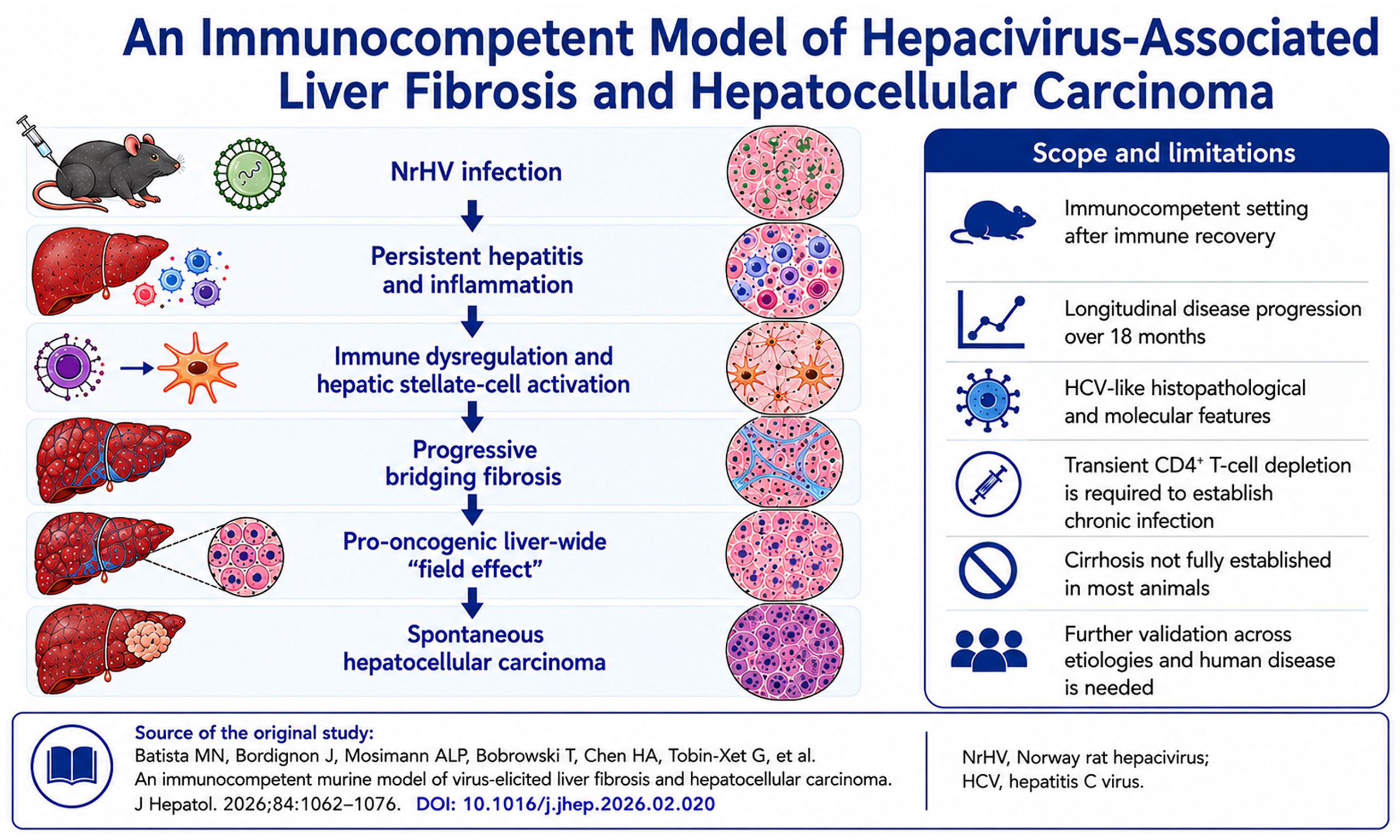
Hepatocellular carcinoma (HCC) is the predominant histological type of primary liver cancer and remains a major global cause of cancer-related mortality[1]. HCC typically arises from a chronically injured liver, but the biological route to cancer differs substantially across etiologies. Chronic hepatitis C virus (HCV) infection, hepatitis B virus (HBV) infection, alcohol-associated liver disease, and metabolic dysfunction-associated steatotic liver disease (MASLD) all converge on inflammation, fibrosis, and malignant transformation, yet they do so through distinct virological, immunological, metabolic, and genomic mechanisms[2,3]. This etiological diversity is particularly important in some regions of Asia, where HBV remains a major contributor to HCC incidence, even as HCV-related HCC has declined following the introduction of highly effective direct-acting antivirals. Therefore, the biological scope of any model based on mouse-adapted Norway rat hepacivirus (NrHV) should be defined according to the specific disease mechanisms it reproduces.
In the Journal of Hepatology, Batista and colleagues report establishing an immunocompetent murine model in which chronic infection with mouse-adapted NrHV induces progressive liver injury, fibrosis, and spontaneous HCC[4]. One potential strength of this system is that it provides a tractable, immunocompetent model of HCV-like hepatocarcinogenesis, rather than HBV or other non-HCV etiologies. This distinction is important when interpreting the model. Previous approaches have relied on viral protein-transgenic mice, toxin-induced fibrosis models, or humanized mice with limited immune competence. By contrast, the NrHV model permits longitudinal analysis of persistent hepacivirus infection, antiviral immunity, fibrogenesis, field effect, and tumor emergence within the same host.
The biological value of the model may be substantial. Chronic NrHV infection persisted for prolonged periods and was associated with hepatitis, portal lymphoid aggregates, steatosis, progressive fibrosis, and eventual HCC. Transcriptomic analyses showed that infected mouse liver resembles human chronic HCV liver disease, with inflammatory, immune, stellate-cell, metabolic, and oncogenic programs. These findings support the model as a meaningful platform for studying how persistent HCV-like infection reshapes the hepatic microenvironment over time.
The model is particularly useful for addressing a long-standing question in HCV-associated carcinogenesis: how a non-integrating RNA virus promotes cancer. Unlike HBV, HCV is an RNA virus with no DNA intermediate and therefore does not promote carcinogenesis through viral integration or persistent episomal viral DNA. HCV-associated HCC is instead thought to arise largely through chronic necroinflammation, oxidative stress, fibrogenesis, altered metabolism, immune dysregulation, and epigenetic or transcriptional remodeling. The NrHV system is well suited to dissecting this sequence because infection, inflammation, fibrosis, and tumor formation can be followed within an immunocompetent organism.
At the same time, the most important limitation is precisely this HCV-centered design. The model should not be presented as a general model of HBV- or other non-HCV hepatitis-associated HCC without qualification. HBV-related HCC, which remains highly relevant in some regions of Asia, has biological features that are not reproduced by an HCV-like hepacivirus model. These include covalently closed circular DNA persistence, viral integration, HBx-associated transcriptional effects, direct viral effects on genome stability, and HCC development that can occur even in the absence of cirrhosis[5]. Thus, the model may help investigate shared processes such as inflammation, fibrosis, immune remodeling, and field effect, but HBV-specific questions require dedicated HBV models.
An additional limitation is that the NrHV model does not consistently develop fully established cirrhosis. Although fibrosis progressed during chronic infection, fully developed cirrhosis was not observed in most animals in the original study[4]. This distinction is clinically relevant because a large proportion of human HCC arises in the setting of cirrhosis or advanced fibrosis. The NrHV system should therefore be interpreted as a model of chronic viral liver injury, progressive fibrosis, and spontaneous HCC, rather than a complete model of cirrhotic hepatocarcinogenesis.
A second boundary concerns the changing epidemiology of HCC. In many developed countries, the relative contribution of HCV to HCC is declining following advances in prevention and highly effective direct-acting antiviral therapy, whereas MASLD- and alcohol-associated liver disease are becoming increasingly important contributors to HCC[2,6,7]. These etiologies involve lipotoxicity, insulin resistance, adipose inflammation, mitochondrial stress, gut-liver signaling, alcohol-derived metabolites, and systemic metabolic dysfunction. Such processes overlap only partially with persistent hepacivirus infection. These differences should be considered when applying findings from the NrHV system to other liver diseases. The model is therefore most appropriate for studying hepacivirus-associated inflammatory fibrogenesis and hepatocarcinogenesis.
Several additional caveats warrant emphasis. NrHV is a hepacivirus surrogate rather than authentic human HCV, and species-specific differences in viral tropism, innate immune sensing, adaptive immunity, hepatocyte turnover, and tumor evolution may influence disease trajectory. The long experimental time course required for cancer development may limit scalability for drug screening. Moreover, murine HCC arising in this setting may not fully capture the molecular and histological heterogeneity of human HCC, particularly in patients with mixed etiologies, advanced metabolic disease, or prior antiviral treatment. These species- and disease-related differences should be considered when interpreting therapeutic or biomarker findings from this model.
Recognizing these limitations helps define the appropriate scope and applications of the model. One area is field effect. In the NrHV model, tumors arose in fibrotic and chronically inflamed livers, and tumor-adjacent tissue showed disease-associated molecular programs consistent with a pro-oncogenic field[4]. This feature may help define early molecular scars that persist before overt cancer appears.
A particularly relevant translational application concerns the immune classification of HCC. Batista and colleagues classified NrHV-associated tumors as inflamed or non-inflamed using an established immunogenomic framework and found that the tumors aligned with the Chiang Interferon molecular subclass[4,8,9]. These findings suggest that the model may be useful for investigating determinants of response and resistance to immune-checkpoint blockade in virus-associated HCC. However, its predictive value for immunotherapy response will require direct experimental validation.
The model may also be useful for antifibrotic research, provided the therapeutic question matches the etiology. Commonly used experimental models of liver fibrosis include hepatotoxin-induced, cholestatic, and diet-induced or metabolic models; however, no single model recapitulates the full etiological and biological complexity of human liver fibrosis[10]. A chronic hepacivirus model offers an opportunity to test interventions in the setting of persistent antiviral immunity and hepacivirus-associated fibrosis. Findings from such studies would require validation in disease-matched models.
In conclusion, Batista and colleagues have established an immunocompetent model that captures important aspects of hepacivirus-associated liver injury, fibrosis, field effect, and spontaneous HCC. Its main utility lies in enabling mechanistic studies of the transition from persistent hepacivirus infection to hepatocarcinogenesis. The NrHV system should be interpreted within this defined biological scope, and its relevance to other HCC etiologies will require validation in complementary disease models and human tissues.
DECLARATIONS
Authors’ contributions
The author contributed solely to the article.
Availability of data and materials
Not applicable.
AI and AI-assisted tools statement
During the preparation of this manuscript, the AI tool ChatGPT (version 5, released 2025-08-07) was used solely for English-language editing. In addition, the AI tool ChatGPT Images (version 2.0, released 2026-04-21) was used solely to generate the Graphical Abstract, which was subsequently reviewed and corrected by the author. These tools did not influence the study design, data collection, analysis, interpretation, or the scientific content of the work. The author takes full responsibility for the accuracy, integrity, and final content of the manuscript.
Financial support and sponsorship
None.
Conflicts of interest
The author declares that there are no conflicts of interest.
Ethical approval and consent to participate
Not applicable.
Consent for publication
Not applicable.
Copyright
© The Author(s) 2026.
REFERENCES
1. Li Q, Ding C, Cao M, et al. Global epidemiology of liver cancer 2022: an emphasis on geographic disparities. Chin Med J. 2024;137:2334-42.
2. Llovet JM, Kelley RK, Villanueva A, et al. Hepatocellular carcinoma. Nat Rev Dis Primers. 2021;7:6.
3. Ringelhan M, McKeating JA, Protzer U. Viral hepatitis and liver cancer. Philos Trans R Soc Lond B Biol Sci. 2017;372:20160274.
4. Batista MN, Bordignon J, Mosimann ALP, et al. An immunocompetent murine model of virus-elicited liver fibrosis and hepatocellular carcinoma. J Hepatol. 2026;84:1062-76.
5. La Frazia S, Magnapera A, Piermatteo L, et al. Direct viral mechanisms underlying the onset of HBV-related hepatocellular carcinoma and implications for therapeutic strategies. Viruses. 2026;18:185.
6. Huang DQ, El-Serag HB, Loomba R. Global epidemiology of NAFLD-related HCC: trends, predictions, risk factors and prevention. Nat Rev Gastroenterol Hepatol. 2021;18:223-38.
7. Singal AG, Kanwal F, Llovet JM. Global trends in hepatocellular carcinoma epidemiology: implications for screening, prevention and therapy. Nat Rev Clin Oncol. 2023;20:864-84.
8. Montironi C, Castet F, Haber PK, et al. Inflamed and non-inflamed classes of HCC: a revised immunogenomic classification. Gut. 2023;72:129-40.
9. Chiang DY, Villanueva A, Hoshida Y, et al. Focal gains of VEGFA and molecular classification of hepatocellular carcinoma. Cancer Res. 2008;68:6779-88.
Cite This Article
 Open Access
How to Cite
Download Citation
Export Citation File:
Type of Import
Tips on Downloading Citation
Citation Manager File Format
Type of Import
Direct Import: When the Direct Import option is selected (the default state), a dialogue box will give you the option to Save or Open the downloaded citation data. Choosing Open will either launch your citation manager or give you a choice of applications with which to use the metadata. The Save option saves the file locally for later use.
Indirect Import: When the Indirect Import option is selected, the metadata is displayed and may be copied and pasted as needed.
About This Article
Copyright

Data & Comments
Data
0










Comments
Comments must be written in English. Spam, offensive content, impersonation, and private information will not be permitted. If any comment is reported and identified as inappropriate content by OAE staff, the comment will be removed without notice. If you have any queries or need any help, please contact us at [email protected].