



Is the second recurrence peak in HBV-related HCC fading in the antiviral era?
 0
0 
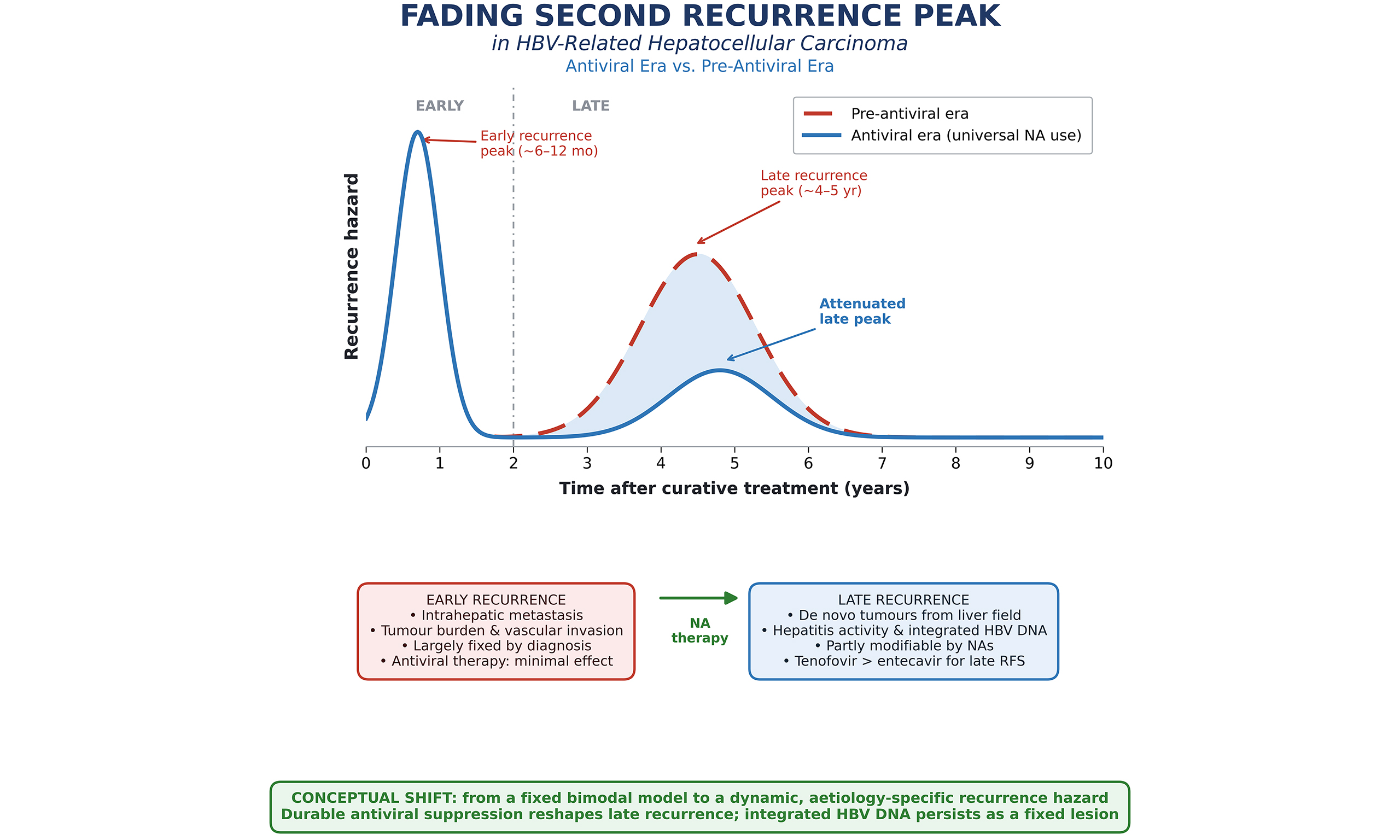
Chan et al. revisit a long-standing model in hepatocellular carcinoma (HCC), the bimodal recurrence pattern after curative treatment[1]. In 765 patients with hepatitis B virus (HBV)-related HCC treated with resection or ablation, antiviral therapy was associated with longer recurrence-free survival (RFS), and the late recurrence peak seen in earlier series was attenuated in the modern era of near-universal nucleos(t)ide analog (NA) use[1]. The value of the study is not that it overturns the early-versus-late recurrence framework, but that it shows the later component of recurrence in HBV-related HCC is less fixed than older literature implied[1]. A randomized controlled trial of 200 patients with low preoperative HBV DNA levels makes the same point from a different angle: antiviral therapy improved RFS compared with no treatment, and was an independent protective factor specifically for late recurrence [hazard ratio (HR) 0.316, 95% confidence interval (CI): 0.157-0.637], but not for early recurrence[2].
This distinction matters because HCC treatment and HBV treatment address different recurrence problems [Table 1]. Curative resection or ablation determines whether a patient clears the first recurrence-prone period, which is driven mainly by tumor burden, multiplicity, vascular invasion, stage, and treatment modality[1,3-5]. This clinical distinction has a genomic correlate. Whole-genome sequencing of paired tumors shows that early, local recurrence is usually clonally related to the index tumor (intrahepatic metastasis), whereas later or more distant recurrence is more often genetically independent (de novo), a split that earlier loss-of-heterozygosity and microsatellite clonality studies also identified[6,7]. The antiviral effect becomes clearer only after that early phase[1]. In the time-dependent multivariable model, antiviral therapy showed only a non-significant trend toward improved RFS (adjusted HR 0.86, 95%CI: 0.72-1.03)[1]. The stronger signal appeared in the landmark analyses, which include only patients who remained recurrence-free at the landmark time and then assess subsequent recurrence, thereby focusing on the later phase rather than isolating it. Baseline antiviral therapy independently improved RFS at both the 6-month (adjusted HR 0.75, 95%CI: 0.59-0.96) and 12-month (adjusted HR 0.62, 95%CI: 0.47-0.82) landmarks, and the effect persisted in patients with cirrhosis (adjusted HR 0.74 and 0.70, respectively)[1]. The data are therefore most consistent with a selective effect of antiviral therapy on later recurrence[1].
Early vs. late recurrence in HBV-related HCC
| Feature | Early recurrence | Late recurrence |
| Typical timing | Within ~2 years (peak 6-12 months)[1,3,4] | After ~2 years (historical second peak at 4-5 years)[1,3] |
| Predominant mechanism | Intrahepatic metastasis from the index tumor[3,6,7] | De novo tumors from the inflamed, injured liver field[3,6,7] |
| Key associated factors | Vascular invasion, AFP, tumor burden, non-anatomical resection[1,3-5] | Hepatitis activity, persistent cirrhosis, tumor multiplicity, gross tumor type, integrated HBV DNA[1,3,4,8] |
| Principal prevention strategy | Curative resection or ablation; adjuvant systemic therapy[16,17] | Long-term antiviral suppression (deeper suppression, greater late-recurrence reduction)[1,2,9-11] |
| Effect of antiviral therapy | Minimal[1,2] | Reduces but does not abolish[1,2,10,11] |
| Modifiability | Largely fixed at diagnosis (tumor biology, stage); addressable mainly through treatment-modality choice[3,5] | Partly modifiable by sustained antiviral therapy and control of background liver disease; the integrated HBV DNA lesion itself is not reversible[1,2,8] |
| Level of evidence | Large multi-institutional cohorts; no RCT[3-5] | RCTs and a meta-analysis for the antiviral effect[2,11,13]; associative mechanistic studies for integrated HBV DNA[8] |
The mechanistic case is strongest when tied to the study’s own virological data[1]. Among the 420 patients who started antiviral therapy at baseline, 154 of the 177 with raised alanine aminotransferase (ALT) (87%) achieved ALT normalization, and 104 of the 148 with detectable HBV DNA (70%) achieved undetectable levels during follow-up[1]. Recurrence nevertheless continued to accumulate[1]. Biochemical and virological control therefore does not eliminate recurrence risk, consistent with HBV biology. NAs suppress viral replication but neither eradicate intrahepatic covalently closed circular DNA (cccDNA) nor remove HBV sequences already integrated into the host genome[8]. Integrated HBV DNA persists as a fixed genomic lesion under suppression, so the carcinogenic substrate may not be fully reversed even when serum HBV DNA becomes undetectable[8]. What antiviral therapy can modify is the inflammatory activity of the field. In Imamura’s original cohort, late recurrence tracked the grade of hepatitis activity in the background rather than viral status itself[3]. This separation of a suppressible inflammatory component from a fixed genomic one may help explain the clinical pattern. More potent antiviral agents reduce recurrence further, with high-potency analogs prolonging RFS compared with low-potency agents[9]. Tenofovir is associated with lower recurrence than entecavir after resection[10]. Why tenofovir might reduce recurrence more than entecavir is not settled, but the pattern of the difference is informative: in a meta-analysis of nine post-curative cohorts (5,298 patients), tenofovir was associated with lower recurrence than entecavir (adjusted HR 0.73, 95%CI: 0.65-0.81), concentrated in late recurrence (adjusted HR 0.58, 95%CI: 0.45-0.76) with no significant difference in early recurrence (adjusted HR 0.88, 95%CI: 0.76-1.02)[11]. This distribution fits a field-directed effect on the injured liver rather than a direct action on residual tumor. Proposed mechanisms include induction of interferon-λ3 and altered innate immune signaling by tenofovir as an acyclic nucleoside phosphonate, together with greater improvement in fibrosis markers, both acting on the background liver rather than the index tumor[12]. These mechanisms remain hypotheses, and much of the comparative evidence is observational and inconsistent across cohorts. A single-center randomized trial after curative resection now supports the clinical pattern, with tenofovir improving RFS over entecavir (HR 0.50) and the benefit confined to late recurrence (HR 0.43) rather than early recurrence[13]. That trial found no association between interferon-λ3 levels and recurrence and attributed the difference to better viral suppression and anti-inflammatory effects rather than a proven antitumor action of tenofovir. The tenofovir-entecavir difference is therefore best read as consistent with a suppressible late-recurrence field rather than as a direct antitumor advantage, and larger multicenter trials are still needed. Suppression is also incomplete in ways that bear on residual risk. Nucleos(t)ide analogs control replication but do not eradicate it, and residual low-level replication may favor selection of carcinogenic or drug-resistant HBV variants. Tenofovir has a higher genetic barrier to resistance than entecavir, which selects resistant mutants more readily, particularly in lamivudine-experienced patients, although this difference is small in nucleos(t)ide-naïve cohorts[14]. Because antiviral therapy also leaves integrated HBV DNA[8] and accumulated host genomic changes in place, a low residual recurrence risk persists regardless of viral control.
The secular trend analysis is visually persuasive, but it is also confounded. In the 2001-2005 cohort, recurrence hazard fell after year 1 and then rose again with a second peak at around 7 years, whereas in the 2011-2015 cohort the hazard continued to decline without a comparable late peak[1]. This later timing differs from the classical Imamura pattern, in which the second peak appeared at 4 to 5 years[3]. The discrepancy suggests that the second peak is less likely a fixed biological clock than a composite signal, one that may be shaped by tumor factors such as multiplicity and tumor type, the grade of background hepatitis activity, and possibly integrated HBV DNA that persists under viral suppression[8]. The 2011-2015 cohort differed from the 2001-2005 cohort in several ways reported by the authors: patients were older, more often diabetic, had smaller tumors, slightly higher ALT, and were less likely to have alpha-fetoprotein (AFP) of at least 400 micrograms/L[1]. Smaller tumors and lower AFP are compatible with stage migration due to earlier detection. At the patient level, many in the later cohort were already established on antiviral therapy before HCC developed, and longer pre-diagnosis suppression fits the smaller tumors and lower AFP recorded[1]. The same cohort was older and more often diabetic, and diabetes is an independent risk factor for late recurrence after curative resection of HBV-related HCC[13], so this demographic shift would tend to raise rather than lower late-recurrence risk. That the second peak still attenuated, despite a less favorable patient profile, argues against cohort demographics as the explanation and is more consistent with viral suppression together with earlier detection. At the system level, several further factors could contribute independently of tumor biology. Surveillance protocols and adherence became more standardized over the two decades separating the cohorts, and improvements in imaging sensitivity detect smaller, earlier-stage lesions, both producing stage migration rather than a true change in late-recurrence risk. Advances in ablative and locoregional treatment over the same period may also have improved local control after the index treatment. The later cohort’s older, more diabetic profile also carries higher competing mortality, which in a hazard comparison across eras can itself flatten the apparent late peak if fewer patients survive to the years in which it would appear. The attenuation of the second peak therefore likely reflects antiviral therapy together with cohort and era effects in detection and treatment, rather than antiviral therapy alone.
On the other hand, the original Imamura series was hepatitis C virus (HCV)-predominant[3], which limited its implications for HBV-driven late recurrence. By focusing on an HBV-related cohort in the antiviral era, the present study addresses that gap and updates the recurrence model in a population where long-term control of the underlying liver disease is clinically actionable[1]. These observations point to a broader conceptual shift. The classical bimodal model was built on fixed early and late peaks derived before routine viral suppression, and it treats recurrence timing largely as a property of the tumor and the calendar. The present data fit a dynamic model better, one in which recurrence hazard is continuously reshaped by inputs that change during follow-up: antiviral response and biochemical control, the activity of the background liver, accumulating tumor and host genomic change, and the intensity of surveillance. On this view the attenuated second peak is not a smaller fixed peak but a hazard curve bent by exposures that evolve over time, and it is better captured by time-updated or landmark models than by a fixed two-peak taxonomy[15].
Current European Association for the Study of the Liver (EASL) and American Association for the Study of Liver Diseases (AASLD) guidance supports close surveillance after curative treatment of HCC and continued long-term follow-up[16,17]. Neither is built around a rigid second-peak concept. The Hong Kong study supports that pragmatic approach while arguing against a one-size-fits-all view of recurrence risk in HBV-related HCC[1]. It does not justify routine de-escalation of follow-up for all treated HCC patients, but it does suggest that durable antiviral therapy belongs in any individualized follow-up strategy, in line with evidence that risk-based post-resection surveillance can detect recurrence earlier and reduce the number of visits without compromising survival[18].
A broader question is whether this pattern is specific to HBV or reflects a general principle[1]. HCV is the closest parallel, because direct-acting antivirals remove an active viral driver, and late recurrence can fall after sustained virological response. The underlying field injury, such as fibrosis and epigenetic change, could persist and may take time to recover in some patients, so risk does not fully reset, and recurrence patterns remain confounded by shifting baseline risk and treatment selection[19]. Metabolic dysfunction-associated steatotic liver disease (MASLD) is different. The driver is metabolic and continuous rather than a single suppressible agent, so there is no equivalent switch-off point. The carcinogenic substrate spans steatosis, chronic inflammation, oxidative stress, and fibrosis, so late recurrence may be harder to modify than in viral liver disease[20]. These differences argue for recurrence models that are explicitly etiology-specific rather than assuming one curve fits all chronic liver diseases[1,19,20].
This study does not show that the second peak of late recurrence has disappeared, nor does it prove that antiviral therapy alone explains its attenuation[1]. It does show that in HBV-related HCC, late recurrence is no longer well captured by a fixed historical model derived before effective viral suppression was routine[1,3,4]. That is the durable contribution of the paper. The late component of HBV-related HCC recurrence appears at least partly modifiable, and antiviral exposure now belongs in prognostic thinking and follow-up planning[1]. The priority for future work is to define why late recurrence falls under antiviral therapy: how much reflects reduced inflammatory field activity, how much reflects slower accumulation of integrated HBV DNA and clonal expansion, and how much reflects era effects in detection and staging. Resolving this matters beyond HBV. If late recurrence is driven by a suppressible field, the same principle may extend to HCV-related HCC after sustained virological response and to MASLD-related HCC when metabolic drivers are controlled, and the present study offers a template for testing it[1].
DECLARATIONS
Authors’ contributions
Drafted the manuscript: Yew KC
Critically revised the manuscript for important intellectual content: Sung JJY
Both authors approved the final version.
Availability of data and materials
Not applicable.
AI and AI-assisted tools statement
During the preparation of this manuscript, the AI tool Claude (version Claude Opus 4.8, released 2026-05-28) was used solely for drafting and language editing and to help identify candidate references, all of which the authors verified against the primary sources. The graphical abstract was initially created using Kimi Chat (developed by Moonshot AI, China) and was subsequently refined and re-rendered using Claude (Anthropic, USA; model Claude Opus 4.8). Both are generative AI tools; the figure was produced entirely from prompts and specifications provided by the authors, based on the content of the manuscript. The authors directed the design, specified the layout and content, and verified the scientific accuracy of the figure. The AI tools did not influence the study design, data collection, analysis, interpretation, or the scientific content of the work. All authors take full responsibility for the accuracy, integrity, and final content of the manuscript.
Financial support and sponsorship
None.
Conflicts of interest
Yew KC serves as an investigator for 89bio, AstraZeneca, and Gilead Sciences. Sung JJY declared that there are no conflicts of interest.
Ethical approval and consent to participate
Not applicable.
Consent for publication
Not applicable.
Copyright
© The Author(s) 2026.
REFERENCES
1. Chan LL, Chan AWH, Yip TCF, et al. Attenuation of the second peak of bimodal recurrence of HBV-related HCC after curative treatment in the antiviral era. J Hepatol. 2025;83:1328-37.
2. Huang G, Li PP, Lau WY, et al. Antiviral therapy reduces hepatocellular carcinoma recurrence in patients with low HBV-DNA levels: a randomized controlled trial. Ann Surg. 2018;268:943-54.
3. Imamura H, Matsuyama Y, Tanaka E, et al. Risk factors contributing to early and late phase intrahepatic recurrence of hepatocellular carcinoma after hepatectomy. J Hepatol. 2003;38:200-7.
4. Portolani N, Coniglio A, Ghidoni S, et al. Early and late recurrence after liver resection for hepatocellular carcinoma: prognostic and therapeutic implications. Ann Surg. 2006;243:229-35.
5. Xing H, Zhang WG, Cescon M, et al. Defining and predicting early recurrence after liver resection of hepatocellular carcinoma: a multi-institutional study. HPB. 2020;22:677-89.
6. Zhou SL, Zhou ZJ, Song CL, et al. Whole-genome sequencing reveals the evolutionary trajectory of HBV-related hepatocellular carcinoma early recurrence. Signal Transduct Target Ther. 2022;7:24.
7. Li Q, Wang J, Juzi JT, et al. Clonality analysis for multicentric origin and intrahepatic metastasis in recurrent and primary hepatocellular carcinoma. J Gastrointest Surg. 2008;12:1540-7.
8. Zhang M, Chen H, Liu H, Tang H. The impact of integrated hepatitis B virus DNA on oncogenesis and antiviral therapy. Biomark Res. 2024;12:84.
9. Cho H, Ahn H, Lee DH, et al. Entecavir and tenofovir reduce hepatitis B virus-related hepatocellular carcinoma recurrence more effectively than other antivirals. J Viral Hepat. 2018;25:707-17.
10. Choi J, Jo C, Lim YS. Tenofovir versus entecavir on recurrence of hepatitis B virus-related hepatocellular carcinoma after surgical resection. Hepatology. 2021;73:661-73.
11. Giri S, Agrawal D, Afzalpurkar S, Gopan A, Angadi S, Sundaram S. Tenofovir versus entecavir for tertiary prevention of hepatocellular carcinoma in chronic hepatitis B infection after curative therapy: a systematic review and meta-analysis. J Viral Hepat. 2023;30:108-15.
12. Murata K, Mizokami M. Possible biological mechanisms of entecavir versus tenofovir disoproxil fumarate on reducing the risk of hepatocellular carcinoma. J Gastroenterol Hepatol. 2023;38:683-91.
13. Linye H, Zijing X, Xiaoyun Z, Zhihui L, Tianfu W, Chuan L. Tenofovir versus entecavir on the prognosis of hepatitis B-related hepatocellular carcinoma after surgical resection: a randomised controlled trial. Int J Surg. 2023;109:3032-41.
14. Lumley SF, Delphin M, Mokaya JF, et al. A systematic review and meta-analysis of the risk of hepatitis B virus (HBV) resistance in people treated with entecavir or tenofovir. J Clin Virol. 2024;174:105711.
15. Akabane M, Kawashima J, Altaf A, et al. Enhancing recurrence-free survival prediction in hepatocellular carcinoma: a time-updated model incorporating tumor burden and AFP dynamics. Ann Surg Oncol. 2025;32:5648-56.
16. European Association for the Study of the Liver. EASL Clinical Practice Guidelines: management of hepatocellular carcinoma. J Hepatol. 2018;69:182-236.
17. Singal AG, Llovet JM, Yarchoan M, et al. AASLD Practice Guidance on prevention, diagnosis, and treatment of hepatocellular carcinoma. Hepatology. 2023;78:1922-65.
18. Fu Y, Li X, Yang Z, et al. A risk-based postresection follow-up strategy for hepatocellular carcinoma patients. Cancer. 2023;129:569-79.
19. Rich NE, Singal AG. Direct-acting antiviral therapy and hepatocellular carcinoma. Clin Liver Dis. 2021;17:414-7.
Cite This Article
 Open Access
How to Cite
Download Citation
Export Citation File:
Type of Import
Tips on Downloading Citation
Citation Manager File Format
Type of Import
Direct Import: When the Direct Import option is selected (the default state), a dialogue box will give you the option to Save or Open the downloaded citation data. Choosing Open will either launch your citation manager or give you a choice of applications with which to use the metadata. The Save option saves the file locally for later use.
Indirect Import: When the Indirect Import option is selected, the metadata is displayed and may be copied and pasted as needed.
About This Article
Copyright

Data & Comments
Data
0










Comments
Comments must be written in English. Spam, offensive content, impersonation, and private information will not be permitted. If any comment is reported and identified as inappropriate content by OAE staff, the comment will be removed without notice. If you have any queries or need any help, please contact us at [email protected].