


Semaglutide and resmetirom for MASH: the AASLD Practice Guidance tells us when, not which
 0
0 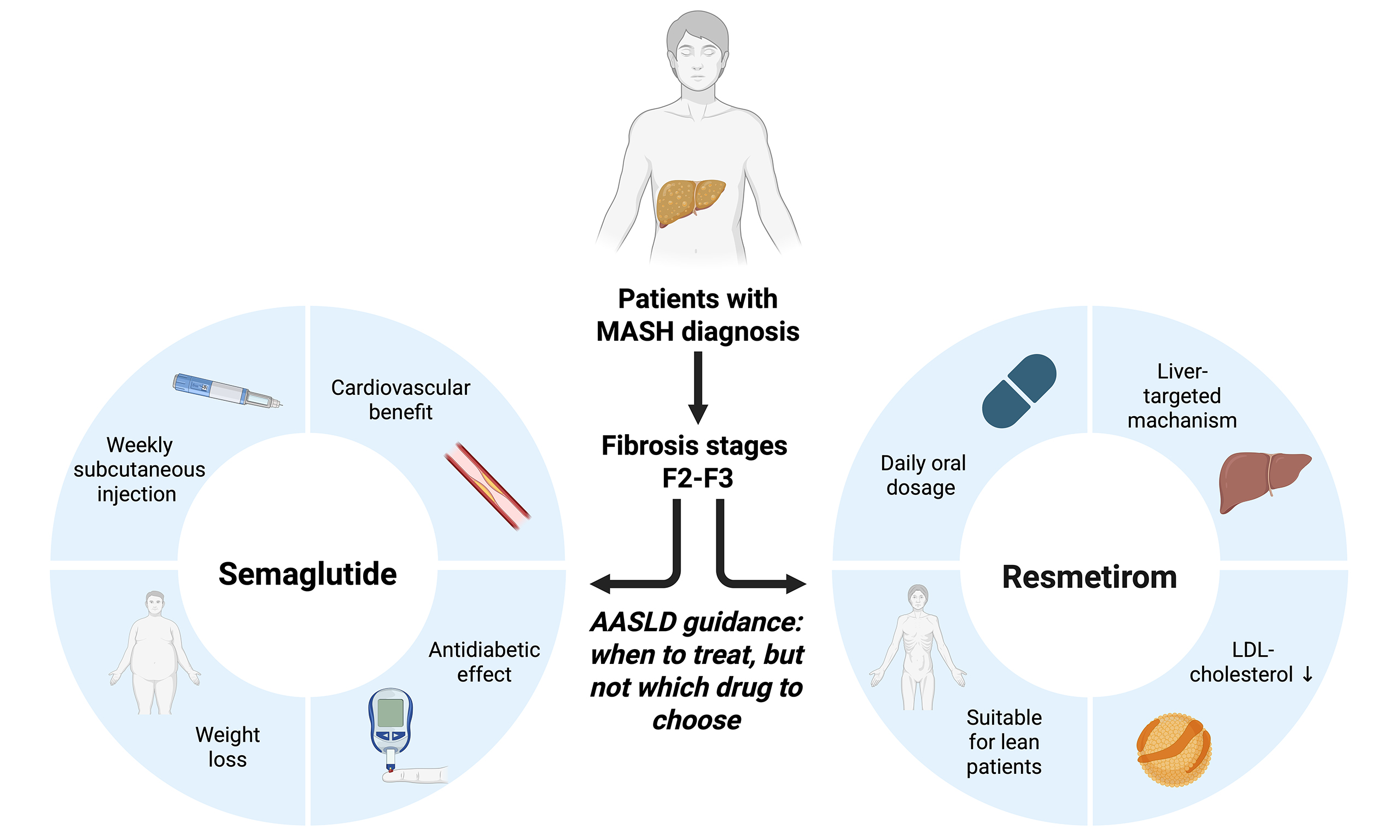
INTRODUCTION: A THERAPEUTIC BREAKTHROUGH
The significance of the recent American Association for the Study of Liver Diseases (AASLD) guidance update[1] on semaglutide therapy for metabolic dysfunction-associated steatohepatitis (MASH) extends well beyond its practical recommendations since treatment options for MASH remain sparse and are highly anticipated. For the second time in less than two years, clinicians treating MASH have gained an approved pharmacologic option supported by a phase 3 clinical trial with rigorous histological endpoints. In the ESSENCE trial, 72 weeks of subcutaneous semaglutide 2.4 mg weekly achieved histological MASH resolution without worsening of fibrosis in 62.9% of treated patients vs. 34.3% on placebo, and ≥ 1-stage fibrosis improvement without worsening of steatohepatitis in 36.8% vs. 22.4%[1,2].
In brief, the AASLD document operationalizes the accelerated United States Food and Drug Administration (FDA) approval of semaglutide (2.4 mg subcutaneously once weekly) for adults with MASH with moderate-to-advanced fibrosis (stages F2-F3) confirmed by biopsy or non-invasive test (NIT)[1]. The recommended candidate identification rests on non-invasive rather than histological criteria: Vibration-Controlled Transient Elastography (VCTE) liver stiffness of 8-15 kPa, magnetic resonance elastography (MRE) of 3.1-4.4 kPa, or an ELF (enhanced liver fibrosis) score of 9.2-10.5, with an additional “may be used” range (VCTE 15-20 kPa, MRE 4.4-5.0 kPa, ELF 10.5-11.3). Semaglutide is explicitly not recommended for MASH-related cirrhosis, active additional concomitant liver disease, pregnancy, or a personal or family history of medullary thyroid carcinoma or multiple endocrine neoplasia type 2 [Figure 1]. Lifestyle modification remains the foundation of care, and combination with resmetirom has not been formally evaluated; however, stable dosing with semaglutide has been accepted as a co-medication in the resmetirom registrational trial[3]. Monitoring of semaglutide treatment is pragmatic: hepatic panels when clinically indicated rather than scheduled, together with surveillance for gastrointestinal intolerance, volume-related acute kidney injury, symptomatic gallbladder disease, pancreatitis, retinopathy progression, and lean-mass loss. According to AASLD guidance, treatment response at 72 weeks should be assessed by the same NITs used for selection, with thresholds of ≥ 30% decrease in VCTE liver stiffness, ≥ 20% in MRE liver stiffness, ≥ 17 U/L or ≥ 20% decrease in alanine aminotransferase (ALT), and ≥ 0.5 reduction in ELF suggesting beneficial response; worsening NITs signal non-response and should prompt a termination of semaglutide therapy in this indication.
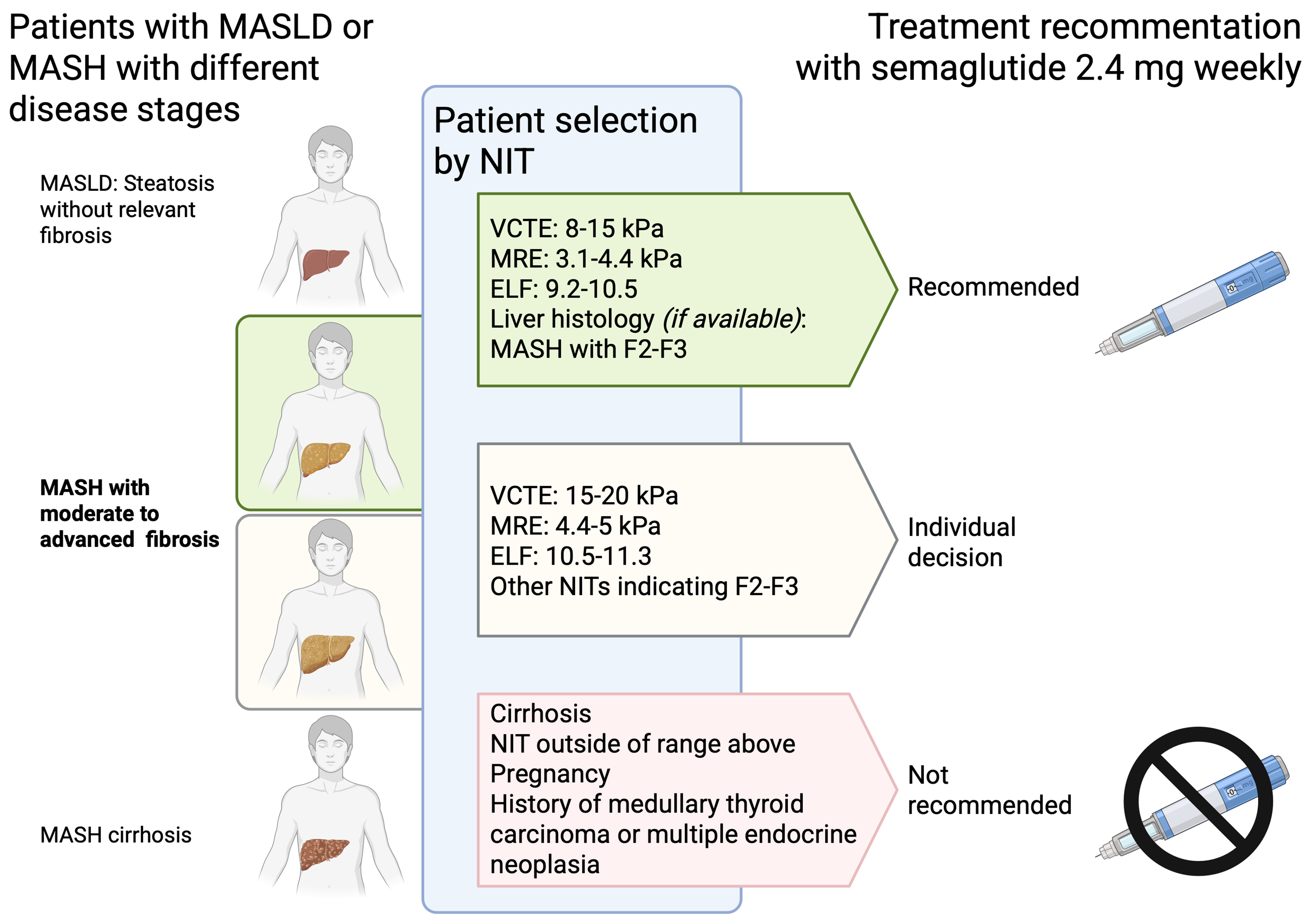
Figure 1. AASLD practice guidance: Patient selection criteria for MASH-targeted treatment with semaglutide. Created in BioRender. com. AASLD: American Association for the Study of Liver Diseases; ELF: enhanced liver fibrosis; F2-F3: fibrosis stage 2-3; MASH: metabolic dysfunction-associated steatohepatitis; MASLD: metabolic dysfunction-associated steatotic liver disease; MRE: magnetic resonance elastography; NIT: non-invasive test; VCTE: vibration-controlled transient elastography; mg: milligram; kPa: kilopascal.
Since metabolic dysfunction-associated steatotic liver disease (MASLD) is a metabolic disorder with cardiometabolic comorbidities, it is noteworthy that the benefits of semaglutide extend beyond the liver. Besides the antidiabetic effect of glucagon-like peptide-1 receptor agonists (GLP-1-RAs), clinical trials have demonstrated a cardiovascular benefit in both non-diabetic adults with overweight or obesity and patients with type 2 diabetes (T2D)[4]. In patients with T2D and chronic kidney disease, renal protection by semaglutide and other GLP-1-RAs has been established[1,5]. Given that cardiovascular disease is the leading cause of mortality among patients with MASLD, the polyvalent benefit profile of semaglutide is suited to the cardiometabolic phenotype that defines this population[6]. In fact, a sub-analysis of the prospective SELECT outcome study, designed to assess cardiovascular outcomes in non-diabetic obese individuals with increased risk factors, found that semaglutide 2.4 mg significantly reduced major adverse cardiovascular events (MACE) by 21% to 34% in patients with suspected MASLD across all FIB-4 risk groups[7]. The AASLD writing group underlines these non-hepatic benefits, reinforcing the conception of MASLD as a systemically relevant metabolic disease[1,8].
The safety profile has been shown to be favorable, but gastrointestinal side effects occur regularly with semaglutide and may lead to treatment discontinuation. In the guideline update, an accompanying monitoring table provides useful guardrails on adverse events ranging from gastrointestinal intolerance and volume-related acute kidney injury to ophthalmologic complications and lean-mass loss[1,5].
This perspective article represents the expert opinion of the authors and is not the result of a meta-analysis or systematic review; it is oriented toward the latest evidence and clinical expertise, but not based on a full literature review.
CENTRAL OPEN QUESTION: COMPARATIVE POSITIONING OF SEMAGLUTIDE AND RESMETIROM
With two FDA-approved agents now available for MASH with F2-F3 fibrosis, clinical practitioners will no longer only be confronted with the question of when to initiate pharmacotherapy but which one to choose. Here, the AASLD practice guideline addition is conservatively silent. The writing group notes that resmetirom and semaglutide have not been studied head-to-head, and that their combined use has not been formally evaluated[1].
However, a cautious, evidence-informed framework for differentiated selection may be offered even in the absence of randomized comparative data. Several reasonable considerations may guide the selection of first-line therapy. Patients with obesity, T2D, established cardiovascular disease, or chronic kidney disease may derive demonstrable extra-hepatic benefits from semaglutide that have not been shown for resmetirom[5,8]. Conversely, resmetirom may be a more suitable first-line choice for lean patients with MASH for whom weight loss may not be advisable, patients already treated with (or intolerant to) GLP-1 receptor agonists, patients with elevated LDL-cholesterol, individuals with elevated lipoprotein(a), symptomatic gallbladder disease or pancreatitis, and those with contraindications for semaglutide such as a personal or family history of medullary thyroid carcinoma or multiple endocrine neoplasia type 2[1,3,5,9]. Potential interactions with other necessary prescription drugs should be considered. Patient preference for either a weekly subcutaneous injection or a once-daily oral tablet is a further legitimate consideration that influences adherence. Notably, the European scientific associations European Association for the Study of the Liver (EASL), European Association for the Study of Diabetes (EASD), and European Association for the Study of Obesity (EASO) are currently preparing a joint guidance document, ‘EASL-EASD-EASO Guidance for the Use of Resmetirom and Semaglutide as MASH-Targeted Therapy’, which will address the comparative positioning of these two therapeutic options[10].
In addition to a provisional positioning framework for both drugs to guide first-line pharmacological MASH treatment based on individual risk profiles and preferences, the case for combination therapy is biologically rational and clinically compelling due to the distinct modes of action for the two agents. A pragmatic trial comparing both monotherapies and combination regimens would simultaneously address several of the most pressing open questions (but is not likely to be available soon). In the absence of head-to-head trials, network meta-analyses provide the best available indirect approximation of comparative efficacy. Analyses integrating diet, exercise and pharmacological interventions show that different strategies optimize different domains of MASLD, with GLP-1 receptor agonists ranking highest for reduction of hepatic fat content[11]; which intervention appears “best” therefore depends on the treatment goal chosen, supporting the guidance position that pharmacotherapy complements rather than replaces lifestyle modification. For reduction of fibrosis by ≥ 1 stage, resmetirom has been ranked with a higher probability than semaglutide (SUCRA 59.2% vs. 44.5%)[12]. Indirect comparisons are valuable but constrained by multiple factors including heterogeneous placebo response rates, the sampling variability of biopsy-based endpoints and differing baseline populations, and ranking probabilities do not establish superiority. Network meta-analyses thus may support a differentiated treatment selection but do not replace comparative data.
IMPLICATIONS FOR HEPATOCELLULAR CARCINOMA
Since MASLD/MASH has become one of the most important risk factors for hepatocellular carcinoma (HCC)[6], whether MASH-targeted pharmacotherapy also translates into a lower incidence of HCC is among the most relevant questions the ongoing outcome phases may help to address. At present, it remains unanswered for both resmetirom and semaglutide: both registrational trials were designed around surrogate histological endpoints at 52 or 72 weeks and were neither intended nor powered to assess a risk reduction for the occurrence of HCC at this point[2,3]. A preventive effect is biologically plausible. Fibrosis stage is the strongest predictor of liver-related outcomes including HCC[13], and both drugs improve fibrosis[2,3]. Consistent with this, a large observational analysis in patients with T2D has reported a lower incidence of HCC under GLP-1 receptor agonists[14]; comparable clinical data are not yet available for resmetirom. Both programs continue into long-term outcome phases, so that more informative data are expected over the coming years[2,3].
COST AND EQUITY
Guidance papers appropriately do not set reimbursement policy, but the economic aspect cannot be divorced from the feasibility of implementation. At list prices, annual semaglutide 2.4 mg therapy exceeds USD 15,000 per patient in the United States, with only modestly lower net prices in most European markets[15]. Given that the global prevalence of MASLD approaches 30% of the adult population, and that a clinically meaningful minority has MASH with F2-F3 fibrosis[16], even modest uptake of the guidance implies enormous aggregate expenditure. In resource-limited health systems, where MASLD prevalence is rising, the recommendations may become aspirational rather than implementable[16]. This concern may not be confined to low- and middle-income countries: even within well-resourced systems, unequal distribution of insurance among the population, and specialist gatekeeping will shape real-world access. There is a legitimate worry that semaglutide may become a therapy predominantly for insured, wealthy and health-literate patients (the same may apply to resmetirom, which has an even higher list price). This does not necessarily reflect the at-need populations in whom MASH morbidity is most concentrated.
Several mitigation strategies merit explicit discussion. Tiered implementation guidance could prioritize patients with the greatest expected polyvalent benefit (for example, MASH with concurrent T2D and established cardiovascular disease) while deferring treatment or emphasizing alternative strategies in others. Structured support for generic and biosimilar pathways, as patent protection for early GLP-1 receptor agonists begins to expire, will be decisive for global access. Continued emphasis on lifestyle modification and structured weight-loss programs remains the most cost-effective first step[1,9].
Adding to this, it is noteworthy that the ESSENCE trial is limited in the ethnic diversity with a small number of Black patients[2]. Diversity aspects should be included in any future clinical trials.
THE ROAD AHEAD
Several clinically consequential questions remain:
First, it remains unclear how clinicians should proceed when therapy with semaglutide is insufficient. In ESSENCE, roughly 37% of treated patients did not achieve MASH resolution and 63% did not show fibrosis improvement at 72 weeks[1,2]. The guidance offers sensible criteria for suspecting non-response but is ambiguous on the next therapeutic step (e.g., changing the treatment regimen to resmetirom or add-on therapy).
Second, emerging incretin-based agents are expected to reshape the therapeutic options within the next few years. Tirzepatide, a dual GLP-1/glucose-dependent insulinotropic peptide (GIP) receptor agonist, has produced 15%-21% body-weight reduction exceeding that of semaglutide[5,8]. The SYNERGY-NASH phase 2 trial reported MASH resolution rates of 44%-62% with tirzepatide doses of 5-15 mg/week vs. 10% with placebo at 52 weeks[17]. Retatrutide, a triple GLP-1/GIP/glucagon agonist, has delivered approximately 25% weight loss in phase 2 studies and shows promising signals for MASH resolution[8,18]. Dual GLP-1/glucagon receptor agonists such as survodutide[19,20] or pemvidutide[21] may confer additional benefits on hepatic lipid handling through direct glucagon co-activation[8]. Future guidance will need to accommodate a rapidly expanding therapeutic toolkit, very likely with increasingly complex selection and sequencing algorithms.
Third, long-term liver-related outcomes remain unknown. Full ESSENCE results are anticipated in 2028; whether 72-week histological and non-invasive biomarker improvements translate into durable reductions in hepatic decompensation, HCC, and mortality is the central question on which full regulatory approval depends[1,2]. Real-world data will add another layer of evidence. The post-discontinuation trajectory is similarly critical: weight regain after cessation of semaglutide is well documented[5], but whether hepatic fibrosis improvements persist or reverse with weight regain will determine whether semaglutide must be conceived as a long-term, potentially lifelong therapy for MASH, with all its attendant cost and tolerability implications.
Fourth, attention to body composition. Sarcopenia is independently associated with adverse outcomes in chronic liver disease, and the approximately 13% loss of lean mass observed with semaglutide is clinically meaningful, particularly in older adults and patients with baseline sarcopenia[1,5,22]. Adequate protein intake and exercise should thus remain a cornerstone of routine care, and lean patients with MASLD deserve special attention when treated with GLP-1-RAs.
Fifth, individualized semaglutide dosing has not been tested for MASLD. In ESSENCE and thus also in the guidance, the same fixed dosage of semaglutide is used across all participants[1,2]. Whether a more individualized therapy recognizing aspects like body weight, sex or age may confer additional benefit remains unclear and should be followed up on in future research. A prespecified analysis from the SELECT trial suggested a meaningful contribution of weight-loss-independent effects of semaglutide on cardiovascular outcomes[23]. In the liver, hepatoprotective effects of semaglutide may also occur independently of weight loss[24]. Hence, it remains to be determined whether the fixed 2.4 mg weekly dose of semaglutide will be needed to confer liver-related benefits for individuals with MASH.
CONCLUSION
The November 2025 AASLD guidance update on the use of semaglutide for MASH is a timely and pragmatic response to a genuine therapeutic breakthrough. Semaglutide’s entry into the MASH therapeutic toolkit will benefit a substantial number of patients, particularly those with the overlapping cardiometabolic phenotype that defines the disease. The guidance succeeds in translating the ESSENCE results and the FDA label into implementable clinical recommendations while declining to take a position on the selection of semaglutide in comparison to resmetirom. In order to advance the field, future clinical research efforts may address some open issues: comparative trials between semaglutide and resmetirom, with differentiated patient selection as an explicit primary objective; economic and equity-focused implementation frameworks that ensure the benefits of these therapies extend beyond insured populations in wealthy health systems; and systematic evaluation of sequencing, combination, and emerging incretin-based therapies including tirzepatide, survodutide and retatrutide. The accelerated approval of semaglutide for MASH marks a pivotal advance in the field. The coming decade will test how well the field capitalizes on this moment.
DECLARATIONS
Acknowledgments
The Graphical Abstract was created with BioRender.com.
Authors’ contributions
Literature research, writing, figures, original draft: Weglage J
Conceptualization, writing and editing, supervision: Tacke F
Availability of data and materials
Not applicable.
AI and AI-assisted tools statement
During the preparation of this manuscript, the AI tool Claude (Claude Sonnet 4.6, released 2026-02-17) was used solely for language editing. The tool did not influence the study design, data collection, analysis, interpretation, or the scientific content of the work. All authors take full responsibility for the accuracy, integrity, and final content of the manuscript.
Financial support and sponsorship
This work is supported by the German Research Foundation (DFG) (TRR 412, Project-ID 535081457; SFB 1382, Project-ID 403224013) and under Germany’s Excellence Strategy (EXC 3118/1, project number 533770413).
Conflicts of interest
Tacke F’s lab has received research grants (funding to the institution) from AstraZeneca, MSD, Gilead, Agomab. Tacke F has received honoraria for consulting or lectures from Gilead, Abbvie, Falk, AstraZeneca, Boehringer, Madrigal, MSD, GSK, Ipsen, Mirum, Novartis, Novo Nordisk, Sanofi. Weglage J has received a travel grant for participation at a conference by Orphala GmbH.
Ethical approval and consent to participate
Not applicable.
Consent for publication
Not applicable.
Copyright
© The Author(s) 2026.
REFERENCES
1. Bansal MB, Patton H, Morgan TR, Carr RM, Dranoff JA, Allen AM. Semaglutide therapy for metabolic dysfunction-associated steatohepatitis: November 2025 updates to AASLD Practice Guidance. Hepatology. 2026;83:1326-40.
2. Sanyal AJ, Newsome PN, Kliers I, et al. ; ESSENCE Study Group. Phase 3 trial of semaglutide in metabolic dysfunction-associated steatohepatitis. N Engl J Med. 2025;392:2089-99.
3. Harrison SA, Bedossa P, Guy CD, et al. ; MAESTRO-NASH Investigators. A phase 3, randomized, controlled trial of resmetirom in NASH with liver fibrosis. N Engl J Med. 2024;390:497-509.
4. Schnell O, Agarwal A, Azizi M, et al. CVOT Summit Report 2025: advances along the cardiovascular-kidney-metabolic disease continuum. Cardiovasc Diabetol. 2026;25:142.
6. Targher G, Byrne CD, Tilg H. MASLD: a systemic metabolic disorder with cardiovascular and malignant complications. Gut. 2024;73:691-702.
7. Meyhöfer SM, Cariou B, Cercato C, et al. ; SELECT Trial Investigators. Semaglutide on liver fibrosis and heart outcomes in patients at high risk of liver fibrosis: a prespecified analysis of the SELECT randomized trial. Nat Med. 2026;32:1686-93.
8. Newsome PN, Ambery P. Incretins (GLP-1 receptor agonists and dual/triple agonists) and the liver. J Hepatol. 2023;79:1557-65.
9. Chen VL, Morgan TR, Rotman Y, et al. Resmetirom therapy for metabolic dysfunction-associated steatotic liver disease: October 2024 updates to AASLD Practice Guidance. Hepatology. 2025;81:312-20.
10. Tacke F. Updates on EASL-EASD-EASO guidance for MASH-targeted pharmacotherapy. In: EASL 2026 Congress (European Association for the Study of the Liver); 2026 May 27-30; EASL; 2026. Available from https://pag.virtual-meeting.org/easl/easl2026/en-GB/pag/session/104319. [accessed 26 August 2026].
11. Wang H, Ma Q, Chen Y, Luo L, Ye J, Zhong B. Optimized strategy among diet, exercise, and pharmacological interventions for nonalcoholic fatty liver disease: a network meta-analysis of randomized controlled trials. Obes Rev. 2024;25:e13727.
12. Han X, Ai X, Sun Y, Chen S, Zhao X, You H. Comparative efficacy of pharmacologic therapies for MASLD in improving fibrosis: systematic review and network meta-analysis. Eur J Gastroenterol Hepatol. 2026;38:407-15.
13. Sanyal AJ, Van Natta ML, Clark J, et al. ; NASH Clinical Research Network (CRN). Prospective study of outcomes in adults with nonalcoholic fatty liver disease. N Engl J Med. 2021;385:1559-69.
14. Wang L, Berger NA, Kaelber DC, Xu R. Association of GLP-1 receptor agonists and hepatocellular carcinoma incidence and hepatic decompensation in patients with type 2 diabetes. Gastroenterology. 2024;167:689-703.
15. Pearson SD, Whaley CM, Emond SK. Affordable access to GLP-1 obesity medications: strategies to guide market action and policy solutions in the US. J Comp Eff Res. 2025;14:e250083.
16. Younossi ZM, Golabi P, Paik JM, Henry A, Van Dongen C, Henry L. The global epidemiology of nonalcoholic fatty liver disease (NAFLD) and nonalcoholic steatohepatitis (NASH): a systematic review. Hepatology. 2023;77:1335-47.
17. Loomba R, Hartman ML, Lawitz EJ, et al. ; SYNERGY-NASH Investigators. Tirzepatide for metabolic dysfunction-associated steatohepatitis with liver fibrosis. N Engl J Med. 2024;391:299-310.
18. Sanyal AJ, Kaplan LM, Frias JP, et al. Triple hormone receptor agonist retatrutide for metabolic dysfunction-associated steatotic liver disease: a randomized phase 2a trial. Nat Med. 2024;30:2037-48.
19. Sanyal AJ, Bedossa P, Fraessdorf M, et al. ; 1404-0043 Trial Investigators. A phase 2 randomized trial of survodutide in MASH and fibrosis. N Engl J Med. 2024;391:311-9.
20. Kaplan LM, Startseva E, le Roux CW, et al. ; SYNCHRONIZE-MASLD Investigators. Survodutide in adults with obesity and metabolic dysfunction-associated steatotic liver disease: SYNCHRONIZE-MASLD, a randomized, double-blind, placebo-controlled phase 3 trial. Nat Med. 2026;32:2948-58.
21. Noureddin M, Harrison SA, Loomba R, et al. Safety and efficacy of weekly pemvidutide versus placebo for metabolic dysfunction-associated steatohepatitis (IMPACT): 24-week results from a multicentre, randomised, double-blind, phase 2b study. Lancet. 2025;406:2644-55.
22. Liu CH, Zeng QM, Kim W, et al. Sarcopenia and MASLD: novel insights and the future. Nat Rev Endocrinol. 2026;22:139-52.
23. Deanfield J, Lincoff AM, Kahn SE, et al. Semaglutide and cardiovascular outcomes by baseline and changes in adiposity measurements: a prespecified analysis of the SELECT trial. Lancet. 2025;406:2257-68.
Cite This Article
 Open Access
How to Cite
Download Citation
Export Citation File:
Type of Import
Tips on Downloading Citation
Citation Manager File Format
Type of Import
Direct Import: When the Direct Import option is selected (the default state), a dialogue box will give you the option to Save or Open the downloaded citation data. Choosing Open will either launch your citation manager or give you a choice of applications with which to use the metadata. The Save option saves the file locally for later use.
Indirect Import: When the Indirect Import option is selected, the metadata is displayed and may be copied and pasted as needed.
About This Article
Special Topic
Copyright

Data & Comments
Data
0










Comments
Comments must be written in English. Spam, offensive content, impersonation, and private information will not be permitted. If any comment is reported and identified as inappropriate content by OAE staff, the comment will be removed without notice. If you have any queries or need any help, please contact us at [email protected].