


Beyond scarcity: rethinking transplant candidacy in the era of pig-to-human liver xenotransplantation
 0
0 
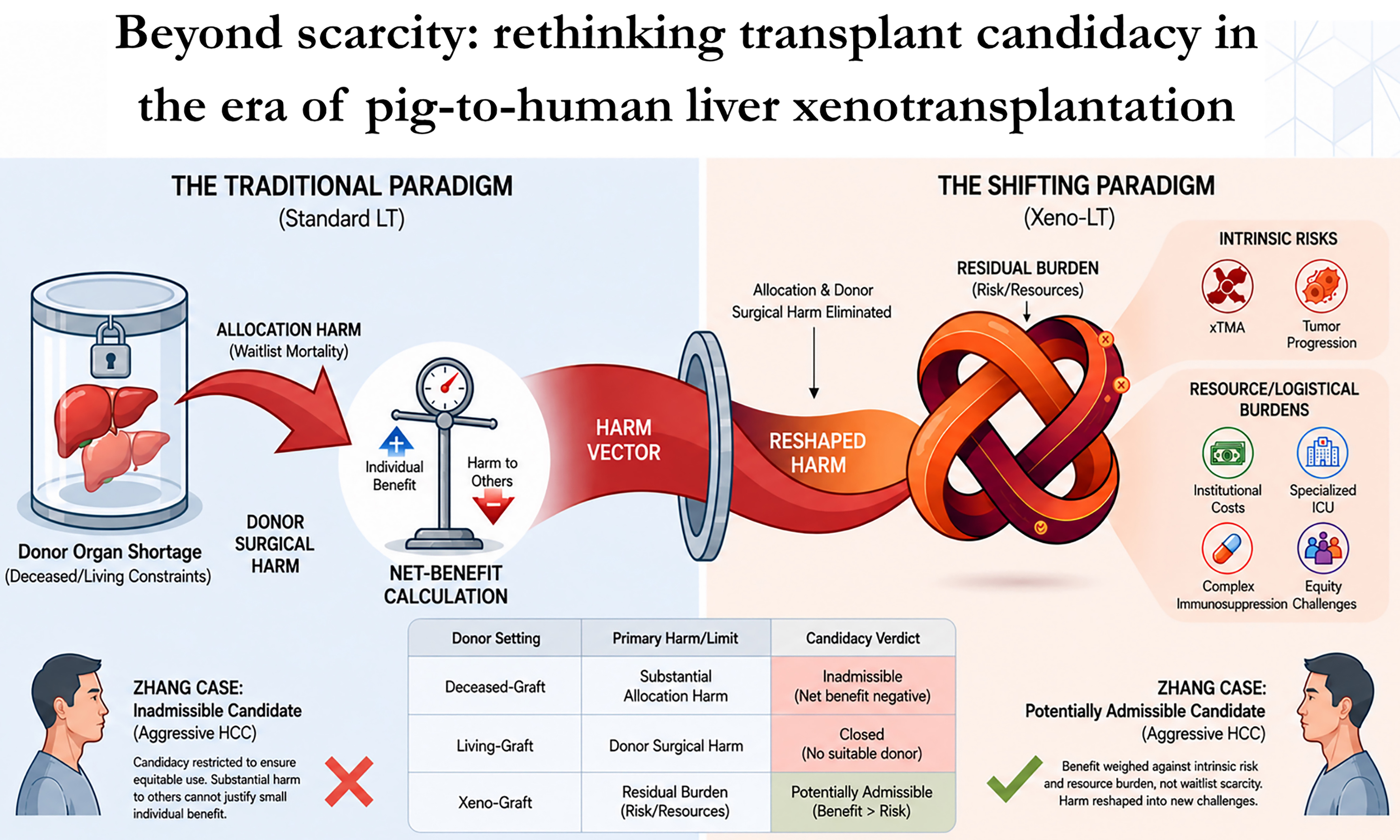
Organ shortage remains a defining constraint in transplant medicine, with persistent waiting-list mortality and only a small fraction of global need currently met. While kidney xenotransplantation has recently entered early clinical research[1], liver xenotransplantation (xLT) remains at a much earlier stage, with clinical application currently limited to temporary extracorporeal support using an external ex vivo perfused genetically modified pig liver and a few compassionate-use cases[2-4]. This reflects the substantially greater immunological, coagulation-related, metabolic and physiological complexity of the liver[5], making the Zhang case an even more significant milestone. Zhang et al. report in the Journal of Hepatology the first auxiliary porcine liver graft to function in a living human recipient, with 171 days of patient survival[6]. Beyond the specific clinical choices the case invites, why tyrosine kinase inhibitors (TKI) rather than immunotherapy, why transarterial chemoembolization (TACE) rather than transarterial radioembolization (TARE), why an auxiliary porcine graft rather than an auxiliary split, the case is methodologically interesting because it raises a more general question: how does the candidacy assessment for liver transplantation (LT) change when the donor is a genetically engineered pig? In particular, it concerns a configuration that current practice treats as inadmissible: a patient with tumor biology so unfavorable that, in standard transplant settings, no allocation could be ethically justified. The xenograft setting may begin to alter the pattern of candidacy for cases of this kind. The remainder of this commentary examines how and within what limits this is the case.
THE MULTIPARAMETRIC FRAMEWORK FOR TRANSPLANT CANDIDACY IN HCC
Recent international guidelines and Italian consensus documents have moved beyond the dichotomous Milan-in/Milan-out logic and now frame LT candidacy in hepatocellular carcinoma (HCC) as a multiparametric judgment integrating fitness, liver function, tumor biology, feasibility, and patient values[7-10]. Within the European Association for the Study of the Liver (EASL) 2025[8] and the Italian consensus[9], candidacy is the outcome of this integrated assessment rather than the application of any single morphological cut-off. The Multiparametric Therapeutic Hierarchy (MTH)[11] and the recent reappraisal of the Barcelona Clinic Liver Cancer (BCLC)[12] framework extend the same logic across the broader HCC therapeutic hierarchy. In this multiparametric framework, the individual benefit of transplantation has long been formalized in the transplant-benefit literature as the difference between expected post-transplant survival and survival on the waiting list. Our group and others have shown that this construct better balances urgency and utility than morphology-based criteria alone[13]. Building on this foundation, we previously proposed an additional step in which the individual transplant benefit is weighted against the cumulative harm that the same allocation creates for other candidates on the waiting list, a net-benefit reading of candidacy that makes explicit the equity dimension intrinsic to any deceased-donor allocation[14].
In this commentary, we adopt the operational reading of the Grading of Recommendations Assessment, Development and Evaluation (GRADE) Evidence-to-Decision (EtD) framework recently proposed by our group for individual-level HCC decision-making[15,16]. At the point of care, the four EtD-derived domains - technical feasibility, resources, equity, and values and acceptability - converge into a unified individual-level construct of feasibility, which describes whether a given treatment can be realized for a specific patient[16]. Throughout Figure 1 and the analysis below, we use Feasibility in this integrative sense, alongside the three biology-related axes of fitness, liver function, and tumor biology, and alongside patient values, which we keep visible as a separate gate when it carries decisional weight in the case.
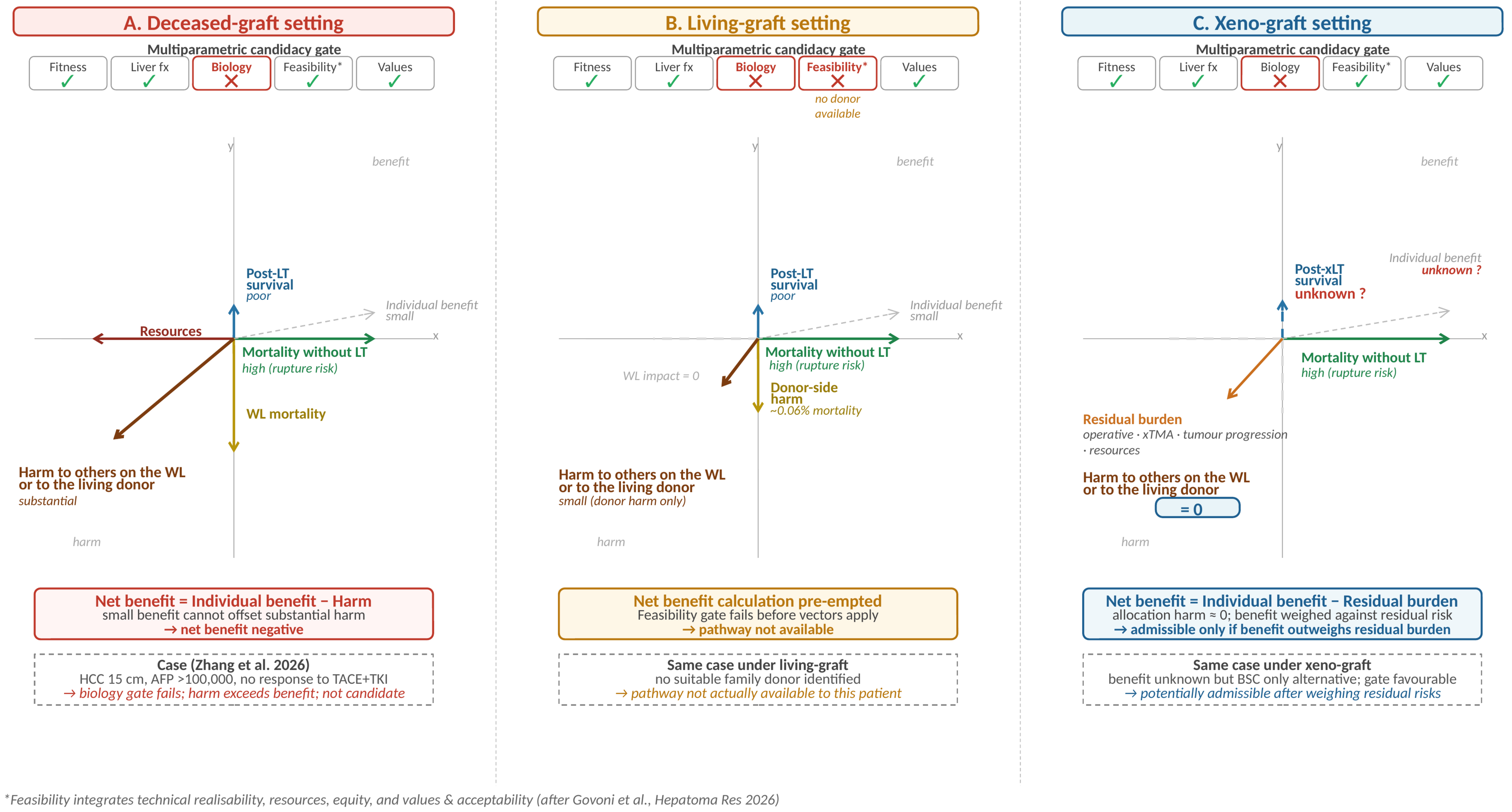
Figure 1. The net-benefit interpretation of transplant candidacy across three donor settings, inspired by the conceptual framework described by Cillo et al.[14]. Each panel depicts the Zhang case under a different donor source scenario[6]. The upper layer represents the multiparametric candidacy gate; the lower layer illustrates the net-benefit equation, where post-transplant survival and mortality without LT define the individual-benefit vector, and harm components are represented on the negative axes. (A) Deceased-donor setting. Scarce-resource use and waiting-list mortality generate a substantial harm vector. In the context of aggressive, treatment-unresponsive tumor biology, the individual-benefit vector is insufficient to offset harm to other candidates, resulting in negative net benefit; (B) Living-donor setting. Waiting-list harm is eliminated, but donor-related surgical harm persists; (C) Xenograft setting. Allocation-related harms are eliminated, but residual burdens remain. Tumor biology is unchanged, as it is patient-specific; uncertainty concerns post-xLT survival and therefore the magnitude of the individual-benefit vector (dashed). The decision shifts from balancing benefit against harm to others towards balancing an uncertain but plausible benefit against residual procedural risks and burdens, conditional on a favorable Feasibility gate. AFP: Alpha-fetoprotein; BSC: best supportive care; Fx: function; HCC: hepatocellular carcinoma; LT: liver transplant; TACE: transarterial chemoembolization; TKI: tyrosine kinase inhibitors; WL: waiting list; xLT: xeno-liver transplant; xTMA: Xenotransplantation-associated thrombotic microangiopathy.
THE CASE UNDER THE MULTIPARAMETRIC FRAMEWORK
Zhang et al. describe a 71-year-old man with HBV-related cirrhosis, a 15 cm × 11 cm × 10 cm right-lobe HCC, Alpha-fetoprotein (AFP) > 100,000 ng/mL with no response to TACE plus TKI, an Indocyanine green retention rate at 15 min (ICG-R15) of 16.5% and a future liver remnant of 41.79%[6]. Conventional and expanded morphological criteria (Milan, UCSF, Hangzhou)[17-19] and the AFP-model[20] were exceeded; the China Organ Transplant Response System (COTRS) allocation system declared him ineligible for allogeneic LT; living-donor liver transplant (LDLT) was unavailable in his social network; safe right hepatectomy and Associating Liver Partition and Portal Vein Ligation for Staged Hepatectomy (ALPPS) were precluded by liver function and rupture risk; systemic and locoregional therapies had failed. Under compassionate use, the right-lobe tumor was resected and a 10-gene-edited porcine liver was implanted in the right hepatic fossa as an auxiliary graft, intended to bridge towards regeneration of the native left lobe.
Read through the multiparametric framework, the candidacy pattern is mixed but, with respect to the standard transplant settings, decisive. Fitness, liver function, the integrated Feasibility domain, and patient values are favorable. tumor biology, however, is unequivocally aggressive and unresponsive to conversion attempts: an HCC of this size with very high AFP and no radiological response after combined locoregional and systemic therapy is, in transplant-oncology terms, the prototypical pattern of expected early recurrence and shortened post-transplant survival. In a deceased-graft setting, this combination yields a negative net-benefit: the small individual benefit cannot offset the substantial harm that allocation would impose on other waiting candidates with better post-transplant prospects. In a living-graft setting, the harm to the waiting list disappears, but the harm vector does not vanish, it is replaced by a residual donor-side risk (pooled mortality ≈ 0.06% across more than 60,000 donors)[21] and a Feasibility constraint that, in this specific patient, was decisive: no suitable family donor was identified. Under the same framework that already governs candidacy decisions, both pathways correctly close [Figure 1A and B].
WHAT CHANGES IN THE XENOGRAFT SETTING WITHIN THE SAME FRAMEWORK
The xenograft does not extract organs from the deceased-donor pool, and it does not expose a healthy human to surgical harm. Therefore, within this framework, human-graft allocation harm and living-donor surgical harm are zero. Within the unchanged net-benefit framework, this represents a quantitative shift in the balance between benefit and harm: the expected individual benefit must still be weighed against the remaining risks and burdens of xenotransplantation, including operative risk, rejection and graft-related complications such as thrombotic microangiopathy (xTMA), tumor progression under immunosuppression, and resource implications [Figure 1C]. This conceptual structure allows an individualized assessment of whether a procedure with uncertain but plausible individual benefit may become ethically admissible after considering the full spectrum of residual risks and feasibility constraints.
That configuration is not generic. It requires that fitness, liver function, and the integrated feasibility domain (technical realisability, resources, equity, values and acceptability) all be favorable, and that the only realistic alternative for the specific patient be best supportive care, neither effective allotransplantation, nor curative resection, nor effective locoregional or systemic therapy. The patient described by Zhang et al. meets these conditions: imminent risk of rupture, exhausted alternatives, preserved fitness, established experimental gene-editing platform, and informed consent under compassionate use[6]. Under such conditions, an experimental procedure with unknown individual benefit but zero deceased-donor allocation/living-donor harm is admissible, not because the framework has changed, but because, when applied honestly, the framework returns a different verdict when the deceased-donor allocation and living-donor surgical components of the harm term are zero.
THREE FRONTIERS THAT REMAIN
The above is the methodological reading of the case. Three biological and structural frontiers determine whether xenotransplantation can become more than a single compassionate-use precedent.
Immunological and coagulation feasibility
In Zhang et al., no hyperacute or acute rejection occurred during the first month, but xenotransplantation-associated xTMA emerged from postoperative day 31, with progressive endothelial complement deposition (C4d, C1q, C3c, C4c, C5b), IgG/IgM accumulation, and intense von Willebrand factor staining at explant[6]. Mechanisms include excessive complement activation, porcine tissue factor pathway inhibitor and thrombomodulin failing to engage human pathways efficiently, and porcine vWF-human glycoprotein Ib mismatch promoting platelet consumption. Anti-C5 strategies, additional genetic edits, and ex vivo extracorporeal liver cross-circulation platforms, recently reported in four brain-dead decedents in Nature Medicine[22,23], represent complementary directions to address this barrier.
Another important issue concerns previous exposure to immune checkpoint inhibitors (ICIs), now the standard first-line therapy for advanced HCC[24,25]. Prior ICIs exposure has been associated with an increased risk of acute rejection after allogeneic LT[26,27], and its implications for xenotransplantation remain unknown given the more complex immunological barriers and the potential interplay among T-cell activation, endothelial injury, complement activation, and coagulation dysregulation. Accordingly, consideration should be given to prior ICIs exposure, appropriate washout intervals, and post-transplant immune monitoring.
Oncological feasibility within a hierarchy
Auxiliary xenotransplantation in HCC is not a destination but a bridge, and the destination matters. Towards delayed resection? Towards allotransplantation? The answer is not merely semantic. Importantly, patient survival, the duration of porcine graft support, and oncological outcomes represent distinct endpoints that should not be conflated. In the Zhang case, the 10-gene-edited porcine graft provided clinically meaningful metabolic, synthetic, and coagulative support for 38 days before removal due to xTMA, the first reported case in a living human recipient with detailed immunological and histopathological characterization[6,28]. Hepatic and renal function remained stable during the first 31 postoperative days, without evidence of hyperacute or acute rejection, whereas xTMA emerged subacutely between POD 31 and 38, driven by cross-species complement-coagulation incompatibility, a mechanism also suggested by previous authors[29]. Following xenograft removal, xTMA was successfully managed with eculizumab and plasma exchange. The remaining 133 days of the patient’s 171-day survival were therefore sustained entirely by the regenerated native left hepatic lobe, without xenograft contribution. This distinction is clinically essential: overall survival should not be equated with the duration of xenogeneic support. Beyond graft function, oncological control remains a separate and critical determinant of outcome. In the setting of extremely aggressive tumor biology, reflected by very high AFP levels, large tumor burden, and failure of previous therapies, survival after xLT should be interpreted within the broader context of tumor behavior and the potential impact of the required immunosuppressive regimen. Auxiliary xenotransplantation may provide temporary hepatic support, but it does not, by itself, overcome the oncological limitations of the native liver.
Removal of the xenograft left the cirrhotic native liver in situ, raising concerns about residual microscopic disease and future recurrence, while native liver regeneration is itself limited by the impaired regenerative capacity of cirrhosis. Additionally, the intense immunosuppression required to achieve xenotolerance further reinforces the need for careful oncological surveillance. Until durable liver xenograft function can be achieved by overcoming the major immunological and coagulation barriers, auxiliary xLT may therefore be better viewed as a bridge to allogeneic LT - or potentially to a staged radical strategy such as the Resection and Partial Liver Transplantation with Delayed Total Hepatectomy (RAPID) concept - rather than as a bridge to native liver regeneration[30-32].
Equity
Within the integrated Feasibility construct adopted here, equity is one of the four converging EtD-derived dimensions, and it does not vanish when the human-graft allocation harm and living-donor surgical harm components of the harm vector are zero; rather, it is reshaped. Eliminating harm to human donor resources does not eliminate the organizational, institutional and societal challenges that determine equitable access to transplantation. Access to gene-edited porcine donors, immunosuppressive regimens, specialized intensive-care capacity, and supportive regulatory frameworks remains profoundly uneven. The United States has historically led the field[33,34], whereas China has rapidly developed the infrastructure to perform two of the three landmark xLTs reported in 2024-2025[6,35,36]. Europe, despite the 2021 European Society for Organ Transplantation (ESOT) positioning, has not yet performed any procedure, partly because of regulatory fragmentation[37]. Thus, the future integration of xLT will depend not only on overcoming biological barriers, but also on the equitable development of the institutional, regulatory, and allocation frameworks required to translate this innovation into clinical practice.
CONCLUSION
Zhang et al. have produced a landmark biological proof of concept[6]. The conceptual lesson the case carries, however, is narrower and more useful than the broad claims sometimes attached to it. The multiparametric net-benefit framework that governs LT candidacy in HCC does not change because of xenotransplantation. In that specific configuration, and only in that configuration, a procedure with uncertain individual benefit can be ethically admissible. The Zhang case is the first empirical illustration of this configuration, not a license to relax candidacy criteria more broadly. Preparing transplant oncology to use this new term in the equation responsibly, and to do so without confusing it with a structural change in the framework, is the methodological work that begins now.
DECLARATIONS
Authors’ contributions
Conceptualization, literature review, critical revision of the manuscript and supervision: Vitale A
Conceptualization, literature review, writing-original draft preparation, and figure preparation: Brolese M
Conceptualization, literature review, writing-original draft preparation and supervision: Cillo U
All authors have read and approved the final manuscript.
Availability of data and materials
Not applicable.
AI and AI-assisted tools statement
During the preparation of this manuscript, the AI tool NotebookLM (version 2026.06, released 2026-06-08) was used for the generation of Graphical Abstract and Claude Opus 5 (Anthropic, released 2026-07-24) was used for the generation of Figure 1. The tool did not influence the study design, data collection, analysis, interpretation, or the scientific content of the work. All authors take full responsibility for the accuracy, integrity, and final content of the manuscript.
Financial support and sponsorship
None.
Conflicts of interest
Vitale A is an Editorial Board Member of Hepatoma Research. Vitale A was not involved in any steps of editorial processing, notably including reviewers’ selection, manuscript handling and decision making. The other authors declare that there are no conflicts of interest.
Ethical approval and consent to participate
Not applicable.
Consent for publication
Not applicable.
Copyright
© The Author(s) 2026.
REFERENCES
1. ClinicalTrials. gov. Study to Evaluate the Safety and Efficacy of the 10 GE Xenokidney in Patients With ESRD (EXPAND). Available from https://clinicaltrials.gov/study/NCT06878560. [accessed 14 August 2026].
2. Pascher A, Sauer IM, Hammer C, Gerlach JC, Neuhaus P. Extracorporeal liver perfusion as hepatic assist in acute liver failure: a review of world experience. Xenotransplantation. 2002;9:309-24.
3. Chari RS, Collins BH, Magee JC, et al. Brief report: treatment of hepatic failure with ex vivo pig-liver perfusion followed by liver transplantation. N Engl J Med. 1994;331:234-7.
4. Fieldhouse R. Pig livers for people: US regulator greenlights first safety trial. Nature. 2025;640:870.
5. Shirini K, Ladowski JM, Harsh N, Meier RPH. Xenotransplantation literature update: July-December 2025. Xenotransplantation. 2026;33:e70123.
6. Zhang W, Xu Q, Xu K, et al. Genetically engineered pig-to-human liver xenotransplantation. J Hepatol. 2026;84:587-98.
7. Mazzaferro V, Regalia E, Doci R, et al. Liver transplantation for the treatment of small hepatocellular carcinomas in patients with cirrhosis. N Engl J Med. 1996;334:693-9.
8. European Association for the Study of the Liver. EASL Clinical Practice Guidelines on the management of hepatocellular carcinoma. J Hepatol. 2025;82:315-74.
9. Cillo U, Burra P, Mazzaferro V, et al. ; I-BELT (Italian Board of Experts in the Field of Liver Transplantation). A multistep, consensus-based approach to organ allocation in liver transplantation: toward a “blended principle model”. Am J Transplant. 2015;15:2552-61.
10. Singal AG, Llovet JM, Yarchoan M, et al. AASLD Practice Guidance on prevention, diagnosis, and treatment of hepatocellular carcinoma. Hepatology. 2023;78:1922-65.
11. Vitale A, Cabibbo G, Iavarone M, et al. ; HCC Special Interest Group of the Italian Association for the Study of the Liver. Personalised management of patients with hepatocellular carcinoma: a multiparametric therapeutic hierarchy concept. Lancet Oncol. 2023;24:e312-22.
12. Reig M, Sanduzzi-Zamparelli M, Forner A, et al. BCLC strategy for prognosis prediction and treatment recommendations: The 2026 update. J Hepatol. 2026;84:631-54.
13. Schaubel DE, Guidinger MK, Biggins SW, et al. Survival benefit-based deceased-donor liver allocation. Am J Transplant. 2009;9:970-81.
14. Cillo U, Vitale A, Volk ML, et al. Liver transplantation for T2 hepatocellular carcinoma during the COVID-19 pandemic: a novel model balancing individual benefit against healthcare resources. Cancers. 2021;13:1416.
15. Alonso-Coello P, Schünemann HJ, Moberg J, et al. ; GRADE Working Group. GRADE Evidence to Decision (EtD) frameworks: a systematic and transparent approach to making well informed healthcare choices. 1: Introduction. BMJ. 2016;353:i2016.
16. Govoni I, Padoan V, Vitale A, et al. ; on behalf of the HCC Special Interest Group of the Italian Association for the Study of the Liver. The role of “treatment unfeasibility” in the multiparametric, multidisciplinary, and expert evaluation of HCC patients. Hepatoma Res. 2026;12:10.
17. Mazzaferro V, Bhoori S, Sposito C, et al. Milan criteria in liver transplantation for hepatocellular carcinoma: an evidence-based analysis of 15 years of experience. Liver Transpl. 2011;17:S44-57.
18. Yao FY, Xiao L, Bass NM, Kerlan R, Ascher NL, Roberts JP. Liver transplantation for hepatocellular carcinoma: validation of the UCSF-expanded criteria based on preoperative imaging. Am J Transplant. 2007;7:2587-96.
19. Chen J, Xu X, Wu J, et al. The stratifying value of Hangzhou criteria in liver transplantation for hepatocellular carcinoma. PLoS One. 2014;9:e93128.
20. Duvoux C, Roudot-Thoraval F, Decaens T, et al. ; Liver Transplantation French Study Group. Liver transplantation for hepatocellular carcinoma: a model including α-fetoprotein improves the performance of Milan criteria. Gastroenterology. 2012;143:986-94.e3.
21. Xiao J, Zeng RW, Lim WH, et al. The incidence of adverse outcome in donors after living donor liver transplantation: a meta-analysis of 60,829 donors. Liver Transpl. 2024;30:493-504.
22. Shaked A, Sagar A, Olthoff KM, et al. Extracorporeal liver cross-circulation using transgenic xenogeneic pig livers with brain-dead human decedents. Nat Med. 2026;32:1034-44.
23. Guo Q, Wang C, Mauduit V, et al. Longitudinal multiomics profiling of extracorporeal cross-circulation with pig liver xenografts in human decedents. Nat Med. 2026;32:2970-82.
24. Yau T, Galle PR, Decaens T, et al. ; CheckMate 9DW investigators. Nivolumab plus ipilimumab versus lenvatinib or sorafenib as first-line treatment for unresectable hepatocellular carcinoma (CheckMate 9DW): an open-label, randomised, phase 3 trial. Lancet. 2025;405:1851-64.
25. Vogel A, Meyer T, Sapisochin G, Salem R, Saborowski A. Hepatocellular carcinoma. Lancet. 2022;400:1345-62.
26. Rezaee-Zavareh MS, Yeo YH, Wang T, et al. Impact of pre-transplant immune checkpoint inhibitor use on post-transplant outcomes in HCC: a systematic review and individual patient data meta-analysis. J Hepatol. 2025;82:107-19.
27. Tabrizian P, Holzner ML, Ajmera V, et al. Intention-to-treat outcomes of patients with hepatocellular carcinoma receiving immunotherapy before liver transplant: the multicenter VITALITY study. J Hepatol. 2025;82:512-22.
28. Meier RPH. Functional xenogeneic liver support in a living human: promise, lessons, and next steps. Xenotransplantation. 2026;33:e70107.
29. Cross-Najafi AA, Lopez K, Isidan A, et al. Current barriers to clinical liver xenotransplantation. Front Immunol. 2022;13:827535.
30. Wang L, Hara H, Cooper DKC, Wang Y, Wei Q, Xu X. Potential strategies in porcine liver xenotransplantation: a bridge to allotransplantation and beyond. Liver Transpl. 2026;32:256-64.
31. Lim C, Turco C, Balci D, et al. Auxiliary liver transplantation for cirrhosis: from APOLT to RAPID: a scoping review. Ann Surg. 2022;275:551-9.
32. Nastase AG, Vasilescu AM, Trofin AM, et al. Liver xenotransplantation: from early primate trials to the first-in-human porcine bridging therapies. J Clin Med. 2026;15:3144.
33. Cooper DKC. Early clinical xenotransplantation experiences-an interview with Thomas E. Starzl, MD, PhD. Xenotransplantation. 2017;24:e12306.
34. Cooper DKC, Ekser B, Tector AJ. A brief history of clinical xenotransplantation. Int J Surg. 2015;23:205-10.
35. Tao KS, Yang ZX, Zhang X, et al. Gene-modified pig-to-human liver xenotransplantation. Nature. 2025;641:1029-36.
36. Xing K, Chang Y, Zhang X, Du X, Song J. Xenotransplantation in China: past, present, and future. Xenotransplantation. 2025;32:e70038.
Cite This Article
 Open Access
How to Cite
Download Citation
Export Citation File:
Type of Import
Tips on Downloading Citation
Citation Manager File Format
Type of Import
Direct Import: When the Direct Import option is selected (the default state), a dialogue box will give you the option to Save or Open the downloaded citation data. Choosing Open will either launch your citation manager or give you a choice of applications with which to use the metadata. The Save option saves the file locally for later use.
Indirect Import: When the Indirect Import option is selected, the metadata is displayed and may be copied and pasted as needed.
About This Article
Copyright

Data & Comments
Data
0










Comments
Comments must be written in English. Spam, offensive content, impersonation, and private information will not be permitted. If any comment is reported and identified as inappropriate content by OAE staff, the comment will be removed without notice. If you have any queries or need any help, please contact us at [email protected].