
fig2
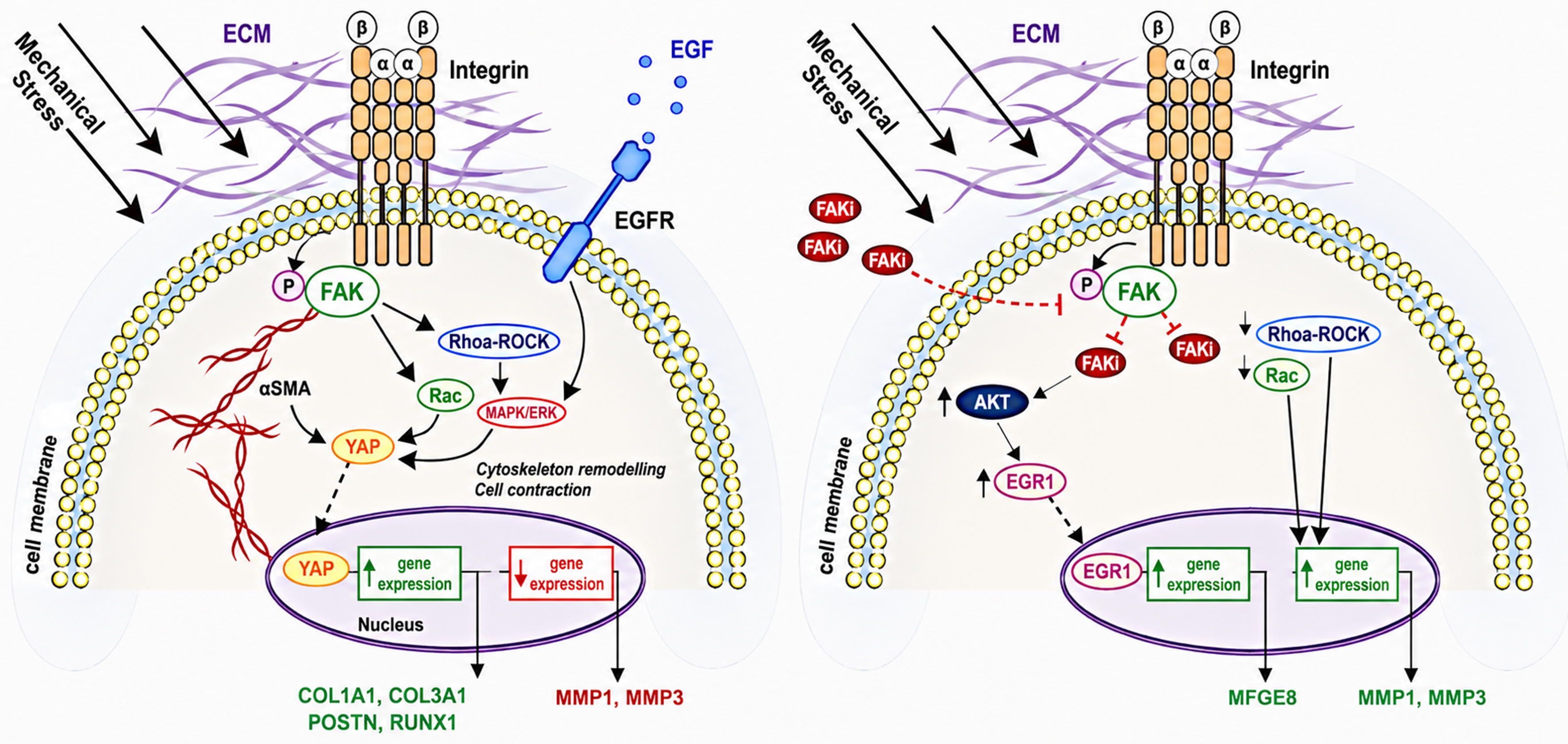
Figure 2. Schematic representation of FAK-dependent mechanotransduction and the effect of mechanical stress. (A) showing the activation of FAK-YAP signaling that promotes fibrosis (B) showing FAK inhibition and the activation of AKT-mediated induction of EGR1 and MFGE8, promoting regenerative repair. Adapted from Chen et al., Nature Communications, 2021[59], licensed under CC BY 4.0. ↑: Increased/upregulated; ↓: decreased/downregulated. ECM: Extracellular matrix; EGF: epidermal growth factor; EGFR: epidermal growth factor receptor; FAK: focal adhesion kinase; FAKi: focal adhesion kinase inhibitor; αSMA: alpha-smooth muscle actin; YAP: Yes-associated protein; AKT: protein kinase B; EGR1: early growth response 1; MAPK: mitogen-activated protein kinase; ROCK: Rho-associated coiled-coil containing protein kinase; Rac: Ras-related C3 botulinum toxin substrate; COL1A1: collagen type I alpha 1 chain; COL3A1: collagen type III alpha 1 chain; POSTN: periostin; RUNX1: runt-related transcription factor 1; MFGE8: milk fat globule-EGF factor 8; MMP1: matrix metalloproteininase 1; MMP3: matrix metalloproteininase 3.