
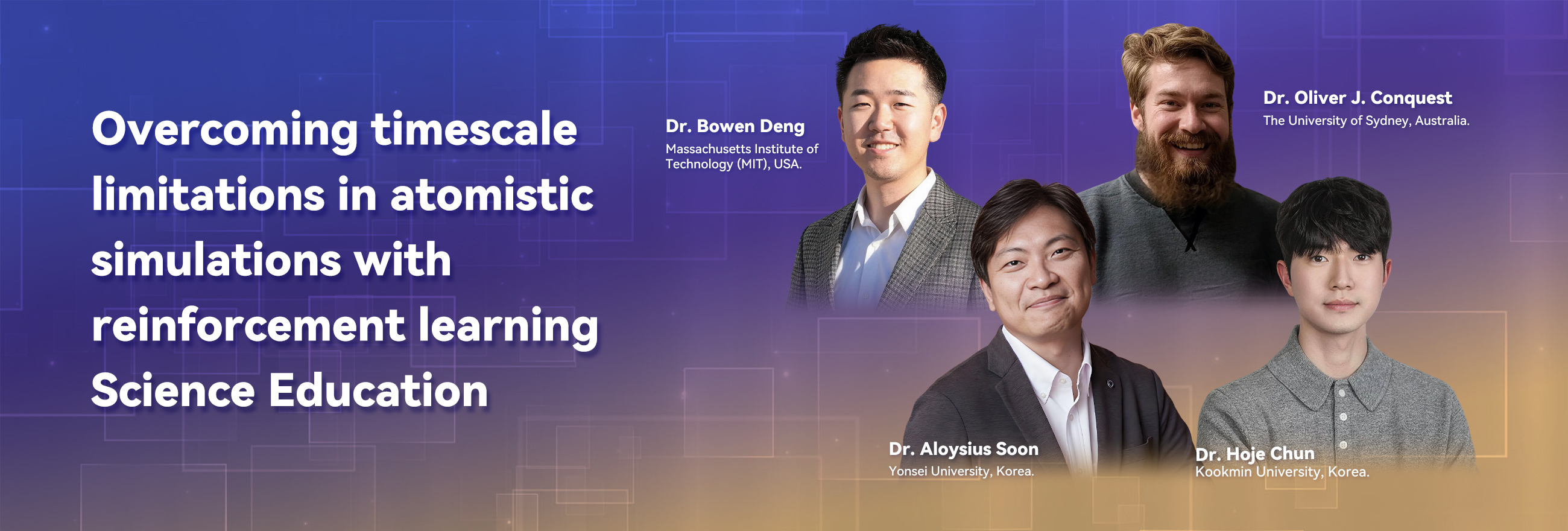
Overcoming timescale limitations in atomistic simulations with reinforcement learning
Contents
Chair
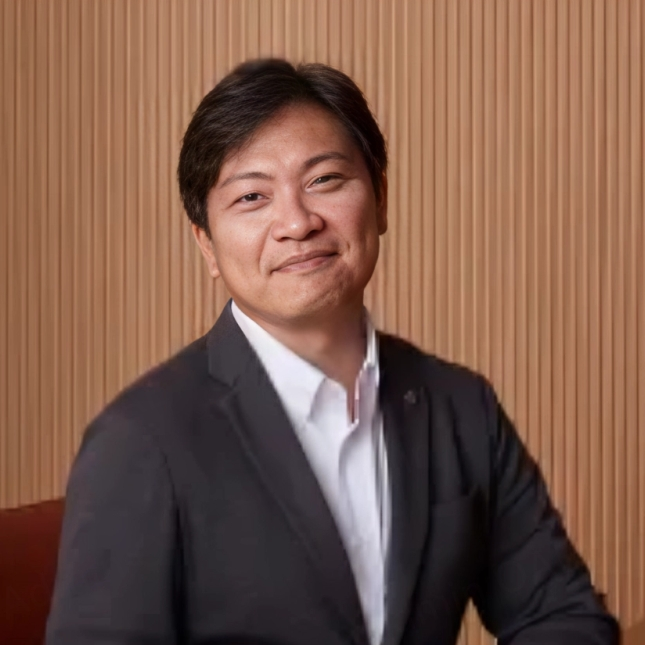
Aloysius Soon
Professor, Yonsei University, Korea.
Professor Aloysius Soon obtained his BSc in Chemistry from the National University of Singapore, his MSc in Chemistry from the University of Auckland, and his PhD in Physics from the University of Sydney. Since 2010, Professor Soon has been a faculty member in the Department of Materials Science and Engineering at Yonsei University in Seoul, Republic of Korea, and he was awarded a tenured full professorship in 2020. Prior to joining Yonsei, he was an Alexander von Humboldt fellow at the former Theory Department (now the NOMAD Laboratory) of the Fritz-Haber-Institut der Max-Planck-Gesellschaft in Germany. Professor Soon's research focuses on acquiring a fundamental understanding of the chemistry and physics of complex materials and their surfaces/interfaces using first- principles electronic structure theory coupled with modern machine-learning methods. Notably, Professor Soon has been elected as a Fellow of both the Institute of Physics (FlnstP, UK) and the Royal Society of Chemistry (FRSC, UK), and is registered as a Chartered Scientist (CSci, UK).
Guest(s)

Oliver J. Conquest
Postdoctoral researcher, The Universit of Sydney, Australia.
Oliver is a postdoctoral researcher in the condensed matter theory group at the University of Sydney. His research interests include catalysis, defects, ferroelectricity, and amorphous materials, with a focus on first-principles simulations. He primarily investigates catalytic processes for CO₂ reduction and oxidation reactions.

Bowen Deng
Postdoctoral researcher, Massachusetts Institute of Technology (MIT), USA.
Bowen Deng is a postdoc at the Massachusetts Institute of Technology (MIT) working with Professor Rafael Gomez-Bombarelli. He obtained his Ph.D. in the Materials Science and Engineering Department in University of California, Berkeley (UCB). He also previously worked at Microsoft Research Asia (MSRA) and Google DeepMind on AI for materials science. Bowen’s research focus is on designing, benchmarking, and applying machine learning and AI methods to solve materials science challenges in areas including Li-ion battery materials for energy storage applications. He is a major early contributor to foundation machine learning interatomic potentials (MLIPs), and he also works on automating agentic scientific research with large language models (LLMs). Bowen has been recognized with a Graduate Student Award from the Materials Research Society.
Speaker

Hoje Chun
Assistant Professor, Kookmin University, Korea.
Hoje Chun is an Assistant Professor in the Department of Chemistry at Kookmin University in Seoul, Korea, a position held since March 2026. Previously, Chun worked as a Postdoctoral Fellow/Associate at the Massachusetts Institute of Technology from October 2023 to February 2026. Chun earned a Ph.D. in Chemical and Biomolecular Engineering from Yonsei University in February 2023. His research interests focus on AI-accelerated atomistic simulation, machine-learning interatomic potentials enabled large-scale simulation, and high-throughput virtual screening of functional materials.
Research Interests:
Deep learning; Time series forecasting; Renewable energy optimization; Reinforcement learning; Model preditcive control
Report highlights:
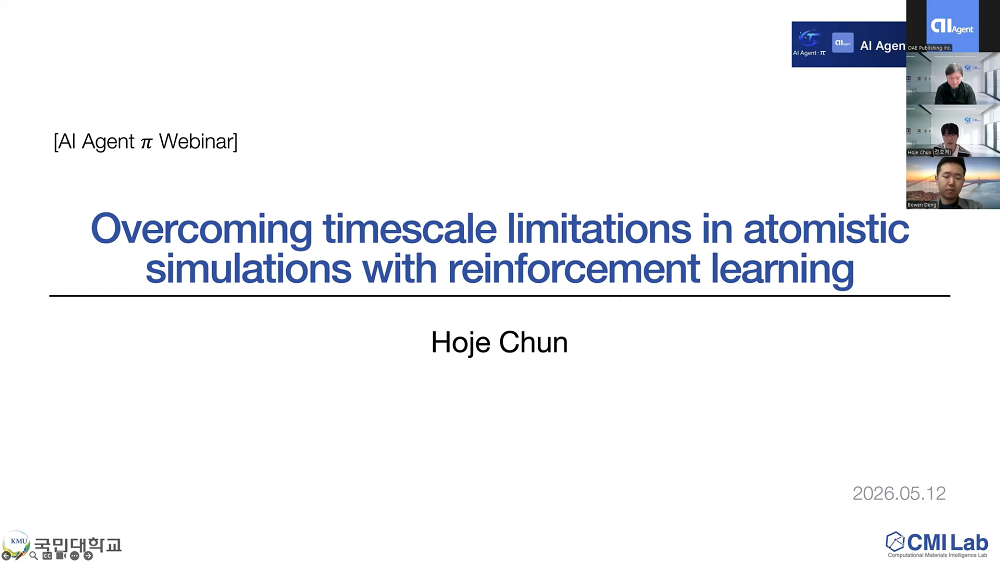
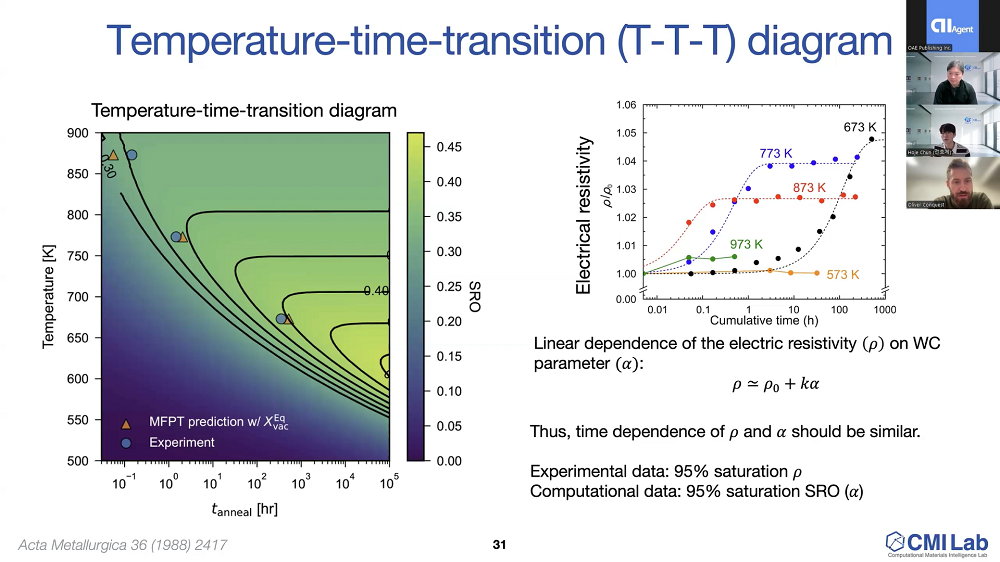
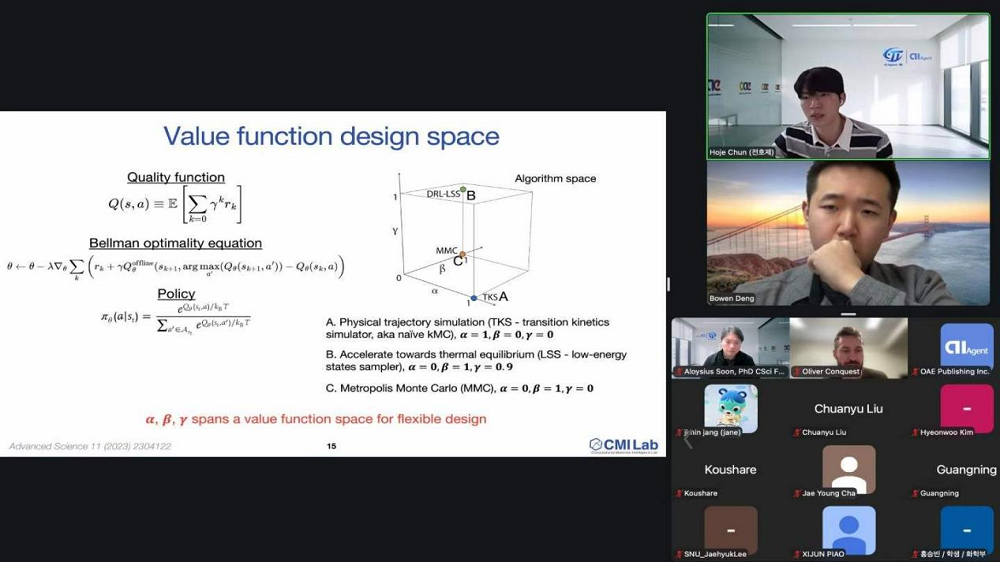
Processes slow compared to atomic vibrations pose significant challenges in atomistic simulations, particularly for phenomena such as diffusive relaxations and phase transitions, where repeated crossings and the shear number of thermally activated transitions make direct numerical simulations impossible. This talk will present a computational framework that captures atomic-scale diffusive relaxation over extended timescales by learning the mean first passage time (MFPT) with a deep neural network. The model is trained via a self-consistent recursive formulation based on the Markovian assumption, relying solely on local residence times and transition probabilities between neighboring states. Furthermore, deep reinforcement learning (DRL)-accelerated atomistic simulations are demonstrated to expedite the identification of thermodynamic equilibrium and the generation of accurate physical transition probabilities. Applied to vacancy-mediated chemical short-range order (SRO) evolution in equiatomic CrCoNi, our method uncovers disorder-to-order transition timescales in quantitative agreement with experimental measurements. By bridging the gap between simulation and experiment, our approach extends atomistic modeling to previously inaccessible timescales and offers a predictive tool for navigating process-structure-property relationships. Finally, this talk will introduce and future directions and potential applications using the reinforcement learning framework.
Research Interests:
Deep learning; Time series forecasting; Renewable energy optimization; Reinforcement learning; Model preditcive control
Report highlights:
Processes slow compared to atomic vibrations pose significant challenges in atomistic simulations, particularly for phenomena such as diffusive relaxations and phase transitions, where repeated crossings and the shear number of thermally activated transitions make direct numerical simulations impossible. This talk will present a computational framework that captures atomic-scale diffusive relaxation over extended timescales by learning the mean first passage time (MFPT) with a deep neural network. The model is trained via a self-consistent recursive formulation based on the Markovian assumption, relying solely on local residence times and transition probabilities between neighboring states. Furthermore, deep reinforcement learning (DRL)-accelerated atomistic simulations are demonstrated to expedite the identification of thermodynamic equilibrium and the generation of accurate physical transition probabilities. Applied to vacancy-mediated chemical short-range order (SRO) evolution in equiatomic CrCoNi, our method uncovers disorder-to-order transition timescales in quantitative agreement with experimental measurements. By bridging the gap between simulation and experiment, our approach extends atomistic modeling to previously inaccessible timescales and offers a predictive tool for navigating process-structure-property relationships. Finally, this talk will introduce and future directions and potential applications using the reinforcement learning framework.
Moments