


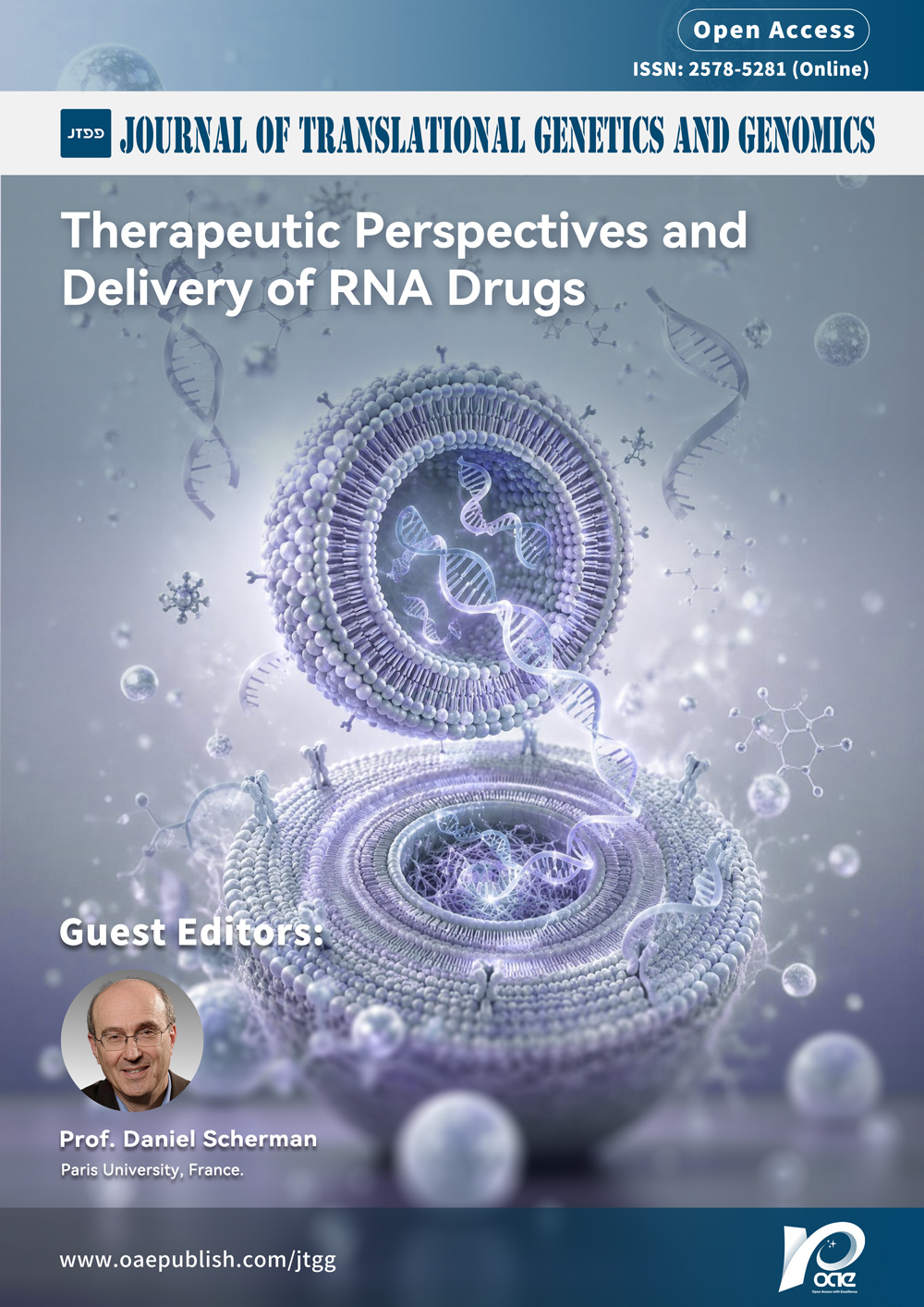
Topic: Therapeutic Perspectives and Delivery of RNA Drugs
A Special Topic of Journal of Translational Genetics and Genomics
ISSN 2578-5281 (Online)
Submission deadline: 28 Feb 2027
Guest Editor
Special Topic Introduction
New RNA Therapeutics: Applications, Delivery, and Future Perspectives
The development of RNA-based therapeutics has revolutionized the treatment of many diseases, in majority of genetic origin, by enabling precise modulation or correction of gene expression. Unlike conventional drugs that primarily target proteins, RNA therapeutics act upstream at the level of gene transcription or translation, making them particularly suitable for monogenic disorders and other diseases with well-defined molecular mechanisms. Among the most advanced RNA-based technologies are antisense oligonucleotides (ASOs), small interfering RNAs (siRNAs), and CRISPR-Cas gene-editing systems, each offering distinct mechanisms of action and therapeutic potential.
Antisense oligonucleotides (ASOs) are short, chemically modified single-stranded nucleic acids designed to bind complementary RNA sequences. Depending on their design, ASOs can induce RNase H-mediated degradation of target mRNA, alter pre-mRNA splicing, or block translation. Small interfering RNAs (siRNAs) utilize the endogenous RNA interference (RNAi) pathway to selectively silence gene expression. Several siRNA therapeutics have received regulatory approval, particularly for liver-associated diseases. CRISPR-Cas technologies extend beyond transient gene silencing by enabling direct modification of the genome. Guided by RNA molecules, Cas nucleases introduce site-specific DNA changes that can permanently correct pathogenic mutations. In addition to conventional CRISPR-Cas9 editing, newer approaches such as base editing and prime editing allow highly precise nucleotide modifications with reduced risk of double-strand DNA breaks. A major determinant of the clinical success of RNA therapeutics is efficient and tissue-specific delivery, because naked natural antisense oligonucleotides or RNA molecules are rapidly degraded by nucleases, exhibit poor cellular uptake, and may activate innate immune responses.
This special issue is dedicated to progress in oligonucleotide and RNA chemistry, genome editing technologies, and computational target identification, which are expected to expand the range of treatable diseases. New therapeutic strategies, spanning basic genetics, translational medicine, improved editing accuracy, artificial intelligence-assisted target identification, advances in delivery technologies – especially extrahepatic –, bioproduction, and personalized medicine enter the scope of this special issue which concerns a cornerstone of precision medicine, offering therapies tailored to the molecular cause of disease rather than its clinical manifestations.
All accepted manuscripts undergo rigorous double-anonymized peer review and are published online continuously upon acceptance, forming a dedicated, unified thematic collection freely accessible to clinicians, scientists and patient communities globally.
Keywords
RNA therapeutics; antisense oligonucleotides; small interfering RNA; genome editing; precision medicine
Submission Deadline
Submission Information
For Author Instructions, please refer to https://www.oaepublish.com/jtgg/author_instructions
For Online Submission, please login at https://www.oaecenter.com/login?JournalId=jtgg&IssueId=jtgg26081310578
Submission Deadline: 28 Feb 2027
Contacts: Iris Yang, Science Editor, [email protected]