


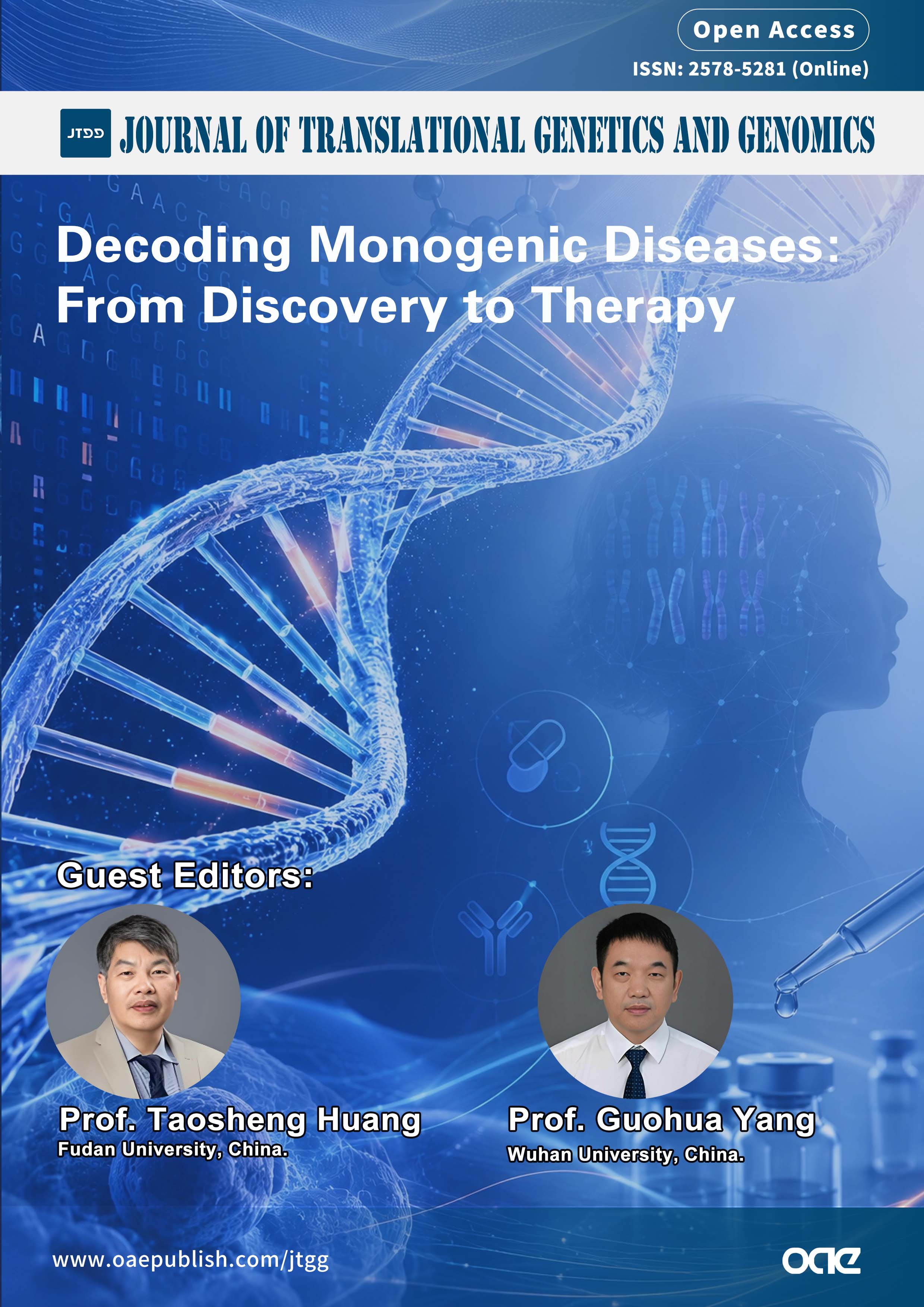
Topic: Decoding Monogenic Diseases: From Discovery to Therapy
A Special Topic of Journal of Translational Genetics and Genomics
ISSN 2578-5281 (Online)
Submission deadline: 28 Feb 2027
Guest Editors
Special Topic Introduction
Background
Monogenic diseases, arising from pathogenic variants in single genes, represent one of the most compelling frontiers in translational genetics. With over 8,000 monogenic disorders now catalogued and collectively affecting an estimated 300 million individuals worldwide, these conditions constitute a significant burden on global health systems and impose long-lasting suffering to patients and families. Yet despite the exponential growth of genomic technologies — from next-generation sequencing to long-read and single-cell platforms — a substantial proportion of patients with suspected monogenic conditions remain without a definitive molecular diagnosis, and curative therapies exist for only a fraction of these disorders.
The gap between gene discovery and clinical translation remains the central challenge in the field. While the pace of novel disease-gene and new variant identification has substantially accelerated, converting these genetic discoveries into mechanistic understanding, accurate diagnosis, and effective treatments still requires sustained, multidisciplinary effort. This is the gap that this column seeks to address.
Aims and Scope
This column aims to provide a dedicated forum for high-quality translational research that advances the mechanistic understanding, diagnosis, and treatment of monogenic diseases. We welcome studies that span the full translational pipeline — from the initial discovery of disease-associated genes and variants, through functional characterization and mechanistic elucidation, to the preclinical and clinical development of targeted therapies.
Topics of Interest
Topics of particular interest include, but are not limited to:
● Novel gene discovery and newvariant interpretation: Identification of new disease-associated genes through whole-exome sequencing (WES), whole-genome sequencing (WGS), and other genomic approaches; functional validation of variants of uncertain significance (VUS); advanced variant prioritization using computational and AI-driven methods; High-throughput and multiplexed functional validation platforms; systematic strategies for variant pathogenicity assessment.
● Genotype-phenotype correlations: Expanding and refining the clinical spectrum of known monogenic disorders; variable expressivity and incomplete penetrance; modifier genes and phenotypic modifiers.
● Molecular mechanisms: Pathophysiological studies at the cellular and molecular level; disease modeling using patient-derived iPSCs, organoids, and animal models; multi-omics integration (transcriptomics, proteomics, metabolomics) for mechanistic insight.
● Diagnostic innovation: Advances in genetic testing technologies and strategies; rapid genomic diagnostics in neonatal and critical care settings; newborn screening programs incorporating genomic approaches; prenatal and preimplantation genetic diagnosis.
● Therapeutic development: Gene therapy and gene editing (CRISPR/Cas9, base editing, prime editing); antisense oligonucleotide (ASO) therapies; small molecule druginterventions; enzyme replacement therapy; hematopoietic stem cell gene therapy; regenerative and cell-based approaches.
● Population genetics and screening: Carrier screening programs and their implementation; population-specific variant spectra and founder mutations; epidemiology and prevalence studies; equitable access to genetic services.
● Ethical, legal, and social implications: Genetic counseling in the genomic era; ethical considerations in pediatric genetic testing and gene therapy; data sharing and privacy in genomic medicine; health equity in rare disease research.
Article Types
We welcome the following types of submissions:
● Original Articles: Original research findings across the translational spectrum.
● Reviews: Comprehensive reviews of emerging areas, including systematic reviews and meta-analyses.
● Case Reports: Clinically informative cases that deepen mechanisticunderstanding of monogenic diseases.
● Perspectives and Commentaries: Expert insightson emerging technologies, policies, and directions in the field.
● Brief Reports: Concise reports of significant novel findings.
Call for Submissions
We invite researchers, clinicians, genetic counselors, and scientists from all related disciplines to contribute their work to this column. By bringing together discoveries from genomics, molecular biology, clinical genetics, and therapeutic development, we aim to build a vibrant community dedicated to decoding monogenic diseases and translating genetic knowledge into tangible benefits for patients worldwide.
Keywords
Monogenic Diseases; Genomic Technologies; Genetic Diagnosis; Disease-Gene Discovery; Precision Medicine.
Submission Deadline
Submission Information
For Author Instructions, please refer to https://www.oaepublish.com/jtgg/author_instructions
For Online Submission, please login at https://www.oaecenter.com/login?JournalId=jtgg&IssueId=jtgg26072110548
Submission Deadline: 28 Feb 2027
Contacts: Gloria, Science editor, [email protected]