

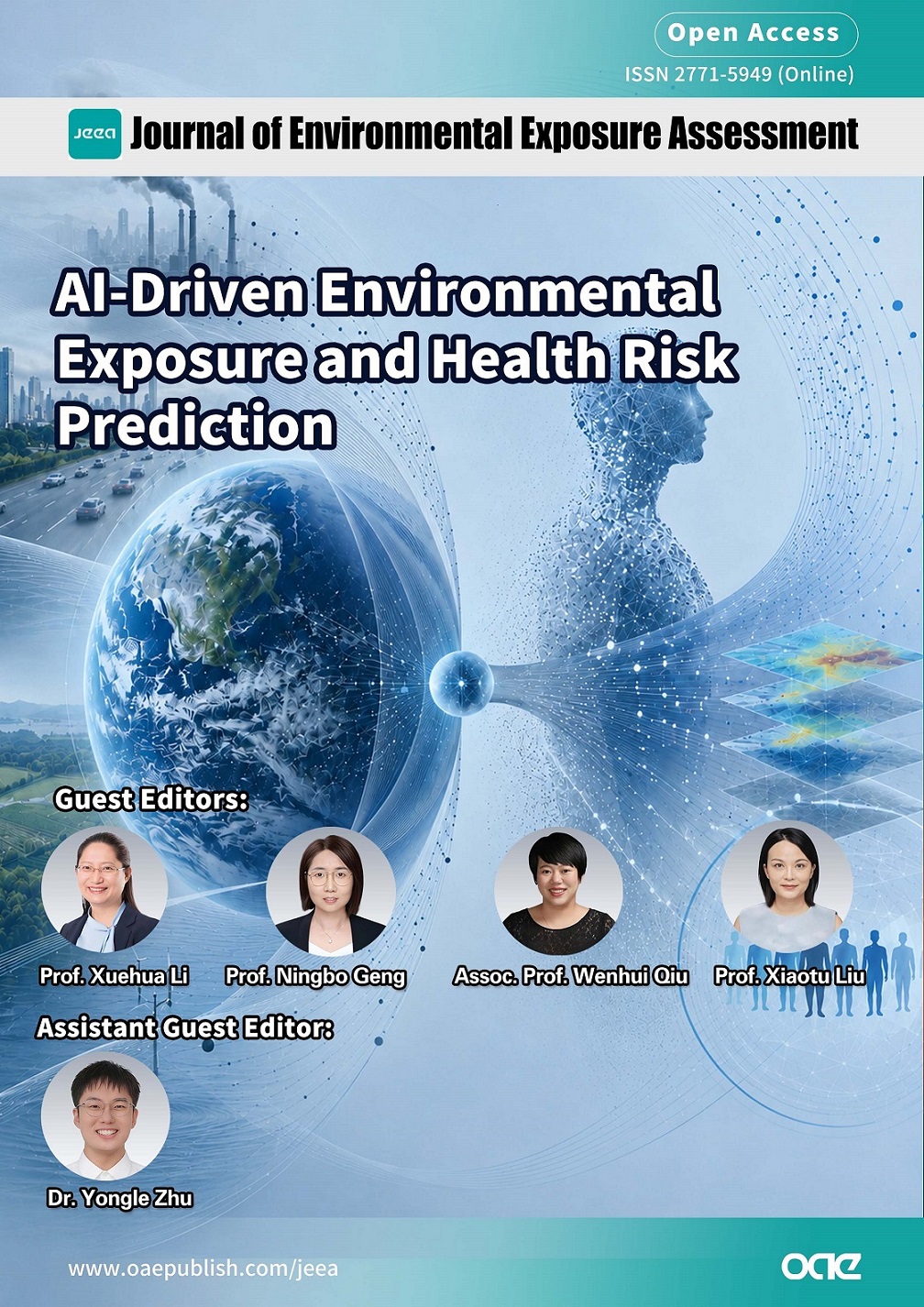
Topic: AI-Driven Environmental Exposure and Health Risk Prediction
A Special Topic of Journal of Environmental Exposure Assessment
ISSN 2771-5949 (Online)
Submission deadline: 31 Mar 2027
Guest Editors
Assistant Guest Editor
Special Topic Introduction
Currently, over 350,000 chemical substances and their mixtures are produced and used worldwide. Many of these substances, such as antibiotics, pesticides, as well as per- and polyfluoroalkyl substances (PFAS), have been frequently detected in environmental and biological matrices, raising growing concerns about their potential adverse effects on human health and ecosystem integrity. Chemical risk is determined by both exposure and toxicity. However, the comprehensive characterization of health risks posed by the expanding chemical space remains a formidable challenge if approached exclusively through conventional experimental assessments, which are often constrained by prohibitive costs, limited throughput and ethical concerns regarding animal use.
The exponential growth of environmental science data has catalyzed the emergence of artificial intelligence (AI) as a transformative tool for exposure science and risk assessment. Advanced big data mining and machine learning algorithms enable the integration of heterogeneous datasets, facilitating a more holistic understanding of the multimedia occurrence, transport and fate of chemicals. Concurrently, in silico models capable of predicting toxicity from molecular structures are gaining traction, significantly reducing the reliance on resource-intensive and time-consuming animal testing. Recognized as an important new methodology within the framework of Next-Generation Risk Assessment (NGRA), AI offers unprecedented potential to enhance the efficiency and accuracy of chemical safety evaluations, thereby enabling more proactive and evidence-based risk management strategies.
This Special Issue aims to highlight recent advances in AI-based methods and applications for environmental exposure assessment and risk prediction of chemicals. Original research articles, reviews and perspectives are welcomed, covering topics including but not limited to intelligent environmental monitoring, exposure prediction, computational toxicology, health risk assessment, environmental fate modeling and AI-assisted decision-making for environmental management. Through this collection, we aspire to accelerate the development and translation of innovative AI-driven strategies that bolster sustainable environmental protection and safeguard public health.
Keywords
Artificial intelligence, computational toxicology, environmental exposure, environmental fate modelling, health risk prediction
Submission Deadline
Submission Information
For Author Instructions, please refer to https://www.oaepublish.com/jeea/author_instructions
For Online Submission, please login at https://www.oaecenter.com/login?JournalId=jeea&IssueId=jeea26090410608
Submission Deadline: 31 Mar 2027
Contacts: Tracy Duan, Assistant Editor, [email protected]