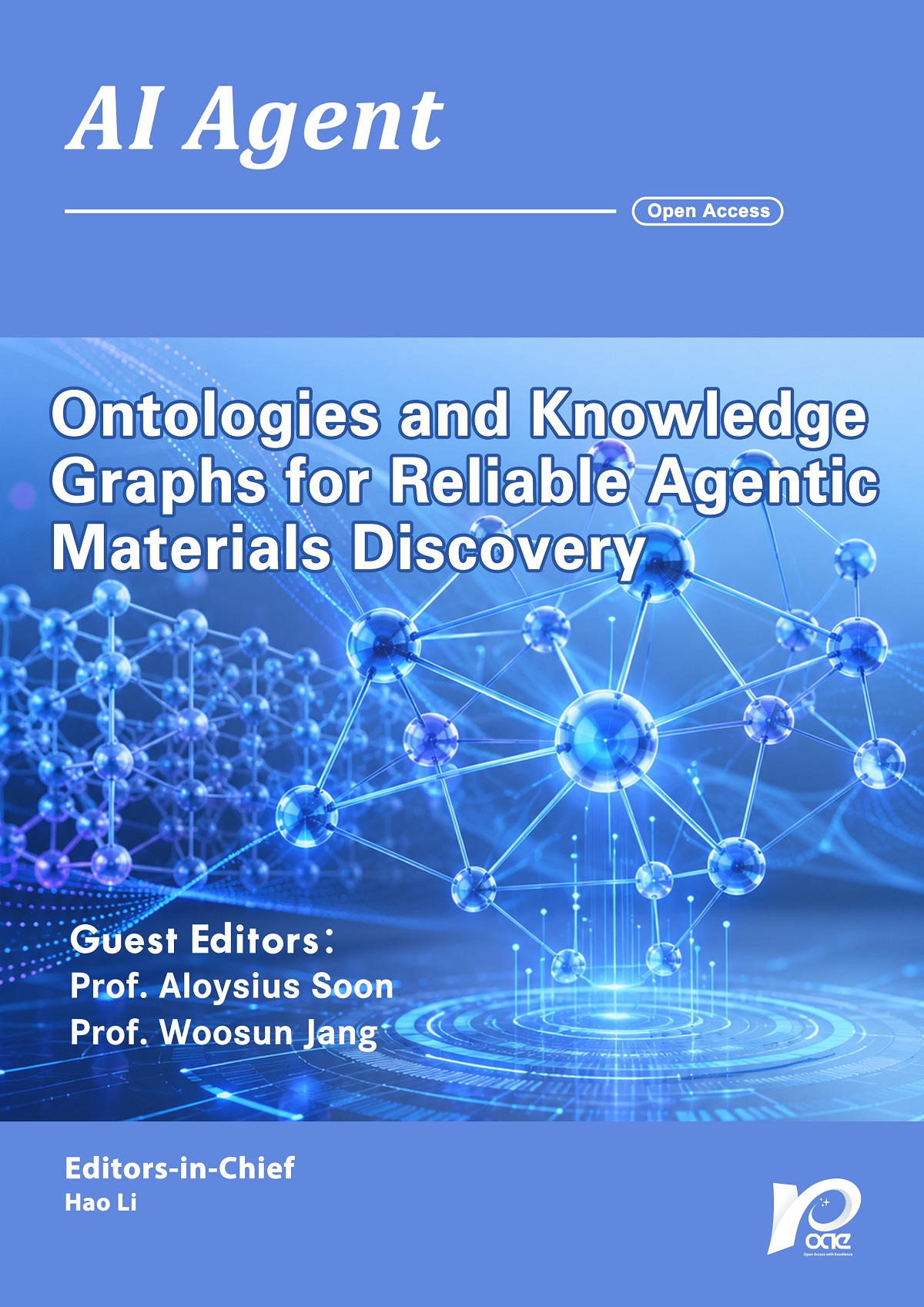
Topic: Ontologies and Knowledge Graphs for Reliable Agentic Materials Discovery
Guest Editors
Special Topic Introduction
Materials science is entering an agentic era in which AI systems do more than predict properties -- they interpret heterogeneous evidence, select tools, plan computations and experiments, and update decisions as new results arrive. Yet these capabilities remain limited by fragmented terminology, incompatible data models, weak provenance, and ungrounded reasoning. Ontologies and knowledge graphs can supply a shared, machine-actionable semantic layer that connects materials, synthesis processes, structures, properties, measurements, simulations, instruments, and literature.
Over the past decade, materials informatics has produced domain data, data standards, and scalable repositories that make scientific entities and relationships computationally accessible. In parallel, advances in large language models, scientific foundation models, and autonomous research platforms have created a new class of users for this structured knowledge: AI agents operating across data, software, and laboratory environments. The convergence of these separate research trajectories in the past creates an opportunity to innovate materials research by organizing information into active components of scientific reasoning and discovery.
This Special Issue will examine how the converged knowledge infrastructures enable reliable and interoperable AI agents across the materials research lifecycle. It moves beyond treating ontologies and knowledge graphs as passive repositories, emphasizing their operational use in grounding large language models, coordinating tools and multi-agent workflows, enforcing scientific constraints, tracing evidence, and closing the loop between prediction, simulation, and experiment. Contributions may address the construction and alignment of materials ontologies; multimodal and LLM-assisted knowledge graph extraction and curation; graph-based retrieval and reasoning; neuro-symbolic AI; agent access to databases, electronic laboratory notebooks, simulation codes, and autonomous laboratories; and human-in-the-loop governance.
Topics of interest include, but are not limited to:
• Materials ontologies and semantic standards for agent-understandable research;
• Multimodal and LLM-assisted knowledge graph construction, curation, and provenance;
• Knowledge-graph-grounded LLMs and agents for retrieval, reasoning, planning, and tool use;
• Neuro-symbolic agents, scientific constraints, and validation;
• Multi-agent and closed-loop workflows connecting literature, simulation, experiment, and robotic laboratories;
• Ontology alignment, federated graphs, FAIR data, and cross-domain interoperability;
• Benchmarks for grounding, uncertainty, hallucination control, reproducibility, and trust;
• Agent-enabled case studies across materials classes and lifecycle stages.
Keywords
AI agents, materials informatics, materials ontologies, knowledge graphs, data interoperability, neuro-symbolic AI, autonomous laboratories
Submission Deadline
Submission Information
For Author Instructions, please refer to https://www.oaepublish.com/aiagent/author_instructions
For Online Submission, please login at https://www.oaecenter.com/login?JournalId=aiagent&IssueId=aiagent26082610589
Submission Deadline: 31 May 2027
Contacts: Margie Ma, Managing Editor, [email protected]; Jocelyn Xue, Editor, [email protected]