Department of Dentistry, National Taiwan University Hospital, Taipei 100, Taipei, China.
Correspondence Address: Dr. Jiiang-Huei Jeng, Department of Dentistry, National Taiwan University Hospital, No. 1, Chang-Te Street, Taipei 100, Taipei, China. E-mail: [email protected]
Received: 13 Dec 2016 | Accepted: 14 Dec 2016 | Published: 31 Mar 2017
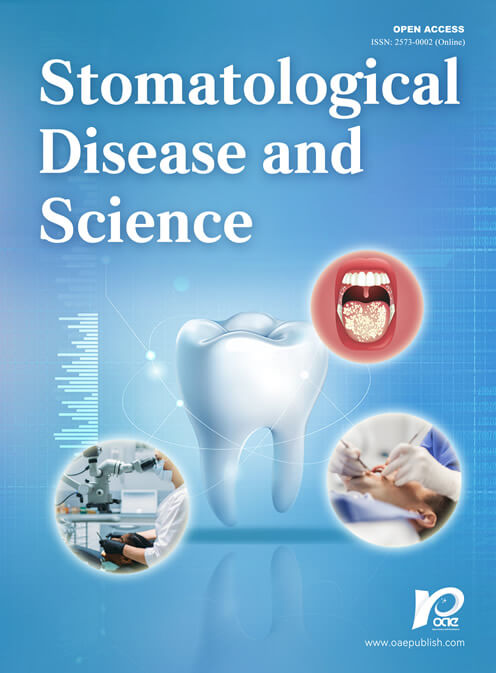
Stomatological Disease and Science (Stomatological Dis Sci, SDS) is a newly launched, international, peer reviewed, open access academic journal which comprises the outstanding achievements of the world's leading researchers in dentistry. By publishing high-quality and novel articles in a wide range of categories, this journal is dedicated to expanding and evolving the knowledge of contemporary dentistry. Basic scientists and clinical dental specialists will be able to obtain valuable information and innovative ideas from the Stomatological Dis Sci articles. The mission of Stomatological Dis Sci is to provide the dental community with a reliable source of information relevant to current developments and discoveries in dentistry. The journal also acts as a forum for exchanging interdisciplinary scientific knowledge from a clinical, professional and an educational point of view.
Stomatological Dis Sci emphasizes the importance of the worldwide collaboration and cooperation in various dental research fields. The topics covered in this journal include clinical and basic sciences relevant to the oral cavity, oral and maxillofacial surgery, implantology, periodontics, endodontics, orthodontics, operative dentistry, pediatric dentistry, prosthodontics, oral pathology, material science, stem cell research, epidemiology and salivary research, etc. Any types of manuscripts submission, such as case reports, case series, new technology reports, short communications, original research articles, review articles, editorials, letters to editor, etc. are all welcomed. To sum up, the latest concept in a variety of research area is collected and summarized in this journal for the readers.
As the Editor-in-Chief of this promising journal, I am deeply grateful to all the authors for their excellent works and remarkable contributions. Each issue offers useful reports and articles to the dental practitioners and research experts. We encourage both clinical and basic research professionals to submit manuscripts on practical and scientific key issues in dentistry of all disciplines. We are looking forward to receive extraordinary manuscripts and to promote the development in the cutting-edge of dentistry.
Financial support and sponsorship
None.
Conflicts of interest
There are no conflicts of interest.
Patient consent
Not applicable.
Ethics approval
Not applicable.
Cite This Article
Editorial
Open Access
A foreword from the Editor-in-Chief
Jiiang-Huei Jeng
How to Cite
Download Citation
If you have the appropriate software installed,
you can download article citation data to the
citation manager of your choice. Simply select
your manager software from the list below and
click on download.
Export Citation File:
Type of Import
Tips on Downloading Citation
This feature enables you to download the
bibliographic information (also called citation
data, header data, or metadata) for the articles
on our site.
Citation Manager File Format
Use the radio buttons to choose how to format
the bibliographic data you're harvesting.
Several citation manager formats are available,
including EndNote and BibTex.
Type of Import
If you have citation management software
installed on your computer your Web browser
should be able to import metadata directly into
your reference database.
Direct Import: When the Direct Import
option is selected (the default state), a
dialogue box will give you the option to Save or
Open the downloaded citation data. Choosing Open
will either launch your citation manager or give
you a choice of applications with which to use
the metadata. The Save option saves the file
locally for later use.
Indirect Import: When the Indirect Import
option is selected, the metadata is displayed
and may be copied and pasted as needed.
About This Article
Disclaimer/Publisher’s Note: All statements, opinions, and data contained in this publication are solely those of the individual author(s) and contributor(s) and do not necessarily reflect those of OAE and/or the editor(s). OAE and/or the editor(s) disclaim any responsibility for harm to persons or property resulting from the use of any ideas, methods, instructions, or products mentioned in the content.
Copyright
This is an open access article licensed under the terms of Creative Commons Attribution 4.0 International License (https://creativecommons.org/licenses/by/4.0/), which permits unrestricted use, distribution, and reproduction in any medium, as long as the original author is credited and the new creations are licensed under the identical terms.
Author Biographies
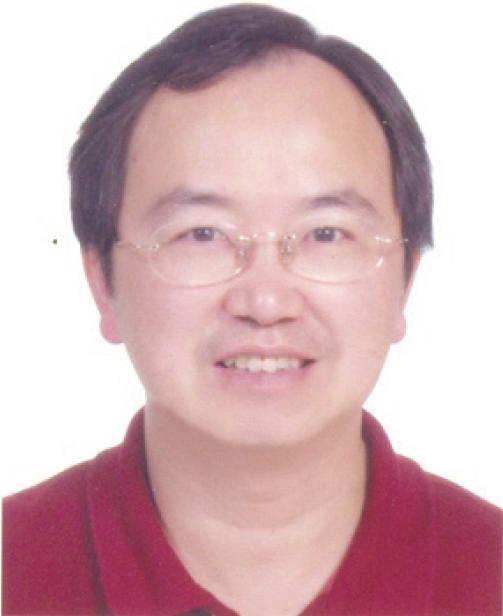
Dr. Jiiang-Huei Jeng graduated from the National Taiwan University's School of Dentistry in 1985. From 1991 to 2000, he completed his specialty training in both endodontics and periodontics. He received the IADR Hatton Award in 1993 and his DDS in 1994. Dr. Jiiang-Huei Jeng has been practicing endodontics, periodontics, and implant dentistry at the National Taiwan University Hospital (NTUH) since 1987. He currently is the Chair of the Department of Endodontics at NTUH. He is also a professor, researcher and teaching staff at the National Taiwan University Dental School. He has published several papers in scientific journals including Biomaterials, Acta Biomaterialia, J Endod, Int Endod J, Carcinogenesis, Oncotargets, J Periodontol, Oral Oncology, and Br J Pharmacol, etc. In 2012 in Brazil, he received the International Association of Dental Research (IADR) Distinguish Scientist Award. He also served as a reviewer, editorial board member, associate editor, and editor of many international journals.
Data & Comments
Data
Views
3862
Downloads
1204
Citations
0
Comments
0
0
Comments
Comments must be written in English. Spam, offensive
content, impersonation, and private information will not
be permitted. If any comment is reported and identified
as inappropriate content by OAE staff, the comment will
be removed without notice. If you have any queries or
need any help, please contact us at
[email protected].

 0
0 
 Open Access












Comments
Comments must be written in English. Spam, offensive content, impersonation, and private information will not be permitted. If any comment is reported and identified as inappropriate content by OAE staff, the comment will be removed without notice. If you have any queries or need any help, please contact us at [email protected].