
2025 Annual Report of Chemical Synthesis
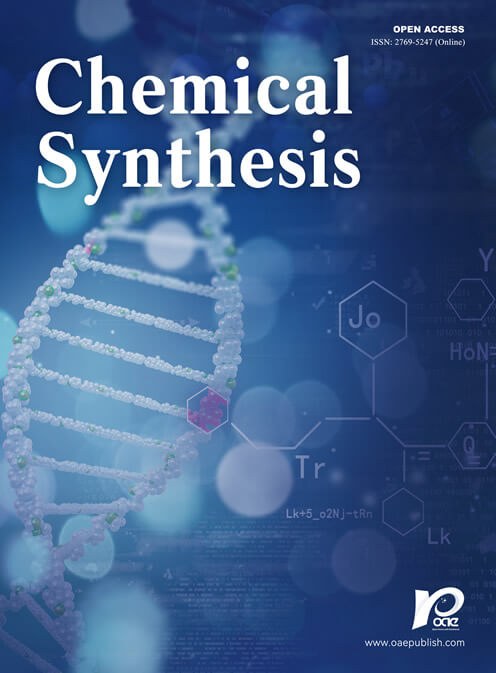
The year 2025 marks another remarkable chapter for Chemical Synthesis (CS; ISSN: 2769-5247), an international, peer-reviewed, open access journal in the field of chemical research. This progress is the result of the dedicated efforts of our editorial team, authors, reviewers, Editorial Board members, conference participants, and readers. Their continued engagement and support have played an essential role in shaping the journal's development. This annual report summarizes CS's performance, key metrics, and major activities in 2025.
1. Submissions and Publications
In 2025, CS published four regular issues, each featuring a cover image highlighting a selected article. From 2021 to 2025, the journal experienced steady growth in both manuscript submissions and published articles, reflecting its growing recognition within the research community. Notably, 65% of the articles published in 2025 were contributed by authors outside China. The journal continued to focus on core research directions, including atomically precise catalysis and the rational design of porous/functional materials. These studies address applications such as green energy conversion, high-value utilization of CO₂ and biomass, and sustainable chemical processes. An increasing number of published works integrate emerging approaches, such as photo/electrocatalysis, advanced characterization techniques, and artificial intelligence (AI)-assisted methods in sustainable chemistry.

Figure 1. Cover Images of Featured Articles Published in 2025
2. Views, Downloads, and Citations
Table 1. Article Views and Downloads of CS in 2025
| Metric | Total Count |
|---|---|
| Article Views | 182,402 |
| Article Downloads | 175,575 |

Figure 2. Distribution of Article Views by Country

Figure 3. Distribution of Article Downloads by Country

Figure 4. CiteScoreTracker of CS (2024-2025)
Throughout 2025, CS showed continuous growth in key metrics, including article views, downloads, and citations. Readers from the United States and China accounted for the largest shares of article views and downloads. The journal's immediate citation performance also showed a positive upward trend. According to Scopus's real-time CiteScoreTracker, the CiteScore rose from 4.8 in May 2025 to 8.1 by the end of the year.
3. Peer Review and Editorial Efficiency

Figure 5. Review Time of CS
In 2025, the Editorial Office continued to refine and streamline the peer-review workflow. As a result, the average time to first decision was reduced to approximately 6 days. This highlights the editorial team's efficiency in initial manuscript screening, reviewer coordination, and editorial decision making, while providing timely feedback and maintaining rigorous peer-review standards.
4. Special Issues


Figure 6. Covers of Special Issues Published in 2025
The Special Issues published in 2025 illustrated the journal's interdisciplinary scope and topic diversity. Covered topics include the preparation, characterization, and application of single-atom catalysts; photocatalytic strategies for green chemistry; electrochemical CO₂ conversion for sustainable chemicals, fuels, and carbon-neutral technologies; and research on photocatalytic materials spanning materials design to practical solar-driven applications. Collectively, these Special Issues highlight the journal's commitment to disseminating both fundamental research and application-oriented innovative studies that address current challenges in chemical synthesis and materials science.
5. Editorial Board Meetings


Figure 7. The 3rd In-Person Editorial Board Meeting of CS


Figure 8. The 4th In-Person Editorial Board Meeting of CS
To further refine editorial processes and discuss the journal's long-term trajectory, CS held two in-person Editorial Board meetings in February and June 2025 in Beijing and Datong, China, respectively. These meetings fostered collaboration and strategic discussions on the journal's development, editorial policies, and future directions. Face-to-face engagement strengthened decision making, reinforced the journal's vision, and ensured alignment with emerging trends in the field.
6. Webinars


Figure 9. CS International Webinar Series in 2025
From January to December 2025, CS organized a series of academic webinars addressing recent advances in chemical synthesis, catalysis, functional nanomaterials, energy storage, and sustainable materials. Key topics included AI-driven materials design, closed-loop scientific discovery, advanced catalytic strategies, and translational nanotechnologies for energy conversion and sensing applications. These events brought together leading researchers from multiple disciplines and regions, fostering academic exchange and discussion of emerging research directions at the interface of fundamental chemistry and applied technologies.
7. Expert Interviews


Figure 10. Expert Interviews in 2025
In 2025, CS interviewed four internationally renowned scholars, focusing on emerging research directions in catalysis and materials science.
- Prof. Christian Serre (French Academy of Sciences) shared perspectives on the design, sustainable synthesis, and application-oriented development of metal-organic frameworks (MOFs).
- Prof. Alain Krief (University of Namur, Belgium) discussed the long-term significance of molecular design and synthetic strategies in complex chemical systems.
- Prof. Hao Li (Tohoku University, Japan) highlighted the growing integration of AI in catalytic materials research and its transformative impact on materials discovery and the understanding of reaction mechanisms.
- Prof. Yuzhu Ma (Inner Mongolia University, China) shared insights into the research and applications of asymmetric mesoporous materials.
Together, these interviews showcased diverse viewpoints and highlighted active research frontiers within the chemical sciences.
8. Academic Conferences and Outreach

Figure 11. Editorial Board Members Presenting CS at Academic Conferences in 2025
In 2025, the Editorial Board actively promoted the journal through on-site outreach activities at academic conferences. A total of 35 journal promotion events were recorded throughout the year. Through in-person presentations and recommendations, CS strengthened its visibility within research communities, reaching a broader audience of researchers.

Figure 12. CS Editorial Team at Academic Conferences
In parallel, the Editorial Office engaged in several academic conferences and forums, including the 2025 Chemical Synthesis Frontier Interdisciplinary Academic Forum on Green Synthesis and Low-Carbon Development in the AI Era, Advances in Materials for Sustainable Energy 2025, and the Chemical Synthesis International Conference on Advanced Synthesis and Application of Nanomaterials. These activities enabled the editorial team to stay abreast of research developments, strengthen academic networks, and gather insights to support the journal's ongoing development.
Acknowledgments
In 2025, CS experienced remarkable growth. We sincerely thank our authors for choosing CS to share their groundbreaking research. We are deeply grateful to our reviewers for their time, expertise, and commitment to maintaining the quality and integrity of the peer-review process. We also acknowledge the invaluable guidance and support provided by our Editorial Board members. Finally, we thank our readers and collaborators for their sustained interest and engagement.
Looking ahead to 2026, CS will continue to prioritize academic quality and editorial rigor, with the goal of publishing high-quality research and supporting the advancement of chemical sciences.
Editor: Qian-Ni Bian
Language Editor: Catherine Yang
Production Editor: Ting Xu
Respectfully Submitted by the Editorial Office of Chemical Synthesis