

Current advances in homozygous familial hypercholesterolemia management
 0



 Download PDF
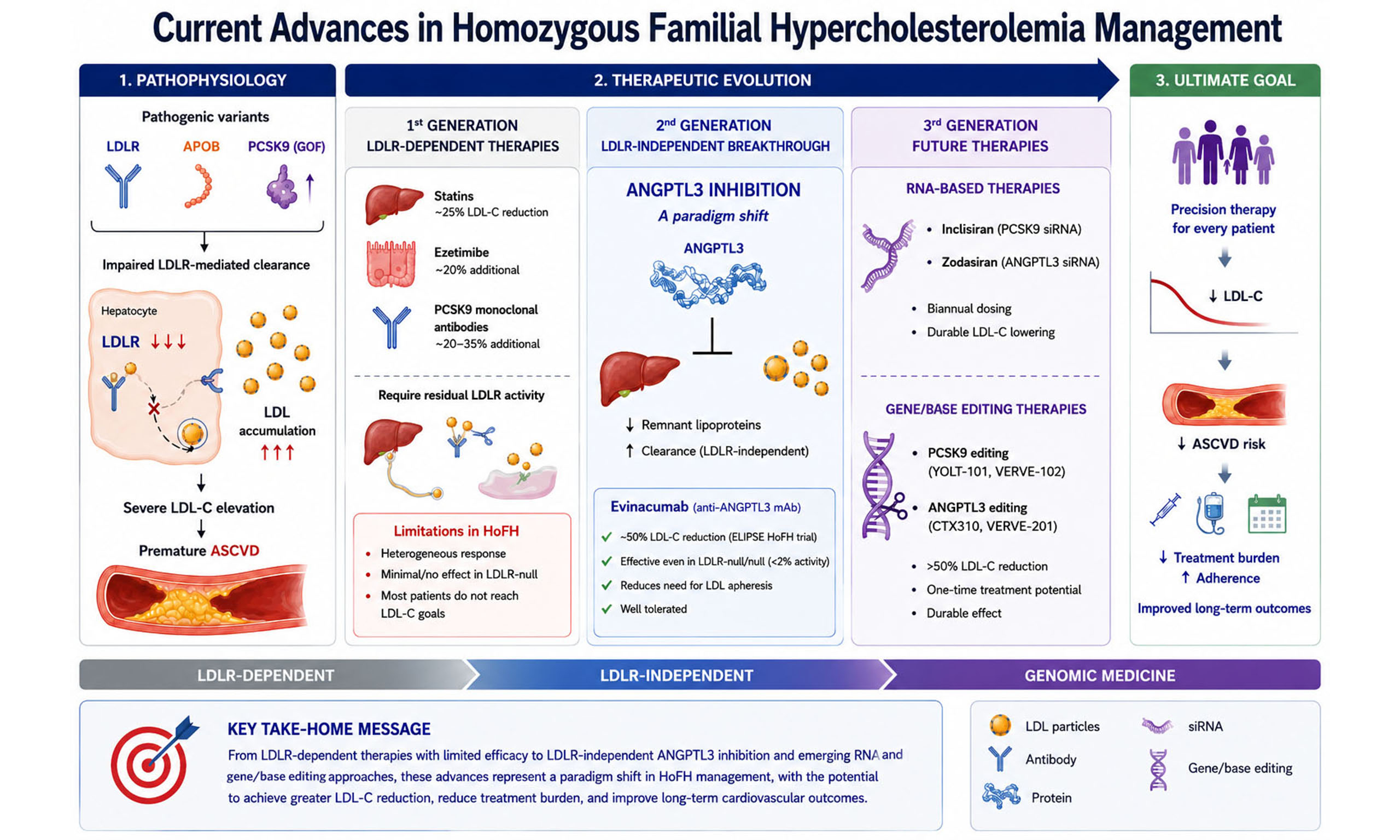
Familial hypercholesterolemia (FH) is among the most common autosomal dominant monogenic disorders, affecting approximately 1 in 250 to 1 in 313 individuals, whereas homozygous familial hypercholesterolemia has an estimated prevalence of approximately 1 in 250,000 to 1 in 360,000 individuals globally. The clinical phenotype is characterized by markedly elevated plasma concentrations of low-density lipoprotein cholesterol (LDL-C) and a substantially increased risk of premature atherosclerotic cardiovascular disease (ASCVD). Disease severity and age at onset are strongly influenced by zygosity; individuals with homozygous FH (HoFH) typically present in childhood with markedly elevated LDL-C levels and accelerated ASCVD compared with those with heterozygous FH (HeFH)[1-4].
FH most commonly arises from pathogenic variants in genes governing LDL receptor–mediated clearance of circulating LDL particles, including the low-density lipoprotein receptor (LDLR), apolipoprotein B (APOB; most frequently p.Arg3527Gln), and proprotein convertase subtilisin/kexin type 9 (PCSK9)[1-4]. These variants impair hepatic uptake and catabolism of LDL, resulting in persistently elevated LDL-C levels. Approximately 85%-90% of pathogenic variants affect LDLR (loss-of-function; receptor-defective or null alleles), 5%-10% involve APOB variants that disrupt receptor binding, and 1%-3% are gain-of-function variants in PCSK9. Individuals with HoFH carry two pathogenic variants (including true homozygotes, compound heterozygotes, or double heterozygotes), whereas individuals with HeFH carry a single variant and generally exhibit a less severe phenotype. A subset of patients who fulfill clinical criteria for HoFH do not carry these pathogenic variants.
Conventional lipid-lowering therapies, including statins and ezetimibe, are most often inadequate to effectively lower LDL-C in most patients with HoFH. PCSK9 monoclonal antibodies provide an additional 20%-35% reduction in LDL-C in HoFH patients receiving maximally tolerated background therapy. However, treatment responses are highly heterogeneous, with some individuals demonstrating minimal or no LDL-C reduction. Notably, sequence variants that impair LDLR recycling render patients resistant to PCSK9 inhibition, thereby attenuating LDL-C lowering efficacy.
Given the limited effectiveness of conventional therapies, many HoFH patients require combination regimens that lower LDL-C independent of LDLR activity[1-4]. These categories of approved therapies include LDL apheresis, lomitapide and more recently evinacumab. LDL apheresis lowers LDL-C by 50%-75%. Lomitapide, a microsomal transfer protein inhibitor, lowers LDL-C by about 50%. A phase 3 open-label trial with lomitapide (5 to 60 mg daily) conducted in 29 patients with HoFH reported reductions in LDL-C by -44% at Week 56 and -38% at week 78[5]. However, gastrointestinal side effects of lomitapide are a limiting aspect with improved tolerability in patients on a strict low-fat diet.
Angiopoietin-like 3 (ANGPTL3) inhibition represents a major therapeutic advance, functioning via an LDLR-independent mechanism to enhance clearance of remnant lipoproteins. In the ELIPSE HoFH trial, evinacumab (15 mg/kg intravenously every 4 weeks) achieved a 49% placebo-corrected reduction in LDL-C in 65 patients with HoFH, despite intensive background therapy that included statins in 92.2% (including 79.3% on high intensity statins), ezetimibe in 80.2%, PCSK9 inhibitors in 62.1%, lomitapide in 19.0%, and LDL apheresis in 38.8%[6]. Importantly, substantial LDL-C reductions were observed even among patients with minimal or absent LDLR activity[7]. These results were confirmed in pooled analyses of patients with severe LDLR dysfunction. Furthermore, evinacumab therapy reduced the need for LDL apheresis in a subset of patients, highlighting its clinical utility in reducing treatment burden. In patients who are refractory to maximally tolerated statins and PCSK9 inhibition, treatment with evinacumab has demonstrated LDL-C reductions of approximately 50%, supporting the expansion of ANGPTL3-targeted therapies to broader FH populations[8].
Therapies requiring infrequent administration, such as small interfering RNA (siRNA)-based approaches administered biannually, may improve adherence, persistence, and overall effectiveness compared with more frequent dosing regimens such as biweekly administration of PCSK9 monoclonal antibody inhibitor[9,10]. In parallel, gene-editing strategies are emerging as potential transformative therapies. An early phase 1 trial using base-editing approaches targeting PCSK9 was conducted in six HeFH patients who received escalating doses of YOLT-101 (0.2, 0.4 or 0.6 mg/kg), an investigational in vivo gene therapy that uses an adenine base editor and delivered via GalNAc-modified lipid nanoparticles, in PCSK9 and LDL-C. The highest cohort
Next-generation approaches targeting ANGPTL3 include RNA interference and gene-editing strategies. Zodasiran, a siRNA targeting ANGPTL3, demonstrated dose-dependent LDL-C reductions of -35.7% and -39.9% in 6 months (200 and 300 mg, respectively) in the phase 2 HoFH-specific GATEWAY trial[13]. Based on favorable efficacy and safety, zodasiran has advanced to the phase 3 YOSEMITE trial (NCT07037771). In 15 non-HoFH patients enrolled in a phase 1 trial with CTX 310, an ANGPTL3 CRISPR-Cas9-base editor, there were dose-dependent (0.1, 0.3, 0.6, 0.7 or 0.8 mg/kg of body weight) reductions in ANGPTL3 levels. The highest dose of CTX 310 (0.8 mg/kg) reduced ANGPTL3 by -73.2% and LDL-C by -48.9%[14]. Ongoing studies are evaluating additional gene-editing approaches directed at ANGPTL3, including base editing with VERVE-201 (NCT06451770), in patients with HoFH and refractory dyslipidemias.
Despite these advances, most patients with HoFH—and a substantial proportion with HeFH—do not achieve guideline-directed LDL-C targets. The advent of ANGPTL3 inhibition, particularly with evinacumab[7], has enabled attainment of LDL-C levels previously achievable primarily with LDL apheresis, while reducing treatment burden and improving accessibility. The continued evolution of RNA-based and gene-editing therapies[14] holds promise for more durable, less burdensome interventions[15]. Together, these advances represent a paradigm shift in FH management, with the potential to substantially reduce ASCVD risk and improve long-term clinical outcomes.
DECLARATIONS
Authors’ contributions
The author contributed solely to the article.
Availability of data and materials
Not applicable.
AI and AI-assisted tools statement
During the preparation of this manuscript, the AI tool Microsoft Copilot (version 1.2608.0301.01) was used solely for revising Graphical Abstract. The tool did not influence the study design, data collection, analysis, interpretation, or the scientific content of the work. The author takes full responsibility for the accuracy, integrity, and final content of the manuscript.
Financial support and sponsorship
None.
Conflicts of interest
Research funding to his institution from 89Bio, Amgen, Argo Biopharma, Arrowhead, AstraZeneca, Kalexo Bio, Lilly, Mammoth Biosciences, Merck Sharp and Dohme, NIH, Novartis, Novo Nordisk, and Verve Therapeutics; consulting fees from General Medicines, GSK, Lipigon, Novo Nordisk, Amgen, Novartis, and Rona Therapeutics; royalties from Wolters Kluwer (UptoDate); stock holdings from MediMergent, LLC.
Ethical approval and consent to participate
Not applicable.
Consent for publication
Not applicable.
Copyright
© The Author(s) 2026.
REFERENCES
1. Rosenson RS. Existing and emerging therapies for the treatment of familial hypercholesterolemia. J Lipid Res. 2021;62:100060.
2. Cuchel M, Raal FJ, Hegele RA, et al. 2023 update on European atherosclerosis society consensus statement on homozygous familial hypercholesterolaemia: new treatments and clinical guidance. Eur Heart J. 2023;44:2277-91.
3. Wiegman A, Bourbon M, Freiberger T, et al. Familial hypercholesterolaemia in children and adolescents: a European Atherosclerosis Society consensus statement. Eur Heart J. 2026;47:3324-46.
4. Ahmad Z, Agarwala A, Cuchel M, et al. Update on familial hypercholesterolemia: an expert clinical consensus from the National Lipid Association. J Clin Lipidol. 2026;20:708-37.
5. Cuchel M, Bloedon LT, Szapary PO, et al. Inhibition of microsomal triglyceride transfer protein in familial hypercholesterolemia. N Engl J Med. 2007;356:148-56.
6. Raal FJ, Greber-platzer S, Reeskamp LF, et al. Efficacy of evinacumab by genotype and low-density lipoprotein receptor function in patients with homozygous familial hypercholesterolaemia: a subanalysis from the ELIPSE open-label extension study. Atherosclerosis. 2026;414:120657.
7. Raal FJ, Rosenson RS, Reeskamp LF, et al. Evinacumab for homozygous familial hypercholesterolemia. N Engl J Med. 2020;383:711-20.
8. Rosenson RS, Burgess LJ, Ebenbichler CF, et al. Evinacumab in patients with refractory hypercholesterolemia. N Engl J Med. 2020;383:2307-19.
9. Rosenson RS, Niu X, Popadic L, et al. Real-world treatment adherence and persistence among patients initiating inclisiran or PCSK9 mAbs. Am J Prev Cardiol. 2026;30:101739.
10. Marnell CS, Koenig W, Bittner V, et al. Barriers and emerging strategies to bridge gaps in implementation of evidence-based lipid-lowering therapies. Circ Popul Health Outcomes. 2026;19:e012330.
11. Wan P, Tang S, Lin D, et al. In vivo base editing gene therapy for heterozygous familial hypercholesterolemia: a phase 1 trial. Nat Med. 2026;32:1045-51.
12. Vafai SB, Täubel J, Ashdown T, et al. In vivo base editing of PCSK9 with VERVE-102 for hypercholesterolemia. N Engl J Med. 2026;395:648-59.
13. Raal FJ, Bergeron J, Gaudet D, et al. Zodasiran, an RNAi therapeutic targeting ANGPTL3, for treating patients with homozygous familial hypercholesterolaemia (GATEWAY): an open-label, randomised, phase 2 trial. Lancet Diabetes Endocrinol. 2026;14:123-36.
14. Laffin LJ, Nicholls SJ, Scott RS, et al. Phase 1 trial of CRISPR-Cas9 gene editing targeting ANGPTL3. N Engl J Med. 2025;393:2119-30.
Cite This Article
 Open Access
How to Cite
Rosenson RS. Current advances in homozygous familial hypercholesterolemia management. Rare Dis Orphan Drugs J. 2026;5:35. https://dx.doi.org/10.20517/rdodj.2026.27
Download Citation
If you have the appropriate software installed, you can download article citation data to the citation manager of your choice. Simply select your manager software from the list below and click on download.
Export Citation File
Type of Import
Tips on Downloading Citation
Citation Manager File Format
Type of Import
Direct Import: When the Direct Import option is selected (the default state), a dialogue box will give you the option to Save or Open the downloaded citation data. Choosing Open will either launch your citation manager or give you a choice of applications with which to use the metadata. The Save option saves the file locally for later use.
Indirect Import: When the Indirect Import option is selected, the metadata is displayed and may be copied and pasted as needed.
About This Article
Copyright

Data & Comments
Data
0










Comments
Comments must be written in English. Spam, offensive content, impersonation, and private information will not be permitted. If any comment is reported and identified as inappropriate content by OAE staff, the comment will be removed without notice. If you have any queries or need any help, please contact us at [email protected].